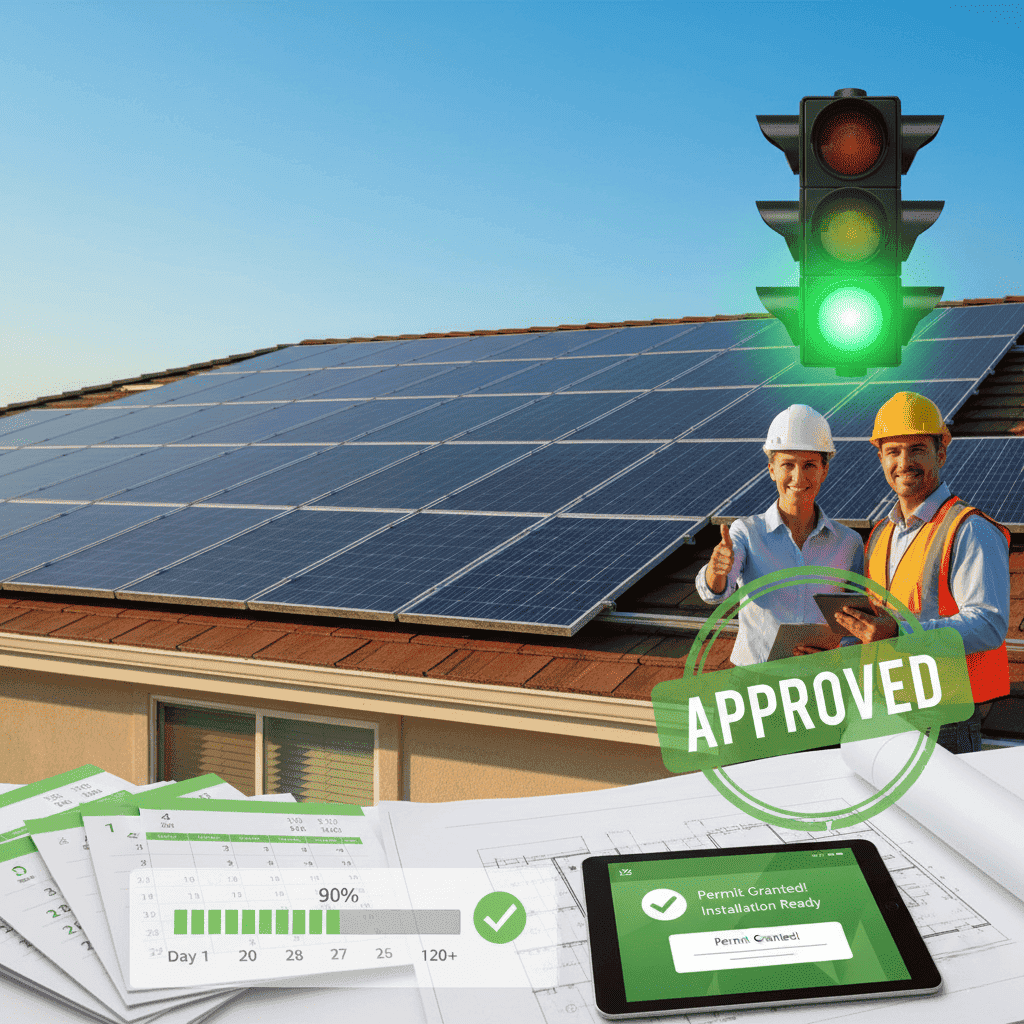
Quick Answer: Solar panel installation takes 4-6 hours for residential systems, but the complete process from contract signing to operational approval spans 45 days to 4 months. The longest phase is permit processing (4 weeks to 4+ months), not the physical installation. In California, expect approximately 45 days for full approval.
Understanding Solar Installation Timelines: What You Need to Know
How long does it take to install solar panels? This question ranks among the most common concerns for homeowners and businesses considering solar energy. The answer involves two distinct timeframes: the actual installation duration and the complete project timeline, including permits and approvals.
The Physical Installation: Solar panel installation itself is remarkably quick, typically 4 to 6 hours for residential systems and 1 to 5 days for commercial projects.
The Complete Timeline: From contract signing to generating electricity, expect 45 days minimum in most locations, with some projects extending to 4 months or longer. The lengthy timeline stems primarily from permit processing, not installation work.
Timeline Breakdown by Phase:
- Site assessment and contract: 1 week
- System design and engineering: 2-4 weeks
- Permit processing: 4 weeks to 4+ months (longest phase)
- Physical installation: 4-6 hours (residential) or 1-5 days (commercial)
- Inspection and approval: 1 week+
- Utility Permission-to-Operate: 1 week to 1 month
Key Insight: Permit acquisition represents the most significant time investment, accounting for the majority of delays in solar projects. Understanding this timeline helps property owners set realistic expectations and plan accordingly.
Solar panel installation demand across the United States has hit unprecedented levels in recent years. Data from the Solar Energy Industries Association (SEIA) reveals that solar energy systems made up 46% of total electricity-generating capacity additions to the national grid throughout 2021. Additionally, solar energy contributed roughly 4% to the nation’s total electricity supply during the previous year.
This upward trajectory shows no signs of slowing, with projections indicating solar power installations will triple over the next decade. As solar technology becomes more cost-effective and widely available, an increasing number of property owners and commercial entities are exploring solar system adoption.
Solar panel installation has gained substantial traction in California, where SEIA data shows approximately 1.5 million residential properties and commercial establishments now operate on solar energy. This growth stems largely from the state’s robust solar incentive programs that reduce the financial barrier to solar adoption. The federal solar tax credit currently offers 26% off the total system cost.
California’s abundant sunshine further enhances its suitability for solar panel installation. Over the past decade, solar panel installation expenses in California have dropped by 53%, reaching new affordability benchmarks. Since California residents face steeper conventional energy costs compared to other states, transitioning to solar can deliver substantial financial relief for both homeowners and businesses.
Nationally, solar panel installation averages approximately $12,000, though actual costs fluctuate based on system specifications and scale. Installation pricing varies across different states, with California typically falling in the upper price range due to elevated cost-of-living factors.

How Long Does Solar Panel Installation Take?
What’s the actual timeframe for solar panel installation? When selecting a solar installation company, you’ll find that the physical installation of solar panel systems, particularly residential solar installations, progresses swiftly, generally requiring just 4 to 6 hours. This duration may fluctuate based on your system’s scale and panel quantity. For commercial solar projects or larger-scale installations, expect the process to extend from several days to potentially longer periods.
The approval phase consumes the majority of time when transitioning to solar energy. In California, obtaining full operational approval typically spans approximately 45 days following contract execution. The positive aspect is that numerous solar energy companies provide comprehensive services encompassing everything from initial consultation through permit acquisition, system design, and final solar system installation.
Your solar transition timeline varies based on several factors: your geographic location, your chosen solar panel installation company, your selected panel type, and whether you’re incorporating a new service panel or battery storage system. It’s important to recognize that most project delays stem from solar permit applications and utility company solar billing application reviews.
Here’s a breakdown of the standard installation workflow:
Site Assessment Scheduling and Contract Execution (1 week)
Prior to commencing work, a solar panel installation company must evaluate your property to verify its readiness and safety for solar panel deployment. A qualified site examiner will visit to inspect your roof and related components. During this evaluation, the examiner focuses on three critical elements:
- Your roof’s structural integrity and measurements
- Roof-related documentation (including warranty details)
- Roof vent positioning and shading patterns
- Your existing service panel
This inspection confirms your roof and electrical infrastructure can accommodate both the solar panel weight and your intended energy production capacity. Your provider should verify optimal sunlight exposure for your panels and confirm the feasibility of installing the proposed panel quantity.
Throughout the assessment, your examiner gathers any Homeowners Association (HOA) documentation and identifies necessary repairs or modifications to support your solar system. With favorable conditions, contract signing can occur within days to one week post-assessment.
Solar System Design and Engineering (2 to 4 weeks)
Following your site evaluation, engineering professionals create a solar system tailored to your energy requirements and local regulatory standards. Upon design completion, the engineering team files permit applications with your municipal building authority. This design and engineering phase typically requires approximately two weeks for straightforward residential solar systems and up to four weeks for more intricate commercial solar panel installation projects. Understanding solar permit requirements across the United States helps streamline this process.
Solar Permit Processing (4 weeks and beyond)
The complete permit application cycle generally spans four weeks. As noted, this segment often becomes the lengthiest due to local building department approval requirements.
Since solar billing activation requires preliminary approval, you must first obtain authorization from your municipality’s Building and Safety Department.
Most municipalities mandate multiple permits for property-based solar installations. Commonly required permits include a Solar PV Permit and an Electrical Permit. While four weeks represents the typical timeframe, some cases may extend to four months or longer. Avoiding common permit application mistakes can significantly reduce these delays.
Solar Panel Installation (1-5 days)
Once your solar system design is finalized and all permits are secured, your solar panel installation company schedules the actual panel installation. Most residential systems require just one day for completion. Larger commercial installations may extend up to five days.
The solar panel installation procedure moves quickly and efficiently, with some residential solar panel installations concluding in mere hours. Homeowners typically don’t need to supervise the installation unless access to specific locations, such as garages, becomes necessary for equipment placement. For remote locations, off-grid solar system designs may require additional installation time.
Inspection and Municipal Approval (1 week and beyond)
Post-installation, a building inspector must examine the completed work to verify compliance with all safety standards and building codes. Following successful inspection and approval, your municipality issues a certificate of occupancy. This complete process generally requires about one week, though timing may shift based on local inspector availability.
Solar Billing Authorization (1 week to 1 month)
After your solar system installation and approval, solar billing activation becomes necessary. Your utility company provides a Permission-to-Operate notification upon receiving the solar billing application accompanied by the city inspector’s approved job card. Depending on your energy provider, this final step may take anywhere from one week to one month. Understanding the complete solar permitting and approval process helps manage expectations during this final phase.
Begin Your Solar Journey With Solar Permit Solutions Today
We recognize that transitioning to solar energy represents a substantial investment, and our commitment is to maximize the value you receive from your solar panels. Solar Permit Solutions delivers comprehensive solar roofing solutions designed to ensure your solar panel installation proceeds seamlessly and efficiently. Transform your solar installation timeline from months of permit frustration to a streamlined process managed by dedicated professionals. Contact our expert team today and see firsthand the impact of specialized permit expertise.
Solar Permit Solutions
Skip the Permit Headaches
We design plan sets that pass inspection the first time. Code-compliant, PE-stamped, accepted by AHJs nationwide.
Conclusion
Understanding the solar panel installation timeline empowers you to set realistic expectations and plan accordingly for your transition to renewable energy. While the physical installation itself requires only hours or days, the complete journey from initial consultation to operational approval spans weeks or months, primarily due to permit processing and regulatory approval phases.
The key takeaway is that permit acquisition represents the most significant time investment in your solar project. With typical approval periods ranging from four weeks to four months depending on your jurisdiction, partnering with experienced professionals who understand local regulations becomes essential for minimizing delays. Our team specializes in navigating these complex approval processes, transforming what could be months of frustration into a streamlined, manageable timeline.
California’s solar adoption surge demonstrates that despite regulatory hurdles, the long-term benefits, including substantial energy cost savings, federal tax credits, and environmental impact, make solar investment worthwhile. The 53% cost reduction over the past decade, combined with robust incentive programs from the Department of Energy, positions solar energy as an increasingly accessible option for both residential and commercial properties.
Your solar timeline depends on multiple variables: location, system complexity, installer efficiency, and most critically, permit processing speed. By selecting comprehensive service providers who handle everything from site assessment through final billing authorization, you eliminate coordination challenges and accelerate your path to clean energy production. Whether you need solar permits in Texas or other states, working with experienced permit specialists makes all the difference.
Don’t let permit complexity postpone your solar benefits. Explore our comprehensive blog resources or contact us today to see firsthand the impact of specialized permit expertise in transforming your installation timeline from overwhelming to effortless.
FAQs
Skip the Permit Headaches
We design plan sets that pass inspection the first time. Code-compliant, PE-stamped, accepted by AHJs nationwide.
Frequently Asked Questions
The complete solar installation process typically spans 45 days to several months from contract signing to operational approval. While the physical panel installation requires only 4-6 hours for residential systems (or 1-5 days for commercial projects), the majority of time is consumed by permit processing, system design, inspections, and utility company approval. In California, the average timeline is approximately 45 days for full operational approval. However, this varies significantly based on your location, local building department workload, and the complexity of your solar system. Projects requiring additional electrical service panel upgrades or battery storage systems may experience extended timelines. Learning about essential solar permit equipment beforehand can help expedite the process.
Permit processing represents the lengthiest phase because it involves multiple regulatory authorities and approval layers. Most municipalities require both Solar PV Permits and Electrical Permits, each subject to review by your local Building and Safety Department. This government review process typically spans four weeks but can extend to four months or longer depending on department workload and application volume. Building departments must verify that your solar system complies with structural requirements, electrical codes, fire safety regulations, and zoning ordinances. Additionally, if you're in an HOA-governed community, architectural review adds another approval layer. The sequential nature of these approvals, where one must be completed before another begins, contributes to extended timelines. According to the National Renewable Energy Laboratory, soft costs, including permitting, can account for significant portions of total solar project expenses.
The site assessment serves as the foundation for your entire solar project by verifying your property's readiness for solar panel installation. During this week-long process, a qualified examiner inspects your roof's structural integrity and measurements, reviews roof-related documentation including warranties, evaluates roof vent positioning and shading patterns, and assesses your existing electrical service panel. This inspection confirms whether your roof can support the solar panel weight and if your electrical infrastructure can handle your intended energy production capacity. The examiner also collects HOA documentation and identifies any necessary repairs or modifications. Without this thorough assessment, you risk installing a system that's incompatible with your property's structural or electrical capabilities, potentially leading to safety hazards or system failures. The Database of State Incentives for Renewables & Efficiency (DSIRE) provides state-specific requirements that may affect your site assessment.
While you cannot control building department processing speeds, several strategies can minimize delays. First, choose a solar installation company that offers comprehensive end-to-end services, handling everything from permits to final utility approval; this eliminates coordination gaps between different service providers. Second, ensure all documentation is complete and accurate before submission, as incomplete applications trigger rejections and resubmission delays. Third, respond promptly to any requests for additional information from building departments or utility companies. Fourth, complete any required roof repairs or electrical upgrades before beginning the permit process. Finally, consider working with permit specialists who understand local requirements and prepare applications correctly the first time, significantly reducing rejection-related delays.
Permit approval and Permission-to-Operate (PTO) are distinct milestones in your solar journey. Permit approval comes first; this is when your local Building and Safety Department authorizes you to proceed with physical installation after reviewing your system design and plans. Once installation is complete, a building inspector conducts a final inspection to verify the work meets all safety standards and issues a certificate of occupancy. Only after passing this inspection can you apply for Permission-to-Operate from your utility company. The PTO is the final authorization allowing you to activate your solar system and begin generating electricity that connects to the grid. Without PTO, your installed system must remain inactive. According to Interstate Renewable Energy Council guidelines, the utility company typically issues PTO within one week to one month after receiving your application with the inspector's approved documentation.

SPS Editorial Team
Solar Permit Solutions
Solar Permit Solutions provides professional solar permit design services for residential, commercial, and off-grid installations across all 50 states. Our team ensures permit-ready plan sets delivered fast.
Related Articles
Solar Permit Requirements In Florida: Complete Step-By-Step Guide
Solar Permit Solutions breaks down Florida’s permit requirements by county...
How to Mount Solar Panels on a Roof: Mounting Systems, Rails, and DIY Tips
Learn how to mount solar panels yourself with this complete guide. Covers compon...
AC vs DC Coupled Solar Batteries: Which Should You Choose?
AC vs DC coupled solar batteries compared: efficiency, costs ($8K-$18K), and ins...