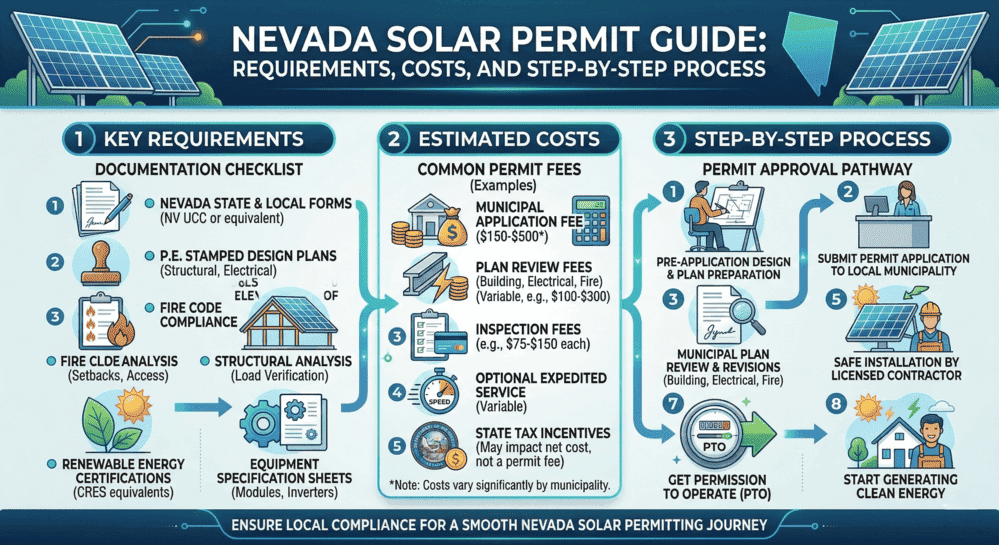
Yes, you need a permit for solar panels in Nevada. All residential grid-connected solar installations require a building permit, an electrical permit, and NV Energy interconnection approval before the system can be activated. Permit fees typically range from $200 to $500, and most applications are approved within one to three weeks when submitted with complete documentation.
Nevada is one of the top solar states in the country, with over 300 sunny days per year and enough installed solar capacity to power more than 870,000 homes. Permit requirements vary by jurisdiction. Clark County offers same-day online permits for licensed contractors, Las Vegas processes applications through its Citizen Portal, and Washoe County enforces specific fire code setbacks for rooftop arrays. Regardless of location, the process follows the same general path: apply for a local building permit, pass inspection after installation, then complete NV Energy interconnection to receive Permission to Operate.
This guide from Solar Permit Solutions breaks down each step of the Nevada solar permitting process, including jurisdiction-specific requirements, required documents, NV Energy’s interconnection timeline, state laws protecting homeowners, and how to avoid the most common permit delays.
Do You Need a Permit for Solar Panels in Nevada?
Yes. This applies whether you are working with a professional solar installer or handling the project as an owner-builder.
Solar permits protect homeowners, neighboring properties, and the electrical grid. Local building departments review system plans to confirm that panels are securely mounted, roof structures can support the weight, electrical wiring meets code, and the system complies with state and local regulations. Without proper approvals, installations may face fines, failed inspections, or delays in activation.
At minimum, residential solar projects in Nevada require a building permit, an electrical permit, and NV Energy interconnection approval.
What Permits Are Required for Solar Installation in Nevada?
The specific permits required depend on your local jurisdiction, but the following are standard across most of Nevada.
A building permit covers the physical installation of panels, racking, and mounting hardware. An electrical permit addresses all wiring, inverter connections, disconnects, grounding, and panel upgrades. In some jurisdictions, these are combined into a single application.
A structural review may be required if the system exceeds a certain weight threshold or if the roof condition raises concerns. A fire department review is required in certain areas to confirm that panel layout meets International Fire Code guidelines, including setback distances and firefighter access pathways.
NV Energy interconnection approval is required for any system connecting to the grid. This is separate from local building permits and involves submitting documentation through NV Energy’s PowerClerk online portal.
Do Ground-Mounted Solar Panels Need a Separate Permit?
Yes. Ground-mounted systems require building and electrical permits just like rooftop installations. Additional zoning considerations may apply, including setback requirements from property lines and height restrictions. Check with your local building department for jurisdiction-specific rules on ground-mounted arrays.
How to Get a Solar Permit in Nevada: Step-by-Step Process
The full process from initial design to Permission to Operate typically takes two to six months.
1. Site assessment and system design. A solar installer evaluates your roof, electrical panel, shading, and energy usage to create a custom system design.
2. Prepare required documents. Gather all necessary documents including a site plan, single-line electrical diagram, electrical load calculations, equipment specification sheets, and proof of property ownership.
3. Submit the permit application. Your installer submits the application to the local building department. Clark County offers same-day permits for licensed contractors. Las Vegas uses an online Citizen Portal.
4. Permit review and approval. The building department reviews plans for code compliance. Approval takes same-day to three weeks depending on jurisdiction. Incomplete applications are the most common cause of delay.
5. Solar panel installation. Most residential rooftop systems are installed in one to three days.
6. Local building and electrical inspection. An inspector verifies the system was built according to approved plans, checking wiring, grounding, mounting, disconnects, and labeling.
7. Submit NV Energy interconnection application. Your contractor submits an interconnection application through PowerClerk with single-line diagrams, site plans, and equipment specifications.
8. NV Energy documentation review. NV Energy has 10 business days to review. If corrections are needed, the 10-day window restarts upon resubmission. Applications not corrected within 60 calendar days are cancelled.
9. Utility inspection and meter swap. NV Energy inspects the installation and replaces your meter with a bi-directional smart meter that tracks energy in both directions.
10. Permission to Operate (PTO). After the utility inspection passes and meters are set, NV Energy emails a PTO notification. Only after receiving PTO can you legally activate your system.
Solar Permit Solutions
Skip the Permit Headaches
We design plan sets that pass inspection the first time. Code-compliant, PE-stamped, accepted by AHJs nationwide.
Nevada Solar Permit Requirements by Jurisdiction
While Nevada has statewide codes, permit processes and requirements vary significantly by jurisdiction. Here is what homeowners should know about the major service areas.
Clark County Solar Permits
Clark County uses an online permitting system with a registration model that allows licensed electrical contractors to obtain same-day permits. Upon providing project location, system capacity, and installer information, contractors pay a fee and receive a printable permit instantly. Clark County has also published an online permitting checklist to increase transparency for solar installers and homeowners.
City of Las Vegas Solar Permits
The City of Las Vegas processes residential photovoltaic permits through its online Citizen Portal. Licensed electrical contractors can apply for same-day permit issuance by uploading an electrical plan and load calculations. Owner-builder permits are not eligible for the same-day process and must go through a full plan review. Systems that include an energy storage device or a ballasted mounting system also require full plan review and are not eligible for same-day issuance. If the system design changes after the permit is issued, a revision application is required. Systems exceeding 10 kW may incur higher permit fees.
Henderson Solar Permits
Henderson maintains its own building department and permit process. Residential solar permits follow a standard plan review timeline. Contact Henderson Development Services for current fees and submission requirements.
Washoe County and Reno Solar Permits
Washoe County and the City of Reno have earned SolSmart designation for their efforts to streamline solar permitting. Reno has committed to increasing distributed renewable energy generation and has an active C-PACE program for commercial properties. Washoe County enforces specific fire code setbacks for rooftop solar, including an 18-inch perimeter clearance along roof edges and a three-foot pathway along one side of the ridge to maintain firefighter access.
Rural Nevada Solar Permits
Homeowners in rural areas served by Valley Electric Association or smaller utilities should contact their county building department for requirements. Valley Electric offers a net billing program similar to NV Energy’s net metering but with its own application process.
How Much Does a Solar Permit Cost in Nevada?
Solar permit costs in Nevada vary by jurisdiction and system size. Building and electrical permit fees typically range from $200 to $500 for standard residential systems, though larger systems or those requiring structural review may cost more. Las Vegas bases permit fees partly on system kilowatt capacity, with higher fees for systems exceeding 10 kW.
NV Energy charges a non-refundable application fee for interconnection. The average cost of a residential solar system in Nevada ranges from approximately $2.25 to $2.60 per watt, with a typical 5 kW system costing roughly $9,500 to $12,900 before the federal tax credit. Permit and interconnection fees represent a small but necessary portion of the overall project budget.
Required Documents for a Nevada Solar Permit
Having all documents prepared before submission is the most effective way to avoid delays. Most Nevada jurisdictions require the following:
A site plan or roof layout showing panel placement, dimensions, and setback distances. A solar electrical diagram showing the system configuration from panels through the inverter to the service panel. Electrical load calculations demonstrating the existing panel can support the solar system. Equipment specification sheets for panels, inverters, racking, and rapid shutdown devices. A structural analysis if required based on system weight or roof condition. Proof of property ownership or agent authorization letter. Utility account information including the NV Energy account number. Contractor license documentation showing a valid Nevada C2 or C2G electrical license. An HOA approval letter if applicable.
NV Energy Interconnection Process Explained
The NV Energy interconnection process is separate from local building permits and is required for any system connecting to the grid. All applications are submitted through the PowerClerk online portal.
Before installation, your contractor submits an application with system design documents including a single-line diagram, site plan, and equipment specifications. After installation, the local building department issues a final inspection card. NV Energy then conducts its own interconnection safety verification, checking voltage readings at the AC disconnect and confirming proper wiring. A bi-directional meter is installed to track energy flowing in both directions.
Once all meters are set and the inspection passes, NV Energy issues Permission to Operate by email. The system can then begin generating power and earning net metering credits.
How Long Does NV Energy Interconnection Take?
The post-installation interconnection timeline typically ranges from two to four weeks when everything goes smoothly. NV Energy has 10 business days to complete the documentation review. If deficiencies are found, the applicant must submit corrections, and the 10-day review clock restarts. Delays most commonly result from high application volume, documentation errors, or scheduling backlogs for the meter swap appointment.
Nevada Solar Laws That Affect Permitting
Nevada has passed several laws designed to protect homeowners, encourage solar adoption, and regulate the solar industry. Understanding these laws helps homeowners navigate the permitting process and protect their investment.
Assembly Bill 405 (2017) is known as the Renewable Energy Bill of Rights. It prohibits HOAs from restricting the installation of solar panels or enforcing rules that compromise system performance. AB 405 also restored net metering in Nevada after it was discontinued in 2015.
Senate Bill 293 (2023) protects consumers from deceptive trade practices in the solar industry. It requires solar companies to highlight key contract terms on the cover page, verbally communicate costs, timelines, and warranties, and maintain recordings of those communications for at least four years. Violations can result in voided contracts and severe penalties.
Senate Bill 407 established the Nevada Clean Energy Fund, a nonprofit providing financial and technical assistance for clean energy projects including residential solar.
Senate Bill 146 (2023) requires state utilities to factor rooftop solar into long-term energy production planning, recognizing distributed solar as a standard form of energy generation.
Assembly Bill 465 (2019) requires electric utilities to offer solar energy options to customers consuming less than 1,000 kilowatt-hours per month, including renters and low-income households who cannot install their own systems.
What Happens If You Install Solar Without a Permit in Nevada?
Installing solar panels without proper permits creates serious risks. Unpermitted systems may fail inspections if discovered, and homeowners can be required to remove or modify the installation at their own expense. Equipment warranties may be voided if the system was not installed to code.
Unpermitted installations also create problems when selling a home. Title companies, lenders, and inspectors flag unpermitted work, which can delay or kill a sale. Insurance companies may deny claims related to unpermitted electrical work.
In most jurisdictions, it is possible to retroactively permit an existing installation, but the process requires a full plan review, potential modifications to meet current code, and reinspection fees. Working with a professional permit service from the start is far more cost-effective.
Can You Install Solar Panels Yourself in Nevada?
Nevada allows property owners to perform their own solar installations under owner-builder rules from the Nevada State Contractors Board. Self-installations must comply with all building codes, electrical codes, and NV Energy interconnection requirements.
In Las Vegas, owner-builder permits require full plan review and are not eligible for same-day issuance. NV Energy requires self-installations to be performed by the property owner personally. For any system paired with an incentivized energy storage device, a licensed Nevada electrical contractor with a C2 or C2G license is required.
Most homeowners find that working with a licensed installer and a dedicated solar permit plan set provider saves significant time and avoids costly mistakes.
Do HOAs Restrict Solar Panels in Nevada?
No. Under Assembly Bill 405, HOAs in Nevada cannot prohibit solar panel installation or enforce restrictions that reduce system performance. This applies to rules about panel size, number, appearance, or placement that would compromise energy production.
HOAs can still require an architectural review application and may request reasonable conditions such as color-matching frames. However, they cannot deny an installation outright.
If an HOA denies your application, request a written explanation, reference AB 405 in your response, and ask for specific modifications that would meet reasonable conditions. If resistance continues, options include internal appeals, mediation, or leveraging statutory deadlines.
Nevada Net Metering and Why Proper Interconnection Matters
Net metering is one of the primary financial benefits of going solar in Nevada, and it only works with proper NV Energy interconnection. New solar customers are enrolled in Tier 4, which provides credits at 75% of the retail electricity rate, approximately 11.25 cents per kilowatt-hour.
Enrolled customers receive a 20-year rate guarantee. NV Energy sizes systems based on the homeowner’s highest 12-month energy usage within a 24-month period. All grid-connected customers continue to receive a monthly basic service charge even when NV Energy delivers no energy. Credits cannot be converted to cash under the NMR-405 tariff but can offset future billing periods.
Nevada Solar Incentives to Know Before You Apply for a Permit
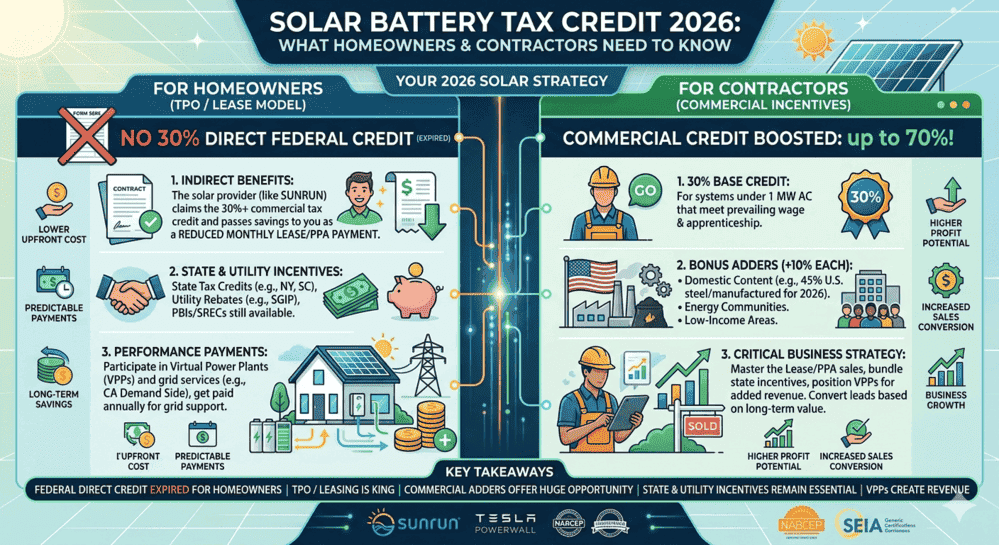
Several financial incentives can reduce the cost of going solar in Nevada. The federal Residential Clean Energy Credit allows homeowners to deduct 30% of total solar system costs from federal income taxes, covering equipment, labor, permitting, and sales tax. Homeowners must own the system or finance through a loan to qualify.
It is important to note that Nevada does not currently offer a residential property tax exemption for solar panels. The property tax exemption under NRS 701A.200 applies to commercial and industrial renewable energy systems, not residential installations. Nevada also does not exempt residential solar equipment from state sales tax. However, the federal tax credit and net metering savings still make solar a strong financial investment.
The Nevada Clean Energy Fund provides financing for qualifying clean energy projects. Southwest Gas offers rebates of up to $1,800 for solar water heating systems meeting SRCC certification. NV Energy’s Expanded Solar Access Program provides community-based solar options for customers who cannot install rooftop systems.
How to Avoid Solar Permit Delays in Nevada
The most common cause of permit delays is incomplete applications. Ensure all required documents are prepared and accurate before submission. System drawings should match local code requirements precisely, including setback distances and conductor sizing.
Address structural concerns proactively. If your roof is older, get a structural engineering assessment upfront rather than waiting for the building department to flag it.
Work with licensed Nevada electrical contractors holding a valid C2 or C2G license. Using an unlicensed contractor can result in NV Energy application rejection. Respond quickly to correction requests and coordinate with NV Energy early so documentation review runs parallel with inspection scheduling.
Battery Storage Permit Requirements in Nevada
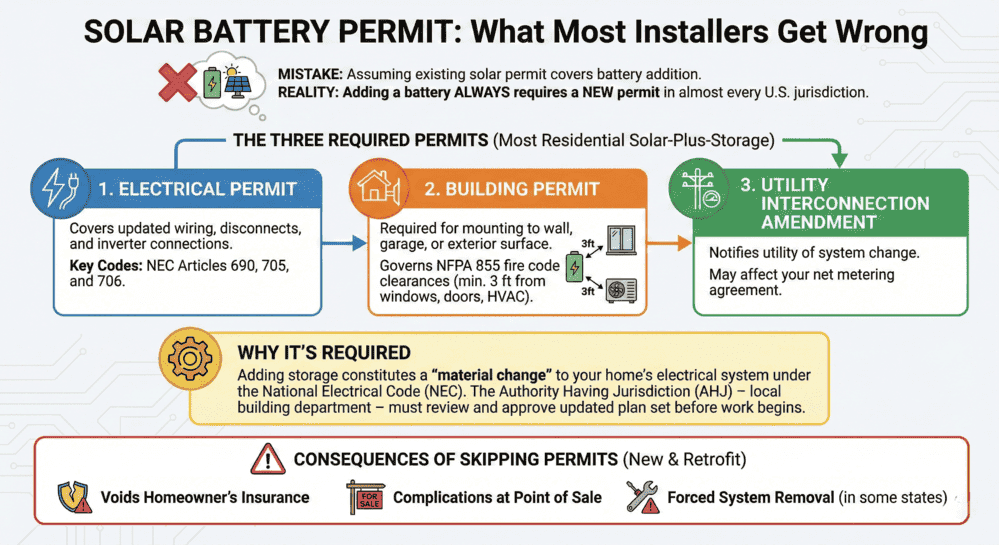
Adding battery storage involves additional permit requirements. NV Energy requires energy storage devices paired with net metering systems to include a bi-directional utility meter and a dedicated energy storage device meter installed within 10 feet of the service entrance.
AC-coupled systems require an additional meter socket to monitor power flowing to and from the storage device. All energy storage equipment must comply with IEEE 1547 or UL 1741 for anti-islanding, UL 9540 for safety, and NEC 706 for installation standards. Signage indicating the presence of a storage device is required on the property.
Systems paired with incentivized storage must be installed by a licensed electrical contractor.
Conclusion
Going solar in Nevada is one of the smartest energy investments a homeowner can make, but the permitting process requires attention to detail. From building permits and electrical permits to NV Energy interconnection and net metering enrollment, each step ensures your system is safe, legal, and fully operational.
Nevada’s solar-friendly laws, including AB 405, SB 293, and AB 465, provide strong homeowner protections. Combined with the federal tax credit and Tier 4 net metering credits, the financial case for solar in Nevada is compelling.
The key to a smooth experience is preparation. Complete documentation, licensed professionals, and an understanding of your jurisdiction’s requirements will help you move from application to PTO without unnecessary delays.
For expert assistance with solar permit plan sets, PE-stamped drawings, and interconnection services across Nevada and all 50 states, contact Solar Permit Solutions.
Frequently Asked Questions About Nevada Solar Permits
Skip the Permit Headaches
We design plan sets that pass inspection the first time. Code-compliant, PE-stamped, accepted by AHJs nationwide.
Frequently Asked Questions
Yes. All grid-connected residential solar systems require building and electrical permits from the local jurisdiction, as well as NV Energy interconnection approval before the system can be activated.
Permit review typically takes one to three weeks for complete applications. The entire process from design to PTO spans two to six months, with physical installation taking only one to three days.
Fees vary by jurisdiction and system size, typically ranging from $200 to $500 for standard residential systems. Las Vegas charges higher fees for systems exceeding 10 kW. NV Energy also charges a non-refundable interconnection fee.
Yes. Clark County offers same-day online permits for licensed electrical contractors. Las Vegas also offers a streamlined process through the Citizen Portal. Owner-builder permits require full plan review and are not eligible for same-day processing.
PTO is the official authorization from NV Energy that allows you to activate your solar system and connect it to the grid. It is issued after NV Energy completes its documentation review, utility inspection, and meter installation. You cannot legally operate your system until PTO is granted.
Yes. Battery storage systems require the same building and electrical permits as solar panels, plus additional NV Energy metering requirements including a dedicated energy storage device meter. Systems paired with incentivized storage must be installed by a licensed electrical contractor.
No. Under Assembly Bill 405, Nevada HOAs cannot prohibit solar panel installation or impose restrictions that compromise system performance. HOAs can require an architectural review but cannot deny a properly submitted application.
If the system fails a local or utility inspection, the identified issues must be corrected and the system reinspected before it can be activated. Common failure reasons include wiring errors, missing disconnects, improper grounding, and panel layouts that do not match approved plans.

SPS Editorial Team
Solar Permit Solutions
Solar Permit Solutions provides professional solar permit design services for residential, commercial, and off-grid installations across all 50 states. Our team ensures permit-ready plan sets delivered fast.
Related Articles
Off-Grid Solar System Requirements: Sizing, Permits & NEC Code Guide
Off-grid solar permit requirements by state: building codes, NEC compliance, bat...
Solar Battery Permit: What Most Installers Get Wrong
Quick Answer: Adding battery storage to a solar system almost always requires ne...
Solar Battery Tax Credit 2026: What Homeowners and Contractors Need to Know
There is no federal solar battery tax credit available to homeowners in 2026. Th...