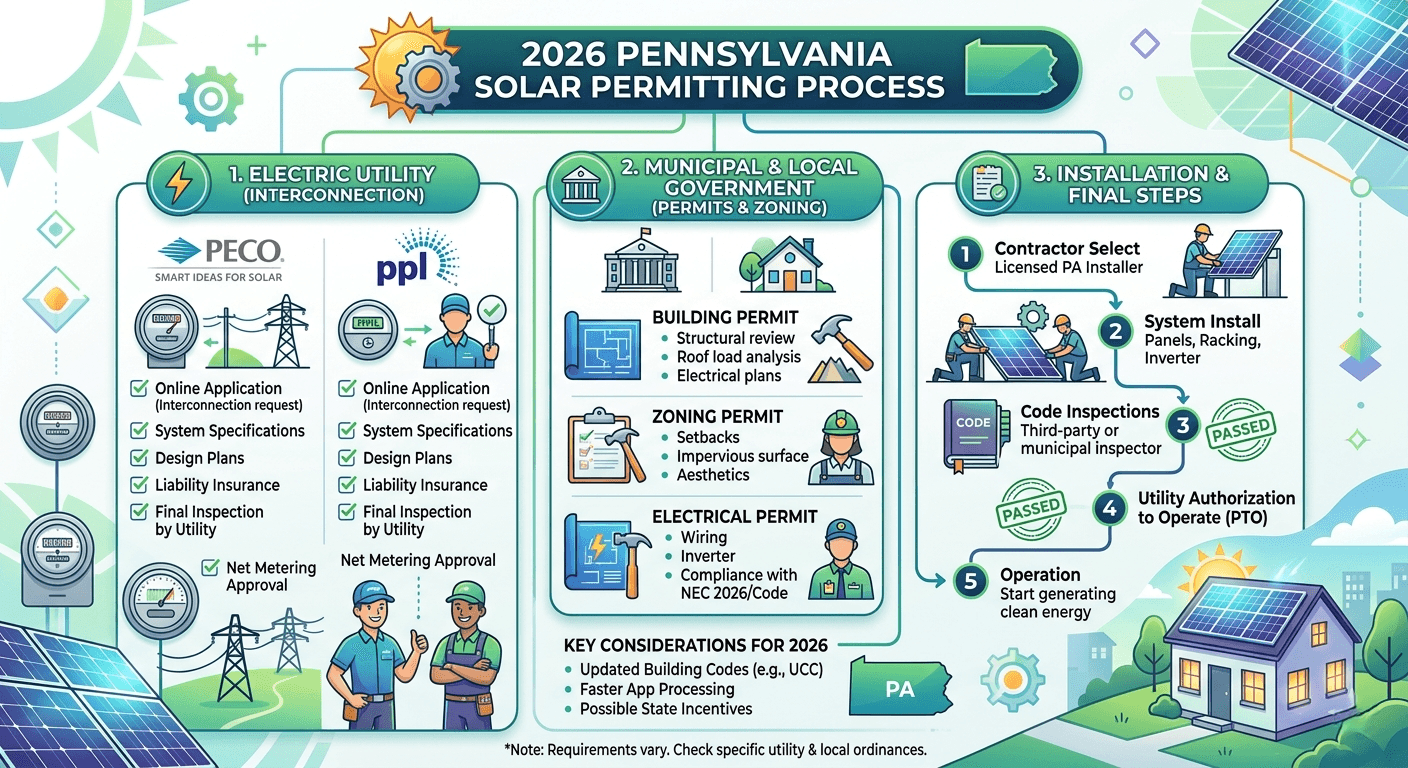
Pennsylvania solar permits require a building permit and an electrical permit from your local Authority Having Jurisdiction (AHJ), plus a utility interconnection application submitted to PECO, PPL Electric, Duquesne Light, or a FirstEnergy subsidiary before your system can export power to the grid.
The 6 core steps of the Pennsylvania solar permitting process are:
- Confirm the AHJ’s adopted code edition (2020 NEC statewide as of July 13, 2025; 2021 I-Codes effective January 1, 2026) and whether your municipality has opted out of UCC local enforcement
- Submit the utility interconnection application (PECO, PPL Electric, Duquesne Light, Met-Ed, Penelec, Penn Power, or West Penn Power) – some AHJs require proof of submission before issuing local permits
- Apply for building and electrical permits simultaneously through the local AHJ (Philadelphia eCLIPSE, Pittsburgh OneStopPGH, or city-specific portal)
- Obtain a PE stamp from a design professional licensed in the Commonwealth of Pennsylvania – out-of-state stamps are not valid
- Complete installation and pass a licensed electrical inspection (in Philadelphia, this must be a licensed electrical inspection agency, not a city inspector)
- Submit the PUC Standard Interconnection Certificate of Completion (Part 2) to the utility and receive Permission to Operate (PTO) for net metering
Pennsylvania adopted the 2020 National Electrical Code effective July 13, 2025, followed by the 2021 International Codes (IBC, IRC, IFC, IMC) on January 1, 2026 under the Pennsylvania Uniform Construction Code (UCC). Permit timelines range from same-day review in Philadelphia (EZ Permit, in-person) to 15 business days in Harrisburg (5 days if PE-stamped), with utility interconnection adding 2 to 5 additional weeks. With residential systems averaging 13.25 kW at roughly $2.63 per watt and Pennsylvania overtaking New Jersey in 2025 commercial solar installations per SEIA, first-pass AHJ approval directly affects project economics. This guide covers every major PA city, both primary utilities (PECO and PPL), and how to submit a plan set that gets approved on the first try.
Pennsylvania Solar Permit Quick-Reference: City-by-City Summary
Requirements vary substantially across Pennsylvania’s major solar cities. The table below summarizes the core variables for each jurisdiction covered in this guide.
| City | Permit Portal | Utility | Review Timeline | NEC Edition | Key Differentiator |
|---|---|---|---|---|---|
| Philadelphia | eCLIPSE (L&I) | PECO | Same-day (EZ in-person) / 3 BD (online) | 2020 NEC | EZ Permit for ≤10 kW residential; $200 building permit cap |
| Pittsburgh | OneStopPGH (PLI) | Duquesne Light | Per AHJ; Accelerated Plan Review available | 2020 NEC | Building Development Application combines building & zoning |
| Harrisburg | Bureau of Codes (in person) | PPL Electric | 15 BD residential; 5 BD if PE-stamped | 2020 NEC | 2021 I-Code adoption effective Jan 1, 2026 |
| Allentown | Bureau of Building Standards | PPL Electric | Per AHJ checklist | 2020 NEC | Residential/commercial fee: greater of $75 or 1.5% of project cost |
| Bethlehem | Bureau of Code Enforcement | PPL Electric | Per AHJ | 2020 NEC | Commercial requires PA-certified plans examiner |
| Lancaster | Bureau of Building Code Admin. | PPL Electric | Per AHJ; commercial often routed to TPA | 2020 NEC | Public/private partnership with third-party code agencies |
| Erie | City Bureau of Code Enforcement | Penelec (FirstEnergy) | Per AHJ | 2020 NEC | Higher snow load (40+ psf) structural requirements |
| Scranton | Dept. of Licenses, Inspections & Permits | PPL Electric | Per AHJ | 2020 NEC | Historic district review for Green Ridge and Hill Section properties |
Pennsylvania Solar Permitting Framework: State Codes and Utility Oversight
Three regulatory layers govern Pennsylvania solar: the Pennsylvania Uniform Construction Code (UCC) and its adopted codes, the Public Utility Commission (PUC) interconnection framework under 52 Pa. Code §75.21, and local municipal ordinances. PA contains 67 counties and over 2,500 municipalities with some autonomy in zoning and permitting – so jurisdiction-specific verification matters before any plan set is submitted.
Pennsylvania Uniform Construction Code and Current Code Adoption
The PA Department of Labor & Industry administers the UCC. Over 90% of PA’s 2,562 municipalities enforce the UCC locally using municipal staff or certified third-party agencies (TPAs). In opt-out municipalities, L&I handles commercial enforcement, and property owners hire certified TPAs for residential inspections. Current code adoption:
| Code Element | Current Version in PA | Effective Date | What It Governs |
|---|---|---|---|
| NEC (NFPA 70) | 2020 NEC | July 13, 2025 | Electrical design, PV Articles 690 and 705, labeling, disconnects |
| IBC / IRC / IFC / IMC | 2021 I-Codes | January 1, 2026 | Structural, fire setback, mechanical, residential framing |
| Interconnection Rules | 52 Pa. Code §75.21 et seq. | Current | 4-level interconnection review framework (Level 1 ≤10 kW) |
| Net Metering Rules | 52 Pa. Code §75.11 et seq. (AEPS Act) | Current | 1:1 retail credit for residential systems ≤50 kW |
A critical point for 2026 plan sets: Pennsylvania adopted the 2020 NEC effective July 13, 2025, with a six-month transitional window for projects with a design contract signed before that date and permit submitted by January 12, 2026. After January 12, 2026, the 2020 NEC applies in full. The 2021 I-Codes went live January 1, 2026. Every current PA plan set should reference both the 2020 NEC and the 2021 I-Code series on the cover sheet. For the full NEC Article 690 updates, see our dedicated guide.
PUC Interconnection Framework (52 Pa. Code §75.21)
The PA PUC regulates all distributed generation interconnection under a four-level review framework. Residential installations almost always fall under Level 1:
- Level 1: ≤10 kW, inverter-based, UL 1741/IEEE 1547 certified – covers 90%+ of residential installs
- Levels 2 & 3: Up to 2,000 kW – requires engineering review ($50 + $1/kW for Level 2, $100 + $2/kW for Level 3)
- Level 4: Above 2 MW or systems that fail Level 1-3 criteria – subject to full impact and facility studies
Per the PUC’s 2022-2024 Net Metering Interconnection Report, the three largest PA utility territories for interconnections are PPL, PECO, and Met-Ed. PA’s net metering rules under the 2004 AEPS Act credit residential systems (up to 50 kW) at full retail rate monthly, with annual excess compensated at the utility’s Price-to-Compare (PTC) rate.
PECO Interconnection: Service Territory, Application Process, and Net Metering
PECO Energy serves Philadelphia and the five surrounding southeast Pennsylvania counties (Bucks, Chester, Delaware, Montgomery, and York). PECO’s solar economics are among the best in Pennsylvania, with a residential rate near $0.21/kWh, strong 1:1 net metering, and no proposed changes to the current tariff as of April 2026.
PECO Level 1 Application Process
- Design the system and confirm UL 1741/IEEE 1547-certified inverters; PECO requires a utility-accessible AC disconnect that is accessible to PECO personnel
- Submit the PUC Standard Interconnection Application/Agreement Part 1 (Level 1) with a site plan and single-line diagram. For Philadelphia projects, this application must precede the L&I permit submission – L&I requires a screenshot of the completed PECO application dashboard
- Receive PECO review – no application fee for Level 1 residential systems ≤10 kW
- Install the system per the approved single-line; pass the licensed electrical inspection
- Submit the PUC Certificate of Completion (Part 2) along with a photo showing the AC disconnect is accessible to PECO personnel
- Receive Permission to Operate (PTO); PECO installs the bi-directional net meter and credits generation at the retail rate. PECO offers up to a $400 credit toward the cost of a second meter board if required (request within 6 months of final interconnection acceptance)
PECO Net Metering and Annual True-Up
PECO credits exported kWh at the full retail rate on a monthly basis. At the end of each net metering year (May 31), PECO pays customers for any remaining excess generation at the Price-to-Compare rate, with no cap on how much PECO will purchase. This one-for-one monthly offset, combined with an annual cash-out, is among the most favorable net metering structures in Pennsylvania.
Solar Permit Solutions
Skip the Permit Headaches
We design plan sets that pass inspection the first time. Code-compliant, PE-stamped, accepted by AHJs nationwide.
PPL Electric: Service Territory, Application Process, and Pending 2026 Tariff Change
PPL Electric Utilities serves central and eastern Pennsylvania, spanning 29 counties, including the Lehigh Valley (Allentown, Bethlehem), Harrisburg, Lancaster, and Scranton. PPL’s current residential rate is approximately $0.21/kWh, but PPL’s September 30, 2025 rate case filing proposes a significant change to net metering starting in mid-to-late 2026 – replacing 1:1 retail rate credits with hourly LMP-based compensation, which could reduce export value by 40-60%.
PPL Electric Level 1 Application Process
1.Review PPL’s interconnection requirements at pplelectric.com/remsi – verify your inverter is certified to UL 1741 Supplement B (only approved inverters are permitted)
2. Submit the application at pplelectric.com/renewable with a one-line diagram (electrical and communications), site plan, equipment datasheets, and electronically signed interconnection agreement
3. Pay the application fee per the PUC Chapter 75 schedule; applications cannot be approved before fee payment
4. Wait for PPL review – systems under 25 kW typically receive a response within 3 to 4 weeks. PPL recommends applying at least 6 months before interconnection is needed for larger systems
5. After installation, submit the Certificate of Completion online at pplelectric.com/renewable. Once approved, PPL issues the Certificate of Completion, which serves as Permission to Operate
Read our complete guide to the PPL Interconnection Application Process.
PPL Net Metering: Current Rules and the July 2026 Proposed Change
PPL currently offers 1:1 retail rate net metering on a monthly basis, with annual excess compensated at the price-to-compare rate. However, PPL’s rate case proposes shifting customer-generators into an hourly LMP-based GSR tariff starting in 2026. Utility rate filings typically take 7-10 months for PUC approval, so the effective date is projected for late summer to early fall 2026.
For PPL territory customers, this creates a meaningful window: systems that achieve Permission to Operate before the new tariff takes effect may be grandfathered under current 1:1 rates, though grandfathering is not guaranteed under Pennsylvania’s AEPS structure. For a full comparison of current PPL economics versus other PA utilities, see our solar interconnection agreement checklist and guide.
PA Utility Comparison: PECO vs. PPL vs. Duquesne Light vs. FirstEnergy
For cities outside PECO and PPL territory, the serving utility determines the interconnection portal, application fees, and net metering economics. Duquesne Light serves Pittsburgh and Allegheny metro; FirstEnergy operates four PA utilities (Met-Ed, Penelec, Penn Power, West Penn Power) covering northeastern, northwestern, and southwestern PA.
| Factor | PECO | PPL Electric | Duquesne Light |
|---|---|---|---|
| Service territory | Philadelphia and 5-county southeast PA | Central & eastern PA (29 counties): Lehigh Valley, Harrisburg, Lancaster, Scranton | Allegheny and Beaver counties (Pittsburgh metro) |
| Residential rate (2026) | ~$0.21/kWh | ~$0.21/kWh (PTC ~12.5¢ as of June 2025) | ~$0.20/kWh |
| Net metering | 1:1 retail rate monthly; annual excess paid at PTC rate on May 31 | 1:1 retail rate monthly; proposed shift to hourly LMP-based credits July 2026 | 1:1 retail rate monthly; 50 kW cap per residential customer |
| Interconnection timeline (Level 1) | 3 to 5 weeks | 3 to 4 weeks for systems <25 kW | Level 1 Part 1 review within 25 business days |
| Application portal | Online application + PUC Standard Forms | pplelectric.com/renewable (Contractor Services Online) | interconnection@duqlight.com / online portal |
| Application fee (Level 1, ≤10 kW) | $0 (no fee) | Per PUC Chapter 75 schedule | Per PUC Chapter 75 schedule |
| Meter cost | Up to $400 credit toward second meter board | Net meter supplied by PPL; no customer cost | Net meter installed at no cost to customer |
FirstEnergy’s four PA operating companies use the same four-level PUC review framework but route applications to different regional engineering addresses. Met-Ed serves south-central PA (Harrisburg metro fringe, York); Penelec serves Erie and north-central PA; West Penn Power serves southwestern PA outside Duquesne Light’s footprint. Use DSIRE to confirm which utility serves a specific address.
City-by-City Solar Permit Requirements in Pennsylvania
Philadelphia Solar Permits
Philadelphia is the most solar-friendly major city in Pennsylvania, having earned SolSmart Gold designation in 2017 and capped building permit fees at $200 in 2019. The city’s Department of Licenses and Inspections (L&I) offers two tracks through the eCLIPSE online portal: an EZ Permit process (no building permit required, plans not needed) and a standard permit process.
EZ Permit eligibility requires all three conditions: (1) the system is 10 kW or less; (2) it is installed on a one- or two-family dwelling; and (3) the property is not on the Philadelphia Register of Historic Places. EZ Permit applications submitted online are reviewed within 3 business days; in-person applications are reviewed the same day. For permit-ready plan sets designed specifically for Philadelphia L&I, see our Philadelphia solar permit services.
Philadelphia requirements:
- All solar projects require an Electrical Permit; non-EZ projects also require a General Building Permit
- Plans must be signed/sealed by a PA-registered design professional when cost of work exceeds $25,000; structural plans require a PA-licensed PE regardless of cost
- A PECO interconnection application dashboard screenshot is required at permit submission – the screenshot must clearly show project location, system capacity, installation type, and application status
- All inspections must be performed by a licensed electrical inspection agency – not a city inspector
- Plans (when required) must be professional quality, drawn to scale (e.g., 1/4″ = 1′-0″), with an 11″ x 17″ sheet size for plan documents
- Labeling must include permanently affixed red background with white lettering resistant to fading per UL 969 and NEC Article 690
Pittsburgh Solar Permits
Pittsburgh’s Department of Permits, Licenses, and Inspections (PLI) administers solar permits through the OneStopPGH online portal. A Building and Development Application (BDA) combines building and zoning review, and a separate electrical permit is required. Pittsburgh offers an Accelerated Plan Review track that cuts review time roughly in half for an additional fee.
Key Pittsburgh requirements:
- All permits applied for through OneStopPGH; permits must be posted at the job site once issued
- Most commercial solar installations route to a registered Third-Party Agency (TPA) for inspections – PLI maintains a list of registered TPAs; residential typically uses PLI inspectors
- TPA inspection documentation must be uploaded to OneStopPGH within 2 business days of the inspection
- Utility: Duquesne Light – Level 1 residential review within 25 business days. Duquesne Light maintains a 50 kW cap per residential customer and installs the net meter at no customer cost
- Pittsburgh’s older housing stock (Squirrel Hill, Shadyside, Point Breeze, South Side) often requires detailed structural review for early-1900s framing – verify rafter size and spacing before finalizing the array layout
Harrisburg Solar Permits
The City of Harrisburg Bureau of Codes at the Martin Luther King Government Center (10 N 2nd Street, Suite 205) handles solar permits under the 2021 IRC, IBC, IFC, IMC, IPC, IEBC, and 2020 NEC. Harrisburg adopted the 2021 I-Codes and 2020 NEC effective January 1, 2026, making it a useful early reference point for other PA jurisdictions that may be in transition.
Harrisburg review timelines:
- Residential permits: must be approved within 15 business days (5 business days if plans are stamped by a PA-licensed design professional)
- Commercial permits: must be approved within 30 business days; Historic Review Board adds time when required
- Historic District exterior improvements route to the Planning Bureau for compliance review – call 717-255-6419 before submitting
- Utility: PPL Electric – same Level 1 process described above
Allentown and Bethlehem Solar Permits (Lehigh Valley)
Both cities fall within PPL Electric territory. Allentown’s Bureau of Building Standards and Safety charges a plan review fee of the greater of $75 or 1.5% of the total cost of work (including materials and labor) for both residential and commercial solar projects, plus the state-mandated $4.50 UCC fee on every permit. Bethlehem’s Bureau of Code Enforcement issues electrical permits that require the PPL Job # on the application – critical for coordinating AHJ approval with utility interconnection timing. Commercial solar in Bethlehem requires construction drawings reviewed and approved by a PA-certified plans examiner.
Lancaster Solar Permits
The City of Lancaster Bureau of Building Code Administration issues construction permits and Certificates of Occupancy and handles all plan reviews and inspections for one- and two-family dwelling projects. Since 2009, Lancaster has used approved third-party code agencies for most commercial projects through a public/private partnership – meaning most commercial solar plan sets will be reviewed by a TPA selected from the city’s approved list rather than by city staff. Lancaster Township (separate from the City of Lancaster) has additional zoning-level requirements including a completed glare study with diagrams showing maximum and minimum angles of reflective glare, plus a PE-stamped certification that the installation does not exceed structural capacity.
Erie and Scranton Solar Permits
Erie is served by Penelec (FirstEnergy) and requires structural documentation accounting for higher snow loads (40+ psf in much of the Erie region). Applications for Penelec interconnection are routed to PN_interconnection@firstenergycorp.com. Scranton falls within PPL territory and follows the same PPL Level 1 process, but historic properties in the Green Ridge and Hill Section neighborhoods may require additional review through the city’s Department of Licenses, Inspections & Permits.
NEC 2020 Requirements for Pennsylvania Solar Permit Plan Sets
Pennsylvania adopted the 2020 NEC effective July 13, 2025, with full enforcement beginning January 12, 2026. Every plan set submitted to a Pennsylvania AHJ after that date should reference NEC 2020 unless the AHJ confirms it is still enforcing the 2017 edition. Key sections Pennsylvania reviewers examine:
- NEC Article 690 – Solar Photovoltaic Systems: system sizing, overcurrent protection, disconnects, and grounding
- NEC 690.12 – Rapid shutdown: conductors in array boundary must drop to 80V or less within 30 seconds; the RSD switch label must be red background with white reflective lettering, min. 3/8 in. caps, within 1 meter of the initiation device. See our rapid shutdown compliance roadmap
- NEC 690.53 – Maximum DC voltage label required at DC disconnect (the 2020 NEC simplified this label by removing max circuit current values; equipment listing covers this data)
- NEC 705.12 – Interconnection rules including the 120% busbar rule for load-side connections – one of the most commonly cited reasons for redlines in PA. See our load-side vs. supply-side interconnection guide
- NEC 690.31(G)(4) – DC conduit and raceway labeling: WARNING: PHOTOVOLTAIC POWER SOURCE required every 10 feet and on every junction box lid. See our solar PV labeling requirements guide
- NEC Article 706 / NFPA 855 – Energy Storage Systems: required when battery storage is included. ESS labeling and ventilation documentation go beyond a PV-only plan set
PE Stamp Requirements in Pennsylvania
Structural calculations and most electrical plans for grid-tied solar installations in Pennsylvania must be sealed by a design professional licensed in the Commonwealth of Pennsylvania. An out-of-state PE stamp is not valid. In Philadelphia, plans must be sealed by a PA-registered design professional when cost of work exceeds $25,000, with structural plans requiring a PA-licensed PE regardless of cost. For a state-by-state breakdown of PE thresholds, see our solar PE stamp requirements guide.

Common Pennsylvania Solar Permit Rejection Reasons
PA permit rejections track national patterns plus several state- and city-specific triggers. The most common redlines:
| Rejection Reason | PA-Specific Context | How to Prevent |
|---|---|---|
| Wrong NEC edition cited | PA moved from 2017 to 2020 NEC on July 13, 2025; some local AHJs may still be transitioning | Confirm the AHJ’s adopted edition before finalizing; cite 2020 NEC on the cover sheet |
| Missing PECO Interconnection screenshot (Philadelphia) | Philadelphia L&I requires a screenshot of the completed PECO interconnection application dashboard before issuing an electrical permit | Submit the PECO application first; capture the dashboard screenshot showing location, kW, and application status |
| Missing PE stamp when cost of work exceeds $25,000 (Philadelphia) | PA-registered design professional seal required for residential plans over that threshold; structural plans require Commonwealth-licensed PE regardless | Use a PE licensed in Pennsylvania; out-of-state stamps are not valid |
| Incorrect 120% busbar rule calculation | Common at all PA AHJs; calculation must reference the panel busbar rating, not the main breaker rating | Document the busbar rating from the panel datasheet explicitly; see load-side vs. supply-side guide |
| Missing rapid shutdown labeling per NEC 690.12 | RSD switch label must be red/white reflective, min. 3/8 in. caps, within 1 meter of initiation device | Include a full label schedule referencing exact wording and format specs |
| Philadelphia EZ Permit ineligibility flagged mid-review | EZ Permit requires ≤10 kW, 1-2 family dwelling, and property not on the Philadelphia Register of Historic Places | Verify all three conditions before selecting ‘Comply with EZ Standard’ on the application |
| Ungrounded system inspection by city inspector | Philadelphia requires a licensed electrical inspection agency – not a city inspector – to perform all PV inspections | Hire one of Philadelphia’s licensed electrical inspection agencies before scheduling final inspection |
| Site plan doesn’t match aerial imagery | Urban PA cities (Philadelphia row homes, Pittsburgh hillside lots) have complex property lines that frequently generate redlines | Use actual survey measurements or drone-based site data; never estimate property boundaries |
Pennsylvania Solar Incentives and 2026 Timing Factors
The federal Section 25D Residential Clean Energy Credit expired for most expenditures after December 31, 2025 under the One Big Beautiful Bill Act. PA’s state-level incentives now carry more weight:
- PA SRECs: One credit per 1,000 kWh generated, trading $26-$40 in early 2026. Systems must be registered in PJM-GATS and certified under the PA AEPS
- Net metering: 1:1 retail rate monthly, annual excess at PTC rate (residential systems up to 50 kW)
- PA Solar Energy Program (SEP): Commercial/institutional grants up to $1 million or $1.50/watt through DCED/DEP
- Section 48E commercial ITC: Still available for leased systems/PPAs; project construction must begin by July 4, 2026 for full credits
Two 2026 factors compress permit timing. First, PPL customers face a proposed shift from 1:1 net metering to hourly LMP-based credits starting mid-to-late 2026 – systems installed before the new tariff may be grandfathered. Second, the Section 48E construction-start deadline (July 4, 2026) affects installers routing residential customers into lease/PPA structures. Philadelphia’s same-day EZ Permit and Harrisburg’s 5-business-day PE-stamped track become meaningfully valuable in this window.
How to Get First-Pass Approval on Pennsylvania Solar Permits
The contractors who consistently move through Pennsylvania’s diverse AHJ landscape without revision cycles share a consistent set of practices:
- Verify the specific AHJ’s adopted code editions before starting the plan set. Pennsylvania’s 2020 NEC and 2021 I-Code adoption is recent enough that some municipalities may still be in transition
- Confirm which utility serves the property address before finalizing system design – PECO, PPL, Duquesne Light, and FirstEnergy each have different portals, application fees, and net metering economics
- For Philadelphia EZ Permits, verify all three eligibility conditions before selecting the EZ track: ≤10 kW, 1-2 family dwelling, and not on the Historic Register
- Submit the PECO interconnection application first when working in Philadelphia – L&I requires the dashboard screenshot as a prerequisite for the electrical permit
- For Pittsburgh commercial installations, coordinate Third-Party Agency inspector registration before submitting the BDA – TPA inspector selection must be documented on the permit application
- Use PE stamps from engineers licensed in Pennsylvania – Philadelphia, Harrisburg, and every major PA AHJ reject out-of-state stamps
- Include a dedicated label schedule in every plan set documenting exact wording, format, and NEC section reference – generic notes referring to ‘all labels per NEC 690’ consistently generate redlines
- For systems including battery storage, reference NEC Article 706 and NFPA 855 in the plan set – a PV-only template will not cover ESS documentation
Frequently Asked Questions
Skip the Permit Headaches
We design plan sets that pass inspection the first time. Code-compliant, PE-stamped, accepted by AHJs nationwide.
Frequently Asked Questions
Yes. All PA jurisdictions require at least a building permit and an electrical permit under the PA UCC. Philadelphia offers a streamlined EZ Permit for qualifying systems ≤10 kW on 1-2 family dwellings that skips the building permit requirement, but an electrical permit is still required. Installing without permits violates the PA Construction Code Act and can void homeowner insurance.
Pennsylvania adopted the 2020 NEC effective July 13, 2025, with full enforcement beginning January 12, 2026. The 2021 I-Codes became effective January 1, 2026. Confirm your specific AHJ's enforcement before finalizing plan set code references.
PA's six major investor-owned utilities: PECO (Philadelphia and 5-county southeast PA), PPL Electric (central and eastern PA – Lehigh Valley, Harrisburg, Lancaster, Scranton), Duquesne Light (Pittsburgh metro), Met-Ed (south-central PA), Penelec (Erie and north-central PA), and West Penn Power (southwestern PA). Use DSIRE or contact the utility directly to confirm.
Yes, for grid-tied residential and commercial installations. Structural and electrical plans must be sealed by a PA-licensed design professional. Out-of-state PE stamps are not valid. Philadelphia requires a PA-registered seal when cost of work exceeds $25,000, with structural plans requiring a PA-licensed PE regardless of cost.
Philadelphia offers same-day in-person EZ Permit review and 3 business days online. Harrisburg targets 15 business days (5 days if PE-stamped). Pittsburgh's Accelerated Plan Review can cut review time roughly in half. Utility interconnection adds 3-5 weeks for PECO, 3-4 weeks for PPL (systems <25 kW), and 25 business days for Duquesne Light Level 1 review.
Both currently offer 1:1 retail rate credits monthly with annual true-up at the PTC rate. The key difference: PPL filed a rate case proposing a shift to hourly LMP-based credits starting mid-to-late 2026, which could reduce export value 40-60%. PECO has no comparable proposed change, making permit timing strategically significant for PPL customers.
The Section 25D residential credit expired after December 31, 2025. Homeowners can still access federal incentives indirectly through solar leases and PPAs, where the third-party owner claims the Section 48E commercial credit and passes savings through via lower monthly payments. Section 48E requires project construction to begin by July 4, 2026.
PA does not have a statewide solar access law comparable to New Jersey's. HOAs in PA can impose restrictions on solar through deed restrictions and covenants, though HOAs may not prohibit solar outright in most circumstances. Always verify HOA approval and deed restrictions before submitting any permit application.

SPS Editorial Team
Solar Permit Solutions
Solar Permit Solutions provides professional solar permit design services for residential, commercial, and off-grid installations across all 50 states. Our team ensures permit-ready plan sets delivered fast.
Related Articles
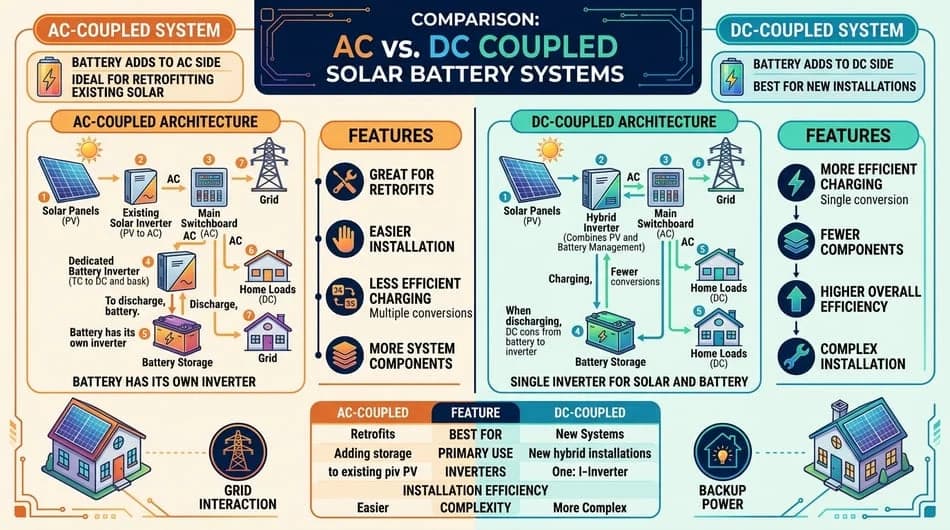
AC vs DC Coupled Solar Batteries: Which Should You Choose?
AC vs DC coupled solar batteries compared: efficiency, costs ($8K-$18K), and ins...
How Many Solar Panels Do I Need to Run Off the Grid?
Most off-grid homes need about 8 to 16 solar panels rated at 400 watts, dependin...
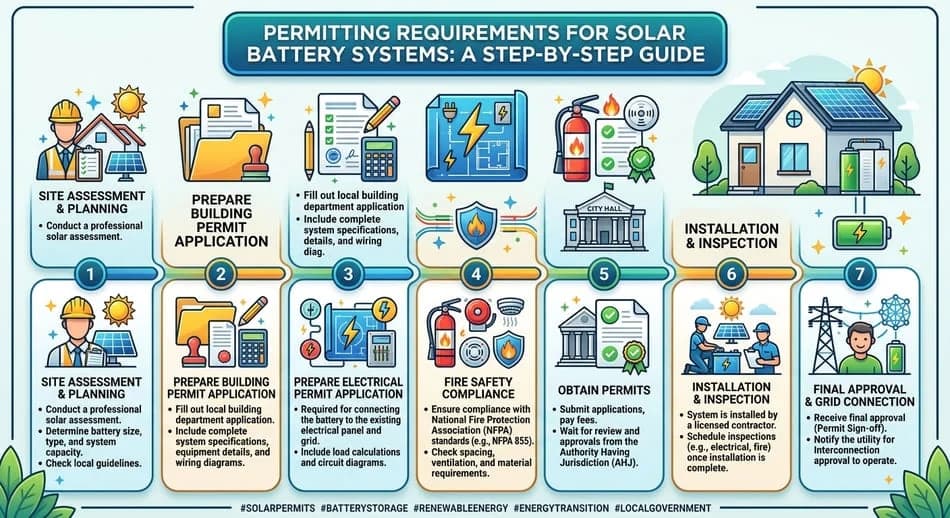
Solar Battery Permit Requirements: What You Need to Know
A solar battery usually needs local approval and a utility review before it can ...