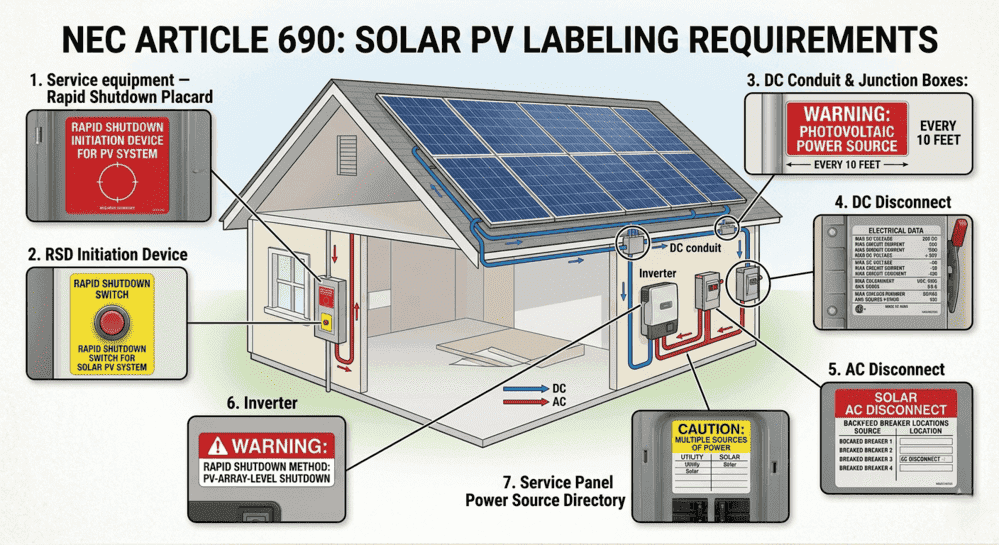
Solar PV labeling requirements are the mandatory markings, placards, and directories that NEC Article 690 Part VI requires on every permitted solar installation. Under NEC 2023 (or 2020/2017 in jurisdictions that have not yet adopted the latest cycle), every residential and commercial PV system must carry labels at seven specific locations covering rapid shutdown, DC conductors, disconnects, and power source identification. Missing or incorrect labels cause roughly 1 in 4 residential solar inspections to fail.
The 7 required label locations under NEC Article 690 are:
- Service equipment – Rapid shutdown placard per NEC 690.12(D) / 690.56(C)
- RSD initiation device – “RAPID SHUTDOWN SWITCH FOR SOLAR PV SYSTEM” per NEC 690.12(D)(2)
- All DC conduit, raceways, and junction box lids – “WARNING: PHOTOVOLTAIC POWER SOURCE” every 10 feet per NEC 690.31(G)(4)
- DC disconnect – Electrical data label (max DC voltage) per NEC 690.7(D) / 690.53
- AC disconnect – System identification and power source cross-reference per NEC 690.54 / 705.10
- Inverter – Manufacturer listing and rapid shutdown method identification per NEC 690.56
- Service panel power source directory – “CAUTION: MULTIPLE SOURCES OF POWER” per NEC 705.10
The requirements come from four overlapping sources: NEC Article 690, the International Fire Code, OSHA 29 CFR 1910.303(b)(2), and individual equipment manufacturer instructions. The NEC edition your jurisdiction has adopted matters significantly, the 2023 NEC changed the color rules for the rapid shutdown building placard, moved the DC voltage label from 690.53 to 690.7(D), and consolidated all power source directory requirements into Article 705.10. This guide covers every label location, exact wording, format requirements, NEC edition differences, and how to document a complete label schedule in your permit plan set for AHJ first-pass approval.
What Are Solar PV Labeling Requirements?
Solar PV labeling requirements are the code-mandated markings that must be present on a solar installation before it can pass a final inspection. They exist for a fundamental reason: a photovoltaic system introduces a second power source onto a building, and anyone interacting with that building, a firefighter venting a roof, a utility lineworker, or an electrician pulling a solar permit, needs to identify that source, locate its disconnects, and de-energize it safely without relying on the installation company being present.
The requirements come from four overlapping authorities, each of which can add to the baseline:
Where the Requirements Come From: NEC, IFC, OSHA, and Manufacturer Instructions
Local AHJ Requirements: Some jurisdictions add requirements beyond the NEC baseline. For an overview of how AHJ requirements vary by location, see our dedicated guide. Always confirm AHJ-specific requirements before finalizing your label schedule.
NEC Article 690 Part VI (Marking): The primary code source. Covers rapid shutdown labeling, DC circuit identification, disconnecting means labels, and electrical data placards. See the full NFPA 70 (NEC) for the authoritative code text. The 2023 NEC moved many power source identification requirements to Article 705.10, creating a unified standard across PV, storage, and generator systems.
International Fire Code (IFC): Adds requirements beyond the NEC on reflectivity, color contrast, weather resistance, and conduit marking intervals. The ICC International Fire Code is the primary reference; some jurisdictions adopt it independently of the NEC cycle.
OSHA 29 CFR 1910.303(b)(2): Requires that listed or labeled equipment be installed per the manufacturer’s instructions. See OSHA 29 CFR 1910.303 for the full regulatory text. Your label package must also reflect what inverter, battery, and disconnect manufacturers specify in their installation documentation.
Why Code Cycle Matters: NEC 2017, 2020, and 2023
Solar labeling requirements change with each NEC edition, and different jurisdictions are on different cycles. As of April 2026, many jurisdictions have adopted NEC 2023, but a significant number still enforce NEC 2020 or NEC 2017. For a full breakdown of how NEC 2023 Article 690 updates affect installations, see our dedicated guide. The 2023 NEC made several labeling changes that directly affect plan sets: it moved the rapid shutdown building placard requirements from 690.56(C) to 690.12(D), removed the specific color and reflectivity mandate for that placard, moved the DC voltage label from 690.53 to 690.7(D), and consolidated power source directory requirements into 705.10.
A key point that trips up many installers: in NEC 2023, the buildings-with-rapid-shutdown placard no longer has a specific color requirement, only that the text must contrast the background. The rapid shutdown switch label (690.12(D)(2)), however, remained a red background with white reflective lettering and did not change. These two labels have different color rules under NEC 2023, which is a common source of confusion. The NEC edition comparison table later in this article details every change.
Solar Permit Solutions
Need Solar Permit Plans?
Professional, permit-ready solar plan sets delivered fast. Residential and commercial projects across all 50 states.
What Labels Are Required on a Solar Permit?
The complete label requirement for a residential or commercial PV installation covers seven primary locations. Each location has specific label text, format requirements, and a corresponding NEC code section. The table below provides the full reference.
The 7 Required Label Locations Under NEC Article 690
| # | Location | Required Label Text | NEC Section | Background | Lettering |
| 1 | Service Equipment (main panel or meter) | SOLAR PV SYSTEM IS EQUIPPED WITH RAPID SHUTDOWN (with roof diagram showing array boundary and conductor zones) | 690.12(D) / 690.56(C) | No specific color required in NEC 2023 – contrasting text to background; red/white is the industry convention | Contrasting to background. Min. 3/8 in. caps. Reflectivity no longer required by NEC 2023 (was required in 2017/2020) |
| 2 | RSD Initiation Device (switch or breaker) | RAPID SHUTDOWN SWITCH FOR SOLAR PV SYSTEM | 690.12(D)(2) | Red | White, reflective, min. 3/8 in. caps. This label DID NOT change in NEC 2023. |
| 3 | All DC Conduit, Raceways, Junction Boxes, Combiner Boxes | WARNING: PHOTOVOLTAIC POWER SOURCE | 690.31(G)(4) | Red | White, caps. Every 10 ft and at each box lid. |
| 4 | DC Disconnect | Electrical data: max DC voltage (NEC 2023: per 690.7(D)); NEC 2017/2020: Voc, Isc, max system voltage, rated current per 690.53 | 690.53 (2017/2020) or 690.7(D) (2023) | N/A | Durable field label or engraved |
| 5 | AC Disconnect | PHOTOVOLTAIC SYSTEM DISCONNECT (plus cross-reference to DC disconnect location per 705.10) | 690.54 / 705.10 | N/A | Permanent, durable |
| 6 | Inverter | Manufacturer listing ID; output voltage and current; rapid shutdown method identification | 690.56 / equipment listing | N/A | Factory or field label per manufacturer |
| 7 | Service Panel / Power Source Directory | CAUTION: MULTIPLE SOURCES OF POWER. Directory listing all power sources and disconnect locations plus off-site emergency contact (NEC 2023 addition) | NEC 705.10 | N/A | Permanent placard or directory card |
Note: This table covers baseline NEC requirements. Storage systems (NEC Article 706 / NFPA 855) and commercial systems may require additional labels. AHJ requirements can also expand the list. Always cross-reference your label schedule against the specific AHJ’s adopted code edition and any published local amendments.
Rapid Shutdown Label Requirements (NEC 690.12(D) and 690.56(C))
The rapid shutdown placard is the most scrutinized label in any residential solar permit plan set. AHJ reviewers look for it first, and inspectors check it at the start of every final inspection walkthrough. A vague note, wrong format, or imprecise wording will trigger a redline, even when every other part of the design is solid.
Under NEC 690.12, PV system circuits installed on or in buildings must include a rapid shutdown function that reduces conductors to safe voltage levels within 30 seconds of initiation. In the 2023 NEC, marking requirements were moved from Section 690.56(C) to Section 690.12(D) so that all rapid shutdown rules and labeling requirements are in the same place.
The Two Distinct Rapid Shutdown Labels – and Their Different Color Rules
There are two required rapid shutdown labels, and they have different color requirements under NEC 2023:
Label 1 – Buildings-with-Rapid-Shutdown Placard (690.12(D) in NEC 2023; 690.56(C) in 2017/2020): Required text (system shuts down array and conductors): SOLAR PV SYSTEM IS EQUIPPED WITH RAPID SHUTDOWN / TURN RAPID SHUTDOWN SWITCH TO THE OFF POSITION TO SHUT DOWN PV SYSTEM AND REDUCE SHOCK HAZARD IN ARRAY. Required text (system shuts down conductors leaving array only): SOLAR PV SYSTEM IS EQUIPPED WITH RAPID SHUTDOWN / TURN RAPID SHUTDOWN SWITCH TO THE OFF POSITION TO SHUT DOWN CONDUCTORS OUTSIDE THE ARRAY. CONDUCTORS IN ARRAY REMAIN ENERGIZED IN SUNLIGHT. NEC 2023 format: No specific color is required – text must contrast with the background. The label is no longer required to be reflective. Red/white is the industry convention and satisfies most AHJs. NEC 2017/2020 format: Yellow background, black text (array + conductors version), or red background, white text (conductors-only version). Reflective required. All editions must include a simple roof diagram showing the array boundary and which conductors remain energized. Title text min. 3/8 in. (9.5 mm). Body text min. 3/16 in. (4.8 mm).
Label 2 – RSD Initiation Device Label (690.12(D)(2)) – UNCHANGED ACROSS ALL EDITIONS: RAPID SHUTDOWN SWITCH FOR SOLAR PV SYSTEM. Format: Red background. White lettering. Reflective. All caps. Minimum 3/8 in. (9.5 mm) letter height. Located on or no more than 1 meter (3 ft) from the switch. This label did NOT change in NEC 2023. It remains red/white and reflective.
For a deeper look at NEC 690.56(C) labeling requirements across all code editions, see our dedicated article. The roof diagram element of the placard is one of the most commonly incomplete items in plan submissions. The diagram must show the building outline and the array boundary and distinguish between the two controlled zones: conductors inside the array boundary and conductors outside it. Generic placards without the roof diagram or without indicating the shutdown type do not satisfy the requirement.
NEC 2023 Update: Carport and Canopy Exception
Exception No. 2 to NEC 690.12, added in the 2023 edition, explicitly exempts non-enclosed detached structures from the rapid shutdown requirement. For full details on which structures qualify for the NEC 2023 carport/canopy exemption, see our dedicated guide. Carports, canopies, and solar trellises that are not enclosed structures fall under this exception. Conductors from those arrays that travel on the exterior of a building may also fall under a separate exception. Verify with the AHJ before omitting the label, not all AHJs apply the exceptions uniformly.
DC Conduit and Raceway Labeling (NEC 690.31(G)(4))
DC conductor labeling is one of the most frequently missed items on residential solar inspections. Unlike the rapid shutdown placard, which is prominent and placed at the service panel, conduit labels are small, distributed across the entire wiring path, and easy to skip when a crew is moving fast.
The 10-Foot Interval Rule
NEC 690.31(G)(4) requires that all exposed raceways, cable trays, and other wiring methods containing PV source circuit and PV output circuit conductors be marked at intervals not exceeding 10 feet. The International Fire Code adds a reflectivity requirement for conduit labels visible from firefighter access positions on the roof. Required label text:
Required text: WARNING: PHOTOVOLTAIC POWER SOURCE
Format: White text on red background. All caps. Applied at intervals of 10 feet or less, at every turn, above and below penetrations through walls and floors.
One important exception for microinverter systems: Microinverters perform DC-to-AC conversion at each module. The trunk cable running from the array to the gateway or combiner is AC, not DC, and does not require the WARNING: PHOTOVOLTAIC POWER SOURCE conduit label. However, any DC wiring that does exist in a raceway on the system (such as module-to-module DC wiring on the roof) still falls under 690.31(G)(4).
Junction Boxes, Combiner Boxes, and Pull Boxes
The same WARNING: PHOTOVOLTAIC POWER SOURCE label is required on the cover or enclosure lid of every junction box, pull box, conduit body, and combiner box containing DC PV conductors per NEC 690.31(G)(3) and (G)(4). The label goes on the exterior lid, visible without opening the box. Inspectors walk the conduit run and check every box, a single missed box lid will generate a correction. Document both the conduit interval requirement and the box lid requirement in your plan set label notes.
Service Equipment Labels and Power Source Identification (NEC 705.10)
Once solar is added to a site, the main panel or disconnect must communicate that a second power source is present. In the 2023 NEC, this requirement was consolidated into Article 705.10, which now covers all distributed energy resources, PV, storage, generators, and fuel cells, under a single standard. The 2023 NEC also added a new requirement: the directory must include an off-site emergency contact number for any company providing off-site services for the system.
The practical requirement is a permanent placard or directory at the service equipment identifying all power sources and their disconnect locations. Where multiple sources supply a building, the label must include the wording,
CAUTION: MULTIPLE SOURCES OF POWER.
Multiple Power Source Warning Labels
For load-side interconnected solar systems, the standard label at the solar backfed breaker identifies it as the solar interconnect. For the AC disconnect, a label that satisfies both NEC 690.54 and NEC 705.10 in one label might read (see our supply-side vs. load-side interconnection guide for full interconnection method context):
Sample combined label (AC disconnect): PV SYSTEM AC DISCONNECT PV DC DISCONNECT LOCATED AT: [location]This single label satisfies the AC disconnect identification requirement under 690.54 and the cross-reference requirement under 705.10.
These service equipment labels generate corrections frequently because they connect multiple documents. The single-line diagram, panel schedule, site layout, and label notes must all tell the same story. If the one-line shows a supply-side connection but the service equipment label references a load-side backfed breaker, reviewers will flag the mismatch.
Back-Fed Breaker Labels Under the 120% Rule
For load-side interconnections using the 120% busbar rule per NEC 705.12(B)(2)(3)(b), where the solar breaker backfeeds at the opposite end of the busbar from the main breaker, an additional label is required at the breaker. The label must indicate it is backfed and warn that it should not be relocated. Most AHJs accept a label reading WARNING: BACKFED BREAKER – DO NOT RELOCATE. Confirm the exact wording preference with your specific AHJ.
ESS and Battery Storage Labeling Requirements (NEC Article 706 / NFPA 855)
Adding battery storage introduces a labeling scope that goes significantly beyond a PV-only plan set. NEC Article 706 governs energy storage system installations alongside Article 690 for combined PV+storage systems. NFPA 855, the Standard for the Installation of Stationary Energy Storage Systems, adds fire safety signage, hazard identification, and emergency control labeling requirements that do not exist in the NEC alone.
Many AHJs are still developing their ESS review processes, which means labeling requirements on storage projects can vary more than on PV-only submissions. The safest approach is to document the full ESS label set in the plan set and request a pre-submittal conference with the AHJ for large-scale or indoor battery installations.
Battery Disconnect and Emergency Shutdown Labels
Storage projects require labels at minimum at the following locations:
- Battery main disconnect: Identified with a manufacturer label plus a field label showing the disconnect type, rating, and cross-reference to other power source disconnects per 705.10.
- Emergency shutdown control: NFPA 855 requires identification of any emergency shutdown or manual control affecting the ESS. The label must be visible and accessible to emergency responders.
- Battery enclosure or cabinet: Warning labels on the exterior identifying the chemistry type (e.g., lithium-ion) and applicable hazard class per NFPA 855 and equipment listing requirements.
- AC and DC disconnects on storage circuits: The same principles as PV disconnects; all must be cross-referenced in the 705.10 power source directory at the service panel.
NFPA 855 Signage Requirements
NFPA 855 requires signage beyond the NEC baseline for PV-only systems. For indoor installations, the standard requires identification of the ESS location, hazard class, and emergency controls at the entry to the space. The signage must comply with ANSI Z535 design standards – specific signal words, color coding by hazard level (Danger, Warning, Caution), and minimum text height requirements.
Never carry forward label notes from a previous PV-only plan set to a storage project. Copied notes that reference equipment, locations, or disconnect configurations from a different project are among the most common sources of labeling redlines on battery storage permit submissions. Storage projects require a project-specific label review on every job.
Label Format and Material Requirements
The NEC specifies what labels must say and where they must go. The IFC adds color and reflectivity requirements for certain labels. OSHA and ANSI Z535 set minimum text height and design standards. NEC 110.21(B) requires that all field-applied hazard markings be durable and permanently affixed, which eliminates paper labels, inkjet-printed labels, and standard adhesive labels on exterior equipment.
The table below consolidates the format requirements for each major label category, with NEC edition distinctions where applicable:
| Label Type | Background Color | Lettering Color | Min. Letter Height | Reflective Required? |
| RSD building placard (690.12(D) in NEC 2023; 690.56(C) in 2017/2020) | NEC 2023: No specific color – contrasting text required. NEC 2017/2020: yellow (array+conductors) or red (conductors only) | NEC 2023: Contrasting to background. NEC 2017/2020: black on yellow or white on red | 3/8 in. (9.5 mm) for title text | NEC 2023: No. NEC 2017/2020: Yes. AHJs may still require reflective. |
| RSD initiation device label (690.12(D)(2)) | Red | White | 3/8 in. (9.5 mm) | Yes – unchanged across all NEC editions |
| DC conduit / raceway / junction boxes (690.31(G)(4)) | Red | White | 3/8 in. recommended | Per AHJ / IFC adoption |
| Service equipment power source directory (705.10) | N/A – permanent placard | Black on white | Legible at 3 ft | No |
| DC disconnect electrical data (690.53 / 690.7(D)) | N/A | Contrasting to background | Legible | No |
| ESS warning labels (NFPA 855 / NEC 706) | Varies by hazard level (ANSI Z535) | White or black per ANSI Z535 | ANSI Z535 compliant | Per AHJ |
Durability and Weather Resistance (UL 969)
The practical standard for field-applied solar label durability is UL 969, which covers marking and labeling systems for outdoor use. UL 969-rated labels are tested for UV exposure, moisture, temperature cycling, and adhesion to powder-coated metal surfaces , the exact conditions found on outdoor solar electrical equipment.
Specifying UL 969-rated labels in the plan set label notes is both a best practice and a common AHJ requirement in jurisdictions that have adopted IFC provisions. The minimum text height standard for critical safety labels is 3/8 inch (9.5 mm) for header text and 3/16 inch (4.8 mm) for body text per IFC and ANSI Z535 guidance. Labels that technically meet this requirement but are difficult to read at arm’s length, have small fonts, low contrast, and non-standard typefaces frequently generate inspector comments even when they pass the letter of the code.

NEC Edition Comparison: What Changed for Solar Labeling in 2020 and 2023
Solar labeling requirements change with every NEC cycle, and the gap between cycles is meaningful. An installer working across multiple jurisdictions will encounter all three editions in active use. For a comprehensive guide to all NEC 2023 Article 690 changes beyond labeling, see our full update guide. The table below summarizes every labeling-specific change:
| Labeling Topic | NEC 2017 | NEC 2020 | NEC 2023 |
| RSD building placard: section | 690.56(C) | 690.56(C) | Moved to 690.12(D) – rules and labels now in same section |
| RSD building placard: color | Yellow/black (array + conductors shut down) or red/white (conductors only shut down); both reflective | Yellow/black or red/white (same as 2017); reflective required | CHANGED: No specific color required. The text must contrast with the background. Label no longer needs to be reflective. Red/white remains industry convention but is not mandated. |
| RSD switch label: color (690.12(D)(2)) | White on red, reflective | White on red, reflective | Unchanged – still white on red, reflective |
| Power source ID consolidation | Article 690 | Article 690 | Moved to Article 705.10 for all distributed energy resources. NEC 2023 also added a requirement for an off-site emergency contact number. |
| Carport/canopy RSD exception | Not addressed | Not addressed | New Exception No. 2 to 690.12 – non-enclosed detached structures (carports, canopies, trellises) not required to comply with rapid shutdown |
| DC voltage label: section | 690.53 (with Voc, Isc, max voltage, rated current) | 690.53 simplified – current values removed; max DC voltage label remains | Moved from 690.53 to 690.7(D). Requirement unchanged: label showing highest max DC voltage. |
| Conduit marking interval | Every 10 ft (IFC) | Every 10 ft | Every 10 ft – no change |
| ESS labeling | NEC 706 (early framework) | NEC 706 and NFPA 855 referenced | Refined coordination between Articles 690, 706, and 705.10 |
The most operationally significant change in NEC 2023 is the removal of the specific color requirement for the buildings-with-rapid-shutdown placard. The NEC 2023 code simply requires that text contrast the background – no yellow, no red requirement for that specific label. The rapid shutdown switch label (690.12(D)(2)), however, is unchanged and remains red background with white reflective lettering. Installers who treat ‘NEC 2023 = red placard’ as a blanket rule are applying the switch label standard to the building placard, which is incorrect. Red/white satisfies NEC 2023 (contrast is achieved), but so does black/white or any other high-contrast combination – subject to AHJ preference.
How to Document a Label Schedule in Your Permit Plan Set
One of the most underexplored dimensions of solar labeling is how to document it in the permit plan set for AHJ review. Field installation and permit documentation are two separate things. A crew can install every required label correctly, but if the plan set does not document the label schedule, the AHJ reviewer will flag it before the job ever reaches installation.
A complete label schedule in a permit plan set should include the following for each required label:
- Location – where specifically the label is placed (e.g., on or adjacent to main service disconnect enclosure)
- Exact label text – the verbatim text required by the applicable NEC section, not a paraphrase
- Format specifications – background color or contrast requirement, letter color, minimum letter height, reflectivity requirement
- Code reference – the specific NEC section that requires the label
- Label source – field-applied, factory-installed, or pre-printed kit (relevant for UL 969 compliance)
Many plan sets include a note that simply says all labeling per NEC Article 690 without providing any specific documentation. This is insufficient for most AHJs and is a common source of plan check comments. The standard that earns first-pass approval is a label schedule sheet or dedicated label notes section that a reviewer and a field inspector can use as a checklist without referring to the code.
What AHJ Reviewers and Inspectors Check in Label Documentation
Understanding the sequence in which reviewers and inspectors evaluate labeling helps you structure your documentation for maximum clarity.
At plan review: The reviewer checks that a label schedule exists and is complete, that the rapid shutdown placard wording and format match the NEC edition the jurisdiction has adopted, that DC conduit runs show the 10-foot interval labeling requirement in plan notes, that the 705.10 power source directory is documented, and that ESS labeling (if applicable) references NFPA 855 and the equipment manufacturer’s instructions.
At field inspection: The inspector walks the seven locations described in the placement table. They start at the service panel (RSD placard), trace the conduit run (10-foot interval labels), check every box lid (WARNING: PHOTOVOLTAIC POWER SOURCE), verify the RSD initiation device label, check the AC and DC disconnects – see our NEC 690.13 disconnect guide for more on disconnect labeling requirements – and finish at the inverter. Any location where the physical label does not match the approved plan set label schedule generates a correction.
Inspectors who flag the most labeling issues are not looking for errors – they are looking for completeness. A well-documented label schedule that is clearly laid out, code-referenced, and includes exact wording makes the inspector’s job straightforward and dramatically reduces the probability of a field correction.
Common Solar Labeling Redlines (And How to Avoid Them)
Labeling corrections are among the most preventable causes of solar permit rejection. They almost never involve complex engineering disputes – they are documentation gaps and formatting errors. For a broader view of all solar permit rejection reasons, see our permit requirements guide. The table below covers the most common labeling-specific redlines:
| Common Redline / Inspection Fail | Root Cause | How to Prevent It |
| Missing rapid shutdown placard at service equipment | Plan set shows RSD on one-line but label not documented in label schedule | Add RSD placard to label schedule with wording, format spec, and location note |
| Wrong RSD placard color for the jurisdiction’s NEC edition | Using NEC 2017/2020 yellow/black placard in a 2023 jurisdiction, or vice versa. Note: NEC 2023 removed the color mandate, but AHJs vary on what they accept. | Confirm AHJ’s adopted NEC edition and local preference before selecting label format. When in doubt, use red/white – it satisfies all editions. |
| No label schedule in permit plan set | Designer documents the system but skips the label documentation page | Include a dedicated label schedule sheet or label notes section in every plan set |
| DC conduit labels missing between 10-foot intervals | Labels placed at ends only, not at required intervals | Show conduit label placement on the site plan and note the 10-ft interval requirement |
| Disconnect labels that don’t match the one-line diagram | Design revised after label notes written; labels not updated | Review label notes against the one-line as the final pre-submission step |
| Service equipment label doesn’t reference multiple power sources | Template from PV-only job carried forward to PV+storage job | Storage projects need a project-specific label review – never reuse a PV-only template |
| ESS on plans but missing NFPA 855 signage | Battery storage added late in design without label review update | Trigger a full label audit any time storage is added or the one-line is revised |
| Field-applied labels not suitable for outdoor conditions | Paper or inkjet labels used on exterior equipment | Specify UL 969-rated, UV-resistant label stock for all exterior locations in plan notes |
| Label text doesn’t match required wording exactly | Paraphrased wording vs. NEC-required exact text | Use verbatim NEC text: SOLAR PV SYSTEM IS EQUIPPED WITH RAPID SHUTDOWN |
The pattern across all of these redlines is the same: labeling corrections happen when the label review is treated as an afterthought rather than a dedicated step in the plan set production process. Building a label review checkpoint into the workflow – after the one-line is final and before the plan set is assembled – catches the vast majority of these issues before they reach the AHJ.
Arc Flash and Other Labels Frequently Asked About
A few label categories generate consistent questions and are worth addressing directly:
Arc Flash Labeling on Residential Systems
NEC 110.16 requires arc flash warning labels on electrical equipment likely to be examined, serviced, adjusted, or maintained while energized. For residential PV systems, this typically does not apply because the equipment is not expected to be serviced while live. The final determination must be made by a qualified person performing an arc flash risk assessment. Some commercial systems – particularly larger inverter systems and utility-interactive installations – do require arc flash labeling. If your plan set includes commercial service equipment, verify whether 110.16 applies with the AHJ and the project’s electrical engineer.
Maximum DC Voltage Label
A field-applied label indicating the maximum DC system voltage is required on every PV system with DC circuits. In the 2023 NEC, this requirement was moved from Section 690.53 to Section 690.7(D). For full context on NEC 690.7 maximum voltage calculations, see our dedicated article. The label must show the highest DC voltage in the system calculated per 690.7 and must be placed at the DC PV system disconnecting means, the PV system electronic power conversion equipment, or distribution equipment associated with the PV system. The 2020 NEC simplified this label by removing the maximum circuit current values from the requirement (equipment listing covers this data) – that simplification carried forward into 2023.
Conclusion
Solar labels are inexpensive. Label-related redlines are not, each correction cycle adds one to four weeks to the project timeline, and labeling failures are almost entirely preventable when the label schedule is treated as a dedicated step rather than a final afterthought.
The contractors who consistently pass label review do four things: they confirm the AHJ’s adopted NEC edition before designing any label schedule, they document exact verbatim wording rather than generic code references, they run a label review pass after the one-line is finalized and before the plan set is assembled, and they never carry label notes forward from a previous project without a project-specific review.
Solar labeling requirements are one of the highest-leverage areas to get right in a permit plan set. Labels themselves are inexpensive. Label-related redlines are not; each correction cycle adds one to four weeks to the project timeline, and labeling corrections are almost entirely preventable when the label schedule is treated as a dedicated documentation step rather than a final afterthought.
The contractors and plan set teams that consistently pass label review share the same habits: they verify the AHJ’s adopted NEC edition before designing any label schedule, they document exact label wording rather than generic code references, they include a label review step after the one-line is finalized and before the plan set is assembled, and they never carry forward label notes from a previous project without a project-specific review.
Solar Permit Solutions produces PE-stamped, AHJ-ready solar permit plan sets for residential and commercial solar projects across all 50 states.
Frequently Asked Questions
Need Solar Permit Plans?
Professional, permit-ready solar plan sets delivered fast. Residential and commercial projects across all 50 states.
Frequently Asked Questions
The primary NEC section for solar PV labeling is Article 690 Part VI (Marking). The most critical subsections are 690.12(D) for rapid shutdown marking (moved from 690.56(C) in the 2023 NEC), 690.31(G)(4) for DC conduit and raceway labeling, 690.7(D) for the maximum DC voltage label (moved from 690.53 in 2023), and 690.54 for AC disconnect identification. The 2023 NEC also consolidated power source identification requirements into Article 705.10, which now governs plaques and directories for all distributed energy resources, including solar, storage, and generators.
It depends on which label and which NEC edition. The RSD initiation device label (690.12(D)(2)) has always required a red background with white reflective lettering, and that did not change in NEC 2023. The buildings-with-rapid-shutdown building placard, however, changed in NEC 2023: the specific color requirement was removed. NEC 2023 only requires that text contrast the background for that placard. In NEC 2017 and 2020, the building placard used yellow/black (for systems that shut down the array and conductors) or red/white (for systems that shut down conductors only). Red/white satisfies NEC 2023 by contrast and is the industry convention. For full details, see our NEC 690.56(C) labeling guide. Always confirm your AHJ's adopted edition and any local preference.
NEC 690.31(G)(4) requires that all raceways and wiring methods containing PV DC conductors be labeled at intervals not exceeding 10 feet. Labels are also required at every turn in the conduit run, above and below penetrations through walls and floors, and on the cover of every junction box, combiner box, and pull box containing DC conductors. The IFC adds a reflectivity requirement for labels on conduit visible from firefighter access positions. Required label text: WARNING: PHOTOVOLTAIC POWER SOURCE. Note: Microinverter trunk cables are AC and are exempt from this requirement.
Battery storage systems require labels beyond the standard PV-only set. At minimum: battery main disconnect identification per NEC 705.10, emergency shutdown control identification per NFPA 855, battery enclosure hazard labels identifying the chemistry type and hazard class, and cross-referenced power source directories at the service equipment. Indoor installations require additional NFPA 855 signage at room entry points per ANSI Z535 design standards. Never carry forward a PV-only plan set's label notes to a storage project, storage labeling requires a project-specific review.
Yes, significantly. Key differences: the NEC 2023 buildings-with-rapid-shutdown placard no longer requires a specific color (only contrasting text) and no longer requires reflectivity – while the 2017 and 2020 editions required specific colors (yellow/black or red/white) and reflectivity. The 2023 NEC moved rapid shutdown marking from 690.56(C) to 690.12(D), moved the DC voltage label from 690.53 to 690.7(D), consolidated power source ID into Article 705.10, added an off-site emergency contact requirement to 705.10 directories, and added the carport/canopy rapid shutdown exception. Confirm your AHJ's adopted edition before finalizing any label schedule.
This depends on the NEC edition and the type of shutdown system. In NEC 2023: the buildings-with-rapid-shutdown placard requires text that contrasts the background, a minimum of 3/8 in. title text and 3/16 in. body text, a simple roof diagram showing array boundary and conductor zones, and exact NEC-specified wording based on the shutdown type (array + conductors or conductors-only). No specific color or reflectivity is mandated by NEC 2023 for this placard. Red/white is the industry convention. In NEC 2017/2020: yellow/black for array + conductor systems, red/white for conductor-only systems; reflective required. The RSD switch label (690.12(D)(2)) is red/white reflective in all editions. See our full rapid shutdown compliance guide for detailed compliance workflows.

SPS Editorial Team
Solar Permit Solutions
Solar Permit Solutions provides professional solar permit design services for residential, commercial, and off-grid installations across all 50 states. Our team ensures permit-ready plan sets delivered fast.
Related Articles
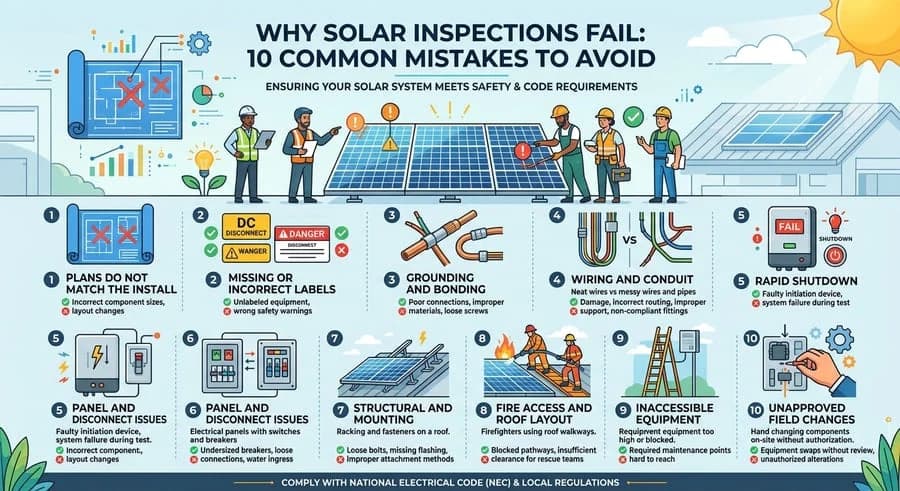
Why Solar Inspections Fail: 10 Common Mistakes to Avoid
Discover the 9 critical reasons solar inspections fail and how to avoid costly m...

Solar Grounding And Bonding: How To Pass Inspection Every Time
Learn how to pass solar grounding and bonding inspections every time. Avoid comm...
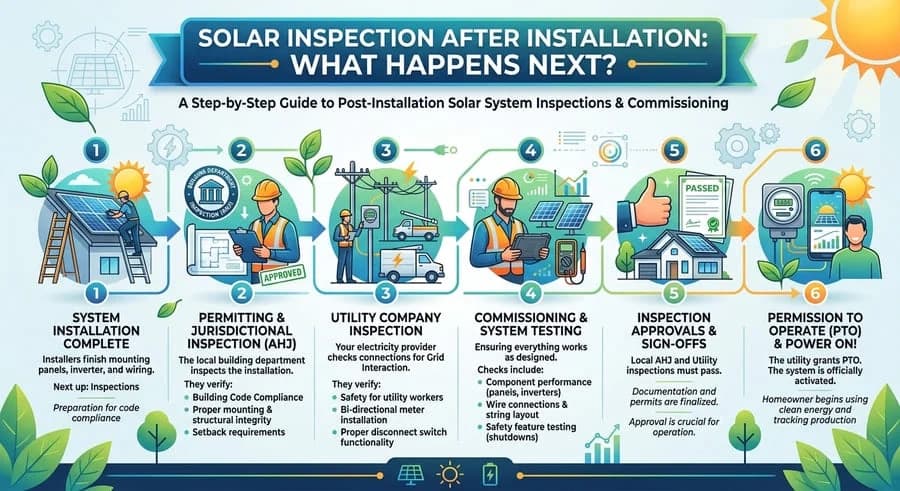
Solar Inspection After Installation: What Happens Next?
Learn how to pass your solar inspection by following essential tips for obtainin...