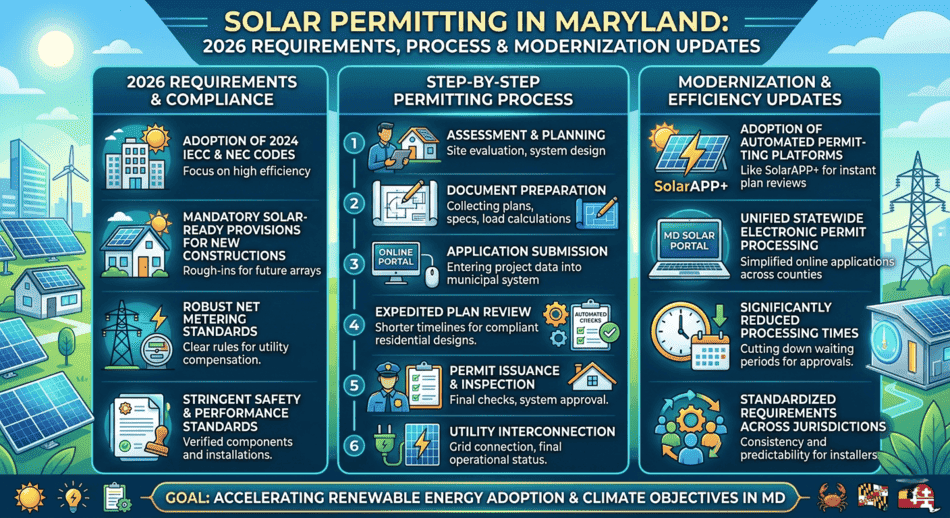
A solar permit in Maryland is a mandatory local government approval required before installing any rooftop or ground-mounted photovoltaic (PV) system. Most jurisdictions require two permits, a building permit and an electrical permit, with plan sets stamped by a Maryland-licensed professional engineer for systems with structural or service upgrades. Following the 2024 Brighter Tomorrow Act and the 2026 Utility RELIEF Act (HB1532), Maryland is rapidly transitioning to automated, same-day permitting through SolarAPP+ software, with statewide adoption now mandated and permitting fees capped at $500 for residential systems.
This guide breaks down the solar permit in Maryland requirements county by county, what the modernization rules mean for installers and homeowners in 2026, and how to navigate the differences between jurisdictions like Montgomery County, Baltimore County, and Prince George’s County.
Do I Need a Permit to Install Solar Panels in Maryland?
Yes. You must obtain a permit to install solar panels in Maryland. Every county and incorporated municipality in the state requires at least a building permit and a separate electrical permit before any PV installation begins. This applies to grid-tied residential rooftop systems, ground-mounted arrays, and any installation paired with battery energy storage.
The legal basis sits in Maryland’s adoption of the International Residential Code (IRC), the International Building Code (IBC), and the National Electrical Code (NEC), enforced locally by each jurisdiction’s department of permitting services. Installing solar without a valid permit can result in stop-work orders, fines, denied interconnection, voided manufacturer warranties, and disqualification from net metering and the SREC program. It also blocks participation in the Maryland Solar Access Program, which requires that systems be installed by MEA-approved contractors and properly permitted to qualify for grant funding.
For installers researching plan set requirements across multiple states, our solar permit design guide walks through the full documentation standards.
Solar Permit in Maryland Requirements: What You Need to Submit
Solar permit in Maryland requirements vary by jurisdiction, but the core documentation is consistent across counties. Every standard residential rooftop application needs the following.
1. Site Plan
A scaled site plan showing property lines, structures, setbacks, and the proposed array location. Ground-mounted systems typically require setback compliance and may trigger zoning review.
2. Roof Plan and Array Layout
Module layout, attachment points, fire setbacks per IRC R324.6, and dimensions. Most Maryland jurisdictions require a minimum 3-foot setback from ridge lines and a 36-inch clear pathway, with exceptions available on hip roofs.
3. Structural Letter or Calculations
A signed and sealed letter from a Maryland-licensed professional engineer verifying that the existing roof structure can support the added dead load (typically 3 to 4 psf for standard PV) and uplift forces from wind. Baltimore County, Howard County, and Anne Arundel County all enforce this requirement strictly.
4. Single-Line Electrical Diagram
A complete single-line diagram showing modules, string configuration, inverter(s), rapid shutdown devices, AC and DC disconnects, overcurrent protection, grounding, and the point of utility interconnection. The diagram must comply with the most recent NEC cycle adopted by the jurisdiction (most Maryland counties are currently on NEC 2020, with some moving to NEC 2023). See our single-line diagram requirements article for formatting standards.
5. Equipment Specifications and Listings
UL 1703 (or UL 61730) listings for modules, UL 1741-SA or UL 1741-SB for inverters, and manufacturer datasheets for racking, rapid shutdown initiators, and any battery storage equipment. Battery systems must additionally show UL 9540 and UL 9540A test compliance under IRC Section R328 for residential installations.
6. Load Calculations
NEC 705.12 service load calculations demonstrating that the existing service panel and busbar can accommodate the new PV backfeed under the 120 percent rule or showing the supply-side connection method, if applicable. For more on this, see our main panel upgrade guide.
7. Contractor License Information
Maryland requires installers to hold a valid Maryland Home Improvement Commission (MHIC) license. Electrical work must be performed under a master electrician licensed in the specific county. Each jurisdiction maintains its own electrical license registry.
The Two-Permit System: Building Plus Electrical
One unique feature of solar permits in Maryland workflows is that nearly every jurisdiction requires two separate permits for the same project.
- Building permit: Covers the structural attachment of the PV array, roof penetrations, racking, and any battery enclosure modifications. Reviewed by the structural and code plan reviewers.
- Electrical permit: Covers the DC and AC wiring, inverter installation, disconnects, grounding, and connection to the home’s electrical service. Reviewed by the electrical inspector and must be filed by a licensed master electrician.
In most counties the building permit must be issued first, after which the electrical permit can be filed referencing the building permit number. Baltimore County, Howard County, and Carroll County all follow this sequence. If a battery storage system is added, an additional residential alteration permit may be required if the battery is installed inside the dwelling.
Solar Permit Solutions
Skip the Permit Headaches
We design plan sets that pass inspection the first time. Code-compliant, PE-stamped, accepted by AHJs nationwide.
County-by-County Snapshot
Because requirements in areas like Montgomery County or Baltimore County may vary, installers should confirm the specific process with the local Authority Having Jurisdiction (AHJ) before submitting. Below are the highest-volume Maryland solar markets and how they handle permitting in 2026.
Montgomery County
Montgomery County’s Department of Permitting Services (DPS) operates the eSolar program, which integrates with SolarAPP+ for instant residential permit issuance. Eligible projects are residential dwellings only, must use a contractor with a valid MHIC license, and cannot exceed a 400A main service, 225A service disconnect switches, or 225A busbars. Ballasted roof systems, commercial properties, and townhouses four stories or more above grade are not eligible and must use the standard application process. Montgomery County was one of the first jurisdictions in the nation to pilot SolarAPP+, and the county committed to completing standard solar permit reviews in five business days, with e-solar permits issued within minutes of payment.
Baltimore County
Baltimore County’s Department of Permits, Approvals, and Inspections handles solar applications through its online portal. Construction plans must demonstrate compliance with the 2021 International Residential Code (IRC), the 2020 National Electrical Code, and the 2015 NFPA 1. A signed certification of solar photovoltaic system installation is required from a licensed master electrician at final inspection. Residential energy storage systems installed inside the dwelling trigger a separate residential alteration building permit on top of the electrical permit. Properties within 3.3 miles of Martin State Airport (MTN) require an additional airport zoning permit.
Baltimore City
Baltimore City zoning code Section 15-517 governs solar alternative energy systems, allowing ground-mounted systems in all yards at least 3 feet from any lot line, with height limits varying by zone. Permits are handled by the Department of Housing and Community Development through the city’s ePermits portal.
Anne Arundel County
Anne Arundel County requires building and electrical permits through its Department of Inspections and Permits. The county also offers a one-time property tax credit of up to $5,000 for qualifying residential solar installations, stackable with the statewide property tax exemption under Maryland Tax-Property Article Section 7-242.
Prince George’s County
Prince George’s County was among the first jurisdictions awarded a state SolarAPP+ implementation grant in 2025, and the county is now phasing in automated instant permitting. The Department of Permitting, Inspections, and Enforcement (DPIE) handles standard applications through its ePermits system.
Howard County
Howard County’s Department of Inspections, Licenses, and Permits requires PE-stamped structural letters for all rooftop installations and enforces strict turn-around times. The county participates in the SolSmart designation program and has been working toward SolarAPP+ adoption under HB1532 compliance timelines.
Carroll County
Carroll County requires building and electrical permits filed in sequence (electrical filed using the building permit number), with an additional plumbing permit triggered if the solar system powers a hot water heater. Installers must submit a Residential Certification of Solar Panel Installation signed by a licensed master electrician, and the county now requires acknowledgment forms for critter guards and flashing methods.
Worcester County
Worcester County was the other 2025 SolarAPP+ implementation grant awardee and is on track for instant permitting rollout in 2026.
Modernization & Speed (2026 Updates)
Maryland has moved aggressively to modernize Maryland solar permitting over the past two years, and 2026 brought the most significant changes to date.
The Brighter Tomorrow Act of 2024
Signed into law as Chapter 595 of the 2024 Acts of Maryland, the Brighter Tomorrow Act established the Maryland Solar Access Program and mandated that local jurisdictions adopt automated solar permitting software. The act set an initial compliance target of August 1, 2025, for jurisdictions to implement instant permitting for residential rooftop solar and home energy storage systems. The Maryland Energy Administration (MEA) created a $3.9 million SolarAPP+ Implementation Grant program to help counties and municipalities cover software integration, staff training, and contractual support costs.
HB1532: The Utility RELIEF Act (2026)
On April 13, 2026, the Maryland General Assembly passed House Bill 1532, the Utility RELIEF (Reducing Energy Load Inflation for Everyday Families) Act, which Governor Wes Moore signed into law before the 2026 general session closed. For solar permitting, HB 1532 is the most consequential change in Maryland’s recent history.
Key provisions affecting solar permits in Maryland workflows:
- Mandatory automated permitting: All counties and municipalities are required to adopt SolarAPP+ or equivalent automated solar permitting software, eliminating the patchwork of multi-week manual review timelines that previously ran double the national average.
- $500 fee cap: The maximum permitting fee that any Maryland jurisdiction may charge for a residential solar energy system is capped at $500, ending the wide variability in fees that previously raised consumer costs and created business uncertainty for installers operating across jurisdictions.
- Streamlined inspections: The bill improves the inspection process to reduce bottlenecks, with the Public Service Commission empowered to establish standardized inspection procedures.
- Plug-in solar authorization: Maryland became one of a small group of states (alongside Utah, Maine, Virginia, and Colorado) to legalize UL-listed plug-in solar systems up to 1,200 watts, opening a new low-friction pathway for entry-level residential solar.
- Enforcement mechanism: The law includes penalties for counties or municipalities that fail to comply with the automated permitting requirement.
SolarAPP+ Adoption Status
SolarAPP+ was developed by the U.S. Department of Energy’s National Renewable Energy Laboratory (NREL) and is in use by over 240 communities nationwide. In Maryland, Montgomery County, Prince George’s County, and Worcester County are early adopters, with remaining jurisdictions phasing in adoption through 2026 and 2027 under HB 1532 compliance timelines. For installers, this means a project that previously took two to six weeks for plan review can now be approved in minutes if it meets the SolarAPP+ eligibility checklist.
How Long Does It Take to Get a Solar Permit in Maryland?
Permit turnaround times depend heavily on jurisdiction and whether the project qualifies for automated review.
- SolarAPP+ instant permitting: Permits are issued in minutes once the application passes the automated eligibility check and fees are paid.
- Standard review (Montgomery County): 5 business days for residential plan review under the county’s current service commitment.
- Standard review (Baltimore County, Howard County, Anne Arundel County): Typically 10 to 20 business days for first review, plus revision cycles if corrections are needed.
- Rural jurisdictions: Can extend to 4 to 6 weeks pre-HB 1532, with significant reductions expected as automated permitting rolls out.
Solar Permit Costs in Maryland
Under HB1532, residential solar permitting fees are now capped at $500 statewide. Before the cap, fees varied widely:
- Montgomery County eSolar combined building and electrical fees typically ran $200 to $400
- Baltimore County permit fees were calculated by system valuation and frequently exceeded $500
- Some smaller jurisdictions charged flat fees as low as $75
The new statutory cap creates predictable cost modeling for installers operating across multiple Maryland counties.

The Maryland Solar Access Program
The Maryland Solar Access Program (MSAP) is a state grant program administered by the MEA that provides up to $7,500 ($750 per kilowatt installed) to income-eligible Maryland residents to offset the cost of residential solar. To qualify:
- Household income must be at or below 150 percent of the statewide median income
- The home must be owner-occupied and serve as the primary residence
- The system must be installed by an MEA-approved contractor on the Participating Contractor List
- The system must be a brand-new installation and must be properly permitted and interconnected
The FY26 program offered $12 million in funding through the Strategic Energy Investment Fund and is currently closed to new applications after exhausting the budget. The MEA expects renewed funding cycles in future fiscal years. Contractors interested in joining the MSAP Participating Contractor List must sign the updated Contractor Agreement issued March 2, 2026.
Interconnection and Net Metering After Permitting
Receiving a solar permit in Maryland is only the first step. After installation, the system must complete utility interconnection, final inspection, and Permission to Operate (PTO) before it can be energized.
- Interconnection application: Filed with the serving utility (BGE, Pepco, Delmarva Power, SMECO, or Potomac Edison), typically in parallel with the permit application.
- Final inspection: Conducted by the county after installation; certification of the solar PV system installation must be signed by the licensed master electrician of record.
- Interconnection Agreement Certificate of Completion (IACOC): Signed by both the customer and the utility.
- PSC certification: Filed with the Maryland Public Service Commission to register the system for SREC generation and net metering.
Maryland’s net metering law under Public Utilities Article Section 7-306 credits customers at full retail electricity rates for excess power exported to the grid. Net metering is available across all investor-owned utilities. For installers managing the full post-install workflow, our PTO process article covers each utility’s procedures.
Common Reasons Maryland Solar Permits Are Rejected
The most frequent rejection reasons across Maryland counties include:
- Missing PE stamp on structural letters or single-line diagrams
- Incorrect NEC code cycle referenced in the electrical drawings
- 120 percent busbar rule violations without supply-side tap documentation
- Insufficient fire setback dimensions on the roof plan
- Missing rapid shutdown labeling per NEC 690.12
- Outdated equipment datasheets that do not match installed models
- Failure to identify properties in historic preservation districts or airport zoning overlays
Each of these can add days or weeks to a project timeline. Working with a permitting service that maintains current AHJ checklists for every Maryland jurisdiction is the most reliable way to keep projects moving.
Getting Your Solar Permit in Maryland: Next Steps
Whether you are a contractor scaling installations across the Baltimore-Washington corridor or a homeowner working with a local installer, the path to a successful solar permit in Maryland follows the same pattern: confirm the AHJ, prepare a complete plan set that matches the jurisdiction’s checklist, submit through the correct online portal (SolarAPP+ for eligible projects), and coordinate the building and electrical permits in the right sequence.
At Solar Permit Solutions, we produce PE-stamped solar permit plan sets for every Maryland jurisdiction, with current AHJ requirements maintained in our internal review database. Our team handles SolarAPP+ submissions, standard plan reviews, structural letters, and revision cycles across Montgomery County, Baltimore County, Prince George’s County, Anne Arundel County, Howard County, Carroll County, Frederick County, and every other Maryland AHJ.
Frequently Asked Questions
Do I need a permit to install solar panels in Maryland?
Yes. Every Maryland county and incorporated municipality requires both a building permit and an electrical permit before installing solar panels. Installing without a permit blocks utility interconnection, net metering, and SREC eligibility and may result in stop-work orders and fines.
What are the solar permit requirements in Maryland?
Standard requirements include a site plan; a roof plan with array layout; a PE-stamped structural letter; a single-line electrical diagram, equipment datasheets, and UL listings; NEC load calculations; and proof of a valid Maryland Home Improvement Commission (MHIC) license. Battery storage systems trigger additional residential alteration permit requirements.
How long does it take to get a solar permit in Maryland?
SolarAPP+ instantly permits issuing approved permits in minutes. Standard manual review takes 5 business days in Montgomery County and 10 to 20 business days in most other counties. HB 1532 (2026) is rapidly compressing these timelines through mandatory automated permitting.
How much does a solar permit cost in Maryland?
Under HB 1532 (2026), residential solar permitting fees are capped at $500 statewide. Most jurisdictions charge between $200 and $500 for combined building and electrical permits.
What is the Maryland Solar Access Program?
The Maryland Solar Access Program is a Maryland Energy Administration grant program that provides up to $7,500 ($750 per kilowatt installed) to income-eligible Maryland homeowners to offset residential solar costs. Applicants must earn at or below 150 percent of statewide median income and use an MEA-approved installer.
Does Maryland use SolarAPP+ for permitting?
Yes. Maryland mandated automated solar permitting software under the Brighter Tomorrow Act of 2024 and HB 1532 (2026). SolarAPP+ is the most widely adopted platform, with Montgomery County, Prince George’s County, and Worcester County leading early adoption.
Do solar permit requirements vary by Maryland county?
Yes. Requirements in areas like Montgomery County or Baltimore County may vary in fee schedules, submission portals, code cycle adoption, and specific documentation. Always confirm with the specific Authority Having Jurisdiction before submitting.
Can I install solar in Maryland without a contractor?
DIY solar installation is technically allowed in some Maryland jurisdictions for homeowners on their primary residence, but the electrical work must still be performed by a master electrician licensed in the county where the work occurs. SolarAPP+ in Montgomery County requires a licensed MHIC contractor and is not available for DIY projects.
Skip the Permit Headaches
We design plan sets that pass inspection the first time. Code-compliant, PE-stamped, accepted by AHJs nationwide.

SPS Editorial Team
Solar Permit Solutions
Solar Permit Solutions provides professional solar permit design services for residential, commercial, and off-grid installations across all 50 states. Our team ensures permit-ready plan sets delivered fast.
Related Articles
Solar Grounding And Bonding: How To Pass Inspection Every Time
Learn how to pass solar grounding and bonding inspections every time. Avoid comm...
Solar Inspection After Installation: What Happens Next?
Learn how to pass your solar inspection by following essential tips for obtainin...
Solar Permit Services in Austin, TX
Solar permits in Austin center on an Auxiliary Power Electrical Permit for any s...