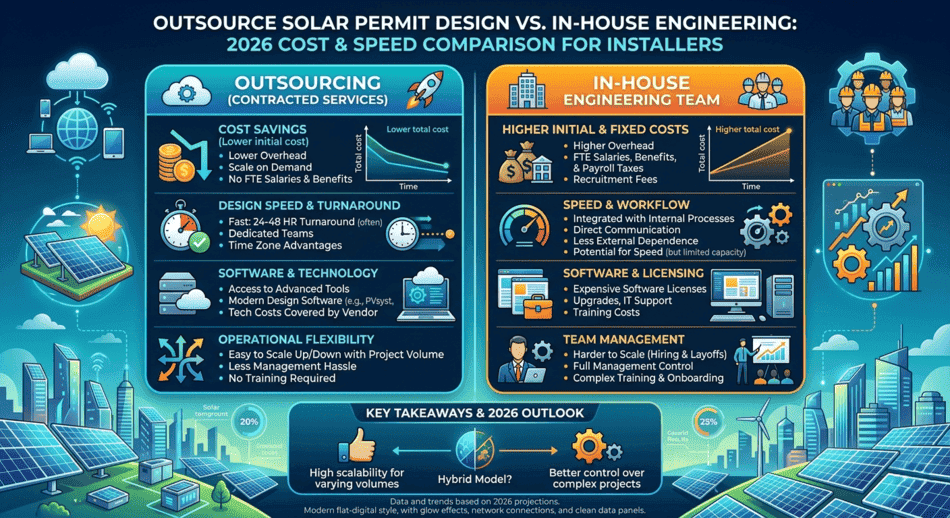
Outsourced solar permit design typically costs $1,200 to $2,000 per residential plan set, while in-house solar engineering costs solar installers $530 to $810+ per project once salaries, PE licensing fees, software, and idle-time overhead are included. For multi-state EPCs and growing residential installers, outsourcing eliminates the 50-state PE licensing problem, removes payroll risk during slow seasons, and delivers PE-stamped, AHJ-ready plan sets in 2 to 5 business days.
This guide compares the true cost, speed, scalability, and risk of in-house solar engineering against outsourced solar permit design services in 2026, so installers, EPCs, and roofing companies can make the right call for their pipeline.
Quick Comparison: In-House vs. Outsourced Solar Permit Design
Before getting into the details, here is the high-level comparison every installer should see first.
| Factor | In-House Engineering | Outsourced Permit Design |
|---|---|---|
| Cost per residential plan set | $530 to $810+ (loaded) | $1,200 flat (PE-stamped) |
| Turnaround time | Variable, depends on staff capacity | 2 to 5 business days |
| PE coverage | Limited to states your engineer holds | All 50 states |
| Slow-season cost | Salary continues regardless of volume | Pay-per-project, zero idle cost |
| Scalability | Capped by headcount and licensing | Scales with pipeline overnight |
| First-pass AHJ approval | Depends on engineer’s AHJ familiarity | 99% with specialists who track 20,000+ AHJs |
| Software / training overhead | $3K to $10K+ per year | Included in plan set price |
| Best fit | Single-state, very high-volume installers | Multi-state EPCs, growing installers |
The Real Cost of In-House Solar Engineering
On paper, an in-house solar engineer looks cheaper than outsourcing. The reality is different once you load every cost back onto each plan set. There are seven cost categories most installers underestimate when they build the in-house budget.
1. Engineer salary and benefits
A solar engineer in the United States earns an average of $102,954 per year according to ZipRecruiter, with the typical range running from $60,000 at the 25th percentile up to $141,500 at the 75th percentile. Salary.com puts the average even higher at $114,031. A solar electrical engineer with PE credentials runs higher still, averaging $111,091 nationally. Layer benefits, payroll taxes, and 401(k) contributions on top, and most installers are paying $130,000 to $170,000 fully loaded for a single PE-licensed engineer.
2. The 50-state PE licensing problem
Here is the trap that catches most growing installers. A professional engineer license is state-specific, not national, according to NCEES. There is no single nationwide PE license that lets an engineer stamp plans across U.S. state lines. A PE licensed in Texas cannot legally seal a plan set for a project in Florida or California.
Most states offer licensure by comity through NCEES Records, but that is not automatic reciprocity. As NJSPE explicitly states, professional engineering licenses are not automatically recognized across state lines. Each state requires its own application, fee, continuing education, and sometimes additional exams. California and Florida have particularly strict requirements, and the Texas Board of Professional Engineers does not allow true reciprocity at all.
The practical impact: every new state your installer expands into requires either a separate PE license for your in-house engineer (which takes months and costs hundreds in fees) or hiring a second engineer. For an EPC operating in five states, that can mean $500,000+ in annual engineering payroll before a single plan set is produced.
3. Software, training, and continuing education
Beyond salary, the real annual overhead per in-house engineer typically includes:
- AutoCAD or similar CAD licenses: $1,800 to $2,500 per seat
- Solar-specific design tools (Aurora, HelioScope, PVSyst): $1,200 to $4,800 per year
- Continuing education credits required for PE renewal: $500 to $1,500 per state
- NEC code update training (NEC 2023 and 2026 transitions): $500 to $1,000
- PE license renewal fees across multiple states: $200 to $600 per state, per cycle
Add it up and software plus training alone runs $4,000 to $10,000+ per engineer, per year.
4. Idle time during slow seasons
Solar is seasonal. Q1 in northern markets is slow. Hurricane season disrupts the Southeast. Tax credit deadline cycles create artificial peaks and valleys. With an in-house engineer on salary, you pay full payroll regardless of volume. If the pipeline drops 40% in a quiet month, your per-plan-set cost effectively doubles.
Outsourced providers absorb that volatility on their side. With flat-rate pricing from Solar Permit Solutions at $1,200 per residential plan set, your engineering cost scales linearly with revenue, not with payroll cycles.
5. AHJ-specific knowledge across 20,000+ jurisdictions
There are over 20,000 Authorities Having Jurisdiction (AHJs) in the United States. Each one has its own quirks: review timelines, required sheet formats, NEC adoption version, fire setback rules, electrical permit fees, and inspection protocols. EnergyScape Renewables breaks down state-by-state PE turnaround variation in detail, and the differences between AHJs even inside a single state are substantial.
A single in-house engineer cannot maintain working knowledge of more than a handful of AHJs at scale. Outsourced providers that process thousands of plan sets per month build that institutional knowledge across the country, which directly translates to higher first-pass approval rates.
6. Permit rejection cost
This is the hidden cost most installers never quantify. A single AHJ rejection adds 1 to 2 weeks to the project timeline. EnergyScape estimates the all-in cost of a permit rejection at $2,000 to $5,000 per job once you factor in crew rescheduling, customer communication, redesign labor, and resubmission fees. For an installer doing 200 projects per year with a 15% rejection rate, that is $60,000 to $150,000 in pure waste annually.
7. The fully loaded per-plan-set math
Take a mid-level in-house solar engineer producing 200 residential plan sets per year:
- Salary loaded: $140,000
- Software and training: $7,000
- Multi-state PE renewals (3 states): $1,500
- Total annual overhead: ~$148,500
- Cost per plan set: ~$742
That is the optimistic math, assuming the engineer is fully utilized year-round and never produces a rejected plan set. Drop utilization to 70% (slow seasons, sick days, training time), and real cost per plan set climbs to $1,060+, already higher than outsourced flat-rate pricing.
The Real Cost of Outsourced Solar Permit Design
Outsourced solar permit design is straightforward to budget because it is per-project. Solar Permit Solutions charges flat-rate pricing: $1,200 for residential plan setups up to 20 kW, $2,000 for large residential systems between 20 kW and 30 kW, and starting at $3,700 for commercial and ground-mount projects 30 kW and up. Optional add-ons include AHJ submission and utility interconnection at $1,000 each.
Every plan set includes:
- Detailed site plan with property line setbacks, conduit routes, and array placement
- Electrical single-line and three-line diagrams
- Structural attachment details (rafter spans, mounting hardware specifications)
- PE stamp and seal valid for the project state
- NEC and IBC code compliance review
- Unlimited revisions until building department approval
That last point matters more than the headline price. Unlimited revisions means a single rejection does not turn into a $2,000 to $5,000 redesign hit. The provider absorbs that cost as part of the flat fee.
Hidden value most installers miss
When comparing quotes, factor in three things outsourced providers bundle that in-house engineering does not:
- All-50-states PE coverage with no licensing delays when you expand into a new market
- Continuous NEC code updates handled by the provider (NEC 2023 and NEC 2026 transitions are non-trivial)
- AHJ-specific submittal formats already built into the templates
Solar Permit Solutions
Solar Contractor? We Design Your Plans.
Outsource your permit plan sets to our team. PE-stamped, code-compliant, fast turnaround so you can focus on installation.
When In-House Engineering Still Wins
Outsourcing is not always the right answer. There are three scenarios where in-house engineering beats outsourcing:
Single-state, very high-volume installers
If you do 500+ residential plan sets per year inside a single state where your engineer holds a PE, the math can favor in-house. At that volume, the fully loaded cost per plan set drops below $400, clearly cheaper than outsourcing.
Highly specialized or recurring designs
If you specialize in a narrow product (e.g., one specific commercial racking system or one inverter platform) and run effectively the same design template repeatedly, an in-house engineer who knows that template inside-out can move faster than an external provider. This is rare for most commercial solar design firms since commercial projects vary significantly.
Tight integration with field operations
A few large EPCs benefit from having engineering, sales, and operations on the same team for fast iteration during design changes. If your team makes 10+ design revisions per project mid-build, in-house can be worth the overhead. For most installers, this is over-engineered. A good outsourced partner that handles residential solar design, off-grid solar system design, and commercial work in one place gives you one consistent point of contact across all project types.
When Outsourcing Wins (Most Installers)
For 80% of solar installers, EPCs, and roofing companies expanding into solar, outsourcing wins. Here is when the math is unambiguous:
Multi-state operations
If you operate in more than two states, the PE licensing problem alone makes outsourcing the only practical path. Florida is a particularly hard state. Florida requires PE stamps on virtually all installs due to its wind zone requirements. California requires structural stamps above 10 kW and electrical stamps above 50 kW. New York, New Jersey, and Massachusetts each have their own rules for residential and commercial systems. An outsourced provider with PE coverage across all 50 states removes that compliance risk overnight.
Growing installers (50 to 300 projects per year)
This is the sweet spot for outsourcing. You are too big to wing it without dedicated engineering but too small to keep an in-house PE fully utilized. Outsourcing scales linearly with your pipeline.
Roofing companies adding solar
If you are a roofing contractor adding solar as a service line, outsourcing your solar permit design eliminates the need to hire engineering staff while you validate the new revenue stream. You keep your overhead lean, learn what works, and decide later whether to build internal capacity.
Seasonal markets
Northern installers with heavy Q2-Q3 volume and quiet Q1 cannot afford in-house payroll during slow months. Pay-per-project pricing matches your revenue cycle.
How to Vet a Solar Permit Design Partner
Not all outsourced providers deliver equally. Before signing a recurring contract, ask the following questions:
1. PE coverage and state licensing
Ask for the specific list of states where the provider holds PE licenses. “All 50 states” should mean exactly that, verifiable on each state’s engineering board lookup site if you want to spot-check.
2. First-pass AHJ approval rate
This is the most important quality metric. Top providers run 95%+ first-submission approval. Anything below 90% means the provider is shipping plans that get redlined, and your operational cost is hiding in revision delays.
3. Turnaround SLA
Standard residential turnaround in 2026 is 2 to 5 business days. Anything longer than 7 business days kills your install schedule. Solar Permit Solutions delivers in 2 to 5 business days with priority routing for urgent projects.
4. Revision policy
Unlimited revisions until AHJ approval should be the standard. Watch out for providers who charge per revision, that quickly turns a $1,200 plan set into a $1,800 plan set.
5. NEC code currency
Confirm the provider designs to the NEC version your AHJ enforces. NEC 2023 is the current standard in most states, with NEC 2026 rolling out in early-adopter jurisdictions.
6. Stamp authenticity
This sounds obvious, but it is not. There are documented cases of installers receiving plans with forged or fraudulent PE stamps from low-cost overseas providers. Always cross-check the stamping engineer’s name against the state board lookup. As reported on Solar Panel Talk forums, this risk is real with budget Fiverr-tier providers.
7. Scope of services
Strong providers offer the full spectrum: residential, commercial, ground-mount and off-grid systems, battery backup, and EV charging integrations. One vendor across all your project types means consistent quality, consistent pricing, and one point of contact.
Decision Framework: Which Path Fits Your Business?
Here is a practical decision tree:
- Are you operating in more than one state? → Outsource
- Do you do fewer than 300 plan sets per year? → Outsource
- Is your pipeline seasonal or volatile? → Outsource
- Are you adding solar to an existing trades business? → Outsource
- Do you operate exclusively in a single state with 500+ projects/year? → Consider in-house
- Do you specialize in one repetitive project type at high volume? → Consider in-house
For everyone else, which is most installers, outsourcing is the disciplined business choice.
State-by-State Examples Where Outsourcing Pays Off
If you are expanding into a new state, the cost difference between learning the AHJ landscape yourself and using a provider that already has it mapped is substantial. Here are a few examples we have written about in detail:
- New York solar permits: two distinct permitting tracks (NYC Department of Buildings vs. unified permit for the rest of the state) plus utility interconnection through Con Edison or NYSEG.
- New Jersey’s 564-municipality permit process: every municipality has its own building department, which makes consistent in-house knowledge nearly impossible.
- Pennsylvania solar permits across PECO, PPL, and FirstEnergy territories, three major utilities, each with its own interconnection package.
- Ohio solar permits, adopted NEC 2023 effective March 1, 2024, with city-by-city variation.
- Georgia solar permits, required for every residential and commercial install statewide.
- Indiana solar permits across Duke, AES, and NIPSCO territories: fees range from $150 to $400 with utility-specific timelines.
- Nevada solar permit guide, required for all grid-connected residential systems with an 8-step approval process.
A provider that processes plan sets across all of these jurisdictions every week carries that institutional knowledge into your projects automatically.
Conclusion
For most solar installers, EPCs, and roofing companies in 2026, outsourcing solar permit design is the disciplined choice. It eliminates the 50-state PE licensing problem, removes payroll risk during slow seasons, and delivers PE-stamped plans in 2 to 5 business days, all for less than the fully loaded cost of an in-house engineer.
If you are evaluating outsourced providers, submit a project to Solar Permit Solutions or contact our team for a custom quote. PE-stamped, NEC-compliant, all 50 states, 2 to 5 day turnaround, unlimited revisions until your AHJ approves. Flat-rate pricing starting at $1,200 per plan set.
Frequently Asked Questions
Solar Contractor? We Design Your Plans.
Outsource your permit plan sets to our team. PE-stamped, code-compliant, fast turnaround so you can focus on installation.
Frequently Asked Questions
Outsourced residential solar permit design typically costs $1,200 per PE-stamped plan set for systems up to 20 kW. Larger residential systems (20 to 30 kW) run around $2,000, and commercial or ground-mount projects start at $3,700. Add-ons like utility interconnection submission and AHJ filing typically run $1,000 each. See Solar Permit Solutions' full pricing for current rates.
Standard turnaround is 2 to 5 business days for residential and 5 to 10 business days for commercial projects. Rush options are typically available. In-house turnaround is faster in theory but slower in practice once your engineer is juggling multiple projects.
No. PE licenses are state-specific, and California does not offer reciprocity. The engineer would need to apply for a separate California license through comity, which takes months. Outsourced providers solve this by holding PE coverage across all 50 states.
It depends on the state and AHJ. Florida requires PE stamps on nearly every install. California requires them above 10 kW for structural and 50 kW for electrical. Many Southeast and Midwest AHJs require structural letters or full PE stamps regardless of system size. When in doubt, stamp it. The rejection cost dwarfs the stamp fee.
Roughly 350 to 400 single-state plan sets per year is the breakeven point. Below that, outsourcing wins on cost alone. Above that, in-house may win, but only if you are operating in a single PE-licensed state with predictable volume.
Some larger installers run a hybrid: in-house engineering for their primary state and outsourced for everything else. This works when you have one dominant market that justifies the in-house capacity but want clean expansion economics for new geographies.

SPS Editorial Team
Solar Permit Solutions
Solar Permit Solutions provides professional solar permit design services for residential, commercial, and off-grid installations across all 50 states. Our team ensures permit-ready plan sets delivered fast.
Related Articles
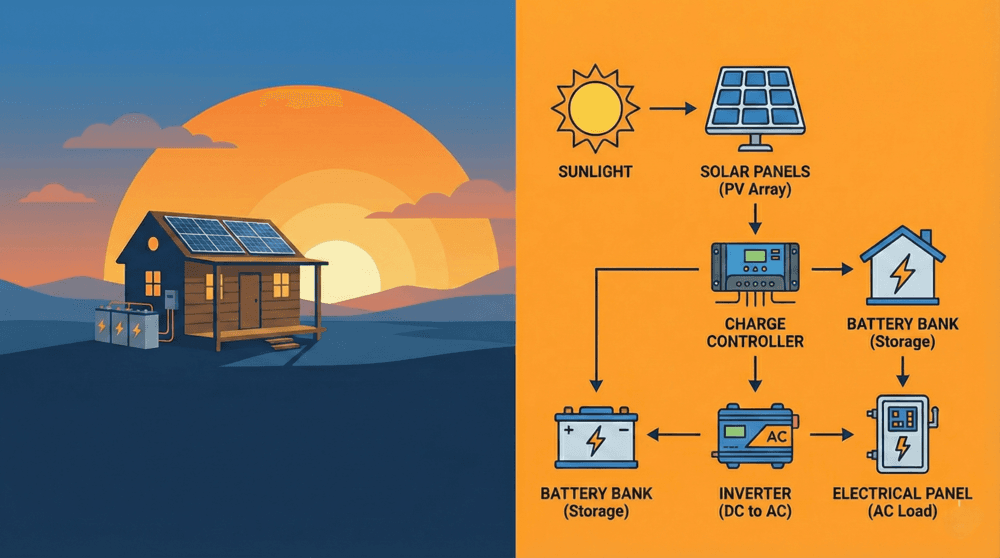
Off-Grid Solar System Requirements: Sizing, Permits & NEC Code Guide
Off-grid solar permit requirements by state: building codes, NEC compliance, bat...
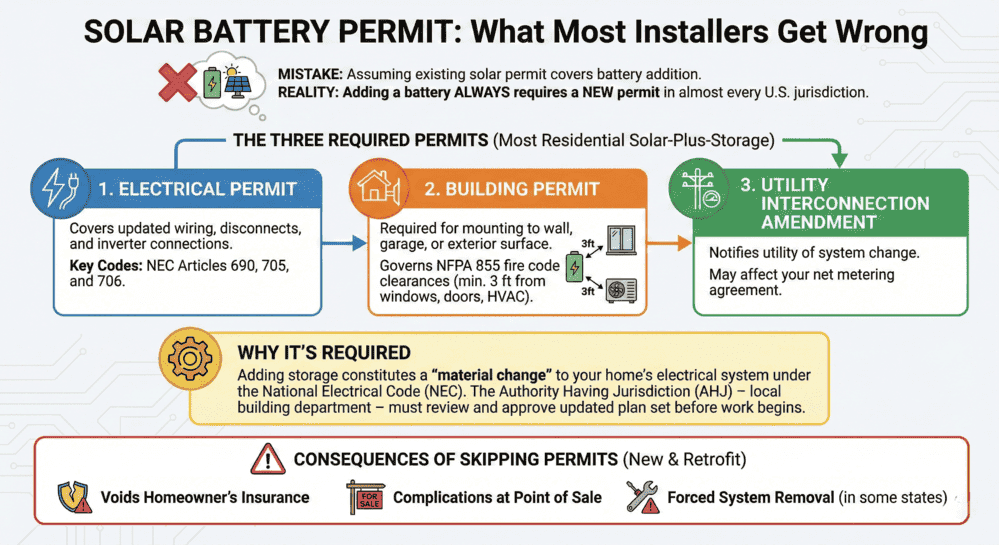
Solar Battery Permit: What Most Installers Get Wrong
Quick Answer: Adding battery storage to a solar system almost always requires ne...
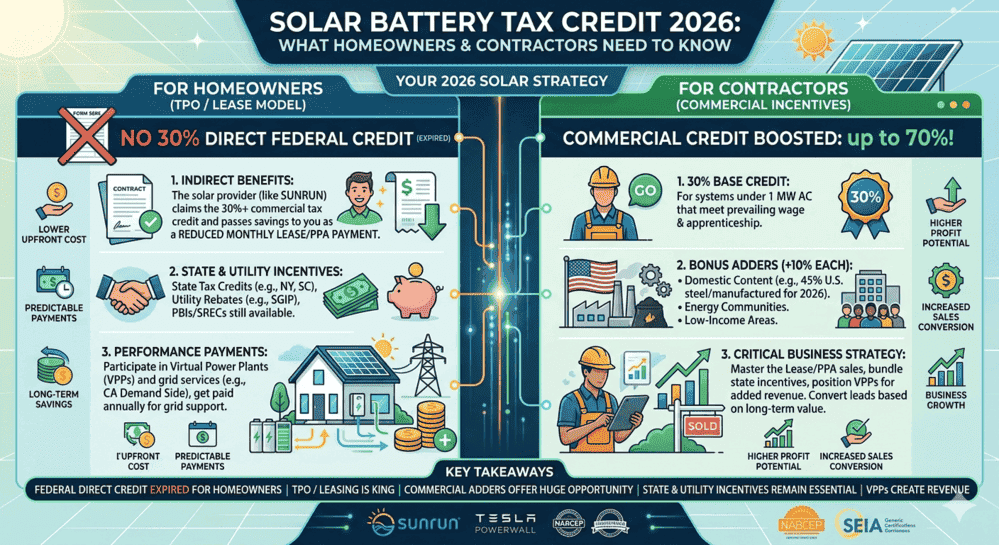
Solar Battery Tax Credit 2026: What Homeowners and Contractors Need to Know
There is no federal solar battery tax credit available to homeowners in 2026. Th...