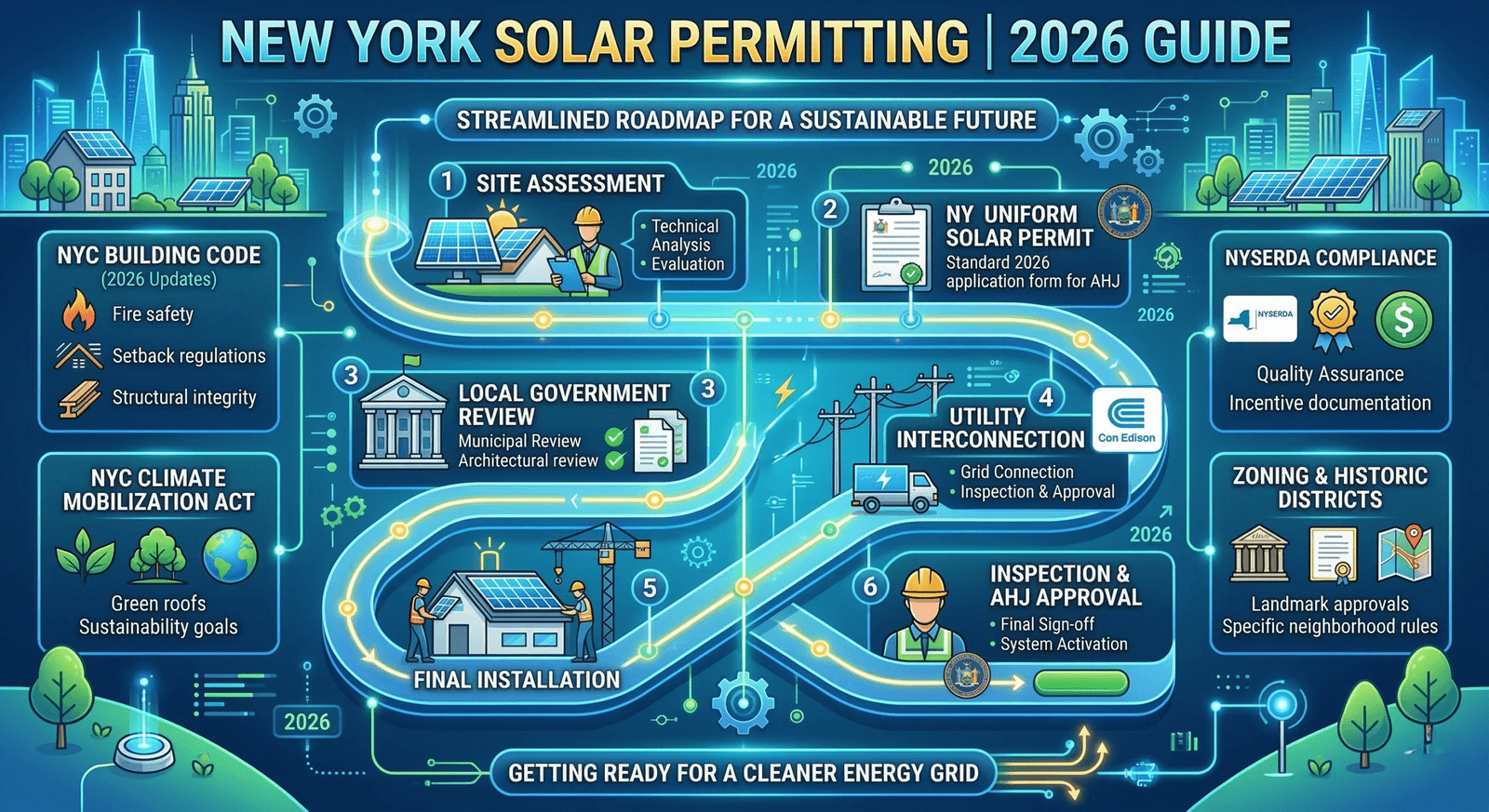
New York solar permits are required for all building-connected photovoltaic installations and are issued through two distinct systems. Outside New York City, over 300 municipalities have adopted the NYS Unified Solar Permit, which covers residential systems up to 25 kW DC and delivers permit determinations within 14 calendar days. Inside the five boroughs, the NYC Department of Buildings manages solar permits through its DOB NOW platform, requiring both an electrical permit and a construction work permit, with typical review times of five to ten business days. Permit fees range from $0 to $500 or more depending on the municipality, and most residential homeowners can expect to move from application to approval in two to three weeks when submitting a complete package. As with solar permits across the US, the requirements vary by jurisdiction, so understanding the local rules is essential.
New York is one of the strongest solar markets in the country thanks to high electricity rates, robust state incentives, and renewable energy targets under the Climate Leadership and Community Protection Act. However, according to NYSERDA’s guide to doing solar business in New York, the state’s 1,607 municipalities each maintain their own permitting rules, and New York City operates under a separate regulatory framework. This guide covers both systems so you know exactly what to expect.
Do You Need a Permit to Install Solar Panels in New York?
What Work Requires a Permit
Yes. Every solar photovoltaic system that connects to a building’s electrical or structural systems requires a work permit in New York. This applies to roof-mounted panels, ground-mounted arrays, carport structures, and building-integrated PV systems. As the NYC DOB solar project categories page confirms, the only exception is solar equipment that does not connect to the building at all. Portable battery chargers and solar landscape lights are not regulated by building, plumbing, or electrical codes and do not require permits. Emergency repairs to existing solar systems can be performed by a licensed electrical contractor prior to obtaining a permit, as long as the permit application is submitted within two business days.
Residential vs. Commercial Permit Differences
Residential solar installations under 25 kW DC follow a streamlined process in most of New York State, especially in municipalities that have adopted the Unified Solar Permit. The application is standardized, a single inspection is typically sufficient, and review timelines are short. Commercial solar projects face additional layers. Systems exceeding 25 kW generally require standard municipal permitting. Large-scale ground-mounted projects may trigger a State Environmental Quality Review (SEQR), require a special use permit, and involve agricultural land review if sited within a state agricultural district.
New York’s Two Solar Permitting Systems Explained
The NYS Unified Solar Permit (Outside NYC)
NYSERDA and the New York State Department of State developed the NYS Unified Solar Permit to reduce costs and delays for residential solar projects. Over 300 authorities having jurisdiction (AHJs) across the state have formally adopted this permit, as documented in the NYSERDA Solar Guidebook. The current version of the NYS Unified Solar Permit form covers roof-mounted and ground-mounted systems up to 25 kW DC on the property owner’s land. Some municipalities still use an older version of the form that caps eligibility at 12 kW, so installers should verify which version the local AHJ uses before submitting.
The unified permit combines building and electrical permits into a single application. To qualify for the expedited process, the installation must meet 13 eligibility criteria covering system size, code compliance, fire safety, structural load, and contractor licensing. If all criteria are met, the municipality must issue a permit determination within 14 calendar days of receiving a complete application. If the application is incomplete or inaccurate, the municipality provides feedback within seven calendar days. After installation, a single inspection is typically sufficient for final approval.
Nassau and Suffolk Counties are excluded from the statewide unified permit. These counties use the separate Long Island Unified Solar Permit, which has its own form and criteria. For more details, visit the NY Solar Map permit resources page.
NYC Department of Buildings Permitting (Five Boroughs)
New York City operates its own permitting system through the Department of Buildings (DOB). As described on the NYC DOB solar panels page, solar PV installations in NYC require two separate permits: an electrical permit issued to a NYC-Licensed Master Electrician (LME) and a construction work permit issued to a NYC-licensed General Contractor. Only these licensees, or employees they directly supervise, may perform solar installation work in the five boroughs.
All applications are filed online through the DOB NOW platform. Before filing, contractors must register with the Department’s ePermit system and have active, current licenses and insurance. The DOB offers several plan review pathways: Full Plan Review through a borough office, Professional Certification (where a Registered Design Professional certifies code compliance, subject to DOB audit), and Same Day Review under Directive 14 for qualifying projects. Complete applications are typically reviewed within five to ten business days, though complex projects may require additional time.
NYC also imposes solar-specific fire code requirements. Under NYC Fire Code Section 512, rooftop PV arrays on buildings 100 feet or less in height must comply with different standards depending on roof slope. For pitched roofs exceeding 20 degrees (FC 512.3), solar panels must not be installed closer than three feet to the ridge line, and a three-foot-wide clear access area must be provided along the ridge on each slope with panels. For flat roofs and roofs with slopes of 20 degrees or less (FC 512.2 / FC 504.4), the more restrictive general rooftop access rules apply, including six-foot-wide by six-foot-deep access clearances at the building perimeter and a six-foot-wide horizontal clear path across the roof. Understanding solar safety code requirements is essential for passing plan review.
NYC vs. Rest of State: Key Differences
| Category | NYS Unified Permit | NYC DOB Permit |
| Permit Type | Combined building + electrical | Separate electrical + construction |
| Filing Method | Paper or electronic to local code office | Online via DOB NOW |
| Review Timeline | 14 calendar days (complete apps) | 5-10 business days (complete apps) |
| Required Professionals | NYS PE or RA for plans | NYC LME + NYC GC + PE or RA |
| System Size Cap | Up to 25 kW DC (current version) | No cap (complexity-based review) |
| Fire Code | NYS Fire Code (2020 Uniform Code) | NYC Fire Code Ch. 5 (FDNY clearances) |
| Inspection | Single inspection typically sufficient | DOB + possible special/progress inspections |
Step-by-Step Solar Permit Process in New York
- Hire a licensed installer and design professional. New York State requires that all solar permit drawings be prepared and stamped by a New York State Professional Engineer (PE) or Registered Architect (RA). In NYC, you also need a Licensed Master Electrician for the electrical permit and a licensed General Contractor for the construction permit. If you are pursuing NYSERDA’s NY-Sun incentives, the installer must be a NYSERDA-qualified contractor. Plans must comply with current NEC 2023 Article 690 requirements.
- Prepare your permit application package. A complete application includes a site plan showing the array location, existing electrical service, utility meter, inverter placement, and system orientation. You also need a single-line or three-line electrical diagram, manufacturer specification sheets for all panels and inverters, and the completed permit application form. If the system exceeds structural thresholds (more than 5 lbs/sq ft distributed weight, more than 45 lbs per attachment point, or multiple roof layers), a structural certification letter from a PE or RA is required. A professional solar permit service can prepare this entire package.
- Submit and track your application. For the unified permit, submit the completed package to your local code enforcement office, either in person or electronically, depending on the municipality. In NYC, file through DOB NOW. Confirm that all required documents are uploaded and fees are paid before submission to avoid delays.
- Permit review and approval. Under the unified permit, expect a determination within 14 calendar days for complete applications. NYC DOB reviews typically take five to ten business days. If the reviewer identifies issues, you will receive feedback within seven calendar days (unified permit) or objections through DOB NOW (NYC). Common reasons for objections include missing fire code clearance dimensions, incorrect NEC references, and incomplete structural documentation.
- Installation and inspection. Once the permit is issued, installation can proceed. After the system is installed, request an inspection. Unified permit jurisdictions typically require a single inspection to verify that field conditions match the approved plans. In NYC, DOB inspections are required and may include a structural stability inspection for existing buildings and a final construction sign-off.
- Utility interconnection. After the installation passes inspection, your installer files a solar interconnection agreement with the local utility (Con Edison, National Grid, PSEG Long Island, NYSEG, RG&E, or others). The utility installs a bidirectional meter for net metering. This process typically takes two to four weeks after permit approval.
Solar Permit Solutions
Skip the Permit Headaches
We design plan sets that pass inspection the first time. Code-compliant, PE-stamped, accepted by AHJs nationwide.
Solar Permit Costs in New York
Permit fees in New York vary widely by municipality. Some towns have eliminated fees for residential solar to encourage adoption, while others charge flat fees or fees based on system value. For strategies on keeping expenses down, see our guide on how to reduce solar permit design costs and approval times.
The largest permitting cost is typically the PE-stamped plan set, not the municipal fee itself. A standard residential plan set ranges from approximately $300 to $800. Complex systems, ground-mounted arrays, or projects requiring structural engineering letters can cost $800 to $1,500 or more.
| Cost Component | Simple Residential | Complex Residential | Commercial |
| Municipal Permit Fee | $0 – $200 | $100 – $500 | $300 – $1,000+ |
| PE-Stamped Plan Set | $300 – $800 | $500 – $1,200 | $1,000 – $3,000+ |
| Structural Letter (if needed) | $200 – $500 | $300 – $800 | $500 – $2,000 |
| Estimated Total | $300 – $1,000 | $600 – $2,000 | $1,500 – $5,000+ |
Solar Permit Solutions provides PE-stamped plan sets and structural engineering letters for residential and commercial projects across all New York jurisdictions, including NYC DOB-compliant packages.
Required Documents for a New York Solar Permit
Whether you are filing through the unified permit or NYC DOB, your application package must include specific documentation. Missing even one item can trigger a feedback loop that adds days or weeks to your timeline. Here is what a complete submission requires:
- Site plan showing the location of the solar array, existing electrical service panel, utility meter, inverter, system orientation, tilt angle, and fire code access pathways
- Single-line or three-line electrical diagram showing the complete circuit from panels to point of interconnection, including disconnects, overcurrent protection, and rapid shutdown devices
- Manufacturer specification sheets for all solar modules, inverters, and racking/mounting hardware (web addresses are accepted in some jurisdictions in lieu of printed sheets)
- Structural certification letter from a PE or RA, required when the system exceeds 5 lbs/sq ft distributed weight, exceeds 45 lbs per attachment point, is mounted on a roof with more than one layer of covering, or uses non-standard mounting
- Completed permit application form with property owner name, address, section/block/lot, system capacity in kW-DC, contractor licensing information, and workers’ compensation documentation
- For NYC: the above plus zoning compliance notes, NYC Energy Conservation Code tabular analysis, and FDNY clearance dimensions drawn to scale on the roof plan
All diagrams and plans must include the project address, property owner contact information, the name and contact of the person preparing the plans, and the system capacity in kW-DC.
New York Solar Permit Timelines: How Long Does It Take?
| Permit Pathway | Review Time (Complete App) | Notes |
| NYS Unified Permit | 14 calendar days | 7-day feedback for incomplete apps; some towns faster (e.g., 2 business days) |
| NYC DOB Full Plan Review | 5-10 business days | Complex projects may take longer |
| NYC Professional Certification | Potentially same day | PE/RA self-certifies; subject to DOB audit |
| Large Commercial / SEQR | Weeks to months | Environmental review adds significant time |
The typical total project timeline from contract signing to utility permission to operate (PTO) ranges from six to twelve weeks for a standard residential system. The permit itself is usually the shortest phase, with design, procurement, installation, and interconnection accounting for the majority of the timeline.
NYS Unified Solar Permit Eligibility Requirements
The unified permit uses a 13-question eligibility checklist. If you answer ‘yes’ to all questions, you qualify for the expedited process. If you answer ‘no’ to any of questions 1 through 10, you must go through the standard permitting process dictated by your municipality. If you answer ‘no’ to questions 11 through 13 only, you can still use the unified form but must provide a structural certification letter from a PE or RA confirming the roof can support the additional weight and wind loads.
The key eligibility criteria include: the system has a rated DC capacity of 25 kW or less (12 kW in municipalities using the older form version), the installation is not subject to architectural or historical review, no zoning variance is required, the system mounts on a permitted structure or the owner’s property, the installation complies with all applicable building, electrical, and fire codes, the contractor meets licensing requirements, all components will be installed per manufacturer specifications, the project complies with the National Electrical Code, the roof has no more than a single layer of covering, the system mounts parallel to the roof or tilts with no more than an 18-inch gap, and the system has a distributed weight of less than 5 lbs per square foot with less than 45 lbs per attachment point.
Special Permitting Considerations in New York
Historic Districts and Landmarks Preservation
In New York City, solar installations on landmarked buildings or in historic districts require review by the Landmarks Preservation Commission (LPC). According to the NYC LPC Solar Panel Fact Sheet, visible installations on sloped roofs must use black-on-black panels and include critter guards at the lower edge. Panels must be organized in a rectilinear footprint to minimize visual impact. Installations not visible from a public thoroughfare may qualify for staff-level approval. More conspicuous proposals may require a public hearing.
Ground-Mounted Systems and Zoning
Large-scale ground-mounted solar typically requires a special use permit from the local zoning board. Municipalities commonly impose setback requirements, height limits, screening provisions, decommissioning plans with financial assurance, and site maintenance requirements. Projects on agricultural land in state agricultural districts must comply with the NYS Agriculture and Markets Guidelines for Solar Energy Projects. For projects involving wetlands or waterways, the NYSDEC Solar PV General Permit may apply.
Battery Storage Additions
In NYC, battery energy storage systems face additional permitting under FDNY and DOB, including compliance with NFPA 855 and the NYC Fire Code. Outdoor systems require a separate ESS permit filing. Some municipalities outside NYC have also begun adopting the NYS Unified Battery Energy Permit for co-located storage.
New York Solar Incentives That Affect Permitting
Several New York incentives require additional permit filings or documentation that tie directly into the permitting process. Understanding these connections prevents missed deadlines and maximizes your financial return.
NYC Property Tax Abatement (PTA)
NYC property owners who install solar can claim a property tax abatement equal to 7.5% of eligible expenditures per year for four years, totaling 30% of system costs. The abatement is capped at the lesser of 30% of expenditures or $250,000 total ($62,500 per year). Systems must be placed in service between January 1, 2024, and December 31, 2034, to qualify. Claiming this benefit requires filing a PTA4 application with the NYC DOB, prepared by a PE or RA, separately from the standard solar permit. The application deadline is March 15 each year for the abatement to take effect in the current fiscal year. The PTA cannot be combined with the NYS RPT 487 property tax exemption on the same property. For more details, see the NYC DOB Solar FAQ.
NYS Solar Tax Credit
New York offers a state income tax credit equal to 25% of net system cost (after NYSERDA rebate), capped at $5,000. The credit applies to both purchased and leased systems and can be carried forward for up to five years if your tax liability is insufficient in a single year. Claim the credit using Form IT-255 when filing your state tax return.
NY-Sun Megawatt Block Rebate
NYSERDA’s NY-Sun program provides per-watt rebates through the Megawatt Block Incentive structure. The rebate amount depends on your utility territory (Con Edison, Upstate, Long Island) and which incentive block is currently open. Rebates are declining as blocks fill, and some blocks have already closed. The rebate is applied directly by your installer, reducing your upfront cost. No separate permit filing is required, but the installer must be a NYSERDA-qualified contractor. For a deeper look at how incentives work for upstate customers, see our NYSEG solar savings guide.
Federal ITC Status: 2026 Update
The One Big Beautiful Bill Act (P.L. 119-21), signed into law on July 4, 2025, repealed the Section 25D Residential Clean Energy Credit. As the IRS FAQ on Section 25D modifications confirms, homeowners who purchase solar systems can no longer claim the 30% federal tax credit for installations completed after December 31, 2025. There is no phase-down period. For a full breakdown, see our guide on solar tax credits in 2026.
However, the Section 48E commercial clean electricity ITC remains available for third-party-owned (TPO) residential solar, meaning solar leases and power purchase agreements (PPAs) can still provide federal tax credit savings to homeowners indirectly. Under the OBBB Act, solar facilities must be placed in service by December 31, 2027, unless construction began on or before July 4, 2026, in which case the project has four years from construction commencement to be placed in service. New FEOC restrictions also apply to projects beginning construction after December 31, 2025.
All New York state and local incentives remain fully active and unaffected by the federal repeal, including the 25% state tax credit, NY-Sun rebates, NYC property tax abatement, the RPT 487 property tax exemption (15-year exemption on added home value in most municipalities), and net metering.
Common Solar Permit Mistakes in New York (and How to Avoid Them)
- Submitting incomplete applications. Missing a single document triggers a seven-day feedback loop under the unified permit and DOB objections in NYC. Double-check every item on the submittal checklist before filing.
- Omitting fire code clearance dimensions from the plan set. Both the NYS Fire Code and NYC Fire Code Chapter 5 require specific access pathways on rooftop arrays. Plans must show these pathways with dimensions drawn to scale.
- Referencing the wrong NEC edition. Verify which National Electrical Code edition your municipality enforces. Some jurisdictions have adopted the 2023 NEC while others still enforce the 2020 or 2017 edition.
- Skipping the structural letter when thresholds are exceeded. If the system exceeds 5 lbs/sq ft, 45 lbs per attachment point, or is on a multi-layer roof, a PE or RA structural certification letter is mandatory. Submitting without one guarantees rejection.
- Not verifying unified permit adoption. Not all 1,607 New York municipalities have adopted the unified permit. Always confirm with the local AHJ before submitting the unified form.
- Failing to file the NYC PTA separately. The property tax abatement requires its own PTA4 filing at DOB, distinct from the solar installation permit. Missing the March 15 deadline means waiting an entire year.
- Not coordinating dual permits in NYC. NYC requires separate electrical and construction permits. Filing one without the other, or failing to link related job filings in DOB NOW, creates delays and potential violations.
How Solar Permit Solutions Simplifies New York Solar Permitting
Solar Permit Solutions provides PE-stamped permit plan sets for residential and commercial solar installations across every New York jurisdiction. Our team prepares code-compliant packages for both the NYS Unified Solar Permit and NYC DOB filings, including site plans, electrical diagrams, structural engineering letters, and fire code documentation.
For NYC projects, we deliver DOB-ready packages with zoning compliance notes, FDNY clearance drawings, and NYC Energy Conservation Code analyses. Our standard residential turnaround is two to five business days. Whether you are an installer managing a pipeline of projects or a homeowner coordinating your first installation, contact our team and our engineers will handle the documentation so your project moves from design to permit approval without delays. Explore more resources on our solar permitting blog.
Conclusion
Solar permitting in New York comes down to knowing which system applies to your project and submitting a complete, code-compliant application package the first time. Outside the five boroughs, the NYS Unified Solar Permit provides an expedited path for residential systems up to 25 kW DC, with permit determinations issued within 14 calendar days. In New York City, the DOB NOW platform requires separate electrical and construction permits filed by licensed professionals, with reviews typically completed in five to ten business days.
The permitting process itself is rarely the bottleneck. Delays almost always trace back to incomplete applications, missing fire code dimensions, or failing to verify which permit version your municipality uses. Preparing a thorough application package with PE-stamped plans, structural documentation where required, and accurate fire code clearance drawings eliminates the most common rejection triggers and keeps your project timeline on track.
With the federal residential ITC no longer available for homeowner-purchased systems in 2026, New York’s state and local incentives carry even greater weight. The 25% state tax credit, NY-Sun rebates, NYC property tax abatement, 15-year property tax exemption, and net metering all remain fully active and continue to make solar one of the strongest financial investments available to New York homeowners and businesses. The key is getting the permitting right so you can start capturing those savings as quickly as possible.
Frequently Asked Questions
Do I need a permit to install solar panels in New York?
Yes. All solar PV systems connected to a building’s electrical or structural systems require permits. The only exceptions are solar landscape lights and portable battery chargers that do not connect to the building.
How much does a solar permit cost in New York? Municipal permit fees range from $0 to $500 or more, depending on the jurisdiction. The total permitting cost, including PE-stamped plan sets and any required structural engineering, typically ranges from $300 to $2,000 for residential systems.
How long does it take to get a solar permit in New York? Fourteen calendar days for complete applications under the unified permit, five to ten business days through NYC DOB, and potentially same-day for professional certification filings. Some upstate municipalities have faster turnarounds of two business days.
Can I install solar panels myself in New York? In very limited circumstances. NYC requires a Licensed Master Electrician and a licensed General Contractor. All permit plan sets statewide must be prepared by a NYS-licensed PE or RA. Electrical work requires a licensed electrician in most jurisdictions. Similar licensing requirements apply in other states; see our Texas solar permits guide and California solar permitting guide for comparison.
What is the NYS Unified Solar Permit? It is a standardized permit form developed by NYSERDA and the NYS Department of State to streamline residential solar permitting. Over 300 municipalities have adopted it. The current version covers systems up to 25 kW DC.
Are solar permits different in NYC compared to the rest of New York? Yes. NYC uses the DOB NOW system and requires two separate permits (electrical and construction) filed by licensed professionals. The rest of the state primarily uses the Unified Solar Permit, which combines building and electrical permits into a single form.
Is the federal solar tax credit still available in 2026? Not for homeowner-purchased systems. The Section 25D Residential Clean Energy Credit was repealed by the One Big Beautiful Bill Act (signed July 4, 2025) for installations completed after December 31, 2025. Solar leases and PPAs can still access the Section 48E commercial credit if the facility is placed in service by December 31, 2027, or if construction began on or before July 4, 2026. All New York state and local incentives remain fully active.
Do I need a structural engineer for solar panels in New York? Only if the system exceeds specific structural thresholds: more than 5 pounds per square foot of distributed weight, more than 45 pounds per attachment point, multiple layers of roof covering, or non-standard mounting systems. The PE or RA certifies that the existing structure can support the additional weight and wind loads.
Skip the Permit Headaches
We design plan sets that pass inspection the first time. Code-compliant, PE-stamped, accepted by AHJs nationwide.

SPS Editorial Team
Solar Permit Solutions
Solar Permit Solutions provides professional solar permit design services for residential, commercial, and off-grid installations across all 50 states. Our team ensures permit-ready plan sets delivered fast.
Related Articles
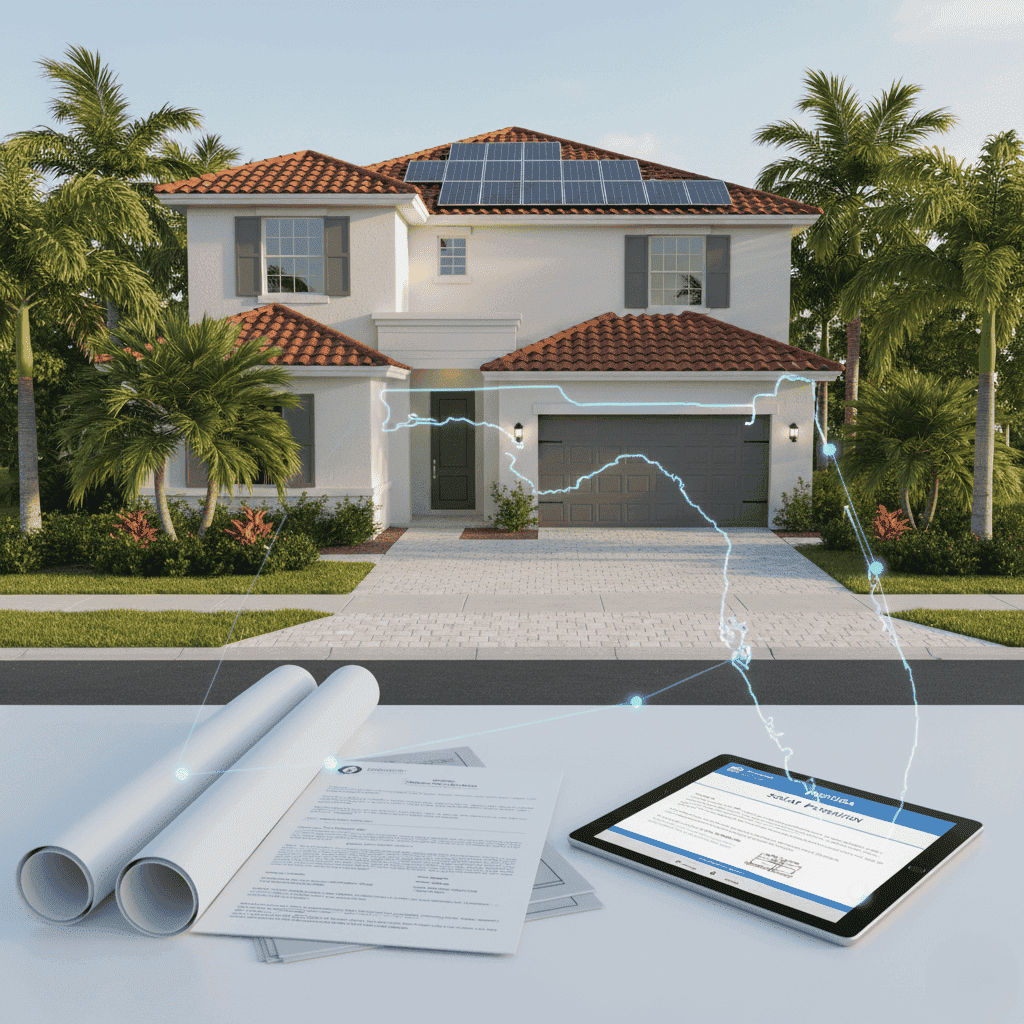
Solar Permit Requirements In Florida: Complete Step-By-Step Guide
Solar Permit Solutions breaks down Florida’s permit requirements by county...
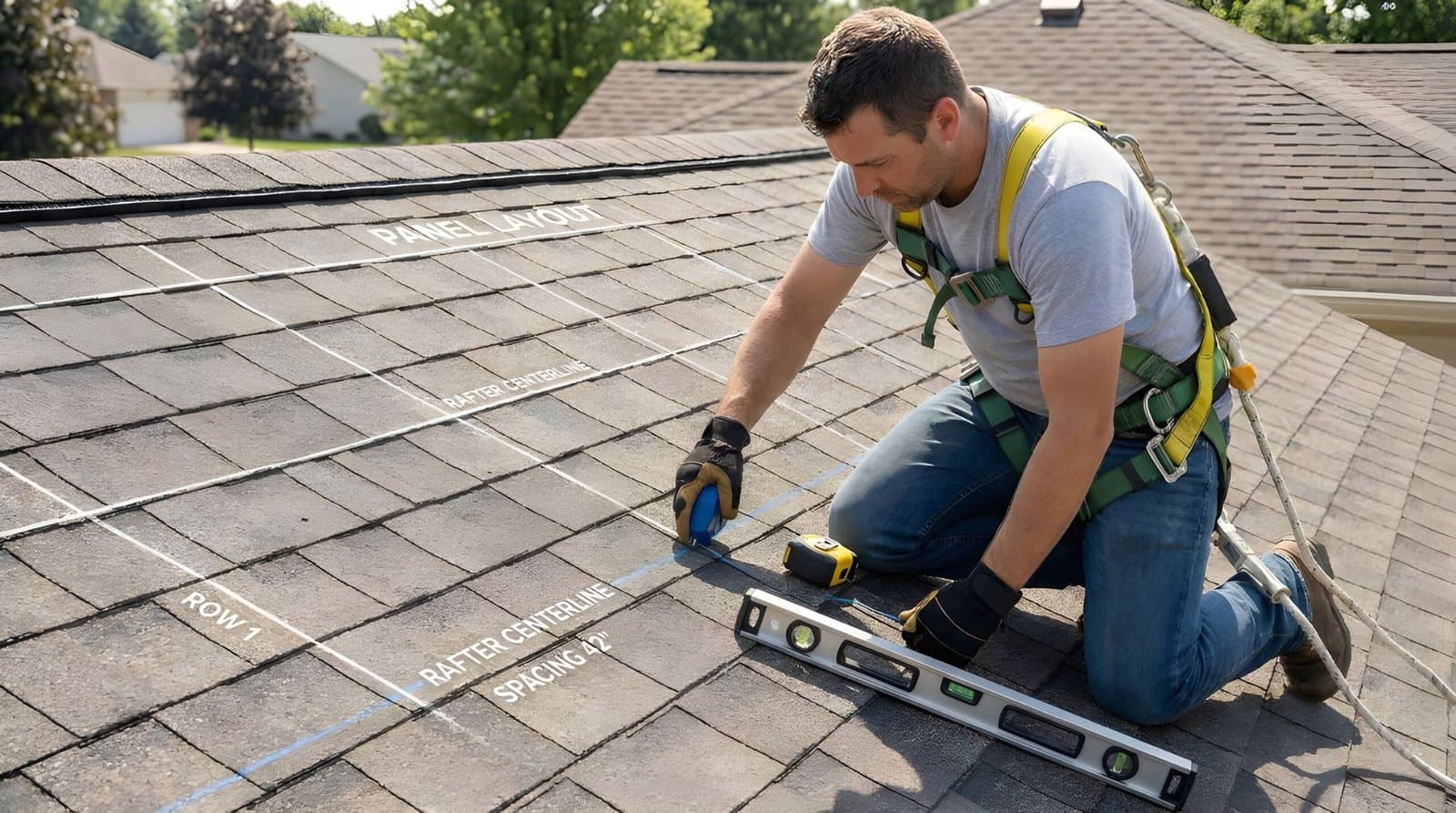
How to Mount Solar Panels on a Roof: Mounting Systems, Rails, and DIY Tips
Learn how to mount solar panels yourself with this complete guide. Covers compon...
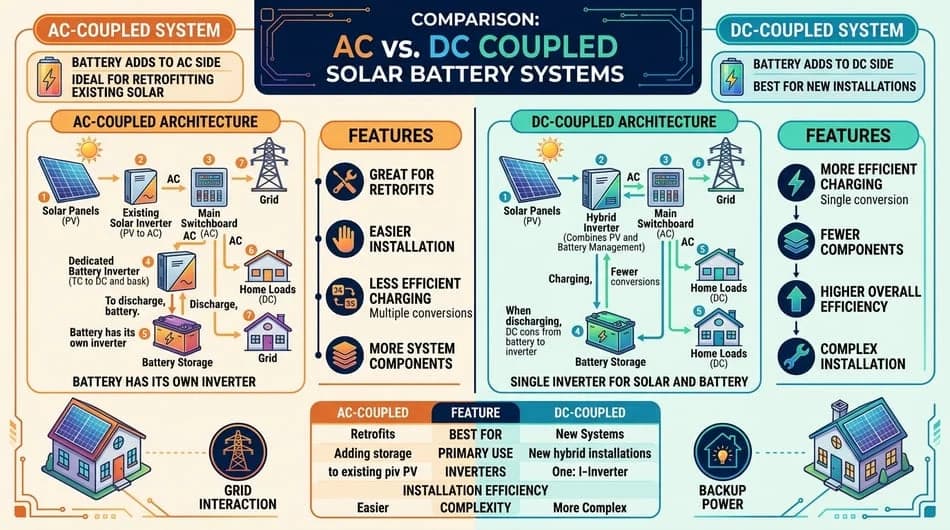
AC vs DC Coupled Solar Batteries: Which Should You Choose?
AC vs DC coupled solar batteries compared: efficiency, costs ($8K-$18K), and ins...