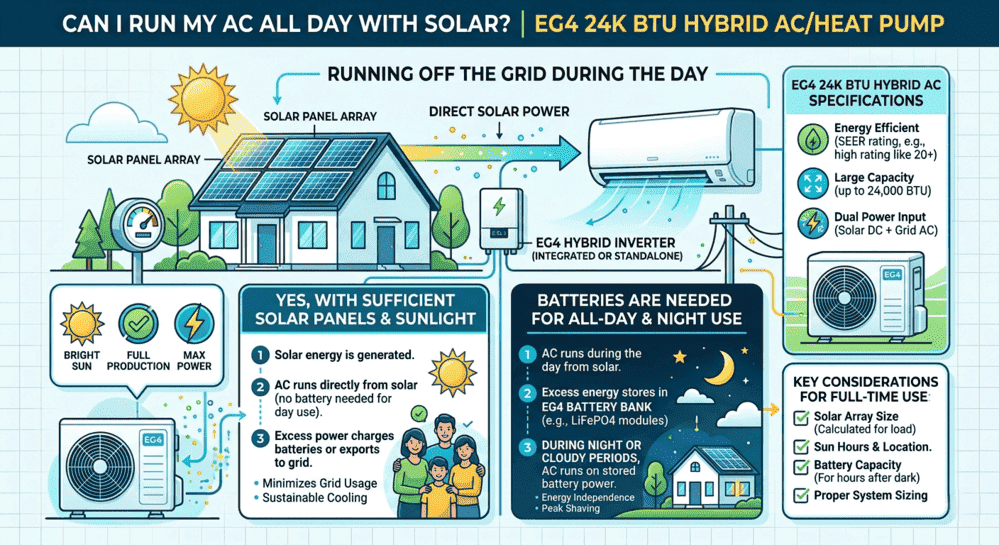
Yes, you can run an AC all day with solar. A hybrid AC/DC mini-split like the EG4 24K BTU connects solar panels directly to the outdoor compressor unit, bypassing the need for an inverter or battery bank. During peak sun hours, the system draws DC power straight from the panels and runs the compressor at zero grid cost. When solar production drops, due to clouds or time of day, the unit automatically blends in AC grid power to maintain the set temperature without interruption. On a typical summer day, a properly sized solar array of 6 to 8 panels (400W each, wired in series) can keep grid draw at zero watts for 6 to 8 hours. This technology is called Power Blending, and it is built into the EG4’s outdoor unit with no additional components required.
Summer heatwaves are no longer just a comfort issue — they are a financial burden. For many homeowners, the largest single expense on their monthly utility bill is a central air conditioner struggling against the afternoon sun. But what if your AC actually performed better as the sun got hotter?
The EG4 24K BTU AC/DC Mini Split is a hybrid system that connects solar panels directly to the outdoor unit, cooling your home without expensive battery banks or complex inverter systems. This review covers how it works, real-world performance numbers, installation requirements under current electrical code, and whether the investment makes sense in 2026. If you are also working through the solar permit design process for this type of installation, the permitting requirements are covered in the installation section below.
How Does a Solar-Powered AC Run All Day Without Batteries?
The EG4 unit operates on a technology called Power Blending — an intelligent energy management system built into the outdoor compressor unit. Understanding how it works across a full day helps explain why it is effective and how to size your panel array. Your local AHJ will also want to see this operating mode documented in your permit plan set.
- Morning startup: As panels begin producing voltage above the 150 VDC operating threshold, the unit starts on solar alone.
- Peak hours (10 AM – 3 PM): The compressor runs at full speed on DC solar power. Grid draw is zero watts.
- Partial cloud cover: The unit detects the voltage drop and blends in just enough AC grid power to maintain the set compressor speed. The transition is seamless, no temperature spike, no shutdown.
- Evening: As solar production falls below the operating threshold, the unit switches fully to AC grid power and continues running.
- Night: Operates entirely on grid power, like any standard mini split.
The result is that on a typical sunny summer day, which is also when cooling demand peaks, your grid meter can sit at zero for 6 to 8 hours. This is the core value proposition of the hybrid AC/DC design.
Technical Specifications: EG4 24K BTU Hybrid Mini Split
All specifications below are from the EG4 Electronics official product listing. The unit carries ENERGY STAR certification and is AHRI certified. For NEC labeling requirements that apply to the DC wiring on this installation, see our solar PV labeling requirements guide.
| Component | Specification |
|---|---|
| Cooling Capacity | 24,000 BTU (1,000-1,350 sq. ft. depending on insulation and climate) |
| Efficiency | Up to 22.5 SEER2 (ENERGY STAR certified) |
| Refrigerant | R32 (Low GWP, EPA-compliant) |
| DC Solar Input Range (Operating) | 150 VDC – 380 VDC |
| Absolute DC Minimum | 90 VDC |
| Max PV Input Wattage | 2,200W |
| Max PV Input Voltage (VOC) | 380 VDC |
| AC Power Requirement | 208-240 VAC, 60 Hz (20A double-pole) |
| Max Solar Current | 20A |
| Refrigerant Pre-Charge | 40.57 oz (pre-charged, quick-connect) |
| Warranty | 5-Year Limited |
The Panel String Sweet Spot
The operating DC voltage range of 150 VDC to 380 VDC is the critical design constraint for your panel string. To reach the rated 2,200W solar input, 6 to 8 panels rated at approximately 400W each, wired in series, is the standard recommendation. This configuration keeps string voltage comfortably between 200 VDC and 340 VDC under real-world temperature variation. For a deeper look at how string configuration flows into your electrical single-line diagram, a required permit document, see our dedicated SLD guide.
Important: Never exceed 380 VDC VOC. Overvoltage trips the internal DC controller and can cause permanent damage. Always calculate your maximum open-circuit string voltage at minimum expected temperature before finalizing your array design.
Installation and Electrical Code Compliance
The EG4 uses pre-vacuumed, pre-charged refrigerant quick-connect lines, which eliminates the need for a vacuum pump or refrigerant handling certification for the refrigerant side of the installation. Estimated labor savings versus a traditional split system install range from $800 to $1,200. However, the electrical side requires permits in virtually every U.S. jurisdiction. Avoiding permit delays and rejections starts with knowing your local AHJ’s specific requirements before you begin.
Here is what the current NEC 2023, the edition in force across most U.S. jurisdictions as of April 2026, requires:
- AC disconnect (NEC 440.14): A disconnecting means must be within sight of the outdoor unit and readily accessible. A lockable 240V disconnect rated for the unit’s load is required.
- DC solar disconnect: A visible, lockable DC isolator switch is required on the solar lines feeding the outdoor unit. MC4 connectors alone do not satisfy this requirement.
- GFCI protection: Verify your local jurisdiction’s adopted code edition and any local amendments for GFCI requirements on HVAC branch circuits. Requirements vary by AHJ.
- MC4 connectors (NEC 690.33): Under NEC 2023, MC4 connectors in the same circuit must be compatible and listed for the application. Using mismatched connectors from different manufacturers is a code violation. See our rapid shutdown compliance guide for related DC wiring requirements.
- Permits: Most jurisdictions require both a mechanical permit and an electrical permit. Requirements vary significantly by state; see our guides for Georgia solar permits, Chicago solar permits, and Nevada solar permits for examples of how AHJ requirements differ across markets.
Note: NEC 2026 is currently in the adoption phase. Most jurisdictions are still enforcing NEC 2023 as of April 2026. Confirm your local AHJ’s adopted code edition before finalizing your installation design.
Solar Permit Solutions
Need Solar Permit Plans?
Professional, permit-ready solar plan sets delivered fast. Residential and commercial projects across all 50 states.
Real-World Results: Cooling a Large Workshop
Independent installer testing documented in Signature Solar’s EG4 review video (YouTube, 2025) shows the 24K unit installed in a large two-story studio space. The interconnection method used was load-side, which is the standard configuration for residential and outbuilding installations. Key findings:
- External temperature: 95 degrees F
- Interior maintained: 74 degrees F
- Grid draw during peak sun hours: 0 watts
- Solar array used: 6 x 400W panels wired in series (~240 VDC under load)
The compressor modulated speed continuously in response to available solar wattage, avoiding hard shutdowns when light cloud cover reduced panel output. For workshop, outbuilding, home office, or small residential applications, this matches the system’s intended use case and rated coverage area.
Federal Tax Credits: What Changed in 2025 and 2026
The Section 25D Residential Clean Energy Credit, which provided a 30% tax credit on purchased solar and battery systems, expired for most residential expenditures after December 31, 2025, under the One Big Beautiful Bill Act. For a full breakdown of how this affects battery storage pairing, see our solar battery tax credit 2026 guide.
However, the Section 25C Energy Efficient Home Improvement Credit remains available for qualifying high-efficiency heat pumps, which include mini-split heat pumps meeting the applicable efficiency thresholds. The EG4 24K unit’s SEER2 rating and heat pump functionality may qualify, but eligibility depends on the specific product requirements and your tax situation. Consult a tax professional for current 2026 eligibility before purchasing.
Is the EG4 24K Hybrid Mini Split Worth It in 2026?
The case for this system comes down to a straightforward comparison. A standard 2-ton mini split costs $1,200 to $2,500 installed. Adding a hybrid solar-direct capability through a system like the EG4 means paying a premium for the DC input hardware, but eliminating the far larger cost of an inverter, batteries, and charge controller that a conventional solar-plus-AC setup would require. Permit costs add to the total, in high-volume markets like New Jersey and New York, permit fees and plan set costs for a system this size typically run $350 to $800.
For homeowners who have grid power but want to offset cooling costs during peak hours, or for off-grid and outbuilding applications where running a dedicated circuit is more cost-effective than battery storage, the hybrid AC/DC design offers a real and measurable reduction in operating cost with no meaningful operational downside.
The bottom line: If your primary cooling need aligns with your peak solar production hours — which it almost always does in summer — this system is one of the most cost-efficient ways to put solar energy to work without a battery bank. According to NREL soft cost research, permitting and inspection account for a significant share of residential solar soft costs, so choosing a streamlined permitting jurisdiction matters as much as equipment selection.
Frequently Asked Questions
Can I run this unit with no grid connection at all?
Yes, with conditions. The unit will run on solar DC alone during daylight when panels produce sufficient voltage. If solar drops below approximately 150 VDC, the unit enters a sleep mode and attempts to restart at 15, 45, and 60-minute intervals as conditions improve. Without a grid AC connection, there is no backup for cloudy days or nighttime operation.
Do I need a licensed HVAC technician for the refrigerant lines?
The quick-connect lines are pre-vacuumed and pre-charged, so no vacuum pump or EPA 608 certification is needed for the refrigerant connection itself. However, most jurisdictions require a licensed electrician for the 240V AC branch circuit and may require a mechanical permit for unit placement. Requirements differ by state, for example, see how White Plains, NY handles solar permits versus a state like Texas, where requirements vary significantly by municipality.
What happens on a cloudy day?
If grid power is connected, the unit automatically blends in AC power to compensate for reduced solar input. There is no interruption in cooling. If operating off-grid only, the compressor slows to match available wattage and enters sleep mode if production falls below the operating threshold.
How many panels do I need?
To reach the 24K unit’s rated 2,200W solar input, 6 to 8 panels rated at approximately 400W each, wired in series, is the standard configuration. This keeps string voltage in the 200 VDC to 340 VDC range under normal operating temperatures. Never exceed 380 VDC VOC.
Is there still a federal tax credit for this system?
The Section 25D Residential Clean Energy Credit expired for most expenditures after December 31, 2025. The Section 25C Energy Efficient Home Improvement Credit may apply to qualifying high-efficiency heat pumps. Consult a tax professional for your specific situation.
Need Solar Permit Plans?
Professional, permit-ready solar plan sets delivered fast. Residential and commercial projects across all 50 states.

SPS Editorial Team
Solar Permit Solutions
Solar Permit Solutions provides professional solar permit design services for residential, commercial, and off-grid installations across all 50 states. Our team ensures permit-ready plan sets delivered fast.
Related Articles
How To Add A Battery To Your Existing Solar System
Adding a battery to your solar system costs $10,000-$20,000. Save with 30% feder...
Solar Inspection Documentation: Required Documents and Checklist
Learn about solar inspection documentation, including permit requirements, NEC c...
Solar Panel Inspection Checklist: What To Check & When To Inspect
Solar panel inspection guide: Learn what to check, when to inspect (annually + e...