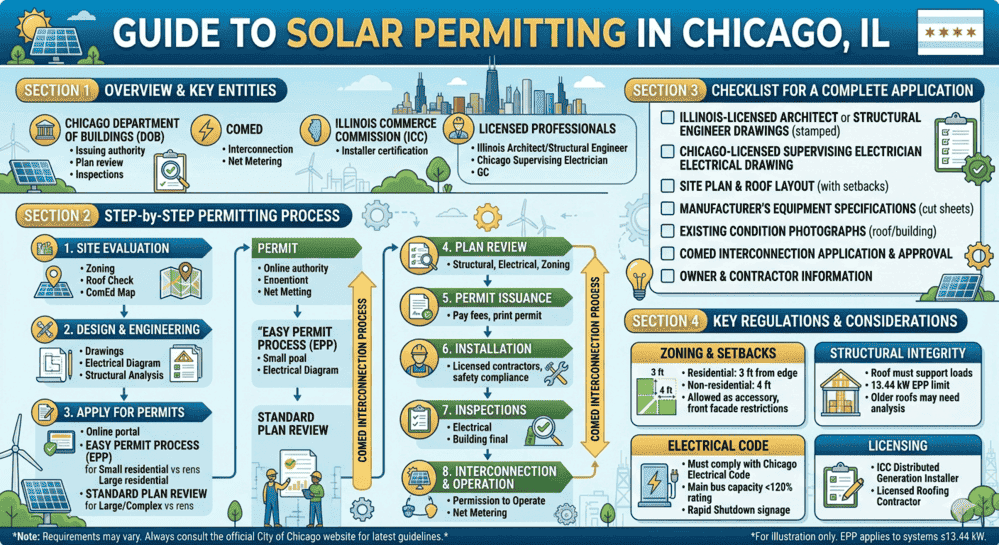
A Chicago solar permit is the official authorization from the City of Chicago Department of Buildings (DOB) that homeowners and contractors must obtain before installing any solar PV system on a residential or commercial property. Chicago offers two permitting pathways: the Express Permit Program (EPP) for rooftop systems up to 13.44 kW, which can issue same-day approvals, and standard plan review for larger or more complex installations, which takes 2 to 4 weeks for residential projects. All plan sets must comply with the 2018 Chicago Electrical Code (based on the 2017 NEC) and the 2019 Chicago Building Code and must include structural documentation certified by an Illinois-licensed architect or structural engineer. After DOB approval, a separate ComEd interconnection application is required before the system can legally export power.
This guide covers everything solar contractors, installers, and property owners need to know about the city of Chicago solar permit process, from permit types and plan set requirements to ComEd interconnection, inspection timelines, and net metering rules as they stand in 2025 and 2026.
What Is a Chicago Solar Permit?
A Chicago solar permit is a construction authorization issued by the Chicago DOB that approves the structural and electrical design of a proposed solar PV installation. Like all building permits in Illinois, it confirms that the proposed work complies with locally adopted codes before any installation begins.
Chicago solar permits serve two primary functions. First, they protect public safety by requiring code-compliant structural and electrical design documentation. Second, they protect the property owner’s investment: an unpermitted system can trigger fines, forced removal, insurance complications, and title issues at property sales.
Who Issues Solar Permits in Chicago?
The City of Chicago Department of Buildings is the Authority Having Jurisdiction (AHJ) for solar permit applications in the city. The DOB reviews structural plans, electrical designs, and zoning compliance. For properties in Chicago landmark districts, a separate pre-permit design review through the Chicago Department of Planning and Development (DPD) may also be required before the DOB application can proceed.
Is a Chicago Solar Permit Different from Other Illinois Jurisdictions?
Yes. Chicago operates under its own 2018 Chicago Electrical Code (based on the 2017 NEC) and 2019 Chicago Building Code, both of which are locally amended versions of the National Electrical Code (NEC) and International Building Code (IBC). Suburban Cook County municipalities, collar counties, and downstate Illinois cities each adopt their own code editions and have distinct permitting requirements. A plan set that earns first-pass approval in Naperville or Evanston will not necessarily meet Chicago DOB standards. Always verify requirements directly with the specific AHJ before preparing any plan set.
Solar Permit Solutions
Skip the Permit Headaches
We design plan sets that pass inspection the first time. Code-compliant, PE-stamped, accepted by AHJs nationwide.
Chicago Solar Permit Types: Express Permit vs. Standard Plan Review
Chicago offers two distinct pathways for solar permit applications, and choosing the wrong one adds weeks to a project timeline.
The Chicago Express Permit Program (Small Systems up to 13.44 kW)
The Express Permit Program (EPP) is the streamlined permitting pathway for qualifying residential and small commercial rooftop solar installations. Key parameters include the following:
- System size limit: 13.44 kW AC output maximum
- Energy storage limit (if included): 20 kWh (10 kWh for non-lithium-ion batteries)
- One installation per ComEd electrical service connection
- Rooftop installations only: wall-mounted or ground-mounted systems do not qualify
- Permit fee: Calculated per the current DOB fee schedule. Note: The legacy $275 flat fee from the original Solar Express program no longer applies. Verify current fees using the Chicago DOB permit fee calculator before project budgeting.
- Approval timeline: Same-day approval for qualifying projects
The EPP was launched to dramatically reduce the permitting timeline for small solar installations. Before the program, Chicago solar permits took up to 30 days for residential projects. The EPP cut that to one business day for qualifying systems.
Important: Before submitting an EPP application, the Illinois-licensed architect or structural engineer who prepares the drawings must conduct an in-person inspection of the property to confirm (1) the structural capacity of the existing roof structure and (2) the condition of the existing electrical system. This is a formal DOB requirement, not optional. The original Solar Express Permit Program stopped accepting new applications on November 2, 2023. It has been replaced by the web-based Express Permit Program. All applications are submitted electronically through the DOB’s online portal.
Standard Plan Review (Systems Over 13.44 kW or Non-Qualifying Projects)
Solar installations that exceed the 13.44 kW threshold or involve ground-mounted arrays, occupied rooftops, landmark-designated properties, or other disqualifying conditions must go through Chicago’s standard plan review process. This requires:
- Full permit plan set prepared by a licensed design professional
- Structural calculations signed and sealed by an Illinois-licensed architect or structural engineer
- Electrical plans compliant with the 2018 Chicago Electrical Code
- Zoning review for systems that do not meet the Solar Zoning Policy’s automatic approval conditions
- Standard review timeline of 2 to 4 weeks for residential and 4 to 8 weeks for commercial
| Factor | Express Permit Program | Standard Plan Review |
| System Size Limit | Up to 13.44 kW | Any size |
| Approval Timeline | Same-day | 2 to 8 weeks |
| Permit Fee | Per current 2025 DOB fee schedule | Varies by project valuation |
| Application Method | Online portal (web-based) | Electronic submission (DOB E-Plan) |
| Structural Stamp Required? | Yes (IL-licensed architect or engineer required for all new installs) | Yes (full PE review) |
| Zoning Review Required? | No (if compliant with Solar Zoning Policy) | Yes |
| Ground Mount Eligible? | No | Yes (non-residential only) |
Chicago Solar Permit Requirements: What Your Plan Set Must Include
The Chicago DOB requires a complete permit plan set for all solar permit applications, including express permit submissions. The following components are required for most Chicago solar permit packages:
- Cover sheet: Project address, contractor license number, design professional contact information, and applicable Chicago code editions. Plans must reference the 2018 Chicago Electrical Code and 2019 Chicago Building Code, not generic NEC references alone.
- Site plan and roof layout: Overhead view showing panel placement, property boundaries, setback dimensions, and fire access pathways. The Chicago Solar Zoning Policy requires a minimum 3-foot setback on residential buildings and a 4-foot setback on non-residential or mixed-use buildings.
- Electrical single-line diagram (SLD): Full circuit path from PV modules through inverters, disconnects, and the point of interconnection. See our guide to solar single-line diagrams for a detailed breakdown of every required component.
- Structural calculations: An Illinois-licensed architect or structural engineer must certify the roof structure can safely support the array. For flat-roof installations, Chicago accepts the SEAOC PV2-2012 wind design standard. See our structural engineering calculations guide for full methodology.
- Electrical permit: The electrical drawing must be signed by a Chicago-licensed supervising electrician or by an Illinois-licensed architect, PE, or structural engineer. Electrical work must be performed by a Chicago-licensed general electrical contractor listed on the application.
- Rafter/joist photos: Photographs of the existing roof framing with a tape measure visible, confirming framing dimensions for the structural analysis.
- Rapid shutdown documentation: Chicago-adopted codes require NEC 690.12 rapid shutdown compliance. The plan set must identify the specific equipment providing module-level rapid shutdown. See our fire safety and roof setback guide for compliance details.
- Equipment datasheets and Bill of Materials (BOM): Current manufacturer spec sheets with active UL listings for all panels, inverters, racking, disconnects, and conduit. See our guide to solar wiring diagrams for component documentation standards.
- Zoning compliance documentation: For EPP applications, zoning review is bypassed if the installation meets the Chicago Solar Zoning Policy. Standard plan review requires formal zoning review through the DOB.
Chicago-Specific Code Requirements
Unlike most Illinois jurisdictions that adopt NEC editions directly, Chicago enforces the 2018 Chicago Electrical Code (based on the 2017 NEC) with locally specific amendments. Plan sets that reference only ‘NEC 2023’ without confirming Chicago’s code edition will generate correction requests. The applicable codes are: 2018 Chicago Electrical Code (Section 14E-6-690 for solar PV, Section 14E-7-706 for storage), 2019 Chicago Building Code (Section 14B-15-1510.7 for photovoltaic panels), and 2019 Chicago Fire Prevention Code (Chapter 14F-12 for energy systems).
Chicago’s Solar Zoning Policy adds requirements beyond standard fire codes. Key zoning provisions include the following:
- Freestanding (ground-mount) solar PV systems are not permitted in Chicago residential districts.
- Freestanding systems in permitted commercial or industrial districts cannot be located within required property setbacks
- Systems installed on Chicago Landmark properties or within Landmark Districts require a separate pre-permit design review by the DPD
- Any solar system extending into the public way requires additional review by the Department of Business Affairs and Consumer Protection (BACP) and/or the Chicago Department of Transportation (CDOT)
- Abandoned solar systems (not in operation for 12 or more months) must be removed, or the City may pursue legal action after a 90-day notice period

The Chicago Solar Permitting Process: Step by Step
Understanding the full workflow from site assessment to Permission to Operate helps contractors plan realistic project timelines. For a deeper look at how long each phase takes, see our dedicated timeline guide.
- Verify Chicago DOB requirements for your specific project. Confirm which permit pathway applies (Express or standard), whether the property is in a Landmark District, and that your plan references the 2018 Chicago Electrical Code and 2019 Chicago Building Code.
- Complete a site assessment. Collect roof dimensions, existing electrical panel data (busbar rating, main breaker size, available breaker spaces), rafter or joist photos with measurements, and a shading analysis.
- Design the system. Configure string wiring, inverter sizing, disconnect placement, and interconnection method (supply-side or load-side) based on the existing electrical service. Identify the Chicago-licensed general electrical contractor at this stage, as their license number is required on the application.
- Prepare the plan set. Create the complete permit package per plan set requirements. For EPP applications, confirm all parameters match DOB guidelines. For standard review, prepare the full engineering package including NEC load calculations.
- Obtain structural and electrical professional certification. An Illinois-licensed architect or structural engineer must certify the structural design. The electrical drawing must be signed by a Chicago-licensed supervising electrician or an Illinois-licensed design professional.
- Submit electronically through the DOB portal. Chicago does not accept walk-in applications from third-party providers. All applications are submitted electronically and processed in order received. Visit the Chicago DOB permits page for the current portal link.
- Pay the permit fee. Fees are calculated per the current DOB fee schedule. Use the Chicago DOB permit fee calculator to estimate costs before submission.
- Respond to any plan check comments. Each correction cycle adds 1 to 4 weeks to the timeline. See the full list of common AHJ review patterns to anticipate what reviewers look for.
- Install per approved plans. Any deviations from the approved design may require a revised permit before work can continue.
- Schedule and pass the DOB inspection. After installation, a Chicago DOB inspector verifies the physical installation matches the approved plans. All safety labels, rapid shutdown controls, and disconnects must be in place.
- Submit the ComEd interconnection application and receive Permission to Operate (PTO). After passing inspection, submit proof of DOB approval to ComEd through Contractor Connect. See our full solar interconnection agreement guide for a complete application walkthrough.

ComEd Interconnection Requirements for Chicago Solar Systems
A building permit from the Chicago DOB authorizes the physical installation. A ComEd interconnection agreement separately authorizes the system to connect to the utility grid. Both are required before a solar system can legally export power in Chicago.
What ComEd Requires
ComEd serves the northern Illinois territory, including all of Chicago. For residential and small commercial systems, interconnection requirements include:
- IEEE 1547 standards compliance for the inverter (anti-islanding and grid protection)
- UL 1741 certification for the inverter, active listing required
- A dedicated external disconnect switch accessible to utility personnel
- Clear labeling of all system components
- For systems over 10 kW AC: liability insurance (typically $1 million in coverage for systems over 10 kW)
- Submission through ComEd’s Contractor Connect portal
Interconnection Timeline
ComEd’s review operates in two phases. Permission to Install (PTI) is submitted before installation. ComEd completes initial reviews within approximately 10 business days and technical reviews within 15 to 20 business days for standard residential systems.
Permission to Operate (PTO) is submitted after installation with proof that the DOB inspection was passed. PTO approval can take a few days to several weeks depending on ComEd’s backlog.
Illinois Net Metering in 2025: What Chicago Solar Owners Need to Know
Illinois net metering policy changed on January 1, 2025, under the Climate and Equitable Jobs Act (CEJA). The change affects every solar system interconnected with ComEd after December 31, 2024.
Systems interconnected before January 1, 2025, are grandfathered into full retail net metering for the life of the system. These customers receive credits offsetting supply charges, delivery charges, and taxes and fees at the full retail rate.
Systems interconnected on or after January 1, 2025, receive Smart Solar Billing (NEM 2.0): credits apply only to the supply portion of the bill. Delivery charges and fixed fees are no longer offset by exported energy. Self-consumption maximization is now the primary financial driver for new Illinois solar installations.
ComEd and Ameren both offer a Distributed Generation (DG) Rebate of $300 per kilowatt DC for qualifying smart inverter systems, plus a Storage Rebate of $300 per kilowatt-hour for battery storage. Note: Accepting the DG Rebate locks the system into NEM 2.0 supply-only terms, so grandfathered customers considering retrofits should review this carefully before applying.
Solar Permitting in Illinois: How Chicago Compares to Suburban Jurisdictions
Chicago’s independently maintained electrical code, dual-pathway permitting system, and strict zoning requirements make it a distinct AHJ environment compared to neighboring municipalities.
| Factor | City of Chicago | Suburban Cook County | Collar Counties / Downstate |
| Code Authority | 2018 Chicago Electrical Code + 2019 Chicago Building Code | Local amendments to NEC/IBC | Local NEC/IBC adoption (varies by municipality) |
| Permit Pathway | Express Permit (up to 13.44 kW) or Standard Plan Review | Typically standard plan review; some use SolarAPP+ | Varies widely; some use SolarAPP+ |
| Ground Mounts in Residential Zones | Not permitted | Varies by municipality | Varies by municipality |
| Structural Stamp Required? | Yes (IL-licensed architect or engineer) | Generally yes | Generally yes; some exempt small systems |
| Electrical Contractor Requirement | Must hold City of Chicago general electrical contractor license | Must be IL-licensed | Must be IL-licensed |
| Typical Residential Timeline | Same-day (EPP) to 2 to 4 weeks | 1 to 4 weeks | 1 to 4 weeks (faster in SolarAPP+ jurisdictions) |
For comparison guides to other states, see our guides to solar permits in Texas and solar permits in New York, which illustrate how requirements differ across major markets.
Illinois Distributed Generation Installer Certification
Illinois law requires that grid-tied solar installation work be performed by persons working under a certified Illinois Commerce Commission (ICC) Distributed Generation (DG) Installer. The Illinois Solar Energy Association maintains resources on certification requirements. Contractors expanding into Chicago from other states must confirm that their team meets this state-level requirement in addition to Chicago’s local licensing rules.
Common Chicago Solar Permit Rejection Reasons
Chicago DOB plan reviewers have jurisdiction-specific requirements that differ from the national NEC defaults used in other states. These are the most frequent causes of correction requests on Chicago solar permit applications:
- Referencing NEC instead of the Chicago Electrical Code. Plans must cite the 2018 Chicago Electrical Code (Section 14E-6-690), not a generic NEC 2023 reference. Chicago’s amendments differ materially from the base NEC.
- Incorrect roof setback dimensions. Chicago requires a 3-foot setback on residential buildings and a 4-foot setback on non-residential or mixed-use buildings per the Solar Zoning Policy. Using a generic 3-foot setback across all building types is a common error.
- Using a non-Chicago-licensed electrical contractor or incorrectly signed drawings. Electrical work must be performed by a City of Chicago licensed general electrical contractor. The electrical drawing must be signed by a Chicago-licensed supervising electrician, or by an Illinois-licensed architect, PE, or structural engineer.
- Missing or insufficient structural documentation. Drawings and calculations by an Illinois-licensed architect or structural engineer are always required for new installations, including EPP applications. Rafter/joist photos with a tape measure must accompany the application.
- Incomplete equipment datasheets. Every component in the BOM must have a current manufacturer spec sheet with an active UL listing. Expired or revoked listings cause automatic rejection.
- Landmark District projects missing DPD pre-permit review. Submitting to the DOB before completing the required DPD design review for landmark properties causes automatic rejection.
- Structural calculations not sealed by an Illinois-licensed professional. Out-of-state PE stamps are not valid for Chicago applications.
- 120% busbar rule violations. The combined rating of the main breaker and the solar breaker cannot exceed 120% of the panel busbar rating for load-side interconnections. Plans that exceed this limit without a documented supply-side alternative are flagged.
- Site plan not matching actual conditions. Chicago DOB reviewers cross-reference site plans against GIS and aerial imagery. Inaccurate dimensions trigger corrections.
- Missing rapid shutdown documentation. The plan set must name the specific equipment providing module-level rapid shutdown per NEC 690.12. Generic compliance statements are insufficient.
Solar Permit Design for Battery Storage in Chicago
Adding a battery energy storage system (ESS) to a Chicago solar installation introduces permit requirements beyond a standard PV-only plan set. Chicago DOB reviews ESS installations under 2018 Chicago Electrical Code Section 14E-7-706 (based on NEC Article 706) alongside 14E-6-690 for solar PV, as well as the NFPA 855 Standard for Energy Storage Systems.
For ESS installations using the Express Permit Program, the storage capacity limit is 20 kWh (10 kWh for non-lithium-ion battery chemistries), and only one installation is permitted per ComEd electrical service connection. ESS installations that exceed these limits must go through standard plan review.
A Chicago solar-plus-storage plan set typically requires additional documentation beyond the standard PV package:
- Battery location plan showing clearances from combustible materials and egress pathways
- Updated electrical diagrams showing AC-coupled or DC-coupled battery integration. See our solar wiring diagram guide for integration documentation standards.
- Ventilation calculations for indoor battery installations
- Fire detection or suppression details where required by NFPA 855 and Chicago Fire Prevention Code Chapter 14F-12
- Revised NEC/Chicago Electrical Code calculations for the additional circuits, overcurrent protection, and disconnects
If you are adding battery storage to an existing solar installation that was originally permitted as PV-only, a new or amended permit is required. Confirm requirements with the Chicago DOB before beginning any retrofit.
Federal and State Incentives for Chicago Solar in 2025 and 2026
Understanding the incentive landscape is essential for contractors setting client expectations and for property owners evaluating solar ROI under current policy.
Federal Investment Tax Credit (ITC): What Changed
Residential (Section 25D): The One Big Beautiful Bill Act (H.R.1), signed July 4, 2025, terminated the 30% federal residential solar tax credit. New residential installations completed in 2026 and beyond are no longer eligible for the Section 25D credit.
Commercial (Section 48E): Commercial and business entities can still claim the Clean Electricity Investment Tax Credit under IRS Section 48E. This credit applies to commercial solar installations and is not subject to the same expiration as Section 25D. Confirm current Section 48E eligibility with a tax professional.
Illinois and ComEd Incentives
Distributed Generation (DG) Rebate: ComEd offers $300 per kilowatt DC for qualifying solar systems using smart inverters. Accepting this rebate locks the system into NEM 2.0 supply-only credit terms. For new installations after January 1, 2025, this is typically worthwhile since NEM 2.0 already applies. Existing grandfathered customers should consult an installer before accepting the rebate, as it forfeits grandfathered net metering status.
Storage Rebate: ComEd offers $300 per kilowatt-hour for battery storage systems. Recipients must enroll in Real-Time Pricing.
Illinois Shines (Adjustable Block Program): Illinois’s solar renewable energy credit (SREC) program provides additional revenue for qualifying solar installations through the Illinois Power Agency. Confirm current block pricing and availability before including this in project proposals.
Illinois property tax exemption: Illinois offers a 100% property tax exemption on the added home value attributable to a solar installation, meaning Chicago homeowners benefit from higher property value without a corresponding property tax increase.
How to Get Your Chicago Solar Permit Approved on the First Submission
First-pass approval saves weeks. Based on patterns across Chicago DOB submissions, these practices consistently lead to higher approval rates:
- Reference the 2018 Chicago Electrical Code (Section 14E-6-690) and 2019 Chicago Building Code explicitly on every sheet. Do not use generic NEC references.
- Verify roof setback dimensions against the Chicago Solar Zoning Policy. Residential: 3-foot setback. Non-residential and mixed-use: 4-foot setback.
- Have structural drawings and calculations prepared and sealed by an Illinois-licensed architect or structural engineer for all new installations, including EPP applications. Include rafter/joist photographs with a tape measure visible.
- Ensure the electrical drawing is signed by a Chicago-licensed supervising electrician, or by an Illinois-licensed architect, PE, or structural engineer. Confirm the electrical contractor holds a City of Chicago general electrical contractor license.
- Check whether the property is in a Chicago Landmark District before submitting to the DOB. If it is, complete the DPD pre-permit design review first.
- Confirm rapid shutdown compliance documentation names the specific equipment per NEC 690.12 rapid shutdown requirements, not just states generic compliance.
- Ensure all equipment datasheets show active (not expired or revoked) UL listings.
- Submit complete applications electronically. Missing pages, unsigned forms, or absent fees cause rejection before technical review begins.
- Verify the 120% busbar rule calculation matches the panel busbar rating on the equipment datasheet. See our supply-side vs. load-side interconnection guide for calculation methodology.
- Use the Chicago DOB permit fee calculator to confirm the correct fee amount before submission. Incorrect fee amounts can delay processing.
Conclusion
Getting a Chicago solar permit right the first time comes down to knowing exactly what makes the city different. The 2018 Chicago Electrical Code, the Express Permit Program’s 13.44 kW threshold, the in-person structural inspection requirement, Chicago-specific setback rules, and the City of Chicago contractor licensing requirements are not details you can import from a plan set that worked in another Illinois jurisdiction. Each one is a distinct point of failure for contractors who treat Chicago like a standard AHJ.
The permitting landscape also shifted materially in 2025 and 2026. NEM 2.0 changed the financial calculus for every new Chicago solar installation, the One Big Beautiful Bill Act ended the residential federal tax credit, and the DOB’s fully electronic Express Permit Program replaced the legacy Solar Express process. Plan sets and project proposals that don’t reflect these changes will generate corrections, client confusion, and delayed timelines.
The contractors who move projects through Chicago DOB without revision cycles share one habit: they build the local requirements into the plan set from the first draft, not as a last-minute check before submission. That means the right code edition on every sheet, a licensed Illinois professional’s in-person site inspection logged before the application goes in, correct setbacks for the building type, and an electrical drawing signed by someone who holds a City of Chicago credential.
Frequently Asked Questions:
Do I need a permit for solar panels in Chicago?
Yes. All solar PV installations in Chicago require a permit from the Chicago Department of Buildings before installation work begins. This applies to rooftop residential systems, commercial rooftop installations, and solar-plus-storage systems. Proceeding without a permit can result in fines, forced system removal, insurance complications, and title issues at property sale. There are no size-based exemptions in Chicago; even small systems require at least an Express Permit application.
Skip the Permit Headaches
We design plan sets that pass inspection the first time. Code-compliant, PE-stamped, accepted by AHJs nationwide.
Frequently Asked Questions
Qualifying residential rooftop systems under 13.44 kW can receive same-day approval through the Express Permit Program. Standard plan review for larger or non-qualifying projects typically takes 2 to 4 weeks for residential and 4 to 8 weeks for commercial. Each correction cycle adds 1 to 4 weeks. Total project timeline from contract to Permission to Operate in Chicago, including design, permitting, installation, and utility approval, typically runs 6 to 12 weeks. See our solar permit timeline guide for a full phase-by-phase breakdown.
Chicago solar permit fees are valuation-based and calculated using the DOB's annual fee schedule. Use the Chicago DOB permit fee calculator to get a current estimate for your specific project. In addition to the DOB fee, budget for plan set design ($200 to $500 for residential), an Illinois-licensed architect or structural engineer stamp ($200 to $500), and ComEd interconnection fees ($0 for residential systems under 10 kW). Total out-of-pocket costs for a typical residential Chicago solar project generally range from $400 to $1,200 or more depending on system size and complexity.
The Chicago Express Permit Program (EPP) is the streamlined permitting pathway for rooftop solar installations up to 13.44 kW with up to 20 kWh of battery storage. Qualifying projects can receive same-day permit approval online and bypass formal zoning review. One important requirement: before submitting an EPP application, the Illinois-licensed architect or structural engineer who prepares the drawings must conduct an in-person inspection of the property to confirm the structural capacity of the existing roof and the condition of the existing electrical system. The EPP replaced the original Solar Express Permit Program in November 2023 and is submitted entirely through the DOB's online portal.
Yes. For all new Chicago solar installations, drawings and calculations must be prepared by an Illinois-licensed architect or structural engineer, and that professional must also conduct an in-person site inspection before the permit application is submitted. This applies to both express permit and standard plan review applications. An out-of-state PE stamp is not valid in Chicago. The electrical drawing must be signed by a Chicago-licensed supervising electrician or by an Illinois-licensed architect, PE, or structural engineer.
Ground-mounted (freestanding) solar PV systems are not permitted in Chicago Residential Districts under the Chicago Solar Zoning Policy. In permitted commercial or industrial districts, freestanding systems may be allowed, but cannot be located within required property setbacks and must go through standard plan review rather than the Express Permit Program. Projects involving landmark properties or systems that extend into the public way require additional review by separate city agencies.
Chicago's Solar Zoning Policy requires a minimum 3-foot setback from the edge of a roof surface on residential buildings, and a minimum 4-foot setback from the edge on non-residential or mixed-use buildings. These requirements apply to all rooftop installations and must be clearly dimensioned on the site plan. Using a generic 3-foot setback for all building types is one of the most common causes of plan check corrections on Chicago solar permit applications.
Electrical work for solar installations in Chicago must be performed by a licensed general electrical contractor that holds a City of Chicago electrical contractor license. Illinois state licensing alone is not sufficient. The electrical drawing submitted with the permit application must be signed by a Chicago-licensed supervising electrician, or alternatively by an Illinois-licensed architect, professional engineer, or structural engineer. The licensed electrical contractor must be listed on the permit application.
Systems interconnected with ComEd on or after January 1, 2025 receive Smart Solar Billing (NEM 2.0): export credits apply only to the supply portion of the electricity bill. Delivery charges and fixed fees are no longer offset by exported energy. Systems interconnected before January 1, 2025 are grandfathered into full retail net metering for the life of the system, provided all required documentation was submitted to ComEd by December 31, 2024. Under NEM 2.0, maximizing self-consumption rather than export is the primary financial strategy for new Chicago solar owners.
Solar remains financially viable in Chicago in 2026, though the calculus has shifted since the federal residential tax credit (Section 25D) expired for systems installed after December 31, 2025. Key factors that still support Chicago solar economics: Illinois electricity prices have risen 22% from 2020 to 2024, solar homes sell for approximately 4.1% more, Illinois offers a 100% property tax exemption on the added value, ComEd offers a $300/kW Distributed Generation Rebate for qualifying smart-inverter systems, and the Illinois Shines SREC program provides additional revenue. Commercial projects can still claim the Section 48E federal tax credit. Payback periods vary by system size and household usage, so obtain site-specific quotes before making a decision.
In most Chicago solar installations, a separate electrical permit is required in addition to the building permit. Electrical work must be performed by a contractor holding a City of Chicago general electrical contractor license. The electrical drawing must be signed by a Chicago-licensed supervising electrician, or by an Illinois-licensed architect, PE, or structural engineer. The licensed electrical contractor must be named on the permit application.

SPS Editorial Team
Solar Permit Solutions
Solar Permit Solutions provides professional solar permit design services for residential, commercial, and off-grid installations across all 50 states. Our team ensures permit-ready plan sets delivered fast.
Related Articles
Solar Grounding And Bonding: How To Pass Inspection Every Time
Learn how to pass solar grounding and bonding inspections every time. Avoid comm...
Solar Inspection After Installation: What Happens Next?
Learn how to pass your solar inspection by following essential tips for obtainin...
Solar Permit Services in Austin, TX
Solar permits in Austin center on an Auxiliary Power Electrical Permit for any s...