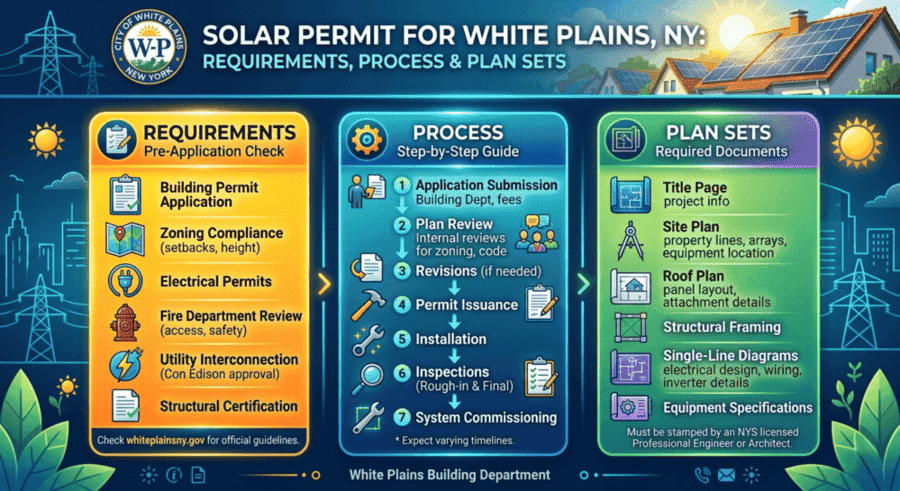
All solar panel installations in White Plains, NY, require a building permit from the City of White Plains Department of Building at 70 Church Street (914-422-1269). Residential rooftop systems of 12 kW or less qualify for the NYS Unified Solar Permit, which White Plains adopted in 2014, with permit determinations issued within 14 calendar days of a complete submission. Required documentation includes a PE- or RA-stamped site plan, single-line electrical diagram, structural engineering calculations, equipment specification sheets, and fire code compliance drawings per the 2020 Residential Code of New York State and NEC 2023. Permit fees for residential projects start at $100 for the first $1,000 of estimated construction cost plus $10 per additional $1,000. Con Edison handles interconnection and net metering for all White Plains solar installations through its Power Clerk portal, with 1:1 retail-rate credits available for residential systems up to 50 kW.
This guide covers every step of the solar permitting process in White Plains, from understanding local AHJ requirements and preparing PE-stamped solar permit plan sets to navigating Con Edison interconnection and maximizing available New York State incentives. For additional state-level context, refer to the NYSERDA Solar Guidebook for Local Governments. Whether you are a solar contractor managing a project pipeline or a homeowner planning your first installation, this resource provides the regulatory details, documentation checklists, and compliance strategies you need for a smooth permit approval in White Plains.
White Plains Solar Permitting Overview: AHJ Requirements and Local Regulations
The City of White Plains Department of Building serves as the authority having jurisdiction (AHJ) for all solar installations within the city limits. Located at 70 Church Street, White Plains, NY 10601 (phone: 914-422-1269), the Building Department accepts permit applications between 9:00 a.m. and 1:00 p.m. on regular business days. The department enforces the ordinances of the City of White Plains and all applicable county and state laws regulating the use and occupancy of private land and structures.
White Plains has established itself as a renewable energy leader in Westchester County. The city was designated a Clean Energy Community by NYSERDA in 2017 and, in 2022, completed a nine-site, 6.8 megawatt community solar portfolio, the largest municipal solar deployment in Westchester County, producing enough energy to power more than 700 homes annually. For more on the city’s sustainability initiatives, see the Go Green White Plains page. This commitment to clean energy translates into a knowledgeable and generally solar-supportive permitting environment for contractors and homeowners.
Unified Solar Permit Pathway
White Plains adopted the New York State Unified Solar Permit in January 2014, making it one of the first municipalities in the state to implement this streamlined process. The Unified Solar Permit applies to small-scale, roof-mounted residential and commercial solar electric installations and provides an expedited review process when all eligibility criteria are met. To qualify for the expedited pathway, a solar installation must meet all of the following conditions:
- Rated capacity of 12 kW DC or less
- Not subject to review by an Architectural or Historical Review Board
- Does not require a zoning variance or special use permit
- Mounted on a permitted roof structure of a building or on a legal accessory structure
- Compliant with all applicable electrical and building codes
- Compliant with the New York State Fire Code
- Installed by a contractor who complies with all licensing and jurisdiction requirements
- Equipment is permitted by code and meets all relevant certification standards
- Installed per manufacturer specifications and adopted NEC requirements
- Roof has no more than a single layer of roof covering (in addition to solar equipment)
- Mounted parallel to the roof surface, or tilted with no more than an 18-inch gap between the module frame and the roof surface
- Distributed weight of less than 5 pounds per square foot
Under the Unified Solar Permit, the municipality must issue permit determinations within 14 calendar days of receiving a complete and accurate application. If an application is incomplete or inaccurate, the city must provide feedback within 7 calendar days. Projects that do not meet any of the first ten eligibility criteria must go through the standard permitting process. Projects that fail to meet only criteria 11 through 13 can still use the Unified Solar Permit form but must include a letter from a PE or RA certifying that the existing structure can support the additional weight and wind loads.
Standard Permit Pathway
For installations that exceed 12 kW, involve ground-mounted arrays, or require zoning variances, White Plains requires the standard building permit application process. Applicants must complete the appropriate application form (Building Short Form for no-volume-added projects or Building Long Form for volume-added projects), available on the White Plains Building Permits and Applications page; have it notarized; and submit it to the Building Department with all required documentation. The standard permit process involves a more detailed plan review and may require additional approvals from the Planning Board or Common Council depending on the installation type and scale.
White Plains has also established specific zoning provisions for solar energy systems. Solar parking canopies are permitted only above existing impervious surfaces such as parking lots or atop parking structures. Ground-mounted solar farms and pole-mounted solar arrays are not permitted under the city’s zoning ordinance. In one- and two-family districts, solar parking canopies under 1,000 kW must be on a minimum lot area of two acres with 30-foot minimum setbacks from all lot lines. Canopies under 1,000 kW require site plan approval by the Planning Board, while those over 1,000 kW require both site plan and special permit approval from the Common Council.
Solar Permit Plan Set Requirements for White Plains
All permit plan sets submitted to the White Plains Building Department must be prepared by a New York State licensed PE or RA, as required by state law. Complete and accurate documentation is essential for avoiding the feedback loop that can add days or weeks to the approval timeline. A comprehensive solar permit plan set for White Plains must include the following components:
Site Plan
The site plan must show the project address, section, block, and lot number of the property. It should include the owner’s name, address, and phone number, along with the name, address, and phone number of the person preparing the plans. The site plan must display the location of the solar array on the property, existing electrical service panel location, utility meter position, inverter placement, system orientation, tilt angle, and all fire code access pathways and setbacks. Property boundaries, setback dimensions, and conduit routing from array to point of interconnection should be clearly indicated.
Electrical Diagrams
A single-line electrical diagram is required showing the complete circuit from solar panels through inverters, disconnects, overcurrent protection devices, and the point of interconnection with the utility service. The diagram must include conductor sizing per NEC Article 690, overcurrent protection ratings, equipment specifications (panel wattage, voltage, and current ratings), inverter model and capacity, and rapid shutdown compliance documentation per NEC 690.12. For systems with battery storage or energy management systems, additional detail is required per NEC Articles 705 and 706.
Three-line diagrams may be required for more complex installations. All wiring diagrams must reference compliance with NFPA 70 and include wire schedule tables showing conductor type, size, insulation rating, and conduit specifications. For commercial installations over 25 kW, refer to our commercial solar plan set guide for additional documentation requirements.
Structural Engineering Documentation
The 2020 RCNYS requires that the roof on which the PV panel system is installed must be able to support the loads imposed by the panel system and transmit the resulting loads to the supporting structural elements of the building. Structural engineering calculations must demonstrate compliance with the following requirements. For additional guidance, refer to the NYS Department of State PV Systems Code Outreach document:
- Dead load analysis accounting for module weight (typically 2 to 4 psf for residential rooftop systems), mounting rails, clamps, flashing, hardware, and any panel-level electronics
- Live load evaluation per applicable building code provisions
- Wind load calculations per ASCE 7, which is particularly important given Westchester County’s exposure to nor’easters and coastal storm systems
- Snow load analysis appropriate for the White Plains climate zone (ASCE 7 ground snow load for Westchester County)
- Verification that the PV panel system has at minimum the same fire classification as the roof assembly required in Section R902
For systems that do not meet the Unified Solar Permit weight criteria (distributed weight under 5 psf, parallel or tilted with no more than 18 inches of gap), a structural engineering letter from a PE or RA is required certifying that the existing structure can support the additional weight and wind loads. This letter must accompany the permit application regardless of which permit pathway is used.
Fire Code Compliance Documentation
The 2020 Residential Code of New York State and the New York State Fire Code establish specific requirements for solar installations regarding roof access, pathways, and ventilation. Plan sets submitted to White Plains must demonstrate compliance with Sections R324.6 through R324.6.2.1 of the 2020 RCNYS. For detailed diagrams illustrating these requirements, refer to the NYSERDA Rooftop Access and Ventilation Guide:
- Not fewer than two 36-inch-wide pathways on separate roof planes, from lowest roof edge to ridge, must be provided on all buildings
- Not fewer than one pathway must be on the street or driveway side of the roof
- For each roof plane with a photovoltaic array, not fewer than one 36-inch-wide pathway from lowest roof edge to ridge must be provided
- For arrays occupying 33% or less of plan view’s total roof area, an 18-inch setback is required on both sides of a horizontal ridge
- For arrays occupying more than 33% of plan view total roof area, a 36-inch setback is required on both sides of a horizontal ridge
- Panels shall not be placed on the portion of a roof below an emergency escape and rescue opening (EERO), with a 36-inch pathway to the EERO
Rapid shutdown labeling is also required under the NYS Fire Code. Buildings with rapid shutdown solar PV systems must have permanent labels indicating the type of shutdown system installed, with specific formatting requirements for character size, color contrast, and placement.
Applicable Building Codes and Electrical Standards
White Plains enforces the New York State Uniform Fire Prevention and Building Code, which includes the 2020 Building Code of New York State (2020 BCNYS), the 2020 Residential Code of New York State (2020 RCNYS), and the 2020 Fire Code of New York State. As of December 31, 2025, the 2025 edition of the Uniform Code became effective, updating various provisions. Contractors should verify with the White Plains Building Department which code edition applies to their specific project at the time of application.
| Code / Standard | Key Solar Provisions | Plan Set Impact |
| 2020 RCNYS Section R324 | Solar energy system design, rooftop mounting, fire classification, structural support | Structural calcs, roof load verification, fire classification documentation |
| NFPA 70 (NEC) Article 690 | Solar PV system installation, wiring methods, grounding, overcurrent protection, rapid shutdown | Single-line diagrams, conductor sizing, OCPD ratings, rapid shutdown compliance |
| NEC Article 705 | Interconnection of distributed energy resources with utility grid | Point of interconnection details, backfeed breaker sizing, bus bar rating verification |
| NYS Fire Code Ch. 12 | Roof access pathways, ridge setbacks, ventilation clearances, rapid shutdown labeling | Fire code setback dimensions on site plan, pathway routing, label specifications |
| UL 1703 / UL 1741 | PV module and inverter listing and labeling requirements | Equipment specification sheets, listing certifications in plan notes |
New York State adopted the NEC 2023 effective December 2025. Solar contractors working in White Plains should confirm with the Building Department whether NEC 2023 provisions apply to their specific project filing date, as the transition period may affect which code edition governs a given installation. Key NEC 2023 changes relevant to solar include updated provisions for energy storage systems, enhanced rapid shutdown requirements, and revised conductor sizing tables.
Solar Permit Solutions
Skip the Permit Headaches
We design plan sets that pass inspection the first time. Code-compliant, PE-stamped, accepted by AHJs nationwide.
Con Edison Interconnection and Net Metering for White Plains
Consolidated Edison (Con Edison) serves as the electric utility for White Plains and all of Westchester County. After obtaining a building permit and completing the solar installation, the system must be interconnected with Con Edison’s distribution grid before it can generate power. Con Edison administers the solar interconnection process through the New York State Standardized Interconnection Requirements (SIR).
Interconnection Process
Con Edison distinguishes between systems greater than and less than 50 kW AC. For systems under 50 kW (which includes most residential installations), Con Edison offers an expedited self-certification process. The Small DG portal on Con Edison’s Power Clerk platform handles interconnection requests of 50 kW AC or less, while the Large DG portal handles requests exceeding 50 kW AC. The SIR applies to projects up to 5 MW AC. For full technical details, refer to the Con Edison Solar Photovoltaics Guide.
The interconnection process follows these general steps:
- Submit the interconnection application through Con Edison’s Power Clerk portal with accurate 14-digit account and 7-digit meter numbers
- Upload all required documents including the site plan, single-line diagram, equipment specification sheets, and building permit
- Con Edison reviews the application and conducts engineering review to determine if any distribution system upgrades are required
- Upon approval, schedule the inverter commissioning test and final inspection
- Con Edison issues the final acceptance letter, places the net meter order, and activates the system
Net Metering and VDER
White Plains residents on Con Edison service benefit from 1:1 net metering under Phase One Net Energy Metering (NEM). When a customer exports more energy to the grid than they consume in a given month, they receive credits valued at the full retail rate of electricity. These credits roll over month to month and can offset future electricity usage. The monthly bill is reduced to just the basic service charge (approximately $20) when credits fully offset consumption.
Residential systems up to 50 kW on Con Edison are eligible for traditional net metering. Customers who enroll lock in this rate structure for 20 years. New York State is gradually transitioning from net metering to the Value of Distributed Energy Resources (VDER) tariff framework, which provides compensation based on the time, location, and environmental value of the energy generated. Most residential customers in White Plains can still access traditional net metering as of 2026, but contractors should confirm current eligibility with Con Edison before finalizing system designs.

Solar Incentives and Tax Credits Available to White Plains Residents
White Plains property owners can take advantage of multiple financial incentives that significantly reduce the net cost of a solar installation. Understanding and documenting these incentives correctly is important because several programs require specific permit filings or documentation that tie into the permitting process.
New York State Tax Credit
New York State offers a personal income tax credit equal to 25% of the net cost of a solar energy system, up to a maximum of $5,000. The credit is claimed on the state tax return using Form IT-255. If the credit exceeds the taxpayer’s state tax liability in the year of installation, the remaining credit can be carried forward for up to five years. The net cost is calculated after subtracting any NYSERDA rebates but before applying the federal tax credit.
NYSERDA NY-Sun Megawatt Block Program
The NY-Sun Megawatt Block (MW Block) Program, administered by NYSERDA, provides upfront rebates applied directly by the installer to reduce system costs. White Plains falls within the Con Edison territory for MW Block purposes. As of early 2026, the standard residential MW Block for the Con Edison region has closed (ending May 29, 2025). Low-income households (at or below 80% of area median income) may still be eligible for the Affordable Solar Residential Incentive at $0.80 per watt through the Solar Energy Equity Framework (SEEF) blocks, subject to availability. Contractors must verify current block status at the NYSERDA Dashboards and Incentives page before quoting projects.
Real Property Tax Exemption (RPT 487)
Under New York State Real Property Tax Law Section 487, solar energy systems are eligible for a 15-year property tax exemption on the added home value attributable to the solar installation. This means that while a solar system increases the market value of a home, the added value is exempt from property taxes for 15 years. Most municipalities in New York, including those in Westchester County, have adopted this exemption. Homeowners should confirm with the White Plains tax assessor’s office that the exemption is in effect.
Sales Tax Exemption
New York State provides a full sales tax exemption on the purchase and installation of solar energy systems. This applies to both the equipment and the labor costs associated with installation, reducing the upfront cost by approximately 8.375% (the combined state, county, and MTA surcharge sales tax rate in White Plains and Westchester County).
Federal Solar Tax Credit Update
The federal residential solar Investment Tax Credit (ITC) under Section 25D has been significantly affected by the One Big Beautiful Bill Act (OBBB Act), signed on July 4, 2025. The OBBB Act terminated the Section 25D residential clean energy credit for expenditures made after December 31, 2025. For commercial solar installations, Section 48E provides a clean electricity investment tax credit, but eligibility is subject to additional requirements, including prevailing wage and apprenticeship provisions and new Foreign Entity of Concern (FEOC) restrictions per IRS Notice 2025-42. Solar facilities seeking 48E credits must generally begin construction by July 4, 2026, with a placed-in-service deadline of December 31, 2027, for projects that miss that construction start window. Contractors and property owners should consult a qualified tax professional regarding current federal tax credit eligibility.
White Plains Solar Incentive Summary
| Incentive | Value | Eligibility | Status (2026) |
| NYS Tax Credit | 25% of net cost, up to $5,000 | All NYS taxpayers | Active |
| NYSERDA MW Block (Con Ed) | $0.20/W standard; $0.80/W low-income | Standard: closed; Low-income: active | Verify block status |
| RPT 487 Property Tax Exemption | 15-year exemption on added value | All solar system owners | Active |
| Sales Tax Exemption | ~8.375% savings on equipment and labor | All solar purchases in NYS | Active |
| Con Edison Net Metering | 1:1 retail rate credits | Residential systems up to 50 kW | Active (20-year lock-in) |
| Federal ITC (Sec. 25D) | Previously 30% | Residential expenditures | Terminated 12/31/2025 |
Step-by-Step Solar Permit Process for White Plains
The following walkthrough outlines the complete process from initial design through final inspection and Permission to Operate (PTO) for a typical residential solar installation in White Plains.
Step 1: Site Assessment and System Design
Evaluate the property for solar suitability, including roof orientation, pitch, shading, structural condition, and available electrical service capacity. Design the system to comply with all applicable codes and optimize energy production. A professional solar shading analysis should be performed to identify any obstructions that may affect panel placement or fire code setback compliance.
Step 2: Prepare PE-Stamped Plan Set
Engage a New York State licensed PE or RA to prepare the complete permit plan set. The plan set must include the site plan, electrical single-line diagram (and three-line diagram if required), structural engineering calculations, equipment specification sheets, fire code compliance drawings, and all required notes and labels. Solar Permit Solutions provides PE-stamped residential solar design packages for White Plains and all New York jurisdictions with a standard turnaround of 2 to 5 business days.
Step 3: Submit Permit Application
For systems qualifying for the Unified Solar Permit, complete the NYS Unified Solar Permit Application (available on the City of White Plains website) and submit it to the Building Department at 70 Church Street. For standard permits, complete the Building Short Form or Building Long Form as appropriate, have it notarized, and submit with all required documentation. White Plains residential permit fees are calculated as $100 for the first $1,000 of estimated construction cost plus $10 for each additional $1,000 (or part thereof). Confirm current fee schedules with the Building Department before filing.
Step 4: Permit Review and Approval
For Unified Solar Permit applications, the Building Department must issue a determination within 14 calendar days of receiving a complete application or provide feedback within 7 calendar days for incomplete submissions. Standard permit applications may take longer depending on project complexity and department workload. Respond promptly to any correction requests to avoid extended delays.
Step 5: Installation
Once the permit is issued, proceed with the solar installation per the approved plan set. All electrical work must be performed by or under the supervision of appropriately licensed electricians. Follow manufacturer installation instructions and all applicable code requirements. Any deviations from the approved plans require a plan revision and re-approval from the Building Department.
Step 6: Inspection
After installation, schedule an inspection with the White Plains Building Department. The inspector will verify that the installation matches the approved plans and complies with all applicable building, electrical, and fire codes. NYSERDA-supported projects may be subject to additional quality assurance inspections. Address any noted deficiencies promptly to obtain the final inspection sign-off.
Step 7: Con Edison Interconnection and PTO
With the final inspection approved, complete the Con Edison interconnection agreement process through the Power Clerk portal. Con Edison will schedule the inverter commissioning test, verify metering, and issue the final acceptance letter granting Permission to Operate (PTO). Do not energize or operate the system until PTO is received.
Common Permit Application Mistakes to Avoid
Based on our experience preparing permit plan sets for New York jurisdictions, the following issues most frequently cause permit delays or rejections in White Plains and Westchester County:
- Submitting incomplete applications. Missing a single document triggers a 7-day feedback loop under the Unified Solar Permit. Use the submittal checklist and verify every item before filing.
- Omitting fire code clearance dimensions. Plan sets that do not clearly show pathway widths, ridge setbacks, and EERO clearances are a leading cause of revision requests.
- Incorrect NEC edition reference. With New York adopting NEC 2023 effective December 2025, plan sets must reference the correct code edition applicable to the project filing date.
- Missing or expired equipment certifications. Panels must be listed per UL 1703 and inverters per UL 1741. Include current specification sheets and certification documentation.
- Insufficient structural documentation. For systems exceeding the Unified Solar Permit weight criteria, a PE or RA structural letter is mandatory. Even for qualifying systems, providing load calculations proactively can prevent reviewer questions.
- Incorrect Con Edison account or meter numbers. Interconnection applications with incorrect 14-digit account or 7-digit meter numbers cause delays. Verify numbers directly from a recent Con Edison bill.
Why Choose Solar Permit Solutions for Your White Plains Solar Project
Solar Permit Solutions provides professional, PE-stamped solar permit plan sets for residential, commercial, and off-grid solar installations across all 50 states, including every jurisdiction in New York. Our team prepares code-compliant packages for both the NYS Unified Solar Permit and standard White Plains Building Department filings, including site plans, electrical diagrams, structural engineering letters, and fire code documentation.
Our standard residential turnaround is 2 to 5 business days. Whether you are a contractor managing a pipeline of Westchester County projects or a homeowner coordinating your first installation, contact our team, and our engineers will handle the documentation so your project moves from design to permit approval without delays.
Conclusion
White Plains offers one of the more straightforward solar permitting environments in Westchester County. The city’s early adoption of the NYS Unified Solar Permit in 2014, its Clean Energy Community designation, and its 6.8 MW municipal solar portfolio all reflect a local government that actively supports solar development. For residential rooftop systems of 12 kW or less that meet the Unified Solar Permit eligibility criteria, contractors can expect a permit determination within 14 calendar days of submitting a complete application to the Building Department at 70 Church Street.
The key to avoiding delays is submitting a complete, accurate, PE-stamped plan set on the first attempt. That means fire code setback dimensions clearly drawn on the site plan, NEC-compliant electrical diagrams with correct code edition references, structural documentation appropriate to your system weight and mounting configuration, and verified Con Edison account and meter numbers ready for the interconnection application. Every correction request adds a minimum of seven days to your timeline under the Unified Solar Permit process.
While the federal residential ITC under Section 25D is no longer available for systems installed after December 31, 2025, White Plains homeowners still benefit from the New York State 25% tax credit (up to $5,000), the RPT 487 property tax exemption, the sales tax exemption, and Con Edison’s 1:1 net metering with a 20-year lock-in. These state and local incentives remain fully active and continue to make solar a strong financial investment in Westchester County.
Solar Permit Solutions prepares PE-stamped permit packages for White Plains and every New York jurisdiction. Our team handles the documentation, from site plans and electrical diagrams to structural engineering letters and fire code compliance drawings, so your project moves from design to approved permit without delays. Contact our team to get started, or call (720) 703-9628 for a project consultation.
Frequently Asked Questions
Skip the Permit Headaches
We design plan sets that pass inspection the first time. Code-compliant, PE-stamped, accepted by AHJs nationwide.
Frequently Asked Questions
Yes. All solar panel installations in White Plains require a building permit from the City of White Plains Department of Building. This applies to both residential and commercial properties. White Plains has adopted the NYS Unified Solar Permit for qualifying residential rooftop systems of 12 kW or less, which provides an expedited review process with permit determinations issued within 14 calendar days.
For projects using the Unified Solar Permit pathway with a complete and accurate application, the city must issue a determination within 14 calendar days. Standard permit applications may take several weeks depending on project complexity. After permit approval, the Con Edison interconnection process typically adds 4 to 8 weeks before the system can receive Permission to Operate.
White Plains residential building permit fees are calculated as $100 for the first $1,000 of estimated construction cost, plus $10 for each additional $1,000 of cost (or part thereof). For a typical residential solar installation with an estimated construction cost of $20,000, the total permit fee would be approximately $290 ($100 base fee plus $10 x 19 additional increments). Fees for the Unified Solar Permit may differ; confirm current fee schedules with the Building Department at 914-422-1269.
Con Edison serves White Plains and all of Westchester County. Interconnection applications for systems of 50 kW or less are submitted through Con Edison's Small DG portal on the Power Clerk platform. Con Edison offers a self-certification process for small residential systems, which expedites the review. Net metering credits are valued at the full retail rate of electricity under Phase One NEM, with credits rolling over month to month.
The federal residential solar Investment Tax Credit under Section 25D was terminated for expenditures made after December 31, 2025, as a result of the One Big Beautiful Bill Act signed on July 4, 2025. White Plains homeowners can still benefit from the New York State 25% tax credit (up to $5,000), NYSERDA rebates (if eligible), the RPT 487 property tax exemption, and the sales tax exemption. These state and local incentives remain fully active and unaffected by the federal change.
New York State requires that all electrical work associated with PV system installation be performed in accordance with NFPA 70. While specific licensing requirements vary by jurisdiction, all solar installations in White Plains must comply with state and local codes, and all plan sets must be prepared by a licensed PE or RA. Contractors should verify any additional local licensing or insurance requirements with the Building Department.

SPS Editorial Team
Solar Permit Solutions
Solar Permit Solutions provides professional solar permit design services for residential, commercial, and off-grid installations across all 50 states. Our team ensures permit-ready plan sets delivered fast.
Related Articles
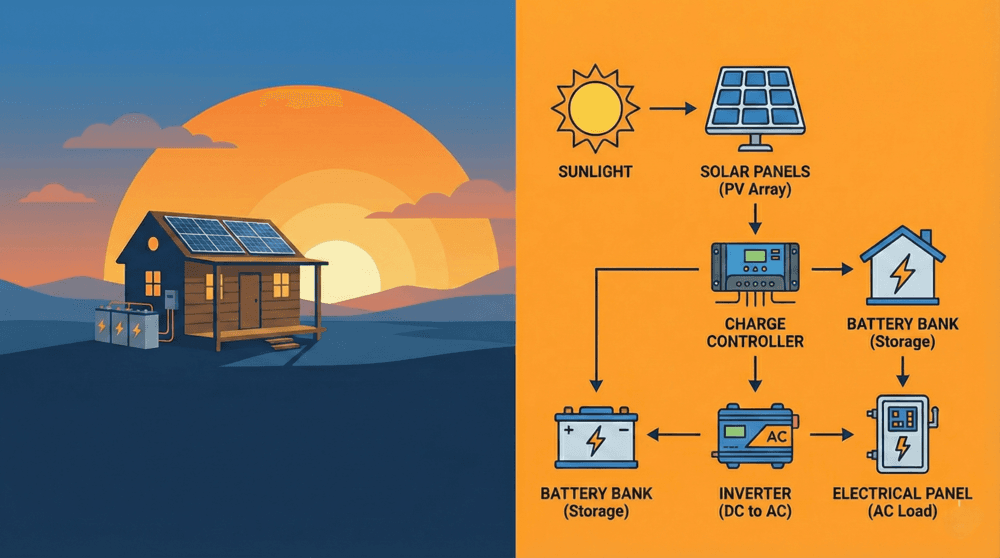
Off-Grid Solar System Requirements: Sizing, Permits & NEC Code Guide
Off-grid solar permit requirements by state: building codes, NEC compliance, bat...
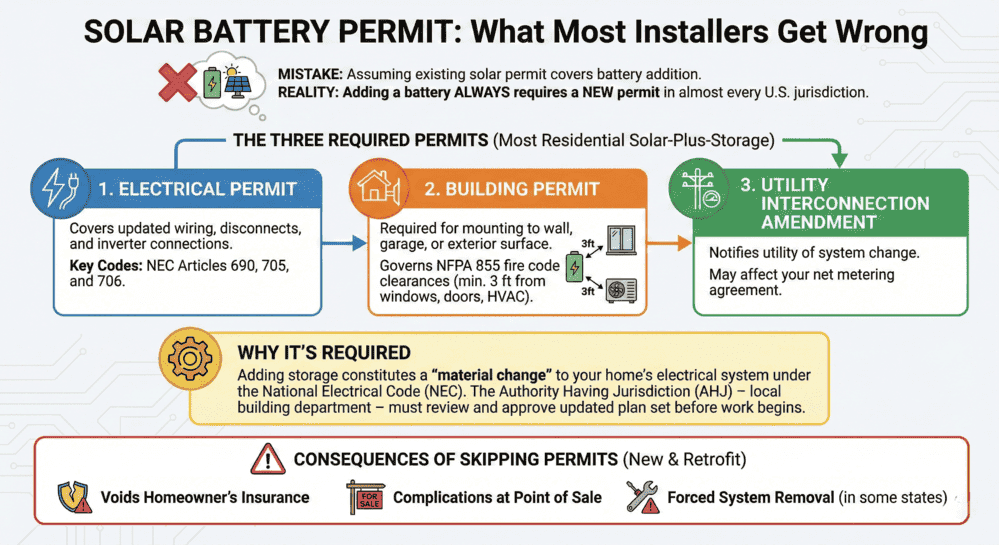
Solar Battery Permit: What Most Installers Get Wrong
Quick Answer: Adding battery storage to a solar system almost always requires ne...
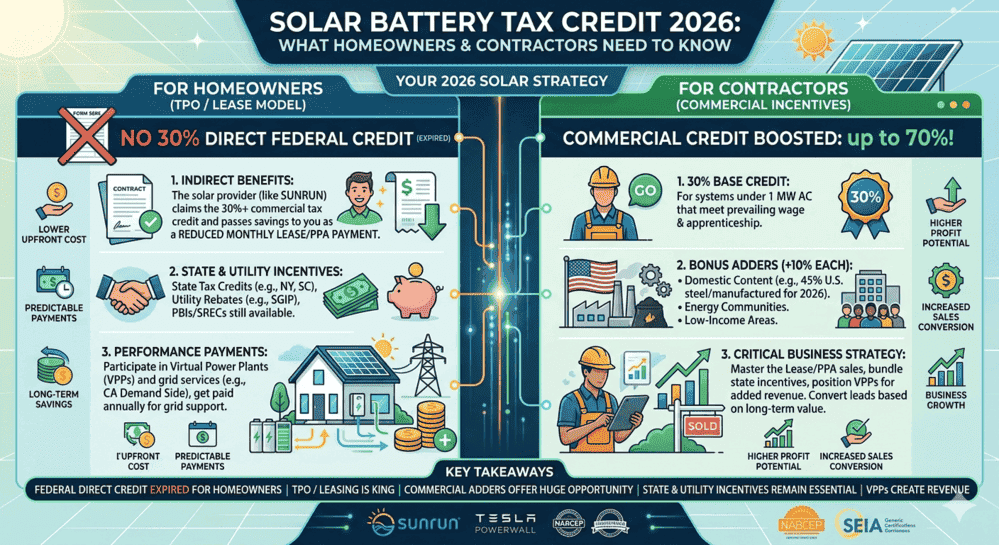
Solar Battery Tax Credit 2026: What Homeowners and Contractors Need to Know
There is no federal solar battery tax credit available to homeowners in 2026. Th...