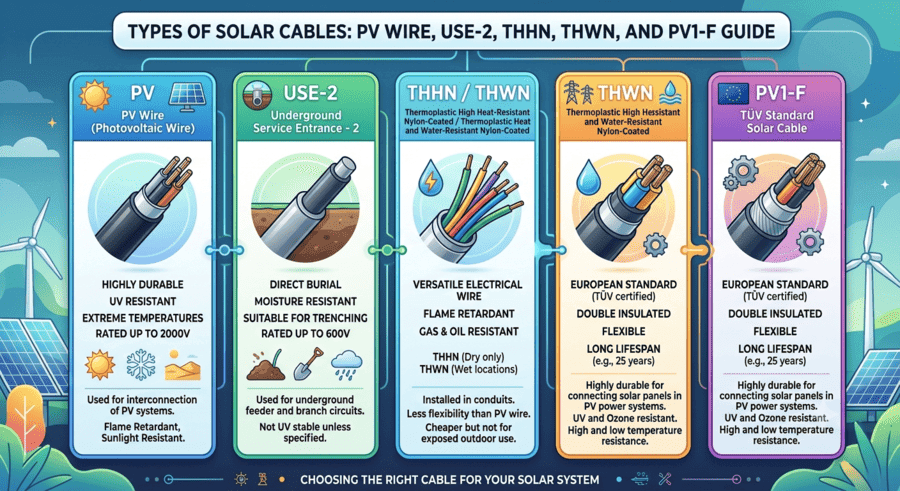
The primary cable used in modern solar panel systems is PV wire, a conductor built specifically for direct current photovoltaic circuits. PV wire is sunlight resistant, moisture resistant, flame retardant, and listed under UL 4703 for up to 2,000 volts. Depending on where a given run sits in the system, installers also use USE-2 wire for direct burial and THHN or THWN wire inside conduit for indoor and utility-side runs.
Choosing the correct solar cable is not a minor spec decision. The conductor running from a PV module to a combiner box, an inverter, or a battery has to survive two or three decades of ultraviolet exposure, thermal cycling, and moisture while carrying enough current to avoid voltage drop and overheating. Different segments of a solar installation call for different cable types, and using the wrong one in the wrong location is a common reason an AHJ reviewer sends a plan set back for correction. This guide breaks down every major solar cable type, USE-2, THHN, THWN, and PV1-F; compares their ratings side by side; walks through AWG sizing; and explains how conductor documentation needs to appear in a permit plan set to earn approval on the first submission.
In This Guide
- What Is PV Wire?
- Types of Solar Cables (PV Wire, USE-2, THHN, THWN, PV1-F)
- Solar Cable Comparison Chart
- How to Choose the Right Solar Cable
- Solar Cable Sizes: AWG Guide
- Solar Cable Standards
- Common Solar Cable Installation Mistakes
- Why Cable Selection Matters for Permitting
- Expert Tips for Choosing Solar Cables
- Frequently Asked Questions
What Is PV Wire?
PV wire, short for “photovoltaic wire,” is a single-conductor cable engineered to interconnect solar modules and carry direct current from the array to the rest of the system. It differs from ordinary building wire in four ways that matter for a permit reviewer: insulation, conductor type, temperature rating, and exposure rating. PV wire typically uses cross-linked polyethylene, or XLPE, insulation, which resists heat deformation far better than the thermoplastic insulation found in general-purpose building wire. The conductor itself is almost always stranded copper, sometimes tinned, which stays flexible enough to route around module frames and through racking without cracking.
The cable is listed under UL 4703, the standard that governs single-conductor photovoltaic wire rated for sunlight exposure at 90°C wet, up to 150°C dry, and system voltages of 600V, 1000V, or 2000V. Because PV wire is rated for continuous outdoor and rooftop exposure, it can run exposed on a racking system without conduit, something THHN and THWN are not permitted to do. It is also rated for both grounded and ungrounded array configurations, which is why it has become the default conductor for the module-to-combiner and combiner-to-inverter segments of a system.
On a solar single-line diagram, PV wire is the conductor callout you will typically see between the array and the first piece of downstream equipment. A reviewer tracing that diagram follows the same physical path the cable actually takes:
- Panel to panel and panel to combiner: PV wire, exposed on racking or in free air
- Combiner to inverter: PV wire in conduit or continuing exposed, depending on routing
- Inverter to battery, where applicable: battery cable or PV wire rated for the application
- Inverter or battery to the main service panel: THHN or THWN inside conduit
Types of Solar Cables
A single solar installation typically uses more than one cable type, because no single conductor is optimized for every segment of the run. The table below introduces the five cable types covered in this guide before the detailed breakdown of each.
PV Wire
PV wire is purpose-built for the DC side of a photovoltaic array. Its thick, UV-stabilized jacket and XLPE insulation let it sit in direct sunlight on a rooftop for the full life of the system, typically 25 years or more, without the insulation drying out or cracking. Because it is rated for both 90°C wet and up to 150°C dry service, it holds up under the thermal cycling that happens every day as a rooftop heats up and cools down.
| Spec | PV Wire Rating |
|---|---|
| Voltage | 600V, 1000V, or 2000V |
| Temperature | 90°C wet / up to 150°C dry |
| Conductor | Stranded copper (bare or tinned) |
| Insulation | XLPE, thick jacket |
| UV rating | Sunlight resistant, rated for permanent outdoor exposure |
| Wet rating | Yes |
| UL standard | UL 4703 |
Pros: exposed installation without conduit, excellent UV and ozone resistance, usable in grounded and ungrounded arrays. Cons: higher cost per foot than THHN, and not intended for direct burial. Best applications: module interconnects, string wiring, and the run between the array and a solar combiner box.
USE-2 Wire
USE-2, underground service entrance cable rated for 90°C wet locations, is the standard choice when a conductor needs to run underground or through direct burial without conduit. It shares a similar temperature and moisture rating with PV wire but is built for a different mechanical environment: USE-2 is typically installed in a trench and left undisturbed, so it does not need the same flexibility or abrasion resistance that a rooftop-routed PV wire needs. Per the NEC 690.31 wiring requirements for solar systems, USE-2 is limited to grounded PV arrays, while PV wire can be used in both grounded and ungrounded configurations, which is one of the most commonly missed distinctions on a plan set.
Pros: cost-effective for underground runs, rated for direct burial, widely available. Cons: not permitted for ungrounded arrays; less UV and mechanical protection than PV wire when run exposed. Best applications: underground homeruns from a ground-mounted array or carport back to the main service equipment.
THHN Wire
THHN, thermoplastic high heat-resistant nylon-coated wire, is standard building wire used almost everywhere except on the exposed DC side of a solar array. It is not rated for sunlight exposure, so it always has to be run inside conduit. On a solar project, THHN typically appears on the AC side, feeding from the inverter output to the disconnecting means and on to the main service panel, where it stays protected inside metal or PVC conduit for its entire run.
Pros: inexpensive, widely stocked, easy to source in any gauge. Cons: not UV resistant, not wet rated in most formulations, requires conduit for the entire run. Best applications: indoor conduit runs and dry conduit runs on the AC side of the system.
THWN Wire
THWN, thermoplastic heat- and water-resistant nylon-coated wire, is essentially THHN with an added wet location rating. Many manufacturers now produce a dual rated THHN/THWN-2 product that satisfies both dry and wet conduit applications in a single cable, which is why THWN frequently replaces THHN wherever a conduit run might see moisture, such as an exterior conduit stub-up at the meter base or a wet underground conduit.
Pros: wet location rated, compatible with outdoor conduit, often sold as a dual-rated THHN/THWN-2 product. Cons: still requires conduit, not intended for exposed rooftop runs. Best applications: wet or exterior conduit runs, meter base connections, and any conduit segment exposed to condensation or weather.
PV1-F Cable
PV1-F is the European equivalent of PV wire, built to the IEC 62930 and EN 50618 standards rather than UL 4703. It is common on projects using European inverters or modules and on international installations where the electrical code references IEC rather than NEC standards. In the United States, PV1-F is rarely accepted on its own for permit purposes unless it is also independently listed to a recognized UL or equivalent NRTL standard, since most AHJs and commercial solar plan sets reference NEC Article 690 and its associated UL listings directly.
Pros: globally recognized, flexible fine-stranded conductor, widely used outside the United States. Cons: limited direct NEC recognition without a parallel UL listing, less commonly stocked by U.S. distributors. Best applications: projects using European equipment or installations where IEC compliance is the governing standard.
Solar Cable Comparison Chart
The table below summarizes how the five cable types compare across the criteria that matter most for system design and permitting. Keep a version of this comparison, along with your project’s solar wiring diagram, on hand any time you are deciding which conductor belongs on a given run.
| Feature | PV Wire | USE-2 | THHN | THWN | PV1-F |
|---|---|---|---|---|---|
| Outdoor exposed use | Yes | Limited | No | Limited | Yes |
| UV-resistant | Yes | Yes | No | Limited | Yes |
| Direct burial | No | Yes | No | No | Limited |
| Wet rated | Yes | Yes | No | Yes | Yes |
| Rated for solar arrays | Yes | Limited | No | No | Yes |
| NEC recognized | Yes | Yes | Yes | Yes | Regional |
Solar Permit Solutions
Need Solar Permit Plans?
Professional, permit-ready solar plan sets delivered fast. Residential and commercial projects across all 50 states.
How to Choose the Right Solar Cable
Cable selection is a system design decision, not a shopping preference. Start with the NEC 690.8 circuit sizing rules, which set the ampacity a conductor has to carry based on the module’s short circuit current and the required continuous current multiplier, then layer in the environmental and mechanical factors below.
- System voltage: confirm the array’s maximum voltage against the cable’s voltage rating, especially on strings pushing toward 600V, 1000V, or higher on commercial arrays
- Current and ampacity: size the conductor to the calculated maximum circuit current with the required safety multiplier, then apply temperature and conduit fill correction factors
- Temperature: match the cable’s temperature rating to both the ambient roof temperature and any derating required for conduit fill or rooftop mounting height
- Voltage drop: keep DC voltage drop under roughly 2 percent and AC voltage drop under roughly 3 percent by upsizing the conductor on long runs
- Distance: longer runs from array to inverter or inverter to service panel often require one or two gauge sizes larger than a short run would need
- Installation method: exposed rooftop routing calls for PV wire, underground calls for USE-2, and any conduit run calls for THHN or THWN
Quick decision guide: roof or exposed array wiring needs PV wire. An underground homerun needs USE-2. An indoor, dry conduit run needs THHN. A wet or exterior conduit run needs THWN. Any conductor inside the rapid shutdown array boundary also has to be documented separately in the plan set, since NEC 690.12 treats those conductors as a distinct safety zone regardless of which cable type is used to build it.
Solar Cable Sizes: AWG Guide
Wire gauge, expressed in AWG (American Wire Gauge), determines how much current a conductor can safely carry before overheating, and it is one of the first things an AHJ reviewer checks against the single-line diagram. Smaller AWG numbers mean thicker conductors and higher ampacity. The table below shows where each common gauge typically shows up in a residential or light commercial system.
| Wire Size | Typical Use |
|---|---|
| 10 AWG | Individual solar module leads and short string runs |
| 8 AWG | Longer string runs and some combiner outputs |
| 6 AWG | Combiner to inverter runs |
| 4 AWG | Inverter to battery connections |
| 2 AWG | Larger battery banks and higher current inverter outputs |
| 4/0 AWG | Whole home energy storage system feeders |
Battery and energy storage conductors deserve extra attention, since an undersized battery cable is a frequent source of overheating complaints in the field. If the project includes storage, review the NEC 690 and 706 compliance checklist for battery storage before finalizing conductor sizes, since a PV-only sizing calculation will not automatically account for the higher continuous currents that a battery discharge cycle can produce.
Solar Cable Standards
Every solar cable type referenced in this guide traces back to a specific code article or safety standard, and citing the correct one in a plan set is part of what earns first pass approval. The National Electrical Code (NFPA 70) governs conductor sizing and installation methods under Article 690 for PV systems and Article 310 for general conductor ampacity. UL 4703 is the listing standard for PV wire itself, while THHN and THWN fall under separate UL insulation standards for general building wire.
Outside the NEC, OSHA 29 CFR 1910.303(b)(2) requires that listed conductors be installed according to the manufacturer’s instructions, which matters when a cable’s data sheet specifies a bend radius, temperature derating, or connector pairing that goes beyond the bare NEC text. Field labeling for conduit runs and junction boxes should also follow ANSI Z535 design conventions for signal words, color coding, and minimum text height, since many AHJs reference ANSI Z535 directly when reviewing a label schedule.
Internationally, PV1-F cable is governed by IEC 62930 and EN 50618, the two standards that define insulation performance and voltage ratings for photovoltaic cable outside the UL system. Confirm with the specific AHJ whether an IEC-only listing will be accepted or whether a parallel UL 4703 listing is required before specifying PV1-F on a U.S. project.
Common Solar Cable Installation Mistakes
Most solar cable-related permit corrections and field failures trace back to one of the mistakes below.
- Using THHN or THWN exposed on a rooftop instead of inside conduit, since neither is rated for direct sunlight exposure
- Undersizing conductors by skipping the ampacity correction factors required under NEC 690.8, which is one of the most frequently cited violations in AHJ plan reviews
- Ignoring conduit fill limits, which forces conductors into contact and raises operating temperature beyond the cable’s rating
- Mixing copper and aluminum conductors at a battery interconnect, such as at an EG4 GridBOSS or similar power gateway, without an approved connector rated for dissimilar metals
- Skipping temperature correction for rooftop mounting height, where conductor temperature can run well above ambient air temperature
- Leaving junction boxes and conduit runs without the required PHOTOVOLTAIC POWER SOURCE conduit labeling every 10 feet under NEC 690.31(G)(4)
- Poor MC4 or crimped connections, which create resistance points that generate heat and, in some documented cases, arc flash events
- Selecting field labels that do not meet UL 969 durability standards for outdoor UV and moisture exposure, leading to labels that fade or peel before the next inspection cycle
Conduit visible from a rooftop firefighter access path also has to meet reflectivity and marking requirements under the International Fire Code, in addition to the NEC’s own labeling rules. A plan set that documents cable type and gauge but skips the labeling schedule is incomplete even when the underlying wire selection is correct.
Why Cable Selection Matters for Permitting
Every conductor specified in a solar design has to be traceable through the permit plan set, not just installed correctly in the field. A solar energy diagram that shows PV wire on the array side but fails to call out the transition to THHN at the first piece of conduit is exactly the kind of mismatch that generates a plan check comment. Reviewers trace the conductor path the same way an inspector will trace it in the field, checking that the cable type, gauge, and insulation rating shown on the diagram match what the equipment datasheets and conduit fill calculations support.
Cable specification requirements are not identical everywhere. Some jurisdictions still enforce older NEC editions with different ampacity tables, and PE stamp and structural thresholds vary by state PE stamp requirements, which means a conductor schedule that satisfies one AHJ can still draw a correction somewhere else. Databases like DSIRE and direct contact with the local Authority Having Jurisdiction remain the most reliable way to confirm which code cycle and conductor requirements actually apply before a plan set is finalized.
Grid-tied systems add another layer: utility interconnection applications typically require documentation that inverters and conductors meet IEEE 1547 interconnection standards, and jurisdictions using automated review platforms like SolarAPP+ enforce strict data completeness on conductor specifications before issuing an instant permit. According to NREL research, permitting and inspection soft costs remain a meaningful share of total residential solar costs, and a plan set that documents cable selection correctly the first time is one of the more reliable ways to avoid adding weeks to that cost through a revision cycle.
Expert Tips for Choosing Solar Cables
- Always follow the manufacturer’s installation instructions for bend radius, temperature derating, and approved connector types
- Size conductors to keep voltage drop under roughly 3 percent for branch circuits, checking both DC and AC segments separately
- Match the cable’s voltage rating to the system’s calculated maximum voltage, not just its nameplate operating voltage
- Use listed, compatible connectors from the same manufacturer family wherever possible to avoid mismatched MC4 pairings
- Confirm the local AHJ’s adopted NEC edition and any local amendments before finalizing a conductor schedule
- Document the full label schedule for conduit and junction boxes alongside the conductor schedule, not as a separate afterthought
Conclusion
Cable selection looks like a small line item on a bill of materials, but it is one of the details an AHJ reviewer checks first, because it touches safety, code compliance, and system longevity all at once. PV wire, USE-2, THHN, THWN, and PV1-F each solve a different problem: exposed array wiring, underground runs, dry conduit, wet conduit, and international equipment compatibility, respectively. Matching the right cable to the right segment of the system, sizing it correctly against NEC ampacity tables, and documenting the full conductor and labeling schedule in the plan set are what separate a first-pass approval from a revision cycle.
Solar Permit Solutions produces PE-stamped, AHJ-ready plan sets for residential and commercial solar projects across all 50 states, including complete conductor schedules, label documentation, and code citations built for first-pass approval. For the full picture of how cable selection fits into a complete submission, see our guide to solar permit design and plan sets. Create a free account to get started, or contact our team to discuss your next project.
Frequently Asked Questions
Can THHN be used outside?
Not exposed. THHN lacks sunlight resistance, and most formulations lack a wet location rating, so it always has to be installed inside conduit when used outdoors, and THWN or dual-rated THHN/THWN-2 is the safer choice for any exterior conduit run.
What is the difference between PV wire and USE-2?
PV wire can be used in both grounded and ungrounded PV arrays and is built with a thicker jacket for exposed, unsupported routing. USE-2 is limited to grounded arrays and is intended for direct burial or underground conduit rather than exposed rooftop routing.
Can PV wire be buried underground?
PV wire is not rated for direct burial. USE-2 is the standard choice for underground runs, since it is specifically listed for that application, while PV wire is intended for exposed or conduit routing above grade.
What size PV wire do I need?
Most individual module leads use 10 AWG, while combiner outputs and longer string runs often step up to 8 or 6 AWG. The correct size depends on the calculated maximum circuit current, the run length, and the voltage drop target, so a full ampacity calculation should confirm the final gauge.
What is the maximum voltage for PV wire?
PV wire listed under UL 4703 is available in 600V, 1000V, and 2000V ratings. The correct rating depends on the calculated maximum system voltage of the array, which has to be verified against the cable’s nameplate rating before installation.
Can solar cables be installed without conduit?
PV wire can be installed exposed without conduit because it carries a sunlight and weather-resistant rating. THHN and THWN cannot be installed exposed and require conduit for the entire run, both indoors and outdoors.
How long do PV wires last?
PV wire listed to UL 4703 is generally rated for a service life matching the solar array itself, commonly cited as 25 years or more, provided it is installed within its voltage, temperature, and mechanical limits and not damaged during installation.
Need Solar Permit Plans?
Professional, permit-ready solar plan sets delivered fast. Residential and commercial projects across all 50 states.
Frequently Asked Questions
PV wire is the primary cable used for solar module interconnects and array wiring because it is listed to UL 4703, is sunlight resistant, and is rated for both grounded and ungrounded arrays. USE-2 is used for direct burial runs, and THHN or THWN is used inside conduit on the AC side and other protected runs.
PV wire is a single-conductor cable built specifically for photovoltaic direct current circuits. It uses XLPE insulation over stranded copper, carries a UL 4703 listing, and is rated for continuous outdoor exposure at 90°C wet and up to 150°C dry, at voltages of 600V, 1000V, or 2000V.
PV wire carries a 90°C wet rating, meaning it is rated for continuous exposure to moisture, rain, and condensation. It is not the same as a submersible or direct burial rating, and it is not typically buried without conduit.

SPS Editorial Team
Solar Permit Solutions
Solar Permit Solutions provides professional solar permit design services for residential, commercial, and off-grid installations across all 50 states. Our team ensures permit-ready plan sets delivered fast.
Related Articles
How To Add A Battery To Your Existing Solar System
Adding a battery to your solar system costs $10,000-$20,000. Save with 30% feder...
Solar Inspection Documentation: Required Documents and Checklist
Learn about solar inspection documentation, including permit requirements, NEC c...
Solar Panel Inspection Checklist: What To Check & When To Inspect
Solar panel inspection guide: Learn what to check, when to inspect (annually + e...