Essential Voltage And Wiring Standards For Solar Installations
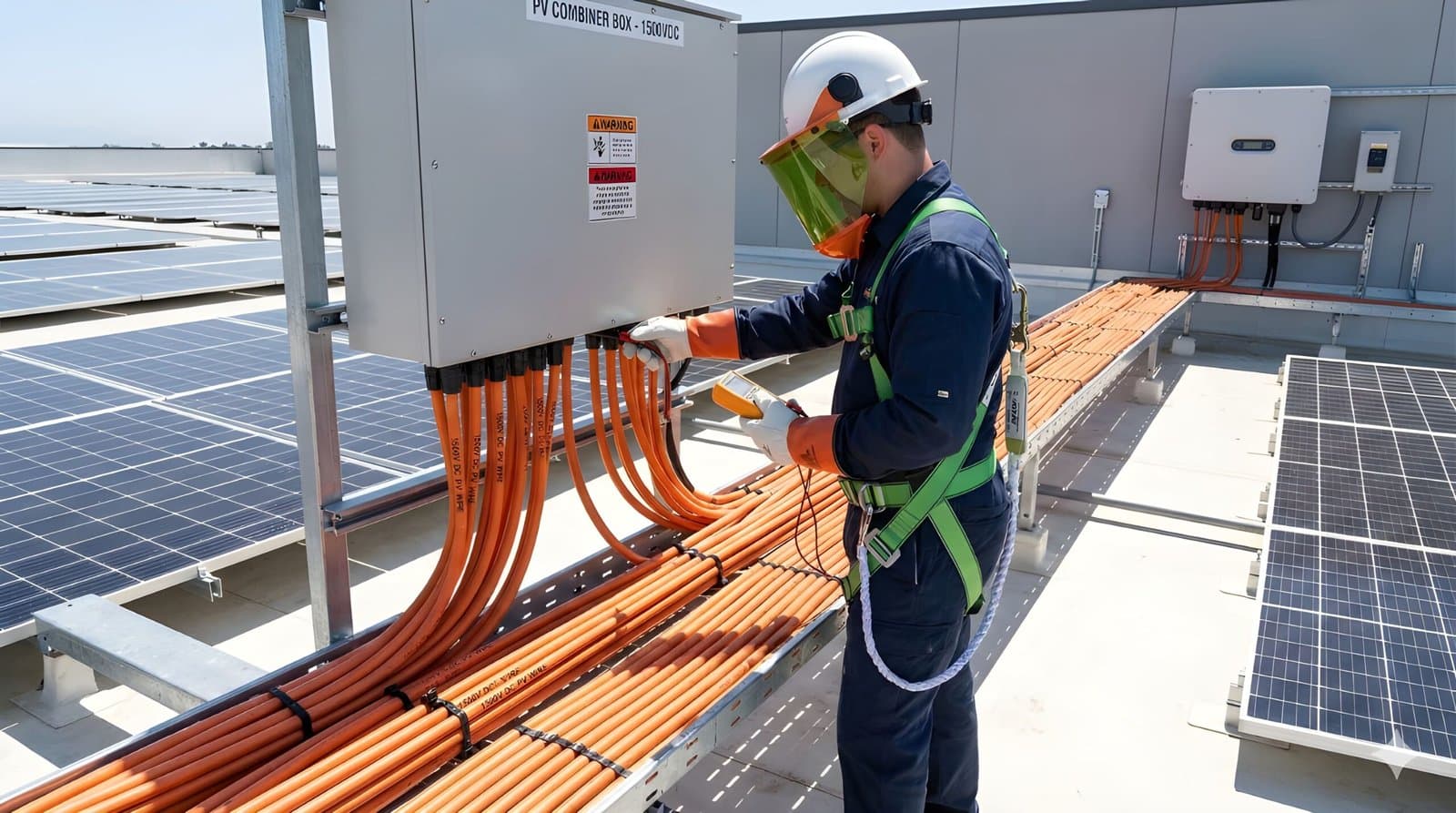
The 2023 NEC opened a door that was previously locked: running DC circuits above 1000 volts on building exteriors. For commercial installers and designers working with ground-mount arrays on tight sites, this changes everything. Instead of stretching long AC runs or forcing inverter placement at the array, Section 690.31(G) now permits higher voltage DC wiring along building surfaces within a defined installation zone.
These new possibilities come from Section 690.31, which governs all solar wire and cable requirements for photovoltaic systems. It establishes three distinct voltage thresholds that determine installation methods: residential systems are limited to 600 volts DC maximum, building-mounted arrays cannot exceed 1000 volts DC, and the 2023 NEC introduces new provisions allowing systems between 1000 and 1500 volts DC on building exteriors under specific conditions.
Section 690.31(G), new to the 2023 code cycle, permits high-voltage DC circuits (above 1000 Vdc) on building exteriors when equipment remains within 10 feet of grade and wiring methods do not extend beyond 33 feet along building surfaces. These installations are prohibited within one-family and two-family dwellings and cannot enter buildings containing habitable rooms. Systems operating in this voltage range must use conductors rated for 2000 volts minimum, such as PV wire or USE-2 cable, with appropriate conduit protection and temperature derating per NEC Article 310.15.
NEC 690.7 Maximum Voltage Requirements
Section 690.7 defines the maximum voltage parameters for PV system DC circuits. The code measures maximum voltage as the highest potential between any two conductors or between any conductor and ground. Three primary requirements govern system voltage limits:
- Building-Mounted Systems: PV system DC circuits originating from or located within arrays on buildings must not exceed 1000 volts. This restriction applies to any circuit within or originating from building-mounted or building-attached arrays.
- Residential Dwelling Limits: One-family and two-family dwellings face stricter voltage constraints, with PV system DC circuits limited to 600 volts maximum for residential solar installations.
- High-Voltage Provisions: Systems exceeding 1000 volts DC must comply with the specialized requirements outlined in Section 690.31(G).

Changes To Voltage Standards In The 2023 NEC
The 2023 code cycle introduced formatting updates to align with NEC style guidelines, converting requirements into a structured list format. While the presentation changed, the fundamental voltage restrictions for arrays remain consistent at 1000 Vdc maximum.
The residential dwelling limit of 600 Vdc carries over unchanged from previous code editions. However, the 2023 NEC introduces new provisions for systems operating between 1000 and 1500 Vdc, detailed in the newly created Section 690.31(G).

Solar Permit Solutions
Skip the Permit Headaches
We design plan sets that pass inspection the first time. Code-compliant, PE-stamped, accepted by AHJs nationwide.
NEC 690.31(G) Wiring Methods For Systems Over 1000 Volts DC
Section 690.31(G) represents a significant addition to the 2023 NEC, establishing specific requirements for equipment and wiring methods containing PV system DC circuits above 1000 volts. This section creates defined pathways for higher voltage installations while maintaining safety parameters.
Residential Restrictions
Systems exceeding 1000 volts DC cannot be installed on or within one-family and two-family dwellings. This prohibition reinforces the 600-volt limit established in Section 690.7(2) for residential applications.
Where You Cannot Install: Habitable Space Limitations
Buildings containing habitable rooms are completely off-limits for wiring methods carrying DC circuits above 1000 volts. The NEC defines habitable rooms as spaces used for living, sleeping, eating, or cooking. This means office buildings, apartment complexes, hotels, and restaurants cannot have these circuits running inside.
However, exterior walls of these same buildings are permitted locations, provided the installation stays within the dimensional zone. Non-habitable spaces like mechanical rooms, storage areas, and utility closets are explicitly excluded from the habitable room definition. Keep in mind that routing any DC circuit above 1000 volts through a building’s interior is generally prohibited by Section 690.31(G); the allowance is specifically for exterior installations only.
The New 33 Foot By 10 Foot Installation Zone
The code permits specific exterior installations for systems exceeding 1000 Vdc when following precise dimensional requirements. This creates a defined installation zone measuring 33 feet wide by 10 feet tall on building exteriors:
Height Restriction: Equipment and wiring methods must be located no more than 3 meters (10 feet) above grade level when measured from ground surface.
Width Limitation: Wiring methods and DC equipment, including conduits and inverters, cannot extend more than 10 meters (33 feet) along the building surface from the equipment location. Proper fuse and protection placement within these constraints ensures accessible maintenance.
This dimensional constraint represents a significant change from previous code editions that completely prohibited DC circuits exceeding 1000 volts on building exteriors.
Primary Benefit: Simplified Ground-Mount Interconnection
The biggest impact of Section 690.31(G) is for ground-mounted arrays on compact sites. Before the 2023 NEC, placing DC circuits above 1000 volts on building exteriors was completely prohibited. This forced installers into two less-than-ideal scenarios: running long, inefficient low-voltage AC wiring from arrays to distant buildings, or positioning inverters and combiners at the array itself, far from the point of interconnection.
Now, installers can mount combiners or inverters directly on a nearby building’s exterior wall within the 33-foot by 10-foot zone and run higher-voltage, more efficient DC wiring. This eliminates excessive AC trenching costs and allows equipment placement closer to the utility interconnection point.
Real-World Application: A ground-mount array sits 20 feet from a warehouse. Instead of digging a 200-foot AC trench to reach the main service panel on the opposite side of the building, you can now: 1) Mount a combiner box on the warehouse exterior wall (within 10 feet of grade), 2) Run DC conduit 25 feet along the wall (under the 33-foot limit), and 3) Position the inverter near the service entrance. This cuts installation costs while maintaining code compliance.
These provisions benefit commercial site layouts where equipment proximity to structures becomes necessary. The dimensional parameters establish clear boundaries for equipment placement while expanding installation possibilities that were previously unavailable.

Wire And Cable Selection Considerations
When implementing systems under NEC 690.31(G), proper wiring method selection becomes critical. The wiring methods must accommodate higher voltage ratings while maintaining appropriate insulation levels and environmental protection. Conduit systems containing these DC circuits require careful routing to stay within the 10-foot height and 33-foot width boundaries.
Conductor Types for High-Voltage Applications
PV wire and USE-2 cable are your primary conductor options for DC circuits between 1000 and 1500 Vdc. Both feature 2000-volt insulation ratings, providing the necessary voltage withstand capability with appropriate safety margins. Standard THWN-2 building wire maxes out at 600 volts and cannot be used for these applications.
Wire sizing must account for both ampacity requirements and voltage drop considerations. Higher voltage systems carry lower current for equivalent power levels, often allowing smaller conductor gauges than comparable 600-volt systems. However, check NEC Article 310.15 for temperature derating factors when multiple conductors share conduit runs or when ambient temperatures exceed standard conditions. Rooftop conduit in full sun requires additional derating.
Conduit Material Selection
Rigid metal conduit (RMC), intermediate metal conduit (IMC), and electrical metallic tubing (EMT) provide robust mechanical protection for DC circuits above 1000 volts on building exteriors. PVC conduit rated for sunlight resistance offers a non-metallic alternative suitable for exposed outdoor installations, though metal conduit systems generally provide superior mechanical protection against impact damage.
The conduit fill calculations specified in NEC Chapter 9, Table 1 apply to these installations. Proper conduit sizing ensures adequate space for conductors while allowing for future wire pulling without damaging insulation. For systems approaching 1500 Vdc, maintaining generous conduit fill ratios becomes particularly important given the enhanced insulation thickness of higher voltage-rated conductors.
Environmental and Installation Factors
Direct sunlight can push conductor temperatures well above ambient levels. Roof-mounted conduit runs or wall-mounted equipment in full sun exposure require temperature correction factors from NEC 310.15(B)(3)(c). Factor these deratings into your ampacity calculations during the design phase, not during inspection.
Cable assemblies and wiring methods for systems above 1000 Vdc need enhanced specifications compared to standard residential work. The physical location restrictions, combined with proper arc fault protection, keep these higher voltage circuits accessible for maintenance while positioned away from casual contact. Label all equipment per NEC 690.31(G) requirements to alert maintenance personnel to elevated voltage levels.
Code Context: Article 495 Replaces Article 490
The 2023 NEC eliminated Article 490 and introduced Article 495, titled “Equipment Over 1000 Volts AC, 1500 Volts DC, Nominal.” For PV systems operating between 1000 and 1500 Vdc, Article 495 does not apply since these systems fall at the threshold of the nominal voltage range. Previous references to Article 490 in NEC 2020 no longer require consultation when working under the 2023 code edition. This is relevant for installers reviewing older high-voltage requirements documentation.
How To Design Within The Installation Zone
Designing installations that utilize the provisions of NEC 690.31(G) requires careful site planning. The equipment must fit within the specified dimensional envelope while maintaining proper clearances from other building features. Wiring routes need mapping to ensure DC circuits remain within the 33-foot lateral distance from equipment locations.
Ground-mount arrays positioned near buildings can benefit from these provisions when inverter or combiner box placement requires proximity to structures. The 10-foot height restriction typically accommodates wall-mounted equipment while preventing placement at elevated positions that would exceed code limits for off-grid system installations.
What Inspectors Want To See: Compliance Documentation
Adhering to NEC 690.31 requirements ensures electrical inspections proceed smoothly. Your permit package should include:
- System voltage calculations clearly showing maximum DC voltage levels
- Equipment location drawings with dimensions from grade and along building surfaces
- Wiring route diagrams demonstrating compliance with the 33-foot lateral and 10-foot height limits
- Conductor specifications showing 2000-volt rated wire (PV wire or USE-2)
- Rapid shutdown requirements documentation for systems exceeding 1000 Vdc
Installers must verify that all wiring methods and equipment meet the voltage ratings required for systems above 1000 Vdc. Clear documentation prevents inspection delays and revision requests.

Implementing 2023 NEC Standards On Your Projects
Understanding the solar wire and cable requirements under NEC 690.31 enables proper system design for installations across the voltage spectrum. The 2023 code updates provide clearer guidance while introducing new options for systems operating between 1000 and 1500 Vdc through professional design services.
Successful implementation requires attention to voltage limits, dimensional restrictions, and proper wiring method selection. These code provisions establish the framework for safe, compliant solar installations that meet current electrical standards while accommodating evolving system technologies.
Conclusion
The 2023 NEC introduces practical standards for solar wire and cable requirements under Section 690.31, expanding installation options for systems between 1000 and 1500 Vdc. The new 33-foot by 10-foot exterior installation zone provides defined pathways for higher voltage DC circuits on building exteriors while maintaining safety parameters.
For commercial installers, this changes the economics of ground-mount systems on compact sites. The ability to route high-voltage DC along building exteriors eliminates long AC trenching runs and enables equipment placement closer to utility interconnection points.
Success requires understanding three key voltage thresholds: 600 volts maximum for residential, 1000 volts maximum for building-mounted arrays, and up to 1500 volts for exterior installations within the dimensional zone. Systems above 1000 volts cannot enter buildings with habitable spaces but can attach to their exterior walls.
Use 2000-volt rated conductors (PV wire or USE-2), apply temperature derating for exposed conduit, and document your compliance clearly in permit packages. The 2023 NEC provides the regulatory framework necessary for safe, code-compliant installations that leverage new voltage capabilities while protecting people and property.
Proper planning, accurate documentation, and adherence to dimensional requirements ensure smooth permitting processes and successful inspections. The evolving landscape of solar installation standards under the 2023 NEC demonstrates the industry’s commitment to safety while accommodating innovative approaches to renewable energy deployment.
Need help designing a system that utilizes the new DC circuits above 1000 volts exterior wiring rules? Solar Permit Solutions specializes in NEC 2023 compliance and provides engineered permit packages with stamped drawings that clearly demonstrate adherence to Section 690.31(G) zone requirements for smooth permitting approval. Contact our engineering team to discuss your high-voltage system design and ensure full code compliance.
FAQs
Skip the Permit Headaches
We design plan sets that pass inspection the first time. Code-compliant, PE-stamped, accepted by AHJs nationwide.
Frequently Asked Questions
No, systems exceeding 1000 volts DC cannot be installed on or within one-family and two-family dwellings. The NEC maintains a strict 600-volt maximum limit for residential applications under Section 690.7(2). This restriction applies to all DC circuits within the PV system, ensuring enhanced safety standards and labeling for homes where occupants may have closer contact with electrical systems.
Equipment and wiring methods containing PV system DC circuits above 1000 volts must be located no more than 3 meters (10 feet) above grade level when installed on building exteriors. This height restriction, specified in NEC 690.31(G)(3), ensures that higher voltage components remain accessible for maintenance while positioned away from elevated areas where contact risks increase.
Wiring methods and DC equipment for systems exceeding 1000 volts cannot extend more than 10 meters (33 feet) along the building surface from the equipment location. This lateral distance limitation works in conjunction with the 10-foot height restriction to create a defined installation zone of 33 feet wide by 10 feet tall for higher voltage DC circuits on building exteriors.
Systems exceeding 1000 volts DC are not permitted within buildings containing habitable rooms. Office spaces qualify as habitable rooms under NEC definitions since they are used for working and occupied activities. However, these systems can be installed on the exterior of such buildings, provided they comply with the dimensional restrictions of 10 feet in height and 33 feet in width specified in Section 690.31(G)(3).
Ground-mount arrays themselves do not face voltage restrictions based on proximity to buildings. However, if DC wiring or equipment from systems exceeding 1000 volts needs to attach to or run along a building exterior, they must comply with NEC 690.31(G)(3) requirements. This means maintaining equipment within 10 feet of grade and limiting wiring runs to 33 feet along the building surface. Ground-mount systems operating between 1000 and 1500 Vdc benefit from these provisions when equipment placement near structures becomes necessary.
Article 495, titled 'Equipment Over 1000 Volts AC, 1500 Volts DC, Nominal,' does not apply to PV systems at exactly 1500 Vdc nominal voltage. The article covers equipment exceeding these thresholds. Since solar systems discussed under NEC 690.31(G) operate between 1000 and 1500 Vdc, they fall below the threshold requiring Article 495 compliance in jurisdictions that have adopted the 2023 NEC.
The NEC does not specify exclusive wiring method types for DC circuits above 1000 volts but requires that selected methods accommodate the higher voltage ratings with appropriate insulation levels. Conduit systems commonly serve these applications, providing mechanical protection and environmental shielding for conductors. The wiring methods must maintain proper voltage ratings throughout their length and comply with the installation location requirements outlined in Section 690.31(G) when attached to buildings.

SPS Editorial Team
Solar Permit Solutions
Solar Permit Solutions provides professional solar permit design services for residential, commercial, and off-grid installations across all 50 states. Our team ensures permit-ready plan sets delivered fast.
Related Articles
AC vs DC Coupled Solar Batteries: Which Should You Choose?
AC vs DC coupled solar batteries compared: efficiency, costs ($8K-$18K), and ins...
How Many Solar Panels Do I Need to Run Off the Grid?
Most off-grid homes need about 8 to 16 solar panels rated at 400 watts, dependin...
Solar Battery Permit Requirements: What You Need to Know
A solar battery usually needs local approval and a utility review before it can ...