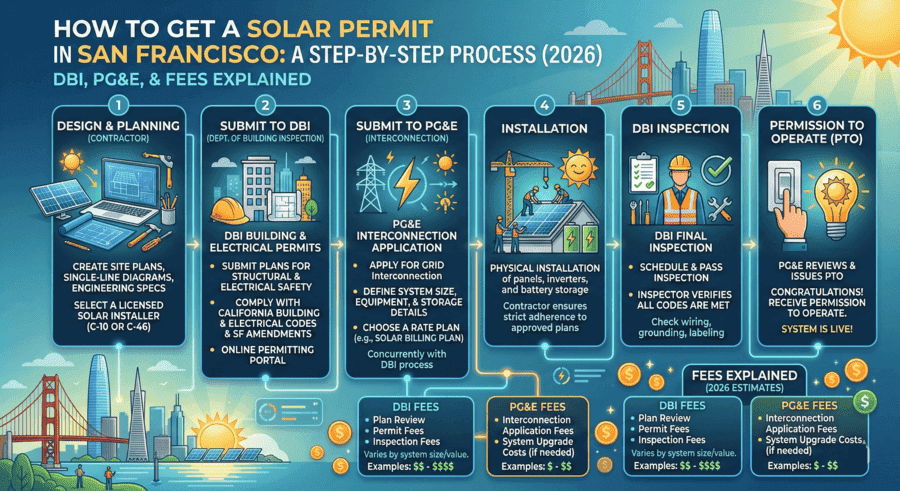
San Francisco solar permits require two separate approvals before your system can legally operate: a permit from the Department of Building Inspection (DBI) and an interconnection approval from PG&E. DBI issues permits at 49 South Van Ness Avenue and has used 100% electronic plan review since January 2024. PG&E governs grid connection under NEM 3.0, its Net Billing Tariff in effect since April 2023.
San Francisco has three permit pathways depending on your project type:
SolarAPP+ (instant permit): Available only for existing single- or two-family homes with systems 4 kWdc or smaller that are the only PV system on site and not located in a historic district.
PV Plans (email submission): Required for all systems over 4 kWdc, multifamily buildings, commercial properties, systems with battery storage, and projects with a panel upgrade. Email plans to DBI.pvplans@sfgov.org.
Building Permit: Required when solar is installed on a newly constructed building.
Every San Francisco solar installation, regardless of pathway, requires a mandatory SF Fire Department inspection at (415) 558-3300 before DBI’s electrical inspection can proceed.
Two additional SF-specific rules catch most homeowners off guard. First, properties in any of San Francisco’s 200+ historic districts or individually designated landmarks require SF Planning Department review before DBI will issue any permit, adding four to eight or more weeks. Second, certain neighborhoods in San Francisco are served by PG&E secondary electrical networks where interconnection may not be available. Verify your address before purchasing equipment.
Residential permit fees are capped at $450 for systems up to 15 kW under California AB 1132 (effective through 2034). PG&E charges a separate one-time $145 interconnection application fee. Under NEM 3.0, new solar customers export excess energy at roughly $0.08/kWh, about 75% less than under the previous NEM 2.0 program, making battery storage the recommended approach to maximize savings in San Francisco in 2026.
Why San Francisco Is One of California’s Most Complex Solar Markets
San Francisco homeowners pay some of the highest electricity rates in PG&E territory, often exceeding $0.35 per kWh, making solar one of the most financially compelling upgrades available. Yet the permitting process here is unlike any other California city, and the economics shifted significantly when PG&E’s NEM 3.0 (Net Billing Tariff) took effect in April 2023. According to the SEIA California Solar Market Insight, California leads the nation in installed solar capacity, but San Francisco’s dense, historic building stock and layered regulatory environment create challenges that statewide guides routinely miss.
This guide covers every step: the three DBI permit pathways, the mandatory SF Fire Department inspection that catches most installers off guard, the historic district rules that can add months to a timeline, PG&E’s NEM 3.0 interconnection process, current fees, and the financial picture after the federal residential tax credit expired December 31, 2025. For the broader California context, see our Solar Panel Permitting in California: Everything You Need to Know. For a deep dive into PG&E territory specifically, see our Going Solar With PG&E: Complete NEM 3.0 Guide.
Do You Need a Solar Permit in San Francisco?
Yes. Every solar PV installation in San Francisco requires at minimum an electrical permit from the Department of Building Inspection. The DBI, located at 49 South Van Ness Avenue, is the permit authority for all construction in the city. As of January 1, 2024, DBI transitioned to 100% electronic plan review, so there are no in-person plan drop-offs for solar applications. For the official step-by-step process, see the SF.gov: Get a Solar PV System Permit.
There is no system-size exemption that eliminates the permit requirement. Even small rooftop systems on single-family homes require a DBI electrical permit at minimum. The pathway to that permit, and what additional reviews are required, depends on your system size, property type, and whether your building has any historic designation.
Understanding What Is the AHJ in Solar and Why It Controls Your Project Timeline matters here: in San Francisco, multiple agencies act as the AHJ depending on the project. DBI handles electrical and building permits. The SF Planning Department controls historic properties. The SF Fire Department has independent inspection authority. PG&E governs interconnection. All four must sign off before your system is legal to operate.
San Francisco’s Three Solar Permit Pathways
San Francisco is unusual among California cities in offering three distinct permit pathways. Choosing the wrong one adds weeks to your timeline and can require a complete resubmission. Here is how to determine which applies to your project.
Pathway A: SolarAPP+ (Instant Electrical Permit)
SolarAPP+ is the fastest route and issues an instant online electrical permit. However, eligibility is narrow. All of the following must apply:
- Existing single- or two-family home (R3 occupancy), not multifamily and not commercial
- System size: 4 kWdc or smaller
- The only PV and energy storage system on the property
- No ballasted or ground-mounted arrays
- No new service or panel upgrade included in the scope
- Property is not a historic landmark or a contributory resource in a designated historic district
If your project meets every criterion, your contractor, who must be registered with DBI, generates a SolarAPP+ Approval ID, Inspection Checklist, and Specification Sheet. That Approval ID enables instant electrical permit issuance from DBI online with no waiting for plan review. Even so, the SF Fire Department inspection covered in Section 5 is still required after installation before PG&E will schedule final interconnection. To understand all the documents involved, see our guide on Solar Panel Permit Requirements: How to Avoid Delays and Rejections.
Pathway B: PV Plans (Email Submission for Electrical Permit)
This is the most common pathway for San Francisco solar projects. It applies to all systems over 4 kWdc, multifamily buildings, commercial properties, projects with battery storage or a panel upgrade, and any system not eligible for SolarAPP+.
How to submit: Email your complete application to DBI.pvplans@sfgov.org with the subject line “New PV Application from [Your Name or Project Name].” Required documents include:
- Completed solar permit application PDF
- Single-line electrical diagram compliant with NEC Article 690 Updates for Installers (2023) and NEC Article 705
- Site plan showing panel placement and roof fire access pathways
- Equipment data sheets for all panels, inverters, and major components
- Structural drawings and calculations stamped and signed by a California-licensed civil or structural engineer. See our resource on PE Stamp Requirements for Texas, California and Florida for what this involves.
- Racking system documentation: manufacturer, maximum allowable weight, attachment method, and product evaluation report
Fire code compliance is reviewed at the plan stage. SF requires a minimum 3-foot setback from the array to the street edge and an 18-inch to 3-foot front-to-back pathway depending on roof pitch. For conductor sizing and grounding details that are frequently rejected, review our NEC 690.8 Circuit Sizing: Stop Permit Rejections guide and Solar PV Grounding and Bonding: Essential Requirements requirements.
Pathway C: Building Permit (New Construction Only)
If solar is being installed on a newly constructed building, you must first obtain a DBI building permit, then apply for the electrical permit after it is issued. New nonresidential buildings of 2,000 square feet or greater and ten or fewer floors must install solar in the designated solar zone under the SF Green Building Code Section 5.201, a requirement with no equivalent in most other California cities. The SF Planning Department must also approve compliance with the “Better Roof” requirements. Contact the SF Planning Department early for new construction projects.
Solar Permit Solutions
Skip the Permit Headaches
We design plan sets that pass inspection the first time. Code-compliant, PE-stamped, accepted by AHJs nationwide.
Historic District Properties: San Francisco’s Biggest Permit Wild Card
San Francisco has more than 200 designated historic districts and thousands of individually landmarked buildings. This is the single most common cause of unexpected permit delays in the city, and it catches homeowners and installers off guard more than any other SF-specific requirement.
The rule: Any solar installation on (a) a designated landmark building, (b) a contributory resource in a designated historic district, or (c) a property on or eligible for the National or State Register of Historic Places requires review by the SF Planning Department before DBI will issue any solar permit. Planning must confirm compliance with Article 10 of the Planning Code. Depending on the outcome, the application may be referred to the Historic Preservation Commission (HPC) under Planning Code Section 1005.
This requirement applies regardless of system size. A SolarAPP+-eligible 3 kW system on a Victorian in the Haight Ashbury Historic District still requires Planning Department review. That review can add four to eight or more weeks to the timeline, and some designated properties face denial if the installation would materially alter the historic character of the building.
Action step: Before preparing any permit documents for a San Francisco solar project, check the property against SF Planning’s historic resources maps at SF Planning Department. Confirming historic status at the outset prevents wasted engineering work and avoids surprise delays mid-application.
SF Fire Department Inspection: Required for Every Pathway
This is the detail that most statewide guides miss entirely. In San Francisco, the SF Fire Department conducts a separate inspection for every solar PV installation, regardless of which permit pathway was used. This is not optional and cannot be waived.
How to schedule: Call the SF Fire Department at (415) 558-3300. You will need the scope of work, contractor contact information, your permit number or SolarAPP+ Approval ID, and the printed checklist and specification sheet.
Inspection sequence by pathway:
- SolarAPP+ (Pathway A): Fire Dept inspection first, then DBI electrical inspection
- PV Plans (Pathway B): Fire Dept review and inspection required before DBI electrical inspection
- Building Permit (Pathway C): Fire Dept district inspector (number on approval stamp), then DBI electrical, then DBI building final inspection
The Fire Department charges $144 per hour for field inspections. DBI inspections start at $181.82 per hour. These fees apply if additional inspections are required beyond the standard visit and can be paid by phone at (415) 558-3300 or in person at Fire Department Headquarters, 698 2nd Street, Room 109. Do not schedule DBI electrical inspection until Fire Dept has signed off, as doing so out of order resets the queue and delays PTO.
PG&E Interconnection: A Separate Required Process
The PG&E Secondary Network Issue
Before submitting any permit or interconnection application, verify your SF address against PG&E’s Secondary Network areas. Certain neighborhoods in San Francisco and Oakland are served by secondary electrical networks where PG&E may not be able to interconnect a solar generator. If your property is in one of these zones, you may face significant delays or outright denial of grid connection. Check the PG&E Secondary Network Areas Notice before investing in engineering or permit documents.
NEM 3.0 (Net Billing Tariff): What It Means for SF Homeowners in 2026
PG&E’s Net Billing Tariff, known as NEM 3.0, has applied to all new interconnection applicants since April 15, 2023. This is the most consequential policy change affecting San Francisco solar economics in a decade. Key facts for 2026:
- Export credit rate: Under NEM 3.0, the average credit for excess solar exported to the grid is approximately $0.08 per kWh, compared to roughly $0.30 per kWh under NEM 2.0, a 75% reduction.
- Self-consumption priority: Battery storage is now economically essential in SF under NEM 3.0. Systems that store daytime solar production and discharge during PG&E’s evening peak hours (6 to 9 PM) recoup far more value than export-only systems.
- ACC Plus adder: PG&E offers a small export rate supplement available through April 2028, declining by 20% annually. Customers who interconnect now receive a higher adder than those who wait.
- Lock-in period: Your export credit structure is locked in for nine years from your Permission to Operate (PTO) date.
- NEM 2.0 grandfathering: The final deadline for NEM 2.0-grandfathered customers to achieve PTO was April 15, 2026. NEM 2.0 is no longer available to new applicants.
- March 2026 billing change: PG&E replaced the monthly Minimum Electric Charge with a Base Services Charge of approximately $24 per month for all solar customers, starting March 2026.
For the complete breakdown of how to size your system and battery under NEM 3.0, see our Going Solar With PG&E: Complete NEM 3.0 Guide. For interconnection application requirements and documentation, see our Solar Interconnection Agreement: Complete Application Guide. For a technical explanation of load-side vs. supply-side connection options, see Supply-Side vs. Load-Side Solar Interconnection Methods.
PG&E Interconnection Application Requirements
Submit the interconnection application through PG&E’s online portal. Required documents: single-line diagram, site plan, inverter and panel specifications (IEEE 1547 and UL 1741 compliant). The one-time interconnection application fee is $145 for residential systems 30 kW or smaller. For the governing framework, see the CPUC Net Billing Tariff (NEM 3.0) or the PG&E Net Energy Metering and Solar Billing Program page.
Typical residential interconnection review takes two to four weeks. Projects in areas requiring PG&E grid upgrades under Electric Rule 21 face longer timelines and may bear upgrade costs. Do not energize the system until PG&E issues Permission to Operate. Operating before PTO is a violation in all 50 states and voids most equipment warranties.
San Francisco Solar Permit Fees
| Fee Item | Cost | Notes |
| DBI Residential Electrical Permit (systems up to 15 kW) | Capped at $450 (state law) | California AB 1132 cap applies through January 2034; $15/kW above 15 kW |
| DBI Electrical Permit (SolarAPP+ eligible systems) | Minimal / flat rate | Registered contractors only; instant online issuance |
| DBI Building Permit (new construction) | Valuation-based | 6 to 9% of construction valuation; per DBI fee schedule |
| SF Fire Dept field inspection (hourly) | $144/hour | Applies if additional inspections required beyond standard visit |
| DBI inspection (hourly) | $181.82/hour | Standard hourly rate for inspections not covered by flat fee |
| PG&E Interconnection Application (residential 30 kW or smaller) | $145 (one-time) | Due at interconnection application submission |
| PG&E Base Services Charge (solar customers) | Approx. $24/month | Effective March 2026; replaces Minimum Electric Charge |
California state law under California AB 1132: Solar Permit Fee Cap Through 2034 caps residential solar permit fees at $450 for systems up to 15 kW, with $15 per kW for each kilowatt above 15 kW. This cap is in effect through January 1, 2034. Note that DBI’s legacy valuation-based system sometimes overcharges; contractors can and should request a refund to comply with the state cap. The $450 residential cap does not cover SFFD hourly inspection fees assessed for additional visits. For strategies to control soft costs on both sides of the permit, see our guide on How to Reduce Solar Permit Design Costs and Approval Times.
Realistic San Francisco Solar Permit Timeline
| Phase | Timeframe | Description |
| 1 | Week 1 | System design, structural assessment, historic property check |
| 2 | Week 1 to 2 | DBI permit submission: SolarAPP+ same day; PV Plans email to DBI.pvplans@sfgov.org |
| 3 | Week 2 to 5 | DBI plan review (PV Plans pathway); SolarAPP+ permit issued instantly |
| 4 | Week 3 to 6 | Physical installation |
| 5 | Week 4 to 7 | SF Fire Dept inspection then DBI electrical inspection (must occur in sequence) |
| 6 | Week 5 to 9 | PG&E interconnection review and PTO issuance (2 to 4 weeks typical) |
| Total | 6 to 12 weeks | SolarAPP+ eligible: 4 to 6 weeks. Historic district properties: add 4 to 8+ weeks for Planning Dept review. |
San Francisco Solar Incentives in 2026
Federal Tax Credit (Section 25D): Expired
The 30% federal residential solar Investment Tax Credit expired December 31, 2025, following the passage of the One Big Beautiful Bill Act (OBBBA) signed July 4, 2025. There is no phase-down period: the credit terminated completely for homeowners installing systems in 2026 and beyond. For the IRS’s official guidance, see the IRS FAQs on Section 25D Expiration Under OBBBA. Third-party-owned systems (leases and PPAs) may still qualify under the commercial Section 48E credit if construction began by July 4, 2026 and the system is placed in service by December 31, 2027.
California Property Tax Exclusion (Active)
Active solar energy systems are excluded from property tax reassessment under California Revenue and Taxation Code Section 73. This means installing solar does not increase your SF property tax bill, despite adding significant property value. The exclusion is renewed periodically by the state legislature and remains in effect for 2026.
SGIP Battery Storage Rebate
The Self-Generation Incentive Program (SGIP) offers rebates for battery storage systems in PG&E territory. Under NEM 3.0, battery storage has shifted from optional to financially essential for most SF homeowners. Income-qualified customers receive higher SGIP rebates. Check current SGIP equity budget availability through Go Solar California before sizing your system.
NEM 3.0 ACC Plus Adder
PG&E offers a small export rate supplement (ACC Plus) through April 2028, declining by approximately 20% each January. Customers who interconnect in early 2026 receive a meaningfully higher adder than those who wait until 2027 or 2028. This creates a real financial incentive to move forward promptly rather than delaying.
DIY Solar and Commercial Permitting in San Francisco
DIY Solar
Homeowner self-installation is technically permitted in San Francisco, but the process is more restrictive than most California jurisdictions. All electrical work must be performed by or under the direct supervision of a licensed C-10 electrical contractor. B-license general contractors may apply for solar permits only on new construction or substantial remodels per the SF Electrical Code supplemental regulations. DBI requires contractor registration before any permit is issued online, which means homeowner self-permits are not an option for solar the way they are for some basic residential improvements. Most SF DIY installers contract with a solar permit design service for engineering drawings and PE-stamped calculations, then hire a licensed C-10 electrician for installation and final sign-off. Our Residential Solar Permit Design service covers both contractor and DIY projects throughout San Francisco.
Commercial Solar
All San Francisco commercial solar projects use Pathway B (PV Plans) or Pathway C (building permit for new construction). Systems over 4 kW require Electrical Division review, and larger commercial systems may trigger reviews from multiple DBI divisions. The SF Green Building Code mandates solar installation in the designated solar zone for new nonresidential buildings of 2,000 square feet or greater with ten or fewer floors. For systems sized to serve commercial loads, proper Solar Engineering Requirements for Permits: Meeting AHJ Standards and NEC-compliant documentation are non-negotiable. See our Commercial Solar Permit Design services for full commercial plan set preparation. The Section 48E commercial ITC remains available for projects starting construction by July 4, 2026.
Conclusion:
San Francisco’s solar permitting process has more moving parts than almost any other California city. Between DBI’s three pathways, the mandatory Fire Department inspection, PG&E’s NEM 3.0 interconnection rules, and the historic district requirements that derail unprepared projects, getting it right the first time saves weeks and hundreds of dollars in resubmission costs.
Solar Permit Solutions handles the complete permit package for San Francisco residential and commercial projects. PE-stamped structural calculations, NEC-compliant electrical diagrams, fire code documentation, and PG&E interconnection preparation, all delivered in two to five business days.
Get Your San Francisco Solar Permit Package from Solar Permit Solutions
Solar Permit Solutions prepares complete permit-ready plan sets for San Francisco homeowners, DIY installers, and solar contractors. We handle the documents that DBI, the SF Fire Department, and PG&E require, including:
- NEC 690-compliant electrical one-line diagrams for the PV Plans pathway
- Structural calculations and PE-stamped letters from California-licensed engineers
- Fire code access pathway documentation for DBI review
- PG&E interconnection application preparation and Rule 21 compliance
- SolarAPP+ project preparation for qualifying systems
We coordinate with DBI and PG&E directly, handling plan review comments so you can focus on installation. Start with our Residential Solar Permit Design or Commercial Solar Permit Design service pages, or contact our team for a free quote.
Frequently Asked Questions
What is the PG&E secondary network restriction?
Certain neighborhoods in San Francisco and Oakland are served by secondary electrical networks where PG&E may not be able to interconnect solar generators. These properties may face delays or denial of grid connection. Always verify your address against PG&E’s Secondary Networks notice before incurring permitting or engineering costs.
Related Resources
From Solar Permit Solutions
- Solar Panel Permitting in California: Everything You Need to Know
- Going Solar With PG&E: Complete NEM 3.0 Guide
- PE Stamp Requirements for Texas, California and Florida
- NEC Article 690 Updates for Installers (2023)
- Solar Interconnection Agreement: Complete Application Guide
- Solar PV Grounding and Bonding: Essential Requirements
- Solar Engineering Requirements for Permits: Meeting AHJ Standards
- Arizona Solar Permits 2026: Requirements, Fees and HB2301 Guide
Official Sources
- SF.gov: Get a Solar PV System Permit
- SF Planning Department
- DBI Fee Schedule at SF.gov
- PG&E Net Energy Metering and Solar Billing Program
- CPUC Net Billing Tariff (NEM 3.0)
- California AB 1132: Solar Permit Fee Cap Through 2034
Disclaimer: Permit fees, timelines, code requirements, and incentive programs are subject to change. Always verify current requirements directly with the San Francisco Department of Building Inspection (sf.gov/dbi) and PG&E before submitting applications. This guide was last updated March 2026.
Skip the Permit Headaches
We design plan sets that pass inspection the first time. Code-compliant, PE-stamped, accepted by AHJs nationwide.
Frequently Asked Questions
Under California AB 1132, residential solar permit fees in SF are capped at $450 for systems up to 15 kW, plus $15 per kW above 15 kW. This cap is in effect through January 2034. Note that DBI's legacy system may initially calculate a higher valuation-based fee; contractors are entitled to a refund to comply with state law. PG&E charges a separate one-time $145 interconnection fee. Starting March 2026, solar customers also pay approximately $24 per month in PG&E's Base Services Charge. SFFD charges $144 per hour for any additional field inspections. Verify current rates at the DBI Fee Schedule at SF.gov.
No. SolarAPP+ is available only for existing single- or two-family homes (R3 occupancy) with systems 4 kWdc or smaller that are the only PV system on site, include no panel upgrade, and are not on a historic property. Larger systems, multifamily buildings, commercial properties, ground-mounted arrays, battery storage projects, and historic district properties are not eligible and must use the PV Plans email submission pathway.
SolarAPP+-eligible projects receive an instant electrical permit. PV Plans projects typically take two to five weeks for DBI review. Add one to two weeks for the required SF Fire Department and DBI electrical inspections, then two to four weeks for PG&E interconnection review. Standard projects run six to twelve weeks total. Historic district properties add four to eight or more weeks for Planning Department review.
Certain neighborhoods in San Francisco and Oakland are served by secondary electrical networks where PG&E may not be able to interconnect solar generators. These properties may face delays or denial of grid connection. Always verify your address against PG&E's Secondary Networks notice before incurring permitting or engineering costs.
No. The 30% federal residential solar tax credit (Section 25D) expired December 31, 2025 under the OBBBA. Homeowners installing solar in 2026 cannot claim this credit as system owners. California's property tax exclusion and SGIP battery storage rebates remain active. Third-party lease and PPA arrangements may still qualify under the commercial Section 48E credit.
Yes, always. The SF Fire Department inspection is mandatory for every solar PV installation in San Francisco, regardless of system size or permit pathway. There are no exemptions. Contact (415) 558-3300 to schedule after installation is complete.
For Pathway B (PV Plans), structural drawings and calculations must be stamped and signed by a California-licensed civil or structural engineer. This applies regardless of system size for any project not eligible for SolarAPP+. SolarAPP+ projects do not require a separate PE stamp. For a full breakdown of California PE stamp requirements, see our PE Stamp Requirements for Texas, California and Florida guide.

SPS Editorial Team
Solar Permit Solutions
Solar Permit Solutions provides professional solar permit design services for residential, commercial, and off-grid installations across all 50 states. Our team ensures permit-ready plan sets delivered fast.
Related Articles
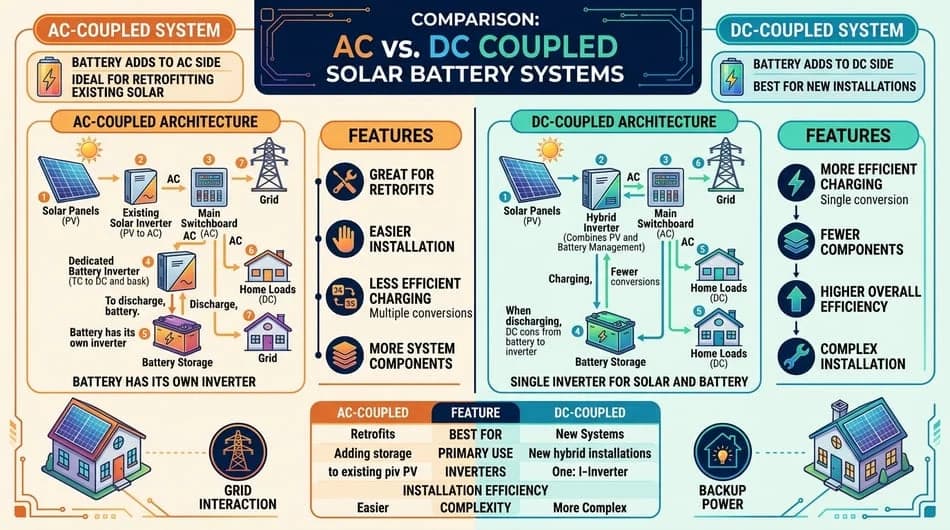
AC vs DC Coupled Solar Batteries: Which Should You Choose?
AC vs DC coupled solar batteries compared: efficiency, costs ($8K-$18K), and ins...
How Many Solar Panels Do I Need to Run Off the Grid?
Most off-grid homes need about 8 to 16 solar panels rated at 400 watts, dependin...
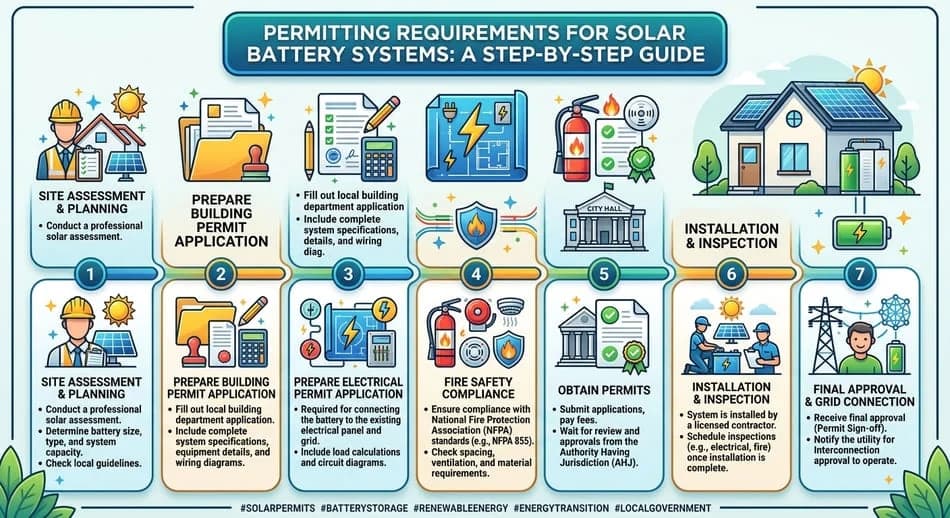
Solar Battery Permit Requirements: What You Need to Know
A solar battery usually needs local approval and a utility review before it can ...