
Updated May 2026 | By Solar Permit Solutions
Solar permits in Tennessee require approval from two separate authorities for nearly every installation: a local building and electrical permit from the city or county Authority Having Jurisdiction (AHJ) and an interconnection agreement with the local power company (LPC) that distributes Tennessee Valley Authority (TVA) electricity. Tennessee adopted the 2023 National Electrical Code statewide, and approximately 99.7% of the state’s service territory is supplied by TVA through 153 LPCs, including Nashville Electric Service (NES), Memphis Light, Gas and Water (MLGW), Knoxville Utilities Board (KUB), and EPB Chattanooga. Permit fees in Nashville start at $75, contractors must hold a Tennessee Department of Commerce and Insurance license, and interconnection follows TVA’s Dispersed Power Production (DPP) standards under IEEE 1547-2018 and UL 1741.
This guide breaks down the exact permitting workflow for installing solar in Tennessee in 2026, covering TVA interconnection rules, NES requirements in Nashville, MLGW requirements in Memphis, KUB requirements in Knoxville, EPB requirements in Chattanooga, contractor licensing, code adoption, and the 2026 federal tax credit window. Whether you’re a contractor managing multi-jurisdiction installs or a homeowner planning a system, every step below maps to a real form, fee, or filing.
Tennessee Solar Permit Overview: What 2026 Looks Like
Tennessee operates under a dual-layer regulatory structure for solar permitting. The state sets the baseline code (Tennessee adopted the 2023 National Electrical Code for construction permitting purposes), while counties and municipalities retain authority over plan review, inspection scheduling, and fee structures. This means a solar permit design approved in Nashville is not automatically valid in Memphis or Knoxville; each AHJ has its own application portal, plan submittal requirements, and fee schedule.
Layered on top of local permitting is the Tennessee Valley Authority. TVA partners with 153 local power companies that distribute its power across seven states serving roughly 10 million people, and every grid-tied solar installation must go through the local LPC’s interconnection process before the system can be energized. The one electric distribution utility in Tennessee not served by TVA is Appalachian Power (serving parts of upper East Tennessee), which is regulated separately by the Tennessee Public Utility Commission.
Net metering does not exist statewide in Tennessee. Instead, customers can sell excess generation through TVA’s Dispersed Power Production (DPP) program, which pays an avoided-cost rate that is substantially below retail. This single fact reshapes how Tennessee solar systems should be sized. A behind-the-meter system designed to maximize self-consumption typically delivers better economics than an oversized export-heavy system, which contrasts sharply with markets in states like California or New Jersey covered in our solar permitting in New Jersey guide.
Key 2026 Code and Standards
- Electrical Code: 2023 National Electrical Code (NEC), including Article 690 for PV and Article 705 for interconnected systems
- Building Code: International Residential Code (IRC) and International Building Code (IBC) as adopted by each AHJ
- Wind Load: ASCE 7-22 design wind speeds varying by county (roughly 90 to 115 mph design speed across most of Tennessee)
- Interconnection Standards: IEEE 1547-2018 and UL 1741 (or UL 1741-SA where applicable) for grid-tied inverters
- Decommissioning: Tenn. Code Ann. § 66-9-207 (2022 Decommissioning Law) governs removal obligations for solar power facilities
Compared with neighboring states, Tennessee’s permitting framework sits between the streamlined utility-driven model of Georgia and the more municipality-heavy structure of New Jersey. Contractors expanding into Tennessee from a Georgia solar permits practice will find the AHJ workflow familiar but the TVA interconnection layer entirely new.
How TVA’s Dispersed Power Production Program Works
The Dispersed Power Production (DPP) program is TVA’s mechanism for compensating residential and commercial customers who export excess solar generation to the grid. The program originated in 1981 following the federal Public Utility Regulatory Policies Act (PURPA) of 1978, was modernized following the Energy Policy Act of 2005; and applies to Qualifying Facilities (QFs) including solar, wind, biomass, and combined heat and power.
Under the published DPP guidelines for January 2026, TVA pays a flat schedule rate of 4.410 cents per kWh, with time-of-use prices that range from a Super Peak rate around 4.96 cents down to a Super Off-Peak rate in the mid-3-cent range. These rates are revised by TVA at least annually to reflect changes in projected avoided energy costs, and they have varied meaningfully through 2025, with monthly flat-schedule rates ranging from roughly 3.67 cents to 4.80 cents per kWh. For a homeowner whose retail rate is approximately 11 to 13 cents per kWh in 2026, this gap between DPP export compensation and retail is the central economic argument for sizing systems to consumption rather than for export. Battery storage further changes the calculation: systems with batteries minimize or eliminate exports altogether, so DPP participation often fails to recover its enrollment costs.
DPP Enrollment Workflow
Step 1. Sign an interconnection agreement with the LPC. Every Tennessee solar installation, regardless of DPP participation, requires an interconnection agreement with the local power company.
Step 2. Install a second meter socket. DPP requires installation of a separate meter socket in series with the residential socket on the utility side of the main residential overcurrent disconnect to measure excess generation for payment.
Step 3. Sign a DPP contract with TVA. This is a direct contract with TVA, separate from the LPC interconnection agreement. The customer is paid directly by TVA.
Step 4. Register through TVA’s online portal. DPP registration is processed through the TVA Green Hub at green.mytva.com, which routes the application to the LPC for technical review.
TVA Green Connect: Quality Contractor Network
Green Connect is TVA’s quality assurance program that connects homeowners with installers who meet TVA’s Quality Contractor Network (QCN) standards. Net metering is not available in the TVA service area, so participation in DPP is the only way to receive direct compensation for exported generation. Customers not participating in DPP can still install solar behind-the-meter for self-consumption, and a battery storage pairing is often the more economical path given the avoided-cost export rate.
Nashville Electric Service & Metro Codes Requirements
Nashville solar installations require two parallel approvals: an Electrical Photovoltaic Permit (the CAEP subtype in the Metro Nashville e-permits system) from the Metropolitan Department of Codes and Building Safety and a separate interconnection approval from Nashville Electric Service (NES). The two reviews run in parallel but are independent. Approval from one does not satisfy the other. NES is one of the 12 largest public power utilities in the United States and serves more than 460,000 customers across Davidson County and portions of six surrounding counties.
Metro Codes CAEP Permit
The CAEP permit is filed online through the Metro Nashville e-permits system. Per Metro Codes guidance, electrical photovoltaic permits start at $75 and may increase marginally depending on the fixture and equipment type. This is dramatically lower than corresponding fees for new construction projects of comparable cost. Nashville deliberately structured solar fees to encourage renewable adoption.
Plan submittal must include a site plan drawn to scale showing the proposed panel layout, required setbacks, and walking paths required by code. A plans examiner will review the documents to confirm that the roof or other installation site has adequate carrying capacity to support the additional load, similar to the roof load and structural review process that drives most plan rejections nationwide. Metro Codes states it makes best efforts to review completed residential permit applications within 30 days, with many residential permits approved within a week.
NES Renewable Energy Interconnection
NES participates in TVA’s Dispersed Power Production program and processes interconnection applications through its Renewable Energy portal at nespower.com. The application requires the same system specifications that Metro Codes also requires for the CAEP permit (single-line diagram, inverter spec sheets, panel datasheets, and structural attachment details), so most contractors prepare a single plan set that satisfies both reviewers.
The interconnection queue is generally well-managed, but contractors should expect 3 to 6 weeks from complete application to interconnection agreement execution. Customers should confirm current terms with NES at (615) 736-6900 before making economic projections, because the structure is set by TVA policy and has evolved over time.
Contractors performing the work must be licensed and bonded with the State of Tennessee’s Department of Commerce and Insurance and registered with the Metropolitan Codes and Building Safety Administration. Inspection scheduling is coordinated by the contractor through Metro epermits, and the electrical inspection request line is (615) 862-6560.
Memphis Light, Gas and Water (MLGW) Requirements
Memphis Light, Gas and Water is the nation’s largest three-service public power utility and serves more than 444,000 customers across electric, gas, and water services in Memphis and Shelby County. Solar installations in the MLGW service territory follow a two-track approval process: a building and electrical permit from the appropriate code enforcement agency and an application for interconnection of distributed generation through MLGW.
MLGW Interconnection Options
MLGW offers customers two interconnection paths. Under self-generation, the customer generates power for use at the home or business, with excess flowing to the MLGW grid without financial benefit. Industry research cited by MLGW shows the average home uses about 60% of instantaneous solar output and the average business uses about 80%, so sizing carefully (or pairing with battery storage) is essential.
Under the Dispersed Power Production track, the customer enrolls with TVA to be paid for excess generation. This requires the second-meter installation discussed earlier. MLGW issues an Interconnection and Parallel Operations Agreement once the project has been approved by both MLGW and TVA, which serves as the notice to proceed with purchasing components and beginning installation.
Memphis Building Permits
Building permits and code enforcement are administered by various municipal agencies depending on the property’s location within Shelby County. Inside the City of Memphis, the Office of Construction Code Enforcement handles permitting; in unincorporated Shelby County and the surrounding municipalities, different code offices apply. The plan set must demonstrate roof structural capacity, fire setbacks, electrical service capacity, and equipment grounding consistent with the 2023 NEC.
System sizing is constrained by customer load. The TVA Solar Calculator uses MLGW rates updated annually and Tennessee Valley weather data, providing more accurate estimates than national solar calculators. MLGW recommends running this calculator before signing any contract because it surfaces the often-overlooked monthly electric service availability charge that solar customers continue to pay regardless of consumption.
Solar Permit Solutions
Skip the Permit Headaches
We design plan sets that pass inspection the first time. Code-compliant, PE-stamped, accepted by AHJs nationwide.
Knoxville Utilities Board (KUB) Interconnection
Knoxville Utilities Board is the city-owned electric, gas, water, wastewater, and fiber utility serving more than 478,000 customers across all services in Knox County and parts of seven adjacent counties. KUB distributes power purchased from TVA and follows TVA’s standardized interconnection framework.
For Knoxville solar installations, a homeowner needs both an electrical permit through the Knoxville Plans Review and Building Inspections division (or Knox County Codes Administration for unincorporated areas) and KUB interconnection approval before the system can be energized. KUB participates in TVA’s DPP program, and the application is initiated through the same TVA Green Hub portal used by other LPCs. The application requires single-line diagrams, equipment spec sheets, and confirmation that the inverter meets UL 1741 and IEEE 1547-2018 compliance.
Knoxville averages approximately 4.7 peak sun hours per day on a south-facing, optimally tilted surface, which puts it in line with the southeastern average. For homeowners weighing East Tennessee’s permitting environment against another active solar market, our solar permit in Washington guide is a useful comparison point on plan set requirements and electrical inspection workflows.
KUB Community Solar Alternative
For Knoxville-area customers who cannot host a rooftop system (because of shading, roof condition, or rental status), KUB Community Solar provides a subscription option that delivers the financial benefits of solar without on-site equipment. This is one of three TVA-region community solar programs commonly referenced alongside NES’s Music City Solar and Middle Tennessee Electric’s Cooperative Solar.
EPB Chattanooga Solar Permitting
EPB Chattanooga serves nearly 180,000 homes and businesses in a 600-square-mile area covering greater Chattanooga, parts of surrounding counties, and areas of North Georgia. EPB is internationally known as the first U.S. utility to offer gigabit and later 10-gigabit residential internet service. From a solar permitting standpoint, EPB functions like other TVA LPCs: it processes interconnection applications, executes parallel operation agreements, and coordinates the final inspection that allows the system to begin exporting to the grid.
Chattanooga solar permits require a building permit for structural roof attachment and an electrical permit for DC/AC wiring, plus EPB interconnection approval. Permits are filed through the City of Chattanooga Land Development Office at (423) 643-5900, and EPB interconnection is initiated at (423) 648-1372. The Land Development Office reviews the structural and electrical plan set; EPB reviews the single-line diagram, inverter spec, and metering plan.
EPB Solar Share Community Program
EPB Solar Share is a 4,408-panel community solar array on Holtzclaw Avenue near Warner Park, operated as a partnership between EPB and TVA. As of early 2026, Solar Share is sold out due to popular demand, and EPB is working with TVA to determine whether expansion is possible. For customers who cannot participate in Solar Share, rooftop solar with EPB interconnection is the primary alternative for accessing solar from a Chattanooga home.
Chattanooga’s heavily wooded residential neighborhoods, particularly in North Chattanooga, Lookout Mountain, Signal Mountain, and other hillside areas, create significant tree shading that can substantially reduce panel production. A solar site assessment that includes a shade analysis (typically via SunEye, Solmetric, or LiDAR-based modeling) is essential before committing to a system size, and this analysis should be reflected in the plan set submitted for permit review.
Contractor Licensing and Electrical Inspections
Tennessee requires solar contractors to hold appropriate state licensure before they can pull permits. According to the Interstate Renewable Energy Council (IREC), a contractor with a specialty ‘S-Solar Panel Installation’ classification may contract to perform the work, but a properly licensed electrical subcontractor must be hired to perform the electrical work and obtain permits for inspections.
For projects under $25,000, a local journeyman or master electrician’s license is required by the electrical subcontractor to permit for inspections. In areas without a local licensing agency, a state Limited Licensed Electrician (LLE) license is acceptable. Contractors holding a CE state contractor’s license are not required to retake the local license exam but must pay local permit and licensing fees.
State Electrical Inspections
Effective August 2023, many Tennessee counties moved electrical inspection requests directly to the State of Tennessee Department of Commerce and Insurance through the Core.TN.gov portal. Contractors create an account, link their license, and submit inspection requests with credit card payment. Counties that previously routed inspections through their LPC, including several rural Middle Tennessee counties, now use the state portal exclusively.
Rutherford County, for example, participates in the State Electrical Program with the exception of Murfreesboro City and Smyrna City, meaning all electrical permits in unincorporated Rutherford County are State of TN permits, and inspections are performed by contracted deputy electrical inspectors. This is a common pattern across Tennessee: large cities run their own inspection programs; the surrounding counties default to the state system. Contractors managing multi-county portfolios need to verify the inspection authority for each property before submitting permits.
Required Plan Set Components
Every Tennessee AHJ requires a complete plan set as part of the building and electrical permit application. The package must include site plan, structural attachment details, single-line electrical diagram, three-line diagram (for systems with multiple inverters), equipment cut sheets, labeling per NEC Article 690, and signed and sealed structural calculations where required by the jurisdiction. PE stamps are required by most AHJs for ground-mount systems and for roof-mount systems on structures where the engineer of record is not available. Contractors used to operating in a major-metro AHJ like Chicago (covered in our Chicago solar permit guide) will find Tennessee’s plan set expectations broadly similar but with TVA interconnection layered on top.
Permit Fees and Timelines Across Tennessee
Permit fees in Tennessee are set at the local AHJ level and vary significantly by jurisdiction. The table below summarizes typical fees and review timelines for the four largest LPC service territories.
| Jurisdiction | Permit Fee | Plan Review Time | Interconnection Time |
| Nashville (Metro Codes / NES) | $75+ (CAEP) | Often within 1 week (up to 30 days) | 3 to 6 weeks |
| Memphis (MLGW) | Varies by AHJ | 7 to 14 business days | 4 to 8 weeks |
| Knoxville (KUB) | $100 to $250 typical | 5 to 10 business days | 3 to 6 weeks |
| Chattanooga (EPB) | $100 to $200 typical | 7 to 10 business days | 4 to 6 weeks |
| Rural counties (State EI) | State EI + local building | Varies | 4 to 8 weeks |
Total elapsed time from permit submittal to Permission to Operate (PTO) in Tennessee typically runs 6 to 12 weeks for residential installations, depending on AHJ backlog and LPC interconnection queue. Commercial systems, particularly those above 50 kW, can extend significantly because of the additional engineering review and the need for TVA review under the Resource Solicitation Cluster framework for larger interconnections.
For contractors working across desert and mountain states, the Tennessee timeline is comparable to but generally faster than the typical workflow detailed in our Nevada solar permit guide, where county-level review can extend total elapsed time meaningfully.
Required Plan Set Documents for Tennessee AHJs
A Tennessee permit-ready plan set must demonstrate that the proposed installation meets both the 2023 NEC and the structural code adopted by the local AHJ. Although individual jurisdictions have minor variations, every Tennessee plan set should contain the following components. This list mirrors the production standard used in our residential solar design packages.
Site Plan
- Property lines and setbacks (typically 3 feet from roof edges per IBC fire code, though Metro Codes does not enforce a fixed minimum on residential systems)
- Structure footprint with the proposed array location dimensioned
- North arrow and scale
- Walking paths required by NFPA fire code
- Location of utility service entrance, main panel, and proposed point of interconnection
Structural
- Roof framing plan with rafter size, spacing, and span
- Attachment detail showing rail-to-roof flashing and lag screw specification
- Dead load and live load calculations including snow, wind, and PV system loads
- PE stamp on calculations when required by the AHJ
Electrical
- Single-line diagram showing modules, inverters, disconnects, and point of interconnection
- Three-line diagram for systems with multiple inverters
- Conductor schedule with wire size, conduit fill, and voltage drop calculations
- Overcurrent protection coordination and the NEC 705.12 ‘busbar 120% rule’ calculation
- PV labeling per NEC Article 690 labeling requirements
Equipment and Certifications
- Module datasheets and UL 61730 certification
- Inverter datasheet and UL 1741/IEEE 1547-2018 listing
- Rapid shutdown device specification per NEC 690.12 for rooftop systems
- Racking system datasheet and ICC-ES report for wind/snow load ratings
Federal Tax Credits and Tennessee Incentives in 2026
Solar economics in Tennessee in 2026 depend more on federal tax policy and state property-tax treatment than on utility incentives. The relevant programs are summarized below.
Federal Residential Clean Energy Credit (Section 25D)
The 30% Residential Clean Energy Credit under Section 25D terminated for expenditures made after December 31, 2025 under the One Big Beautiful Bill Act (OBBBA), signed into law on July 4, 2025. Homeowners who placed solar systems in service on or before December 31, 2025 can still claim the credit on their 2025 federal return. Systems placed in service on or after January 1, 2026 are no longer eligible for Section 25D. Under the prior Inflation Reduction Act framework, the credit was scheduled to remain at 30% through 2032 before phasing down to 26% in 2033 and 22% in 2034. OBBBA scrapped that schedule for residential property entirely.
Commercial and third-party-owned (TPO) systems remain eligible under Section 48E for the near term, subject to Foreign Entity of Concern (FEOC) component restrictions that took effect in 2026. Homeowners working with TPO providers may still see the benefit of the credit reflected in lease pricing. Our solar battery tax credit 2026 guide walks through the 2026 credit landscape in more detail.
Tennessee State Incentives
- Sales tax exemption: Tennessee exempts solar energy equipment from the 7% state sales tax, which saves approximately $1,400 on a $20,000 equipment purchase.
- Green Energy Property Tax Assessment: Tennessee’s certified green energy property tax assessment can sharply limit how much solar increases taxable property value, preserving the homeowner’s pre-installation property tax basis on most of the system’s value.
- No state income tax credit: Tennessee does not levy an income tax on wages, so there is no state-level analog to the federal Residential Clean Energy Credit.
Utility-Level Compensation
As discussed in Section 2, TVA’s dispersed power production rate runs in the 3.5 to 5.0 cent per kWh range, set monthly based on TVA’s avoided cost, with the January 2026 flat schedule at 4.41 cents. The economics in 2026 still favor sizing systems to consumption rather than to export, particularly for homeowners who pair solar with battery storage. Our 10 kW solar system guide runs through the production and economic math for a typical Tennessee residential system size.
Frequently Asked Questions
Skip the Permit Headaches
We design plan sets that pass inspection the first time. Code-compliant, PE-stamped, accepted by AHJs nationwide.
Frequently Asked Questions
Yes. Every grid-connected solar installation in Tennessee requires a building permit, an electrical permit, and an interconnection agreement with the local power company. Off-grid systems may have reduced permit requirements depending on the AHJ, but a structural and electrical permit is still required wherever the system is roof-mounted or connected to a habitable structure.
Typical timelines run 5 to 14 business days for the local AHJ permit and 3 to 8 weeks for the LPC interconnection approval, depending on the city and current backlog. Nashville Metro Codes states it makes best efforts to review residential CAEP permits within 30 days, with many approved within a week. Total project elapsed time from contract to PTO is usually 6 to 12 weeks.
No. Tennessee does not have a statewide net metering program. TVA's Dispersed Power Production (DPP) program pays homeowners the avoided cost (in the 3.5 to 5.0 cent per kWh range under 2025 and early 2026 schedules) for excess generation, which is well below the retail rate. This makes self-consumption (and battery storage) more economically attractive than oversized export systems.
The four largest are Nashville Electric Service (NES, more than 460,000 customers); Memphis Light, Gas and Water (MLGW, more than 444,000 customers across electric, gas, and water); Knoxville Utilities Board (KUB, more than 478,000 customers across all services); and EPB Chattanooga (nearly 180,000 homes and businesses). Middle Tennessee EMC serves the fast-growing suburbs of Rutherford, Williamson, Wilson, and Cannon counties. Your LPC is determined by your physical address.
The Electrical Photovoltaic Permit (CAEP) in Nashville starts at $75 and may increase marginally depending on fixture and equipment type. Metro Codes designed the fee schedule deliberately low to encourage solar adoption.
It depends on the AHJ. Ground-mount systems almost always require PE-stamped structural calculations. Roof-mount residential systems sometimes do not, particularly when the system is below a certain weight threshold and the installer can demonstrate compliance with prescriptive provisions. When in doubt, including a PE stamp is the safer path because it eliminates the most common cause of plan review rejection.
Tennessee does not have a uniform statewide rule on homeowner-performed solar work. Some AHJs allow owner-occupied single-family residences to pull their own permits and perform the work; others require a licensed electrical contractor to pull the permit and perform the electrical interconnection regardless of who installs the modules. Verify with your specific AHJ before assuming homeowner installation is permitted.
The 30% Residential Clean Energy Credit (Section 25D) terminated for expenditures made after December 31, 2025 under the One Big Beautiful Bill Act. Systems placed in service from January 1, 2026 onward do not qualify for the residential credit. Commercial systems (Section 48E) and third-party-owned residential systems may still access credit pathways subject to FEOC component restrictions.

SPS Editorial Team
Solar Permit Solutions
Solar Permit Solutions provides professional solar permit design services for residential, commercial, and off-grid installations across all 50 states. Our team ensures permit-ready plan sets delivered fast.
Related Articles
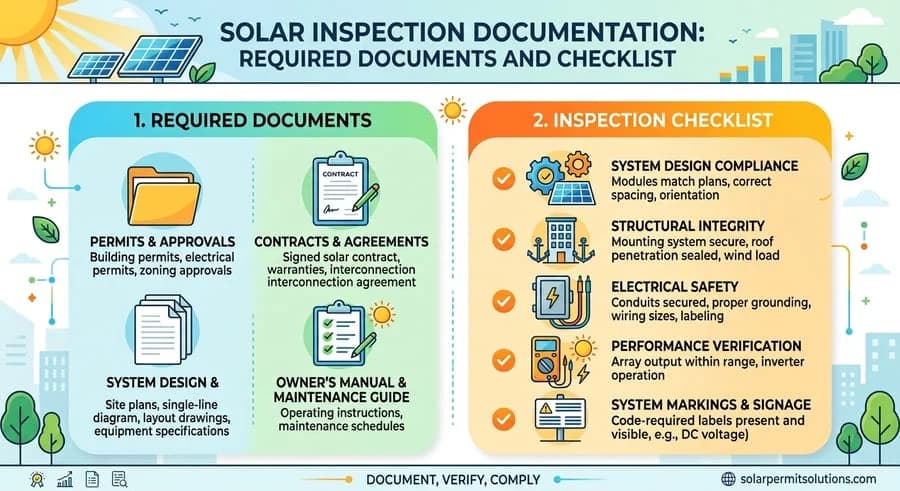
Solar Inspection Documentation: Required Documents and Checklist
Learn about solar inspection documentation, including permit requirements, NEC c...
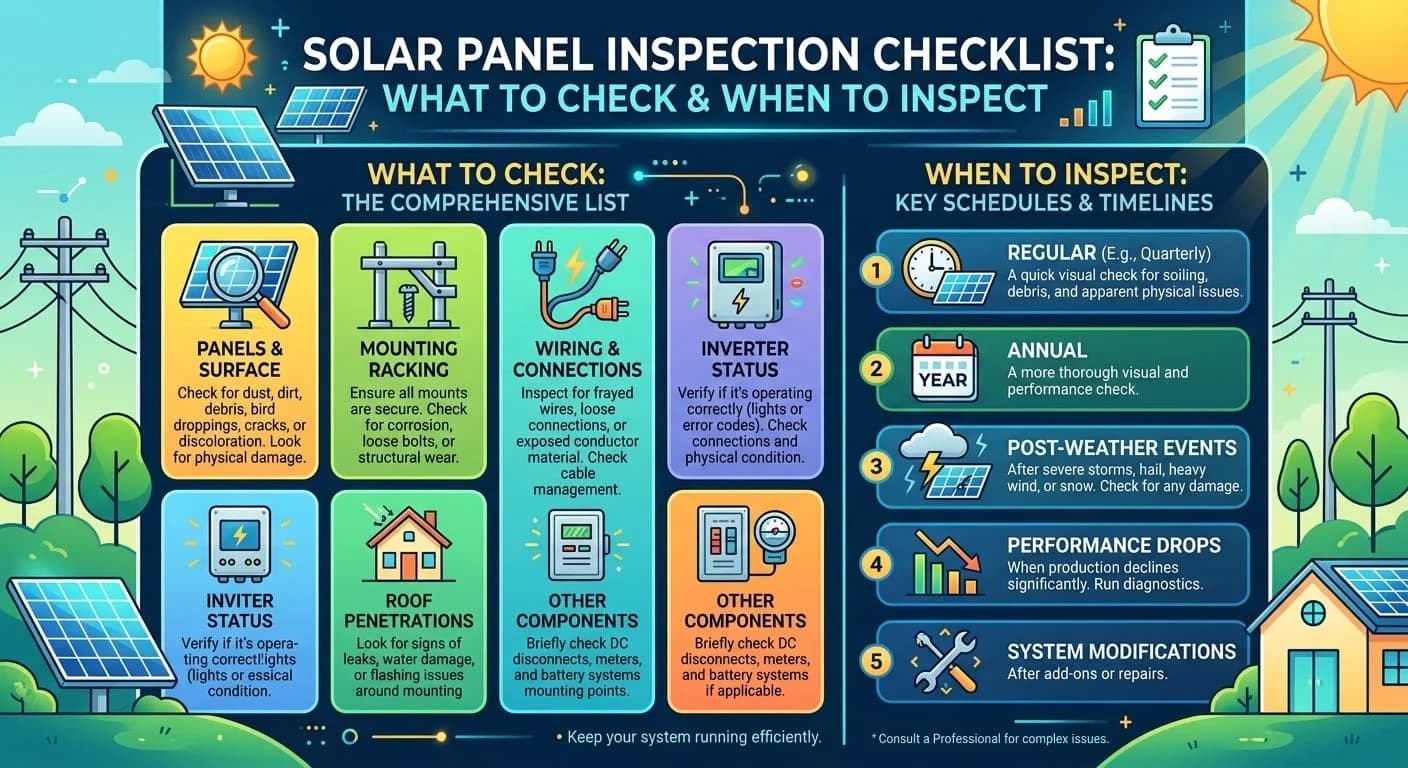
Solar Panel Inspection Checklist: What To Check & When To Inspect
Solar panel inspection guide: Learn what to check, when to inspect (annually + e...
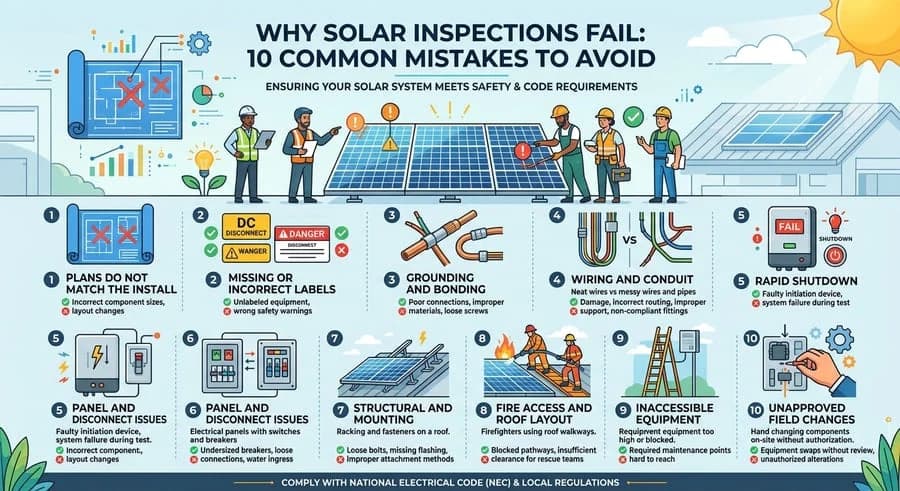
Why Solar Inspections Fail: 10 Common Mistakes to Avoid
Discover the 9 critical reasons solar inspections fail and how to avoid costly m...