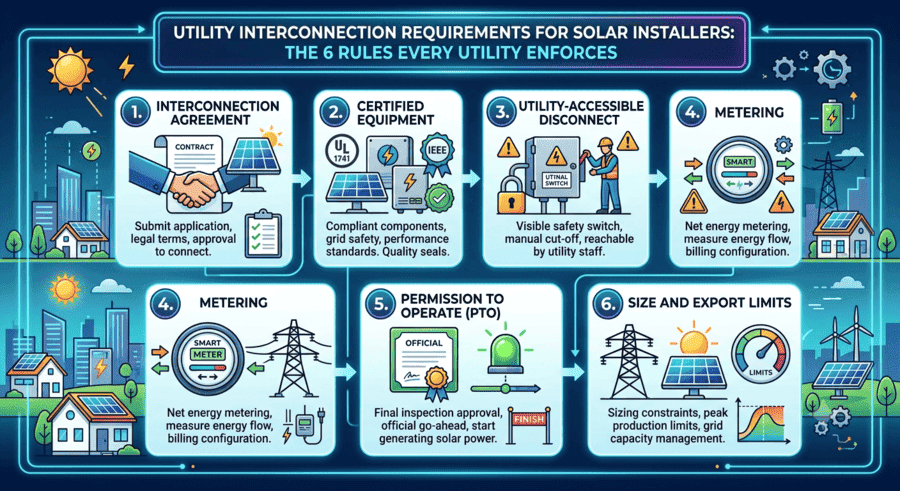
interconnection agreement, UL 1741 and IEEE 1547 certified inverters, a utility-accessible AC disconnect switch, proper metering, Permission to Operate (PTO), and system size or export limits. Every utility enforces its own version of these before a system can legally connect to the grid.
Passing a local AHJ inspection is only half the job. Before a residential or commercial PV system can legally export a single watt, the serving utility has to approve it separately, through its own interconnection process, its own equipment standards, and its own final sign-off. Installers who treat utility requirements as an afterthought are the ones who end up with a fully built, fully inspected system sitting dark for weeks while the interconnection application catches up. This guide walks through the six requirements every utility enforces in some form, how the review tiers work, where requirements diverge by territory, and the documentation that keeps an application moving instead of stalling. For the paperwork side of this process, see our solar interconnection agreement checklist and guide.
The 6 Core Utility Requirements at a Glance
Utility interconnection standards differ from one service territory to the next, but nearly every US utility builds its review around the same six pillars.
| # | Requirement | What It Covers | Primary Code or Standard |
| 1 | Interconnection agreement | Application, hosting capacity screening, and utility approval before equipment purchase | State PUC interconnection tariffs; NEC Article 690 |
| 2 | Certified equipment | Anti-islanding, ride-through, and grid-support functions in the inverter | IEEE 1547-2018; UL 1741 (SA/SB) |
| 3 | Utility-accessible disconnect | Lockable, visible-blade AC disconnect utility personnel can reach without keys | NEC 690.13, 690.15; utility technical requirements |
| 4 | Metering | Production and bi-directional metering to track generation and net export | NEC 705.10; state net metering tariffs |
| 5 | Permission to Operate (PTO) | Final utility sign-off after AHJ inspection is passed | Utility interconnection tariff, Section G/H procedures |
| 6 | Size and export limits | Net metering caps, hosting capacity, and zero-export throttling | NEC 705.12 (120% rule); state net metering rules |
Requirement 1: An Approved Interconnection Agreement Before You Buy Equipment
Before purchasing panels, inverters, or racking, the installer or property owner has to apply for and receive an approved interconnection agreement from the local serving utility. The application package typically includes a completed interconnection form, a site plan, an electrical single-line diagram, and equipment specification sheets showing the exact inverter model and its certification listing. Utilities use this submission to run a hosting capacity screen, checking whether the local distribution transformer and feeder can absorb the proposed generation without upgrades.
If the screen passes, the utility issues an authorization to install, sometimes called Permission to Install or Approval to Install depending on the utility. If it fails, the project is routed into a supplemental engineering review, which adds weeks and sometimes a cost-sharing requirement for distribution upgrades. Some utilities have started automating parts of this screening step; NREL’s partnership with the Sacramento Municipal Utility District, documented in NREL’s research on automating solar interconnection review, is one example of utilities working to cut manual review time as application volume grows. Submitting the application early, in parallel with the local building permit rather than after it, is the single biggest lever an installer has over project timeline. For the interconnection method decision that shapes this application, including load-side versus supply-side connections and the busbar math involved, see our supply-side and load-side interconnection guide.
Requirement 2: Certified Equipment, IEEE 1547 and UL 1741
Utilities mandate that every inverter interfacing with the grid carry certification from a nationally recognized testing laboratory. In practice, that means an active UL 1741 listing, which verifies the inverter meets the interconnection and anti-islanding requirements defined in IEEE 1547, the industry standard for interconnecting distributed energy resources with electric power systems. Anti-islanding is the function that forces the inverter to disconnect from the grid within a fraction of a second during a power outage, protecting utility line workers from an energized circuit they believe is dead.
A growing number of states require the newer UL 1741 Supplement B listing, which aligns with IEEE 1547-2018 and adds advanced grid-support functions such as voltage and frequency ride-through, reactive power control, and remote settings management. California’s Rule 21 was the first framework to require these smart inverter functions statewide, and several other states have since adopted similar advanced inverter mandates. The equipment model, firmware version, and certification listing all need to match exactly what is documented on the interconnection application and the electrical single-line diagram; a mismatch between the datasheet and the diagram is a common reason applications bounce back for correction.
Requirement 3: A Dedicated, Utility-Accessible AC Disconnect Switch
Most utilities require an external, lockable, visible-blade AC disconnect switch, typically mounted next to the electric meter. This switch lets utility personnel physically isolate the solar array from the grid to safely service power lines nearby, without needing to coordinate with the homeowner or obtain a key. Accessibility is not a suggestion: the switch cannot sit behind a locked gate, inside a fenced yard, or under an enclosed patio. Some utilities publish exact placement rules; AEP Ohio, for example, requires its accessible disconnect within 6 feet of the utility meter and lockable in place with a padlock, a level of specificity worth confirming with the utility serving an Ohio project before finalizing equipment placement.
The disconnect also needs correct field labeling identifying it as the utility disconnecting means, cross-referenced against any other power source directory at the service panel. Our solar PV labeling requirements guide covers the exact wording and format the NEC requires for this and every other required placard on a PV installation.
Solar Permit Solutions
Solar Contractor? We Design Your Plans.
Outsource your permit plan sets to our team. PE-stamped, code-compliant, fast turnaround so you can focus on installation.
Requirement 4: Metering and Net Energy Metering (NEM)
The utility determines how a property’s solar generation gets measured, and the answer varies by program. Some utilities require a dedicated production meter socket that tracks every kilowatt-hour the array generates, whether it is consumed on site or exported. Nearly all net metering programs also require a bi-directional meter, which separately measures energy pulled from the grid and energy sent back to it. Utility metering programs differ meaningfully in how they credit exported energy: Duke Energy Florida, for instance, offers full retail-rate net metering with an annual true-up at a lower avoided-cost rate for any remaining surplus, a structure our Duke Energy Florida interconnection guide breaks down in full, including insurance and disconnect requirements specific to that territory.
Because net metering rules are set at the state or utility level rather than nationally, installers working across multiple territories should confirm the applicable program before finalizing system size, since the metering structure directly affects the economics a homeowner or business is signing up for. The DSIRE database is the most reliable public source for looking up current state-by-state net metering and interconnection policy.
Requirement 5: Permission to Operate (PTO), the Utility’s Final Sign-Off
Passing the local AHJ electrical inspection does not mean a system can be turned on. Once installation is complete and inspected, the installer notifies the utility that the local inspection has passed. The system must remain de-energized until the utility completes its own verification and grants formal Permission to Operate, often coinciding with the installation of the new bi-directional meter. Only after PTO is issued can the system legally export power and begin accruing net metering credits.
PTO delays are one of the most common frustrations in the entire solar installation timeline, and they are rarely caused by the physical installation itself. Our solar Permission to Operate guide covers the most frequent causes of PTO delay and how to avoid them. It is also worth distinguishing this utility-side approval from the separate, AHJ-side inspection process; our explainer on what an AHJ is and how it controls project timelines lays out exactly where the two approval paths diverge and where they have to line up.
Requirement 6: System Size and Export Limitations
Utilities place limits on how much power a system can produce and how much it can export back to the grid. In many net metering programs, systems are capped at offsetting somewhere between 100 and 120 percent of the property’s trailing 12-month energy consumption; the exact ceiling depends on the state and utility. Where local hosting capacity is constrained, a utility may only approve a system as a strict zero-export configuration, in which the inverter’s power control settings throttle production to prevent any generation from flowing back onto the distribution line. NREL’s ongoing hosting capacity analysis research is the technical foundation most utilities now draw on to publish these hosting capacity limits publicly rather than evaluating every application from scratch.
On the residential load-side interconnection side, the export limitation question intersects directly with the 120 percent busbar rule under NEC 705.12, which caps the combined rating of the main breaker and the solar backfeed breaker at 120 percent of the panel’s busbar rating. Our supply-side versus load-side interconnection guide, linked earlier in this article, walks through this calculation and when a supply-side tap is the better design choice for a system that would otherwise exceed it.
Adding battery storage touches all six requirements at once. Many utilities treat a battery addition, even an export-limited one that never sends power back to the grid, as a change to the existing interconnection agreement, which means a new or amended application rather than a simple equipment swap. Our solar battery permit requirements guide covers the additional UL 9540 documentation, NEC 706 labeling, and utility notification steps that come with pairing storage onto a new or existing PV system.
Interconnection Review Tiers: How Utilities Screen Applications by Size
Most utilities sort incoming interconnection applications into review tiers based on system capacity, so a small residential system and a 500 kW commercial rooftop are never evaluated on the same track.
| Tier | Typical Capacity | Review Type | Example |
| Level 1 | Up to 25 kW (varies by state; some set 10 kW) | Expedited, screens against a simplified checklist | Covers 90 percent or more of residential systems |
| Level 2 | 25 kW to 2 MW | Supplemental engineering review, added review fee | Most commercial rooftop and carport systems |
| Level 3 | Above 2 MW, or systems that fail Level 1 or 2 screens | Full impact and facility study | Utility-scale and complex grid-impact projects |
These thresholds are illustrative; the exact kW cutoffs, fees, and required documentation vary by state and by individual utility tariff, and some utilities set the Level 1 threshold as low as 10 kW rather than 25 kW. Commercial and larger systems that fall into Level 2 or Level 3 review carry their own documentation burden on top of the standard PV plan set, covered in detail in our commercial solar interconnection guide. The IREC Model Interconnection Procedures are the template most state utility commissions have drawn from when writing these tiered review frameworks, so they are a useful reference when a specific utility’s tariff language is ambiguous.
How These Requirements Play Out Across Different Utility Territories
The six core requirements above are close to universal, but the specific thresholds, forms, and portals differ enough between utilities that a plan set built for one territory rarely transfers cleanly to another. Illinois installers working in ComEd territory submit through the Contractor Connect portal in two phases, Permission to Install and Permission to Operate, and net metering credits are grandfathered differently depending on whether the system was interconnected before or after January 1, 2025, under the state’s Climate and Equitable Jobs Act; our Chicago solar permit and ComEd interconnection guide cover both the city permit and the utility side of that process.
National Grid, which serves parts of Massachusetts and upstate New York, runs two entirely separate regulatory frameworks in its own territory: Massachusetts uses tariff MDPU 1579 with three review pathways, while New York follows the statewide Standardized Interconnection Requirements. A single company operating under two different rulebooks in two different states is not unusual; it is the norm, and our National Grid interconnection guide for Massachusetts and New York breaks down the timelines and technical standards for each. The practical lesson for any installer covering multiple states is the same one that applies to permit design: never assume the interconnection process in a new territory mirrors the one you already know.
Xcel Energy adds another layer to that lesson: it serves customers across eight states, but its Colorado interconnection process runs through a distinct application portal and tariff structure from its operations elsewhere in the Midwest. Our guide to connecting solar to Xcel Energy in Colorado walks through the state-specific submission steps and net metering rules installers need there. The same holds true out in the Pacific Northwest, where publicly owned utilities like Tacoma Public Utilities run their own interconnection standards, separate from the investor-owned utility processes installers may already be used to; our Tacoma utilities interconnection guide covers that territory’s application sequence and equipment rules. Ohio rounds out the picture in a smaller but no less important way: AEP Ohio’s precise, six-foot disconnect placement rule, covered in our going solar with AEP Ohio guide, is a reminder that even a single required component like the AC disconnect can carry territory-specific specifications worth confirming before equipment goes on order.

Solar Permit vs. Utility Interconnection: What’s the Difference?
It is worth restating plainly because it trips up even experienced installers: the utility interconnection approval and the AHJ building or electrical permit are two entirely separate processes, run by two different entities, on two different timelines. The AHJ reviews the plan set for compliance with the National Electrical Code, referencing the specific edition it has adopted, plus any local building and fire code amendments; our solar permit design and plan set guide covers what that plan set has to include from the cover sheet to structural calculations. The utility, separately, reviews the interconnection application against its own tariff and technical requirements.
The two processes do intersect on a handful of specific documents. Rapid shutdown compliance under NEC 690.12 has to be documented consistently on both the AHJ plan set and, in many territories, referenced on the interconnection application’s equipment list; our rapid shutdown compliance roadmap covers the labeling and equipment documentation that needs to match across both submittals. Every listed component, from the inverter down to the disconnect, also has to comply with OSHA 29 CFR 1910.303(b)(2), which requires listed or labeled equipment to be installed according to its listing instructions, and with the marking requirements in NFPA 70, the National Electrical Code. Most jurisdictions require both the AHJ permit and the utility PTO before a system can be legally energized, and increasingly, streamlined AHJ review platforms are being paired with faster utility processing; the Department of Energy’s solar permitting streamlining initiative is the federal effort tracking that trend on the permit side of the equation.
Common Reasons Utility Interconnection Applications Get Rejected or Delayed
☐ Equipment installed before the interconnection agreement is approved. Utilities can require de-installation or reject the application outright when construction starts ahead of authorization.
☐ Inverter model or firmware version on the datasheet does not match the model listed on the application or shown on the single-line diagram.
☐ Missing or expired UL 1741 listing, or an SA-listed inverter submitted to a utility that now requires SB certification.
☐ Disconnect switch location shown on the site plan is not actually accessible to utility personnel, such as behind a locked gate or inside a garage.
☐ Proposed system size exceeds the utility’s net metering cap relative to the property’s trailing 12-month usage, without a documented request for a larger allowance.
☐ Missing proof of required liability insurance on commercial applications, which several utilities require before issuing an approval to install.
☐ The site plan or single-line diagram submitted to the utility does not match the version submitted to the AHJ, creating a discrepancy reviewers on either side will flag.
A Step-by-Step Utility Interconnection Timeline for Installers
- Confirm the serving utility for the project address and pull its current interconnection tariff or technical requirements document before finalizing system design.
- Select and confirm certified equipment, verifying the inverter’s active UL 1741 listing and IEEE 1547 compliance against the utility’s specific requirements.
- Submit the interconnection application with a complete site plan, single-line diagram, and equipment specification sheets, ideally in parallel with the AHJ permit submission.
- Receive authorization to install, then begin construction, including the utility-accessible disconnect switch at its required location and labeling.
- Pass the AHJ’s electrical inspection and forward proof of that inspection to the utility.
- Receive Permission to Operate once the utility completes its verification and installs the bi-directional meter, and only then energize the system.
Frequently Asked Questions
Solar Contractor? We Design Your Plans.
Outsource your permit plan sets to our team. PE-stamped, code-compliant, fast turnaround so you can focus on installation.
Frequently Asked Questions
An approved interconnection agreement. Utilities require a signed interconnection application, often including a site plan and single-line diagram, before an installer can purchase major equipment or begin construction. Skipping this step and installing first is one of the most common causes of a stalled Permission to Operate.
Yes. Virtually every US utility requires inverters used in grid-tied systems to carry an active UL 1741 listing, which verifies the inverter meets the anti-islanding and safety requirements referenced in IEEE 1547. Many utilities, including those in California under Rule 21, now require the newer UL 1741 SB listing for advanced grid-support functions.
The utility-accessible AC disconnect exists so a line worker can physically isolate a home's solar system from the grid without needing the homeowner present or a key to a locked enclosure. The AHJ inspection confirms code compliance for the building; the utility disconnect requirement protects personnel working on the distribution grid, which is a separate concern from local code enforcement.
Permission to install, sometimes called approval to install depending on the utility, authorizes construction to begin after the utility reviews the application. Permission to Operate is the final authorization issued after installation is complete, the AHJ inspection has passed, and the utility has verified the as-built system, usually after installing a bi-directional meter. A system cannot legally export power until PTO is granted.
Yes. Many utilities cap net metering eligibility at 100 to 120 percent of a property's trailing 12-month electricity consumption, and some require a zero-export configuration when local hosting capacity is limited. A zero-export system uses inverter-level power control settings to prevent any generation from flowing back onto the distribution line.
No. Most utilities use a tiered framework similar to Level 1, Level 2, and Level 3 reviews, but the exact capacity thresholds, fees, and documentation requirements vary by state and by utility. Always confirm the specific tier thresholds with the utility serving the project address before finalizing system size.
No, they are separate approvals administered by different entities. The Authority Having Jurisdiction reviews the plan set for building, electrical, and fire code compliance and issues the construction permit. The utility separately reviews and approves the interconnection application and issues permission to operate. Most jurisdictions require both approvals before a system can be energized.

SPS Editorial Team
Solar Permit Solutions
Solar Permit Solutions provides professional solar permit design services for residential, commercial, and off-grid installations across all 50 states. Our team ensures permit-ready plan sets delivered fast.
Related Articles
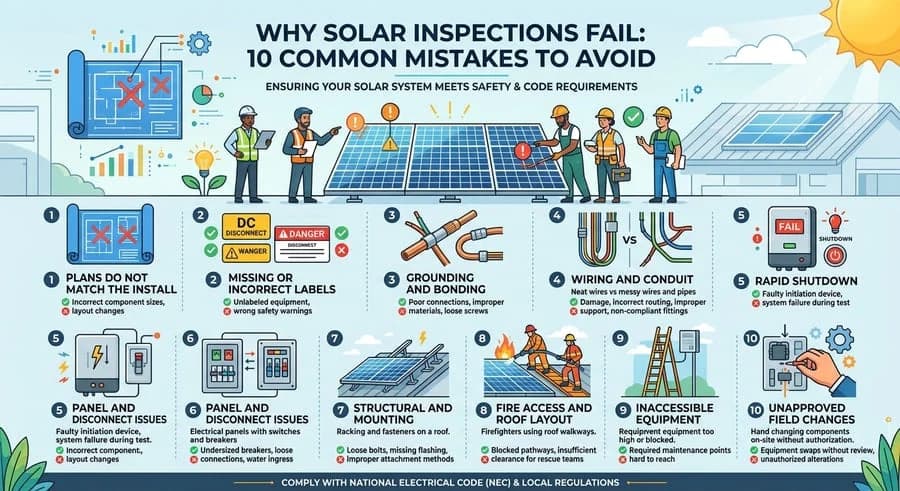
Why Solar Inspections Fail: 10 Common Mistakes to Avoid
Discover the 9 critical reasons solar inspections fail and how to avoid costly m...

Solar Grounding And Bonding: How To Pass Inspection Every Time
Learn how to pass solar grounding and bonding inspections every time. Avoid comm...
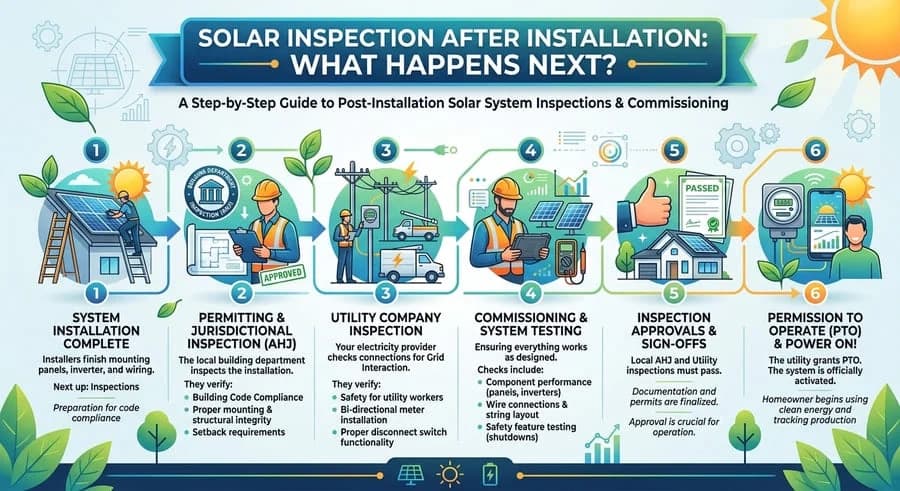
Solar Inspection After Installation: What Happens Next?
Learn how to pass your solar inspection by following essential tips for obtainin...