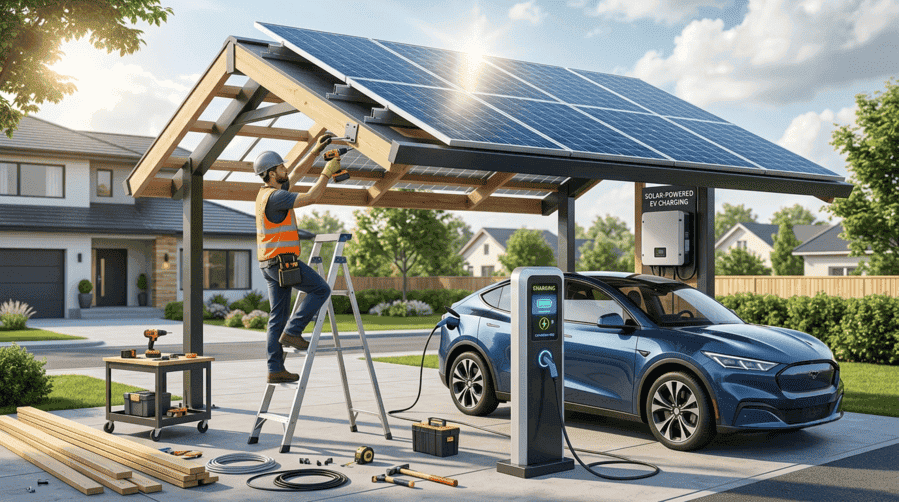
Yes, an EV charging station can be powered by solar. A grid-tied solar array paired with a Level 2 charger is the most common setup, sized to your car’s daily miles. A solar-plus-battery system adds nighttime charging and backup power. An off-grid system works anywhere without a utility connection, but usually cannot run a DC fast charger at full speed without a very large battery bank. Building one requires sizing the array to your driving habits, choosing the right charging equipment, and getting an AHJ-approved, PE-stamped permit plan set before installation.
This guide answers both questions people search for most: whether solar can actually power an EV charger and the step-by-step process for building a solar-powered charging setup at home or on a commercial property. It also covers the National Electrical Code requirements, permitting steps, and 2026 incentive changes that affect the project.
Can an EV Charging Station Be Powered by Solar?
Yes. Solar panels generate direct current electricity that an inverter converts to the alternating current your EV charger uses, exactly the same way solar powers any other electrical load in a building. The practical question is not whether it can be done, but which of three configurations fits your charging needs and site.
- Grid-tied solar EV charging: the array feeds your home or business’s electrical system and the utility grid. Your EV draws from whichever source is available at the moment, and net metering or export credits offset grid draw at night. This is the standard setup for most residential and commercial installs.
- Off-grid (standalone) solar EV charging: the array charges a battery bank with no utility connection. This works well for remote sites, parking lots without nearby grid access, or true energy independence, but the battery has to be large enough to cover charging demand on low-sun days.
- Hybrid solar-plus-battery charging: a grid-tied system with battery storage added. Solar charges the battery during the day, the EV draws from the battery at night or during an outage, and the grid remains available as backup. This is the most flexible option for daily commuters who charge overnight.
The one meaningful limitation is charging speed versus real-time solar output. A single Level 2 charger drawing 7.6 kW needs a mid-size residential array producing at or above that rate to run entirely on real-time solar during peak sun; most installers instead size the array to offset the EV’s daily energy use over a full day or month rather than trying to match instantaneous output one-to-one.

How Solar EV Charging Works
A complete solar EV charging system has four parts: the PV array, an inverter, the electric vehicle supply equipment (EVSE, the technical term for the charger), and optionally a battery. Here is how the power flows in each configuration.
Grid-Tied Solar EV Charging
Solar panels produce DC power, which the inverter converts to AC and routes into the home or business electrical panel. From there it either powers the EVSE directly, exports to the grid for a bill credit, or is drawn back from the grid when the array is not producing enough (at night or on cloudy days). This is the configuration covered by the same interconnection rules that apply to any grid-tied solar PV system, and it requires a signed utility interconnection agreement before the system can export power.
Off-Grid Solar EV Charging
The array charges a battery bank through a charge controller. The EVSE draws exclusively from that battery, and there is no grid connection or interconnection agreement to file. Off-grid solar EV chargers are common at trailheads, remote job sites, and rural parking areas where running utility service would cost more than the charging station itself. The tradeoff is that the battery and array both have to be sized for the worst realistic weather stretch, not the average day.
Hybrid Solar-Plus-Battery EV Charging
This setup keeps the grid connection but adds a battery, most often a stacked residential unit such as a Tesla Powerwall or Enphase Encharge system. Solar charges the battery during the day. In the evening, when most EV owners plug in, the vehicle draws from stored solar energy instead of grid power. If the battery runs low, the system automatically falls back to the grid. Adding a battery to an existing PV-only system typically requires an amended permit, since the original plan set will not cover the additional circuits and disconnects. For the specific documentation an AHJ will expect, see our NEC 690 and 706 compliance checklist for battery storage and our guide to battery placement and clearance requirements.
Can Solar Power a DC Fast Charger?
Technically yes, but rarely in real time. A Level 3 (DC fast) charger draws anywhere from 50 kW to 350 kW, far beyond what a rooftop or even most commercial solar arrays produce instantaneously.
Public fast-charging sites that market themselves as solar-powered almost always use one of two approaches: a large battery buffer that slow-charges from solar throughout the day and then discharges quickly to the vehicle, or a grid-tied array that offsets the site’s total annual energy use rather than powering each charging session directly.
For most home and small commercial projects, a Level 2 charger paired with solar is the practical, cost-effective match. DC fast charging with true solar-direct power is a utility-scale undertaking.
Solar Permit Solutions
Need Solar Permit Plans?
Professional, permit-ready solar plan sets delivered fast. Residential and commercial projects across all 50 states.
How Much Solar Do You Need to Charge an EV?
Sizing starts with your vehicle’s energy use, not the charger’s rating. The average EV in the United States uses roughly 30 to 35 kWh per 100 miles driven. A driver covering 30 to 40 miles a day, a common commute distance, uses approximately 10 to 14 kWh daily, or 3,500 to 5,000 kWh a year. A solar array produces roughly 3.5 to 4.5 kWh per day for every 1 kW of installed capacity, depending on location and orientation, which puts most single-EV households in the 2.5 kW to 4 kW range of dedicated solar capacity before accounting for the rest of the home’s electric load.
| Daily Driving | Approx. Daily kWh Needed | Approx. Added Solar Capacity | Typical Panel Count (400W panels) |
|---|---|---|---|
| 15-20 miles | 5-7 kWh | 1.5-2 kW | 4-5 panels |
| 30-40 miles (average commute) | 10-14 kWh | 2.5-4 kW | 6-10 panels |
| 60-80 miles | 20-27 kWh | 5-7 kW | 13-18 panels |
| 100+ miles / daily long-haul | 31-40+ kWh | 8-10+ kW | 20-25+ panels |
These figures assume the array is dedicated to EV charging on top of existing household solar. Most installers instead size the whole-home array to cover the EV and other loads together and then true up the difference through net metering.
How to Build a Solar-Powered Charging Station: Step by Step
Whether you are adding a charger to an existing home solar system or building a dedicated commercial charging station, the process follows the same eight-step sequence.
Step 1: Calculate Your Charging Demand
Start with annual mileage and the vehicle’s kWh-per-100-miles rating (available on the EPA’s window sticker or fueleconomy.gov). This number, not the charger’s amperage, drives array and battery sizing.
Step 2: Assess the Site and Solar Potential
Evaluate roof or ground-mount area, orientation, shading, and structural capacity. Commercial lots often use a solar carport or canopy over the parking area itself, which doubles as covered parking and avoids competing for roof space. See our guides to solar canopies and solar carport costs for structural and cost planning specific to parking-area installations.
Step 3: Size the Solar Array
Use the sizing approach above, then add margin for winter production drop, panel degradation, and any planned second EV. Oversizing modestly is cheaper than a second permit cycle later.
Step 4: Choose Grid-Tied, Off-Grid, or Hybrid
Confirm utility availability and interconnection rules for the site, then decide whether a battery is worth the added cost for backup power, time-of-use rate optimization, or true energy independence. Our supply-side vs. load-side interconnection guide explains how this decision affects the electrical design.
Step 5: Select the EVSE and inverter.
Choose a Level 2 EVSE (240V, typically 32 to 48 amps for residential) unless the site genuinely needs DC fast charging, and confirm the inverter and any energy management system are rated for the combined solar and EV load. UL 2594-listed EVSE and UL 1741-listed inverters are baseline requirements most AHJs check first.
Step 6: Design the Electrical System
This is where a licensed designer produces the single-line diagram showing the PV array, inverter, EVSE branch circuit, disconnects, overcurrent protection, and interconnection point. The EVSE branch circuit and overcurrent protection are governed by NEC Article 625, separate from the Article 690 requirements that apply to the solar side, and both have to reconcile on the same diagram.
Step 7: Prepare and Submit the Permit Plan Set
Most jurisdictions require both an electrical permit and, for commercial or carport-mounted installations, a building permit. The plan set needs a PE stamp from an engineer licensed in the project’s state, equipment datasheets, and a complete label schedule per NEC labeling requirements. See our overview of the full solar permit design and plan set process for what the local AHJ will expect on first submission.
Step 8: Install, Inspect, Interconnect, and Energize
After installation, the AHJ performs a final inspection against the approved plan set. Grid-tied systems then need the utility interconnection agreement finalized and Permission to Operate (PTO) issued before the system can legally export power or, in many territories, before net metering credits begin. Off-grid systems skip this step entirely since there is no utility connection to authorize.
NEC Code Requirements for Solar EV Charging Stations
A solar-powered EV charging station has to satisfy two separate NEC articles at once: Article 690 for the solar side and Article 625 for the charging equipment, plus Article 705 wherever the two connect to the building’s electrical system.
Article 625: Electric Vehicle Power Transfer Systems
- 625.40: an EVSE outlet rated above 16 amperes or 120 volts must be on its own individual branch circuit; the 2023 NEC removed the blanket individual-circuit requirement for all EVSE outlets.
- 625.42: the branch circuit and feeder must be rated for at least 125 percent of the EVSE’s continuous load, unless a listed energy management system limits the load, in which case smaller conductors are permitted.
- 625.43: a disconnecting means capable of opening all ungrounded conductors is required, and permanently connected EVSE rated above 60 amperes or 150 volts to ground needs a lockable disconnect within sight of the equipment.
- 625.54: Every receptacle installed for EVSE connection must be GFCI protected.
- 625.48: Bidirectional or power-export-capable EVSE (vehicle-to-home or vehicle-to-grid) must be listed for that purpose and falls under Article 702 (standby systems) or Article 705 (power production sources) depending on how it is used.
For the complete code text, see NEC Article 625 in the National Electrical Code and the New York State Energy Research and Development Authority’s Article 625 overview. A useful permit-application walkthrough is also available from the Department of Energy’s Alternative Fuels Data Center.
Article 690, Article 705, and Article 706: The Solar and Storage Side
The PV array itself is governed by Article 690, covering conductor sizing, overcurrent protection, and rapid shutdown compliance under 690.12. Where the solar system connects to the building’s electrical service, Article 705 governs the interconnection method, including the 120 percent busbar rule for load-side connections. If a battery is part of the design, Article 706 adds requirements for disconnecting means, overcurrent protection, and system labeling that a PV-only plan set will not already cover.
For a deeper technical breakdown of EVSE branch circuit rules, continuous load ratings, and wiring methods, see the IEEE 1547 interconnection standard referenced by most utility interconnection applications and EC&M’s summary of NEC Article 625 requirements.
Permitting a Solar EV Charging Station: What Your AHJ Will Require
Because the project combines two code articles, most AHJs will want to see both scopes documented on a single, coordinated plan set rather than two separate submissions. A complete package typically includes:
- A site plan showing the array, EVSE location, parking area (for carport or canopy installs), and access pathways
- An electrical single-line diagram covering the PV array, inverter, EVSE branch circuit, disconnects, and interconnection point
- Structural calculations if the array is mounted on a canopy, carport, or roof, verifying the structure can carry the added dead and wind load
- Equipment datasheets for the panels, inverter, EVSE, and any battery, with current UL listings
- A label schedule covering both the NEC 690 solar labels and any EVSE signage the AHJ or manufacturer requires
- A PE stamp from an engineer licensed in the project’s state, covering both the structural and electrical scope
Commercial installations, and any site with a canopy or carport structure, typically also require zoning or site-plan review in addition to the building and electrical permits. Our guide to how commercial solar systems work covers the additional stakeholder and structural review steps that apply at that scale, and our guide to what happens if you install solar without a permit explains the risks of skipping this step.
Residential vs. Commercial Solar EV Charging Stations
| Factor | Residential | Commercial / Public |
|---|---|---|
| Typical charger level | Level 2 (240V) | Level 2 fleet banks or Level 3 DC fast charging |
| Typical array size | 2.5-10 kW dedicated to EV load | 25 kW to 1 MW+, often solar canopy or carport mounted |
| Battery use case | Optional: backup power and overnight charging | Common on DC fast sites, to buffer peak demand |
| Permits required | Electrical permit; building permit if roof-mounted | Electrical, building, zoning, and often fire department review |
| Structural scope | Roof load analysis if rooftop | Full carport or canopy structural and foundation design |
| Interconnection level | Level 1 utility review (most residential systems) | Level 2 or 3 utility review with engineering study |
Cost to Build a Solar-Powered EV Charging Station
Costs vary widely by system size, mounting type, and whether a battery is included. The ranges below are planning estimates, not quotes, and should be confirmed against current local contractor pricing and your specific equipment selection.
| Component | Typical Residential Range | Notes |
|---|---|---|
| Solar array (2.5-10 kW, dedicated to EV load) | $6,000-$28,000 | Before incentives; varies by roof vs. ground mount |
| Level 2 EVSE and installation | $800-$2,500 | Hardware plus electrician labor for dedicated circuit |
| Battery storage (optional) | $9,000-$18,000 | 10-15 kWh residential unit, installed |
| Permit plan set and PE stamp | $350-$1,200 | Combined plan set, PE stamp, and AHJ permit fee |
| Solar carport or canopy structure (if applicable) | $3.15-$4.50 per watt | Structural framework in addition to the array itself |
Federal Incentives for Solar EV Charging in 2026: What Changed
The incentive landscape for solar-powered EV charging shifted significantly under the One Big Beautiful Bill Act (Public Law 119-21). Three changes matter for anyone planning a project in the second half of 2026:
- Section 25D residential solar credit: expired for expenditures after December 31, 2025. The 30 percent credit on the solar array itself is no longer available for cash-purchased residential systems.
- Section 30C EV charger and refueling property credit: the 30 percent credit (up to $1,000 residential and up to $100,000 per commercial charging port) had already been narrowed to eligible census tracts, and it expired entirely for property placed in service after June 30, 2026, under the same law. Since that date has now passed, new residential or commercial EVSE installations no longer qualify. See the IRS’s Section 30C credit page and Argonne National Laboratory’s eligible census tract mapping tool for the historical eligibility rules.
- Section 48E commercial credit: remains available for third-party-owned (lease or PPA) commercial systems, including EV charging infrastructure, provided construction begins before July 4, 2026. This keeps commercial and fleet charging projects using lease or TPO financing on a more favorable timeline than residential cash purchases. See our solar battery tax credit 2026 guide for how the same law affects storage paired with EV charging.
State-level incentives, utility rebates, and demand-charge reduction programs for commercial sites are unaffected by the federal changes and, in many states, now carry more of the financial case for a project than the federal credit does.
Solar Carports and Canopies: The Most Common Commercial Setup
Parking-lot EV charging almost always pairs the charger with a solar carport or canopy rather than a roof-mounted array, since it puts generation directly above the vehicles being charged and avoids competing with existing building roof space. These structures carry their own structural engineering and code compliance scope, since the frame has to support the array plus wind and snow loads independent of any building, and the 2023 NEC’s carport and canopy exception exempts many of these non-enclosed structures from the rapid shutdown requirement that applies to rooftop arrays. Confirm this exception applies with your specific AHJ before finalizing the design; not every jurisdiction treats it as automatic.
Common Mistakes When Building a Solar EV Charging Station
- Sizing the array to the charger’s rated output instead of actual daily driving demand, which usually leads to an oversized and unnecessarily expensive system
- Assuming a DC fast charger can run directly off real-time solar without a large battery buffer
- Submitting a plan set that documents the solar array under Article 690 but omits the EVSE branch circuit sizing required under Article 625
- Treating a battery added to an existing PV-only system as a simple hardware swap rather than a permit amendment requiring new documentation
- Assuming the 30C tax credit is still available for a project starting after June 30, 2026, or that the residential solar credit still applies to a cash-purchased system
- Skipping structural engineering on a carport or canopy because “it’s just a parking cover,” when the frame carries the same wind and snow load requirements as any other solar mounting structure
Get Your Solar EV Charging Station Permitted Right the First Time
A solar-powered EV charging station has to satisfy two NEC articles, a structural review if it is carport- or canopy-mounted, and a utility interconnection process, all on one coordinated plan set. Solar Permit Solutions delivers PE-stamped, AHJ-ready plan sets for residential and commercial solar-plus-EV charging projects across all 50 states, including commercial solar design and off-grid system design. Create a free account to get started, or explore our complete blog library for more technical guidance on solar permitting, NEC compliance, and interconnection requirements.
Frequently Asked Questions
Need Solar Permit Plans?
Professional, permit-ready solar plan sets delivered fast. Residential and commercial projects across all 50 states.
Frequently Asked Questions
Yes. Solar panels generate DC electricity that an inverter converts to AC power for a Level 1 or Level 2 EV charger, the same way solar powers any other home or business electrical load. The system can be grid-tied, off-grid with a battery bank, or a hybrid of both. DC fast charging can be solar-powered too, but almost always requires a large battery buffer rather than direct real-time solar output, since fast chargers draw far more power than a typical array produces instantaneously.
Calculate the EV's daily energy use from actual driving distance, size the solar array (and battery, if included) to that demand, choose a Level 2 EVSE and a compatible inverter, and have a licensed designer produce a single-line diagram that satisfies both NEC Article 690 (solar) and Article 625 (EV charging equipment). Submit the complete, PE-stamped plan set to the local AHJ for permit approval, install the system, pass final inspection, and, for grid-tied systems, finalize the utility interconnection agreement before energizing.
Yes. Virtually every U.S. jurisdiction requires an electrical permit for EV charging equipment and a building or electrical permit for the solar array, regardless of whether the system is grid-tied or off-grid. Carport- or canopy-mounted arrays typically add a structural permit and, for commercial sites, zoning review.
Only with a substantial battery buffer in most cases. Level 3 chargers draw 50 kW to 350 kW, well beyond the real-time output of a typical rooftop or small commercial array, so solar-powered fast-charging sites generally trickle-charge a large battery throughout the day and discharge it quickly during each vehicle session or size the array to offset the site's total annual energy use rather than power each session directly.
Not for new residential systems placed in service after 2025 and 2026 deadlines that already passed. The Section 25D residential solar credit expired for expenditures after December 31, 2025, and the Section 30C EV charger credit expired for property placed in service after June 30, 2026. The Section 48E commercial credit remains available for lease or third-party-owned commercial systems, including EV charging infrastructure, that begin construction before July 4, 2026.
For a typical 30 to 40 mile daily commute, expect to add roughly 2.5 to 4 kW of dedicated solar capacity, or about 6 to 10 standard 400-watt panels, on top of whatever the rest of the home already uses. Higher daily mileage or a second EV scales this up proportionally.

SPS Editorial Team
Solar Permit Solutions
Solar Permit Solutions provides professional solar permit design services for residential, commercial, and off-grid installations across all 50 states. Our team ensures permit-ready plan sets delivered fast.
Related Articles
Solar Grounding And Bonding: How To Pass Inspection Every Time
Learn how to pass solar grounding and bonding inspections every time. Avoid comm...
Solar Inspection After Installation: What Happens Next?
Learn how to pass your solar inspection by following essential tips for obtainin...
Solar Permit Services in Austin, TX
Solar permits in Austin center on an Auxiliary Power Electrical Permit for any s...