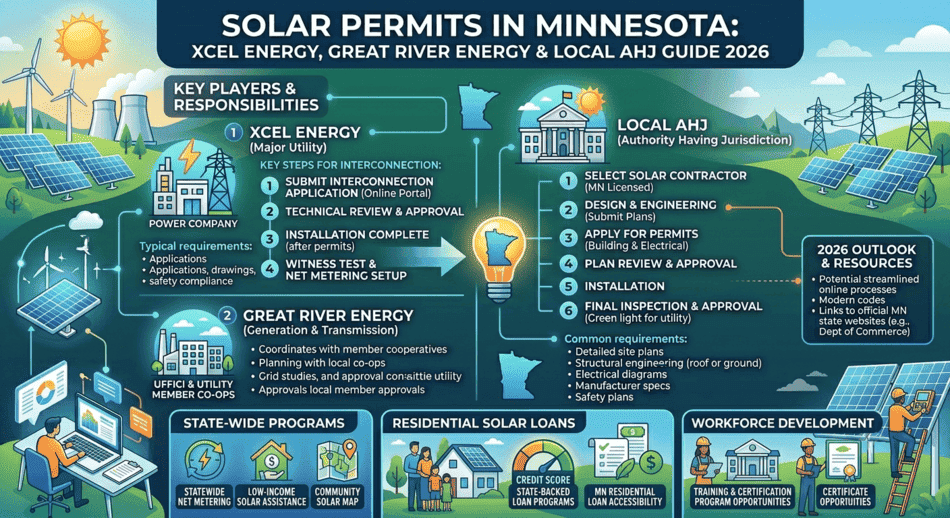
Minnesota solar permits require a building permit and an electrical permit from your local Authority Having Jurisdiction (AHJ), plus a utility interconnection application submitted to Xcel Energy, Minnesota Power, Otter Tail Power, or your serving cooperative before your system can export power to the grid. The Minnesota Board of Electricity adopted the 2023 NEC effective July 1, 2023 – meaning every solar permit filed after that date must reference NEC 2023, including updated rapid shutdown labeling under NEC 690.12(D) and the power source directory requirements of NEC 705.10. All electrical work on a solar installation must be performed by a licensed electrician or a licensed electrical contractor registered with the Department of Labor and Industry (DLI). Permit timelines range from same-week review in smaller cities to 10 or more days at the state median. Utility interconnection adds 2-6 weeks on top of that for most Minnesota homeowners.
The 6 core steps of the Minnesota solar permitting process:
- Confirm your AHJ – city, county, or township building department and their adopted code edition (NEC 2023 is the statewide standard as of July 1, 2023)
- Prepare permit documentation – site plan, single-line electrical diagram, structural calculations, and equipment spec sheets. Running a solar feasibility study before this stage helps confirm production estimates and avoid costly redesigns later
- Apply for building and electrical permits – filed simultaneously through your local AHJ portal; electrical permit must be obtained by a DLI-licensed master electrician or registered solar contractor
- Submit the utility interconnection application – Xcel Energy Solar Application Portal, Minnesota Power, Otter Tail Power, or your cooperative under Minnesota PUC rules (Chapter 7835)
- Complete installation and pass inspection – local AHJ inspector verifies code compliance, grounding, labeling, and rapid shutdown equipment before final sign-off, often following criteria similar to what the International Association of Electrical Inspectors publishes nationally. Review our guide to passing your solar inspection and our solar panel inspection checklist before scheduling your AHJ visit
- Receive Permission to Operate (PTO) – utility installs bi-directional meter; your system can legally export power and earn net metering credits
This guide covers every major Minnesota city and utility, the NEC 2023 requirements your plan set must hit, and what separates a first-pass AHJ approval from a revision cycle. Solar Permit Solutions produces PE-stamped, AHJ-ready plan sets for Minnesota residential and commercial installations across all 50 states.
Minnesota Solar Permitting Framework: State Codes, DLI, and Utility Oversight
Before diving into city-level requirements, it helps to understand the two layers that every Minnesota solar project sits inside: the Minnesota State Electrical Code and the Minnesota Public Utilities Commission (PUC) interconnection rules. Together, they set the baseline that every local AHJ and utility must follow.
Minnesota Electrical Code: NEC 2023 Is the Statewide Standard
The Minnesota Board of Electricity adopted the 2023 National Electrical Code effective July 1, 2023. This is administered by the Minnesota Department of Labor and Industry (DLI) under Chapter 1315 of the Minnesota State Building Code. Every electrical permit filed on or after July 1, 2023, must comply with the 2023 NEC. Permits filed before that date were governed by the 2020 NEC.
A note on the 2026 cycle: Minnesota has formed a NEC 2026 Adoption Review Committee, but no official adoption date has been set as of June 2026. Do not reference NEC 2026 in plan sets submitted to Minnesota AHJs – NEC 2023 remains the enforceable standard statewide.
Key NEC 2023 changes Minnesota plan sets must reflect:
- Rapid shutdown labeling moved from NEC 690.56(C) to 690.12(D) – the buildings-with-rapid-shutdown placard no longer requires a specific color, only contrasting text
- DC voltage label moved from NEC 690.53 to NEC 690.7(D)
- Power source directory consolidated into NEC 705.10, with a new requirement for an off-site emergency contact number
- Carport and canopy exception added to NEC 690.12 Exception No. 2 – non-enclosed detached structures are exempt from rapid shutdown
DLI Electrical Licensing: Who Can Pull a Solar Permit in Minnesota?
This is one of the most important Minnesota-specific rules for solar contractors to get right. All electrical work on a solar PV installation must be performed by someone who is either:
- A licensed master electrician or journeyworker electrician licensed by DLI
- A licensed electrical contractor with a DLI-registered responsible licensed individual (a master electrician) on staff
- A registered unlicensed electrician working under direct supervision of a DLI-licensed electrician (no more than 2 unlicensed workers per licensed supervisor)
General contractors who hire a licensed electrical subcontractor do not need their own electrical contractor license. But the electrician performing the work must be actively licensed. You can verify any license at dli.mn.gov license lookup. Using an unlicensed electrician is one of the fastest ways to trigger an AHJ rejection and potentially void your homeowner’s insurance. Licensed contractors affiliated with groups like the National Electrical Contractors Association also follow OSHA solar installation safety guidance, a useful cross-check during jobsite walkthroughs.
Minnesota PUC Interconnection Rules (Chapter 7835)
The Minnesota PUC governs how distributed generation systems connect to the grid under Minnesota Rules Chapter 7835 and Chapter 7835A, modeled in part on the Interstate Renewable Energy Council’s model interconnection procedures. All investor-owned utilities – Xcel Energy, Minnesota Power, and Otter Tail Power – must follow these rules. Rural electric cooperatives operate under their own interconnection tariffs but generally mirror the PUC framework.
| Level | System Size | Key Requirement | Notes |
|---|---|---|---|
| Simplified (Level 1) | 40 kW or less, inverter-based, UL 1741/IEEE 1547-certified | Site plan and single-line diagram | Covers 90%+ of residential installs; fastest review path |
| Standard (Level 2) | 40 kW to 2 MW | Engineering review, application fee | Additional review period; some utilities require PE stamp |
| Level 3 / Study Required | Above 2 MW or fails Level 1/2 criteria | Full impact and facility study | Commercial and utility-scale; contact utility directly |
Residential systems (typically 8-15 kW) almost always fall under the simplified process. The utility reviews the application for safety compliance and grid compatibility before issuing conditional approval. All inverters must meet UL 1741 and IEEE 1547 requirements for anti-islanding protection.
Xcel Energy Solar Permits: Service Territory, Solar*Rewards, and Interconnection
Xcel Energy serves roughly 1.25 million Minnesota customers, covering most of the Twin Cities metro and surrounding areas. If you are in Minneapolis, Saint Paul, Eden Prairie, Burnsville, Brooklyn Park, Plymouth, or most of the metro ring, Xcel is almost certainly your utility. Their Solar*Rewards program makes Xcel territory one of the most financially favorable environments for residential solar in the Midwest.
Xcel Energy Solar Rewards: How It Works
Solar*Rewards is a production-based incentive that pays you a per-kWh rate for the electricity your system generates, on top of standard net metering credits. It runs for 10 years from the system’s interconnection date. Rates are set by Xcel and updated periodically based on program capacity – check Xcel Energy Solar Application Portal for the current incentive rate before finalizing your financial model.
What does not change is the program structure: you produce solar energy, and Xcel credits you for net metering at the full retail rate under Minn. Stat. § 216B.164, and you separately receive the Solar*Rewards production payment for 10 years. That stacked structure is a meaningful differentiator from utility territories where only net metering applies.
Xcel Net Metering: The Key Numbers
- Credit rate: Full retail rate (1:1) – you get credited the same per-kWh rate you would pay for grid power
- System size cap: 120% of previous 12-month usage for residential; up to 1 MW for commercial
- Excess credits: Carry forward month to month and reduce future bills
- Meter: Xcel installs a bi-directional net meter after PTO is issued; no customer cost
Xcel Energy Interconnection Application Process
- Finalize system design – string configuration, inverter type and sizing, whether power optimizers are part of the design, and interconnection method (load-side or supply-side per NEC 705.12)
- Submit through the Xcel Solar Application Portal with your site plan and single-line diagram. Your installer typically submits on your behalf.
- Pay the interconnection application deposit (refunded if the application is not approved)
- Xcel engineering review – for Level 1/Simplified applications, this typically takes 2-6 weeks
- Pass AHJ building and electrical inspection
- Execute the Interconnection Service Agreement
- Xcel installs bi-directional meter; receive Permission to Operate (PTO)
- Enroll in Solar*Rewards and begin receiving production incentive payments. Contact: SolarProgramMN@xcelenergy.com
Customers who prefer not to participate in Solar*Rewards can still get a net meter through Xcel’s general interconnection process and keep their own Renewable Energy Credits (RECs). The application goes through the same por
Minnesota Power, Otter Tail Power & Cooperative Interconnection
If you are not in Xcel Energy territory, your interconnection process, net metering structure, and available incentives look different. Minnesota has three other major investor-owned utilities and dozens of electric cooperatives. Identifying the right one before designing your system matters – not all of them offer the same Solar*Rewards-style stacked incentives Xcel does.
Minnesota Power
Minnesota Power serves northeastern Minnesota, including Duluth, Brainerd, and Hibbing. Their solar interconnection follows the PUC Chapter 7835 framework. For residential systems under 40 kW, the process mirrors Xcel’s simplified track. Minnesota Power does not offer a program equivalent to Solar*Rewards, but standard net metering applies under state law – you receive credits for excess generation at the average retail rate (not full 1:1 retail like Xcel). Contact Minnesota Power’s interconnection team through their customer portal or call 800-228-4966.
Duluth-area installers should note that the city of Duluth has published specific solar permitting guidance at duluthmn.gov/csi and requires both building and electrical permits for PV installations. Call 218-730-5240 for the current AHJ checklist before submitting plans.
Otter Tail Power
Otter Tail Power serves western and south-central Minnesota, including Fergus Falls, Marshall, and parts of the Red River Valley. For residential systems under 40 kW, Otter Tail credits excess generation at the retail rate under their Net Metering Rate rider – one of the better structures among Minnesota’s non-Xcel utilities. Systems must follow the Minnesota Distributed Interconnection Process (DIP) and use a UL 1741/IEEE 1547-certified inverter. Visit otpco.com for current application requirements.
Electric Cooperatives: Connexus, Dakota Electric, and Others
Minnesota has more than 50 rural electric cooperatives. They are not subject to PUC retail interconnection rules directly – each co-op sets its own interconnection tariff, though most mirror the Chapter 7835 framework by policy. Connexus Energy (Ramsey and northern suburbs) has published a clear DER interconnection process covering PV systems up to 10 MW. Dakota Electric Association offers a one-time $500 rebate for new residential PV installations. Always confirm co-op requirements directly – a plan set sized for Xcel territory may need different documentation for a co-op project.
| Factor | Xcel Energy | Minnesota Power | Otter Tail Power |
|---|---|---|---|
| Service territory | Twin Cities metro and surrounding areas: ~1.25M MN customers | Northeastern MN (Duluth, Brainerd, Hibbing) | Western and south-central MN (Fergus Falls, Marshall) |
| Net metering credit | Full retail rate (1:1) under Minn. Stat. § 216B.164 | Average retail rate | Full retail rate for systems under 40 kW |
| Production incentive | Solar*Rewards – per-kWh payment for 10 years | None equivalent to Solar*Rewards | No equivalent program |
| Residential cap for net metering | 120% of prior 12-month usage; up to 1 MW commercial | 40 kW (residential simplified process) | 40 kW (simplified process) |
| Application portal | Xcel Solar Application Portal (online) | Customer portal / phone | otpco.com / email |
| Interconnection timeline (Level 1) | 2-6 weeks typical | 2-6 weeks | 2-6 weeks |
Minnesota Solar Permit Requirements: City-by-City Guide
Minnesota has over 850 municipalities, and each one is its own AHJ with the authority to add requirements above the state baseline. The table below summarizes key variables for major Minnesota cities before the detailed sections.
| City | Permit Portal | Utility | Key Differentiator |
|---|---|---|---|
| Minneapolis | Online portal (minneapolismn.gov) | Xcel Energy | Building and electrical permits required; licensed MN electrician must pull electrical permit |
| Saint Paul | City of St. Paul online / DSI | Xcel Energy | 2023 NEC enforced from July 1, 2023 per Bulletin 2023-01; electrical permit required |
| Rochester | City of Rochester permits portal | Rochester Public Utilities (RPU) | RPU is a municipal utility – not PUC regulated; separate interconnection process; $500 RPU rebate |
| Duluth | duluthmn.gov/csi / 218-730-5240 | Minnesota Power | City-published solar checklist; snow load requirements for structural calcs |
| Bloomington | City of Bloomington online | Xcel Energy | Metro suburb; standard Xcel/city building department process |
| Saint Cloud | City of St. Cloud permits | Xcel Energy | Metro fringe; standard Xcel territory; confirm zoning for ground mounts |
| Eden Prairie | City of Eden Prairie EPermit | Xcel Energy | SolSmart participant; generally streamlined residential review |
Minneapolis Solar Permits
Minneapolis requires both a building permit and an electrical permit for solar PV installations. Electrical permits must be pulled by a DLI-licensed master electrician or electrical contractor – homeowners cannot pull their own electrical permit for solar work in Minneapolis. The City’s Building Inspections division handles building permits through their online portal. Visit their website for the current fact sheet and residential guidelines. Minneapolis is in Xcel Energy territory, so the Solar*Rewards interconnection process applies.
For properties in Minneapolis’s historic districts – including parts of Lowry Hill, Kenwood, or other designated areas – additional design review may be required before permit submission. Confirm with the City’s planning department before finalizing your array layout if the property has any historic designation.
Saint Paul Solar Permits
Saint Paul’s Department of Safety and Inspections (DSI) administers solar permits. Under City Bulletin 2023-01, Saint Paul enforced the 2023 NEC on all electrical permits obtained on or after July 1, 2023 – one of the earliest Minnesota cities to publish formal 2023 NEC transition guidance. Electrical permits are applied for online at stpaul.gov solar PV electrical permits. All work must comply with the current Minnesota-adopted NEC edition. Saint Paul is Xcel Energy territory.
Summit Hill and Cathedral Hill are historic districts in Saint Paul where exterior alterations – including solar panels visible from the street – may require additional approval from the Heritage Preservation Commission before the building permit is issued. Verify the property’s historic status before designing the system.
Rochester Solar Permits
Rochester operates its own municipal electric utility, Rochester Public Utilities (RPU). This makes Rochester fundamentally different from Xcel and Minnesota Power territory: RPU is not subject to PUC retail interconnection rules. RPU has its own interconnection process, net metering tariff, and incentive structure. RPU offers a one-time $500 rebate for new residential PV installations, which partially offsets the loss of Xcel’s Solar*Rewards production payment.
Rochester requires both a building permit from the city and an electrical permit pulled by a DLI-licensed electrician. Contact RPU directly at rpumass.com or 507-280-1500 to confirm current interconnection requirements before submitting the utility application.
Duluth Solar Permits
Duluth is in Minnesota Power territory and has one of the clearest solar permitting frameworks among Minnesota’s mid-size cities. The city publishes solar installation guidance at duluthmn.gov/csi and maintains a CSI contact line at 218-730-5240 for permit-specific questions.
An important structural note for Duluth: the city sits in a higher snow-load zone than the Twin Cities. Structural calculations submitted with a Duluth permit must account for snow loads specific to the St. Louis County / Duluth climate region under ASCE 7. Using a Twin Cities default snow load value in a Duluth plan set will get flagged in review. Confirm the applicable ground snow load with the city before finalizing structural calculations.
SolarAPP+ in Minnesota: Automated Permitting for Faster Approvals
The Minnesota Department of Commerce is actively supporting local governments that want to adopt SolarAPP+ – the NREL-developed automated permitting platform that can issue residential solar permits in minutes instead of days or weeks. As of mid-2025, SolarAPP+ was live in approximately 300 jurisdictions across 15 states, with Minnesota running an incentive program to accelerate local adoption.
According to NREL data, Minnesota’s median solar permit approval time is 10 days – meaning half of all residential solar projects wait longer than that. SolarAPP+ is designed to cut that to near-zero for qualifying systems. The platform checks 250-300 code compliance data points automatically, covering NEC 2023 (and 2017 and 2020), the 2018 and 2021 I-Codes, and local amendments.
What SolarAPP+ Means for Minnesota Contractors
- Faster permits: Qualifying systems can receive instant permit approval instead of waiting 10+ days
- Stricter data upfront: SolarAPP+ requires complete, accurate system data – a plan set with missing fields will not clear the automated check
- Optional, not mandatory: Jurisdictions that adopt it can offer it as an alternative to their standard process; installers can still use traditional submissions.
- Incentive for jurisdictions: Minnesota local governments can receive $5,000-$20,000 from the Commerce Department for adopting SolarAPP+; check mn.gov/commerce for current availability
To check whether a specific Minnesota city or county is using SolarAPP+, visit gosolarapp.org or contact the local AHJ directly. Not all jurisdictions have adopted it – confirm before assuming same-day approval is available.
Solar Permit Solutions
Skip the Permit Headaches
We design plan sets that pass inspection the first time. Code-compliant, PE-stamped, accepted by AHJs nationwide.
What a Minnesota Solar Permit Plan Set Must Include
While each Minnesota AHJ can add requirements, most residential solar plan sets need the same core documents to pass review. Missing any of these is the fastest path to a revision cycle.
- Cover sheet: Project address, contractor and engineer contact information, NEC 2023 reference, and AHJ-specific notes
- Site plan and array layout: Overhead view showing panel placement, property boundaries, fire setback dimensions per IFC (typically 3 feet from ridges, 18 inches from eaves), and firefighter access pathways
- Electrical single-line diagram (SLD): Full circuit path from panels through string wiring, inverter, disconnects, and point of grid interconnection. See our solar single-line diagram guide for what must be documented.
- Structural calculations: Roof load analysis per ASCE 7 with the correct snow and wind criteria for the specific Minnesota location; Duluth and northern Minnesota require higher snow load values than metro projects
- NEC calculations: Conductor sizing per NEC 690.8, the 120% busbar rule per NEC 705.12 for load-side connections, voltage drop verification, and whether a main electrical panel upgrade is needed to accommodate the new solar circuit
- Equipment datasheets and bill of materials: Current manufacturer spec sheets with active UL listings for every component, such as a three-phase commercial inverter on a commercial project or an EG4 GridBoss on a hybrid battery system
- Label schedule: Complete documentation of all required labels per NEC 2023 Articles 690 and 705.10, with exact wording, format, and NEC section reference. See our solar PV labeling requirements guide for the full breakdown.
- FAQPage JSON-LD schema: Recommended for blog posts; required for AI Overview eligibility (see schema at end of article)
NEC 2023 Requirements for Minnesota Solar Permits
Minnesota enforces the 2023 National Electrical Code for all electrical permits filed on or after July 1, 2023. The sections below are the ones Minnesota AHJ reviewers check most consistently on solar plan submissions.
| NEC Section | Requirement | Minnesota Note |
|---|---|---|
| Article 690 | Solar PV systems – covers sizing, overcurrent protection, disconnects, rapid shutdown, grounding | Primary code article for all MN solar plan sets; reference 2023 edition on cover sheet |
| 690.12 / 690.12(D) | Rapid shutdown – conductors in array must drop to 80V or less within 30 seconds; labeling moved to 690.12(D) in NEC 2023 | RSD required on all rooftop systems; carport/canopy exception in 690.12 Exception No. 2 |
| 690.7(D) | Maximum DC voltage label at DC disconnect (moved from 690.53 in NEC 2020/2023) | Confirm AHJ edition – permits before July 1, 2023 used 690.53; after use 690.7(D) |
| 705.12 | Interconnection rules – 120% busbar rule for load-side connections; supply-side connection requirements | Commonly flagged in MN plan review; see load-side vs. supply-side guide |
| 705.10 | Power source directory – CAUTION: MULTIPLE SOURCES OF POWER; off-site emergency contact added in NEC 2023 | Required on all MN plan sets filed after July 1, 2023 |
| 690.31(G)(4) | DC conduit labeling – WARNING: PHOTOVOLTAIC POWER SOURCE every 10 feet and on every junction box lid | Frequently missed at MN inspections; required on every box lid |
| Article 706 / NFPA 855 | Energy storage systems – required when battery storage is included | ESS adds documentation scope beyond PV-only plan sets |
Rapid Shutdown: Two Labels with Different Color Rules Under NEC 2023
This is one of the most common labeling mistakes on Minnesota plan sets. NEC 2023 has two separate rapid shutdown labels with different color requirements, and they are frequently confused:
- Buildings-with-rapid-shutdown placard (690.12(D)): NEC 2023 removed the specific color requirement. Text must only contrast the background – no specific color is mandated. Red/white remains the industry standard and satisfies most Minnesota AHJs, but black/white also complies.
- RSD initiation device label (690.12(D)(2)): Still requires red background with white reflective lettering, minimum 3/8 inch caps. This label did NOT change in NEC 2023.
For full wording, format, and placement details, see our solar PV labeling requirements guide. The rapid shutdown requirements for Minnesota specifically are documented in our NEC 690.12 compliance roadmap.
PE Stamp Requirements for Minnesota Solar Permits
Minnesota does not have a single statewide rule that specifies exactly when a PE stamp is required on solar plans – it varies by AHJ and system type. In practice:
- Commercial solar installations: PE stamp is required by most Minnesota AHJs for structural and electrical plans, regardless of system size
- Residential installations above 15 kW: Most Minnesota building departments require a PE stamp for structural calculations
- Residential under 10-15 kW: Some AHJs accept installer-prepared plans without a separate PE review, but this varies – confirm with the specific city or county before submitting
- Utility interconnection: Xcel Energy requires a PE-stamped diagram for Level 2 (systems above 40 kW). Level 1 residential submissions typically do not require a separate PE stamp for the interconnection application itself
The PE must hold a current license in the state of Minnesota. A PE stamp from Wisconsin or another state is not valid for a Minnesota project. See our solar PE stamp requirements guide for the full state-by-state breakdown. Solar Permit Solutions provides PE stamps from Minnesota-licensed engineers as part of our plan set service.
Minnesota Solar Incentives in 2026: What Is Still Available
The federal Section 25D Residential Clean Energy Credit expired for most residential expenditures after December 31, 2025, under the One Big Beautiful Bill Act, a shift the Solar Energy Industries Association tracks closely, along with research from the DOE Solar Energy Technologies Office. Minnesota state-level incentives now carry more weight for homeowners evaluating the economics of going solar.
State Incentives Still Available in 2026
- Minnesota sales tax exemption: Solar equipment purchases are exempt from Minnesota state sales tax. This is automatic – no application required and no expiration. For a typical Minnesota residential system, this saves $1,000-$2,500 in upfront costs. Consumer Reports’ solar buying guide and ENERGY STAR both offer independent equipment comparisons worth reviewing alongside any installer quote.
- Property tax exemption: Solar installations are exempt from Minnesota property tax assessments. The value added to your home by the solar system is not included in your property tax calculation, which compounds over time. For a full breakdown of how these incentives stack against utility rates, see our guide to solar panel electricity bill savings.
- Xcel Energy Solar*Rewards: 10-year per-kWh production payment stacked on top of net metering credits. Only available in Xcel territory. Check current rates at xcelenergy.com before finalizing financial projections.
- Community solar gardens: Minnesota’s community solar program allows homeowners who can’t install rooftop solar to subscribe to a share of a larger solar array and receive credits on their utility bill, similar in spirit to the EPA’s Green Power Partnership model. Both Xcel and some cooperatives participate.
- Section 48E commercial ITC: Still available for commercial and C&I systems and for residential systems installed under lease/PPA structures where the third-party owner claims the credit. Commercial project construction must begin by July 4, 2026, to lock in the full credit window.
- Rochester Public Utilities $500 rebate: One-time rebate for new residential PV installations in RPU service territory.
- PACE financing: Property Assessed Clean Energy financing is available in several Minnesota cities, including Saint Paul, Minneapolis, Duluth, Mankato, and others, for commercial, industrial, and agricultural solar.
Common Minnesota Solar Permit Rejection Reasons
Minnesota AHJ rejection patterns follow national trends with a few state-specific triggers. For a broader look at why solar inspections fail, see our national breakdown. Based on patterns observed across Minnesota solar permit submissions:
| Rejection Reason | Minnesota-Specific Context | How to Prevent |
|---|---|---|
| Wrong NEC edition cited | Minnesota adopted NEC 2023 effective July 1, 2023; plans referencing NEC 2020 on permits filed after that date will be flagged | Reference NEC 2023 on the cover sheet and in all code citations; confirm the edition is correct before submitting |
| Incorrect rapid shutdown label citation | NEC 2023 moved RSD placard requirements from 690.56(C) to 690.12(D); using the 2020 section reference is technically incorrect for post-July 2023 permits | Cite NEC 690.12(D) for rapid shutdown labeling; document both the placard and the switch label separately with different color rules |
| Missing PE stamp when required | Most commercial and many residential Minnesota projects require a MN-licensed PE seal; out-of-state stamps are not valid | Confirm PE stamp requirement with the specific AHJ before submitting; use a PE licensed in Minnesota |
| Wrong snow load in structural calcs | Duluth and northern Minnesota projects using Twin Cities snow load defaults will be flagged; ground snow load varies significantly across the state | Look up ASCE 7 ground snow load for the specific project ZIP code; do not use a metro default for northern projects |
| Incorrect 120% busbar rule calculation | Common at all MN AHJs, calculation must reference the panel busbar rating, not the main breaker rating | Document the busbar rating from the panel datasheet explicitly; show the arithmetic in the plan set |
| Unlicensed electrician pulled the permit | Minnesota requires a DLI-licensed master electrician or electrical contractor to pull solar electrical permits | Verify electrician license at dli.mn.gov before submitting; using an unlicensed contractor is grounds for rejection and potentially criminal liability |
| Missing label schedule | Generic notes saying “all labels per NEC 690” are consistently flagged; Minnesota inspectors expect a complete schedule | Include a dedicated label schedule with exact wording, format specs, and NEC section references for each label location |
| Utility interconnection not confirmed before city permit | Minneapolis L&I and some other MN AHJs want to see that the utility interconnection process has started before issuing the building permit | Submit the Xcel or utility interconnection application before or simultaneously with the building department application |
How to Get First-Pass Approval on Minnesota Solar Permits
Per NREL data, Minnesota’s median residential solar permit approval time is 10 days – but many projects take longer when plan sets are incomplete. The contractors who move through Minnesota’s varied AHJ landscape without revision cycles share a consistent set of habits:
- Call the specific AHJ and confirm the adopted NEC edition before starting the plan set. Most Minnesota AHJs enforce NEC 2023 as of July 1, 2023, but verify before finalizing code references.
- Confirm your utility before designing the system. Xcel, Minnesota Power, Otter Tail, municipal utilities, and cooperatives each have different interconnection portals, application fees, and net metering structures.
- Check whether the jurisdiction has adopted SolarAPP+. If so, prepare for stricter data completeness requirements upfront – but potentially same-day or next-day approval.
- Look up ASCE 7 ground snow load for the specific project location – not the metro region default. Use ASCE 7 hazard tool or the applicable ASCE 7-22 maps for Minnesota.
- Include a complete label schedule with exact NEC wording, not a generic note. This single step eliminates the most common labeling-related redlines.
- Confirm PE stamp requirements with the AHJ before submitting, not after the rejection. Most commercial and higher-kW residential projects in Minnesota need a PE licensed in Minnesota.
- Verify DLI license status for the electrician pulling the permit before submitting. A license can lapse between projects.
- For battery storage projects, reference NEC Article 706 and NFPA 855 explicitly in the plan set. A PV-only template will not cover ESS documentation requirements, and our solar battery placement guide covers the clearance and location rules that often trip up first-time ESS submissions
Getting Minnesota Solar Permits Right the First Time
Minnesota solar permitting is more straightforward than many states in some ways – the 2023 NEC is the uniform statewide standard, the DLI licensing framework is clear, and the Xcel Solar*Rewards program makes the financial case for solar in the metro area strong. But the variation between cities (Saint Paul’s published NEC bulletin vs. a smaller city with no formal guidance), between utility territories (Xcel’s stacked incentives vs. Minnesota Power’s simpler structure), and between AHJs (SolarAPP+ adopters vs. traditional manual review) means that the plan set that earns same-day approval in one place can sit for two weeks somewhere else.
The contractors who consistently move through Minnesota’s AHJ landscape without revision cycles do one thing above all else: they verify the specific requirements before starting the plan set, not after the rejection. That means confirming the AHJ’s adopted NEC edition, confirming the utility service territory, checking PE stamp requirements, and reviewing the local checklist or portal requirements for every project.
Solar Permit Solutions produces PE-stamped, AHJ-ready plan sets for residential and commercial solar projects across all 50 states, including every major Minnesota city covered in this guide. Create a free account to get started, or explore our complete blog library for more technical guidance on solar permitting, NEC compliance, and interconnection requirements.
Working on projects outside Minnesota too? Our state and city guides cover North Carolina solar permits, Portland, OR permit fees and timelines, and Arkansas solar permitting changes for 2025, among many other jurisdictions.
Frequently Asked Questions
Does Minnesota require a permit for solar panels?
Yes. All Minnesota jurisdictions require at minimum an electrical permit and a building permit for residential and commercial solar PV installations. Both rooftop and ground-mounted systems require permits. Installing without proper permits violates the Minnesota State Building Code, can void your homeowner’s insurance, and can create title issues when you sell the property. See our guide to solar permit requirements and how to avoid rejections for the full documentation checklist.
What NEC edition does Minnesota use for solar permits?
Minnesota adopted the 2023 National Electrical Code effective July 1, 2023. Every solar electrical permit filed on or after that date must comply with NEC 2023. The 2020 NEC applies to permits filed before July 1, 2023. Minnesota has formed a NEC 2026 review committee but has not set an adoption date. Always confirm the enforced edition with your specific AHJ before finalizing any plan set.
Does Minnesota require a PE stamp for solar permits?
It depends on the AHJ and system type. Commercial solar installations and residential systems above roughly 10-15 kW typically require structural and electrical plans signed and sealed by a PE licensed in Minnesota. An out-of-state PE stamp is not valid. Some smaller residential systems may not require a separate PE stamp, but requirements vary by city and county – confirm with the specific building department before submitting. See our solar PE stamp requirements guide for details.
Who can pull a solar electrical permit in Minnesota?
Only a DLI-licensed master electrician or a licensed electrical contractor with a DLI-registered master electrician on staff can pull a solar electrical permit in Minnesota. Homeowners cannot pull their own electrical permit for solar PV installations in most Minnesota jurisdictions. Verify your contractor’s license at dli.mn.gov before signing any installation contract.
How long does Minnesota solar permitting take?
Per NREL SolarTRACE data, Minnesota’s median residential solar permit approval time is 10 days. City-level timelines vary: some Minneapolis and Saint Paul online submissions can move in 5-7 business days for complete, correct plan sets; smaller cities and rural counties can take longer. Utility interconnection adds 2-6 weeks for most Level 1 applications. Jurisdictions using SolarAPP+ can issue permits in minutes for qualifying systems – check gosolarapp.org to see if your jurisdiction participates.
What is the difference between Xcel Energy and other Minnesota utility net metering?
Xcel Energy offers the most favorable net metering structure in Minnesota: full retail rate (1:1) credits under Minn. Stat. § 216B.164, plus the Solar*Rewards production incentive paid separately for 10 years. Minnesota Power and Otter Tail Power offer net metering at average retail rates without a stacked production incentive. Cooperatives and municipal utilities set their own tariffs – Rochester Public Utilities, for example, offers a $500 installation rebate but does not have an equivalent to Solar*Rewards. Your utility determines your net metering economics before you finalize system sizing.
Does Minnesota have net metering for solar?
Yes. Minnesota state law (Minn. Stat. § 216B.164) requires all investor-owned utilities to offer net metering to residential customers with solar systems up to 40 kW (recently expanded to 1 MW for IOUs under House File 729). Xcel Energy credits exported kWh at the full retail rate on a 1:1 basis. Minnesota Power and Otter Tail Power credit at average retail rates. Credits carry forward month to month and reduce future bills.
Do I need HOA approval for solar panels in Minnesota?
Minnesota does not have a statewide solar access law that broadly limits HOA authority over solar panels the way some other states do. Individual HOA declarations and deed restrictions may permit or restrict solar installations. Always verify HOA approval and any deed restrictions before submitting any permit application. Cities like Eden Prairie and Bloomington are served by Xcel Energy and have straightforward AHJ processes, but an HOA restriction on your specific subdivision can create separate legal issues that the building permit process does not resolve.
Skip the Permit Headaches
We design plan sets that pass inspection the first time. Code-compliant, PE-stamped, accepted by AHJs nationwide.

SPS Editorial Team
Solar Permit Solutions
Solar Permit Solutions provides professional solar permit design services for residential, commercial, and off-grid installations across all 50 states. Our team ensures permit-ready plan sets delivered fast.
Related Articles
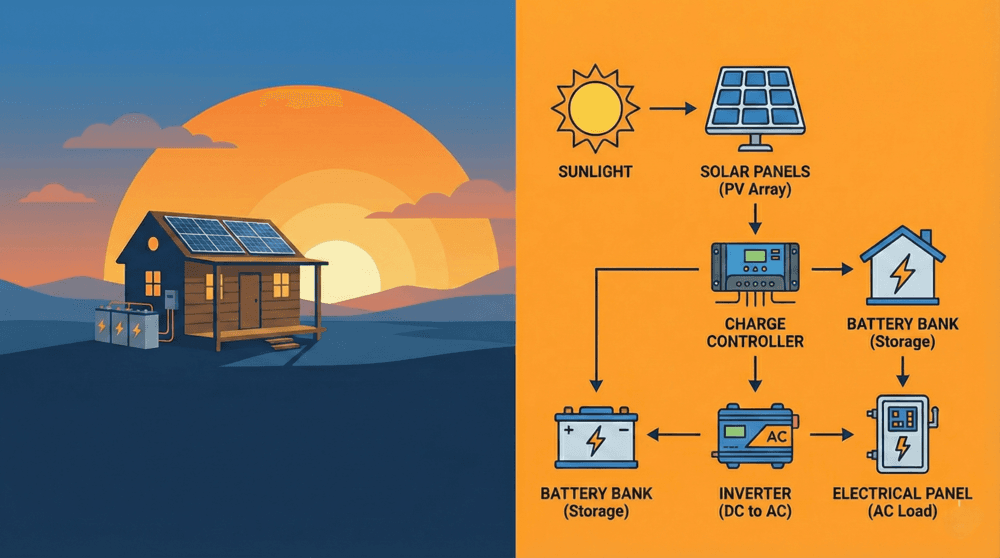
Off-Grid Solar System Requirements: Sizing, Permits & NEC Code Guide
Off-grid solar permit requirements by state: building codes, NEC compliance, bat...
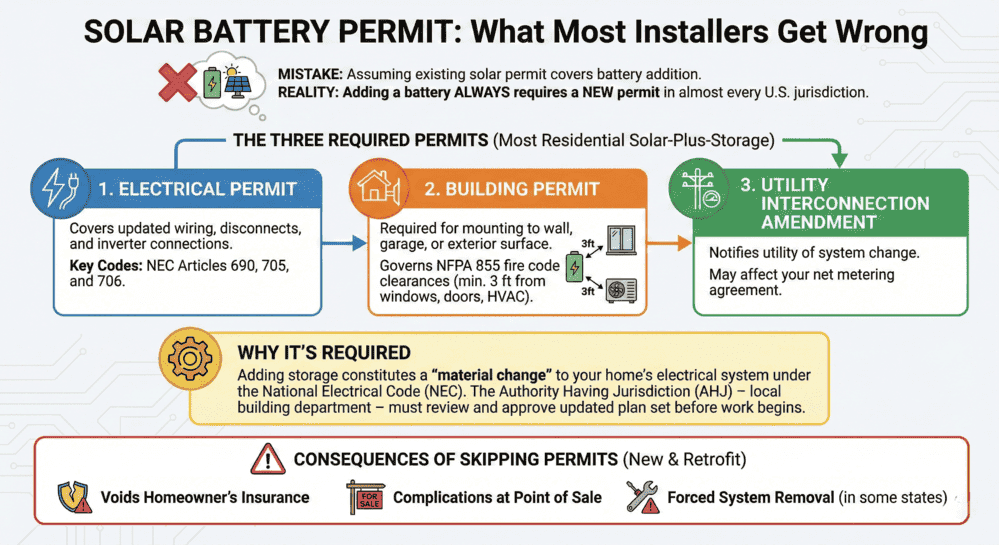
Solar Battery Permit: What Most Installers Get Wrong
Quick Answer: Adding battery storage to a solar system almost always requires ne...
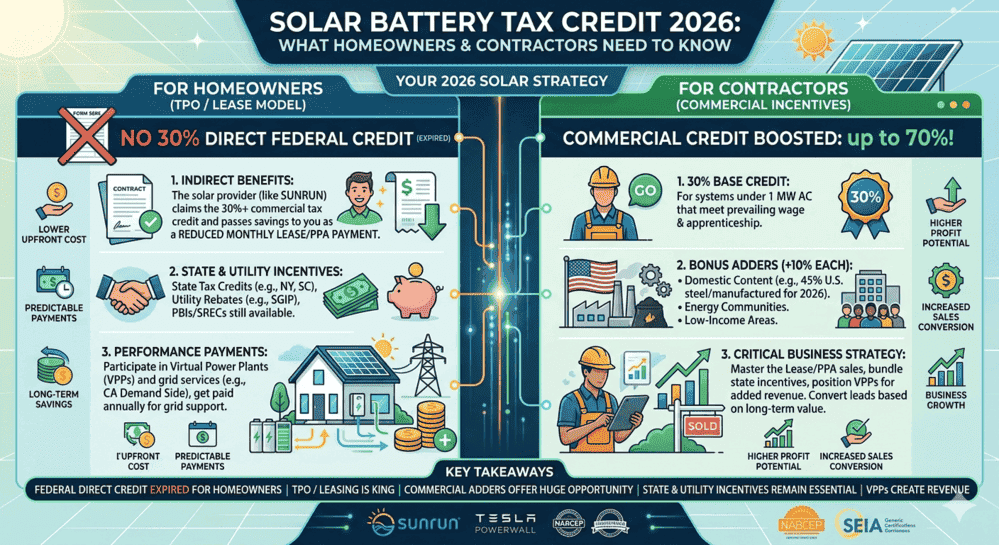
Solar Battery Tax Credit 2026: What Homeowners and Contractors Need to Know
There is no federal solar battery tax credit available to homeowners in 2026. Th...