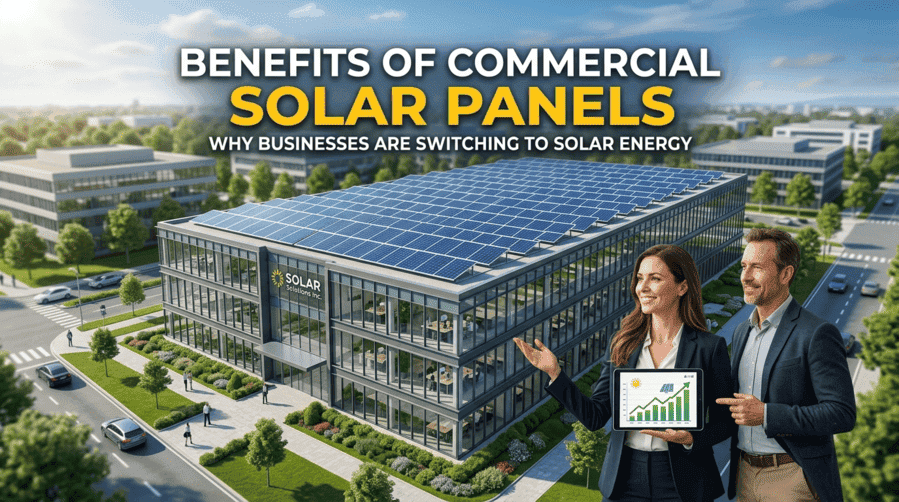
Commercial solar panels help businesses lower electricity expenses, reduce exposure to rising utility rates, cut demand charges, qualify for the Section 48E federal tax credit and five-year MACRS depreciation, and improve energy independence. For warehouses, manufacturing plants, offices, and retail buildings with large daytime energy use, a properly designed and permitted solar system becomes a long-term financial asset rather than just an operating cost, and pairing it with battery storage adds resilience during outages and peak-demand periods.
Quick Answer: How Commercial Solar Pays Off
| Benefit | Business Impact |
|---|---|
| Lower electricity costs | Offsets purchased grid power during operating hours |
| Demand charge reduction | Solar plus battery storage trims peak-usage billing spikes |
| Section 48E tax credit | Up to 30% federal investment tax credit on qualifying systems |
| MACRS depreciation | Businesses recover roughly 20-25% of system cost through accelerated tax deductions |
| Energy independence | Less exposure to utility rate increases and grid volatility |
| Sustainability / ESG | Supports emissions reporting and green power commitments |
| Battery storage | Improves resilience, backup power, and peak-shaving |
What Are Commercial Solar Panels?
Commercial solar panels are photovoltaic systems sized and engineered for businesses rather than single-family homes: warehouses, manufacturing plants, office buildings, retail centers, schools, hotels, agricultural operations, and industrial facilities. The core technology is the same as residential solar, but commercial systems are typically larger (25 kW to several megawatts), often three-phase, and mounted on rooftops, ground arrays, or parking canopies rather than a single sloped residential roof.
Because commercial buildings draw more power, over longer hours, and often on three-phase electrical service, commercial solar projects require more detailed electrical planning, structural review, and code compliance work than residential jobs. A commercial system has to satisfy the building’s actual demand profile, not just annual usage, which is why upfront engineering, careful
system design work matters so much. Commercial solar projects require careful electrical planning and engineering review to make sure the system satisfies both building codes and utility interconnection requirements before installation begins; see our commercial solar design services for how that process works.
15 Benefits of Commercial Solar Panels for Businesses
1. Reduce Business Electricity Costs
Electricity is one of the largest controllable operating expenses for most commercial properties. Solar offsets purchased grid power by generating electricity on-site, and because most commercial buildings consume the bulk of their power during the day, when solar production is highest, the match between generation and consumption is often better for a business than it is for a typical home.
2. Protect Your Business Against Rising Utility Rates
Utility rates fluctuate with fuel costs, grid infrastructure spending, and regional demand, and commercial rate classes are not exempt from those swings. Solar converts a variable, unpredictable line item into a fixed, known cost for the life of the system, which makes multi-year budgeting and cost forecasting considerably easier for finance teams.
3. Improve Commercial Solar ROI
Commercial solar is an investment decision, not just an energy purchase. Return on investment depends on system size, local electricity rates, expected solar production for the site, available incentives, the financing method chosen, and roof or ground-mount conditions. A properly scoped feasibility analysis, not a rule-of-thumb estimate, is what actually determines payback period; NREL’s market research tracks how these variables have shifted commercial solar economics nationally.
4. Take Advantage of Commercial Solar Tax Incentives
Commercial projects can currently qualify for the federal Section 48E Clean Electricity Investment Credit, which remains available at up to 30% for qualifying commercial solar and storage projects that begin construction before July 4, 2026. Businesses can also generally claim accelerated depreciation through the Modified Accelerated Cost Recovery System (MACRS), and many states and utilities layer additional rebates or incentives on top. Together, these can meaningfully reduce the effective cost of a commercial project; see SEIA’s overview of MACRS depreciation for solar for how the accelerated schedule works.
5. Lower Overall Operating Expenses
Beyond the electricity bill itself, solar helps businesses reduce monthly operating expenses, improve cash flow, and increase financial predictability, three factors that matter as much to lenders and investors as they do to a facility manager.
6. Reduce Demand Charges With Commercial Solar
Many commercial electricity bills include two separate charge types. Energy charges are based on total kWh consumed. Demand charges are based on the single highest spike in electricity draw during a billing period, often measured in a 15-minute window. A business can run efficiently overall and still get hit with a high demand charge because of one short burst of peak usage, such as equipment startup or a mid-afternoon production surge.
Solar reduces daytime peak demand directly by offsetting grid draw during the hours when demand charges are most likely to spike. Pairing solar with battery storage extends this further: batteries can discharge specifically during peak-demand windows, smoothing out load spikes and materially improving utility bill savings beyond what solar alone achieves.
7. Increase Energy Independence
Commercial solar reduces a business’s dependence on utility rate increases, grid fluctuations, and broader energy market volatility. Adding battery storage to the mix increases that independence further, giving a facility a genuine buffer against both price swings and outages.
Solar + Battery Storage for Businesses
A growing share of commercial solar projects now include battery storage from day one, rather than as a later add-on. The reasons cluster around four practical benefits:
Backup Power Protection
Battery storage keeps critical loads running during an outage, which matters most for warehouses, healthcare facilities, manufacturing lines, and any operation where downtime is expensive or unsafe.
Peak Demand Reduction
Batteries can discharge stored solar energy during the utility’s most expensive peak-demand periods, directly attacking the demand-charge problem described above.
Energy Management
Businesses can store excess midday solar production and use it later in the day, optimizing overall electricity consumption rather than exporting all excess generation back to the grid.
Grid Resilience
Storage supports outage preparedness, opens the door to microgrid configurations for larger campuses, and protects critical loads even when the broader grid is down.
Because a battery adds circuits, disconnects, and labeling scope that a PV-only design does not cover, any storage addition needs its own compliance review rather than a simple hardware add-on. See our NEC 690 and 706 battery storage compliance checklist for the documentation an AHJ will expect and our solar battery tax credit 2026 guide for how storage incentives currently work for commercial versus residential projects.
8. Improve Sustainability and ESG Performance
Businesses increasingly use on-site solar to reduce measured carbon emissions, meet internal or investor-driven sustainability targets, and strengthen environmental reporting. Organizations that formalize this can also pursue recognition through voluntary programs like the
EPA Green Power Partnership, which supports companies procuring green power above baseline utility mixes.
9. Strengthen Brand Reputation
Visible solar adoption signals environmental responsibility, operational innovation, and long-term planning to customers, employees, and investors alike.
10. Increase Commercial Property Value
A well-designed, permitted solar system can improve a property’s attractiveness to buyers or tenants, its perceived operating efficiency, and its overall marketability, particularly for industrial and logistics properties where energy costs are a major line item for prospective tenants.
11. Maximize Unused Roof and Parking Space
Commercial properties often have square footage that solar can put to work: large flat rooftops, ground space, and parking lots. A solar canopy or solar carport over an existing parking area generates power without competing for roof space and doubles as covered parking for employees or customers.
12. Support EV Charging Infrastructure
Solar can support employee EV charging, commercial fleet charging, and customer-facing charging stations, often combined with the same canopy or carport structure used for parking coverage. See our guide to solar-powered EV charging stations for how the sizing and permitting works for that combined use case.
13. Improve Energy Reliability
Solar, battery storage, and an energy management system working together create a materially more resilient energy setup than any one piece alone, particularly for operations that cannot tolerate downtime.
14. Prepare Businesses for Future Energy Requirements
Solar helps companies get ahead of tightening sustainability reporting requirements, evolving state energy regulations, and the likelihood of continued long-term increases in commercial electricity costs.
15. Gain a Competitive Business Advantage
Taken together, lower operating expenses, a stronger sustainability profile, and improved operational resilience add up to a real competitive edge, particularly in industries where customers and partners increasingly factor energy practices into vendor decisions.
Solar Permit Solutions
Commercial Solar Design Services
Professional permit plan sets for commercial installations. PE-stamped, code-compliant, fast delivery.
Which Businesses Benefit Most From Commercial Solar?
Warehouses and Distribution Centers
Large flat roof areas, daytime-heavy energy consumption, and high overall electricity usage make warehouses some of the strongest candidates for commercial solar.
Manufacturing Facilities
Heavy equipment loads, high demand charges from machinery startup cycles, and continuous multi-shift operations create both a large energy bill and a strong demand-charge-reduction case for solar plus storage.
Retail and Commercial Buildings
Large parking areas make solar canopies a natural fit, and visible solar installations offer customer-facing sustainability signaling in addition to the direct cost savings.
Agricultural Businesses
Pumps, refrigeration, and other continuously running equipment create predictable daytime loads that solar is well suited to offset.
How Much Can Commercial Solar Save a Business?
Every commercial solar project requires a customized financial analysis, but four factors consistently drive the size of the opportunity. State and utility incentive stacking varies widely, so checking DSIRE for the current programs available at a specific business address is a useful starting point, alongside the Department of Energy’s Solar Energy Technologies Office for broader national data on solar soft costs and deployment trends.
- Electricity consumption: higher usage generally creates more savings opportunities.
- Utility rates: higher electricity costs improve solar’s underlying economics.
- System size: larger systems can capture more savings, within the limits of available roof, ground, or canopy space.
- Incentives: the Section 48E credit and MACRS depreciation both reduce the effective upfront investment.
Commercial Solar Financing Options
| Financing Method | Key Advantage |
|---|---|
| Cash purchase | Maximum lifetime savings; full ownership of tax benefits |
| Solar loan | Preserves working capital while the business still owns the system |
| Power purchase agreement (PPA) | Minimal upfront cost; a third party owns and operates the system |
| Solar lease | Predictable fixed payments without ownership responsibilities |
Under a PPA or lease, the third-party owner, not the business, typically claims the Section 48E credit and MACRS depreciation and passes some of that value through as a lower rate. See our guide to third-party ownership (TPO) solar for how that trade-off plays out in practice.
Commercial Solar Permitting Challenges
Commercial solar projects involve meaningfully more permitting complexity than residential systems, and underestimating this step is one of the most common causes of project delay.
1. AHJ Permit Requirements
Every Authority Having Jurisdiction (AHJ) sets its own requirements for electrical drawings, structural documentation, equipment specifications, and code compliance detail, and commercial submissions face stricter scrutiny than residential ones.
2. Structural Review Requirements
Commercial roofs, canopies, and carports may require detailed load calculations, attachment review, and full structural analysis against ASCE 7 wind, snow, and seismic criteria before an AHJ will approve the design. See our commercial solar roof integration guide for how this review typically unfolds.
3. Electrical Design Requirements
Commercial plan sets need one-line (and often three-line) diagrams, full load calculations, any required service upgrades, and documented compliance with NEC (NFPA 70). Our single-line diagram guide walks through what every reviewer expects to see on that drawing.
4. Utility Interconnection Challenges
Utility review timelines, required supporting documents, and correction or revision cycles all add time to a commercial project, and larger systems commonly trigger a more detailed engineering review than residential Level 1 applications. See our commercial solar interconnection process guide and our breakdown of supply-side versus load-side interconnection, which becomes especially relevant once a project outgrows the 120% busbar rule. Commercial inverters must also meet IEEE 1547 interconnection and anti-islanding standards.
5. Engineering Stamps
Most commercial projects require both a PE electrical stamp and a structural engineering stamp from an engineer licensed in the project’s state, and an out-of-state stamp is not valid.
For the full documentation package a commercial reviewer expects, see our commercial solar plan sets guide and our broader overview of how commercial solar systems work and our commercial solar compliance guide for installation standards across roof, ground-mount, and carport projects.
Commercial Solar Installation Process
- Energy Assessment: Review historical utility bills, demand charge patterns, and operating hours to establish the actual savings opportunity, using UL-listed equipment specifications as the baseline for system sizing.
- Site Evaluation: Assess roof condition, ground space, or parking area, along with shading and structural capacity.
- Solar Design: Engineer the array, inverter configuration, and (if included) battery system for the site, following the design process referenced above.
- Engineering & Permit Package: Produce the PE-stamped, AHJ-ready plan set covering the site plan, diagrams, structural calculations, and equipment datasheets referenced above.
- AHJ Approval: Submit for building and electrical permit review and respond to any correction cycles.
- Installation: Licensed contractors install the array, electrical systems, and any battery storage per the approved plan set.
- Inspection & Permission to Operate: Pass final AHJ inspection, finalize the utility interconnection application, and receive permission to operate before the system can legally export power.
Frequently Asked Questions
Commercial Solar Design Services
Professional permit plan sets for commercial installations. PE-stamped, code-compliant, fast delivery.
Frequently Asked Questions
For most businesses with meaningful daytime electricity use, yes. The combination of direct energy savings, demand charge reduction, the Section 48E tax credit, and MACRS depreciation typically produces a payback period well within the system's operating life, though the exact number depends on local rates, incentives, and system size.
Savings vary by electricity consumption, local utility rates, system size, and available incentives, which is why every commercial project needs its own financial analysis rather than a generic estimate.
Yes. Solar reduces daytime peak demand directly, and adding battery storage extends that benefit by discharging during the specific windows when demand charges are calculated.
Battery storage adds backup power protection, further demand-charge reduction, more flexible energy management, and greater grid resilience on top of what solar alone provides.
Yes. Virtually every commercial solar installation requires both a building permit and an electrical permit from the local AHJ, plus a utility interconnection agreement, as covered in the permitting section above.
A typical package includes a site plan, structural calculations, electrical one-line (and often three-line) diagrams, equipment datasheets, a label schedule, and PE stamps for both structural and electrical scope, all covered in the commercial solar plan sets guide linked above.
Physical installation is often faster than the surrounding process. Design, engineering, permitting, and utility interconnection review typically take longer than the on-site construction itself, particularly for systems that trigger a Level 2 or Level 3 utility engineering review.

SPS Editorial Team
Solar Permit Solutions
Solar Permit Solutions provides professional solar permit design services for residential, commercial, and off-grid installations across all 50 states. Our team ensures permit-ready plan sets delivered fast.
Related Articles
Solar Permit Requirements In Florida: Complete Step-By-Step Guide
Solar Permit Solutions breaks down Florida’s permit requirements by county...
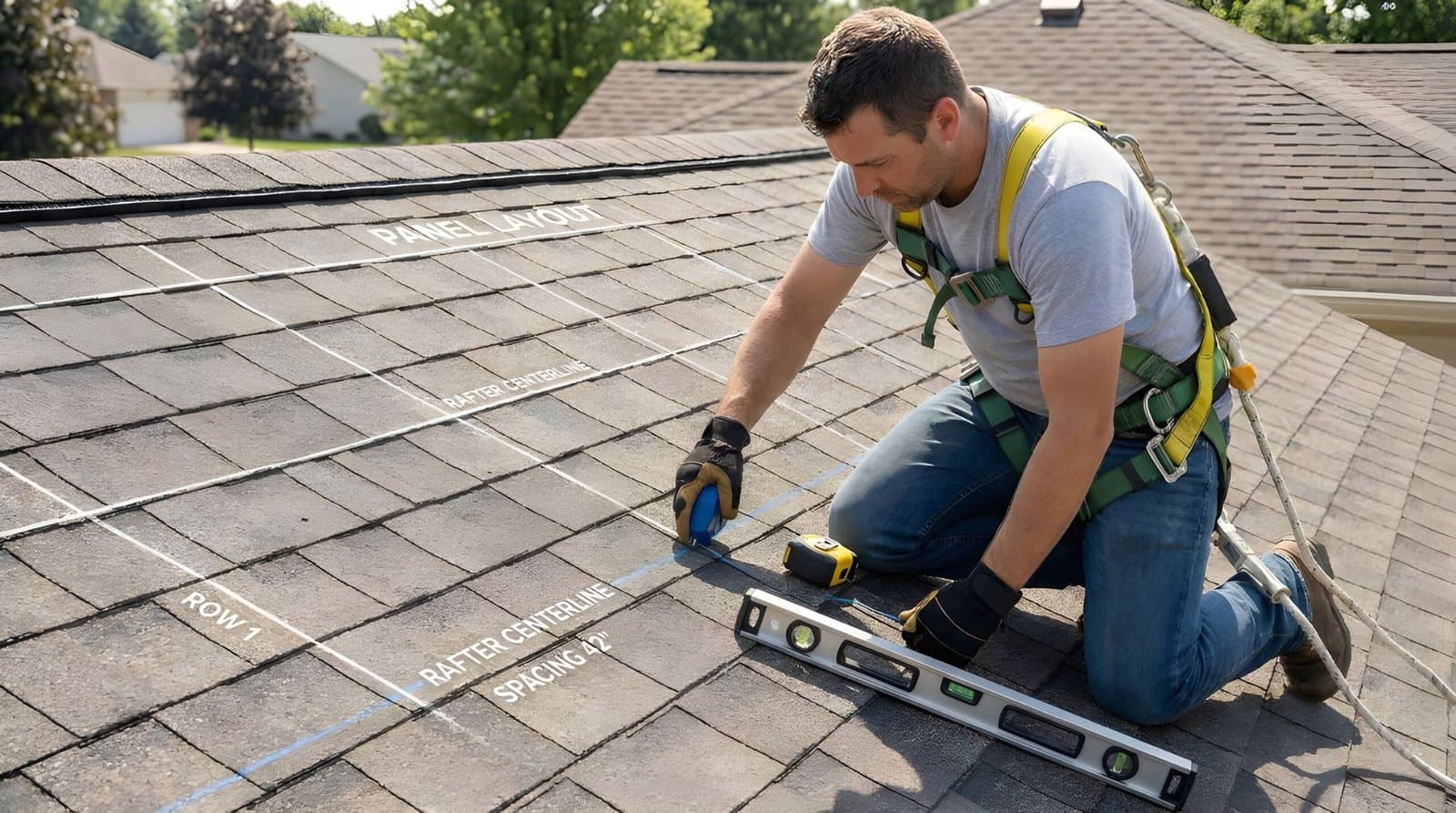
How to Mount Solar Panels on a Roof: Mounting Systems, Rails, and DIY Tips
Learn how to mount solar panels yourself with this complete guide. Covers compon...
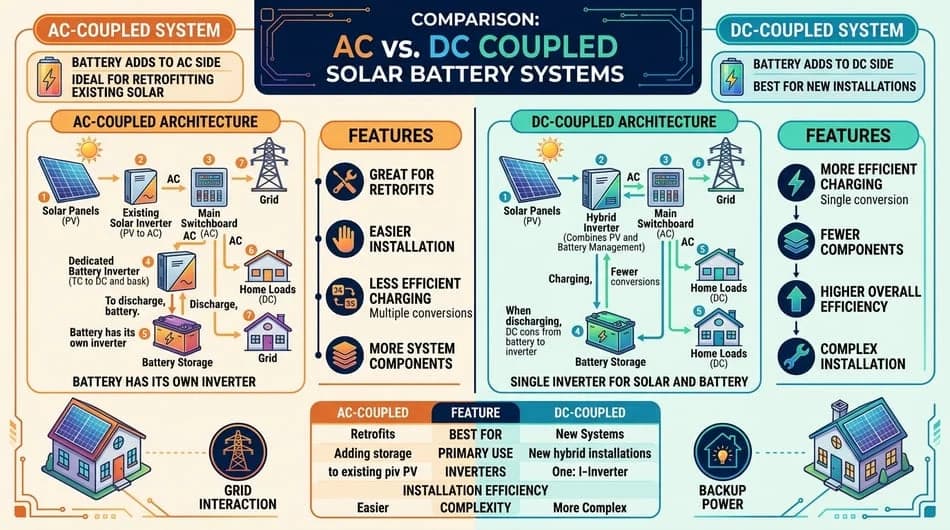
AC vs DC Coupled Solar Batteries: Which Should You Choose?
AC vs DC coupled solar batteries compared: efficiency, costs ($8K-$18K), and ins...