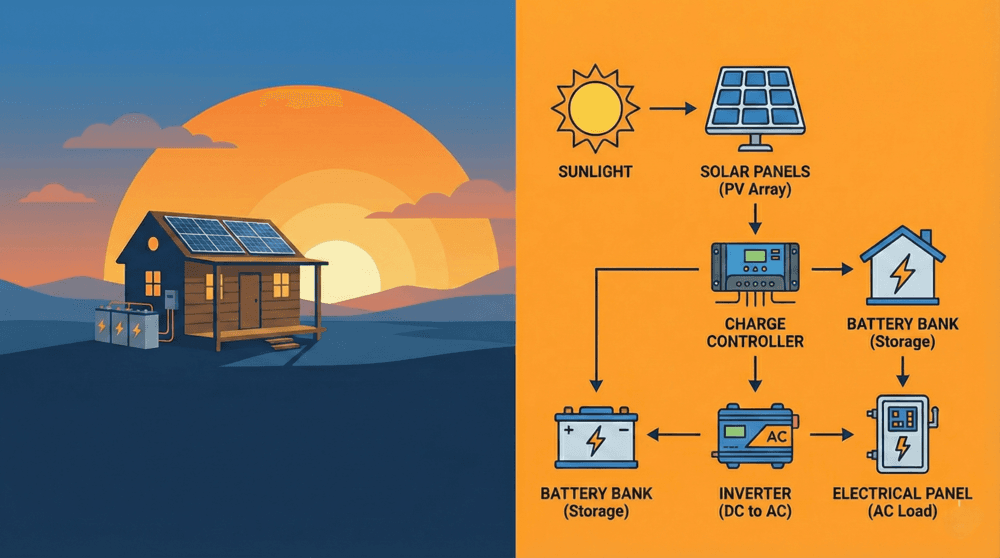
An off-grid solar system generates and stores electricity without relying on the utility grid. A typical system includes solar panels, battery storage, an off-grid inverter, and charge-control equipment, with the system sized to meet the property’s electrical loads and expected periods of low solar production.
Can you install off-grid solar without a permit? Sometimes, but being off-grid does not automatically make a solar installation permit-exempt. Permit requirements depend on the local jurisdiction and may include electrical, building, structural, zoning, or battery-storage approvals. Unlike grid-tied solar, a true off-grid system generally does not require utility interconnection or net-metering approval because it does not operate in parallel with the utility grid.
This guide explains how to size an off-grid solar system, how much battery storage may be needed, what permits and approvals may apply, and which NEC requirements are relevant to stand-alone solar installations. Because requirements vary by location, always confirm the applicable rules with the local Authority Having Jurisdiction (AHJ) before construction.
What is an Off-Grid Solar System?
An off-grid solar system is a standalone power generation setup that operates completely independent of the utility grid. These systems combine solar panels, battery storage, charge controllers, and inverters to provide reliable electricity to properties without utility connections.
Core Components of Off-Grid Solar Systems
- Solar Panels: Convert sunlight into DC electricity. Modern panels range from 400W to 500W+ per panel.
- Charge Controller: Regulates power flow from panels to batteries, preventing overcharging. MPPT controllers are preferred for off-grid applications.
- Battery Bank: Stores energy for use when the sun isn’t shining. Lithium iron phosphate (LiFePO₄) batteries are the current industry standard.
- Off-Grid Inverter: Converts DC battery power to AC electricity for household use. Many off-grid inverters include built-in charge controllers.
- Backup Generator (Optional): Provides supplemental power during extended cloudy periods or high-demand situations.
Off-Grid vs. Grid-Tied vs. Hybrid Solar
The fundamental difference between off-grid and grid-tied systems lies in utility connection and energy storage requirements. Grid-tied systems can rely on the utility as a backup and benefit from net metering programs, while off-grid systems must be entirely self-sufficient.
Off-grid systems typically require 2-3 times more battery capacity than grid-tied battery backup systems because they must account for multiple days of autonomy during inclement weather.
Solar Permit Solutions
Off-Grid Solar System Design
Expert design services for off-grid and battery backup systems. Complete permit packages delivered fast.
Off-Grid Solar System Sizing Guide
Proper system sizing is the most critical factor in off-grid solar success. An undersized system leads to frequent power shortages, while an oversized system wastes money on unnecessary equipment. Industry data from the Solar Energy Industries Association shows continued growth in off-grid installations.
Calculating Your Daily Energy Needs (kWh)
Start by calculating your daily kilowatt-hour (kWh) consumption. Review past utility bills if available, or create a detailed appliance inventory, multiplying each device’s wattage by hours of daily use.
Common Appliance Power Consumption:
A typical off-grid home with moderate energy efficiency measures uses 15-30 kWh per day. Highly efficient homes or cabins can operate on as little as 5-10 kWh daily.
Solar Panel System Sizing (kW)
Once you know your daily energy needs, calculate the required solar array size based on your location’s peak sun hours. The NREL PVWatts Calculator provides accurate solar production estimates for any U.S. location.
Formula: Daily kWh needed ÷ Peak Sun Hours ÷ 0.80 (system efficiency) = Required kW
Example: 20 kWh daily need ÷ 5 peak sun hours ÷ 0.80 = 5 kW solar array
Recommended System Sizes by Application:
Battery Bank Sizing (kWh)
Battery capacity must account for days of autonomy, the number of cloudy days your system can sustain without solar production. Most off-grid systems are designed for 2-3 days of autonomy.
Formula: Daily kWh × Days of Autonomy ÷ Depth of Discharge = Required Battery Capacity
Example: 20 kWh × 3 days ÷ 0.80 DoD (lithium) = 75 kWh battery bank
Lithium batteries can safely discharge to 80-90% depth of discharge (DoD), while lead-acid batteries should only discharge to 50% to preserve lifespan.
Off-Grid Solar Equipment Breakdown
Selecting the right equipment is crucial for off-grid system reliability and longevity. Each component must be properly sized and compatible with the overall system design.
Solar Panels for Off-Grid Systems
Modern monocrystalline panels offer the best efficiency and value for off-grid installations. Look for panels with 20%+ efficiency ratings and robust warranties. For detailed specifications, review our solar panel selection guide.
- Panel wattage: 400W-500W panels are standard for residential off-grid systems
- Temperature coefficient: Lower is better for hot climates (-0.3%/°C or better)
- Warranty: A 25-year performance warranty is the industry standard
Charge Controllers (MPPT vs. PWM)
The charge controller regulates power flow from solar panels to batteries. MPPT (Maximum Power Point Tracking) controllers are strongly recommended for off-grid systems due to their 15-30% efficiency advantage over PWM controllers.
- MPPT Controllers: Convert higher panel voltage to optimal battery charging voltage, capturing maximum available power
- PWM Controllers: Simple and affordable but waste energy when panel voltage exceeds battery voltage
Size charge controllers based on solar array wattage and battery bank voltage. A 5 kW array with 48 V batteries requires approximately 105 A charge controller capacity.
Off-Grid Inverters
Off-grid inverters convert DC battery power to AC household electricity. Unlike grid-tied inverters, off-grid models must create their own AC waveform and handle surge loads from motors and compressors. Learn more in our inverter types guide.
- Pure Sine Wave: Required for sensitive electronics and most modern appliances
- Continuous vs. Surge Rating: Size for continuous load plus 2-3x surge capacity for motor starting
- Inverter/Charger Combos: Integrate battery charging, inverter, and transfer switch in one unit
Battery Options for Off-Grid Solar
Battery selection significantly impacts system cost, maintenance requirements, and lifespan. For comprehensive battery information, see our solar battery storage guide.
Lithium Iron Phosphate (LiFePO₄):
- 10-15 year lifespan with 4,000-6,000 cycle life
- 80-90% usable depth of discharge
- No maintenance required
- Higher upfront cost but lowest cost per cycle
Lead Acid (Flooded, AGM, Gel):
- 3-7 year lifespan with 500-1,500 cycle life
- 50% recommended depth of discharge
- Flooded batteries require regular watering and equalization
- Lower upfront cost but higher long-term expense
Backup Generators
While not required, backup generators provide peace of mind during extended cloudy periods or unexpected high-demand situations. Propane generators are popular for off-grid applications due to fuel stability and cleaner operation.
- Propane: Clean burning, indefinite fuel storage, quiet operation
- Diesel: Fuel-efficient, durable, widely available fuel
- Gasoline: Lower cost, but fuel degrades within 3-6 months
Off-Grid Solar System Costs
Off-grid solar systems cost significantly more than comparable grid-tied installations due to battery storage requirements. However, when compared to the cost of extending utility lines to remote properties, off-grid solar often provides substantial savings. Consult NREL best practices for photovoltaic systems for technical guidance.
Component Cost Breakdown
Total System Cost Ranges
For detailed cost analysis and financing options, visit our solar cost guide.
- Small System (3-5 kW + 15-25 kWh battery): $15,000-$30,000
- Medium System (8-12 kW + 40-60 kWh battery): $35,000-$55,000
- Large System (15-20 kW + 80-100 kWh battery): $60,000-$100,000+
Off-Grid vs. Grid Extension Costs
Systems connecting to the grid must meet IEEE 1547 interconnection standards.
Utility companies typically charge $15,000-$50,000 per mile to extend power lines to remote properties. If your property is more than half a mile from existing utility infrastructure, off-grid solar often costs less than grid connection while eliminating monthly utility bills entirely.
Do You Need a Permit for Off-Grid Solar?
In most cases, you should expect some form of permitting or inspection for a permanent off-grid solar installation, but the exact requirements depend on the local jurisdiction.
The key distinction is that an off-grid system normally does not need utility interconnection approval because it is not connected to the utility grid. However, the electrical installation itself may still be subject to local permitting and inspection requirements.
Depending on the project, the AHJ may require:
- Electrical permit — For the installation of the electrical generation, wiring, disconnects, batteries, and related equipment
- Building permit — May apply to roof-mounted systems, ground-mounted structures, equipment shelters, or other construction
- Structural review — May be required when solar equipment is installed on a roof or structural support system
- Zoning approval — May apply to ground-mounted arrays, setbacks, height restrictions, or equipment locations
- Fire review — May apply to certain battery storage installations or system configurations
- Battery/energy-storage requirements — Additional requirements may apply depending on the battery technology, location, and system size
What Off-Grid Solar Usually Does Not Require
Because a true off-grid system does not operate in parallel with the utility grid, it generally does not require the same utility interconnection process as a grid-tied system.
This can mean no:
- Utility interconnection agreement
- Net-metering application
- Permission to operate from the utility
However, no utility interconnection does not mean no permit.
A homeowner or installer should confirm the requirements with the local Authority Having Jurisdiction (AHJ) before beginning construction. Requirements can vary significantly between cities, counties, and states.
Off-Grid Solar System Permits & Code Requirements
Permitting requirements for off-grid solar systems vary significantly by location. While rural areas may have minimal requirements, most jurisdictions require at least an electrical permit for any permanent solar installation. Understanding your local requirements upfront prevents costly delays and compliance issues.
When Permits Are Required
Unlike grid-tied systems, off-grid installations do not require utility interconnection agreements or net metering applications. However, most jurisdictions still require building and/or electrical permits. For a complete overview of permit processes, see our solar permitting guide.
Permits typically required:
Electrical Permit: Required in most jurisdictions for any permanent electrical installation
Building Permit: Often required for roof-mounted or ground-mounted structures
Zoning Approval: May be needed for ground-mounted arrays or battery enclosures
NOT required for off-grid:
Utility interconnection agreement
Net metering application

Off-Grid Solar Permit Requirements by State Overview
California Off-Grid Solar Laws
California has specific requirements for off-grid solar installations. The California Solar Permitting Guidebook provides comprehensive guidance. The state’s Solar Rights Act limits local government’s ability to impose overly burdensome requirements on solar installations. The DOE Solar Energy Technologies Office provides comprehensive technical resources.
Per the 2022 California Electrical Code, solar installers must hold a valid C-10 (Electrical) or C-46 (Solar) contractor’s license. Most municipalities require both building and electrical permits. For California-specific requirements, visit our California solar permitting page.
Texas Off-Grid Solar Permits
Texas permitting requirements vary dramatically by county. Many rural counties have minimal or no permitting requirements for off-grid systems, while cities like Houston, Austin, and Dallas require full electrical and building permits. Our Texas solar permitting guide covers requirements by region.
Arizona Off-Grid Solar Requirements
Arizona’s abundant sunshine makes it ideal for off-grid solar. Most counties require electrical permits, and installations must comply with NEC requirements. Maricopa County and Pima County have streamlined permit processes for residential solar installations.
Florida Off-Grid Solar Permits
Florida requires electrical permits for solar installations statewide. Additionally, all installations must meet Florida Building Code requirements for hurricane and wind load resistance, a critical consideration for the state’s coastal and inland regions.
Colorado Off-Grid Solar Requirements
Colorado’s mountain communities have significant off-grid solar adoption. Most counties require electrical permits, and systems must be designed for local snow loads. Some rural counties have minimal requirements, while resort communities may have additional aesthetic guidelines.
Permit Application Process
The permit application process varies by jurisdiction but typically requires:
Site Plan: Property layout showing system location and setbacks
Electrical Diagrams: Single-line diagram showing all system components
Equipment Specifications: Spec sheets for panels, inverters, batteries, and charge controllers
Structural Analysis: Engineering stamps may be required for roof-mounted or large ground-mounted systems.
Typical permit fees: $100-$500 depending on jurisdiction and system size. Processing time ranges from same-day approval to 4+ weeks.
Can I Use SolarAPP+ for Off-Grid Systems?
SolarAPP+ is designed to streamline permitting for standard residential grid-tied solar installations and does not currently support off-grid system applications. Off-grid systems have unique requirements that fall outside SolarAPP+’s automated approval criteria. For jurisdictions using SolarAPP+, off-grid projects must go through traditional permit review processes.

NEC Code Requirements for Off-Grid Solar
The National Electrical Code (NEC) establishes safety requirements for all electrical installations, including off-grid solar systems. Compliance with current NEC requirements is essential for permit approval and system safety. For comprehensive code information, see our NEC solar compliance guide. All equipment should carry UL Solar Panel Certification Standards for safety compliance.
- Grounding Requirements (NEC 690.47): Off-grid systems must have a grounding electrode system connected to the system’s grounding conductor. Equipment grounding conductors must be sized according to NEC Table 250.122.
- Disconnects and Overcurrent Protection (NEC 690.9, 690.13): Readily accessible disconnects are required for all ungrounded conductors. Disconnects must be clearly marked and easily operated. Overcurrent protection devices (OCPDs) must protect all conductors and equipment.
- Battery Installation Requirements (NEC 480.9, 690.71): Batteries must be installed with adequate ventilation (especially lead-acid), protected from physical damage, and have properly sized interconnection conductors based on system voltage and current.
- Wiring Methods (NEC 690.31, Article 300): Proper conductor types and installation methods must be used. Conduits and cable trays must protect against physical damage and environmental factors.
- Arc Fault and Ground Fault Protection (NEC 690.5, 690.11): DC arc-fault circuit protection is required for certain PV systems. Ground-fault protection must detect and interrupt ground faults in the PV array.
- Labeling and Markings (NEC 690.56, 110.21): All components must be clearly marked with durable, weather-resistant labels indicating function and hazards. Maximum voltage and current ratings must be displayed.
- Inverter Requirements (NEC 690.60, 690.64): Inverters must be listed and labeled by a recognized testing laboratory. Output circuits must be properly sized and protected.
- Rapid Shutdown Considerations (NEC 690.12): While primarily for grid-tied rooftop systems, certain off-grid configurations may require rapid shutdown capabilities. Consult your local AHJ for specific requirements.
For detailed NEC requirements, reference the NFPA 70 National Electrical Code, the current edition adopted by your jurisdiction.
NEC Article 710: Stand-Alone Systems
NEC Article 710 addresses stand-alone electrical systems that operate independently from an electric utility. This is particularly relevant to true off-grid solar installations because these systems are designed to operate without a permanent utility connection.
Article 710 works alongside other applicable NEC requirements. Depending on the system design, an off-grid solar installation may also need to comply with requirements covering photovoltaic systems, energy storage, grounding and bonding, wiring methods, disconnects, overcurrent protection, and equipment listing.
For an off-grid solar project, the applicable NEC requirements should be evaluated as a complete system rather than relying on Article 710 alone.
Common NEC areas to review include:
- Article 690 — Photovoltaic (PV) systems
- Article 710 — Stand-alone systems
- Article 706 — Energy storage systems
- Article 250 — Grounding and bonding
- Article 110 — General requirements for electrical installations
Always verify which NEC edition and local amendments have been adopted by the AHJ for the specific project.
Off-Grid Solar Inspection Checklist
Passing inspection on the first attempt saves time and money. Use this checklist to prepare for your off-grid solar inspection. For additional inspection guidance, see our solar inspection guide.
Pre-Inspection Preparation
- Verify all equipment matches approved permit documents
- Confirm proper torque on all electrical connections
- Install all required labels and warning signs
- Complete grounding electrode system installation
- Ensure disconnects are accessible and properly marked
- Have equipment spec sheets and permit documents on-site
- Verify battery ventilation meets code requirements
- Confirm wire sizing matches system specifications
Common Inspection Failure Points
Missing or incorrect labels: Ensure all DC voltage warnings, disconnect labels, and system ratings are properly displayed.
Grounding deficiencies: Improper grounding electrode connections or undersized equipment grounding conductors
Battery room ventilation: Insufficient ventilation for lead-acid batteries or improper battery enclosure
Conductor protection: Exposed wiring, improper conduit fill, or missing bushings
Equipment substitutions: Installing different equipment than specified on approved permit drawings
Off-Grid Living: Practical Considerations
Living off-grid requires a different relationship with energy consumption than grid-connected homes. Understanding these practical considerations helps set realistic expectations and ensures system success.
Daily Energy Budgeting
Off-grid living requires awareness of your daily energy budget. A solar monitoring system helps track production and consumption in real-time, allowing you to adjust usage patterns based on available power.
During sunny periods, run high-consumption appliances like washing machines and water pumps when excess solar power is available. On cloudy days, conserve battery capacity by reducing non-essential loads.
Appliance Compatibility
Some appliances work better in off-grid applications than others:
Off-Grid Friendly:
LED lighting, laptop computers, efficient refrigerators, DC-powered well pumps, ceiling fans, and small electronics
Use Sparingly:
Microwave ovens, power tools, vacuum cleaners, hair dryers
Consider Alternatives:
Electric water heaters (use propane or solar thermal), electric ranges (use propane), central air conditioning (use mini-splits or passive cooling)
Seasonal Production Variations
Solar production varies significantly by season. Winter months may produce 50-70% less power than summer in northern latitudes due to shorter days and lower sun angles. Design your system for winter production levels, or plan for increased generator use during darker months.
Off-Grid Solar Maintenance Schedule
Regular maintenance ensures optimal performance and extends system lifespan. Off-grid systems require more attention than grid-tied installations due to battery maintenance requirements.
Panel Cleaning and Inspection
Monthly: Visual inspection for debris, damage, or shading issues
Quarterly: Clean panels if dusty or soiled (more frequent in dusty environments)
Annually: Check mounting hardware, inspect wiring connections, verify production against expected output
Battery Maintenance
Lithium Batteries:
Monitor state of charge and cell balance through BMS interface. Keep batteries within the manufacturer’s temperature specifications. No regular maintenance required.
Lead-Acid Batteries:
Monthly: Check electrolyte levels in flooded batteries and add distilled water as needed. Quarterly: Clean terminals and check for corrosion. Semi-annually: Perform equalization charge per manufacturer specifications.
Expected System Lifespan
Solar Panels: 25-30 years (degrading ~0.5% annually)
Lithium Batteries: 10-15 years
Lead-Acid Batteries: 3-7 years
Off-Grid Inverters: 10-15 years
Charge Controllers: 10-15 years
Off-Grid Solar Financing and Incentives
Important Update: The federal solar tax credit landscape changed significantly in July 2025. Understanding the current incentive structure is essential for project planning and budgeting.
Financing Options
Even without federal tax credits, off-grid solar remains financially viable through several financing approaches:
Cash Purchase: Provides the best long-term value and immediate ownership. No tax credit means you’ll want to compare total system cost vs. alternative power solutions.
Solar Loans: Spread costs over 10-20 years while retaining ownership. Compare rates carefully, as the loss of tax credits changes payback calculations.
Home Equity: HELOCs or home equity loans often offer lower rates for property improvements.
Third-Party Ownership: For those who want to access remaining commercial tax benefits, solar leases or PPAs may be available in some markets.
Conclusion
Get Expert Help With Your Off-Grid Solar Project: Our off-grid solar system design team ensures optimal system sizing.
Off-grid solar systems offer true energy independence but require careful planning and proper design to ensure reliable performance. From accurate load calculations and equipment sizing to NEC compliance and permit approval, every detail matters for off-grid success.
While the federal tax credit landscape has changed, off-grid solar remains a viable and often cost-effective solution for remote properties and those seeking energy independence. The key is working with experienced professionals who understand both the technical requirements and the current incentive landscape.
Solar Permit Solutions specializes in solar system design and permitting for both grid-tied and off-grid installations. Our experienced team can prepare permit-ready plan sets and engineering stamps and ensure your system meets all local code requirements. Contact us today to discuss your off-grid solar project.
Frequently Asked Questions
Off-Grid Solar System Design
Expert design services for off-grid and battery backup systems. Complete permit packages delivered fast.
Frequently Asked Questions
Sometimes. Permit requirements depend on the local jurisdiction, system type, property, and installation method. Being off-grid eliminates the need for utility interconnection in a true stand-alone system, but it does not automatically eliminate electrical, building, structural, zoning, or other permitting requirements.
In many jurisdictions, yes. A permanent off-grid solar system involves electrical generation, wiring, disconnects, batteries, and other equipment that may be subject to electrical permitting and inspection. Check with the local AHJ before installation.
A true off-grid system that is not connected to or operated in parallel with the utility generally does not require a utility interconnection agreement or net-metering approval. However, local building and electrical permits may still apply.
Off-grid systems can be subject to several parts of the National Electrical Code, including Article 690 for PV systems, Article 710 for stand-alone systems, Article 706 for energy storage systems, and Article 250 for grounding and bonding. The applicable NEC edition and local amendments should be confirmed with the AHJ.
The appropriate battery autonomy depends on the property's energy consumption, solar resource, weather conditions, backup generation, and design goals. Many off-grid systems are designed around multiple days of autonomy, but the correct value should be determined through the project's load and production analysis.
Yes, but the system must be designed around the home's actual electrical loads and expected energy use. Large loads such as HVAC systems, electric water heaters, well pumps, ranges, and EV chargers can significantly increase the required solar array, inverter, and battery capacity.
Not necessarily. A properly designed system can operate without a generator, but some off-grid systems include a generator as backup during extended periods of low solar production or unusually high energy demand.
SolarAPP+ is primarily designed for eligible residential solar and storage permitting workflows. Off-grid systems may fall outside the platform's supported project criteria and may require traditional AHJ review. Confirm eligibility with the specific jurisdiction before relying on SolarAPP+ for an off-grid project.
The answer depends on the location and system design. An AHJ may require an electrical permit, building permit, structural review, zoning approval, fire review, or battery-storage approval. A site-specific review is the safest way to determine the required permits.

SPS Editorial Team
Solar Permit Solutions
Solar Permit Solutions provides professional solar permit design services for residential, commercial, and off-grid installations across all 50 states. Our team ensures permit-ready plan sets delivered fast.
Related Articles
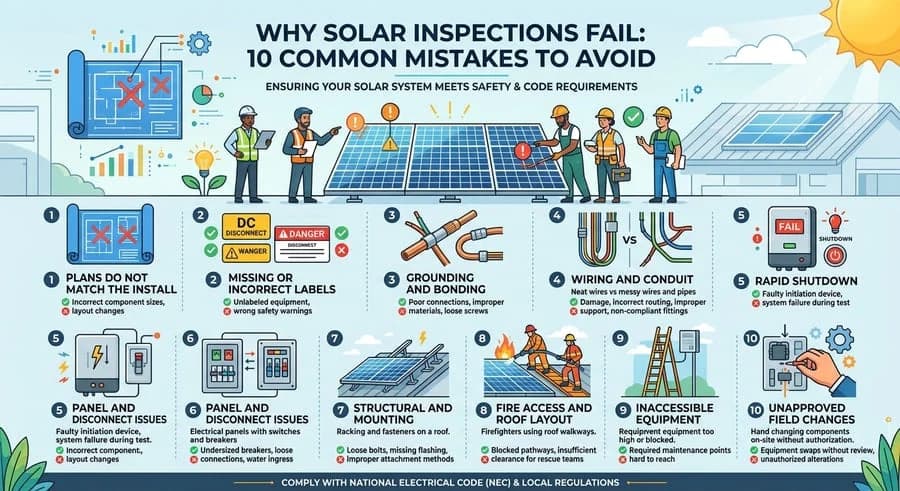
Why Solar Inspections Fail: 10 Common Mistakes to Avoid
Discover the 9 critical reasons solar inspections fail and how to avoid costly m...
Solar Grounding And Bonding: How To Pass Inspection Every Time
Learn how to pass solar grounding and bonding inspections every time. Avoid comm...
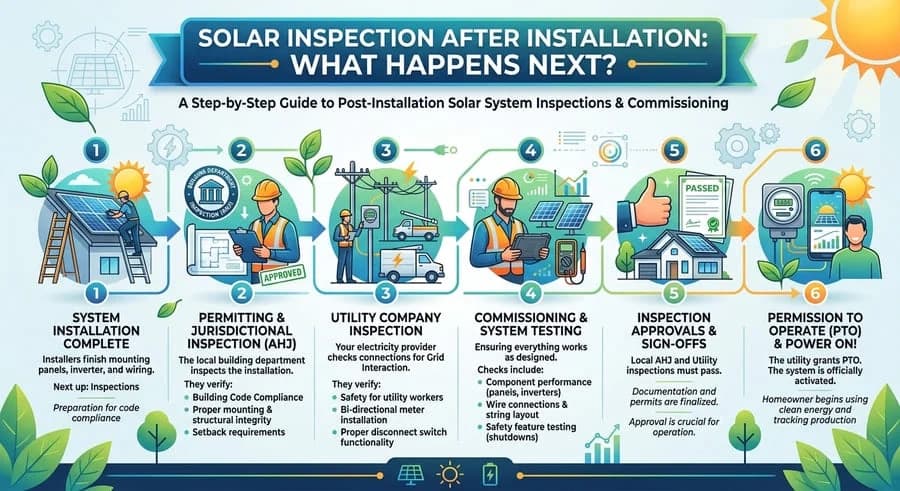
Solar Inspection After Installation: What Happens Next?
Learn how to pass your solar inspection by following essential tips for obtainin...