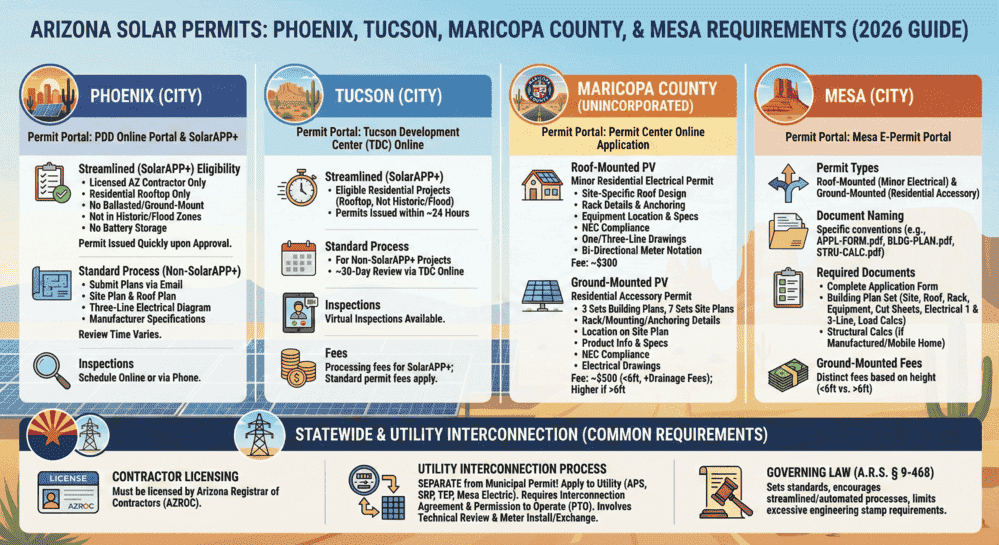
Arizona solar permitting at a glance: Arizona HB2301 now requires every municipality and county to offer instant solar permitting as of January 1, 2026. Phoenix, Tucson (Pima County), Maricopa County, and Mesa all accept SolarAPP+ for same-day residential PV permits. Three major utilities serve Arizona’s solar market: APS (net billing at ~$0.069/kWh), SRP (export plans at $0.0345/kWh or demand plans with retail credit), and TEP (net billing at ~$0.051/kWh). Permit fees range from $94 in Pima County to $300 in unincorporated Maricopa County. Typical residential permitting and interconnection takes 3 to 8 weeks depending on the AHJ requirements in your jurisdiction.
Arizona ranks among the top five states for installed solar capacity, and for good reason. With over 300 sunny days per year, the state offers some of the strongest solar production potential in the country. But navigating the permitting landscape across different cities, counties, and utility territories still creates friction for installers and homeowners alike.
This guide breaks down the solar permitting process across four of Arizona’s most active solar markets: Phoenix, Tucson, Maricopa County, and Mesa. We cover the state-level regulatory framework that governs all Arizona jurisdictions, then walk through each city’s specific permitting process, inspection requirements, and utility interconnection steps. Whether you are an installer filing applications across multiple jurisdictions or a homeowner trying to understand what happens between signing a contract and flipping the switch, this guide provides the details you need.
Arizona’s State-Level Solar Permitting Framework
Arizona’s solar permitting rules begin at the state level with ARS 9-468 (for municipalities) and ARS 11-323 (for counties). These statutes establish minimum standards that every jurisdiction must follow when processing residential solar permits. The key requirements include showing the PV system location on construction plans with roof plan and elevation views, providing photovoltaic panel mounting details, and submitting one-line or three-line electrical diagrams. That last requirement comes with an important exception: electrical diagrams are not required when a qualified online automated permitting platform verifies code compliance, which is exactly what SolarAPP+ does.
The most significant recent change came through HB2301, which mandates that all Arizona municipalities and counties adopt an instant permitting process for home power installations by January 1, 2026. This law covers solar PV systems, energy storage installations, main panel upgrades, and main breaker derates. It also requires jurisdictions to offer offline field report inspections at the same cost and within the same timeframe as in-person inspections, giving installers more scheduling flexibility.
HB2301 key provision: Once a municipality receives a completed notice of installation with required documentation, it must issue the building permit or certificate of completion within two business days, or provide written notice identifying deficiencies. If the municipality fails to respond within that two-day window, the permit is deemed approved as a matter of law and must be issued on the next business day.
Arizona law also prohibits HOAs from banning solar installations, though associations can adopt reasonable aesthetic guidelines regarding placement. The state does not require a specific solar contractor license; however, installers must hold an appropriate Arizona electrical contractor license. The R-11 classification covers residential electrical work on single-family and multi-family dwellings up to 15 units, while the K-11 covers broader commercial electrical scopes that include solar.

Arizona’s Three Major Utilities: APS, SRP, and TEP Compared
Understanding which utility serves your project location is critical because each utility has different interconnection processes, billing structures, and grid interconnection timelines. Arizona Public Service (APS) covers the largest geographic territory, Salt River Project (SRP) dominates the Phoenix metro east valley, and Tucson Electric Power (TEP) serves the Tucson metro area and surrounding communities. All three have transitioned away from traditional net metering toward net billing structures, though the details differ significantly.
| Feature | APS | SRP | TEP |
| Billing Structure | Net billing (RCP) | Export or demand plans | Net billing (RCP) |
| Export Rate | ~$0.069/kWh | $0.0345/kWh (export plans) | ~$0.051/kWh |
| Rate Lock Period | 10 years | Updated annually | 10 years |
| Required Rate Plan | Time-of-use (TOU) | Time-of-use (TOU) | Time-of-use (TOU) |
| Demand Charges | Optional (TOU-Demand) | Yes (demand plans) | No |
| Annual Rate Adjustment | Up to 10% decrease each October | Varies by plan | Up to 10% decrease each October |
| Fixed Monthly Charge | ~$12 | ~$32 | Varies by plan |
| Interconnection Portal | APS online portal | SRP application | PowerClerk |
| Interconnection Timeline | 3 to 6 weeks | 2 to 4 weeks | 3 to 6 weeks |
For comprehensive guides on the APS and SRP interconnection processes, including step-by-step application walkthroughs and rate plan comparisons, see our detailed articles on APS solar permitting requirements in Arizona and going solar with SRP.
TEP Solar Interconnection: Tucson Electric Power Deep Dive
Tucson Electric Power fully transitioned from net metering to net billing in October 2018. All new solar customers receive export credits through the Resource Comparison Proxy (RCP) rate, which currently sits at approximately $0.051 per kWh following the ACC-approved 10% decrease that took effect October 1, 2025. That rate is locked for 10 years from the date TEP receives the interconnection agreement application, protecting customers against future annual decreases. The Arizona Corporation Commission limits RCP reductions to a maximum of 10% per year.
TEP requires all solar customers to enroll in a time-of-use pricing plan, where rates vary based on when electricity is consumed. On-peak hours carry higher rates, making self-consumption during those windows more valuable than exporting to the grid at the RCP rate. This structure increasingly favors solar-plus-battery configurations that can store midday production and discharge it during expensive evening peak periods.
TEP Interconnection Application Process
The TEP interconnection process follows a structured sequence, and one critical detail sets it apart from many other utilities: construction may not begin until TEP approves the interconnection application. Starting work before approval can result in project delays and compliance issues.
| Step | Description | Timeline |
| 1. Application Submission | Installer submits interconnection application and documents through the PowerClerk portal on behalf of the customer | Day 1 |
| 2. Initial Review | TEP reviews paperwork for completeness and program compliance | Within 7 days |
| 3. Technical Review | TEP evaluates system technical details, including Screen A (circuit capacity) and Screen E (transformer loading at 75% threshold) | Within 14 days (21 days for systems over 20 kW AC) |
| 4. Equipment Pickup | Installer picks up TEP-supplied metering equipment from Border States Electric in Tucson | After approval |
| 5. Installation and Notice | Installer completes construction and submits Notice of Completion with photos to TEP | 1 to 3 days for installation |
| 6. Meter Installation | TEP installs solar production meter and completes meter exchange | After AHJ clearance |
| 7. Permission to Operate | TEP issues PTO; installer energizes system | After meter set |
TEP partners with Border States Electric (BSE) to provide material kits for approved Level 1 and Level 2 residential projects. These kits include required metering components, and failure to install any component can result in a meter set rejection. Installers should contact BSE at 520-294-1414 to confirm material availability before pickup. TEP will not reimburse for kits purchased from other electrical supply stores.
For projects requiring a power kill, installers must schedule through TEP Design Services after the Renewables Department approves the project. TEP requires an electrical inspection release or clearance from the local AHJ before re-energizing any primary or secondary service. The interconnection agreement is sent electronically via DocuSign for Level 1 projects (20 kW AC or less) and via AdobeSign for Level 2 and Level 3 projects.
TEP System Expansion Rules
Homeowners looking to expand an existing solar system must have their installer submit a new application to TEP. If the homeowner is on a grandfathered net metering plan (installed before October 2018), they can keep the original rate for the full 20-year term as long as the expansion does not require upgrades to TEP’s distribution system. For customers on the RCP rate, the original export rate remains locked for 10 years unless the system size increases by 1 kW or 10%, whichever triggers first.
Solar Permit Solutions
Skip the Permit Headaches
We design plan sets that pass inspection the first time. Code-compliant, PE-stamped, accepted by AHJs nationwide.
Solar Permits in Phoenix
Phoenix is the largest city in Arizona and one of the most active residential solar markets in the country. The city’s Planning and Development Department (PDD) accepts SolarAPP+ approved designs for residential PV projects, providing an instant permitting pathway that aligns with the HB2301 mandate. Phoenix also offers alternative pathways including over-the-counter review and the Residential Permit by Inspector (RPBI) program.
| Pathway | Eligibility | Timeline | Key Requirements |
| SolarAPP+ | Residential PV on single-family or duplex; must meet SolarAPP+ eligibility criteria | Instant permit | SolarAPP+ approval ID, three-line diagram, plot plan, manufacturer spec sheets emailed to PDD |
| RPBI (Permit by Inspector) | Residential PV systems meeting RPBI eligibility | Field review at inspection | Plot plan per residential guidelines; plan review occurs in the field |
| Over-the-Counter | Residential PV not eligible for SolarAPP+ or RPBI | Same day to several days | Full plan set with electrical diagrams, equipment specs, structural details |
| Standard Plan Review | Commercial PV; complex residential systems | 5 to 15 business days | Complete commercial plan submittal per PDD requirements |
Phoenix SolarAPP+ Process
For SolarAPP+ eligible projects, the process begins with the installer entering system design specifications into the SolarAPP+ platform, which performs automated code compliance checks. Once approved, the installer applies for the PDD permit online and enters the SolarAPP+ approval ID in the applicable field. The approved SolarAPP+ documents, manufacturer specification sheets, three-line diagram, and plot plan must be emailed to [email protected] with the PDD permit number and property address in the subject line.
All SolarAPP+ documents must correlate with each other. If the approved checklist, three-line diagram, and plot plan contain discrepancies, inspection delays will occur. For revisions after permit issuance, installers must resubmit through SolarAPP+ for a new approval report and email the revised documents to [email protected]. A $37.50 record change fee applies to revisions.
Phoenix Fire Department requirement: Unlike most Arizona jurisdictions, the Phoenix Fire Department requires a separate permit for photovoltaic and battery energy storage systems. This is in addition to the PDD building/electrical permit. Installers must visit Phoenix Fire Prevention for fire permit requirements and should factor this additional step into their project timelines.
Phoenix PDD announced a user fee increase effective January 20, 2026. Installers should verify current fee schedules through the PDD online portal before submitting applications. Phoenix is primarily served by APS and SRP, so installers must determine the correct utility based on the project address before initiating the interconnection process. Permit timelines vary dramatically by state, and Phoenix’s SolarAPP+ pathway puts it among the fastest cities for solar permits in the nation.
Solar Permits in Tucson and Pima County
The Tucson metro area splits between two permitting authorities: the City of Tucson Planning and Development Services Department (PDSD) handles permits within city limits, while the Pima County Development Services Department covers unincorporated areas. Both jurisdictions accept SolarAPP+ for expedited residential solar permits, and Pima County was one of the first communities in the country to pilot the platform.
Pima County’s SolarAPP+ program charges a $94 permitting fee plus a processing fee from the SolarAPP+ platform. After obtaining SolarAPP+ approval, the contractor applies through the Pima County Permit Gateway, including the SolarAPP+ approval number in the application. The word “SolarAPP” must appear as the first word in the project description. Inspections use the county’s Offline Field Report service, and power kill inspections can be scheduled as remote inspections through the Building Inspection Portal.
Pima County SolarAPP+ Eligibility Restrictions
Not all Tucson-area projects qualify for SolarAPP+. The following restrictions apply in Pima County:
| Requirement | Detail |
| Location | Must be in unincorporated Pima County |
| Structure Type | Main dwelling rooftop only; permitted residential structures |
| Mounting | No ballasted systems |
| Environmental Zones | Not in an environmentally sensitive area or hillside development zone |
| Flood Areas | Not in a County Flood Hazard or flood plain area (exception: leased systems may use SolarAPP+ in flood hazard areas; owned systems require traditional review) |
| Contractor | Licensed contractors only |
Projects that do not meet SolarAPP+ criteria follow the standard permitting process. Pima County’s traditional solar plan review turnaround is one business day for residential and commercial-scale projects (excluding utility-scale). Plan submittals must include system component locations on a scaled drawing (1:10 to 1:50), panel array dimensions with highest point above grade, distances from property lines, and UL-listed equipment cut sheets in PDF format.
For projects within Tucson city limits, the PDSD follows similar requirements. Tucson’s solar market is served almost exclusively by TEP, so the interconnection process described in the TEP section above applies to virtually all Tucson-area projects. Designing systems that comply with all applicable codes from the start reduces costly revision cycles, and our single-line electrical diagram guide explains the documentation standards that AHJs expect.
Solar Permits in Maricopa County (Unincorporated)
Maricopa County’s Planning and Development Department (PND) handles solar permits for properties in unincorporated areas of the county. This includes rural and semi-rural communities outside incorporated city limits throughout the Phoenix metro region. The county offers both SolarAPP+ and traditional permitting pathways.
The county’s flat fee structure is straightforward: $300 for a roof-mounted residential solar system, which includes all administrative reviews, building plan reviews, and building inspection. Ground-mounted systems under 6 feet in height cost $500, classified as minor permits that include administrative, zoning, building plan reviews, and upfront inspection fees. Ground-mounted systems exceeding 6 feet become residential accessory structures with $110 upfront fees, and additional drainage fees may apply based on site-specific engineering requirements.
| System Type | Fee | Includes |
| Roof-Mounted PV | $300 | Administrative review, building plan review, building inspection |
| Ground-Mounted PV (under 6 ft) | $500 | Administrative, zoning, building plan reviews, upfront inspection |
| Ground-Mounted PV (over 6 ft) | $110 upfront + additional fees | Residential accessory structure classification; drainage fees may apply |
| SolarAPP+ Processing | Additional platform fee | Automated code compliance check |
Maricopa County Plan Submittal Requirements
When submitting solar permit applications, Maricopa County requires specific documents with correct naming conventions. For roof-mounted systems, the submittal must include the completed application form, a building plan set (with cut sheets, specifications, and load calculations included as a single file rather than separate uploads), manufacturer product information, equipment specifications, nameplate data for electrical services, sub-panels and combiner panels, the serving electrical utility name, and clear indication of whether the system is utility-interactive with the required bi-directional meter shown on drawings.
For SolarAPP+ eligible projects, Maricopa County PND accepts approved designs that pass the platform’s NEC 2017 and IRC 2018 code compliance checks. Parcels in floodplains or hillside development zones are not eligible for SolarAPP+ and must follow traditional review. All reviews, approvals, and revisions are managed through the Maricopa County Permit Center portal.
Properties in unincorporated Maricopa County are predominantly served by APS, though some areas fall within SRP territory. Verifying the correct utility before filing the interconnection application prevents delays that add to the other soft costs that eat into project margins.
Solar Permits in Mesa
Mesa is the third-largest city in Arizona and sits within a unique utility overlap zone. Most Mesa residents receive electricity from SRP, but the city also operates its own municipal electric utility through the Mesa Energy Resources Department. Mesa electric customers have access to a city-run solar program with its own interconnection requirements separate from SRP.
For Mesa electric utility customers, applications must be received and accepted for interconnection before the system is installed. The program may have limitations on total capacity and is subject to adjustment at the discretion of Energy Resources. SRP customers within Mesa city limits follow SRP’s standard interconnection process.
Mesa’s Development Services Department handles building permits for solar installations. The city accepts SolarAPP+ for qualifying residential projects and also offers a self-certification program where a registered Arizona architect or structural engineer can certify code compliance, with permits issued within five business days of application. Mesa uses valuation-based permit fees that vary by project scope.
For commercial solar installations in Mesa, an electrical permit is specifically required when any of the following conditions apply: the PV system is not listed and labeled by a nationally recognized testing agency, the system exceeds 10,000 aggregate square feet, or the work is not completed by an Arizona licensed contractor. Commercial plan submittals must include distance from roof surface to top of panels, panel tilt angles, parapet heights, and roof slopes. Mesa offers expedited review (10 working days at 100% premium) and super expedited review (5 working days at 200% premium) for commercial projects.
Arizona Solar Incentives and Tax Credits
Arizona’s incentive landscape has shifted significantly. The state offers a Credit for Solar Energy Devices providing a 25% state tax credit on residential solar system costs, capped at $1,000. This one-time credit applies to both primary and secondary residences and unused portions carry forward for up to five years. The IRS residential clean energy credit page confirms that systems placed in service by December 31, 2025 remain eligible for the full 30% federal credit.
On the federal side, the residential solar tax credit situation changed dramatically in 2025. The One Big Beautiful Bill Act (OBBBA) eliminated the residential clean energy credit for systems placed in service on or after January 1, 2026, with no phase-down period. Homeowners who completed installations by December 31, 2025 can still claim the 30% credit on their 2025 tax returns filed by April 15, 2026 (or October 15, 2026 with an extension). For complete documentation requirements, see our guide on solar tax credit deadline and IRS documentation requirements.
Commercial solar projects have a different timeline. The commercial Investment Tax Credit under Section 48E remains available for projects that begin construction by July 4, 2026 or are placed in service by December 31, 2027, subject to prevailing wage and apprenticeship requirements for systems larger than 1 MW AC. This distinction between residential and commercial timelines matters for third-party ownership (TPO) solar arrangements and solar leases that were structured to capture the credit before it expired.
Arizona exempts solar installations from property tax increases and sales tax, keeping the effective cost lower than the sticker price suggests. Combined with the state’s exceptional solar irradiance, these factors contribute to NREL’s permitting research showing Arizona among the fastest residential solar payback periods in the nation.
Codes, Inspections, and Common Compliance Requirements
All Arizona jurisdictions enforce the National Electrical Code for solar installations, though the specific edition varies. Phoenix and Mesa have adopted more recent NEC provisions, while Maricopa County references NEC 2017 through its SolarAPP+ integration. Regardless of jurisdiction, every residential solar installation must address NEC Article 690 requirements for solar PV systems, including rapid shutdown compliance, arc-fault protection, grounding, and overcurrent protection.
Inspection requirements are consistent across Arizona jurisdictions. A typical residential PV installation requires a combined building and electrical inspection covering structural mounting, electrical connections, grounding and bonding, rapid shutdown functionality, equipment labeling, and fire department access compliance. The DOE Solar Energy Technologies Office resources that inform many western state standards also shape Arizona’s inspection checklists, particularly around roof loading and fire setback requirements.
For residential solar design, the structural analysis must confirm the roof can support the additional dead load of panels, racking, and associated equipment. Arizona’s desert environment introduces specific considerations including high wind uplift resistance (particularly during monsoon season), extreme thermal cycling effects on electrical connections, and UV exposure impacts on conductor insulation ratings. Commercial solar design projects face additional structural, fire code, and utility coordination requirements beyond the residential scope.
Why Arizona’s Multi-Jurisdiction Landscape Creates Opportunity
Arizona’s permitting environment is more installer-friendly than many states thanks to HB2301’s instant permitting mandate and widespread SolarAPP+ adoption. But complexity still exists in the details. An installer working across the Phoenix metro might file permits with Phoenix PDD, Maricopa County PND, Mesa Development Services, and multiple smaller municipalities in the same week, each with slightly different portal workflows, fee structures, and document naming conventions.
| Feature | Phoenix | Tucson / Pima County | Maricopa County | Mesa |
| Permitting Authority | PDD | PDSD / Pima County DSD | PND | Development Services |
| SolarAPP+ Available | Yes | Yes | Yes | Yes |
| Permit Fee (Roof PV) | Valuation-based | $94 (Pima County) | $300 flat | Valuation-based |
| Separate Fire Permit | Yes (Phoenix FD) | No | No | No |
| Primary Utility | APS / SRP | TEP | APS | SRP / Mesa Electric |
| Self-Certification Option | No | No | No | Yes (5-day permits) |
| Traditional Review Time | 5 to 15 business days | 1 business day (Pima County) | Varies | Up to 18 working days (commercial) |
The utility side adds another layer. A project in north Scottsdale files with APS while a project in Tempe files with SRP, and each utility has different interconnection forms, review timelines, and metering requirements. Tucson projects deal exclusively with TEP but must navigate either Pima County or Tucson PDSD for the building permit. These overlapping jurisdictions mean that experience with one AHJ does not automatically translate to efficiency with the next.
Data from the EIA Electric Power Monthly shows Arizona’s residential electricity rates continuing to climb, with APS, SRP, and TEP all proposing or implementing rate increases through 2026. Rising retail rates improve solar economics even as net billing export rates decline, because the value of self-consumed solar production increases with every rate hike. The DSIRE database tracks current Arizona incentives and rate structures as they evolve.
Conclusion
Arizona’s solar permitting process has become significantly more streamlined with HB2301’s instant permitting mandate and broad SolarAPP+ adoption across Phoenix, Tucson, Maricopa County, and Mesa. Residential projects that qualify for automated review can secure permits the same day, while traditional plan review still moves quickly at one to five business days in most jurisdictions. The combination of instant permitting, strong solar irradiance, and rising utility rates makes Arizona one of the most attractive solar markets in the country.
The critical steps remain consistent regardless of jurisdiction: confirm your utility territory and rate plan options, submit the interconnection application through the correct portal (APS online, SRP application, or TEP PowerClerk), obtain SolarAPP+ or traditional building permits from the local AHJ, complete installation and inspections, and receive PTO to energize the system. Each step has jurisdiction-specific details that can create delays when handled by teams unfamiliar with local requirements.
Solar Permit Solutions handles permitting and design across all Arizona jurisdictions, from Phoenix SolarAPP+ submittals to TEP interconnection packages to Maricopa County plan sets. Our team manages the documentation, portal workflows, and AHJ coordination so installers can focus on what they do best: putting panels on roofs. Reach out for a consultation to see how we can streamline your Arizona solar projects.
Frequently Asked Questions
Skip the Permit Headaches
We design plan sets that pass inspection the first time. Code-compliant, PE-stamped, accepted by AHJs nationwide.
Frequently Asked Questions
Timelines vary by jurisdiction. Phoenix issues SolarAPP+ permits instantly for eligible residential PV systems. Maricopa County charges a flat $300 fee with same-day SolarAPP+ approval for qualifying projects. Tucson and Pima County also accept SolarAPP+ for instant permits at $94. Traditional plan review takes 5 to 15 business days depending on the city. Arizona's HB2301 mandates all municipalities adopt instant permitting for home power installations as of January 1, 2026.
APS pays approximately $0.069 per kWh through Resource Comparison Proxy (RCP) export rates, locked for 10 years. SRP offers export-based plans at $0.0345 per kWh or demand-based plans with full retail credit but demand charges. TEP pays approximately $0.051 per kWh under its RCP rate (effective October 2025), also locked for 10 years. All three utilities require time-of-use rate plans for solar customers. APS and TEP rates decrease up to 10% annually each September and October, respectively.
Yes. Arizona HB2301, effective January 1, 2026, requires all municipalities and counties to adopt an instant permitting process for home power installations including solar PV systems, energy storage, main panel upgrades, and main breaker derates. The law also requires offline field report inspection options at the same cost and timeframe as in-person inspections. One-line or three-line electrical diagrams are not required if a qualified online automated permitting platform like SolarAPP+ verifies code compliance.
Phoenix accepts SolarAPP+ approved designs for residential PV projects through the Planning and Development Department (PDD). Eligible projects receive instant permits. Applicants must email SolarAPP+ approved documents, manufacturer specification sheets, a three-line diagram, and a plot plan to PDD. The Phoenix Fire Department requires a separate permit for PV and battery energy storage systems. Non-SolarAPP projects can use over-the-counter review or the Residential Permit by Inspector (RPBI) pathway.
TEP interconnection follows a structured process: the installer submits an interconnection application through the PowerClerk portal. TEP conducts an initial review within 7 days and a technical review within 14 to 21 days for systems under 20 kW AC. After approval, the installer picks up TEP-supplied metering equipment from Border States Electric. Following installation, the installer submits a Notice of Completion. TEP then installs the production meter, conducts a final inspection, and issues Permission to Operate (PTO). Construction may not begin until TEP approves the application.
Maricopa County charges a flat $300 permit fee for roof-mounted residential solar systems, which includes all administrative reviews, building plan reviews, and building inspection. Ground-mount.

SPS Editorial Team
Solar Permit Solutions
Solar Permit Solutions provides professional solar permit design services for residential, commercial, and off-grid installations across all 50 states. Our team ensures permit-ready plan sets delivered fast.
Related Articles
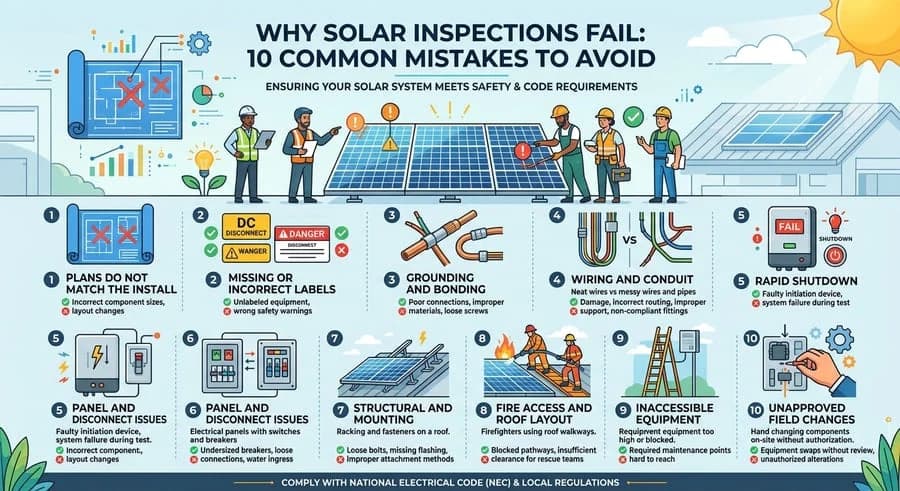
Why Solar Inspections Fail: 10 Common Mistakes to Avoid
Discover the 9 critical reasons solar inspections fail and how to avoid costly m...
Solar Grounding And Bonding: How To Pass Inspection Every Time
Learn how to pass solar grounding and bonding inspections every time. Avoid comm...
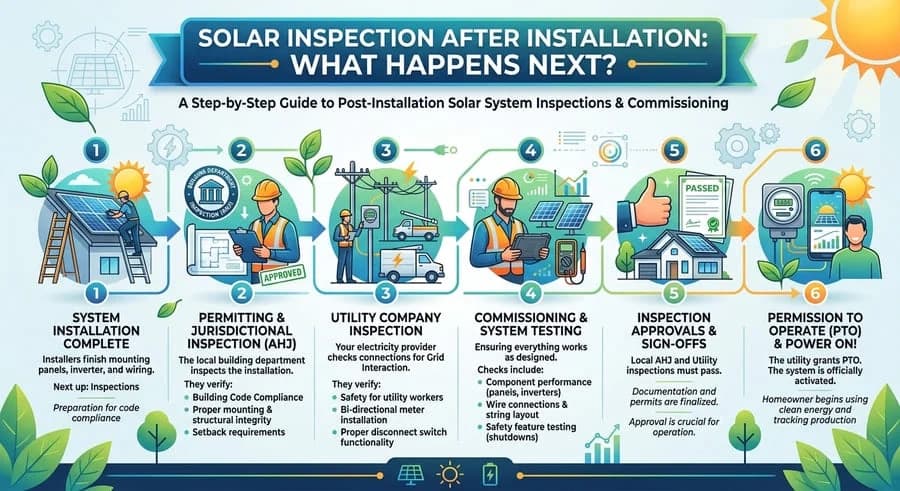
Solar Inspection After Installation: What Happens Next?
Learn how to pass your solar inspection by following essential tips for obtainin...