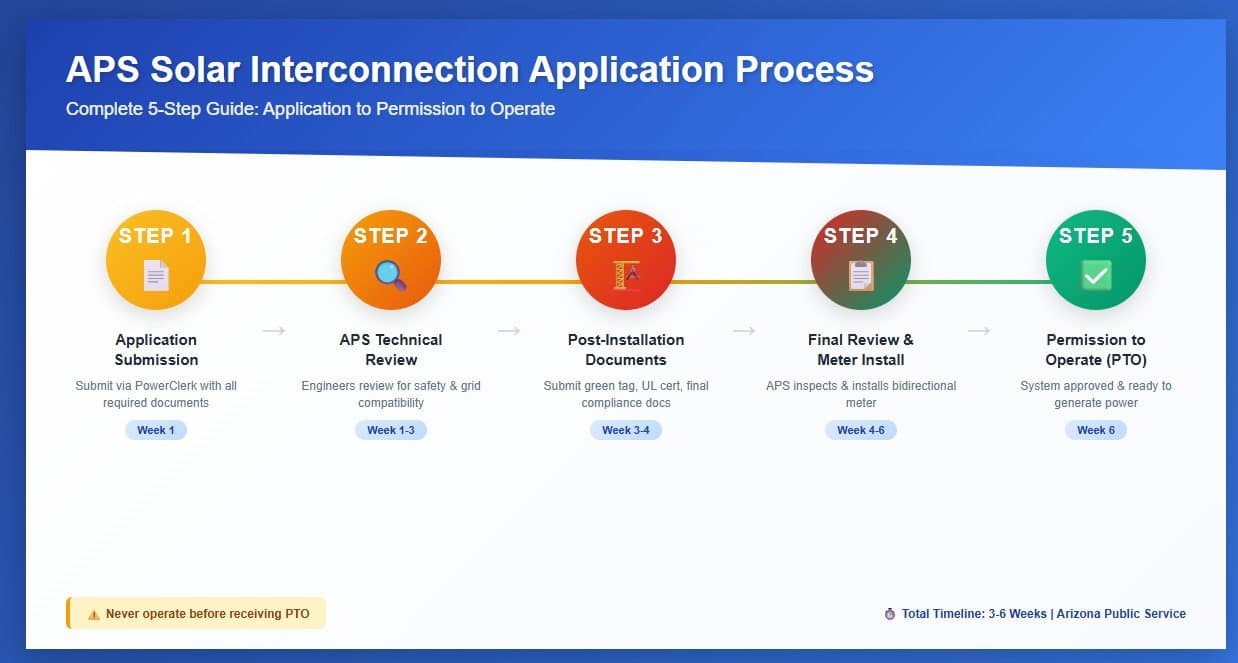
Arizona Public Service (APS) customers need to complete an interconnection application, submit installation contracts, provide site plans and electrical diagrams, and obtain Permission to Operate (PTO) before activating solar systems. The complete permitting and approval process takes 3-6 weeks, with installation requiring 1-3 days depending on system complexity.
Key permitting requirements for APS solar customers include:
- Interconnection application filed by your licensed solar installer
- Signed installation contract and completed authorization forms
- Site plan showing solar panel layout on your property
- Three-line electrical diagram of the system design
- Municipal building permits coordinated by your contractor
- APS inspection and bi-directional meter installation
- Permission to Operate (PTO) approval before system activation
Critical timeline considerations: With APS solar buyback rates decreasing 10% annually each September and a proposed 14% utility rate increase in 2026, completing your interconnection before September 2025 locks in current compensation rates for 10 years. Additionally, the 30% federal solar tax credit expires December 31, 2025.
APS-approved solar installers handle most permitting paperwork, but understanding Arizona’s solar requirements helps you navigate the process smoothly and avoid delays. This guide covers net billing programs, rate plans, permitting steps, timelines, and post-installation considerations for APS solar customers.
Is Net Metering Available Through APS?
The traditional net metering option has been discontinued at APS, but their net billing alternative still delivers value to solar homeowners.
Net billing functions on a similar principle: surplus electricity your panels create beyond what you consume gets fed into the power grid, generating billing credits each month. Use these accumulated credits when production dips during nighttime or when clouds block sunlight.
The catch? Net billing compensates at lower rates than the old net metering system did. Your exported energy receives credit based on the Resource Comparison Proxy (RCP) export valuation rather than standard retail pricing. This rate undergoes yearly evaluation by the Arizona Corporation Commission, dropping 10% every September from 2017 forward (2020 being the lone exception during COVID-19). September 2025 will see yet another decrease, arriving in mere weeks.
Here’s the silver lining: Securing your APS interconnection paperwork ahead of the crucial deadline guarantees rate protection against future reductions for the next ten years. Plus, acting now ensures you capture the 30% federal tax credit for solar panel and battery installations before this benefit disappears at year-end 2025.
How Arizona Public Service’s Net Billing System Operates
While net billing won’t deliver the dollar-for-dollar returns of previous net metering programs, it still provides substantial reductions to your electricity expenses. Here’s a breakdown of the net billing framework at APS.
Export Compensation Through Resource Comparison Proxy (RCP)
Arizona Public Service calculates compensation for surplus electricity your panels send to the grid using their Resource Comparison Proxy (RCP) methodology.
Currently in 2025, this compensation sits at $0.06857 for each kilowatt-hour (kWh) you export. This translates to approximately 50% of the standard retail electricity price of $0.12/kWh. Solar power consumed directly within your home saves you the complete retail cost, but surplus energy flowing back to the grid generates lower-value credits.
To optimize your financial returns under this utility’s structure, prioritize consuming your solar generation during daylight hours when panel output peaks.
Peak-Period Pricing Through Time-of-Use Plans
Arizona Public Service mandates time-of-use (TOU) billing for all solar panel installations. Under TOU plans, electricity costs increase during high-demand windows (generally 4 PM through 7 PM).
The utility currently provides two TOU pricing options:
*Billing determined by your peak single-hour consumption during high-demand periods monthly.
TOU-E works best for households that can schedule major appliance use outside peak windows. TOU-Demand provides lower baseline pricing but adds a demand fee when concentrated energy consumption occurs within any 60-minute period during premium hours. Minimize demand fees by spreading out operation of energy-intensive equipment like air conditioners, dishwashers, electric vehicle chargers. Alternatively, install battery storage to disconnect from the grid during expensive peak periods, eliminating premium charges entirely.
Export Credit Program Choices
Arizona Public Service solar customers select between two compensation structures for surplus power generation:
RCP Export Compensation: Credits accumulate from month to month under this framework. Annual credits exceeding $25 result in a check payment from the utility. Credits below $25 annually carry forward into the following year. Your credit value links directly to the purchase rate assigned when your solar application was submitted.
EPR-2 Renewable Energy Billing: Credit values fluctuate based on seasonal peak versus off-peak designations, with monthly credit rollovers. Complex billing arrangements typically utilize this option.
The majority of homeowners opt for the RCP structure due to its straightforward and predictable nature.
Understanding Production vs. Export Credits
Your solar array’s total output differs from the compensation you earn from Arizona Public Service:
- Production measures your system’s complete electricity generation
- Credits represent only the surplus power exported to the grid after your household consumption
The utility monitors both metrics monthly and applies earned credits to your billing statement.
Additional Billing Considerations for APS Solar Customers
Key points to remember when making your solar transition:
- Arizona Public Service conducts annual net billing rate assessments each September, implementing changes effective September 1. The RCP compensation drops 10% yearly.
- Your rate structure becomes fixed for a decade once your system connects to the grid. Earlier solar adoption typically secures more favorable compensation rates.
- Budget Billing, which averages monthly energy consumption for consistent payments, remains unavailable for solar households currently.

Solar installers initiate the interconnection process through APS’s PowerClerk online platform. Homeowners can monitor application status or begin the process by accessing their aps.com account, navigating to the ‘Interconnecting to the grid’ section, and selecting ‘View existing applications'” to track progress.
Step 1: Initial Application Submission and Required Documentation
Your solar contractor completes the interconnection application through the PowerClerk system and uploads all mandatory documentation:
Core Application Documents:
- Executed installation contract (when applicable)
- Disclaimer statement (when applicable)
- Consumer Acknowledgement form
- Authorization Form (digital signature via DocuSign required)
- Interconnection Agreement (digital signature via DocuSign required)
Technical System Documentation:
- Site Plan Diagram illustrating panel placement and system layout
- Electrical Three-Line Diagram (residential customers may submit a One-Line Diagram exclusively for single-phase, load-side connections)
Depending on your specific system configuration, APS may request supplementary documentation beyond these standard requirements. Refer to the official Document Guide for configuration-specific submissions.
Solar Permit Solutions
Skip the Permit Headaches
We design plan sets that pass inspection the first time. Code-compliant, PE-stamped, accepted by AHJs nationwide.
Step 2: APS Technical Review and Approval Process
Arizona Public Service engineers evaluate your submitted application for grid compatibility and safety compliance. Following their assessment, APS will either:
- Approve the application, authorizing your installer to proceed with physical construction, or
- Request design revisions to address safety concerns, grid access requirements, or technical specifications
This review ensures your solar system meets all electrical safety standards and grid integration protocols before installation begins.
Step 3: Post-Installation Documentation Requirements
After completing physical system installation, your contractor submits final compliance documents to APS:
Mandatory Final Documents:
- Municipal green tag or permit clearance confirming local building department approval
- APS-approved Current Transformer (CT) rated enclosure verification (applies to specific connection types)
- Nationally Recognized Testing Laboratory (NRTL) certification letter from an authorized Underwriter’s Laboratories Inc. (UL) inspector confirming the electrical tap meets UL standards and National Electrical Code requirements
- Photograph of the UL certification sticker affixed at the installation site
For systems requiring NRTL certification, verify your inspector appears on the official OSHA-authorized provider list. These documents demonstrate code compliance and safety standard adherence.
Step 4: Final Document Review and Meter Installation Scheduling
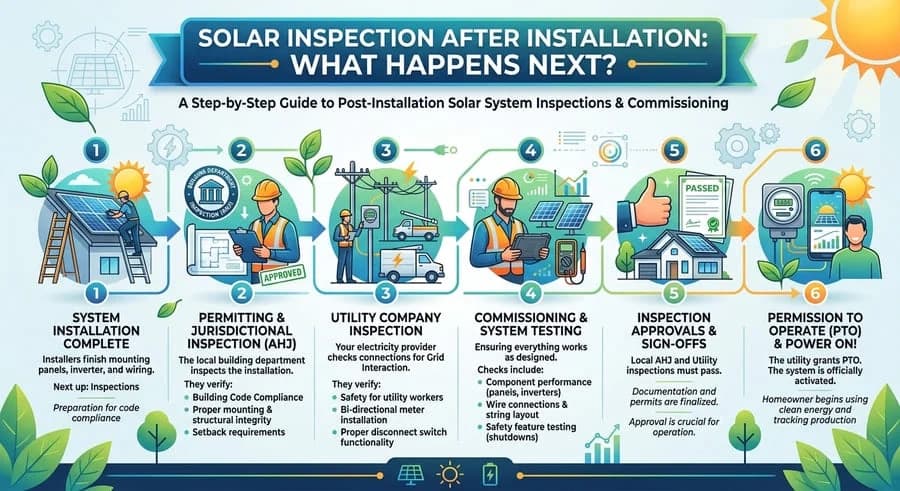
APS examines all submitted final documentation and schedules the physical inspection and bidirectional meter installation. During the on-site visit, APS technicians verify that installed equipment and system configuration precisely match the approved application diagrams and technical specifications.
This field verification ensures no unauthorized modifications occurred during installation and that all safety protocols remain intact.
Step 5: Permission to Operate (PTO) Issuance or Corrective Actions
Following the inspection and meter installation, one of two outcomes occurs:
Scenario A: PTO Approval Granted
If your system passes all safety checks and matches approved specifications, APS issues immediate Permission to Operate. You’ll receive confirmation through:
- A door hanger notice left at your property
- An official confirmation email to your installer
Your solar system is now authorized to generate electricity and connect to the grid.
Scenario B: PTO Conditional on Corrections
If field conditions don’t align with approved plans or safety standards aren’t met, APS cannot issue PTO. The technician will:
- Document specific deficiencies on the door hanger
- Notify your installer of required corrective actions
- Provide detailed remediation instructions
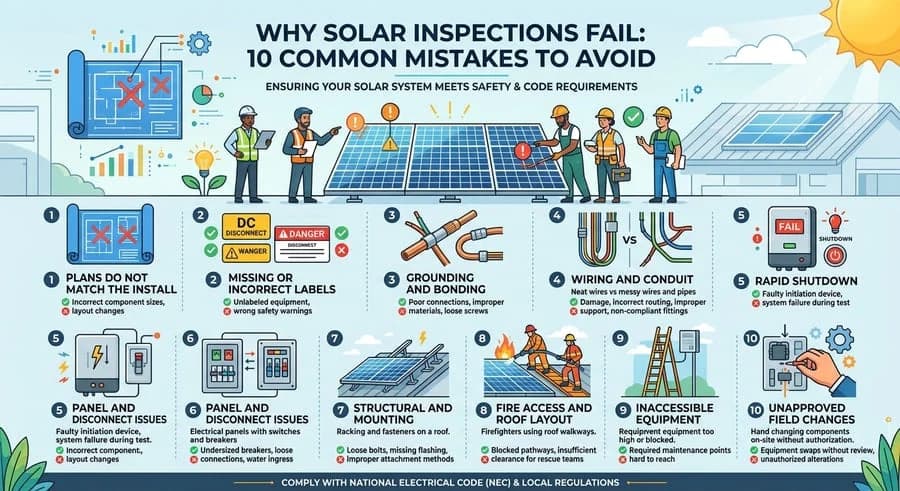
Once your installer completes necessary repairs and notifies APS, the utility reschedules the inspection and meter installation. Common issues requiring correction include equipment label discrepancies, wiring configuration errors, or safety code violations.
⚠️ Critical Safety Warning
Never activate or energize your solar system before receiving official Permission to Operate from Arizona Public Service. Operating without PTO authorization:
- Violates APS interconnection agreements and utility regulations
- Creates serious electrical hazards for utility line workers
- May void manufacturer warranties on solar equipment
- Could result in system disconnection, fines, or legal liability
Wait for both the physical door hanger and email confirmation before switching on your solar energy system.
Understanding the APS Interconnection Timeline
The complete process from application submission to permission to operate typically requires 3-6 weeks, with variables including:
- Application complexity and system size
- Completeness of initial documentation
- Municipal permit processing times
- APS review workload during peak solar season
- Whether design revisions are necessary
Systems incorporating battery storage or supply-side connections generally require extended review periods due to enhanced safety verification protocols.
According to IEEE Power & Energy Society research, streamlined permitting processes significantly reduce solar adoption barriers.
Key Takeaways for APS Solar Customers
- Professional installers manage the entire process – Homeowners rarely interact directly with PowerClerk or submit documentation
- Digital signatures are mandatory – Authorization Forms and Interconnection Agreements require DocuSign authentication
- Technical accuracy prevents delays – Precise electrical diagrams and site plans minimize revision requests
- Final documentation is non-negotiable – UL certification and municipal permits must be complete before PTO issuance
- Never self-activate your system – PTO authorization protects your safety and maintains grid integrity
Partnering with an experienced, APS-approved solar installer ensures smooth navigation through each interconnection requirement, minimizing delays and maximizing compliance with Arizona Public Service protocols.
What’s the installation timeline?
Complete APS interconnection typically spans one to four weeks, varying with system design and utility processing speed. Timelines extend during peak periods like summer months or year-end. Battery or advanced component integration adds processing time, though your contractor manages communications and maintains progress.
According to IEEE Power & Energy Society research, streamlined permitting processes significantly reduce solar adoption barriers.
Should APS Customers Add Battery Storage?
Arizona Public Service customers exploring solar should evaluate battery storage integration.
As discussed earlier, APS’s net billing structure provides reduced compensation for grid-exported energy. Battery storage captures surplus generation for later consumption during expensive peak periods, decreasing grid dependence when rates climb.
Battery systems also maintain power to critical appliances like refrigerators, internet connectivity, and medical equipment during grid failures. Additionally, batteries maximize renewable energy utilization. If environmental impact matters to you, storage significantly reduces your carbon footprint.
However, battery systems require substantial upfront capital that may not suit every budget. When considering storage, assess financial viability and alignment with your energy priorities. Your solar permit designer should present various battery options with projected payback timelines across different usage scenarios.

Going Solar With APS: What Comes Next
Your solar system is operational. Now what?
Decoding Your Modified APS Statement
Despite solar panel installation, your property remains grid-connected, ensuring reliable electricity during nighttime or overcast conditions. Monthly billing continues, reformatted to reflect your solar configuration.
Your revised statement includes:
- Rate Structure: Choose between two TOU frameworks: Time-of-Use 4pm-7pm Weekdays, or Time-of-Use with Demand Charge
- Consumption Analysis: View hourly usage, costs, and historical comparisons
- Renewable Rider (Export Credits): Surplus energy sent to Arizona Public Service generates account credits, reducing monthly charges
- Grid Connection Fee: Fixed monthly infrastructure maintenance charge
Optimize Consumption Timing for Maximum Savings
Maximize solar benefits by consuming electricity during peak generation periods, typically daylight hours. Additional savings come from operating major appliances (washing machines, dryers, and ovens) during off-peak windows when rates decrease.
Energy efficiency practices combined with smart energy timing create optimal solar savings.
Track System Performance
With panels operational, regular performance monitoring ensures optimal function. You can:
- Access your APS account portal to view grid export quantities
- Utilize your installer’s monitoring application to track generation
- Contact your contractor when noticing unusual production decreases, particularly on sunny days
Maintain warranty documentation for panels, inverters, and batteries for future reference.
Solar panels function for 25+ years, though inverters or batteries may require earlier replacement. Future system upgrades require:
- APS application submission for expansions exceeding 1 kW or 10% capacity increase
- Email to renewables@aps.com for minor modifications to request Equipment Amendment Forms
Power Outages Occur
Grid failures trigger automatic shutdowns in affected zones for safety purposes. Your solar system also deactivates unless battery or generator backup exists. Battery systems automatically power appliances during grid outages.
The EPA’s Green Power Markets program provides additional resources on renewable energy resilience.
You Need to Sell Your Property
Solar-equipped homes typically sell faster at premium prices compared to non-solar properties. Green building practices like solar installations increase property values significantly.
Conclusion
Transitioning to solar energy as an Arizona Public Service customer represents a significant investment in your home’s future and Arizona’s renewable energy landscape. While APS’s net billing structure offers reduced compensation compared to traditional net metering, solar installation still delivers substantial long-term savings, environmental benefits, and energy independence.
The key to maximizing your return lies in timing and strategy. With RCP export rates decreasing 10% annually each September and a proposed 14% rate increase on the horizon for 2026, acting sooner rather than later locks you into more favorable rates for the next decade. Additionally, the 30% federal solar tax credit remains available through the end of 2025, providing immediate financial relief on your investment.
Whether you choose a straightforward solar panel system or opt for battery storage to maximize savings during peak hours, partnering with an experienced, APS-approved installer ensures smooth navigation through interconnection requirements, permitting processes, and rate plan selection. Your solar journey with Arizona Public Service doesn’t end at installation, it’s an ongoing opportunity to reduce your carbon footprint, lower monthly expenses, and take control of your energy future.
The International Energy Agency reports that solar adoption continues accelerating globally, with homeowners recognizing both financial and environmental benefits.
Ready to explore solar options for your home? Contact our expert team today to discover how much you could save with solar energy. Our comprehensive solar services and expert guidance ensure your project succeeds from start to finish.