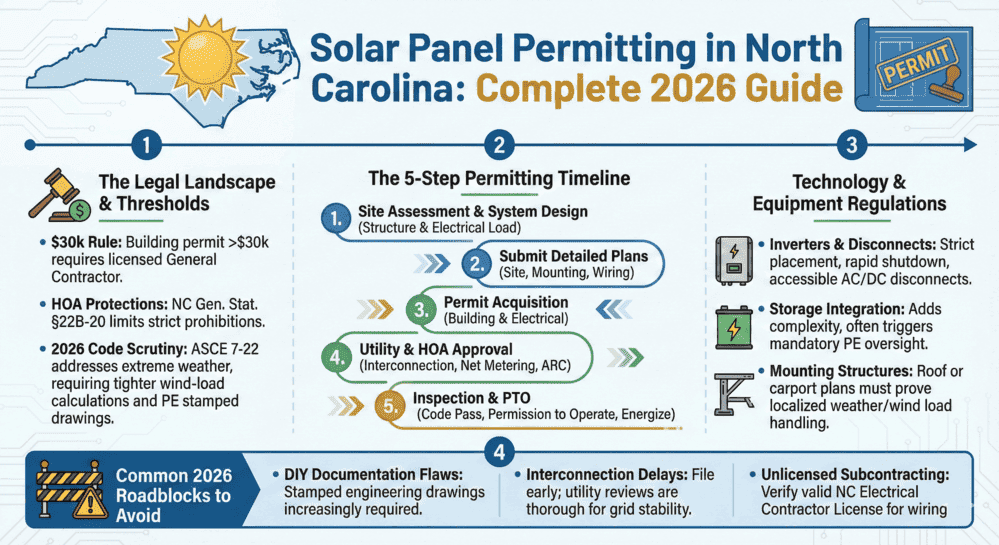
Solar panel permitting in North Carolina requires an electrical permit and building permit from your local Authority Having Jurisdiction (AHJ). Permit fees range from $100 to $500, and approval timelines average 3 to 10 business days depending on the jurisdiction. All solar installations must be performed by a licensed electrical contractor under N.C. Gen. Stat. 87-43, and systems must comply with the NEC (currently the 2020 edition with NC amendments). Raleigh offers same-day permitting for most residential rooftop solar, while Charlotte and Durham typically process applications in 5 to 10 days. An NC registered design professional must seal the structural design if the PV system exceeds 3 psf, the roof has multiple shingle layers, or the project is in a 140+ mph wind zone.
North Carolina ranks #4 nationally in installed solar capacity, with solar power generating over 9.75% of the state’s total electricity. Whether you are a homeowner exploring rooftop panels or a solar installer managing multiple projects across the Tar Heel State, understanding solar panel installation permits in NC is critical to avoiding costly delays, failed inspections, and permit denials.
This guide covers every step of the solar panel installation permits process in NC, from state licensing requirements and building codes to local AHJ variations in Charlotte, Raleigh, Durham, and beyond. You will also learn what the solar policy in North Carolina means for your project, including Duke Energy interconnection programs, net metering changes, and financial incentives that directly affect your bottom line.
Need permit-ready solar plan sets for North Carolina? Solar Permit Solutions delivers professional residential and commercial solar designs across all 50 states, including NC-compliant plan sets that meet local AHJ requirements.
WHAT IS THE SOLAR POLICY IN NORTH CAROLINA?
North Carolina has established a strong legislative foundation supporting solar energy adoption. The state’s solar policy framework includes solar access protections, property tax exemptions, net metering programs, and statewide permitting standards that collectively make NC one of the most solar-friendly states in the Southeast.
Solar Access Law (N.C. Gen. Stat. 22B-20)
North Carolina’s solar access statute, enacted in 2007 through Senate Bill 670, prohibits deed restrictions, covenants, and similar agreements from blocking solar panel installations on residential properties. In a landmark 2022 ruling (Belmont Association v. Farwig), the NC Supreme Court strengthened this protection by ruling that HOAs cannot rely on general architectural review authority to deny solar installations. HOAs may only restrict panel placement if their covenants include explicit, narrowly written solar-specific provisions, and even then, they cannot require placement that would reduce energy production by half or more.
With approximately 40% of NC homeowners living in HOA communities, this ruling removed a significant barrier to solar installation NC residents had previously faced. Learn more about navigating HOA requirements in our HOA Solar Panel Rules guide.
Property Tax Exemption
North Carolina offers an 80% property tax exclusion for solar energy systems used on residential properties. This means installing solar panels will not significantly increase your property tax bill, even though the system adds value to your home. Research from Zillow shows homes with solar sell for approximately 4.1% more than comparable properties without panels, making this exemption a significant financial benefit for NC homeowners.
Net Metering and Duke Energy Programs
Duke Energy Carolinas and Duke Energy Progress serve the majority of NC households. Following legislative changes in 2017 and 2021, Duke introduced new rate structures for solar customers. The current options include:
- Net Metering Bridge Rate: Available through December 31, 2026, this is the most financially beneficial option for new solar customers. Participants can remain on this rate for up to 15 years after their interconnection date, subject to annual capacity caps.
- Residential Solar Choice Rider: A time-of-use rate structure where compensation for excess solar exports varies by time of day and season. Less favorable than the Bridge Rate but remains an option after 2026.
- PowerPair Program: Duke Energy’s solar-plus-battery incentive offering up to $9,000 in combined rebates ($0.36/watt for solar up to 10 kW-AC, plus $400/kWh for battery storage up to 13.5 kWh).
For Dominion Energy customers in northeastern NC, standard net metering with a $200 interconnection fee for systems under 20 kW applies. Blue Ridge EMC customers can choose between net metering or net billing. For a deeper dive into the interconnection process, see our Solar Interconnection Agreement guide.
NORTH CAROLINA SOLAR PANELS COST: WHAT TO EXPECT IN 2026
Understanding North Carolina solar panels cost helps homeowners budget for the full project, including permit fees. As of early 2026, the average cost of solar panel installation in NC ranges from $2.34 to $3.18 per watt depending on the data source, system size, and equipment selection. For a typical 8 to 10 kW residential system, homeowners can expect to pay approximately $18,700 to $31,800 before incentives.
| System Size | Estimated Cost (Before Incentives) | After 30% ITC* | Average Payback Period |
| 5 kW | $11,700 to $15,900 | $8,190 to $11,130 | 6 to 8 years |
| 8 kW | $18,720 to $25,440 | $13,100 to $17,800 | 7 to 10 years |
| 10 kW | $23,400 to $31,800 | $16,380 to $22,260 | 8 to 12 years |
| 13 kW+ | $30,400 to $41,300 | $21,280 to $28,900 | 9 to 13 years |
*Note: The 30% federal Investment Tax Credit (ITC) under Section 25D expired on December 31, 2025. Homeowners who placed systems in service before this date may still claim the credit. Check our Solar Tax Credit Deadline 2025 guide for eligibility details.
Factors that influence your total cost include roof type and complexity, shading conditions, equipment brand preferences (monocrystalline panels are standard), inverter selection (string inverter vs. microinverter), and whether you add battery storage. Duke Energy’s PowerPair program can offset up to $9,000 of the cost for solar-plus-battery installations, making storage a more attractive investment for NC homeowners.
Permitting and inspection fees typically add $200 to $600 to the total project cost depending on your jurisdiction. These costs are covered in detail below. For information on reducing overall project costs, visit our guide on how to reduce solar permit design costs and approval times.
STATE LICENSING REQUIREMENTS FOR SOLAR INSTALLATION NC
Before diving into the permitting process, it is important to understand who is legally authorized to install solar panels in North Carolina. The state enforces strict licensing requirements through two primary boards.
Electrical Contractor License
Under N.C. Gen. Stat. 87-43, all solar photovoltaic (SPVP) installations require a licensed electrical contractor, regardless of project value. The NC State Board of Examiners of Electrical Contractors issues three license tiers:
| License Type | Project Value Limit | Scope |
| Limited | Up to $60,000 | Small residential systems |
| Intermediate | Up to $150,000 | Mid-size residential and small commercial |
| Unlimited | No limit | All project sizes |
General Contractor License
The NC Licensing Board for General Contractors considers solar installations to be electrical work unless the scope includes structural or other improvements totaling $30,000 or more. A building permit is required for any project (including SPVP installations) at a cost of $20,000 or more in North Carolina. For more on how AHJ requirements vary, see our AHJ Solar Requirements guide.
Solar Permit Solutions
Skip the Permit Headaches
We design plan sets that pass inspection the first time. Code-compliant, PE-stamped, accepted by AHJs nationwide.
PERMITS REQUIRED FOR SOLAR PANEL INSTALLATION IN NORTH CAROLINA
Solar panel installation permits in North Carolina typically involve multiple permit types depending on the project scope and jurisdiction. Most residential rooftop installations require two core permits.
Electrical Permit
Every grid-connected solar installation in NC requires an electrical permit. This permit covers all wiring from the panels through the inverter to the point of interconnection with the utility grid. In many jurisdictions (including Raleigh, Charlotte, and Durham), the electrical permit is included within the building permit application rather than filed separately.
Building Permit
A building permit is required for all residential rooftop solar PV installations in North Carolina. The NC Office of the State Fire Marshal (OSFM) issued a statewide Guidance Paper in 2019 establishing uniform inspection procedures for residential rooftop solar. This document is not optional; all inspection departments statewide must follow it. The building permit application requires:
- Sketch of the electrical design compliant with the NEC
- Structural mounting design with manufacturer specifications
- Equipment specification sheets for all PV system components
- Third-party approvals on NC Department of Insurance Appendix G
- Notice of Lien Agent (unless exempt) filed at liensnc.com
When a Structural Engineer Stamp Is Required
Under the NC OSFM Guidance Paper, a NC registered design professional must provide a sealed structural design if any of the following conditions exist:
- The PV system weight exceeds 3 pounds per square foot (psf)
- The roof has more than one layer of asphalt shingles
- The roofing material is anything other than asphalt shingles or metal
- The project is located in a 140 mph or greater wind zone (coastal NC counties)
For more details on when engineering stamps are required, review our Solar PE Stamp Requirements guide and our Solar Structural Engineering Calculations guide.
Zoning Permits
Rooftop solar panels in most NC jurisdictions do not require a separate zoning permit. In Raleigh, for example, rooftop PV systems can exceed the maximum building height by up to 12 feet per UDO Section 1.5.7.D.2.g without a zoning approval. Ground-mounted systems, however, typically require a site plan and may be subject to setback and screening requirements under local UDO regulations.
Utility Interconnection Application
In addition to local building permits, all grid-connected solar systems in NC must receive interconnection approval from the serving utility (Duke Energy, Dominion Energy, or the local EMC). Homeowners must also file a Report of Proposed Construction form with the NC Utilities Commission (NCUC). Most installers handle this paperwork as part of the project. See our Solar PTO guide for a complete walkthrough of the Permission to Operate process.
NORTH CAROLINA BUILDING CODE AND NEC COMPLIANCE
North Carolina adopted the 2023 NEC (National Electrical Code) with state-specific amendments as part of the 2024 NC State Building Code. However, the effective date has been indefinitely delayed by the General Assembly through Session Law 2025-2. As of early 2026, the 2020 NEC with NC amendments remains in effect for most jurisdictions, though the 2023 NEC adoption is expected to take effect once the legislative delay is resolved.
Key code requirements for solar PV installations in NC include:
- NEC Article 690: Solar photovoltaic systems, covering conductor sizing, overcurrent protection, rapid shutdown, disconnect requirements, and system labeling
- NEC Article 705: Interconnected electric power production sources, governing how solar systems connect to the utility grid
- NEC Article 706: Energy storage systems (for battery installations)
- NC Residential Code (2018 edition currently in effect) for one- and two-family dwellings
- NC Fire Code for commercial installations, including fire setback and access pathway requirements
Installers must ensure compliance with rapid shutdown requirements under NEC 690.12, which mandate that conductors within the array boundary be reduced to 80V or less within 30 seconds of rapid shutdown initiation. For detailed guidance, see our Article 690 Updates for NEC 2023 guide and our Understanding Solar Rapid Shutdown compliance roadmap.
STEP-BY-STEP SOLAR PERMIT PROCESS IN NORTH CAROLINA
The permitting process in NC follows a consistent pattern across most jurisdictions, though specific timelines and submission methods vary by locality.
Step 1: Site Assessment and System Design
Your installer evaluates roof condition, structural capacity, shading, electrical panel configuration, and utility service type. A complete plan set is designed including panel layout, electrical single line diagram, structural attachment details, and equipment specifications. For information on what goes into a proper design package, visit our Solar Single Line Diagram guide.
Step 2: Permit Application Submission
Submit the complete application package to your local building department. Many NC jurisdictions now accept online submissions through their permit portals. Raleigh, for example, offers same-day online permitting for most residential rooftop solar systems through their Permit and Development Portal.
Step 3: Plan Review
The local building department reviews your plans for code compliance. Review timelines vary: Raleigh processes residential solar permits in a 3-day review cycle; Charlotte and Durham typically complete reviews within 5 to 10 business days. If corrections are needed, you will receive a revision request through the permit portal or by email.
Step 4: Permit Issuance and Fee Payment
Once the plan review is approved, the jurisdiction issues an invoice. After payment, the permit is activated and installation may begin. You must begin work within six months of permit issuance in most NC jurisdictions.
Step 5: Installation
Licensed electrical contractors perform the physical installation. Typical residential rooftop installations are completed in one to three days.
Step 6: Inspection
After installation, schedule an inspection through the permit portal. Under the NC OSFM Guidance Paper, all equipment exceeding 8 feet above grade must be clearly photographed or video recorded showing proper installation. The hard copy documentation must be provided to the field inspector at the final inspection. Most residential solar systems require only a final inspection, which covers both electrical and structural compliance. For a detailed understanding of common inspection issues, read our Solar Panel Permit Requirements guide.
Step 7: Utility Interconnection and PTO
After passing final inspection, the utility receives notification (automatically in some jurisdictions like Raleigh) and will install or swap the meter within 3 to 10 business days. Once the meter is changed and the interconnection agreement is complete, you receive Permission to Operate (PTO) and can begin generating and exporting electricity. Review our complete How Do Solar Panels Connect to the Grid guide for technical details.
LOCAL PERMITTING VARIATIONS ACROSS NORTH CAROLINA
While NC enforces statewide building codes and the OSFM Guidance Paper provides a uniform inspection framework, individual cities and counties maintain their own permitting processes, fee structures, and submission requirements. Below are the key local variations in the state’s largest solar markets.
Charlotte / Mecklenburg County
- Jurisdiction: Mecklenburg County Code Enforcement handles permits for Charlotte and unincorporated Mecklenburg County
- Utility: Duke Energy Carolinas
- Code: 2018 NC Building Code (2024 code adoption delayed; the 2023 NEC is on indefinite delay per S.L. 2025-2)
- Submission: Online via Mecklenburg County Accela portal
- Fee: Permit fees based on Building Permit Fee Schedule G; typically $150 to $400 for residential solar
- Review Timeline: 5 to 10 business days for residential PV
- Note: Historic districts (such as Myers Park and Dilworth) may require additional design review for street-visible panels
Raleigh / Wake County
- Jurisdiction: City of Raleigh Planning and Development (within city limits); Wake County Building Inspections (unincorporated areas)
- Utility: Duke Energy Progress
- SolSmart Designation: Silver (2022), working toward Gold
- Submission: Online through Raleigh’s Permit and Development Portal; most residential rooftop solar qualifies for same-day permitting
- Fee: Per the Development Fee Guide; residential solar permits typically $100 to $300
- Review Timeline: 3-day review cycle for applications requiring multi-trade review; many approved same-day
- Note: Historic overlay districts require review through the Sustainability in Historic Districts process
Durham / Durham County
- Jurisdiction: Durham City-County Building and Safety Department (joint city-county operation)
- Utility: Duke Energy Progress
- Submission: Applications and supporting documents submitted per the Solar PV System Permitting Requirements document
- Code: Commercial installations comply with the 2018 NC Building Code and 2018 NC Fire Code; residential installations comply with the 2018 NC Residential Code
- Review Timeline: Best efforts for residential one- and two-family dwelling solar permits reviewed within 3 to 5 business days
- Required Documents: Site plan (ground mount only), electrical design sketch, structural mounting design, equipment spec sheets, manufacturer installation instructions, NC DOI Appendix G approvals
Asheville
- Jurisdiction: City of Asheville Development Services
- Utility: Duke Energy Carolinas
- Incentive: $175 permitting fee rebate for solar energy systems within Asheville city limits
- Note: Asheville is in the western NC mountain region; snow load considerations may apply to structural design
Coastal NC Counties (Wilmington, Outer Banks, Jacksonville)
Projects in coastal counties face additional structural requirements due to high-wind zones. The NC OSFM Guidance Paper triggers mandatory PE-sealed structural design for any installation in a 140 mph or greater wind zone, which covers much of coastal NC. Hurricane-rated mounting hardware and additional attachment points are standard requirements. Installers should also plan for longer inspection timelines during hurricane season (June through November).
PERMIT FEES BY JURISDICTION
| Jurisdiction | Typical Residential Solar Permit Fee | Review Timeline | Online Submission |
| Charlotte / Mecklenburg | $150 to $400 | 5 to 10 business days | Yes (Accela) |
| Raleigh | $100 to $300 | Same-day to 3 days | Yes (Permit Portal) |
| Durham | $150 to $350 | 3 to 5 business days | Yes |
| Asheville | $175 to $350 ($175 rebate available) | 5 to 7 business days | Yes |
| Wake County (unincorporated) | $100 to $250 | 3 to 7 business days | Yes |
| Wilmington / New Hanover | $200 to $500 | 5 to 10 business days | Yes |
| Greensboro / Guilford | $150 to $350 | 5 to 10 business days | Yes |
For a full breakdown of average permit timelines by state, see our Average Solar Permit Timeline by State guide.

COMMON PERMIT REJECTION REASONS IN NORTH CAROLINA
Understanding why permits get denied helps installers and homeowners avoid costly resubmissions. The most frequent rejection reasons for NC solar permit applications include:
- Incomplete structural documentation: Missing PE-sealed structural analysis when required (weight exceeds 3 psf, multi-layer shingles, non-standard roofing, or 140+ mph wind zone)
- Missing or incorrect single line diagram: The electrical schematic must clearly show the PV array, inverters, disconnects, and point of interconnection
- Non-compliant rapid shutdown labeling: Labels must meet NEC 690.56(C) requirements for wording, placement, and durability
- Missing Notice of Lien Agent: Required for all NC projects unless exempt under the Lien Agent statute
- Insufficient equipment specification sheets: All system components require manufacturer spec sheets with third-party approvals submitted on NC DOI Appendix G
- Ground-mount site plan omission: Ground-mounted systems require site plans showing setbacks and zoning compliance
Working with an experienced solar permit design firm significantly reduces rejection risk. Solar Permit Solutions delivers NC-compliant plan sets that address every AHJ requirement, helping you avoid resubmissions and get to installation faster. Learn more about common design errors in our Solar Permit Denials: Design Mistakes You Must Fix Now article.
NORTH CAROLINA SOLAR INCENTIVES SUMMARY
| Incentive | Value | Details |
| Federal ITC (Section 25D) | 30% of system cost | Expired 12/31/2025; check safe harbor eligibility |
| NC Property Tax Exemption | 80% exclusion | Automatic for non-business residential use |
| Duke Energy PowerPair (Solar) | $0.36/W up to 10 kW ($3,600 max) | Must use Duke Trade Ally installer |
| Duke Energy PowerPair (Battery) | $400/kWh up to 13.5 kWh ($5,400 max) | Combined potential of $9,000 |
| Net Metering Bridge Rate | Monthly bill credits at retail rate | Available through 12/31/2026; 15-year lock-in |
| Solar for All (EnergizeNC) | $156M state program | Low-to-moderate income households |
| Asheville Permit Fee Rebate | $175 | Within Asheville city limits only |
For detailed guidance on claiming federal tax credits, see our IRS Form 5695 Guide and Texas Solar Incentives guide for comparison.
TIPS FOR FASTER SOLAR PERMIT APPROVAL IN NORTH CAROLINA
- Use a professional solar permit design service: Pre-engineered plan sets that meet NC OSFM and local AHJ requirements drastically reduce revision cycles.
- Submit complete applications: Include all spec sheets, structural documentation, NEC-compliant diagrams, and the Notice of Lien Agent upfront.
- Use online portals: Raleigh, Charlotte, Durham, and most NC jurisdictions offer online submission, which is faster than in-person filing.
- Verify which NEC edition your jurisdiction enforces: The 2023 NEC adoption is on indefinite delay statewide, so most AHJs still reference the 2020 NEC with NC amendments.
- Apply for interconnection early: File your Duke Energy or Dominion interconnection application as soon as the design is finalized, well before installation begins.
- Lock in the Bridge Rate before it closes: The Net Metering Bridge Rate is available through December 31, 2026, with annual capacity caps. Filing early ensures you secure this more favorable rate.

NORTH CAROLINA SPECIFIC REQUIREMENTS IN 2026
Navigating the “Solar Coaster” in North Carolina requires more than just a roof and a dream. It requires a deep understanding of three specific regulatory pillars that shifted significantly as we entered 2026.
1. The “Solar + Battery” Mandate (PowerPair Dynamics)
In 2026, the era of “solar-only” installations is effectively over for homeowners looking to maximize ROI. To qualify for the state’s most lucrative incentive, the Duke Energy PowerPair rebate, you can no longer install just panels.
- The Requirement: To unlock the $9,000 rebate, your system must be an integrated “Solar + Storage” bundle.
- The Tech Specs: You must pair your array with a battery storage system (up to 13.5 kWh). If you install panels alone, you forfeit the $400/kWh battery incentive and the $0.36/watt solar rebate.
- 2026 Availability Alert: As of February 2026, Duke Energy Progress (DEP) has moved to a waitlist model, while Duke Energy Carolinas (DEC) is approaching 90% capacity. Permitting your battery and panels simultaneously is the only way to secure these remaining funds.
2. HOA Rights and Placement Strategy (NCGS 160D-912)
A common myth in 2026 is that North Carolina HOAs can still ban solar panels. Thanks to the landmark NC Supreme Court rulings and NCGS 160D-912, your “Right to Solar” is protected, but with a catch. For more on your HOA rights, see our HOA Solar Panel Rules guide.
- The “10% Rule”: Your HOA cannot legally prohibit you from installing solar panels on your property. However, they can dictate where those panels go (e.g., the back of the house instead of the street-facing side) unless that placement reduces the system’s efficiency by more than 10%.
- Your Defense: When filing your permit and HOA application, include a shading analysis or a PVWatts production report. If the HOA’s preferred location drops your production from 10,000 kWh to 8,500 kWh (a 15% drop), their restriction is legally unenforceable under North Carolina law.
3. Decommissioning Clarity and Disposal (SL 2023-58)
While Session Law 2023-58 was originally designed to ensure utility-scale solar farms (2MW+) did not leave “electronic graveyards” in rural NC, its influence has trickled down to residential permitting in 2026.
- Residential Impact: Many North Carolina counties (particularly Wake and Mecklenburg) now require a “disposal plan” or “end-of-life” acknowledgment within the residential permit packet.
- Landfill Bans: As of December 1, 2026, North Carolina law officially prohibits the disposal of solar (photovoltaic) modules in unlined landfills.
- The Checklist Item: Ensure your installer provides documentation that your panels are UL 1703 or UL 61730 certified and includes a “take-back” or certified recycling program plan. This is not just eco-friendly; it is becoming a requirement for passing your final building inspection.
THE 2026 POWERPAIR REBATE: HOW TO CLAIM YOUR $9,000
The 2026 Duke Energy PowerPair program offers North Carolina residential customers up to $9,000 in rebates for installing new solar ($0.36/watt, max $3,600) and battery storage ($400/kWh, max 13.5kWh). To claim, you must use a certified Duke Trade Ally, enroll in the Net Metering Bridge Rider, and submit an application within 90 days of installation.
The Power Pair pilot is the most significant solar incentive in North Carolina’s history, but it comes with a strict “use it or lose it” deadline. Unlike previous solar-only rebates, this program requires you to install solar panels and battery storage simultaneously.
Mandatory Permitting Rules for Power Pair
To qualify for the rebate, your permit and installation must follow these “non-negotiables”:
Inverter Limit: Your solar inverter must be rated at 10 kW-AC or below to qualify for the full solar portion of the rebate.
Approved Trade Ally: Your system must be installed by a Duke Energy Approved Trade Ally. Self-installs or non-certified contractors are ineligible.
90-Day Rule: You must submit your PowerPair application within 90 days of your system’s operational date.
Step-by-Step Claim Process:
Hire a Trade Ally: Select a contractor from the authorized Duke Energy Trade Ally list to ensure eligibility.
Submit Interconnection Request: Before applying for the rebate, a valid Interconnection Request must be submitted for the new system.
Install & Activate: Complete the installation and ensure the system is operational.
Apply for the Rebate: Submit the PowerPair application within 90 days of the system becoming operational.
Enroll in Net Metering: You must enroll in the Net Metering Bridge Rider and maintain it for 24 months.
Current Availability (February 2026 Status)
- Duke Energy Progress (DEP): CAPACITY REACHED. New applicants are currently being placed on a waitlist. If you are in the Raleigh, Fayetteville, or Asheville areas, you should still apply to hold your place in case earlier projects drop out.
- Duke Energy Carolinas (DEC): LIMITED CAPACITY. Roughly 10 to 15% of the original 30,000 kW capacity remains. Homeowners in Charlotte, Greensboro, and Durham must act by Q2 2026 to ensure a reservation.
The Incentive Breakdown
The program offers a one-time upfront rebate capped at $9,000 per residence:
| Component | Rate | Maximum |
| Solar Panel Incentive | $0.36 per watt-AC | Capped at 10 kW or $3,600 |
| Battery Storage Incentive | $400 per kWh | Capped at 13.5 kWh or $5,400 |
| Combined Maximum | Solar + Battery | $9,000 per residence |
To maximize this incentive, a 10 kW solar system paired with a 13.5 kWh battery (like a Tesla Powerwall 3 or Enphase IQ 5P) is the “sweet spot” for the full $9,000 payout.
Two Ways to Enroll (Choosing Your Cohort)
When you apply for your permit, you must choose between two “Cohorts” which determine your ongoing monthly savings:
- Cohort A (Residential Solar Choice): You maintain total control over your battery. You use your stored power whenever you want (e.g., during a storm or peak hours).
- Cohort B (Energy Wise Battery Control): You allow Duke Energy to “tap into” your battery 30 to 36 times per year during grid stress. In exchange, you receive a monthly bill credit (averaging $30 to $40/month), which can add up to $4,400+ over 10 years.
COUNTY-SPECIFIC PERMITTING CHECKLISTS (2026 UPDATES)
While the NC Residential Building Code provides the foundation, each county has its own “flavor” of enforcement. Here are the 2026 specifics for the three highest-volume solar permitting counties.
Wake County (Raleigh, Cary, Apex)
- The Portal: All applications must go through the Wake County Permit Portal.
- Key Requirement: Aviation Clearance. If your home is within 5 miles of a public airport (RDU or local municipal strips) and your array is over 0.5 acres (rare for residential but common for estates), you must provide an FAA determination letter.
- Structural Note: Wake County is strict on “concentrated loads.” You must provide a plan showing that the rafters/trusses can support the 13.5 kWh battery weight if wall-mounted.
- Timeline: Typically 7 to 14 business days for plan review.
Mecklenburg County (Charlotte, Huntersville, Matthews)
- The Portal: Use the Mecklenburg County Accela Portal.
- Crucial Step: You must pass Zoning Review before the Building Permit is even opened. In Charlotte, this is the “CLTZR” application.
- Lien Agent: For any project over $40,000 (which most 2026 Solar + Battery systems are), you must appoint a Lien Agent and provide the entry number on your permit application.
- Timeline: Slightly slower; expect 10 to 15 business days for zoning + building approval.
Guilford County (Greensboro, High Point)
- The Portal: Applications are handled via the Guilford County Civic Access Portal.
- The “Inside” Rule: Guilford County inspectors frequently require access to the attic and the main service panel inside the home. Your contractor must provide a ladder for the inspector. If they cannot access the attic to see the solar attachments, they will fail the inspection.
- Automated Scheduling: Use the APRIL (Automated Response system) to schedule your final electrical inspection once the panels are on the roof.
- Timeline: One of the fastest in the state, often approving within 5 to 10 business days.
2026 TECHNICAL CHECKLIST FOR ALL NC PERMITS
Ensure your permit packet includes these four documents to avoid a “Request for Information” (RFI) delay:
- PE Stamped Structural Letter: A North Carolina licensed Professional Engineer must certify the roof can handle the dead load of the panels plus the 2026 snow load requirements.
- NEC 2023 Compliant One-Line Diagram: Must show the Rapid Shutdown (RSD) device location and the battery storage interconnection.
- Site Map/Plot Plan: A scaled drawing showing the array’s distance from roof ridges and hips (for firefighter access).
- Manufacturer Spec Sheets: Specifically for the UL 9540 certification (the safety standard for battery systems).
Need help assembling your NC permit packet? Solar Permit Solutions delivers complete, AHJ-ready plan sets with PE-stamped structural letters, NEC-compliant one-line diagrams, and all required spec sheets for every North Carolina county.
CONCLUSION
Solar panel permitting in North Carolina is straightforward once you understand the state’s licensing structure, local AHJ requirements, and the statewide OSFM inspection framework. The key takeaways for a smooth permitting experience in NC:
- Every grid-connected solar installation requires an electrical permit and building permit, pulled by a licensed electrical contractor
- The NC OSFM Guidance Paper establishes uniform statewide inspection procedures that all jurisdictions must follow
- PE-sealed structural design is only required under specific conditions (3+ psf, multi-layer shingles, non-standard roofing, or 140+ mph wind zones)
- Permit fees range from $100 to $500 across major NC cities, with Raleigh offering the fastest turnaround (same-day to 3 days)
- The Net Metering Bridge Rate closes to new applicants after December 31, 2026; lock it in before the deadline
- Duke Energy’s PowerPair program offers up to $9,000 in combined solar-plus-battery rebates, but capacity is limited
Whether you are installing in Charlotte, Raleigh, Durham, Asheville, or coastal NC, working with a professional solar permit design service ensures your plan sets meet every local requirement the first time. Contact Solar Permit Solutions for NC-compliant designs that get approved faster.
FREQUENTLY ASKED QUESTIONS
GET PERMIT-READY SOLAR DESIGNS FOR NORTH CAROLINA
Navigating solar panel permitting in North Carolina does not have to slow down your project. Solar Permit Solutions delivers professional, NC-compliant solar plan sets for residential and commercial projects across all 100 NC counties. Our designs meet the NC OSFM Guidance Paper requirements, local AHJ specifications, and current NEC standards, helping you avoid rejections and get to installation faster.
Contact Solar Permit Solutions today for a consultation, or explore our complete blog for more solar permitting, NEC compliance, and interconnection guides.
Skip the Permit Headaches
We design plan sets that pass inspection the first time. Code-compliant, PE-stamped, accepted by AHJs nationwide.
Frequently Asked Questions
Yes. Virtually all grid-connected solar installations in North Carolina require both an electrical permit and a building permit from your local Authority Having Jurisdiction (AHJ). Even projects under the $20,000 general contracting threshold still require electrical permits. Installing without proper permits can result in fines, forced system removal, insurance issues, and complications when selling your property.
Permit review timelines vary by jurisdiction. Raleigh offers same-day approval for many residential rooftop solar systems, with a 3-day review cycle for more complex projects. Charlotte and Durham typically process residential solar permits within 5 to 10 business days. The overall timeline from application to Permission to Operate, including installation and utility interconnection, averages 45 to 90 days across NC.
Solar permit fees in NC range from approximately $100 to $500 depending on the jurisdiction and system size. Raleigh typically charges $100 to $300, Charlotte $150 to $400, and coastal counties up to $500. Asheville offers a $175 rebate on permitting fees for projects within city limits.
No. Under N.C. Gen. Stat. 22B-20 and the 2022 NC Supreme Court ruling in Belmont Association v. Farwig, HOAs cannot rely on general architectural review authority to prohibit solar installations. HOAs may only impose narrowly written, explicit restrictions on panel placement, and even those restrictions cannot reduce the system's energy production by 50% or more (such as requiring north-facing installation on a south-facing roof).
North Carolina's solar policy in 2026 includes solar access protections under state law, an 80% property tax exemption for residential solar, Duke Energy's Net Metering Bridge Rate (available through December 2026), the PowerPair program offering up to $9,000 for solar-plus-battery systems, and the $156 million Solar for All (EnergizeNC) program for low-to-moderate income households.
You need a NC registered design professional to seal the structural design if the PV system exceeds 3 psf, the roof has multiple shingle layers, the roofing material is not asphalt shingles or metal, or the project is in a 140+ mph wind zone (coastal NC). For standard residential rooftop installations on single-layer asphalt shingle roofs outside coastal zones, a structural engineering stamp is typically not required.
Traditional net metering has been modified for Duke Energy customers. The Net Metering Bridge Rate, which provides monthly bill credits similar to traditional net metering, is available for new interconnection applications through December 31, 2026. Customers who enroll can remain on the Bridge Rate for up to 15 years. After 2026, Duke Energy's Residential Solar Choice Rider (a time-of-use rate structure) will be the primary option. Dominion Energy customers in northeastern NC still have access to standard net metering.
As of 2026, solar panel installation in NC averages $2.34 to $3.18 per watt depending on system size and data source. A typical 8 kW system costs approximately $18,700 to $25,400 before incentives. With Duke Energy's PowerPair rebate ($3,600 solar + $5,400 battery) and remaining federal or state incentives, out-of-pocket costs can be significantly reduced. Average payback periods in NC range from 6 to 12 years depending on system size, utility rates, and available incentives.

SPS Editorial Team
Solar Permit Solutions
Solar Permit Solutions provides professional solar permit design services for residential, commercial, and off-grid installations across all 50 states. Our team ensures permit-ready plan sets delivered fast.
Related Articles
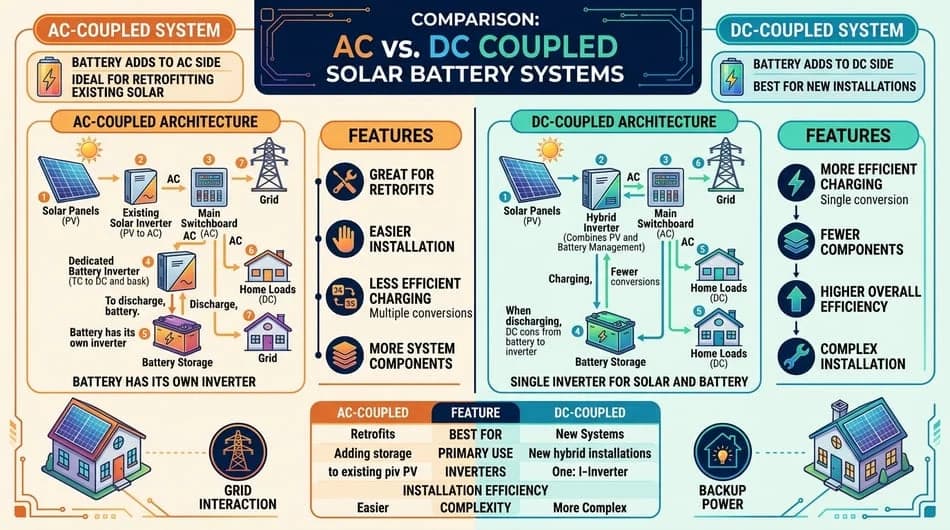
AC vs DC Coupled Solar Batteries: Which Should You Choose?
AC vs DC coupled solar batteries compared: efficiency, costs ($8K-$18K), and ins...
How Many Solar Panels Do I Need to Run Off the Grid?
Most off-grid homes need about 8 to 16 solar panels rated at 400 watts, dependin...
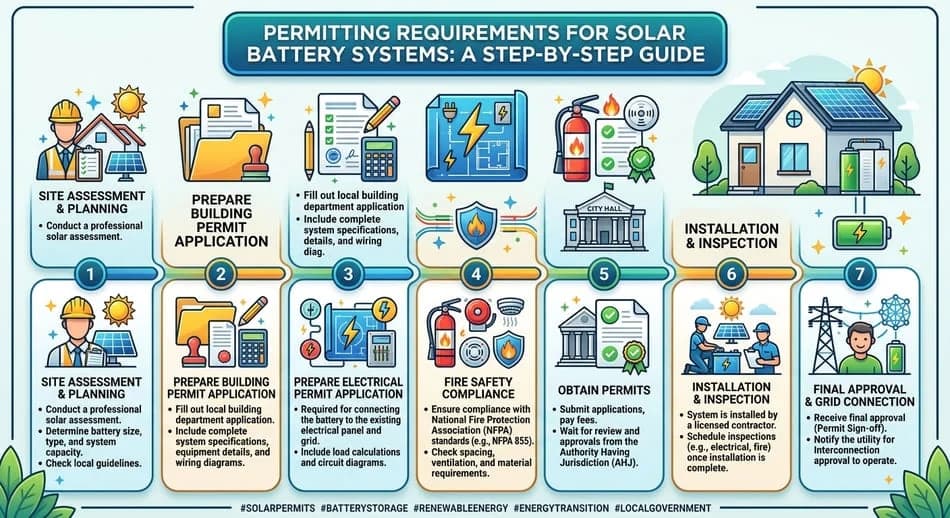
Solar Battery Permit Requirements: What You Need to Know
A solar battery usually needs local approval and a utility review before it can ...