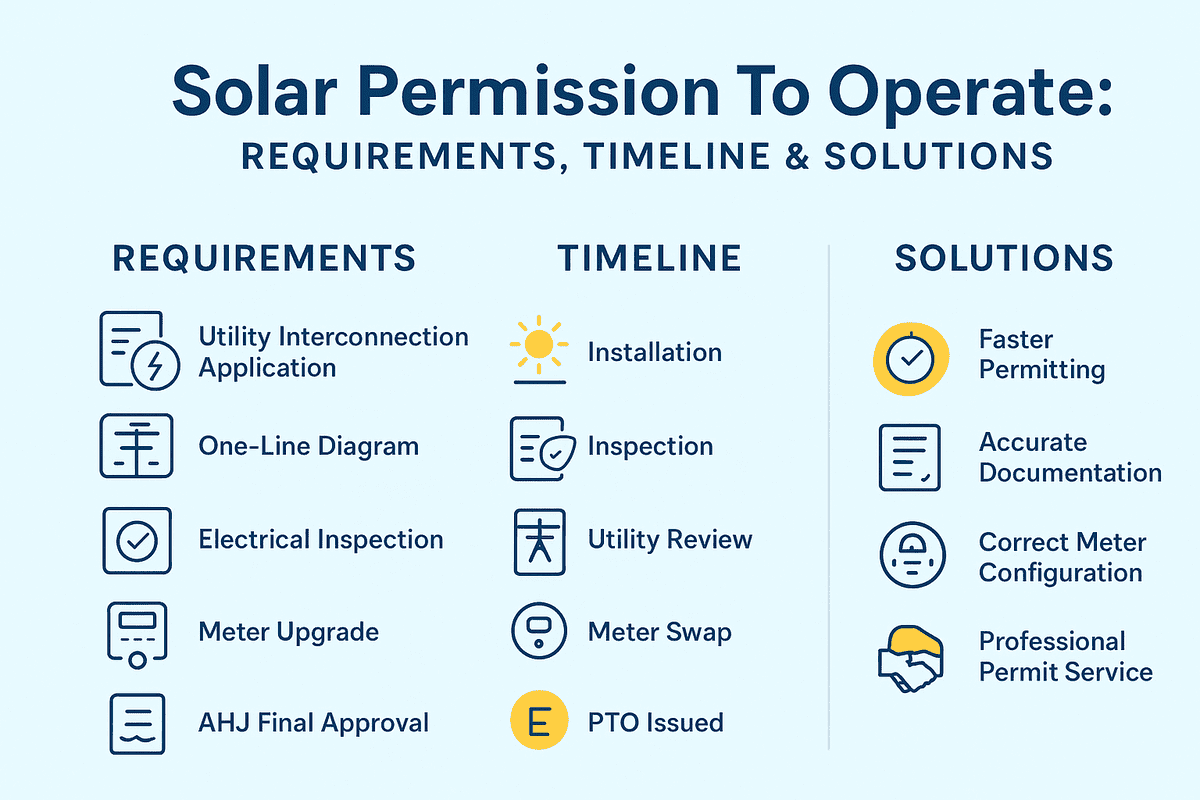
Solar Permission to Operate (PTO) is your utility company’s mandatory approval allowing your solar system to connect to the electrical grid, and without it, your panels cannot legally generate electricity or earn net metering credits. The PTO approval process typically takes 2-12 weeks after installation and costs between $0 and $1,500 depending on your state and utility provider, with California averaging $300-$800, Texas often charging nothing, and Florida ranging from $100 to $250.
Understanding solar PTO requirements prevents costly delays. Approximately 35% of applications get rejected due to incomplete electrical diagrams, 20% fail from non-approved equipment, and 15% stall from inadequate insurance documentation. Major utilities like Pacific Gas & Electric, Southern California Edison, and San Diego Gas & Electric currently process applications in 4-8 weeks, while smaller municipal utilities complete reviews in 2-3 weeks. Systems over 10 kilowatts require additional engineering review, adding 2-4 weeks, and battery storage increases timelines by approximately 30%.
Operating solar panels before PTO approval is illegal across all 50 states and results in fines up to $10,000-$15,000, forced disconnection, voided warranties, and potential criminal charges. Your utility must verify proper grounding, overcurrent protection, conductor sizing, and safety disconnects before issuing authorization. The bi-directional meter measuring both consumption and solar export for net metering only gets activated after PTO approval, meaning premature operation provides zero credit while violating federal regulations.
The four-step PTO process includes (1) obtaining building permits confirming code compliance, (2) passing professional inspections by municipal or utility personnel, (3) submitting interconnection applications with detailed technical documentation, and (4) receiving final utility authorization enabling grid connection. Complete, accurate applications move 40% faster than those requiring revisions, and professional assistance typically reduces timelines by 2-4 weeks through established utility relationships and jurisdiction-specific expertise.
Common PTO delays stem from utility backlogs following California’s NEM 3.0 implementation (8-12 week delays), peak installation months from March to June, policy transitions when utilities update standards (4-6 week delays), and orphaned solar systems from defunct installers lacking proper documentation. Expedited processing options exist for standard residential systems under 8 kilowatts using approved inverters like Enphase or SolarEdge, reducing approval time to 10-14 days for qualifying installations.
State-specific requirements vary significantly: California’s Rule 21 requires PE-stamped diagrams for systems over 10 kW and $1 million liability insurance; Texas follows ERCOT procedures with minimal bureaucracy; New York mandates $2 million insurance and PE-certified drawings for systems exceeding 12 kW; Florida caps processing at 60 days under state-mandated standards. Each utility implements distinct approval workflows; understanding your specific requirements prevents application rejection and accelerates grid connection.
Solar Permit Solutions has secured PTO approval for thousands of homeowners since 2013, navigating complex utility requirements, resolving orphaned installations, and overcoming interconnection obstacles across all 50 states. Whether facing your first application or struggling with authorization delays, this comprehensive guide to solar energy covers timelines, costs, state requirements, common rejection reasons, DIY versus professional approaches, and critical steps ensuring your solar investment achieves full operational capacity and maximum financial returns.

Understanding Solar PTO
Permission to Operate serves as your utility’s official green light, authorizing your photovoltaic installation to connect with the power grid. This approval marks a pivotal checkpoint in your solar journey, confirming your system passes all mandatory safety protocols, technical requirements, and regulatory standards before grid integration begins.
The Solar PTO Process Explained
Achieving PTO approval requires navigating several distinct phases that verify your system’s readiness for safe grid operation. Here’s how the approval pathway unfolds:
Permit Acquisition Phase: Start by obtaining necessary permits from your local building authority. Your installation must align with municipal electrical and construction codes before you can pursue utility authorization. These solar permits demonstrate your system meets established regulatory frameworks.
Professional Inspection Stage: Once installation wraps up, qualified inspectors evaluate your system’s compliance. Depending on your jurisdiction, municipal officials, utility personnel, or both will assess whether your setup follows approved designs, maintains proper safety measures, and meets interconnection criteria.
Grid Connection Paperwork: Submit your interconnection request along with required technical documents to your electric provider. They’ll evaluate whether your installation aligns with their safety protocols and technical specifications. Expect to provide detailed system information and compliance documentation during this review.
Final Authorization: After clearing inspections and application reviews, your utility grants formal PTO, activating your system’s capacity to export electricity and begin reducing your energy costs. This approval certifies your installation can operate without disrupting grid operations or creating safety hazards.
The Critical Role of PTO Approval
PTO authorization isn’t just bureaucratic red tape; it’s the gateway to your system’s complete operational capacity. This approval protects your home’s electrical infrastructure while ensuring grid stability for your entire community. Operating without proper authorization blocks access to net metering programs and prevents you from capturing the full financial value of your solar investment, including the federal solar tax credit.
Facing delays or roadblocks in securing approval? Professional assistance helps overcome interconnection obstacles and accelerates your path to full system activation. Solar Permit Solutions brings over a decade of specialized experience helping homeowners and installation professionals successfully navigate utility requirements and secure timely PTO approval.
Solar Permit Solutions
Need Solar Permit Plans?
Professional, permit-ready solar plan sets delivered fast. Residential and commercial projects across all 50 states.
Common Scenarios Requiring PTO Intervention
Your solar system may face authorization delays for several reasons, each demanding prompt attention to activate your investment. Understanding these common bottlenecks helps you recognize when expert PTO assistance becomes necessary.
Inadequate System Commissioning
Flawed commissioning procedures rank among the leading culprits behind PTO authorization setbacks. When your installation bypasses essential verification steps or arrives at the utility’s desk without complete documentation, approval stalls. Meeting National Electrical Code standards and utility interconnection protocols requires meticulous attention to commissioning details.
Watch for these frequent commissioning deficiencies:
Deficient Inspection Coverage: Essential safety verifications and performance validations get overlooked or receive inadequate documentation, leaving gaps in your approval package.
Documentation Defects: Your interconnection agreements may contain inaccuracies, or electrical schematics might show incomplete information, both triggering review delays and approval setbacks.
Non-Certified Components: Installing equipment that lacks utility certification guarantees swift rejection. Every component must appear on your provider’s approved equipment roster, as detailed in the equipment specification requirements.
Configuration Mismatches: System designs that clash with regulatory requirements force costly redesigns and equipment repositioning before clearing inspection hurdles, particularly when HOA regulations impact permit approvals.
Consider this scenario: Your installer uses inverters absent from the utility’s certified list, or skips mandatory grid compatibility testing. These oversights prevent utilities from validating your system’s readiness, creating authorization gridlock that blocks interconnection progress.
Evolving Utility Standards
Electric providers continuously revise their technical specifications as grid infrastructure advances and regulations adapt. Your system’s original approval criteria may no longer satisfy current interconnection mandates, creating unexpected compliance gaps.
Utilities frequently update requirements governing inverter technologies, safety mechanisms, and protection equipment necessary for grid connection. When your existing configuration falls short of revised standards, resolving the gap demands professional intervention, potentially requiring equipment upgrades, electrical reconfiguration, or refreshed documentation submissions that align with contemporary utility protocols.
Abandoned Installation Projects
Neglected or incomplete solar deployments create another category requiring specialized PTO expertise. These abandoned projects, often casualties of contractor departures or business closures, typically lack proper authorization because critical installation phases were never completed or adequately documented for utility review.
Orphaned systems frequently bypass vital commissioning checkpoints, rendering them unable to secure the authorization needed for grid connection. They commonly suffer from obsolete components, inspection failures, or fragmented permitting records that compound approval challenges.
Regardless of the underlying cause, targeted PTO remediation strategies restore system compliance and operational efficiency, unlocking the complete financial and performance benefits that grid connection delivers.
Advantages of Resolving PTO Obstacles
Clearing authorization barriers delivers transformative benefits that activate your system’s full potential:
Unleash Maximum Production Capacity: Resolved PTO challenges enable unrestricted electricity export to the grid, driving peak performance from your solar panels while maximizing generation output according to renewable energy research.
Achieve Regulatory Alignment: Professional remediation guarantees your installation satisfies every utility mandate and safety benchmark, eliminating future compliance risks and operational restrictions.
Accelerate Financial Returns: Grid-connected systems immediately begin accumulating net metering credits and energy export compensation, amplifying savings and shortening your payback timeline. Swift PTO resolution prevents leaving money on the table.

Warning Signs Requiring Expert PTO Assistance
These indicators suggest your system needs professional commissioning support or PTO remediation:
Missing Utility Authorization
When your utility withholds PTO approval despite completed installation, you’re facing a clear remediation scenario. Your panels remain disconnected from the grid, preventing credit accumulation on your electricity bills. However, distinguish between legitimate delays, standard processing times or meter replacement schedules, and actual authorization problems requiring intervention.
Diminished Savings or Absent Performance Data
Modern photovoltaic systems typically include monitoring platforms from manufacturers like SolarEdge, Enphase, SMA, or Tesla that provide real-time production visibility and performance tracking through mobile applications.
Experiencing unexpectedly modest utility savings or missing monitoring information signals potential interconnection gaps. Absent production data may reveal incomplete authorization preventing full operational status and net metering eligibility. Alternatively, technical troubleshooting like verifying your solar meter configuration, installing firmware updates, or power-cycling your inverter might resolve the issue.
Utility Compliance Alerts
Receiving official notices about compliance deficiencies from your electric provider strongly indicates remediation needs. Utilities issue these warnings when installations fail to meet interconnection specifications or when they identify discrepancies in system configuration or submitted documentation.
Such compliance gaps can postpone or completely block PTO issuance, restricting your system’s operational capabilities. Address these concerns immediately to prevent prolonged performance limitations. If your original installer actively pursues approval resolution, allow reasonable time for their efforts to succeed.
When compliance challenges persist beyond reasonable timeframes, or your original contractor becomes unreachable, engaging specialized PTO remediation professionals becomes critical. Solar Permit Solutions provides expert assistance overcoming even severe authorization obstacles, leveraging more than ten years of specialized experience resolving interconnection and permitting complications nationwide.
Essential Phases in Solar PTO Remediation
Addressing PTO authorization obstacles demands a systematic approach that identifies deficiencies and brings your installation into full utility compliance. Follow this structured remediation pathway:
1. Comprehensive Installation Evaluation
Professional technicians initiate remediation by conducting exhaustive system evaluations that uncover compliance gaps and technical deficiencies blocking your PTO authorization. This diagnostic phase examines your complete installation, from component selection to configuration accuracy, verifying alignment with utility grid connection protocols.
Solar Permit Solutions has delivered expert residential solar design assessments since 2013, helping property owners and installation contractors identify precise remediation requirements through detailed technical analysis.
2. Paperwork Verification and Correction
Incomplete or flawed documentation represents a primary obstacle to timely authorization. The verification phase involves meticulous examination of every submitted form, permit application, and compliance certificate to confirm accuracy and currency.
Reviewers scrutinize installation documentation, inspection reports, and regulatory compliance filings against utility benchmarks. Accurate, complete paperwork proves indispensable for securing grid connection authorization and activating your system’s operational capabilities while avoiding common permit denial mistakes.
3. Equipment Upgrades and Technical Corrections
When initial assessments expose defective or non-compliant components, technicians implement necessary repairs and equipment modernization. This phase may require integrating mandatory safety mechanisms or replacing outdated hardware to satisfy contemporary standards.
From installing utility-certified equipment to resolving technical barriers preventing interconnection, Solar Permit Solutions’ qualified technicians execute these modifications with precision, guaranteeing your installation meets every PTO specification.
4. Utility Liaison and Application Management
The remediation sequence concludes with strategic utility coordination. Following completion of required modifications, Solar Permit Solutions engages directly with your electric provider to resubmit authorization applications or schedule supplemental inspections.
This collaborative phase proves critical as utilities must validate full compliance before issuing PTO authorization. Our established utility relationships enable efficient navigation through approval procedures, accelerating final authorization. Solar Permit Solutions’ specialized knowledge ensures your remediation receives professional handling from assessment through final approval, delivering a compliant, safe, fully operational system.
How Long Does Solar PTO Take? (Timeline & Expectations)
Standard Timeline: 2-12 weeks after installation completion, varying by utility, jurisdiction, and system complexity.
Breakdown by Phase:
Initial Application Review: 3-5 business days
- Utility verifies specifications and documentation completeness
- Extends to 2+ weeks if errors or missing information require resubmission
Inspection Phase: 1-4 weeks
- Urban areas (LA County, SF Bay Area): Up to 6 weeks during peak seasons (spring/fall)
- Rural jurisdictions: Often completed within days due to lower permit volumes
Final Utility Review: 1-3 weeks post-inspection
- Major CA utilities (PG&E, SCE, SDG&E): 4-8 weeks total in 2025
- Small municipal utilities/rural co-ops: 2-3 weeks total
Timeline Extension Factors:
- Systems over 10kW: Add 2-4 weeks for engineering review
- Battery storage: Increases timeline ~30% due to safety/interconnection requirements
- Three-phase service/complex configurations: Extended review for grid impact assessment
- Utility backlogs: 8-12 week delays following NEM 3.0 (April 2023); peak months (March-June) still slower
- Policy transitions: 4-6 week delays when utilities update interconnection standards
Acceleration Strategies:
- Complete documentation: Moves 40% faster than applications requiring revisions
- Professional assistance: Reduces timeline 2-4 weeks through utility-specific expertise
- Expedited programs: 10-14 days for qualifying systems (under 8kW, approved inverters like Enphase/SolarEdge, standard configurations)
Action Steps for Delays:
- Contact utility interconnection department directly
- Track progress via online utility portals
- Document all communication (reference numbers, representative names) for potential escalation to state public utility commission

Solar PTO Costs and Fees by State
PTO approval costs range from $0 to over $1,500 depending on location, system size, and utility provider. Budget for these expenses to avoid surprise charges during interconnection.
State-by-State Fee Breakdown:
California: $300-$800 total
- PG&E: $145 (under 10kW), up to $450 (larger systems with engineering review)
- SCE: $75-$325 (based on system size)
Texas: $0-$600
- Most municipal utilities/cooperatives: $0 for standard systems
- Oncor (Dallas-Fort Worth): $0 for standard residential
- Complex installations: $200-$600
Florida: $100-$250
- FPL and major utilities: $100-$250
- Municipal utilities (Jacksonville, Orlando): Often $0 for systems under 10kW
New York: $150-$400
- ConEd, National Grid: Complete interconnection processing fees
Arizona: $50-$300
- APS: $125 standard residential
- Salt River Project: $200
New Jersey: $200-$750
- JCP&L: ~$350 standard
- PSE&G: $275 (under 10kW), ~$500 (up to 20kW)
Massachusetts: $200-$400
- National Grid: $195
- Eversource: $250
Nevada: $150 base fee
- NV Energy: ~$150 (under 25kW)
- Infrastructure upgrades: $500-$2,000 additional
Additional Cost Categories:
Building Inspection Fees: $50-$300
- Major metros (NYC, LA, Chicago): $200+
- Small municipalities: $50 or waived
Meter Upgrades: $0-$300
- Many utilities include free bi-directional meter installation
- Some charge $100-$300 (appears on first bill post-PTO)
Engineering Reviews: $300-$1,000
- Required for systems over 15kW
- Three-phase service or transformer upgrades increase costs
Battery Storage Additions: $150-$400
- Supplemental safety reviews
- Enhanced inspection requirements
Expedited Processing: $200-$500
- Reduces timeline ~50%
- Not available in all territories
Reinspection Fees: $50-$150 per reinspection
- Avoid by ensuring code compliance before initial inspection
Cost-Saving Strategy: Work with experienced installers familiar with local utility requirements. Complete, accurate initial applications prevent revision cycles that extend timelines and trigger additional fees. Most professional installers include PTO application management in service packages, streamlining the entire approval process.
Can I Use My Solar System Before PTO Approval?
Absolutely not. Operating your solar system before receiving PTO approval is strictly illegal and violates utility interconnection agreements across all fifty states, regardless of utility type.
Severe Consequences Include:
- Fines up to $10,000-$15,000 (California utilities)
- Forced system disconnection and permanent interconnection denial
- Voided insurance coverage and equipment warranties
- Civil liability for grid damage or neighbor impacts
- Potential criminal misdemeanor charges in extreme cases
Why the Prohibition Exists: Federal Energy Regulatory Commission guidelines and state utility commissions mandate explicit authorization before grid connection. Utilities must complete final safety verifications confirming proper grounding, overcurrent protection, conductor sizing, and disconnect switches. Premature activation creates electrical fire risks, ground faults, and equipment damage threatening your property and family.
Key Legal Framework: Your bi-directional meter, installed during PTO approval, measures both consumption and solar export for net metering. Without this utility-activated meter, you receive zero credit for excess production while still violating regulations. Modern grid-tied inverters lack components for safe off-grid operation, and attempting modifications voids warranties while creating code violations.
Liability Exposure: Insurance companies deny fire or electrical damage claims from unauthorized operation. If your system malfunctions and disrupts neighboring properties or injures utility workers, you face personal injury lawsuits and property damage claims, all while operating illegally.
Permissible Pre-PTO Activities:
- Monitoring systems only: Some equipment allows communication verification and data reporting setup without power production (inverter remains disconnected)
- Battery backup functions: Certain batteries can charge from grid and provide outage backup before PTO, provided solar panels stay disconnected from both battery and grid
Bottom Line: Extended PTO timelines, typically caused by correctable paperwork or inspection issues resolving within weeks, never justify illegal operation. Contact your installer to expedite outstanding requirements legally rather than risking thousands in fines, voided warranties, and permanent grid connection denial. Brief patience protects your investment and ensures safe, reliable operation for your system’s 25-30 year lifespan.
DIY vs Professional Solar PTO: When to Hire Help
Handling PTO applications independently saves professional fees but demands technical expertise, substantial time investment, and thorough utility knowledge. Choose the right approach by weighing your capabilities against system complexity.
DIY Applications Work Best For:
- Simple residential systems under 10 kilowatts using standard equipment (Enphase, SolarEdge, Generac)
- Homeowners comfortable with electrical diagrams and NEC requirements
- Straightforward installations with complete documentation from reputable installers
Expect a 10-30 hour time commitment, including utility research, form completion, documentation gathering, inspection coordination, and revision responses. Common DIY errors like incomplete diagrams, non-approved equipment, and missing engineering stamps trigger rejections that extend timelines two to four weeks per revision cycle.
Professional Services Are Essential For:
- Battery storage systems requiring complex safety documentation
- Large systems exceeding 15 kilowatts needing load flow studies and professional engineering stamps
- Properties with three-phase power or complex electrical configurations
- Orphaned systems from defunct installers lacking documentation
- Metropolitan areas with intricate utility-specific procedures
Professional services cost $200-$1,000 but accelerate approvals through established utility relationships and jurisdiction-specific expertise. Solar Permit Solutions maintains current knowledge across multiple territories, reducing rejection risks and timeline delays.
Financial Reality: Failed DIY attempts often cost more than hiring professionals initially. Six months of PTO delays means $1,000+ in lost solar savings, erasing any fee savings. Transitioning to professional help mid-process adds service costs to already-wasted time.
Hybrid Option: Technically skilled homeowners can prepare applications independently while retaining consultants for pre-submission document review ($200-$400), combining cost savings with expert error-catching. Consider reviewing essential DIY solar energy books for additional guidance.
Bottom Line: Straightforward systems with complete documentation support DIY approaches. Complex installations, orphaned projects, or utility-specific challenges demand professional engagement. Assess your technical competency, available time, and system complexity honestly to optimize both cost and timeline, consulting professional solar resources when needed.
State-by-State Solar PTO Requirements (2025 Guide)
PTO requirements vary significantly by state due to differing utility regulations, interconnection standards, and building codes. Here’s what each major state requires:
California (6-10 week timeline)
- Rule 21 governs PG&E, SCE, SDG&E interconnections
- Online portal applications; PE-stamped diagrams for systems >10kW
- $1M+ liability insurance; signed interconnection agreements
- NEM 3.0 requires specific inverter capabilities for grid stability
- Fast Track available for pre-approved standardized designs
Texas (3-6 week timeline)
- ERCOT territories: Apply to T&D utilities (Oncor, CenterPoint, AEP)
- Single-line electrical diagrams; UL/IEEE 1547 compliance proof
- Minimal bureaucracy; rural co-ops may have unique requirements
Florida (4-8 week timeline, 60-day cap)
- State-mandated standardized process via FPL, Duke Energy, Tampa Electric
- Complete application forms, array layouts, equipment cut sheets
- Utility named as additional insured; net metering agreement
- Coastal areas: Enhanced structural and wind load requirements
Arizona (4-7 week timeline)
- APS, Tucson Electric follow AZ Corporation Commission rules
- NEC Article 690 compliant electrical drawings
- Utility-approved inverter list compliance required
- Inverters must operate reliably at 115°F+
New York (6-12 week timeline)
- ConEd, National Grid, NYSEG process applications
- PE-certified drawings for systems >12kW
- $2M liability insurance minimum; NYSERDA equipment approval
- NYC: Additional Department of Buildings requirements, electrician affidavits
Massachusetts (5-9 week timeline)
- Schedule Z tariff governs interconnection procedures
- Fire safety emphasis: Clear labeling, accessible disconnects for firefighters
- Municipal utilities often faster than investor-owned utilities
Nevada (3-6 week timeline)
- NV Energy’s streamlined process for systems <25 kW
- Simplified electrical diagrams; online portal submission
- Rural single-phase lines may require transformer capacity review
New Jersey (8-12 week timeline during peaks)
- JCP&L, PSE&G, Atlantic City Electric process applications
- NJ Clean Energy Program equipment approval required
- High application volumes create processing backlogs
North Carolina (4-8 week timeline)
- Duke Energy Progress/Carolinas serve most areas
- Notarized signatures; NC-licensed contractor certifications
- Electric cooperatives have varying requirements per state solar guidelines
Colorado (5-8 week timeline)
- Xcel Energy serves Front Range corridor
- NEC-compliant diagrams; approved inverter verification
- Mountain/rural areas: Different requirements per local infrastructure
Key Takeaway: Contact your utility’s interconnection department early to clarify jurisdiction-specific expectations. Work with installers experienced in your state’s requirements for smoother approvals and regulatory compliance.

Top Reasons Solar PTO Applications Get Rejected
Understanding common rejection causes helps avoid costly delays. Here are the primary culprits:
1. Incomplete/Inaccurate Electrical Diagrams (35% of rejections)
- Missing wire sizing/ampacity calculations
- Omitted equipment ratings for breakers/disconnects
- Incorrect grounding electrode conductor sizing
- Missing disconnect locations/labeling
- Hand-drawn sketches lacking technical detail
- Fix: Submit professional-quality single-line diagrams showing full NEC Article 690 compliance
2. Non-Approved Equipment (20% of rejections)
- Components not on utility’s approved equipment list
- Obsolete inverter models no longer certified
- Fix: Verify all equipment appears on current utility-approved lists before purchase
3. Missing/Expired Professional Engineer Stamps
- Required for systems exceeding state thresholds (CO: >10kW, NY: >12kW)
- Outdated stamps or out-of-state PE licenses
- Fix: Obtain current stamps from certified solar professionals
4. Inadequate Insurance Documentation (15% of rejections)
- Utility not named as additional insured when required
- Expired policies or insufficient coverage ($1M-$2M typically required)
- Wrong property address on certificates
- Fix: Request utility-specific insurance certificates from your provider
5. Incorrect System Sizing
- Capacity exceeding 120% of annual consumption
- Creates grid management complications
- Fix: Review 12+ months of utility bills for accurate capacity calculations
6. Failed Building Inspections
- Improper equipment labeling
- Inadequate working clearances
- Missing/incorrect rapid shutdown systems
- Grounding deficiencies
- Fix: Use experienced installers familiar with local inspection requirements; adds 2-4 weeks per reinspection
7. Unsigned/Incorrect Interconnection Agreements (10% of delays)
- Missing notarization when required
- Non-property-owner signatures
- Outdated agreement forms
- Fix: Carefully review agreement instructions; ensure proper execution
8. Missing Net Metering Applications
- Separate enrollment required at some utilities
- Fix: Submit simultaneously with interconnection application when possible
9. Incomplete Equipment Specifications
- Generic descriptions (“solar panels”) without model numbers
- Missing inverter anti-islanding protection data
- Fix: Submit complete specification packages for all major components
10. Infrastructure Upgrade Requirements
- Limited distribution capacity, aging transformers
- Upgrade costs: $1,500-$5,000 for residential systems
- Fix: Properties in rural areas or end-of-circuit locations face higher risks
11. Rapid Shutdown Non-Compliance (2017 NEC)
- Must reduce voltage to ≤80V within 30 seconds
- Fix: Show correct implementation in electrical diagrams
12. Inadequate Structural Capacity
- Missing roof load calculations in high wind/snow areas
- Older structures with unknown capacity
- Fix: Provide engineering analysis confirming adequate structural support and racking systems
Prevention Strategy: Thorough pre-submission documentation review, equipment verification against approved lists, and coordination with experienced solar professionals significantly reduce rejection risks. Quick responses with complete corrections minimize timeline impacts when rejections occur.
California PTO Authorization Challenges
California homeowners encounter distinctive authorization obstacles stemming from utility processing backlogs, rigorous compliance mandates, and documentation precision requirements. The California Public Utilities Commission imposes demanding interconnection specifications that amplify complexity for both property owners and installation professionals.
The shift to Net Energy Metering 3.0 introduced additional hurdles, as installations missing pre-deadline PTO authorization face diminished economic advantages. Furthermore, divergent approval workflows at Pacific Gas & Electric, Southern California Edison, and San Diego Gas & Electric generate unpredictable timeline variations across service territories.
Recent solar company bankruptcies throughout California have stranded numerous homeowners with incomplete installations lacking proper commissioning support, further complicating PTO acquisition as property owners struggle to secure qualified assistance for authorization completion according to renewable energy trends.
The Value of Expert PTO Guidance
Successfully navigating utility protocols and regulatory frameworks for solar authorization involves substantial complexity and time investment. Each electric provider implements distinct requirements and approval workflows that fluctuate based on geographic location and system specifications. Without comprehensive knowledge of these intricacies, critical oversights and procedural errors easily derail authorization timelines.
Solar Permit Solutions delivers the specialized expertise required to streamline every process phase, from mastering local interconnection standards to managing utility communications, ensuring proper commissioning and efficient grid connection without preventable delays. Our commitment aligns with broader clean energy initiatives while maintaining compliance with environmental regulations.
Conclusion
Obtaining permission to operate represents far more than a bureaucratic formality; it serves as the critical gateway that transforms your solar installation from an expensive rooftop addition into a fully functional energy-producing asset. Without proper PTO authorization, your panels remain disconnected from the grid, unable to generate net metering credits, export excess electricity, or deliver the financial returns that justified your investment.
The PTO approval process demands careful attention to technical specifications, documentation accuracy, and utility-specific requirements that vary significantly across states and service territories. From California’s rigorous Rule 21 compliance to Texas’s streamlined cooperative processes, each jurisdiction implements unique standards governing grid interconnection. Successfully navigating these requirements requires either substantial personal expertise and time investment or professional guidance from specialists who understand the nuances of local utility protocols.
Timeline expectations range from two weeks for straightforward installations in cooperative territories to twelve weeks or longer in backlogged urban utility districts processing high application volumes. Costs span an equally broad spectrum, from zero dollars in Texas municipal territories to over fifteen hundred dollars for complex California installations requiring engineering reviews and battery integration. Understanding these variables helps you budget accurately and set realistic activation timelines for your solar system.
The consequences of attempting premature system operation extend beyond simple regulatory violations. Unauthorized grid connection risks substantial financial penalties reaching fifteen thousand dollars, permanent interconnection denial, voided insurance coverage, and potential criminal charges in extreme cases. Modern grid-tied systems lack the components necessary for safe off-grid operation, making any workaround both dangerous and legally untenable. Brief patience during the approval process protects your investment and ensures decades of safe, reliable solar production.
Common rejection triggers like incomplete electrical diagrams, non-approved equipment, missing engineer stamps, and inadequate insurance documentation account for the majority of application delays. Proactive verification of equipment against utility-approved lists, thorough documentation review before submission, and coordination with experienced installation professionals significantly reduce rejection risks. When complications arise from orphaned installations, evolving utility standards, or commissioning deficiencies, professional remediation services can restore compliance and secure authorization where DIY efforts typically fail.
Solar Permit Solutions has spent over a decade helping homeowners and installation contractors overcome PTO obstacles across all fifty states. Our established utility relationships, comprehensive knowledge of jurisdiction-specific requirements, and systematic remediation approach accelerate approvals while minimizing costly delays. Whether you’re facing your first interconnection application or struggling to resolve authorization barriers from an incomplete installation, expert guidance delivers the fastest path to full system activation and maximum financial returns from your solar investment.
Take action today by contacting your utility’s interconnection department to clarify current requirements, verifying your equipment appears on approved lists, and ensuring your installation team understands local compliance standards. Your solar system represents a significant financial commitment designed to generate savings for twenty-five to thirty years. Proper PTO authorization protects that investment and unlocks the complete environmental and economic benefits of clean solar energy, as highlighted in global renewable energy reports.
FAQs
Your utility issues PTO only after verifying your installation passes all safety inspections, meets National Electrical Code requirements, and includes proper protection equipment. Without PTO approval, your solar panels cannot legally connect to the grid, meaning you miss out on net metering benefits and can’t offset your electricity bills despite having a fully installed system.
The PTO process typically involves four key steps: obtaining building permits, passing professional inspections, submitting interconnection applications with technical documentation, and receiving final utility authorization. Most residential solar systems receive PTO approval within two to twelve weeks after installation completion, though timelines vary by utility provider and location.
Major California utilities like PG&E, SCE, and SDG&E currently average four to eight weeks for complete PTO approval in 2025, while smaller municipal utilities and rural cooperatives often move faster at two to three weeks total. Urban areas with high solar adoption rates experience longer delays. Los Angeles County and the San Francisco Bay Area can extend to six weeks during peak installation seasons in spring and fall.
Several factors extend standard timelines: systems over 10 kilowatts add two to four weeks for engineering review, battery storage increases timelines by approximately thirty percent, and utility backlogs can create eight- to twelve-week delays. Complete, accurate documentation moves forty percent faster than applications requiring multiple correction cycles, making professional assistance valuable for accelerating approval.
Federal Energy Regulatory Commission guidelines mandate explicit utility authorization before any grid-connected solar system begins operation. Utilities must complete final safety verifications confirming proper grounding, overcurrent protection, conductor sizing, and disconnect switches before issuing PTO. Your bi-directional meter, which measures both electricity consumption and solar export for net metering, gets installed and activated only during the PTO approval process.
Premature system activation creates serious safety hazards, including electrical fire risks, ground faults, and equipment damage, threatening your property and family. If unauthorized operation causes power quality issues affecting neighbors or injures utility workers, you face civil liability lawsuits and property damage claims. The brief wait for PTO approval protects your investment and ensures safe, reliable operation for your system’s twenty-five- to thirty-year lifespan.
Major cost components include utility application fees ($0-$450), building inspection charges ($50-$300), meter upgrades ($0-$300, often included free), and engineering reviews ($300-$1,000 for systems over 15 kilowatts). Battery storage systems trigger additional fees of $150-$400 for supplemental safety reviews. Failed inspections requiring corrections add $50-$150 per reinspection.
Some utilities offer expedited processing for $200-$500 extra, reducing approval time by approximately fifty percent. Three-phase electrical service or properties requiring transformer upgrades face higher engineering fees and potential infrastructure upgrade costs of $500-$2,000. Working with experienced installers who submit complete, accurate applications prevents revision cycles that extend timelines and occasionally trigger additional review fees, ultimately saving money despite professional service costs.
Systems over 10 kilowatts require supplemental engineering review, adding two to four weeks, while battery storage increases timelines approximately thirty percent due to enhanced safety requirements. Properties with three-phase electrical service or complex configurations need extended review for grid impact assessment. Peak installation months from March through June create longer processing times as utilities handle increased application volumes.
Check your application status by contacting your utility’s interconnection department directly, as many utilities provide online portals tracking progress through each review stage. Document all communications, including reference numbers and representative names. If delays extend significantly beyond typical timeframes for your area (check utility websites for published timelines), escalate through utility management, or file complaints with your state’s public utility commission.
Incomplete applications from your installer, non-approved equipment requiring replacement, or missing professional engineer stamps commonly cause avoidable delays. Solar Permit Solutions specializes in identifying bottlenecks and accelerating stuck applications through established utility relationships and comprehensive knowledge of jurisdiction-specific requirements, typically reducing timelines by two to four weeks compared to DIY resolution attempts.
Need Solar Permit Plans?
Professional, permit-ready solar plan sets delivered fast. Residential and commercial projects across all 50 states.
Frequently Asked Questions
PTO stands for Permission to Operate, which is the official authorization from your utility company allowing your solar system to connect to the electrical grid. Think of it as the final approval that activates your solar panels and enables them to send excess electricity back to the grid for net metering credits. Your utility issues PTO only after verifying your installation passes all safety inspections, meets National Electrical Code requirements, and includes proper protection equipment. Without PTO approval, your solar panels cannot legally connect to the grid, meaning you miss out on net metering benefits and can't offset your electricity bills despite having a fully installed system. The PTO process typically involves four key steps: obtaining building permits, passing professional inspections, submitting interconnection applications with technical documentation, and receiving final utility authorization. Most residential solar systems receive PTO approval within two to twelve weeks after installation completion, though timelines vary by utility provider and location.
Solar PTO approval typically takes two to twelve weeks after your installation is complete, depending on your utility company, location, and system complexity. The timeline breaks down into three main phases: initial application review (3-5 business days), inspection scheduling and completion (1-4 weeks), and final utility review (1-3 weeks). Major California utilities like PG&E, SCE, and SDG&E currently average four to eight weeks for complete PTO approval in 2025, while smaller municipal utilities and rural cooperatives often move faster at two to three weeks total. Urban areas with high solar adoption rates experience longer delays. Los Angeles County and the San Francisco Bay Area can extend to six weeks during peak installation seasons in spring and fall. Several factors extend standard timelines: systems over 10 kilowatts add two to four weeks for engineering review, battery storage increases timelines by approximately thirty percent, and utility backlogs can create eight to twelve week delays. Complete, accurate documentation moves forty percent faster than applications requiring multiple correction cycles, making professional assistance valuable for accelerating approval.
No, operating solar panels before receiving PTO approval is strictly illegal across all fifty states and violates your utility interconnection agreement. Attempting to energize your system prematurely can result in severe consequences including fines up to $10,000-$15,000, forced system disconnection, permanent denial of grid connection, voided insurance coverage and equipment warranties, and potential criminal misdemeanor charges. Federal Energy Regulatory Commission guidelines mandate explicit utility authorization before any grid-connected solar system begins operation. Utilities must complete final safety verifications confirming proper grounding, overcurrent protection, conductor sizing, and disconnect switches before issuing PTO. Your bi-directional meter, which measures both electricity consumption and solar export for net metering, gets installed and activated only during the PTO approval process. Premature system activation creates serious safety hazards including electrical fire risks, ground faults, and equipment damage threatening your property and family. If unauthorized operation causes power quality issues affecting neighbors or injures utility workers, you face civil liability lawsuits and property damage claims. The brief wait for PTO approval protects your investment and ensures safe, reliable operation for your system's twenty-five to thirty year lifespan.
Solar PTO costs range from zero dollars to over $1,500 depending on your state, utility provider, and system size. Texas homeowners often pay nothing as many municipal utilities and cooperatives like Oncor process residential applications at no charge. Florida residents typically pay $100-$250, while California homeowners face $300-$800 in total PTO-related fees. Major cost components include utility application fees ($0-$450), building inspection charges ($50-$300), meter upgrades ($0-$300, often included free), and engineering reviews ($300-$1,000 for systems over 15 kilowatts). Battery storage systems trigger additional fees of $150-$400 for supplemental safety reviews. Failed inspections requiring corrections add $50-$150 per reinspection. Some utilities offer expedited processing for $200-$500 extra, reducing approval time by approximately fifty percent. Three-phase electrical service or properties requiring transformer upgrades face higher engineering fees and potential infrastructure upgrade costs of $500-$2,000. Working with experienced installers who submit complete, accurate applications prevents revision cycles that extend timelines and occasionally trigger additional review fees, ultimately saving money despite professional service costs.
Extended PTO timelines typically result from incomplete documentation, utility processing backlogs, failed inspections requiring corrections, or systems needing additional engineering review. Applications with missing information or errors require resubmission, adding two or more weeks per revision cycle. Utilities experiencing high application volumes, particularly California providers following NEM 3.0 implementation, face processing delays of eight to twelve weeks. Systems over 10 kilowatts require supplemental engineering review adding two to four weeks, while battery storage increases timelines approximately thirty percent due to enhanced safety requirements. Properties with three-phase electrical service or complex configurations need extended review for grid impact assessment. Peak installation months from March through June create longer processing times as utilities handle increased application volumes. Check your application status by contacting your utility's interconnection department directly as many utilities provide online portals tracking progress through each review stage. Document all communications including reference numbers and representative names. If delays extend significantly beyond typical timeframes for your area, escalate through utility management or file complaints with your state's public utility commission. Incomplete applications from your installer, non-approved equipment requiring replacement, or missing professional engineer stamps commonly cause avoidable delays. Solar Permit Solutions specializes in identifying bottlenecks and accelerating stuck applications through established utility relationships and comprehensive knowledge of jurisdiction-specific requirements, typically reducing timelines by two to four weeks compared to DIY resolution attempts.

SPS Editorial Team
Solar Permit Solutions
Solar Permit Solutions provides professional solar permit design services for residential, commercial, and off-grid installations across all 50 states. Our team ensures permit-ready plan sets delivered fast.
Related Articles
Off-Grid Solar System Requirements: Sizing, Permits & NEC Code Guide
Off-grid solar permit requirements by state: building codes, NEC compliance, bat...
Solar Battery Permit: What Most Installers Get Wrong
Quick Answer: Adding battery storage to a solar system almost always requires ne...
Solar Battery Tax Credit 2026: What Homeowners and Contractors Need to Know
There is no federal solar battery tax credit available to homeowners in 2026. Th...