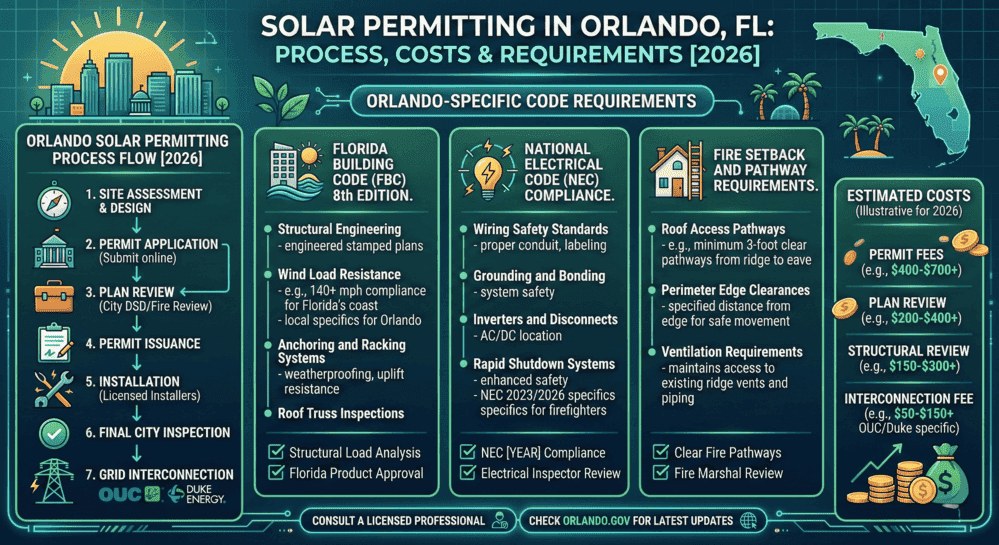
Solar permitting in Orlando, FL, requires a building permit and an electrical permit for photovoltaic (PV) installations within city limits or an electrical permit for residential rooftop systems in unincorporated Orange County. Permit fees typically range from $100 to $400 for residential systems, and Orange County’s expedited solar program processes most applications within three to five business days. All installations must comply with the Florida Building Code 8th Edition (2023), the NEC 2020, and ASCE 7-22 wind load standards, with Orlando’s design wind speed falling in the 130 to 140 mph range. After passing building and electrical inspections, homeowners must complete utility interconnection through Orlando Utilities Commission (OUC) or Duke Energy Florida to receive Permission to Operate (PTO).
Orlando is one of Florida’s most active residential solar markets, with approximately 233 sunny days per year and strong incentives for clean energy adoption. Understanding solar permit requirements in Florida, including Orlando-specific AHJ rules, document requirements, and interconnection procedures, is essential for avoiding permit rejections and project delays. Whether you are a homeowner planning your first rooftop installation or an installer managing multiple projects across Orange County, this guide walks you through every step of the process.
Below, we cover who needs a permit, the step-by-step application process, required documents, Orlando-specific code requirements under the FBC and NEC, permit costs and timelines, OUC and Duke Energy interconnection, HOA rights under Florida’s Solar Rights Act, and tips for a first-pass approval. Understanding the role of the local Authority Having Jurisdiction in solar is critical for navigating this process efficiently.
Who Needs a Solar Permit in Orlando?
If you are installing a grid-tied or off-grid solar PV system in the Orlando area, you need a permit. This applies to both residential and commercial installations, whether rooftop-mounted or ground-mounted. According to OUC Rooftop Solar and Interconnection documentation, the City of Orlando requires a building permit and an electrical permit for PV solar installations. If your property is in unincorporated Orange County rather than within city limits, the requirements differ slightly. Orange County requires an electrical permit for residential rooftop PV systems, with ground-mount and commercial systems starting as building permits with an electrical sub-permit added after approval. For City of Orlando submissions, visit the City of Orlando Permits and Inspections page for the latest forms and checklists.
To determine which jurisdiction applies to your property, check the Orange County Property Appraiser website. If the municipality field shows “Un-Incorporated,” your permit goes through Orange County’s Building Division. If it shows “City of Orlando,” you will submit through the City of Orlando’s Permitting Services Division.
Contractor licensing is another key consideration. Florida law requires that solar installations be performed by a licensed electrical contractor or a licensed solar contractor. Homeowners are legally allowed to pull permits for their own primary residence, but the electrical work still must be inspected and meet all code requirements. Working with a licensed, experienced installer who understands Orlando’s specific AHJ requirements is strongly recommended.
The Solar Permitting Process in Orlando: Step by Step
The solar permitting process in Orlando follows a predictable sequence of steps. For a broader look at solar permit timelines across different jurisdictions, see our detailed guide. Whether you are working within the City of Orlando or unincorporated Orange County, the general workflow is similar.
Step 1: Site Assessment and System Design
Before any permit application is submitted, the installer evaluates the property. This includes a roof assessment for structural integrity, shading analysis, roof orientation, available mounting area, and electrical service capacity. The system is then designed around these factors, with equipment selections for modules, inverters, racking, and any additional components like rapid shutdown devices or optimizers.
Step 2: Prepare the Permit Plan Set
The permit plan set is the most critical component of your application. This package typically includes a site plan showing the property layout and equipment locations, a roof plan with panel placement and dimensions, a solar single-line diagram showing how the PV system ties into the existing electrical service, structural attachment details with engineering calculations for wind loads, and equipment specification sheets for modules, inverters, and racking. For a complete breakdown of documentation, review our guide to solar panel permit requirements. For Orange County, the structural plans must be signed and sealed by a licensed Florida Professional Engineer (PE). Fastener specifications, wind load exposure category, and roof attachment details are all required.
Step 3: Submit the Permit Application
Both the City of Orlando and Orange County process permits electronically. Orange County uses its Orange County Fast Track permitting portal for all solar permit submissions. The City of Orlando uses its ProjectDox digital plan review system. Applicants submit their application through the City’s online services portal and then upload digital plans through ProjectDox after receiving access.
Step 4: Plan Review
After submission, the building department reviews the plan set for code compliance. Residential solar permits in Orange County are typically reviewed within three to five business days through the county’s expedited solar program. The City of Orlando’s review timeline varies depending on project complexity, but standard residential rooftop systems generally move through review within a similar timeframe. If the reviewer identifies issues, the applicant will receive a corrections notice and must resubmit revised plans.
Step 5: Permit Approval and Installation
Once plans are approved and permit fees are paid, the permit is issued and installation can begin. For the City of Orlando, applicants receive instructions for fee payment and can then download approved plans from ProjectDox. It is important to print approved plans to scale and keep them posted at the job site during construction, as inspectors will reference them.
Step 6: Inspections
After installation, the system must pass inspections before it can be energized. Inspections typically include a building or structural inspection to verify roof attachments and structural integrity, an electrical inspection to confirm wiring, grounding, bonding, conduit, disconnect switches, and NEC compliance, and in some cases a final inspection that covers the overall system. Understanding AHJ solar requirements can help you prepare for what inspectors will look for. Schedule inspections within six months of permit issuance to prevent the permit from expiring.
Step 7: Utility Interconnection and PTO
After passing all inspections, the final step is connecting to the grid through your utility’s interconnection process. For a detailed walkthrough, see our solar interconnection agreement checklist. For Orlando residents served by OUC, the contractor submits a solar interconnection application through OUC’s online portal. OUC reviews the application, and if approved, replaces the existing meter with a bi-directional net meter. For customers in areas served by Duke Energy Florida, the interconnection process follows Duke’s own application and review timeline. Permission to Operate is granted once the utility confirms the system is safe to connect and the meter is installed.
Solar Permit Solutions
Solar Contractor? We Design Your Plans.
Outsource your permit plan sets to our team. PE-stamped, code-compliant, fast turnaround so you can focus on installation.
Required Documents for an Orlando Solar Permit
A complete permit application package for solar installation in the Orlando area typically includes the following:
- Site plan showing the property, existing electrical service location, and proposed equipment placement
- Roof plan or layout drawing with panel dimensions, setbacks, and fire pathways
- Single-line electrical diagram (riser diagram) showing the PV system connection to the existing service
- Structural attachment details including lag bolt or rail mount specifications and spacing
- Wind load calculations per ASCE 7-22 and the Florida Building Code
- PE-stamped structural engineering plans (required in Orange County)
- Equipment specification sheets and listings for modules, inverters, and racking (products must be UL-listed or FSEC-approved)
- Load calculations demonstrating the roof can support the added weight of the system
- If applicable, HOA approval documentation or a Notice of Commencement for projects exceeding $5,000 in value
Submitting a complete, accurate package on the first attempt is the single best way to avoid delays. Missing documentation or calculation errors are the most common reasons for plan review rejections and revision cycles.
Orlando-Specific Code Requirements
Florida Building Code (FBC) 8th Edition
Orlando falls under the Florida Building Code, 8th Edition (2023), which adopts ASCE 7-22 as the standard for wind load calculations. For technical details, refer to the Florida Building Commission ASCE 7-22 wind load fact sheet. Orlando’s design wind speed typically falls in the 130 to 140 mph range, which places it outside the High-Velocity Hurricane Zone (HVHZ) that applies to Miami-Dade and Broward counties. While this simplifies some structural requirements compared to South Florida, wind load compliance is still a serious consideration. All rooftop-mounted PV systems must be designed for wind loads in accordance with ASCE 7, and structural plans must demonstrate that the roof and attachment points can withstand the applicable design pressures.
The FBC 8th Edition also requires that PV panels and modules be listed and labeled in accordance with UL 1703, and inverters must comply with UL 1741. Building-integrated PV products such as solar shingles have additional testing requirements under ASTM D3161 or TAS 107.
National Electrical Code (NEC) Compliance
The FBC 8th Edition incorporates the NEC 2020 (NFPA 70) with Florida-specific amendments as the governing electrical standard. Key NEC requirements for solar installations in Orlando include rapid shutdown compliance under NEC 690.12, which mandates that PV systems on buildings reduce conductor voltage to safe levels within a specified timeframe when initiated. Proper grounding and bonding for solar PV under Article 690 and Article 250, correct conductor sizing based on NEC 690.8 circuit sizing requirements, overcurrent protection, and disconnect switch placement are all scrutinized during electrical plan review and inspection. Installers should also familiarize themselves with the latest NEC Article 690 updates for installers, as some AHJs may reference NEC 2023 provisions. You can verify your state’s adopted edition through the NFPA NEC enforcement map.
Fire Setback and Pathway Requirements
Solar panel arrays on residential rooftops must comply with fire code setback and access pathway requirements. These rules ensure that firefighters have safe access to the roof and can ventilate the structure in an emergency. Typically, this includes maintaining clear pathways along ridgelines and eaves, and keeping panels set back from roof edges. The specific dimensions depend on the roof configuration and the fire code adopted by the local jurisdiction. For more details on fire-related safety standards, see our guide to solar panel safety codes.
How Much Does a Solar Permit Cost in Orlando?
Permit fees for residential solar installations in the Orlando area are among the more affordable in major Florida metros. In Orange County, residential solar permit fees typically range from $100 to $300, depending on the system size and the valuation-based fee calculation used by the building department. The City of Orlando calculates permit fees based on the total project value, starting at $26 for the first $1,000 and adding $3 per additional $1,000 for residential projects.
For most standard residential rooftop solar installations in the 5 kW to 15 kW range, homeowners can expect total permit costs between $150 and $400. Commercial installations will have higher fees based on system size and project scope. Keep in mind that these fees cover only the building department permit and do not include any utility interconnection application fees, engineering costs, or plan set preparation.
How Long Does Solar Permitting Take in Orlando?
Timeline is one of the most common concerns for homeowners and installers. In Orange County, residential solar permits are typically reviewed and approved within three to five business days through the county’s expedited solar permit program. The City of Orlando’s plan review timeline depends on project type and current volume, but most residential rooftop solar applications are processed within one to two weeks.
The most common reasons for delays include incomplete applications with missing documents or unsigned engineering plans, errors in structural calculations or wind load analysis, single-line diagrams that do not match the proposed equipment, and inconsistencies between the site plan and the actual property layout. Working with a professional permit plan set provider or an experienced installer who knows the local AHJ’s expectations can significantly reduce the risk of revision cycles and shorten your overall project timeline.
Utility Interconnection: OUC and Duke Energy
Orlando Utilities Commission (OUC)
OUC is the primary electric utility serving the City of Orlando and portions of Orange and Osceola counties. After your solar installation passes all building and electrical inspections, your contractor submits a solar interconnection application through OUC’s online portal. The application must include a single-line diagram, inverter datasheets, and a site plan. Understanding your supply-side and load-side solar interconnection method is also important, as it affects your panel design and documentation.
OUC’s standard residential interconnection applications are typically processed within seven to fourteen business days. Once approved, OUC replaces the existing meter with a bi-directional meter for net metering at no cost to the customer. According to the NREL PVWatts Calculator, a 1 kW DC system in Orlando is expected to produce an average of approximately 1,350 kWh per year. Homeowners should also be aware of upcoming rate changes: effective July 1, 2025, new solar customers who submit a completed interconnection application will be credited at the community solar farm rate for exported energy, with rate changes taking effect in Fall 2026.
Duke Energy Florida
Parts of the greater Orlando metro area, particularly in surrounding communities, are served by Duke Energy Florida. Duke’s interconnection process requires its own application, along with documentation of the approved building permit and system specifications. Processing timelines with Duke Energy can range from ten to twenty business days for standard residential systems, and Duke installs a bi-directional meter upon interconnection approval. The Duke Energy Clean Energy Connection Program also offers community solar subscription options for customers who cannot install rooftop panels.

HOA Rules and Florida’s Solar Rights Act
If you live in an HOA-governed community in Orlando, it is important to understand your rights under Florida law. Florida Statute 163.04, commonly referred to as the Solar Rights Act, prohibits homeowners associations, deed restrictions, covenants, and similar binding agreements from preventing the installation of solar collectors on residential property.
Under this statute, an HOA cannot ban solar panels on your roof. However, the HOA may have some authority to determine where on the roof the panels are installed, as long as the placement does not impair the system’s effective operation. Generally, panels must be allowed in areas facing south, east, or west of due south for optimal energy production. Restrictions that effectively prohibit solar by limiting panels to a north-facing or heavily shaded location would likely violate the statute.
While most HOA disputes over solar installations in Florida have been resolved through mediation rather than litigation, it is still wise to notify your HOA before installation and document all communications. Having your permit plan set and engineering documentation readily available can help address any concerns your association may raise. For more on HOA rights and local solar resources, visit the Orange County solar and clean energy resources page.
Tips for a Smooth Solar Permitting Experience in Orlando
Getting through the permit process quickly and without setbacks comes down to preparation. Here are the key steps that consistently lead to faster approvals and fewer headaches:
- Verify your jurisdiction before starting. Check whether your property falls under the City of Orlando or unincorporated Orange County, as the permit type and submission portal differ.
- Submit a complete and accurate permit plan set on the first attempt. This is the single most effective way to avoid revision cycles. Ensure all drawings match, calculations are correct, and engineering stamps are in place.
- Use PE-stamped structural plans. Orange County requires structural engineering plans signed by a licensed Florida PE. Even when not strictly required, having stamped plans adds credibility and reduces reviewer pushback.
- Double-check equipment listings. All modules, inverters, and racking must be UL-listed or FSEC-approved. Verify that spec sheets match the products shown on the single-line diagram and site plan.
- Coordinate early with the utility. Contact OUC or Duke Energy before or during installation to understand their interconnection requirements and timelines. This prevents delays between passing inspection and receiving PTO.
- Ensure code-compliant equipment and installation details. Review requirements for solar disconnect switches and wiring solar panels to a breaker box before finalizing your design.
- Work with professionals who know the local AHJ. An installer or permit plan set provider familiar with Orlando’s specific requirements can save significant time and avoid common pitfalls. Solar Permit Solutions provides professionally prepared permit plan sets for projects across all 50 states, including detailed packages tailored to Orlando and Orange County’s requirements.
Conclusion
Solar permitting in Orlando, FL, is a manageable process when you understand the local requirements and come prepared. The Orlando area benefits from a relatively streamlined permitting environment, with Orange County’s expedited solar program offering approval turnarounds as fast as three to five business days and permit fees that remain among the lowest of Florida’s major metros.
The keys to a smooth experience are knowing your jurisdiction, preparing a thorough and accurate permit plan set, meeting all Florida Building Code and NEC requirements, and coordinating with OUC or Duke Energy for interconnection. Whether you are a homeowner going solar for the first time or an installer scaling operations across central Florida, having the right permitting support makes all the difference.
Solar Permit Solutions specializes in preparing complete, code-compliant solar permit plan sets for residential and commercial projects. If you need help navigating Orlando’s permitting process or want a professionally prepared plan set for your next project, visit solarpermitsolutions.com to get started.
Frequently Asked Questions
Solar Contractor? We Design Your Plans.
Outsource your permit plan sets to our team. PE-stamped, code-compliant, fast turnaround so you can focus on installation.
Frequently Asked Questions
Yes. The City of Orlando requires both a building permit and an electrical permit for solar PV installations. In unincorporated Orange County, an electrical permit is required for residential rooftop PV, while ground-mount and commercial systems require a building permit with an electrical sub-permit.
Residential solar permit fees in the Orlando area typically range from $100 to $400, depending on the system size and local jurisdiction. Orange County’s fees generally fall between $100 and $300, while City of Orlando fees are calculated based on total project value.
In Orange County, residential solar permits are typically approved within three to five business days through the expedited solar program. The City of Orlando’s review timeline varies but most residential applications are processed within one to two weeks.
Solar installations in Orlando require building (structural) and electrical inspections after installation. Inspectors verify that roof attachments, wiring, grounding, bonding, disconnects, and all system components comply with the Florida Building Code and NEC. After passing inspections, the system can proceed to utility interconnection.
Florida Statute 163.04 prohibits HOAs from banning solar panel installations on residential rooftops. Your HOA may regulate the placement of panels on the roof, but cannot impose restrictions that effectively prevent the system from operating. It is advisable to notify your HOA before installation and keep documentation of all communications.

SPS Editorial Team
Solar Permit Solutions
Solar Permit Solutions provides professional solar permit design services for residential, commercial, and off-grid installations across all 50 states. Our team ensures permit-ready plan sets delivered fast.
Related Articles
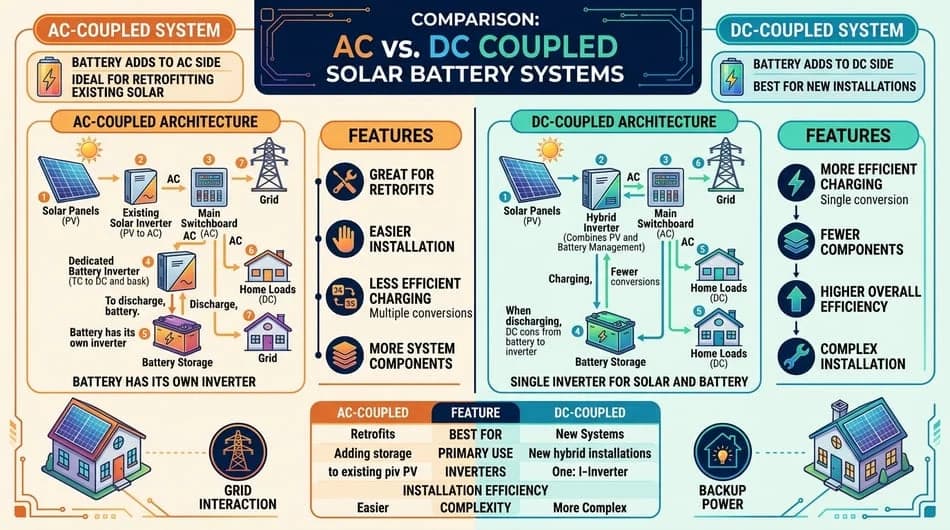
AC vs DC Coupled Solar Batteries: Which Should You Choose?
AC vs DC coupled solar batteries compared: efficiency, costs ($8K-$18K), and ins...
How Many Solar Panels Do I Need to Run Off the Grid?
Most off-grid homes need about 8 to 16 solar panels rated at 400 watts, dependin...
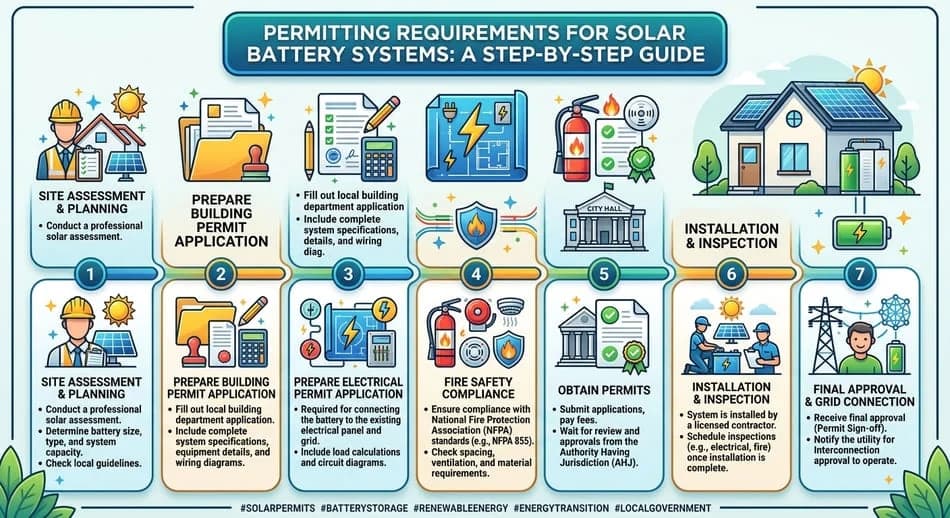
Solar Battery Permit Requirements: What You Need to Know
A solar battery usually needs local approval and a utility review before it can ...