
Yes, you can cancel a solar panel contract after installation, but the path depends on three things: when you signed, what kind of contract you signed (lease, PPA, or loan), and the law in your state. The fastest exit is the FTC Cooling-Off Rule (16 CFR Part 429), which gives you 3 business days. Texas gives 5 business days under SB 1036. After that window, your exit usually requires a buyout, a lease transfer, a breach-of-contract claim, proof of fraud or misrepresentation, or evidence that the system was never properly permitted.
Can You Cancel a Solar Panel Contract After Installation? (Short Answer)
Yes. Even after the panels are on your roof, you have real legal options. The strength of those options depends on three things in this order: (1) what kind of contract you signed, a lease, a power purchase agreement (PPA), a solar loan, or a cash purchase; each has different exit mechanics; (2) when you signed it, federal and state cooling-off periods (3 to 5 business days) only protect you for a short window after signing; and (3) what state you live in, Texas, California, and Florida each have their own statutes layered on top of federal law.
If you’re outside the cooling-off window, exit isn’t automatic. You’ll typically need one of these: a contractual buyout, a transfer of the lease to a new homeowner, a breach-of-contract claim, proof the company misrepresented savings or tax credits, or a defense most homeowners never hear about: evidence that the system was never properly permitted by your local Authority Having Jurisdiction (AHJ). This guide walks through each path with the statutes that actually apply.

First, What Kind of Solar Contract Did You Sign?
Before you do anything else, identify your contract type. Each one has a different exit playbook and different cancellation economics. Pull out the first page of your agreement and look for the words “lease,” “power purchase agreement,” “PPA,” “retail installment contract,” or “loan.” If you can’t find your contract, call your solar company and ask them to send you a copy.
| Contract Type | Who Owns the Panels? | Typical Exit Options |
| Solar Lease | Solar company | Buyout (scheduled or fair-market value), transfer to new homeowner, breach claim |
| Power Purchase Agreement (PPA) | Solar company | Buyout, transfer, breach claim, NEM misrepresentation claim (CA) |
| Solar Loan / Retail Installment Contract | You own the panels (lender holds a UCC-1 lien) | Pay off the loan, refinance, FTC Holder Rule defenses, sell the system |
| Cash Purchase | You | Return-for-refund (cooling-off only), breach claim, fraud claim |
Why this matters: A lease buyout is usually a dollar amount the leasing company quotes you. A loan can’t be “canceled” in the same way; you either pay it off, refinance it, or raise installer defenses against the bank under the FTC Holder Rule. A PPA functions like a lease but with payments tied to electricity production. Knowing which one you have determines which of the next sections actually applies to you.
Solar Permit Solutions
Need Solar Permit Plans?
Professional, permit-ready solar plan sets delivered fast. Residential and commercial projects across all 50 states.
The 5-Step Process to Cancel a Solar Contract
If you’ve decided you want out, work through these steps in order. Skipping ahead, especially stopping payments without a written cancellation, is what gets homeowners sent to collections.
Step 1: Identify your contract type and find your signed copy
See the section above. You can’t choose a path until you know whether you have a lease, PPA, or loan. If you financed the system, also check your county recorder’s office for any UCC-1 liens filed against your property; these affect refinancing and home sales.
Step 2: Calculate whether you’re still inside the cooling-off period
Count business days from the day you signed (not the day the panels were installed). Under federal law you get 3 business days. Texas gives 5. California gives 3 (5 for seniors). Florida gives 3. If your cancellation notice was missing or defective at signing, the clock may not have started; check Step 3.
Step 3: Gather your documentation
Before contacting anyone, collect the full signed contract and all addendums; financing documents; sales presentation materials and quotes; text messages or emails with the salesperson; your utility bills from before and after installation; any production reports from the monitoring system; and your AHJ permit records (request these directly from your city or county building department).
Step 4: Send a written cancellation or demand letter
Write a clear letter stating your intent to cancel, the legal basis (cite the FTC Cooling-Off Rule and your state statute), and the contract reference number. Send by certified mail with return receipt requested. Email and phone calls are not enough. Keep copies of everything.
Step 5: File complaints with the right agencies
In parallel with your letter, file complaints with the agencies that regulate solar in your state: the Texas Department of Licensing and Regulation (TDLR) if you’re in Texas; the California Contractors State License Board (CSLB) and the Department of Consumer Affairs if you’re in California; and the Florida Department of Agriculture and Consumer Services (1-800-HELP-FLA) if you’re in Florida. Also file with your state attorney general and the FTC. These complaints are free and create a documentary record that strengthens any later legal action.
Your Federal Right to Cancel: The FTC Cooling-Off Rule Explained
Federal law gives you a baseline 3-business-day right to cancel any home-solicitation contract. This is the FTC Cooling-Off Rule, codified at 16 CFR Part 429. For sales made at your home, it applies to any contract worth $25 or more (solar contracts are far over this threshold). For sales made at other temporary locations, hotel rooms, conventions, and fairgrounds, the threshold is $130 or more.
How it works: the seller must give you a written cancellation notice at the time of signing. The 3-business-day window starts the day after you sign. To cancel, you have to send a written “Notice of Cancellation” by midnight of the third business day. Certified mail is the safest method because the postmark is what matters.
The most important point most homeowners miss: if the seller failed to give you a proper written cancellation notice, the 3-day clock may never have started. In that situation, courts in multiple states have held that the rescission window stays open well past 72 hours, sometimes indefinitely, until the seller cures the defect. Pull out your contract and check whether the cancellation notice is present, accurate, and prominently formatted. If it isn’t, you may still have a federal cancellation right today.
State-by-State Cooling-Off Periods (Comparison Table)
Most states have layered their own cooling-off windows on top of the FTC rule. Here’s how the major solar markets compare:
| State | Window | Senior Citizens | Controlling Statute |
| Federal (all 50 states) | 3 business days | Same | 16 CFR Part 429 |
| Texas | 5 business days | Same (enhanced penalties) | Occ. Code Ch. 1806 (SB 1036) |
| California | 3 business days | 5 business days | Civ. Code §1689.6(a) |
| Florida | 3 business days | Same | Fla. Stat. §501.025 |
| New York | 3 business days | Same | Pers. Prop. Law §428 |
| Arizona | 3 business days | Same | A.R.S. §44-5004 |
| Nevada | 3 business days | Same | NRS 598.230 |
| New Jersey | 3 business days | Same | N.J.S.A. 17:16C-95 et seq. |
| Maryland | 3 business days | Same | Com. Law §14-302 |
Note: This table reflects in-home / door-to-door solicitation sales. Contractual cancellation windows in your specific solar lease may be longer (often 14-30 days). Always check the four corners of your agreement. Information is general; consult a licensed attorney for advice on your situation.
Can You Cancel a Solar Panel Contract After Installation in Texas?
Yes, Texas now gives you stronger cancellation rights than most states. Under Senate Bill 1036 (Texas Occupations Code Chapter 1806), effective September 1, 2025, every residential solar contract must include a 5-business-day right to cancel without penalty. The Texas Department of Licensing and Regulation (TDLR) now regulates the residential solar sales process, not just installation.
SB 1036 also makes several specific sales practices illegal: misleading statements about system performance or cost, claiming affiliation with a public utility or government agency that doesn’t exist, and soliciting at homes that display “No Soliciting” signs without an invitation. Each violation carries civil penalties of up to $2,500 per violation, rising to $10,000 per violation when the consumer is 65 or older. TDLR can also cancel the contract outright and order refunds for victims.
After the 5-day window closes, Texans still have several exit routes: breach-of-contract claims, the Texas Deceptive Trade Practices Act (DTPA), and complaints to TDLR or the Texas Attorney General. Contracts signed before September 1, 2025 that omitted the federally required FTC cancellation notice may have a rescission window that never properly started. These are worth a second look with an attorney. If you’re researching solar in Texas, our Austin solar permitting guide covers the broader regulatory landscape.
Can You Cancel a Solar Panel Contract After Installation in California?
Yes. California gives homeowners some of the most layered solar-cancellation protections in the country. Under California Civil Code §1689.6(a) (the Home Solicitation Sales Act), you have 3 business days to cancel and 5 business days if you are a senior citizen. The required form of the cancellation notice is set out in §1689.7. The California Department of Consumer Affairs Legal Guide K-9 lays out the full procedure.
Two California-specific protections are worth knowing about: (1) the seller cannot begin work until the cancellation window has expired; if they did, you may have extended cancellation rights, and they may be required to restore your property at their own expense; and (2) §1689.7 requires the cancellation notice to be written in the same language principally used in the oral sales presentation, so if you were sold to in Spanish but the notice was English-only, the notice may be defective.
After the cooling-off window, California homeowners can still cancel by invoking the Consumer Legal Remedies Act (CLRA, Civ. Code §1750 et seq.), the unfair competition law (Bus. & Prof. Code §17200), or by alleging fraud, misrepresentation, or unconscionability. NEM 3.0 misrepresentation, a salesperson promising “bill elimination” or specific dollar savings that NEM 3.0 economics made impossible, has become a particularly strong cancellation argument since April 2023. You can also file a complaint with the Contractors State License Board (CSLB).
Note on California SB 784: Senate Bill 784 would extend these cancellation windows to 5 business days (and 7 for seniors) for contracts entered on or after January 1, 2026. As of May 2026, SB 784 is pending legislation; it was held in the California Assembly Appropriations Committee in August 2025 and has not been signed into law. Confirm current status on the California Legislative Information bill page before relying on its extended windows.
For broader California solar context, our California solar incentives guide walks through the state-specific economics.
Can You Cancel a Solar Panel Contract After Installation in Florida?
Yes. Florida law gives you a 3-business-day right to cancel under Florida Statute §501.025 (Home Solicitation Sales Act) when a solar contract over $25 was signed at your home or any location that isn’t the seller’s permanent place of business. The Florida Attorney General’s office provides a plain-language overview of the rule.
Critical detail: the notice of your right to cancel must appear on every note or evidence of indebtedness given as part of the sale. If your loan documents don’t include the cancellation notice or include it in fine print rather than a prominent format, the 3-day clock may never have validly started, and your rescission rights may still be open.
After the cooling-off window, Florida’s primary post-installation tool is the Deceptive and Unfair Trade Practices Act (FDUTPA, Chapter 501 Part II, §501.204). FDUTPA prohibits unfair, deceptive, or unconscionable practices in trade or commerce and applies regardless of whether the panels are already on your roof. Common FDUTPA grounds in solar cases include false savings projections, misrepresented federal tax credits, undisclosed UCC liens, and improper permitting.
On permitting: under Florida HB 683 (signed June 13, 2025, effective July 1, 2025), Florida tightened solar permit requirements. Local governments now have 5 business days to approve residential solar permits. If your system was installed without the required AHJ building permit or with permits that were never inspected and closed out, you have a strong public-policy argument that the underlying contract is unenforceable. We cover this in detail in our Florida HB 683 permitting article. File complaints with the Florida Department of Agriculture and Consumer Services (1-800-HELP-FLA) or the Office of the Attorney General.
Legal Grounds to Cancel After the Cooling-Off Window Closes
Even months or years after installation, several legal grounds can support cancellation. The strength of each depends on the documentation you can produce, which is why Step 3 of the 5-step process matters so much.
- Misrepresentation or fraudulent inducement. A salesperson made specific factual claims about savings, tax credits, system production, or utility affiliation that turned out to be false. Verbal promises during the sale, captured in texts or emails, often count.
- Material breach of contract. The installer failed to perform, the system never turned on, performance falls dramatically short of contracted output, warranty work was refused, and completion deadlines were missed. Document each breach with dates.
- Defective FTC or state cancellation notice. If the required cancellation notice was missing, illegible, in the wrong language, or in the wrong format, the rescission window may not have started, meaning you can still cancel under the original cooling-off rule today.
- Forged or unauthorized signatures. Some solar sales involve electronic signatures captured on a tablet the salesperson controlled. If your signature was applied to documents you never saw or to addendums you didn’t agree to, the contract may be unenforceable.
- Undisclosed material terms. Liens, escalator clauses, monitoring fees, or transferability restrictions that weren’t disclosed at signing can void the contract or specific provisions of it.
- Contracts so one-sided that they shock the conscience, particularly when paired with high-pressure tactics or vulnerable consumers, can be set aside by courts.
- Improper permitting. Covered in detail in the section below, a structural defense unique to solar.
None of these grounds guarantees cancellation on its own. A demand letter that cites the specific statutes, attaches your evidence, and sets a deadline for response often resolves the dispute without litigation. If the installer refuses to engage, the next step is usually a solar fraud attorney; many work on contingency in clear cases.
What If Your Solar Installer Went Out of Business?
This is one of the largest unaddressed pain points in residential solar right now. SunPower filed for bankruptcy in August 2024. Sunnova Energy filed for Chapter 11 on June 9, 2025, and the bankruptcy court confirmed its plan on November 12, 2025, with substantially all assets sold to Solaris Assets LLC and operations transitioned to SunStrong Management. Hundreds of thousands of homeowners are now in “orphaned” systems: the panels are on the roof, the financing payments continue, but the original installer no longer exists in the form that signed the contract.
The key federal tool here is the FTC Holder Rule (16 CFR Part 433). Every consumer credit contract is required by law to include this notice:
ANY HOLDER OF THIS CONSUMER CREDIT CONTRACT IS SUBJECT TO ALL CLAIMS AND DEFENSES WHICH THE DEBTOR COULD ASSERT AGAINST THE SELLER OF GOODS OR SERVICES OBTAINED PURSUANT HERETO OR WITH THE PROCEEDS HEREOF. RECOVERY HEREUNDER BY THE DEBTOR SHALL NOT EXCEED AMOUNTS PAID BY THE DEBTOR HEREUNDER.
What this means in plain English: if your installer made fraudulent or deceptive claims, broke the contract, or never finished the work, you can raise those same defenses against the bank that holds your financing, even if the original installer is bankrupt and gone. Important caveat: under the Holder Rule alone, your recovery is capped at the amounts you have already paid under the contract. The rule can stop ongoing payments and recover money paid, but it does not by itself force the lender to remove the panels.
Practical steps if your installer is gone:
- Identify who currently services your system; there’s usually a successor entity. For Sunnova, that’s SunStrong Management.
- Pull your original contract and look for the FTC Holder Rule notice. If it’s missing, that itself is a potential FDUTPA / UDAP violation.
- Document every misrepresentation, breach, or warranty failure with dates, names, and evidence.
- Send a written demand letter to the financing company invoking the Holder Rule and listing your defenses.
- File complaints with your state attorney general, the FTC, and the bankruptcy court (the Sunnova bankruptcy in the Southern District of Texas had a separate process for consumer claims; deadlines have largely passed, but related litigation continues).
Was Your System Properly Permitted? The Hidden Cancellation Argument
This is the defense most homeowners, and most attorneys, overlook. Every solar PV system in the United States requires a building permit from the local Authority Having Jurisdiction (AHJ) and, for grid-tied systems, a utility interconnection approval. A solar installation completed without proper permits, with forged or backdated plans, or with a permit that was never closed out by final inspection is a code violation in virtually every jurisdiction. Depending on your state, it can also be a violation of consumer protection statutes, supporting a FDUTPA claim in Florida, a UDAP claim in Texas under the DTPA, or a §17200 unfair competition claim in California.
Why this matters for cancellation: courts in multiple states have held that contracts requiring illegal performance, or where the performance was illegal as rendered, can be unenforceable as a matter of public policy. Even where they don’t void the contract outright, evidence of unpermitted work is powerful leverage in negotiation and powerful proof in a FDUTPA / UDAP case.
How to check whether your system was properly permitted:
- Identify your AHJ, usually your city or county building department.
- Submit a public-records request for all permits and inspection reports associated with your property address. Most AHJs respond within 10-20 business days.
- Compare the permitted scope (panel count, inverter model, electrical interconnection method, rapid shutdown plan) against what was actually installed on your roof.
- Verify that the permit was closed out with a final inspection sign-off. “Open” or “expired” permits without final inspection are a red flag.
- Confirm Permission to Operate (PTO) was issued by your utility. No PTO means the system isn’t legally authorized to export power to the grid.
If the permit records don’t match the as-built system, or if no permit was ever pulled, you have a documented public-policy and consumer-protection argument. Many solar permit denials trace back to design mistakes that should have been caught before installation. For broader context on what proper permitting looks like, see our complete solar permit guide and our overview of PE-stamp requirements by state.
SPS Permit Review: If you suspect your installation wasn’t properly permitted, or if you need an expert review of the as-built versus as-permitted plans, contact our team. We’ve reviewed permit records across all 50 states and can identify code violations that support a cancellation argument.
How Much Does It Cost to Get Out of a Solar Contract?
Costs vary widely by exit path. Here’s what to expect:
| Exit Path | Typical Cost Range | Notes |
| State AG / TDLR / CSLB complaint | Free | First step. Creates documentary record. No attorney required. |
| Demand letter (self-drafted) | $0 (just postage) | Often resolves the dispute without escalation. |
| Demand letter (attorney-drafted) | $300 to $1,500 | Strong signal to installer. Many attorneys offer flat-fee letters. |
| Lease buyout (scheduled) | Set price in contract | Often below market value; check your contract for buyout intervals. |
| Lease buyout (fair market value) | $8,000 to $25,000+ | Depends on system size and age. Get an independent appraisal. |
| Solar fraud attorney (litigation) | Contingency (no upfront) or hourly $300+ | Many take strong cases on contingency. Initial consults are often free. |
| Removal of panels (if contract canceled) | $1,500 to $5,000+ | Reroofing costs may add to this. |
A practical sequence that minimizes cost: start with free agency complaints, then a self-drafted demand letter, then an attorney consultation. Only consider litigation if the installer refuses to engage and the dollar amount justifies it. Most solar contract disputes resolve before trial.
How to Write a Cancellation Letter
A well-drafted cancellation letter is often the entire dispute. It signals that you understand your rights, creates a paper trail, and gives the installer a clear off-ramp. Keep it short, factual, and citation-rich.
Send it by certified mail, return receipt requested. Email it as well. Keep copies of everything, including the postmarked envelope.
Required elements:
- Your full legal name and the property address where the system was installed
- Date the contract was signed and contract/account number
- The legal basis for cancellation: cite the specific statute (e.g., “pursuant to 16 CFR Part 429 and California Civil Code §1689.6”)
- A clear, unambiguous statement that you are canceling the contract
- A demand for any specific remedies (refund of down payment, removal of panels, lien release)
- A deadline for response (10-14 days is typical)
- Your signature and date
Sample opening paragraph: “I am writing to cancel the residential solar agreement referenced above (Contract # _____) pursuant to my rights under [16 CFR Part 429 / Tex. Occ. Code Ch. 1806 / Cal. Civ. Code §1689.6 / Fla. Stat. §501.025]. This contract was solicited at my residence on [date], and I am exercising my right to cancel within the applicable cooling-off period. Please confirm receipt and provide written confirmation of cancellation, refund of any amounts paid, and removal of any UCC-1 liens within 14 calendar days.”
Get Your Permit Records Reviewed Before You Negotiate
If you’re preparing to challenge a solar contract, one of the strongest pieces of evidence you can bring to the table is documentation that the system was never properly permitted or that the as-built installation doesn’t match the as-permitted plans. That’s a defense most installers don’t expect, and one most attorneys don’t know to look for.
Solar Permit Solutions reviews permit records, plan sets, and as-built configurations across all 50 states. If you suspect your installation has permit defects, contact our team for a permit review, or submit your project details here. We can identify the code violations that strengthen your cancellation argument.
Disclaimer: This article is general information and does not constitute legal advice. Solar Permit Solutions is a permit design firm, not a law firm. For advice specific to your situation, consult a licensed attorney in your state.
Frequently Asked Questions
Can I cancel my solar contract before installation?
Yes, and pre-installation cancellation is the easiest exit you’ll have. Under the FTC’s Cooling-Off Rule (16 CFR Part 429), you have 3 business days from signing to cancel any home-solicitation contract. Texas extends this to 5 business days under SB 1036. California gives 3 days, or 5 for seniors, under Civ. Code §1689.6. Many solar leases also include an additional contractual cancellation window of 14 to 30 days that runs after the legal cooling-off period ends. Send a written cancellation notice by certified mail with return receipt.
Can you cancel a solar panel contract after installation in Texas?
Yes. Texas Occupations Code Chapter 1806 (SB 1036), effective September 1, 2025, gives every residential solar contract a 5-business-day right to cancel without penalty. After that window, you can exit through breach-of-contract claims, the Texas Deceptive Trade Practices Act (DTPA), or by reporting violations to TDLR, which can impose penalties of $2,500 per violation, rising to $10,000 when the consumer is 65 or older.
Can you cancel a solar panel contract after installation in California?
Yes. California Civil Code §1689.6(a) gives you 3 business days to cancel, 5 if you’re a senior citizen. After that, the Consumer Legal Remedies Act, fraud claims, and NEM 3.0 misrepresentation arguments remain available. The Contractors State License Board handles installer complaints. Senate Bill 784 would extend these windows to 5 and 7 days for contracts entered after January 1, 2026, but as of May 2026, it remains pending and has not been signed into law.
Can you cancel a solar panel contract after installation in Florida?
Yes. Florida Statute §501.025 gives you 3 business days to cancel any home-solicitation sale over $25. If the required cancellation notice wasn’t included on your loan documents, the window may never have started. After that, FDUTPA (§501.204) is the primary post-installation cancellation tool, covering false savings claims, misrepresented tax credits, and improper permitting. File complaints with Florida DACS (1-800-HELP-FLA) or the Attorney General.
How do I get out of a solar lease?
Four main paths: (1) buyout, either the scheduled price in your contract or the fair market value; (2) transfer to a new homeowner when you sell your house; (3) breach of contract claim if the installer failed to perform; or (4) a fraud/misrepresentation claim if the original sale was deceptive. Outright cancellation without one of these grounds is difficult because leases are designed as 10- to 25-year commitments.
What happens if I stop paying my solar lease?
Don’t. Stopping payments without a legal strategy doesn’t cancel the contract; it puts you in default, can damage your credit, and may trigger collections, a UCC lien claim, or foreclosure depending on how your contract is structured. Always send a written cancellation or dispute letter before stopping payments, and consult an attorney about whether you can lawfully escrow payments while a dispute is pending.
Can I cancel if the solar company has gone out of business?
Probably yes, in part. The FTC Holder Rule (16 CFR Part 433) lets you raise installer defenses against the bank that holds your financing, even if the installer is bankrupt. Recovery under the Holder Rule alone is capped at amounts you’ve actually paid. SunPower’s August 2024 bankruptcy and Sunnova’s June 2025 Chapter 11 (plan confirmed November 12, 2025) created hundreds of thousands of orphaned systems. Document everything and file complaints with the FTC, your state AG, and the relevant bankruptcy court.
Does a solar lease transfer when I sell my house?
In most cases, yes, the new homeowner takes over the lease, but they have to qualify with the leasing company (typically a credit check). Some leases are tied to the property title, which can complicate home sales. Talk to your leasing company early in the sale process and disclose the lease to potential buyers upfront.
Can the salesperson promise verbally that I can cancel any time?
No, verbal promises that contradict the written contract generally aren’t enforceable. That said, verbal misrepresentations during the sale are themselves grounds for cancellation under state UDAP statutes (DTPA in Texas, CLRA in California, FDUTPA in Florida). If you have texts, emails, or quote sheets backing up what was promised, save them; they’re evidence.
How much does it cost to buy out a solar lease?
It varies dramatically. Scheduled buyouts in your contract often kick in at year 5 or year 10 at predetermined prices below market. Fair-market-value buyouts typically run $8,000-$25,000+ depending on system size, age, and condition. Some contracts also include a buyout markup that exceeds the remaining lease payments; read the buyout calculation language carefully. Get an independent appraisal before agreeing to any buyout figure the leasing company quotes you.
Need Solar Permit Plans?
Professional, permit-ready solar plan sets delivered fast. Residential and commercial projects across all 50 states.

SPS Editorial Team
Solar Permit Solutions
Solar Permit Solutions provides professional solar permit design services for residential, commercial, and off-grid installations across all 50 states. Our team ensures permit-ready plan sets delivered fast.
Related Articles
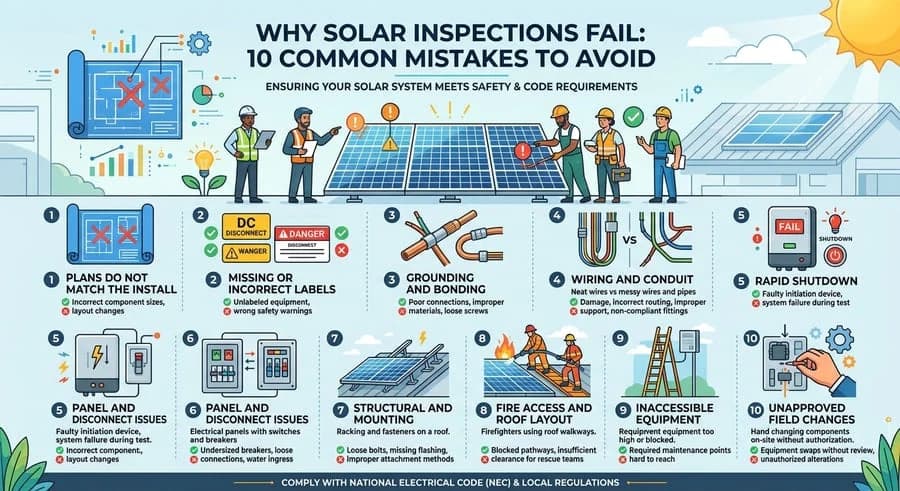
Why Solar Inspections Fail: 10 Common Mistakes to Avoid
Discover the 9 critical reasons solar inspections fail and how to avoid costly m...
Solar Grounding And Bonding: How To Pass Inspection Every Time
Learn how to pass solar grounding and bonding inspections every time. Avoid comm...
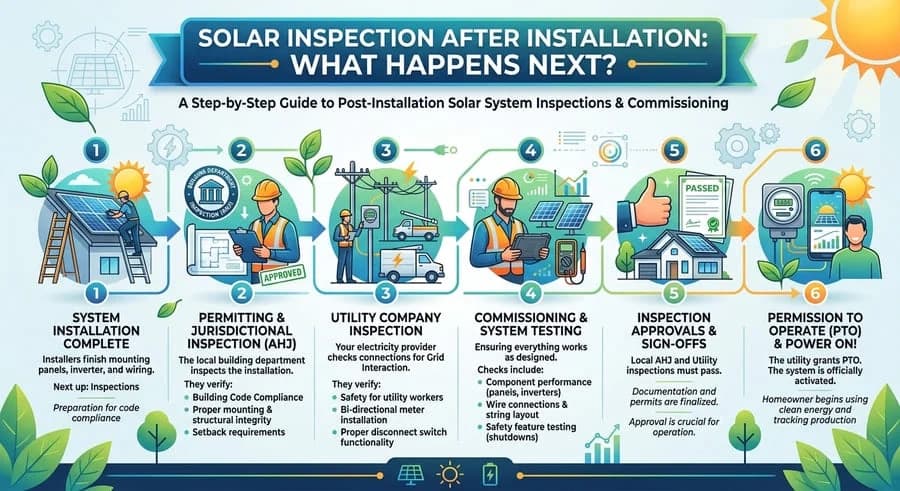
Solar Inspection After Installation: What Happens Next?
Learn how to pass your solar inspection by following essential tips for obtainin...