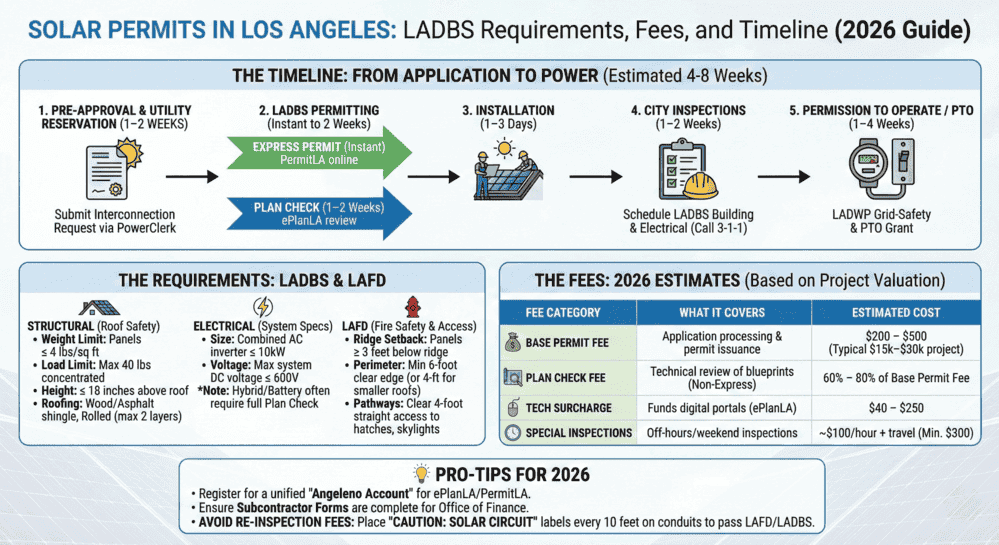
Quick Answer: Solar permits in Los Angeles are issued by LADBS and require LAFD fire department approval. Residential rooftop systems under 10 kW qualify for same-day express permits through PermitLA. Larger systems require plan check through ePlanLA (2 to 4 weeks). LADWP handles interconnection and still offers true net metering at retail rates. Residential permit fees are capped under AB 1124 at $450 for systems up to 15 kW.
Los Angeles is the largest solar market in the United States, and its permitting process reflects both the scale of that demand and the complexity of building in a major metro. Unlike most cities where a single building department handles everything, LA solar installations require coordination between LADBS for construction permits, LAFD for fire safety clearance, and LADWP for utility interconnection.
This guide covers every step of the LA solar permitting process, from determining which permit pathway applies to your project through final PTO requirements and timeline with LADWP. Whether you are an installer navigating AHJ requirements for the first time in Los Angeles or a homeowner trying to understand what happens after you sign a contract, this is the reference you need.
LADBS: Los Angeles Solar Permitting Authority
The Los Angeles Department of Building and Safety (LADBS) is the authority having jurisdiction (AHJ) for solar permits in the City of Los Angeles. LADBS reviews construction plans, issues permits, and performs inspections for all solar PV and energy storage installations. The department operates entirely online through two platforms: PermitLA for express permits and ePlanLA for projects requiring plan check.
Both platforms require an Angeleno account, which is the City of Los Angeles single sign-on for municipal services. Contractors and homeowners should register for an Angeleno account before beginning the permit application process.
It is important to distinguish between the City of Los Angeles (served by LADBS) and unincorporated Los Angeles County or other incorporated cities within the county. Jurisdictions like Pasadena, Long Beach, Glendale, and Santa Clarita have their own building departments. Our guide to solar permitting in California covers statewide requirements that apply regardless of jurisdiction.

Two Permit Pathways: Express vs. Plan Check
LADBS offers two distinct pathways for solar PV permits. The pathway your project follows depends on system size, complexity, and the characteristics of the host building.
Express Permits (Same-Day, No Plan Review)
Express solar PV permits are available through PermitLA for residential rooftop systems that meet all of the following criteria. Note that online express permits are currently available for licensed contractors only (per LADBS Information Bulletin P/GI 2026-003, effective January 1, 2026):
| Requirement | Express Permit Threshold |
| Building Type | Rooftop system on a one- or two-family dwelling |
| System Size | 10 kW AC or less |
| AC Power System | 120/240V single phase |
| Service Panel Rating | 225 amps or less |
| Inverter Configuration | Up to 2 string inverters, 4 strings + 1 combiner per inverter, or microinverters with up to 4 branch circuits |
| AC Overcurrent Protection | No GFCI or AFCI overcurrent devices in AC inverter output |
| DC Arc-Fault Protection | Required per NEC Article 690.11 |
| System Exclusions | Not hybrid, BIPV, or PV roll roofing |
LADBS also offers an express permit for combined PV and energy storage systems (ESS) under Section V-16. The PV+ESS pathway has additional requirements including crystalline or multi-crystalline modules, four or fewer strings, AC-coupled ESS rated at 10 kW AC or less, NEC Article 705.12(B)(2)(3) compliance, and LAFD Fire Plan Check approval for the battery.
If your system meets the PV-only criteria above, you can apply through PermitLA and receive same-day permit issuance without a plan review. This express pathway makes LA one of the fastest cities for solar permits in the state.
Standard and Regular Plan Check
Systems that do not qualify for express permits must go through plan check via ePlanLA. This includes systems larger than 10 kW, commercial installations, ground-mounted arrays, and systems requiring service panel upgrades beyond 225 amps. Plans must include complete roof layouts with dimensions, single-line electrical diagrams, structural calculations where applicable, and equipment specifications for all listed components.
LAFD Fire Safety Requirements
Every solar PV installation in Los Angeles requires LAFD approval before LADBS will issue the electrical permit.
Residential Access Pathways and Setbacks
For one- and two-family dwellings, LAFD requires the following fire access provisions, which directly affect how many panels can fit on your roof:
| Requirement | Specification |
| Hip Roof Access | One 3-foot pathway from eave to ridge per slope with panels, at bearing wall |
| Single-Ridge Roof Access | Two 3-foot pathways from eave to ridge per slope with panels; excludes eave overhang |
| Ridge Setback (Ventilation) | Panels no higher than 3 feet below ridge (2-foot exception with approved alternative) |
| Dead-End Limit | No dead ends > 25 feet; travel distance to next pathway must not exceed 150 feet |
| Array Dimension Limit | No single array exceeding 150 by 150 feet in either axis |
| DC Wiring in Enclosed Spaces | Must be in metallic conduit or raceways |
California Residential Code Section R324.6 adds supplemental requirements including at least two 36-inch pathways on separate roof planes per building, one on the street side, and an exemption for roofs with slopes of 2:12 or less. These combine with LAFD-specific rules above. See also our guide on NEC 2023 Article 690 requirements. Rapid shutdown compliance under NEC 690.12 is mandatory for all new installations.
Solar Permit Solutions
Skip the Permit Headaches
We design plan sets that pass inspection the first time. Code-compliant, PE-stamped, accepted by AHJs nationwide.
LADWP Interconnection: Net Metering at Retail Rates
One of the biggest advantages for Los Angeles solar customers is that LADWP, as a publicly owned municipal utility, still offers true net energy metering (NEM) at retail rates. This is a critical distinction from the NEM 3.0 (Net Billing Tariff) that took effect in April 2023 for California’s three investor-owned utilities: PG&E, SCE, and SDG&E.
LADWP residential rates currently range from approximately 23 to 37 cents per kWh depending on tier, zone, and season, with further rate increases effective January 2026. By comparison, NEM 3.0 export credits for IOU customers average roughly 8 cents per kWh, making LADWP’s program approximately 3 to 4 times more valuable for solar customers.
Interconnection Types
LADWP categorizes grid interconnection into four tiers:
| Type | System Size | Typical Application |
| Type 1 | Up to 30 kW (single meter) | Standard residential PV and/or battery storage |
| Type 2 | Up to 30 kW (multi-meter) | Multi-family, service upgrades, non-NEM cogeneration |
| Type 3 | 30 kW to 1 MW | Large commercial, tract home projects |
| Type 4 | Over 1 MW | Utility-scale distributed generation |
Most residential installations follow Type 1. Customers apply through LADWP’s online portal. Systems under 10 kW may qualify for LADWP’s Fast Track process. The interconnection agreement must be executed before the system can operate.
Permit Fees: California AB 1124 Caps
California AB 1124 caps the total permitting fees that jurisdictions can charge for solar installations. These caps apply to all cities in the state, including Los Angeles:
| System Type | Fee Cap (AB 1124) | Typical LADBS Range |
| Residential (up to 15 kW) | $450 maximum | $200 to $450 |
| Residential (above 15 kW) | $450 + $15/kW above 15 kW | Varies by system size |
| Commercial (up to 50 kW) | $1,000 maximum | $500 to $1,000 |
| Commercial (51-250 kW) | $1,000 + $7/kW (51-250 kW) | Varies by system size |
| Commercial (above 250 kW) | Previous + $5/kW above 250 kW | Varies by system size |
These caps were extended through January 1, 2034 by AB 1132. Additional costs may include LAFD plan review fees and electrical panel upgrade permits. The DSIRE database tracks state and local incentive programs. See also solar permit costs for strategies to reduce fees.
Timeline: From Application to Permission to Operate
The total timeline from permit application to LADWP Permission to Operate depends on which pathway your project follows:
| Phase | Express Permit | Plan Check |
| Permit Application and Approval | Same day | 2 to 4 weeks |
| Physical Installation | 1 to 3 days | 1 to 5 days |
| LADBS Final Inspection | 1 to 2 weeks | 1 to 3 weeks |
| LADWP Meter and Interconnection | 2 to 4 weeks | 3 to 6 weeks |
| Total Estimated Timeline | 4 to 7 weeks | 7 to 14 weeks |
NREL’s permitting research confirms that jurisdictions with online portals like LA’s PermitLA achieve faster approval times. Permit timelines vary dramatically by state, and even within California, LA’s process is more complex due to dual LADBS/LAFD approval.
2026 Federal Tax Credit Changes Affecting LA Solar
The One Big Beautiful Bill Act (OBBBA), signed July 4, 2025, terminated the Section 25D residential credit effective December 31, 2025. Homeowners purchasing solar outright in 2026 do not receive a federal tax credit. However, Section 48E remains available for third-party ownership (TPO) solar arrangements including leases and power purchase agreements, where the commercial entity that owns the system can claim the credit and pass savings to the homeowner through lower monthly payments.
For details on transition rules, see our solar tax credit deadline and IRS documentation requirements guide. The IRS residential clean energy credit page has the latest guidance. California’s property tax exclusion for solar energy systems remains in effect regardless of federal changes.

Key Documents for Your LA Solar Permit Application
| Document | Details |
| Site Plan / Roof Layout | Dimensioned drawing showing panel placement, setbacks, pathways, and equipment locations |
| Single-Line Electrical Diagram | Shows PV modules, inverters, disconnects, meter, panel, and all wiring connections |
| Equipment Specifications | UL-listed data sheets for modules, inverters, racking, and rapid shutdown devices |
| Structural Calculations | Required when system exceeds roof live load capacity or for non-standard mounting |
| LAFD Fire Access Plan | Shows pathways, ridge setbacks, array dimensions, and DC conduit routing per LAFD requirements |
| LADWP Interconnection Application | Submitted separately to LADWP after LADBS permit issuance for NEM enrollment |
The building permit exemption for structural support applies when the system is roof-mounted, does not exceed the existing building height, and the total weight does not exceed the roof’s designed live load capacity. When these conditions are not met, a separate building permit with structural engineering calculations is required in addition to the electrical permit. For detailed guidance on preparing these documents, consult your permit design provider or LADBS publications library for the latest submittal checklists.
Why LA’s Permitting Complexity Creates Opportunity
Los Angeles’s multi-agency approval process and LAFD fire safety requirements make it one of the more demanding solar permitting environments in the country. But that complexity also creates a significant advantage for installers and homeowners who navigate it correctly.
LADWP’s true net metering program, combined with residential electricity rates that have increased by approximately 12% to 15% year over year, means the financial return on a properly permitted LA solar installation is among the best in the nation. Data from the Solar Energy Industries Association (SEIA) consistently ranks California as a top solar market, and LADWP’s territory is one of the strongest segments within the state. The EIA Electric Power Monthly data confirms that California electricity rates continue climbing, and LADWP’s recent rate adjustments for 2026 have only accelerated that trend.
Homeowners exploring residential solar can start with our residential solar design services, which include complete LADBS-ready permit packages with LAFD-compliant fire access plans. For larger installations, our commercial solar design team handles the full plan check process including structural engineering and utility coordination. Our understanding of the average solar permit timeline by state helps us set realistic expectations and avoid the delays that plague less experienced teams.
Conclusion
Getting a solar permit in Los Angeles requires coordination across three agencies, but the process is straightforward once you understand which pathway applies to your project. Systems under 10 kW on one- or two-family dwellings can move through the express permit route and reach Permission to Operate in as little as four to seven weeks. Larger or more complex systems take longer through plan check, but the financial case remains strong thanks to LADWP’s retail-rate net metering and rising electricity costs.
The key steps are clear: confirm your system qualifies for express or plan check, prepare LAFD-compliant fire access plans, submit through PermitLA or ePlanLA, pass inspection, and complete LADWP interconnection. Knowing the AB 1124 fee caps, the LAFD pathway requirements for your specific roof type, and the 2026 tax credit landscape puts you ahead of the majority of applicants who encounter avoidable delays.
Whether you are an installer expanding into the LA market or a homeowner evaluating proposals, this guide gives you the reference points to keep your project on track. For permit-ready design packages that account for every LADBS, LAFD, and LADWP requirement covered here, Solar Permit Solutions handles the complexity so you can focus on the installation.
Frequently Asked Questions
Skip the Permit Headaches
We design plan sets that pass inspection the first time. Code-compliant, PE-stamped, accepted by AHJs nationwide.
Frequently Asked Questions
Residential solar permit fees are capped under AB 1124 at $450 plus $15 per kilowatt for each kilowatt above 15 kW. A standard 6 to 10 kW system typically costs $200 to $450 through LADBS. These caps were extended through January 1, 2034 by AB 1132.
Express permits can be issued same-day via PermitLA for qualifying systems under 10 kW. Standard plan check takes 2 to 4 weeks. The full timeline from application to LADWP Permission to Operate typically spans 45 to 90 days.
No. NEM 3.0 only applies to California's three investor-owned utilities (PG&E, SCE, SDG&E). LADWP maintains its own net metering program crediting excess generation at full retail rates, making solar significantly more valuable for LADWP customers.
LAFD requirements vary by roof type. Hip roofs need one 3-foot pathway per slope with panels. Single-ridge roofs need two 3-foot pathways per slope. Panels must be no higher than 3 feet below the ridge. Arrays cannot exceed 150 by 150 feet. California Residential Code R324.6 adds supplemental requirements including two 36-inch pathways on separate roof planes and an exemption for roofs with slopes of 2:12 or less.
Express permits are available online for licensed contractors installing residential rooftop PV on one- or two-family dwellings: 10 kW or less, 225-amp panel or less, 120/240V single-phase, up to 2 string inverters with 4 strings each (or microinverters, 4 branch circuits), no GFCI/AFCI in inverter AC output. Issued same-day without plan review. Systems exceeding any threshold require plan check through ePlanLA (2 to 4 weeks).
The OBBBA terminated the Section 25D residential credit effective December 31, 2025. Homeowners purchasing solar outright in 2026 do not receive a federal tax credit. However, TPO arrangements (leases and PPAs) can access Section 48E. California's property tax exclusion for solar remains in effect.

SPS Editorial Team
Solar Permit Solutions
Solar Permit Solutions provides professional solar permit design services for residential, commercial, and off-grid installations across all 50 states. Our team ensures permit-ready plan sets delivered fast.
Related Articles
Solar Grounding And Bonding: How To Pass Inspection Every Time
Learn how to pass solar grounding and bonding inspections every time. Avoid comm...
Solar Inspection After Installation: What Happens Next?
Learn how to pass your solar inspection by following essential tips for obtainin...
Solar Permit Services in Austin, TX
Solar permits in Austin center on an Auxiliary Power Electrical Permit for any s...