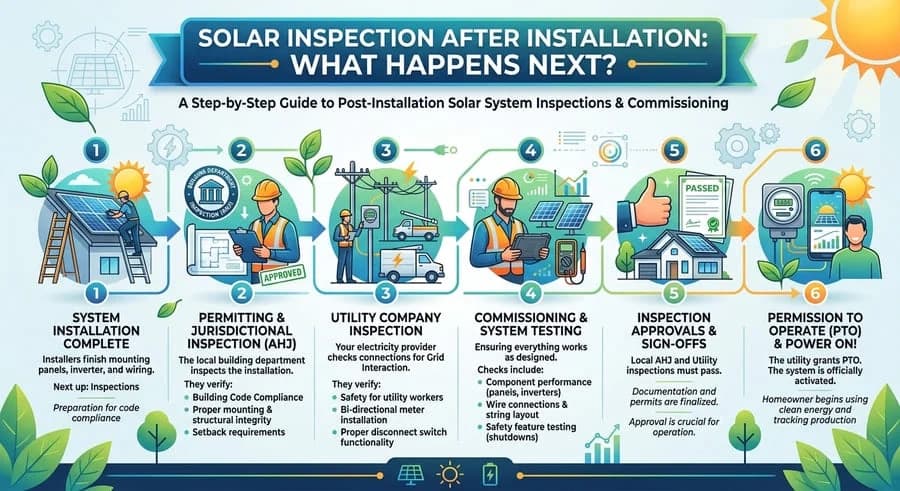
After solar installation, most grid-connected systems must pass an inspection by the local authority having jurisdiction (AHJ) and then clear the utility’s interconnection requirements before the utility grants Permission to Operate (PTO). Passing inspection does not by itself mean you can turn the system on.
Your solar panels are installed. What happens now? For most grid-connected projects, installation is not the final step. The completed system may need to be inspected by the AHJ to verify that it complies with applicable requirements and, where applicable, matches the approved permit plans. After the required inspection is approved, the project may still need to complete utility interconnection before the system receives Permission to Operate (PTO).
A typical process looks like this:
Solar installation completed, then final inspection scheduled, then AHJ inspection, then corrections if needed, then inspection approval, then utility and interconnection review, then PTO.
The exact process varies by city, county, state, AHJ, and utility. Some projects require multiple inspections, while others use a single final inspection. Some jurisdictions and utilities also offer remote or virtual inspection options.
This guide explains what happens during a solar inspection after installation, what inspectors commonly check, how to prepare, what happens if an inspection fails, and what comes next before PTO.
Solar Inspection After Installation: Quick Reference
|
Stage |
Who Handles It |
What Happens |
Result |
|
Final inspection |
AHJ (building or electrical department) |
The inspector compares the completed system with the approved plans and applicable code requirements. |
Approval, or a list of correction items |
|
Corrections and reinspection |
Installer or responsible party |
Fix the cited items, document the changes, and request a reinspection if required. |
Final approval from the AHJ |
What Is a Solar Inspection After Installation?
A solar inspection is a review of a completed solar PV installation to determine whether it meets the applicable requirements for the project. Depending on the jurisdiction and project, an inspection may involve building, electrical, structural, fire-safety, or other applicable requirements.
The inspector may compare the completed installation with:
- Approved permit plans
- Electrical diagrams
- Structural details
- Equipment specifications
- Applicable code requirements
- Local AHJ requirements
- Other project documentation
The most important thing to understand is that the inspection process is not identical everywhere. The AHJ determines the inspection requirements for the project, and utilities may have separate interconnection requirements. Aurora Solar likewise notes that inspection requirements are determined by the AHJ and/or utility and that the installed system should follow the permitted design.
That variation is why timelines differ so widely. Research from the National Laboratory of the Rockies (formerly NREL) on permitting, inspection, and interconnection timelines notes that review and approval across thousands of jurisdictions and utilities can sometimes add weeks or months to an installation.
What Happens After Solar Installation?
Once the physical installation is complete, the project generally moves into the inspection and approval stage. While the exact process varies, the following sequence is common.
1. The Solar Installation Is Completed
The installer completes the solar PV system according to the approved design. This may include solar modules, inverters, racking, wiring, conduit, disconnects, rapid shutdown equipment, battery storage if applicable, labels and placards, and structural attachments.
Before scheduling an inspection, compare the completed installation against the approved plans. This matters most if anything changed during construction, for example:
- Module quantity or array layout changed
- Inverter changed
- Battery was added or removed
- Equipment location changed
- Electrical configuration or structural attachments changed
A field change does not automatically mean the project will fail inspection, but it may require revised plans or AHJ approval depending on the jurisdiction and the type of change.
2. The Required Inspection Is Scheduled
The responsible party schedules the required inspection with the applicable AHJ. Some AHJs use online scheduling systems, while others use different methods. The project may also have separate utility requirements.
3. The Inspector Reviews the Installation
During the inspection, the inspector evaluates the completed system against the applicable requirements. This can include electrical, structural, equipment, labeling, access, and other project-specific items.
4. The Inspection Is Approved, or Corrections Are Required
If the installation satisfies the applicable requirements, the inspection can be approved. If the inspector identifies problems, correction items may be issued.
5. Corrections Are Completed
The installer or responsible party addresses the identified issues. Depending on the correction, this may involve:
- Physical changes to the installation
- Adding or replacing labels
- Correcting wiring
- Addressing grounding or bonding
- Providing additional documentation
- Revising plans
- Obtaining additional AHJ approval
6. A Reinspection May Be Required
If corrections were required, the AHJ may require a reinspection before the project receives final approval.
7. The Project Moves to Utility Interconnection
Once the required inspection and approval steps are complete, the project may continue through the utility’s interconnection process. This is where the distinction between inspection approval and PTO becomes important.
Solar Permit Solutions
Skip the Permit Headaches
We design plan sets that pass inspection the first time. Code-compliant, PE-stamped, accepted by AHJs nationwide.
Solar Inspection vs. Permission to Operate
Passing a solar inspection does not necessarily mean the system immediately has permission to operate on the utility grid. These are separate stages, and the U.S. Department of Energy describes permitting and inspection as processes that need to happen before a solar array can receive permission to interconnect to the grid.
Solar inspection
The AHJ reviews the completed installation for compliance with the applicable requirements.
Utility interconnection
The utility reviews the project according to its interconnection requirements.
Permission to Operate
Once the utility’s requirements are satisfied, the utility can issue PTO where applicable.
A simplified sequence is: installation, AHJ inspection, inspection approval, utility and interconnection requirements, Permission to Operate. The exact sequence depends on the project and utility.
The distinction matters because a homeowner may hear that the inspection has passed and assume the system can immediately be turned on. For a grid-connected system, the utility’s requirements still need to be satisfied. Our guide to solar PTO explains that stage in more detail.
What Does a Solar Inspector Check?
There is no single checklist that applies identically to every solar project. However, inspectors commonly review the completed installation for compliance with the approved design and applicable requirements. The IREC Model Inspection Checklist for Rooftop PV is one widely referenced example that AHJs adapt to their own requirements. Its published update reflects the 2017 NEC, so confirm the code edition your AHJ enforces today. Here are the areas that may be checked.
1. Solar Panels and Equipment
The inspector may verify that the installed equipment corresponds with the approved project. This can include module quantity and locations, the inverter, battery equipment, disconnects, rapid shutdown equipment, and other equipment shown on the approved plans. If the installed equipment differs from the approved plans, determine whether the AHJ requires a revision before the inspection.
2. Electrical Wiring and Conduit
Electrical components may be inspected for compliance with applicable requirements, including conductors, conduit, wiring connections, breakers, equipment connections, conductor protection, and wiring methods. The specific requirements depend on the applicable code and jurisdiction. The National Electrical Code (NFPA 70) is the baseline, and AHJs enforce the edition they have adopted.
3. Grounding and Bonding
Grounding and bonding are important parts of the electrical installation. The inspector may verify that these systems have been installed according to the approved design and applicable electrical requirements. Our solar PV grounding and bonding guide covers the design side.
4. Rapid Shutdown
Where required, the inspector may verify that the rapid shutdown system is installed as designed. The equipment and system configuration should correspond with the approved plans.
5. Disconnects
Required disconnecting means may be checked for installation, accessibility, identification, and other applicable requirements.
6. Labels and Placards
Required labels may also be inspected. Depending on the project, these can identify PV system equipment, disconnects, electrical equipment, rapid shutdown, service equipment, battery storage equipment, and other required information. Missing or incorrect labels can result in correction items.
Label rules change between code cycles. For example, the 2023 NEC moved rapid shutdown marking requirements into 690.12(D). Because AHJs adopt code editions on different schedules, confirm which edition applies before you label the system. Our solar PV labeling requirements guide breaks down the wording, format, and edition differences.
7. Structural and Mounting Components
For rooftop solar, applicable structural components may be reviewed. This can include racking, mounting hardware, structural attachments, and roof penetrations and their sealing. For ground mounts, the inspector may also review foundations and framing as shown on the approved plans. The goal is to confirm that what is on the roof or in the ground matches the approved structural details.
8. Fire Access and Setbacks
Many jurisdictions apply fire-code requirements for roof access pathways and setbacks. The inspector may confirm that the array layout matches the approved plans and that required pathways are maintained. Requirements vary by jurisdiction and by the fire code edition the AHJ has adopted.
9. Battery Storage
If the project includes batteries, the inspector may check the battery location, clearances, disconnects, labeling, and equipment against the approved plans. Energy storage installations are governed by NEC Article 706 and by fire-safety standards such as NFPA 855, and some AHJs apply additional local requirements.
What Happens If a Solar Inspection Fails?
A failed inspection is not the end of the project. The inspector issues correction items, the responsible party fixes them, and the AHJ may require a reinspection before final approval. Aurora Solar notes that the reasons can range from something minor, such as a missing label, to returning to the plan set process when the design itself does not meet AHJ requirements.
A practical response looks like this:
- Get the correction list in writing. Confirm exactly which items were cited and which code or plan sheet each one references.
- Sort minor from major. Labels and workmanship fixes are usually physical corrections. Design or equipment changes may require revised plans and AHJ approval.
- Fix and document. Take dated photos of each correction so the reinspection goes smoothly.
- Request the reinspection. Follow the AHJ’s scheduling process and confirm whether any reinspection fee applies.
If the corrections involve plan revisions, our guide on how to respond to solar permit corrections walks through building a clear response. To avoid the failure in the first place, see why solar inspections fail for the most common field mistakes.
How to Prepare for a Solar Inspection
Preparation is mostly about making the installation match the paperwork. Before you request the inspection:
- Compare the finished system against the approved plan set, sheet by sheet.
- Confirm that every required label is installed, legible, and matches the label notes in the plans.
- Make sure disconnects, panels, and junction boxes are accessible.
- Gather the permit, approved plans, equipment documentation, and any utility paperwork the AHJ expects on site.
- Provide safe access to the roof and the electrical equipment.
- Note any field changes and confirm with the AHJ whether a plan revision is needed.
Our guide to solar inspection documentation explains the permits, code references, and records that support a smooth inspection, and our solar panel inspection checklist gives you a walkthrough to run before the inspector arrives.
Some jurisdictions use automated permitting. SolarAPP+ issues an instant permit and an inspection checklist for compliant systems, and in participating jurisdictions the field inspector may compare the installation to that checklist. Any design change may need to be approved in the platform before you schedule the inspection. Streamlined approaches like the SolSmart National Simplified Solar Permitting Guide aim to make permitting and inspection more consistent for local governments.
Many inspection failures trace back to the plan set rather than the field work. If you want plans built to the AHJ’s expectations, see our solar permit design services, including residential solar design and commercial solar design.
Can a Solar Inspection Be Done Remotely?
Some jurisdictions and utilities offer remote or virtual inspection options, but availability varies. Our overview of virtual solar inspections explains how they work. Confirm with your AHJ and utility whether a remote option is available for your project before you plan around it.
What Comes After Inspection Approval: Interconnection and PTO
Once the AHJ approves the inspection, the utility side takes over. For grid-tied systems, both the local AHJ and the utility have a role: the AHJ signs off on the installation, and the utility authorizes operation.
Utility interconnection typically involves confirming that the installed system matches the interconnection application, and in many territories the utility reviews or installs the meter. The technical baseline for inverter-based interconnection is IEEE 1547. For the application side of this stage, see our solar interconnection agreement checklist and guide.
Here is how it plays out in one real utility territory. In Austin, Austin Energy states that every solar system in its service area must pass a final solar inspection before it can be turned on, and the solar company requests that inspection through the City portal. Other utilities and AHJs use different portals and sequences, so treat this as one example rather than a rule.
Off-grid systems follow a different path. They do not connect to the utility, so there is no interconnection or PTO step, but AHJ permit and inspection requirements still apply. Our off-grid solar design service covers those projects.
Frequently Asked Questions
Skip the Permit Headaches
We design plan sets that pass inspection the first time. Code-compliant, PE-stamped, accepted by AHJs nationwide.
Frequently Asked Questions
For most grid-connected systems, the installer schedules an inspection with the local AHJ. If the system passes, the project moves to utility interconnection review, and the utility issues Permission to Operate (PTO) once its requirements are satisfied. Corrections and a reinspection may be needed if the inspector finds problems.
The AHJ, typically the local building or electrical department, performs the inspection, sometimes through a third-party agency it authorizes. The utility may also have its own review or inspection requirements.
No. Inspection approval comes from the AHJ. PTO comes from the utility after its interconnection requirements are satisfied. Do not turn on a grid-connected system until the utility authorizes operation.
Inspectors commonly check that the installed equipment matches the approved plans, along with wiring and conduit, grounding and bonding, rapid shutdown, disconnects, labels and placards, structural attachments, fire access pathways, and battery storage where applicable. Exact requirements depend on the AHJ and the adopted codes.
The inspector issues correction items. The installer fixes them, documents the changes, and the AHJ may require a reinspection before final approval. Minor items such as missing labels are usually quick to fix, while design or equipment changes may require revised plans.
Sometimes, but a field change may require revised plans or AHJ approval. Confirm with the AHJ before the inspection if modules, inverters, batteries, array layout, or structural attachments differ from the approved plans.
Some jurisdictions and utilities offer remote or virtual inspection options, but availability varies. Confirm with your AHJ and utility before relying on one.
In most jurisdictions, yes. Off-grid systems skip utility interconnection and PTO, but building and electrical permit and inspection requirements generally still apply. Confirm with the local AHJ.
It varies by utility, workload, and whether corrections were needed. Check the utility's published process and confirm that your inspection approval and any required paperwork reach the utility promptly.
The AHJ is the local authority that enforces building, electrical, and fire codes and inspects the installation. The utility is the electric company that reviews the interconnection and authorizes the system to operate on its grid.

SPS Editorial Team
Solar Permit Solutions
Solar Permit Solutions provides professional solar permit design services for residential, commercial, and off-grid installations across all 50 states. Our team ensures permit-ready plan sets delivered fast.
Related Articles
Why Solar Inspections Fail: 10 Common Mistakes to Avoid
Discover the 9 critical reasons solar inspections fail and how to avoid costly m...

Solar Grounding And Bonding: How To Pass Inspection Every Time
Learn how to pass solar grounding and bonding inspections every time. Avoid comm...
Solar Permit Services in Austin, TX
Solar permits in Austin center on an Auxiliary Power Electrical Permit for any s...