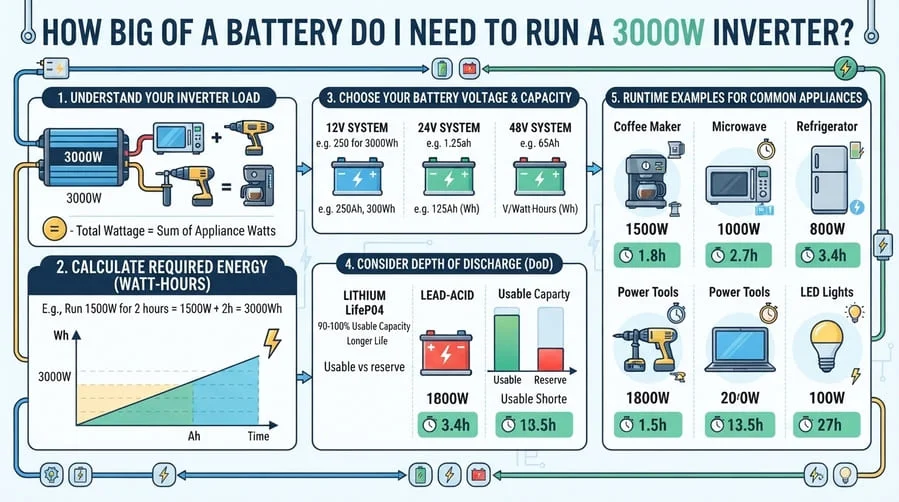
A 3000W inverter needs about 3.3 kWh of usable battery for every hour it runs at full load. In practice that is a 48V 75–100Ah, 24V 150–200Ah, or 12V 300–400Ah lithium (LiFePO₄) bank, and the battery management system (BMS) must also deliver the current: about 70A at 48V, 140A at 24V, or 280A at 12V. Lead-acid needs roughly twice the rated capacity because only about half of it is usable.
This guide gives the sizing formula, runtime tables for a 200 Ah battery, BMS current limits, how many batteries to wire at each voltage, and a worked example from a real home load list.
Quick answer
Battery size for one hour at full load (about 3.3 kWh of usable battery), by system voltage:
| System voltage | Lithium (LiFePO₄) | Lead-acid / AGM | DC current at 3000W |
|---|---|---|---|
| 12V | 300–400 Ah | 550–600 Ah+ | ~280A |
| 24V | 150–200 Ah | 280–300 Ah | ~140A |
| 48V | 75–100 Ah | 140–150 Ah | ~70A |
If you only run lighter loads (say 1000–1500W) most of the time, you can go smaller. But the battery must still be able to deliver the current the inverter pulls at peak, and that is where many 12V setups fail.
Our recommendation: for a 3000W inverter, choose a 24V or 48V system with LiFePO₄ batteries. A 48V 100Ah lithium battery (about 5 kWh) is the simplest setup that handles full load comfortably. Paired with solar panels, a bank like this also keeps your home running through outages, one of the main benefits of combining solar and storage.
Why battery size depends on more than wattage
A 3000W inverter label tells you the most it can output, not how much battery you need. As with any home solar battery storage setup, four things decide the right size:
- System voltage (12V, 24V, or 48V). Your inverter is built for one input voltage. Higher voltage means lower current for the same power.
- Your real load. Running a 600W fridge and some lights is very different from running a 2,800W kettle or air conditioner.
- How long you need power. Runtime is what sets capacity (Ah or kWh).
- Battery chemistry. Lithium lets you use 80–95% of rated capacity. Lead-acid should only be drained to about 50%.
On top of capacity, the battery’s maximum discharge current must be high enough to feed the inverter. We cover that in detail below, because it’s the most common reason a “big enough” battery still shuts off.
How much current does a 3000W inverter draw?
Inverters aren’t 100% efficient, which is one reason choosing the right inverter matters. Most pure sine wave models run at about 85–92%. Assuming 90%, a full 3000W AC load pulls about 3,333W from the battery.
Formula: DC current (A) = AC load (W) ÷ (battery voltage × inverter efficiency)
| System | Calculation | Continuous draw | Surge draw (2× for a split second) |
|---|---|---|---|
| 12V | 3000 ÷ (12 × 0.9) | ~278A | ~550A+ |
| 24V | 3000 ÷ (24 × 0.9) | ~139A | ~280A |
| 48V | 3000 ÷ (48 × 0.9) | ~69A | ~140A |
As battery voltage sags under load (a 12V battery can drop to 11–11.5V), current climbs even higher. At 12V you are pushing close to 300A continuously, which needs 4/0 AWG cable, a large Class T fuse, and batteries rated for that current. At 48V the same power runs through a cable the thickness of a pencil. Victron’s DC wiring guide explains how current and cable length drive these sizes.
Solar Permit Solutions
Off-Grid Solar System Design
Expert design services for off-grid and battery backup systems. Complete permit packages delivered fast.
What size battery is best for a 3000W inverter?
Use this formula to size your bank:
Battery capacity (Ah) = (Load in watts × hours of runtime) ÷ (battery voltage × inverter efficiency × depth of discharge)
- Inverter efficiency: use 0.9
- Depth of discharge (DoD): 0.9 for LiFePO₄, 0.5 for lead-acid/AGM
Example: 3000W for 1 hour on a 12V lithium bank: 3000 × 1 ÷ (12 × 0.9 × 0.9) = 309Ah → round up to a 300–400Ah bank.
Recommended battery size for 1 hour at a full 3000 W load
| System voltage | LiFePO₄ (90% DoD) | Lead-acid / AGM (50% DoD) |
|---|---|---|
| 12V | ~310 Ah → use 400 Ah | ~560 Ah → use 600 Ah+ |
| 24V | ~155 Ah → use 200 Ah | ~280 Ah → use 300 Ah |
| 48V | ~77 Ah → use 100 Ah | ~140 Ah → use 150 Ah |
Two notes on these numbers:
- Lead-acid figures are a minimum. At high discharge rates, lead-acid delivers less than its rated capacity, an effect described by Peukert’s law. A 3000W load on a 12V lead-acid bank can cut real capacity by 20–40%. Battery monitors correct for this with a Peukert exponent setting, usually around 1.25 for lead-acid.
- Size for your real load, not the label. If your usual load is 1200W, size for 1200W and simply make sure the battery can still handle the inverter’s peak current.
Best overall choice: a 48V 100Ah LiFePO₄ battery (about 5 kWh). It gives roughly 1.3 hours at full 3000W, 3+ hours at 1200W, draws only ~70A, and avoids the cabling and BMS problems of 12V. It also leaves room to grow: if you outgrow a 3000W inverter, a 48V bank works with larger units such as the EG4 12kPV hybrid inverter.
Check the BMS: the step most guides skip.
Every lithium battery has a battery management system (BMS) that limits how much current it can deliver. If the inverter asks for more, the BMS cuts power to protect the cells, even if the battery is full.
Common 12V LiFePO₄ BMS ratings and the most AC power each can support:
| 12V battery | Typical BMS | Max continuous AC output (approx.) |
|---|---|---|
| 12V 100Ah | 100A | ~1,150W |
| 12V 200Ah | 200A | ~2,300W |
| 12V 300Ah | 200–250A | ~2,300–2,900W |
That means:
- One 12V 100Ah battery can’t run a 3000W inverter at full load. It will shut off almost immediately.
- Even a single 12V 200Ah battery with a 200A BMS tops out around 2,300W.
- To run 3000W at 12V, you need at least 3, and ideally 4, 12V 100Ah batteries in parallel, or two 200Ah batteries in parallel, so the current is shared.
Also check the BMS surge (peak) rating. Motors, compressors, and microwaves can briefly pull 2–3× their running watts, and the battery must handle that spike.
How many batteries do I need to run a 3000W inverter?
The count depends on the battery size and how you wire them. Batteries wired in series add voltage. Batteries wired in parallel add capacity and current.
Using 12V 100Ah LiFePO₄ batteries (1,280Wh each)
| Inverter voltage | Wiring | Batteries | Bank size | Usable energy | Runtime at 3000W |
|---|---|---|---|---|---|
| 12V | 4 in parallel | 4 | 12V 400Ah | ~4.6 kWh | ~1.2–1.4 h |
| 24V | 2 in series × 2 parallel | 4 | 24V 200Ah | ~4.6 kWh | ~1.2–1.4 h |
| 48V | 4 in series | 4 | 48V 100Ah | ~4.6 kWh | ~1.2–1.4 h |
The energy is the same in each case. What changes is the current: ~280A at 12V versus ~70A at 48V. That’s why 24V and 48V systems are safer, cheaper to wire, and lose less power as heat.
Using lead-acid / AGM 12V 100Ah batteries
Because you should only use about half the capacity, you need roughly twice as many: about 6–8 batteries for an hour at full load, regardless of system voltage. They’re also heavy (about 30 kg / 65 lb each).
Quick rules
- Minimum to run 3000W at all (lithium, 12V): 3–4 × 100Ah in parallel, or 2 × 200Ah.
- Minimum at 24V: 2 × 12V 100Ah in series works for moderate loads. Use 4 (2S2P) for full 3000W.
- Minimum at 48V: 4 × 12V 100Ah in series, or one 48V 100Ah battery.
How long will a 200Ah battery run a 3000W inverter?
A 12V 200Ah battery stores about 2,400–2,560Wh (LiFePO₄ is 12.8V nominal). We use 2,400 Wh to keep the estimates conservative. Here’s what you can expect after inverter losses (90%) and usable capacity:
| AC load | 12V 200Ah LiFePO₄ (90% usable) | 12V 200Ah lead-acid (50% usable) |
|---|---|---|
| 3000W | ~39 min* | ~20 min or less* |
| 2000W | ~58 min | ~30 min |
| 1500W | ~1.3 h | ~40 min |
| 1000W | ~1.9 h | ~1 h |
| 500W | ~3.9 h | ~2 h |
| 300W | ~6.5 h | ~3.5 h |
Runtime formula: Runtime (h) = (Battery V × Ah × DoD × 0.9) ÷ AC load (W)
*The 3000W row is theoretical. A single 12V 200Ah battery usually has a 200A BMS and can’t deliver the ~280A a 3000W load needs, so it will shut off. A lead-acid battery will also suffer large voltage sag at that current.
Higher-voltage 200Ah batteries go much further:
- 24V 200Ah lithium (4.8 kWh): ~1.3 h at 3000W, ~2.6 h at 1500W
- 48V 200Ah lithium (9.6 kWh): ~2.6 h at 3000 W, ~5 h at 1500 W
What kind of batteries are needed for a 3000W inverter?
Lithium has largely replaced lead-acid in new systems, a shift covered in Solar Power World’s look at off-grid battery choices. Here’s how the main types of solar energy storage compare for a 3000W inverter:
| Battery type | Usable capacity | Handles high current? | Cycle life | Best for |
|---|---|---|---|---|
| LiFePO₄ (lithium iron phosphate) | 80–95% | Yes, check the BMS rating. | ~900 (80% DoD) to ~3,000 (40% DoD) | Most 3000W setups: home backup, RV, off-grid solar |
| AGM | ~50% | Fair voltage sags | 300–700 | Budget or occasional backup |
| Gel | ~50% | Poor at high current | 500–1,000 | Low-draw, slow discharge |
| Flooded lead-acid | ~50% | Fair | 500–1,200 | Cheap, ventilated, maintained setups |
What to look for in a battery for a 3000W inverter:
- Deep-cycle, not a car starting battery. Starter batteries are built for short bursts, not hours of steady draw.
- Continuous discharge rating that, combined across the bank, exceeds your inverter’s DC draw (~280A at 12V, ~140A at 24V, and ~70A at 48V).
- Matching voltage with your inverter’s input (a 24V inverter needs a 24V bank).
- Identical batteries in a bank: same brand, model, capacity, and age.
- Low-temperature charging protection if you charge below 0°C / 32°F (lithium can’t safely charge below freezing without it). This matters for cold-climate installs such as solar projects in Minnesota.
For most people, LiFePO₄ is the right choice. It costs more upfront, but you need fewer batteries, it handles high current, it weighs about a third as much as lead-acid, and it lasts longer, so the cost per cycle can be lower. Shallower discharges stretch its life a lot: Battery University’s cycle-life data puts LiFePO₄ at roughly 900 cycles at 80% depth of discharge, about 3,000 at 40%, and about 9,000 at 20%, counted until capacity falls to 70%. To compare specific models, see our solar battery selection guide.
Worked example: sizing a battery for a home backup load
Labels give the maximum, but your bank should match what you’ll actually run. To estimate your own appliances, multiply watts by hours of use, as the Virginia Tech Extension appliance energy guide explains. Here’s a typical evening-and-overnight list for a solar battery backup system on a 3000W inverter:
| Appliance | Watts | Hours/day | Wh/Day |
|---|---|---|---|
| Refrigerator (running watts; compressor cycles on about 8 of 24 hours) | 150 | 8 | 1,200 |
| LED lights | 100 | 5 | 500 |
| TV | 120 | 4 | 480 |
| Laptop + router | 60 | 4 | 240 |
| Microwave (1,000W cooking power) | 1,500 (actual draw) | 0.25 | 375 |
| Total | 2,795 Wh |
Microwaves are sold by cooking power, but they draw about 1.4–1.5× that from the outlet. Always use the input watts on the label.
Step 1. Add inverter losses: 2,795 ÷ 0.9 = 3,106 Wh
Step 2. Add depth of discharge (lithium 90%): 3,106 ÷ 0.9 = 3,451 Wh needed
Step 3. Convert to Ah:
- 12V: 3,451 ÷ 12 = 288 Ah → 300Ah bank
- 24V: 3,451 ÷ 24 = 144 Ah → 150–200 Ah bank
- 48V: 3,451 ÷ 48 = 72Ah → 100Ah bank
Step 4. Check peak current. The microwave running while the fridge compressor starts can briefly reach 2,000–2,500 W. That’s up to ~230A at 12V, more than one 12V 100Ah or 200Ah battery’s BMS allows, but only ~58A on a 48V bank.
Result: a 48V 100Ah LiFePO₄ battery (5.1 kWh) covers a full day of this load with about a third of its capacity to spare. For outages that last longer, the Building America guide to PV battery storage for outages explains how solar recharging extends backup time. If the battery is part of a rooftop system, our residential solar design service can size the whole system together.
12V vs. 24V vs. 48V: Which should you choose?
| 12V | 24V | 48V | |
|---|---|---|---|
| Current at 3000W | ~280A | ~140A | ~70A |
| Typical cable size (short run) | 4/0 AWG | 1/0–2/0 AWG | 4–3 AWG |
| Voltage drop and heat | High | Moderate | Low |
| Batteries needed for current sharing | 3–4 in parallel | 2–4 | 1–4 |
| Best for | Small vans, existing 12V systems | RVs, boats, cabins | Home backup, off-grid solar |
If you’re buying a new 3000W inverter, 24V is the practical minimum and 48V is ideal. Stick with 12V only if the rest of your system (vehicle, alternator charging, existing batteries) is already 12V. Victron’s DC wiring guide puts the preferred upper limit at 3000VA for 12V systems and 5000VA for 24V, so a 3000W inverter sits at the very top of what 12V should carry. Always follow your inverter’s manual for exact cable and fuse sizes.
For permanent home installs, the battery location, cabling, and fusing also have to pass inspection. Our guide to solar battery permit requirements covers what inspectors look for, and our PE-stamped solar permit plans include these details. Rules vary by location, so check the solar permit requirements by state or local pages, such as solar permit services in Sacramento.
Key takeaways
- A 3000W inverter at full load needs about 3.3 kWh of usable battery per hour of runtime.
- 12V: 300–400Ah lithium or 600Ah+ lead-acid. 24V: 150–200Ah lithium. 48V: 100Ah lithium.
- A single 12V 100Ah battery can’t run a 3000W inverter. The BMS limits it to about 1,150W.
- Lithium (LiFePO₄) gives nearly twice the usable energy of lead-acid at the same rating.
- Size for your real daily load, then confirm the bank can deliver the inverter’s peak current.
- Higher voltage (24V or 48V) means less current, thinner cables, and fewer problems.
Planning a full off-grid setup around your 3000W inverter? Our off-grid solar system design service sizes the batteries, inverter, and solar array together and delivers permit-ready plans.
Frequently Asked Questions
Off-Grid Solar System Design
Expert design services for off-grid and battery backup systems. Complete permit packages delivered fast.
Frequently Asked Questions
Not at full load. A 12V 100Ah lithium battery usually has a 100A BMS, which supports only about 1,150W of AC output. It can power small loads through a 3000W inverter, but anything above that will trigger a shutdown. A 48V 100Ah battery, however, can run a 3000W inverter for about 1.3 hours.
At loads it can actually support, a 12V 100Ah LiFePO4 battery gives roughly 1 hour at 1,000W or 2 hours at 500W. It can't sustain 3000W.
Only for a few minutes with the engine running. Car batteries are starting batteries, not deep-cycle, and they're damaged by sustained heavy discharge. Use deep-cycle lithium or AGM batteries instead.
It depends on daily usage and sun hours. For the ~3.5 kWh example above with 4–5 peak sun hours, you'd need about 900–1,200 W of panels (for example, 3 × 400 W panels), plus a charge controller that matches your battery voltage. NREL's PVWatts calculator estimates solar output for your exact address, and sunny desert locations, like the projects we handle for solar permitting in Henderson, NV, need fewer panels than northern ones. Already have panels? Here's how to add a battery to an existing solar system.
Yes. Most 3000W inverters draw about 20–40W at idle (roughly 1.5–3A from a 12V battery). For example, the Samlex PST-3000 spec sheet lists under 1.6A at no load. Over 24 hours, that adds up to about 0.5–1 kWh, so switch the inverter off or use power-saving mode when you're not using it.
No. Mixing ages, brands, or capacities causes uneven charging and discharging, which shortens battery life. Build your bank from identical batteries bought together.

SPS Editorial Team
Solar Permit Solutions
Solar Permit Solutions provides professional solar permit design services for residential, commercial, and off-grid installations across all 50 states. Our team ensures permit-ready plan sets delivered fast.
Related Articles
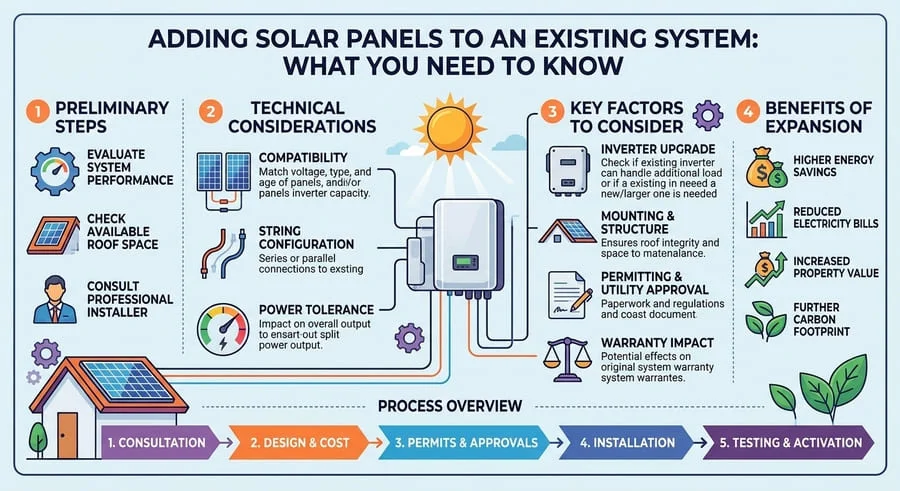
Adding Solar Panels to an Existing System: What You Need to Know
Learn 3 proven methods to expand your solar panel system. Expert guide covers co...
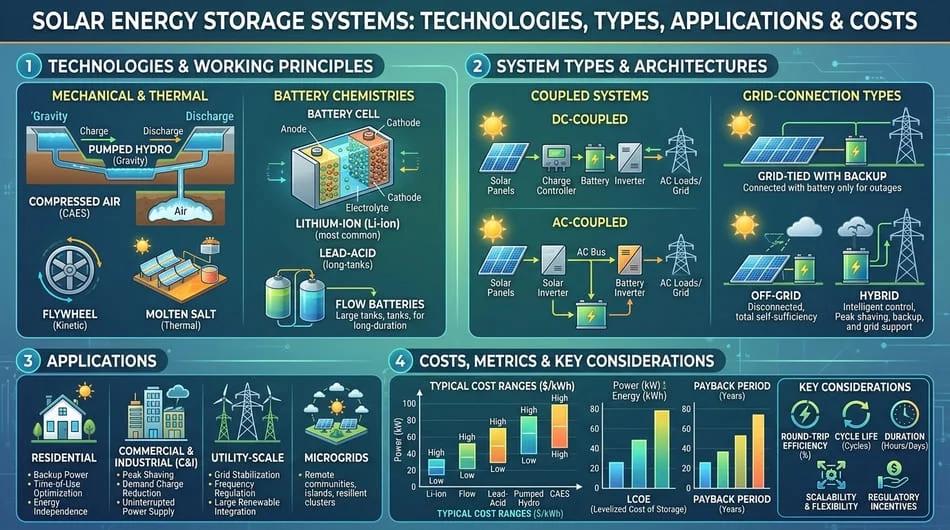
Solar Energy Storage Systems: Technologies, Types, Applications & Costs
Compare solar energy storage systems: LFP vs NMC batteries, AC vs DC coupling, c...

Structural vs. Electrical PE Stamps: What Solar Projects Need
Updated November 2026 | By Solar Permit Solutions Editorial Team A structural PE...