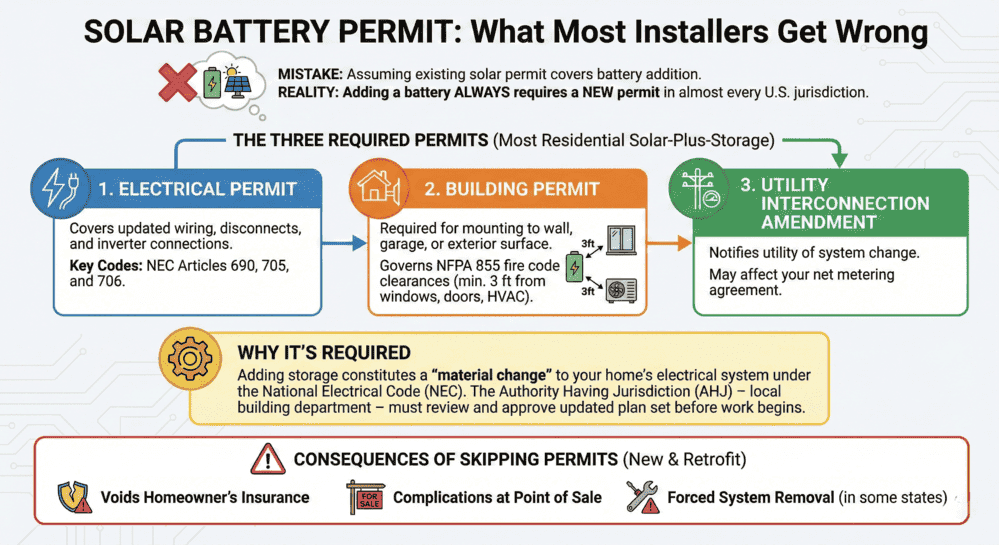
Quick Answer: Adding battery storage to a solar system almost always requires new permitting, even on an already-permitted PV system. Most residential installs need an electrical permit, a building permit (if wall- or floor-mounted), and a utility interconnection amendment. Commercial ESS additionally triggers fire department review and, above certain aggregate energy thresholds, mandatory fire suppression. Batteries must be UL 9540 listed and installed per NFPA 855 clearances (3 ft minimum from unit-to-unit and from doors/windows) and NEC Article 706.
Adding a battery to a solar system requires a new permit in almost every U.S. jurisdiction, regardless of whether the solar panels are already installed.
Most residential solar-plus-storage installations require three separate permits:
- Electrical permit—covers updated wiring, disconnects, and inverter connections under NEC Articles 690, 705, and 706
- Building permit—required when mounting a battery to a wall, garage, or exterior surface; governs NFPA 855 fire code clearances (minimum 3 feet from windows, doors, and HVAC equipment)
- Utility interconnection amendment—notifies your utility of the system change and may affect your net metering agreement
This applies to both new combined solar + battery installations and retrofits where storage is added to an existing solar system. Skipping any of these permits can void homeowner’s insurance, create complications at point of sale, and in some states result in forced system removal.
The permit is required because adding battery storage constitutes a material change to your home’s electrical system under the National Electrical Code. The Authority Having Jurisdiction (AHJ), your local building department, must review and approve an updated plan set before work begins.
Why Adding a Battery Triggers a New Permit
Many homeowners assume that because their solar panels are already permitted and inspected, adding a battery is a minor upgrade that doesn’t require additional paperwork. This is one of the most common misconceptions in residential solar, and it can be a costly one.
When you add battery storage to a solar system, you are making material changes to the electrical system of your home. Specifically, you are introducing a new energy source (the battery), modifying how power flows to and from the grid, and potentially changing your
solar interconnection agreement with your utility. Each of these changes must be reviewed and approved by the Authority Having Jurisdiction (AHJ) – typically your local local AHJ – and in many cases by your utility company as well.
Under NEC Article 690 (Photovoltaic Systems) and Article 706 (Energy Storage Systems), battery systems installed in connection with PV systems must meet specific requirements for disconnecting means, labeling, and circuit protection. Because two separate NEC articles now apply, the AHJ must review an updated plan set before work can begin.
According to the U.S. Department of Energy, permitting and inspection are required before a solar or storage system is allowed to produce or supply electricity on the grid, and this applies to additions and modifications, not just new installations.
The 3 Permits Required for Solar + Battery Systems
For most residential solar-plus-storage projects, three types of permits are involved. The exact mix depends on your jurisdiction, the battery size, and whether storage is being added to an existing or new solar install.
Permit 1: Electrical Permit
An electrical permit is required for virtually every solar + battery installation. It covers the new wiring, disconnects, breakers, and inverter connections introduced by the battery system. The AHJ’s electrical inspector will review your updated
solar single-line diagram to confirm compliance with NEC Articles 690, 705, and 706 before approving work.
For AC-coupled battery systems (such as a Powerwall added to an existing string-inverter solar system), the electrical changes are particularly significant, a new battery inverter/charger and associated disconnects are introduced on the AC side of the system. For DC-coupled systems using a hybrid inverter, the changes may be more contained but still require plan review.
Permit 2: Building Permit
A building permit is required when the battery system involves physical structural work, most commonly when a wall-mounted battery is installed in a garage, utility room, or on an exterior wall. Building permits ensure the mounting meets structural requirements and that the installation location complies with NFPA 855 setback and clearance requirements (minimum 3 feet from windows, doors, and HVAC equipment for most lithium-ion systems).
Even for floor-standing batteries, many jurisdictions require a building permit to confirm that the installation location is compliant with fire safety codes. Your local AHJ determines whether a building permit is required in addition to the electrical permit.
Permit 3: Utility Interconnection Amendment
This is the permit step that surprises many homeowners. Your existing solar interconnection agreement was written for a solar-only system. When you add battery storage, the grid sees a different system, one that can be configured to export stored energy, operate in backup mode, or limit exports depending on utility requirements.
Many utilities require a new or amended interconnection application when storage is added, particularly if the system is configured to export energy to the grid. Even export-limited configurations (where the battery only powers the home and never exports) often require updated documentation. Failing to notify your utility can result in your net metering agreement being voided.
The National Renewable Energy Laboratory (NREL) notes that interconnection requirements vary significantly by state and utility, making it critical to verify your specific utility’s process before installation begins.
New Install vs. Retrofit: How the Process Differs
The permit path for solar-plus-storage depends heavily on whether you are installing both systems at the same time or adding storage to an existing solar installation.
Scenario A: Installing Solar and Battery Together
When solar panels and a battery are installed simultaneously, they are typically covered under a single combined permit package. The plan set includes both the PV system design and the storage system design in one submission. This is the most efficient path, one plan review, one inspection sequence, and one interconnection application.
Many Solar Permit Solutions customers choose this route because it reduces total soft costs and speeds up the path to Permission to Operate (PTO).
Scenario B: Retrofitting Storage onto an Existing Solar System
This is where homeowners most often get caught off-guard. If solar panels are already installed and permitted, adding a battery requires a new permit application; it cannot be done under the original solar permit.
The retrofit process typically requires:
- A new or amended site plan reflecting the battery location
- An updated single-line diagram showing the battery integrated with the existing PV system
- Battery equipment specification sheets confirming UL 9540 listing
- A new or amended interconnection application with the utility
- In some jurisdictions, updated load calculations
Retrofit permits can take longer than new-install permits because the AHJ must review how the new storage system interacts with existing equipment. Systems with older string inverters may require an inverter upgrade to support AC coupling, which adds additional scope to the permit package.
Pro tip: If you are planning to add storage within 12 months of your solar install, discuss it with your installer upfront. In many jurisdictions, it is possible to design the initial permit set in a way that anticipates battery storage, reducing the complexity of a later amendment.
Solar Permit Solutions
Solar Contractor? We Design Your Plans.
Outsource your permit plan sets to our team. PE-stamped, code-compliant, fast turnaround so you can focus on installation.
Who Pulls the Permit—Installer or Homeowner?
In most states and jurisdictions, the solar installer or their designated permitting agent pulls the permit on behalf of the homeowner. This is because solar + battery permits require licensed contractor registration with the local building department, a condition most homeowners don’t meet.
However, some states do allow homeowners to pull their own permits for owner-occupied residential properties, a path often taken by DIY solar installers. Even in these cases, the permit still requires a professionally prepared plan set that meets AHJ standards. A homeowner pulling their own permit without a compliant plan set is one of the most common reasons solar + storage permits get rejected on the first submission.
Whether the permit is pulled by the installer or the homeowner, the plan set itself, the site plan, single-line diagram, equipment specs, and structural calculations must be prepared to a professional standard. This is where professional solar permit design services provide the most value: ensuring the permit package is complete and code-compliant before it ever reaches the building department.
Commercial Battery Storage Permitting: What’s Different
Commercial ESS permitting is a different process than residential, not just a bigger version of it. The aggregate energy thresholds are higher, more departments get involved, and the documentation burden increases substantially.
Aggregate Energy Thresholds and Fire Suppression
Once a commercial installation exceeds the aggregate energy limits set by NFPA 855 for its occupancy type and location, automatic fire suppression becomes mandatory. For indoor commercial systems, this can mean coordinating a sprinkler system upgrade with the building’s existing fire protection design, which adds both cost and a separate review cycle.
Structural Review
Battery racks are heavy, and many existing structures were never designed to carry that load. Rooftop and mezzanine-level commercial ESS installations typically require a structural engineering review to confirm the roof or floor assembly can support it. This is one of the most commonly missed steps on commercial storage jobs, and catching it late in the process is one of the most expensive mistakes to fix.
Emergency Responder Requirements
Commercial ESS installations generally require signage identifying battery chemistry, energy capacity, and emergency shutdown procedures for first responders. Some jurisdictions also require Knox box access so fire crews can reach the equipment without forced entry.
Fire Department Plan Review
For commercial projects, fire department reviews typically evaluate:
- Egress paths and clearances around the battery installation
- Fire suppression and detection systems
- Ventilation and exhaust requirements
- Emergency responder signage and access
- Compliance with NFPA 855 aggregate energy limits for the occupancy type
In many jurisdictions, fire department approval must happen before the building department will accept the permit submittal; not concurrently. Confirming this sequencing with the local fire marshal’s office early prevents a submittal from stalling mid-review.
Commercial ESS by Installation Type
| Installation Type | Key Requirements |
| Indoor commercial | NFPA 855 aggregate limits, suppression triggers, ventilation, signage |
| Rooftop | Structural loading review, drainage, setbacks, fire access |
| Ground-level outdoor enclosure | Setback from structures, clearances, bollard protection |
| Utility-scale | Full interconnection study, fire suppression, environmental review |
A commercial solar + battery permit package prepared with structural review and fire department requirements addressed upfront avoids the multi-week delays that come from discovering these requirements mid-submission.
Battery Storage Rules by State: What Varies
NFPA 855 and NEC Article 706 provide the baseline, but adoption and enforcement vary by state and even by local jurisdiction. A few states layer on additional requirements worth knowing before you finalize a plan set.
California
California adds three layers on top of the base NFPA 855/NEC 706 framework:
- Title 24 building standards apply to ESS installations, and the state has adopted NFPA 855 with state-specific amendments
- Local AHJ and fire department amendments still vary by jurisdiction even under the statewide framework
- Rule 21 governs utility interconnection for storage systems and requires specific review for export-capable batteries
See our guide to solar permitting in California for the base permit process this builds on.
New York
New York’s State Building Code incorporates ESS requirements directly. Utilities, including Con Edison and PSEG, have their own interconnection requirements specific to solar-plus-storage systems, separate from the AHJ permit process.
Massachusetts
Massachusetts references NFPA 855 through its State Building Code, and some utilities in the state require a separate storage interconnection application in addition to the standard AHJ permit. See our Massachusetts solar permitting guide for the full state process.
How to Confirm Requirements in Your Jurisdiction
State-level rules are the floor, not the ceiling; local AHJs and fire departments can add their own documentation requirements on top. Before finalizing a plan set:
1. Confirm which NFPA 855 edition your AHJ has adopted (requirements shifted between the 2020, 2023, and 2026 cycles).
2. Ask whether the ESS permit is combined with the solar permit or filed separately.
3. Ask whether a fire department review is required and whether it must happen before or alongside the building department submittal.

How SolarAPP+ Streamlines the Combined PV + Storage Permit
SolarAPP+ is a web-based automated permitting platform developed by the National Renewable Energy Laboratory (NREL) and funded by the U.S. Department of Energy. It is designed to automate code compliance checks for residential solar and solar-plus-storage permit applications, allowing participating jurisdictions to issue permits instantly for qualifying systems.
SolarAPP+ now supports combined PV + battery storage systems, which is significant for installers working in participating jurisdictions. Instead of waiting weeks for a plan reviewer to manually check your permit package, an approved SolarAPP+ submission generates an instant permit, in some cases within minutes of submission.
As of 2024, more than 160 communities across the United States have adopted SolarAPP+. The platform is free for jurisdictions and charges installers a modest processing fee. For installers managing high volumes of residential solar + battery projects, verifying whether your target AHJs participate in SolarAPP+ can dramatically reduce project timelines.
For jurisdictions that have not yet adopted SolarAPP+, the traditional plan review process applies, which is where the quality of your permit package directly determines your approval speed. A complete, well-prepared solar permit plan set that anticipates common reviewer questions is consistently the fastest path to approval.
Common Reasons Solar + Battery Permits Get Rejected
Understanding why permits get rejected is the fastest way to ensure your application doesn’t end up in the resubmission queue. Based on AHJ feedback and industry experience across all 50 states, the most common rejection reasons for solar + battery permits are:
- Single-line diagram not updated to reflect battery integration—the most frequent issue. The SLD must show the battery, its inverter/charger, disconnects, and NEC 706 required labeling.
- Missing or outdated equipment cut sheets—UL 9540 listing documentation for the battery system must be included. If the battery is not on the AHJ’s approved equipment list, the application stalls.
- Incorrect battery location on site plan—The site plan must show the battery’s exact location with required clearances from windows, doors, HVAC equipment, and egress paths.
- NEC 690.8 circuit sizing errors—Circuit-related violations account for 30-40% of all solar permitting rejections nationwide.
- No interconnection amendment submitted to the utility—Some installers complete the AHJ permit but forget the utility notification. The system cannot legally operate until both are resolved.
- NEC 690.12 rapid shutdown compliance not addressed: All grid-tied solar systems must include rapid shutdown capability, and this must be reflected in the updated plan set when storage is added.
A professional plan set prepared by an experienced solar permit design company addresses all of these points systematically, reducing rejection rates and getting your project to inspection and PTO faster.
Timeline: How Long Does a Solar + Battery Permit Take?
Permit timelines vary significantly by jurisdiction, system complexity, and whether the project uses SolarAPP+ or a standard plan review process.
| Scenario | Typical Timeline | Key Variable |
|---|---|---|
| SolarAPP+ jurisdiction (new install + storage) | 1-3 business days | AHJ participation in SolarAPP+ |
| Standard plan review (new install + storage) | 1-4 weeks | AHJ workload and plan set quality |
| Retrofit storage on existing solar | 2-6 weeks | Utility amendment timeline |
| Resubmission after rejection | Adds 1-3 weeks | Reason for rejection and fix complexity |
The utility interconnection amendment is often the longer leg of the process, especially in states with high solar adoption where utility queues are backed up. Starting the interconnection application at the same time as the AHJ permit (rather than waiting for AHJ approval first) can shave weeks off the overall project timeline.
States like California and New York have made significant strides in streamlining combined solar + storage permitting. For state-specific timelines, see our guides to solar panel permitting in California and solar permits in Texas.
Conclusion
Adding battery storage to a solar system is one of the smartest upgrades a homeowner can make, but it is not a permit-free upgrade. Whether you are pairing storage with a new solar install or retrofitting a battery onto an existing system, permits are required, and the quality of your plan set directly determines how fast you get approved.
The good news: the process is predictable and manageable when you know what to expect. Understanding which permits are required, the difference between a new install and a retrofit, and how to avoid the most common rejection reasons puts you well ahead of most homeowners and installers navigating this for the first time.
For installers managing multiple solar + battery projects, a professional permit design partner eliminates the most time-consuming parts of the process and keeps projects moving toward PTO. Learn more about our solar permit plan set services or contact our team to discuss your current pipeline.
Frequently Asked Questions
Solar Contractor? We Design Your Plans.
Outsource your permit plan sets to our team. PE-stamped, code-compliant, fast turnaround so you can focus on installation.
Frequently Asked Questions
No. In virtually all U.S. jurisdictions, adding battery storage to a solar system requires at least an electrical permit. Operating a solar + battery system without required permits can void your homeowner's insurance, create complications when selling your home, and may require the system to be removed or modified at your expense.
It depends on your utility and state. In many cases, adding storage requires a new or amended interconnection application that formally notifies the utility of the system change. In states like California operating under NEM 3.0, the battery's export configuration directly affects how your energy credits are calculated. Always verify with your utility before installing storage. Our guide on solar interconnection agreements covers this in detail.
The primary NEC articles governing solar + battery systems are Article 690 (Photovoltaic Systems), Article 705 (Interconnected Electric Power Production Sources), and Article 706 (Energy Storage Systems). The U.S. Department of Energy's Solar Codes and Standards page provides background on how these standards evolve and are adopted at the state level.
In jurisdictions using SolarAPP+, qualifying permits can be approved in as little as 1-3 business days. In jurisdictions using standard plan review, timelines typically range from 1-4 weeks. Retrofit permits – adding storage to an existing solar system – tend to take longer due to the utility amendment process. A complete, professional plan set is the single biggest factor in minimizing approval time.
Yes, in virtually all jurisdictions. UL 9540 is the system-level safety standard for energy storage systems and is referenced by NFPA 855 and the NEC. AHJs require proof of UL 9540 listing as part of the permit submittal – typically in the form of equipment cut sheets. Non-listed systems face significant approval barriers and may require expensive third-party testing. The Solar Energy Industries Association (SEIA) maintains resources on storage safety standards and equipment certification.
Yes. Solar Permit Solutions prepares complete, permit-ready plan sets for solar + storage systems across all 50 states, including updated single-line diagrams, site plans, structural calculations, and equipment documentation. Our team is experienced with both new combined installs and retrofit storage additions. Contact us to get a quote for your project.

SPS Editorial Team
Solar Permit Solutions
Solar Permit Solutions provides professional solar permit design services for residential, commercial, and off-grid installations across all 50 states. Our team ensures permit-ready plan sets delivered fast.
Related Articles
Solar Inspection Documentation: Required Documents and Checklist
Learn about solar inspection documentation, including permit requirements, NEC c...
Solar Panel Inspection Checklist: What To Check & When To Inspect
Solar panel inspection guide: Learn what to check, when to inspect (annually + e...
Why Solar Inspections Fail: 10 Common Mistakes to Avoid
Discover the 9 critical reasons solar inspections fail and how to avoid costly m...