Updated November 2026 | By Solar Permit Solutions Editorial Team
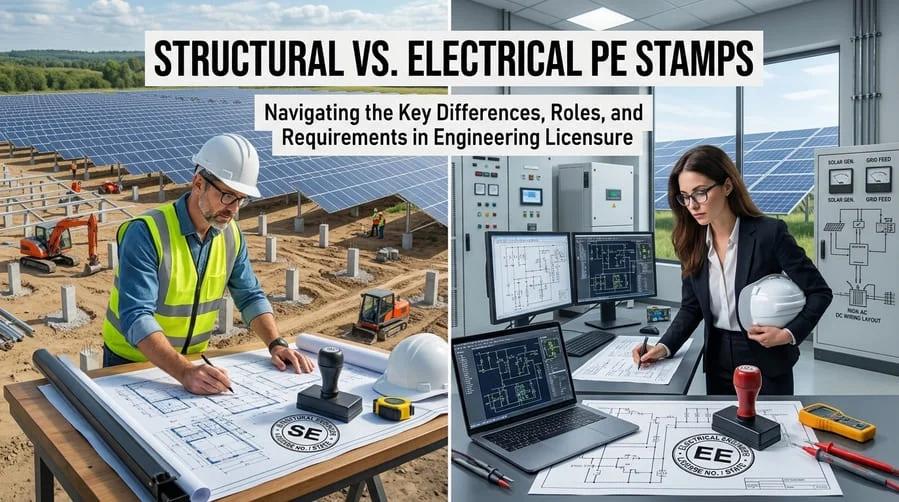
A structural PE stamp certifies that the roof or ground structure can carry a solar array, while an electrical PE stamp certifies the wiring, equipment, and interconnection design. Neither replaces the other, and no single national rule requires both on every project. Your local AHJ, state rules, and whether you qualify for a prescriptive permit pathway decide which stamps you need.
When you prepare a solar permit application, the building department may ask for a structural PE stamp, an electrical PE stamp, both, or neither. If you are a homeowner, a DIY builder, an installer, or a contractor, knowing the difference helps you prepare the right documents and avoid preventable plan review comments. If you plan to install the system yourself, our DIY solar installation guide shows how permits, plans, and engineering fit together.
Both stamps involve a licensed Professional Engineer (PE), but they cover different engineering work. A structural review asks whether the building or support structure can safely carry the equipment and withstand the applicable loads. An electrical review asks whether the system’s wiring, protection devices, grounding, and connections to the property’s electrical service are designed correctly.
Engineering requirements are not the same everywhere. Some projects qualify for a prescriptive permitting pathway with no project-specific engineering, while others need engineered, sealed documents. This guide explains what each stamp covers, how they differ, and what to confirm before you submit a plan set.
Structural vs. Electrical PE Stamps: Quick Reference
The table below summarizes how the two stamps divide the engineering work on a typical solar permit.
| Factor | Structural PE stamp | Electrical PE stamp |
|---|---|---|
| What it evaluates | Whether the roof, framing, foundation, or racking can carry the array and resist wind, snow, and other loads | Whether the electrical design is correct for the equipment, the service, and the point of interconnection |
| Typical documents | Structural calculations, attachment details, framing or foundation details, engineering letter | Single-line diagram, conductor and overcurrent calculations, grounding and bonding details |
| Governing references | Adopted building code and ASCE 7 load criteria | NEC Articles 690, 705, and 706 as adopted locally |
| More likely to be needed when | Roof framing falls outside prescriptive limits, ground mounts, canopies, and unusual attachments. | Complex inverter or battery layouts, service modifications, commercial or unusual interconnections |
| What it does not cover | Wiring, protection devices, or utility interconnection | Roof capacity, foundations, or racking loads |
What Is a PE Stamp for a Solar Project?
A Professional Engineer (PE) stamp, also called an engineering seal, identifies the licensed engineer who is responsible for the engineering documents they have reviewed and sealed. For solar projects, a seal may appear on structural calculations, electrical drawings, engineering reports, or other documents that need professional engineering review.
Engineering licenses are issued by individual states and territories. NCEES, the national body that develops the engineering licensing exams, explains that there is no single nationwide license that lets engineers practice across state lines and that state laws reserve the stamping and sealing of designs for licensed PEs. In practice, the engineer must hold a license that is valid where the project is located.
A PE stamp does not guarantee permit approval, and it does not certify every part of an installation. It identifies who is responsible for the specific work the sealed pages cover. Thresholds and rules differ widely, so see our guide to PE stamp requirements by state before you budget for engineering.
What Is a Structural PE Stamp for Solar?
A structural PE stamp covers the engineering that relates to the physical support of the solar installation. Its purpose is to show that the roof, building, mounting system, or ground-mounted structure can safely support the proposed equipment under the design conditions that apply to the site. For rooftop solar, a structural review may consider:
- Existing roof framing, such as rafters or trusses, and their size, spacing, and condition
- Dead load from the panels and mounting system
- Wind uplift and other environmental loads
- Snow load, where applicable
- Attachment points, fasteners, and how loads transfer into the framing
- Additional framing or reinforcement, when the existing structure needs it
The U.S. Department of Energy’s Building America Solution Center notes that the added weight of an array is usually modest, but mounting hardware concentrates that load on small areas of the roof, and that the design wind loads come from ASCE 7. The ASCE 7 standard sets design load criteria for wind, snow, seismic, and other hazards, and the edition that applies depends on the building code your jurisdiction has adopted.
Some jurisdictions spell out what an engineered rooftop submittal must show. The City of Portland, Oregon, for example, requires engineered systems to be analyzed for point loads at each racking standoff, rather than treating the array as a uniform load, and requires the structural drawings to be stamped by an engineer registered in Oregon. Your own AHJ may ask for different details, so confirm its checklist first. For a closer look at what these documents contain, read our guide to solar structural engineer reports.
What About Ground-Mounted Solar Systems?
Ground-mounted systems raise different structural questions from rooftop installations. Instead of evaluating an existing roof, the design may address posts, foundations, racking, soil conditions, wind loads, and the way loads transfer into the ground. Depending on the project, the engineering documents may include foundation details, post and racking calculations, and connection details. The AHJ decides which of these it requires, so review our ground-mount solar permit plans page to see how these packages are typically assembled.
Solar Permit Solutions
Need Solar Permit Plans?
Professional, permit-ready solar plan sets delivered fast. Residential and commercial projects across all 50 states.
What Is an Electrical PE Stamp for Solar?
An electrical PE stamp covers the professional engineering work behind the electrical design. That design shows how the solar equipment, any energy storage, the building’s electrical service, and the utility connection fit together. Depending on the scope, an electrical review may address:
- Module and inverter specifications
- The electrical single-line diagram
- Conductor sizing and overcurrent protection
- Disconnecting, grounding, and bonding
- System voltage and current calculations
- The point of interconnection and the main service panel
- Battery and energy storage connections
Solar and battery projects are governed by several parts of the National Electrical Code. Article 690 covers photovoltaic systems, Article 705 covers interconnected power production sources, and Article 706 covers energy storage systems. Always check which NEC edition and local amendments your AHJ enforces.
A permit-ready electrical design does not automatically mean a separate electrical PE stamp is required. That depends on the jurisdiction and the project. For a breakdown of the documents involved, see our overview of solar PV plan sets.
Structural vs. Electrical PE Stamps: What Is the Difference?
The difference is the area of engineering each stamp covers. A structural review does not show that the electrical design is correct, and an electrical review does not show that the roof or foundation can carry the installation. A roof can be fully adequate while the conductors are undersized, and a flawless single-line diagram does not help if the framing cannot take the attachment loads.
Reviewers also think about these as separate topics. NREL’s training for code officials treats structural, electrical, and fire and safety guidelines as distinct review areas, which is why a project can trigger one kind of engineering request without the other.
Does a Solar Project Need Both Structural and Electrical PE Stamps?
Not necessarily. No universal nationwide rule requires every solar installation to carry both a structural and an electrical stamp. The answer depends on:
- State engineering and sealing regulations
- The building and electrical codes the AHJ has adopted
- The AHJ’s permit application checklist
- Whether the project qualifies for a prescriptive pathway or needs an engineered one
- System size, configuration, and equipment
- Roof or ground-mount conditions, and whether batteries are included
Portland shows how this works in practice. Its solar permit page describes a prescriptive process and an engineered systems process. Systems that meet the prescriptive path in the state building code do not have to be designed by an Oregon-registered design professional, while systems that do not meet it follow the engineered process and must be. This is one city’s rule, not a national standard.
Simplified permitting guidelines work the same way. The National Simplified Residential Roof PV Permit Guidelines give building officials a structural checklist, and the guidelines state that if any structural item cannot be checked off, the building official may require calculations or details stamped and signed by a design professional. On the electrical side, a system too complex for the guidelines’ standard diagram does not qualify for the simplified permit. These guidelines date from 2019 and reference older code editions, so use them as a model, not as your local rule.
Automated permitting follows a similar logic. The Department of Energy explains that SolarAPP+ approves eligible projects through automated code checks while more technically complex systems are re-routed for manual review. Larger and commercial projects more often need both stamps, as we explain in our guide to commercial solar plan sets. State practice also varies, which our PE stamp guide for Texas, California, and Florida illustrates. Before you prepare a plan set, read our overview of solar engineering requirements for permits and check your AHJ’s current checklist.
When Is a Structural PE Review More Likely to Be Needed?
A structural review is more likely when the project falls outside a jurisdiction’s prescriptive criteria or has conditions that need project-specific analysis. Examples include
- Roof framing that does not meet the applicable prescriptive criteria
- Older buildings or roofs with unusual framing
- Large or unusually configured arrays
- Ground-mounted structures
- Elevated canopies, carports, or pergolas
- Unusual mounting or attachment methods
- Sites with additional loads or site-specific conditions
The engineer may ask for roof framing plans, photographs, racking specifications, or attachment details. Confirm the need for a structural stamp with the AHJ and the engineer handling the project.
When Is an Electrical PE Review More Likely to Be Needed?
An electrical review is more likely when the design falls outside standard prescriptive requirements or when the AHJ or utility requires sealed electrical documents. Situations that may warrant one include:
- Complex or multiple-inverter configurations
- Large commercial installations
- Battery systems with more involved electrical layouts
- Unusual points of interconnection
- Service equipment changes or complex load calculations
- Specialized equipment or system configurations
The presence of a battery or a large inverter does not automatically require a separate electrical stamp. The complete design and the local requirements decide it.
Can One PE Stamp Both Structural and Electrical Documents?
It depends on the engineer’s qualifications and authorization under the state’s laws and regulations. A PE license does not establish expertise in every discipline, and the engineer must be competent to perform and take responsibility for each scope they seal. Some engineers are qualified in more than one discipline, while others specialize in structural or electrical work.
Also, PE and SE should not be treated as interchangeable. Some jurisdictions have a separate Structural Engineer (SE) designation or extra structural requirements, and others do not. Our article on commercial solar PE and SE stamps explains how the two designations differ on larger projects. If a project needs both scopes, confirm that each responsible professional is qualified and authorized for the project location.
What Happens If Required Engineering Documents Are Missing?
Missing or incomplete engineering documents lead to plan review comments, delays, or requests for revised plans. Depending on the AHJ, reviewers may ask for:
- Structural calculations or an engineering letter
- Electrical calculations or a revised single-line diagram
- Signatures and seals on specific sheets
- Racking and mounting documentation
- Roof framing or foundation details
- Clarification of design criteria or code references
Plan reviewers often work from a checklist. IREC’s model plan review and inspection checklist for rooftop PV is one widely used example, although its published update reflects the 2017 NEC, so confirm the edition your AHJ enforces today. The best way to avoid revisions is to identify the permit pathway and the engineering requirements before you submit. Our guide to solar panel permit requirements covers the full documentation checklist, and our article on design mistakes behind solar permit denials shows what reviewers send back most often. If your AHJ asks for original ink or digital seals, read our comparison of PE stamps vs. wet stamps.
How Solar Permit Solutions Helps With PE-Stamped Solar Plans
A solar permit package is more than drawings. The documents must reflect the actual equipment, the site conditions, the system configuration, and the requirements of the local permitting authority.
Per our solar permit pricing page, every plan set is reviewed and sealed by a licensed professional engineer who is valid for the project’s state, and the plan set includes a site plan, an electrical single-line diagram, structural attachment details, equipment specifications, and a cover sheet. This describes what our service package includes. It is not a claim that every solar project is legally required to carry both a structural and an electrical stamp, which your AHJ decides.
Solar Permit Solutions prepares permit-ready plan sets for homeowners, DIY builders, contractors, and commercial projects, including rooftop systems, ground mounts, and battery additions. Project details and local requirements are reviewed as part of the design process.
Ready to get started? Submit your project and we will confirm the documentation your building department needs.
Frequently Asked Questions
Need Solar Permit Plans?
Professional, permit-ready solar plan sets delivered fast. Residential and commercial projects across all 50 states.
Frequently Asked Questions
No. A structural PE stamp covers structural engineering work, such as roof framing, mounting attachments, and foundations. An electrical PE stamp covers electrical engineering work, such as wiring, equipment connections, calculations, and interconnection design.
No. Requirements vary by state, local jurisdiction, project design, and permitting pathway. Some installations may qualify for a prescriptive pathway that does not require a registered design professional, while others require engineered documents and professional seals.
Some do. Ground-mounted projects often need stamped structural calculations or other engineering documents, particularly when the design involves project-specific foundations, posts, or support structures. The exact requirement depends on the AHJ and the applicable regulations.
Not automatically. Battery installations must meet the applicable electrical, building, and fire safety requirements. Whether sealed electrical engineering documents are required depends on the system design and the local permitting requirements.
Only if the engineer is professionally competent and legally authorized to perform that electrical work. A structural engineering qualification does not automatically authorize someone to seal electrical engineering documents.
A PE is a professional engineer licensed by a state. An SE is a structural engineer, a separate designation or added requirement in some jurisdictions. The terms are not interchangeable, and the rules differ by state.
Often, depending on the AHJ and the state. Installing the system yourself does not change the engineering requirement, because the permit pathway your AHJ assigns to the project decides which sealed documents are needed.
Yes. Solar Permit Solutions states that every plan set is reviewed and sealed by a licensed professional engineer valid for the project state. Package details and pricing are listed on the pricing page.
The cost depends on the project scope, the engineering requirements, the system complexity, and the amount of analysis needed. Some providers include engineering and PE sealing in a complete plan package, while other projects need separate engineering services.
No. A PE stamp identifies the licensed engineer responsible for the sealed work. Approval also depends on the completeness of the application, compliance with the applicable codes, local AHJ requirements, and any required revisions.

SPS Editorial Team
Solar Permit Solutions
Solar Permit Solutions provides professional solar permit design services for residential, commercial, and off-grid installations across all 50 states. Our team ensures permit-ready plan sets delivered fast.
Related Articles
Common Solar Panel Defects: Complete Homeowner’s Guide
Updated 2026 | By Solar Permit Solutions Editorial Team Solar panels typically l...

Solar Permitting in Connecticut: Requirements, Process, and Checklist
Solar permitting in Connecticut requires a building permit and an electrical per...
Community Solar 101: Complete Guide
What is community solar? Learn how renters and homeowners access solar energy wi...