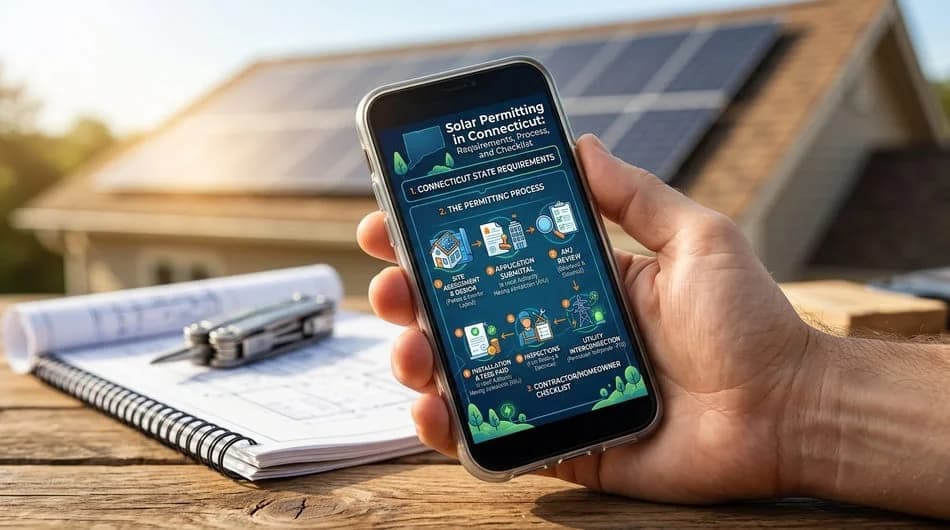
Solar permitting in Connecticut requires a building permit and an electrical permit from your municipal building department, plus a utility interconnection application to Eversource or United Illuminating (UI) before a grid-connected system can operate. Ground mounts often add zoning review. Connecticut enforces the 2022 State Building Code, which adopts the 2020 NEC, and offers a standardized Solar PV Permit Application Supplement.
Whether you are a homeowner planning a DIY installation, an owner-builder managing your own project, or a solar contractor working across several towns, the biggest source of delay is the same: documents that do not match each other, or a local requirement nobody checked. Connecticut has no single statewide solar permit. Each of the 169 municipalities runs its own application, so the standardized supplement helps with the technical data, but your building department still decides what else it needs.
The rules are also changing. Public Act 26-127 created a framework for qualifying plug-in solar devices that took effect on October 1, 2026, and it requires a future automated permitting platform for eligible residential rooftop systems. This guide explains how solar permitting works in Connecticut, which documents you need, what homeowners can and cannot do themselves, and how to move a project from application to Permission to Operate.
Connecticut Solar Permitting: Quick Reference
| Item | What applies in Connecticut |
|---|---|
| Local permits | Building permit and electrical permit from the municipal building department; zoning review for ground mounts and in some towns for all solar |
| State building code | 2022 Connecticut State Building Code (permit applications filed from October 1, 2022), based on the 2021 I-Codes and the 2020 NEC |
| Standard form | Connecticut Standardized Solar PV Permit Application Supplement, submitted with the local permit application |
| Solar electrical licenses | PV-1 (contractor) and PV-2 (journeyperson); connections to existing panels or the meter require an E-1 or E-2 licensee |
| Utility interconnection | Eversource or UI, both through PowerClerk; Permission to Operate is required before operating in parallel with the grid |
| Homeowner work | Licensing exemption for owner-occupied single-family homes, but permits, code compliance, and municipal inspection still apply |
| Plug-in solar | Public Act 26-127, effective October 1, 2026; qualifying devices up to 1,200 W; building and fire codes still apply |
| Automated permitting | State platform required by July 1, 2028 for rooftop systems up to 25 kW; not yet available statewide |
What Are the Solar Permitting Requirements in Connecticut?
Most conventional grid-connected solar installations in Connecticut need building and electrical approvals before construction begins. The exact permits depend on the system type, the property, and the municipality.
Building Permits for Solar Installations
A building permit lets the local building department review the proposed installation for compliance with construction and structural requirements. For rooftop systems, the review may consider the existing roof construction and structural capacity, the added dead load from panels and racking, wind and snow loads, roof attachment methods, panel placement and fire access requirements, and any structural calculations the town requires. Ground-mounted systems add review of foundations, support structures, setbacks, and site conditions.
Electrical Permits for Solar Installations
Electrical permits cover the wiring, equipment, and connections of the solar installation. The review may include modules and string configuration, inverter specifications, DC and AC wiring, disconnects, overcurrent protection, grounding and bonding, rapid shutdown equipment, the main service panel and point of interconnection, and battery storage where applicable.
The City of Bridgeport shows how specific a town can be. Its electrical permit page lists solar systems as requiring an electrical permit, asks for the Connecticut Standardized Solar PV Permit Application Supplement and a Connecticut structural engineer’s roof inspection report with every solar application, and requires a separate zoning plan for all solar and generator permits.
Zoning and Land-Use Approvals
Zoning matters most for ground-mounted and larger systems. Depending on the municipality and property, you may need approval for property line setbacks, maximum structure height, accessory structure rules, wetlands and watercourses, agricultural or protected land, and historic districts. A rooftop system often has a simpler zoning review than a ground mount, but as the Bridgeport example shows, do not assume zoning approval is unnecessary.
Connecticut State Building Code Requirements
According to the Department of Administrative Services, the 2022 Connecticut State Building Code applies to permit applications filed from October 1, 2022. It adopts the 2021 International Building Code, 2021 International Residential Code, 2021 International Existing Building Code, 2021 International Mechanical Code, and the 2020 National Electrical Code (NFPA 70), among others. The current code, adopted model codes, and prior editions are listed on the state’s Connecticut State Building Code regulations page.
Because Connecticut enforces the 2020 NEC, labels and rapid shutdown markings follow the 2020 section numbering rather than the 2023 NEC changes. Our solar PV labeling requirements guide compares the three code editions. Always confirm the edition and any local amendments with the building official before preparing construction documents.

How Does the Solar Permitting Process Work in Connecticut?
The exact submission procedure differs by town, but this workflow is a practical starting point.
Step 1: Identify Your Local Authority Having Jurisdiction (AHJ)
The AHJ is the local authority that reviews and enforces building and safety requirements. For most residential solar projects, start with the municipal building department. Confirm which building permit application applies, whether a separate electrical permit is needed, whether zoning approval is required, which drawings and documents to submit, whether an online portal exists, and whether structural engineering documents or a PE stamp are required. For background, see our AHJ solar permitting guide.
Step 2: Verify Local Permitting Requirements
Before preparing plans, contact the building department and get its current application checklist. Ask whether it accepts the Connecticut Standardized Solar PV Permit Application Supplement and whether it requires additional forms. Also confirm whether a ground mount needs separate zoning, wetlands, or site plan approval.
Step 3: Prepare the Solar Permit Plan Set
A typical residential package includes a site plan, panel layout, structural drawings and calculations when required, an electrical single-line diagram, equipment datasheets, mounting system specifications, and battery documentation if applicable. Module counts, inverter ratings, and electrical configuration must match across every document. See our guide to solar permit design and plan sets.
Step 4: Complete the Connecticut Standardized Solar PV Permit Application Supplement
Fill out the supplement and attach the supporting documents your municipality requests. The next section lists exactly what the form asks for.
Step 5: Submit Building and Electrical Permit Applications
Submit the completed applications and supporting documentation to the appropriate municipal departments. Some towns use online portals, while others accept applications in person or by other methods. Depending on the project, you may also need zoning documentation or other approvals.
Step 6: Respond to Plan Review Comments
The building department may issue corrections or request more information. Common requests include additional roof framing information, structural calculations, clarified attachment details, revised single-line diagrams, updated inverter or battery specifications, missing datasheets, and corrected site plans. Address each comment and resubmit according to the municipality’s instructions.
Step 7: Obtain Permit Approval
Once the required reviews are complete, the municipality issues the permits. Do not begin permitted work before the authorization is in hand.
Step 8: Install the System and Complete Inspections
Install according to the approved plans and manufacturer instructions, then schedule the inspections required by the local building and electrical departments. The inspector may verify equipment, mounting, wiring, grounding, protection devices, labels, and agreement with the approved drawings.
Step 9: Complete Utility Interconnection and Obtain Permission to Operate
Municipal approval and utility interconnection are separate processes. Eversource and UI both accept applications through PowerClerk, and you can often submit while municipal permitting is underway. After installation and inspection, submit the closeout documents and wait for the utility’s Permission to Operate (PTO) before running a grid-connected system in parallel with the grid. Our solar interconnection agreement checklist walks through the application stages.
Solar Permit Solutions
Skip the Permit Headaches
We design plan sets that pass inspection the first time. Code-compliant, PE-stamped, accepted by AHJs nationwide.
Can You Install Your Own Solar Panels in Connecticut? DIY and Owner-Builder Guide
Connecticut law gives certain homeowners a licensing exemption for work on their own homes. That exemption is not a permit exemption, and the distinction matters.
Can a Homeowner Apply for Their Own Solar Permit?
Often yes, depending on the municipality. Bridgeport, for example, states that a property owner of a single-family residence who permanently resides at the property may apply for an electrical permit. Other towns have their own rules on owner authorization, proof of ownership, and occupancy. Call your building department before preparing an application.
What Is the Connecticut Owner-Builder Exemption?
Connecticut General Statutes Section 20-340(11) exempts people installing, maintaining, repairing, and servicing electrical and solar equipment, among other systems, in and about single-family residences they own and occupy or will occupy from the occupational licensing requirements of Chapter 393. The statute adds that the work remains subject to inspection and approval by the municipality’s building official and must conform to the State Building Code. You can read the chapter on the Connecticut General Assembly website.
In practice, this means the exemption does not remove the building permit requirement, electrical work must still meet code, required municipal inspections still apply, and the exemption does not cover rental or commercial properties or work done for someone else. Confirm eligibility with the local building official.
Can a DIYer Prepare Their Own Solar Permit Plans?
A homeowner can prepare project information and drawings, but the municipality decides whether they satisfy its technical requirements. A typical package includes a property site plan, panel layout, roof dimensions, structural information, mounting details, a single-line diagram, equipment specifications, and calculations where required. Some towns, such as Bridgeport, ask for a Connecticut structural engineer’s report. If you plan a DIY installation, our DIY solar panel installation guide explains the drawings, engineering, and permitting involved.
Do DIY Solar Installations Still Require Inspections?
Yes. A homeowner with a licensing exemption must still comply with the State Building Code and municipal inspection requirements. The inspector checks that the installed system matches the approved plans and meets electrical and structural safety requirements.
What Should an Owner-Builder Prepare Before Applying?
Gather these items before you submit:
- Property information and a site survey, if available
- Solar module and inverter specifications
- Proposed panel layout and roof framing information
- Mounting system details
- Electrical single-line diagram
- Battery specifications, if applicable
- Structural calculations or engineering documents when required
- Your municipality’s permit application forms
Connecticut Solar Contractor Licensing Requirements
Connecticut licenses solar electrical work through the Department of Consumer Protection (DCP). The DCP’s solar trades licenses and scope of work page defines each license.
What Is a PV-1 Solar Contractor License?
PV-1 is the Limited Solar Electric Contractor license. Its holder may perform work limited to solar electric systems, meaning the installation, erection, repair, replacement, alteration, or maintenance of photovoltaic or wind generation systems, including storage and distribution of that energy to a point immediately inside a structure or adjacent to an end use.
What Is a PV-2 Solar Journeyperson License?
PV-2 is the Limited Solar Electric Journeyperson license. Its holder performs the same limited scope only while employed by a licensed electrical contractor.
What About E-1 and E-2 Electrical Licenses?
The Electrical Work Examining Board clarified that PV-1 and PV-2 holders may not connect to any existing panel, junction box, wiring, or circuits on the premises. They are limited to terminating their wiring into a junction box or controller that is not connected to the building’s existing electrical system or the utility meter. Connections to the existing electrical system or meter can be made only by an E-1 or E-2 licensee. Verify the scope of work before assigning electrical tasks.
What Is the Connecticut Standardized Solar PV Permit Application Supplement?
The Connecticut Green Bank worked with the Connecticut Building Officials Association and the Office of the State Building Inspector to create a uniform format for the technical information building officials need to review residential rooftop and ground-mounted PV systems. The Department of Administrative Services explains the background in its Standardized Photovoltaic Supplement Memorandum.
What Information Does the Supplement Require?
The form asks for a general description and the system size in DC kilowatts, the mounting type, manufacturer, and model, and, for roof-mounted systems, the building type and height. It also asks for the electrical service size and type, the main breaker amperage and whether it will change, the main panel busbar rating, the type of interconnection, the panel location, and subpanel details if the system ties into a subpanel.
What Supporting Documents Should Accompany the Supplement?
- Additional subcontractor information
- One-line electrical drawing
- One-line site plan drawing
- Roof attachment details (line drawing), for roof-mounted systems
- Solar PV module specification sheets
- Inverter specification sheets
- Pole or ground mount information, instead of the roof attachment details, when applicable
- Structural evaluation, if required by the municipality
- Additional information for larger systems, when specified by the municipality
The form asks you to submit either the roof attachment details or the pole and ground mount information, not both. If your municipality requires a structural evaluation, the form identifies two potentially acceptable formats: the Structural Review Worksheet, if the building department authorizes it, or proof of a structural review by a registered design professional such as a Professional Engineer.
Does the Standardized Supplement Replace the Local Permit Application?
No. It supports the local application by providing technical solar information in a standard format. You still follow the municipality’s procedures and supply any additional documents it requires.
Where Can You Download the Official Form?
You can download the Connecticut Standardized Solar PV Permit Application Supplement (PDF) from the state’s website. The footer of the current PDF reads Version 8.1.2014, so confirm with your building department that it still uses this version.
What Is in a Connecticut Solar Permit Plan Set?
A complete plan set helps building officials evaluate the installation before construction. Requirements vary by project and municipality, but the following documents are commonly requested.
Site Plan Requirements
The site plan shows where the equipment sits relative to the property and existing structures. It may include property boundaries, existing buildings, the array and equipment locations, setbacks, access routes, conduit routing, and, for ground mounts, foundation locations and zoning setbacks. The state supplement specifically asks the site plan to show roof obstructions, the main breaker panel, the utility meter, and the AC disconnect.
Solar Panel Roof Layout
The roof layout shows roof dimensions and slopes, panel locations and quantity, orientation, obstructions, mounting locations, and fire access pathways. The panel count must match the electrical drawings and equipment specifications.
Structural Drawings and Roof Framing Details
Structural documentation shows whether the existing roof can carry the proposed system. It may include rafter or truss size and spacing, the framing configuration, sheathing, mounting details, attachment locations, and load calculations.
Structural Calculations
Calculations may address module and racking dead loads, wind uplift, snow loads, seismic considerations where applicable, attachment capacity, and roof member capacity. Not every installation automatically needs a PE-stamped structural report. The municipality and project conditions decide what is required. See our guide to solar structural engineering calculations.
Electrical Single-Line Diagram (SLD)
The single-line diagram shows how the system connects to the building’s electrical service and the grid. It commonly identifies modules, string configuration, inverters, combiner boxes, disconnects, breakers, conductors, grounding and bonding, the main service panel, the point of interconnection, and battery equipment. The state supplement asks the one-line to show the service size, main breaker and busbar sizes, DC and AC capacity, the interconnection method and overcurrent protection, wire and conduit types, and grounding details. Learn more in our single-line diagram guide and our overview of solar energy diagrams.
Equipment Specifications and Datasheets
Include current manufacturer documentation for modules, inverters, racking, batteries, disconnects, and rapid shutdown equipment. Verify that the models in the drawings match the submitted datasheets.
Required Labels and Placards
The drawings may also need to identify PV system and disconnect identification, electrical source identification, rapid shutdown labeling, battery storage warnings, and other labels required by code and the AHJ.
Structural Engineering Requirements for Solar Permits in Connecticut
Structural engineering shows that the existing structure or the new support system can safely carry the added loads.
When Is a Structural Review Required?
A review may be needed when the roof has limited capacity, framing information is incomplete, mounting conditions are unusual, loading is significant, the project is a ground mount, or the building department asks for calculations. The state supplement itself lists the structural evaluation as an attachment required only if the municipality requires it.
What Roof Framing Information Is Needed?
An engineer may request the roof slope, rafter or truss dimensions and spacing, framing plans, sheathing information, site photographs, the roof’s condition, and proposed attachment locations. If plans are unavailable, photographs and field measurements may help establish the existing configuration, subject to the engineer’s review.
Solar Panel Attachment Spacing and Racking Requirements
Attachment spacing controls how loads move from the racking into the roof. The review may consider racking manufacturer requirements, attachment and fastener types, framing dimensions, wind uplift, rail spans, and attachment locations. Do not assume a standard spacing works for every roof.
When Is a Professional Engineer’s Stamp Required?
A PE stamp may be required when the building department requests engineered calculations or the project falls outside accepted prescriptive or simplified criteria. Some towns ask for an engineer’s report on every solar application, as Bridgeport does. Confirm before you submit. Our PE stamp requirements guide compares state rules.
Ground-Mounted Solar Structural Requirements
Ground mounts involve foundation design, soil conditions, frost depth, wind loading, post spacing, racking configuration, concrete pier or helical pile specifications, and property setbacks. See our ground-mount solar design and foundation guide.
Is Plug-In Solar Legal in Connecticut? Understanding the 2026 Plug-In Solar Law
Yes, for qualifying devices. Connecticut Public Act 26-127 (House Bill 5340) was signed on June 4, 2026, and its portable solar provisions took effect on October 1, 2026. It lets customers use portable solar devices of 1,200 watts or less without a utility interconnection agreement or utility fees, but the law does not create a blanket exemption from building, fire, or electrical code requirements.
What Is Plug-In Solar?
Plug-in solar, sometimes called balcony solar, is a portable photovoltaic device that connects to a building’s electrical system through a standard outlet. Unlike rooftop solar, it is not wired into the building, and it is meant to offset part of the electricity a household uses.
What Does Connecticut Public Act 26-127 Allow?
A qualifying device must meet the Act’s conditions, which include these:
- Maximum output of 1,200 watts
- Compliance with the State Building Code, the Fire Safety Code, and the National Electrical Code
- Certification by UL or another nationally recognized testing laboratory
- Anti-islanding protection, so the device does not energize the building during an outage
- Compliance with the Act’s consumer warning and other conditions
This list is a summary, so read the Act itself before you buy or install a device, because the statutory language controls.
Do Plug-In Solar Systems Require Utility Interconnection Approval?
Not if the device qualifies. The Act bars utilities from requiring an interconnection agreement or charging fees related to a qualifying device. The exemption applies only to devices that meet the legal definition and technical requirements.
Are Building Permits or Electrical Permits Still Required?
The Act states that qualifying devices remain subject to the State Building Code, the Fire Safety Code, the State Fire Prevention Code, and applicable local ordinances. It also directs the state’s building and fire code authorities to examine whether regulatory changes are needed to implement the new rules. Some retailers describe plug-in solar as permit-free, but the utility exemption is not a building permit exemption. If a device needs a new outlet, circuit, or other electrical modification, contact your building department first.
Can Homeowners and Renters Install Plug-In Solar Systems?
The law lets customers use qualifying devices without the traditional utility agreement. Renters should still check lease terms, property management rules, and local requirements, and everyone should confirm that the specific product and installation meet the statutory conditions.
How Is Plug-In Solar Different From Traditional Rooftop Solar?
| Feature | Plug-In Solar | Traditional Rooftop Solar |
|---|---|---|
| Installation | Portable device | Permanently mounted PV system |
| Output under the new law | Up to 1,200 watts | No equivalent limit |
| Utility interconnection agreement | Exempt if the device qualifies | Generally required for grid-connected systems |
| Structural review | Depends on installation and applicable codes | May be required |
| Building and fire code compliance | Still applies | Applies |
| Municipal requirements | Local ordinances still apply | Local permitting applies |
Important: Public Act 26-127 does not make every small solar panel or balcony kit legal. Verify the product’s certification, specifications, and installation conditions.
Solar Permitting Requirements by Project Type
Residential Rooftop Solar
Expect a building permit application, an electrical permit application, the solar PV supplement, a site plan, a roof layout, structural documentation when required, an electrical SLD, and equipment datasheets.
Commercial Rooftop Solar
Commercial projects may add structural analysis of the commercial building, review of service capacity, three-phase configurations, larger inverter systems, multiple panels, fire department access, and extra zoning or site approvals.
Ground-Mounted Solar
Ground mounts may require a site survey, setback documentation, foundation details, soil information, structural calculations, racking specifications, an SLD, and zoning or wetlands review. For project-specific documentation, see our ground-mount solar permit plans.
Solar Systems With Battery Storage
Batteries can trigger added building, electrical, fire safety, and utility review. Documentation may include manufacturer datasheets, a battery location plan, an updated SLD, inverter specifications, mounting details, required clearances, applicable fire safety information, and utility interconnection updates. The state supplement also asks the one-line to show battery type, quantity, voltage, and capacity. Adding a battery to an existing system can require its own permit. Read our solar battery permit requirements guide.
Solar Installations With EV Chargers
EV chargers add electrical documentation: the charger model, load, breaker and conductor sizing, equipment location, service capacity, solar and battery integration, and updated drawings.
Solar Canopies and Carports
Canopies and carports combine an elevated structure with PV. Expect structural design, foundation and wind load calculations, site plans, setback information, electrical drawings, equipment specifications, and possible zoning review. See our solar carport installation and permitting guide.
Solar Permitting Requirements by Connecticut Municipality
Municipalities administer local building permits and may use different portals, fees, forms, and supporting documents even though they all follow the statewide code. Bridgeport, for instance, requires a zoning plan and a structural engineer’s roof report for solar, while other towns may ask for less or more. Check the current requirements with your own building department before you prepare a package.
| Municipality | What to verify |
|---|---|
| Hartford | Building and electrical applications, zoning requirements |
| Stamford | Permit portal and residential solar documentation |
| New Haven | Building department submission requirements |
| Bridgeport | Electrical permit, zoning plan, supplement, and structural engineer’s roof report |
| Waterbury | Local permit forms and application procedures |
| Norwalk | Building and electrical permit requirements |
| Danbury | Application process and zoning requirements |
| Greenwich | Local building and land-use requirements |
| West Hartford | Residential solar application procedures |
| Milford | Building, electrical, and zoning requirements |
Why Should You Check With the Local Building Department?
Local rules can change whether a separate electrical permit is needed, whether zoning approval applies, whether the standardized supplement is accepted, which structural documents are required, whether a PE stamp is necessary, how applications are uploaded, and what inspection documentation is expected. A package accepted in one town may not be accepted in another.
Connecticut Solar Inspections and Utility Interconnection
Municipal permit approval is only one part of completing a project. After installation, the system must pass inspection and receive utility authorization.
What Happens During a Solar Building Inspection?
A building inspection may cover roof attachments, the mounting configuration, structural details, ground-mount foundations, agreement with the approved plans, and required clearances and access. Requirements depend on the project and the local building official.
What Happens During an Electrical Inspection?
An electrical inspection may cover wiring methods, conductor sizing, breaker ratings, disconnects, grounding and bonding, rapid shutdown, labels, inverter installation, and battery equipment. Keep the approved drawings and manufacturer documentation available. For more, see our solar inspection documentation guide.
Eversource Solar Interconnection Requirements
Eversource processes Connecticut interconnection applications through PowerClerk. Its Connecticut application to connect page lists a $200 application fee for inverter-based generators of 25 kW or less, with a 15 business day timeline, and requires proof of UL 1741 certification. It asks for a one-line diagram, a site plan showing the AC disconnect in relation to the meter, and proof of insurance where the project size requires it. Eversource expects the isolation device to be visible and within 10 feet of the main utility panel unless a variance is approved in writing.
United Illuminating Solar Interconnection Requirements
UI customers apply through UI’s PowerClerk portal, and the installer or authorized agent usually submits the package on the customer’s behalf. UI’s Renewable Energy Solutions interconnection page lists a $200 interconnection application fee for new systems of 25 kW or less. Solar projects interconnecting on or after January 1, 2022 also apply to the Renewable Energy Solutions incentive program, which carries a separate $129 application fee for residential systems of 25 kW or less. UI reviews the interconnection and program applications together.
Fees and forms change, so confirm the current figures with the utility before you file.
What Is Permission to Operate (PTO)?
Permission to Operate is the utility’s authorization for an approved grid-connected system to run in parallel with the grid. Passing municipal inspection does not automatically grant it. Do not energize or operate a conventional grid-connected system until the utility issues PTO.
How Long Does Solar Permitting Take in Connecticut?
Timelines depend on the municipality, system complexity, application completeness, and utility review. A straightforward rooftop project usually moves faster than one needing structural corrections, zoning review, ground-mount foundations, or batteries. Eversource lists a 15 business day timeline for its inverter-based interconnection process of 25 kW or less, and that review runs separately from the town permit.
| Stage | Factors affecting timing |
|---|---|
| Application preparation | Availability of project information and drawings |
| Municipal review | Building department workload and project complexity |
| Structural review | Engineering requirements and missing roof information |
| Corrections | Number and complexity of plan review comments |
| Permit issuance | Completion of required municipal approvals |
| Inspections | Local inspection scheduling |
| Utility interconnection | Utility application review and technical requirements |
| PTO | Completion of final utility requirements |
What Can Delay Solar Permit Approval?
Common causes are incomplete forms, missing structural information, incorrect electrical drawings, inconsistent equipment specifications, missing zoning approvals, unresolved review comments, incomplete contractor information, and utility documentation mismatches. Confirming local requirements and submitting a coordinated plan set is the best way to avoid them.
How Much Does a Solar Permit Cost in Connecticut?
No single statewide price applies. Municipal permit fees follow local fee schedules and the type and valuation of the work. Other costs can include the following:
| Expense | What it covers |
|---|---|
| Building permit fee | Municipal building review |
| Electrical permit fee | Electrical work and inspection |
| Zoning fee | Additional land-use review, when required |
| Structural engineering | Calculations and engineering review |
| PE stamping | Professional engineering certification, when required |
| Plan preparation | Solar drawings and technical documentation |
| Utility fees | Interconnection application fees, such as the $200 Eversource and UI fees for systems of 25 kW or less |
Who Pays for the Solar Permit?
Settle this with your installer before the project starts. Depending on the contract, the installer may handle applications and include certain permitting services in the price. Municipal fees and engineering costs should be itemized so you know what is included and what is separate.
Connecticut’s New Automated Solar Permitting Platform: What You Need to Know
Public Act 26-127 also requires a smart solar permitting platform, such as SolarAPP+ or a similar internet-based system, to automate review and issuance of building permits for qualifying residential solar projects.
When Will the Automated Solar Permitting System Become Available?
The Commissioner of Administrative Services must implement the platform no later than July 1, 2028. That is a future deadline, not a statement that the platform is available statewide as of November 2026.
Which Solar Projects May Qualify?
The program covers rooftop systems of 25 kW or less on single-family or multifamily homes, including systems paired with energy storage. Commercial systems, ground mounts, and other projects outside that definition should not be assumed to qualify.
Will Municipalities Still Be Involved?
Yes. Municipalities must adopt the state platform or an equivalent alternative automated platform by January 1, 2029. The platform reviews qualifying applications against the State Building Code, but it does not eliminate electrical requirements, inspections, or utility interconnection.
Common Connecticut Solar Permit Rejections and How to Avoid Them
Incomplete or inconsistent documents lead to plan review comments and delays. Check these items before you submit.
| Common issue | How to prevent it |
|---|---|
| Missing structural information | Include available roof framing details and required calculations |
| Incorrect panel count | Verify the panel layout against the electrical design |
| Inconsistent inverter model | Match equipment information across every drawing |
| Incomplete electrical SLD | Show the required electrical connections and protection |
| Missing equipment datasheets | Include current manufacturer documentation |
| Incorrect attachment details | Verify racking specifications and mounting locations |
| Missing zoning information | Confirm local zoning requirements before submission |
| Incomplete battery documentation | Include equipment location and updated electrical drawings |
| Missing contractor information | Verify applicable license and application details |
| Unresolved review comments | Respond to each correction and submit coordinated revisions |
How Can You Improve the Chances of First-Pass Approval?
- Confirm the municipality’s application requirements.
- Review the applicable building and electrical codes.
- Check the solar PV supplement for completeness.
- Verify that the roof layout and SLD match.
- Confirm equipment model numbers.
- Include supporting structural documentation when required.
- Check applicable zoning requirements.
- Review the entire package for inconsistencies.
Connecticut Solar Permitting Checklist
Before Preparing the Application
☐ Identify the local Authority Having Jurisdiction.
☐ Confirm building permit requirements.
☐ Confirm electrical permit requirements.
☐ Verify zoning and land-use requirements.
☐ Confirm whether the standardized solar supplement is accepted.
☐ Verify contractor and homeowner application eligibility.
☐ Confirm structural engineering requirements.
Prepare the Solar Plan Set
☐ Completed building permit application.
☐ Completed electrical permit application, if applicable.
☐ Connecticut Standardized Solar PV Permit Application Supplement.
☐ Site plan.
☐ Solar panel roof or ground-mount layout.
☐ Structural drawings and calculations, when required.
☐ Roof framing information, when applicable.
☐ Electrical single-line diagram.
☐ Solar module datasheets.
☐ Inverter datasheets.
☐ Racking and mounting documentation.
☐ Battery specifications, if applicable.
☐ Required electrical labels and placards.
After Submitting the Application
☐ Monitor the application status.
☐ Respond to plan review corrections.
☐ Submit revised drawings when requested.
☐ Obtain the required municipal permits.
☐ Install the system according to the approved plans.
☐ Schedule required inspections.
☐ Obtain final municipal inspection approval.
☐ Complete the utility interconnection process.
☐ Receive Permission to Operate before operating the grid-connected system.
Need Help With Solar Permitting in Connecticut?
A complete permit package is hard to assemble when a project needs structural engineering, electrical drawings, and several municipal approvals. Solar Permit Solutions prepares PE-stamped, AHJ-ready plan sets for residential and commercial projects across all 50 states, including Connecticut. Our services include plan-set preparation, site plans and layouts, single-line diagrams, structural calculations, PE stamps when required, battery and ground-mount documentation, and plan review corrections.
Ready to get started? Submit your Connecticut project and we will confirm the documentation your building department needs.
Regulatory note: Requirements, forms, fees, and municipal procedures can change. Verify current requirements with the relevant Connecticut building department, licensing authority, and utility before submitting an application.
Frequently Asked Questions
Generally, yes. Conventional rooftop solar installations typically need municipal building and electrical approvals, and zoning or other approvals may apply depending on the property and installation.
Connecticut provides a licensing exemption for certain work on single-family homes you own and occupy or intend to occupy. Building permits, code compliance, and municipal inspections still apply.
Skip the Permit Headaches
We design plan sets that pass inspection the first time. Code-compliant, PE-stamped, accepted by AHJs nationwide.
Frequently Asked Questions
Can I install my own solar panels in Connecticut?
Often, depending on the town. Some municipalities, such as Bridgeport, allow an owner who permanently resides in a single-family home to apply for an electrical permit. Check with your building department first.
Connecticut regulates solar electric work through PV-1 contractor and PV-2 journeyperson licenses. PV-1 and PV-2 holders cannot connect to a building's existing electrical system or meter, which requires an E-1 or E-2 licensee. Owner-occupant exemptions exist but do not cover every project.
Costs vary by municipality, project valuation, system type, and additional approvals. Structural engineering, zoning, and utility fees can be separate. Eversource and UI each list a $200 interconnection application fee for systems of 25 kW or less.
The timeline depends on the municipality, application completeness, structural review, project complexity, and local workload. Eversource lists 15 business days for its inverter-based interconnection process of 25 kW or less. Corrections or zoning approvals can add time.
It is a standardized form that gives building officials consistent technical information about a residential rooftop or ground-mounted PV system, including the mounting, electrical service, and supporting drawings. It supports the local permit application but does not replace it.
Structural review may be required to show that the roof or support structure can carry the system. The municipality and project conditions decide whether calculations or a PE-stamped report are necessary.
Not every project automatically does. The need depends on code requirements, project configuration, structural conditions, and the building department's review. Some towns ask for an engineer's roof report on every solar application.
Yes, for qualifying devices. Public Act 26-127 lets customers use portable solar devices up to 1,200 watts without a utility interconnection agreement, effective October 1, 2026. The devices must meet specific safety and certification conditions, and building and fire code requirements still apply.
Not if the device qualifies under the Act. Utilities may not require an interconnection agreement or charge fees for qualifying devices. The exemption does not cover every portable solar product.
They may. Zoning or land-use review can apply depending on the municipality, property, setbacks, wetlands, and proposed structure. Confirm local requirements before finalizing the layout.
Battery installations may require additional building, electrical, fire safety, or utility approvals, depending on the equipment, location, and local authority.
No. Do not begin work that requires a permit until the approvals are issued. Starting early can lead to enforcement action, inspection problems, or added costs.
Yes. Conventional grid-connected systems need utility authorization before operating in parallel with the grid. Municipal inspection approval alone is not Permission to Operate.

SPS Editorial Team
Solar Permit Solutions
Solar Permit Solutions provides professional solar permit design services for residential, commercial, and off-grid installations across all 50 states. Our team ensures permit-ready plan sets delivered fast.
Related Articles
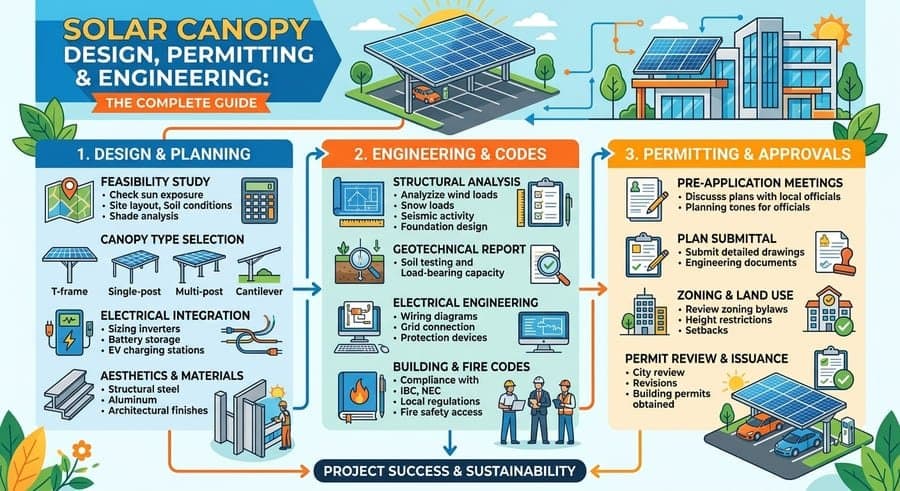
Solar Canopy Design, Permitting & Engineering: The Complete Guide
Discover solar canopy types, costs, benefits and how they work in 2025. Learn ab...
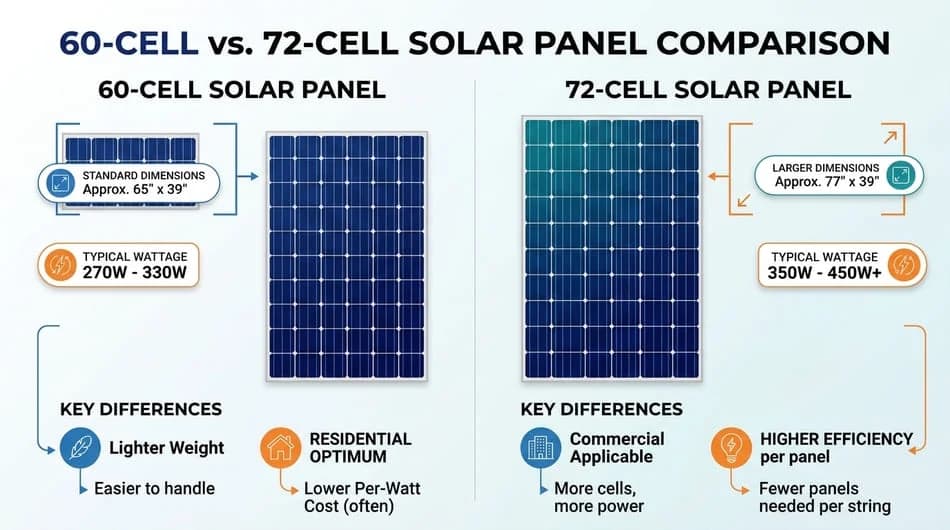
60-Cell VS 72-Cell Solar Panels: Complete Comparison Guide
Compare 60-cell vs 72-cell solar panels. Learn key differences in size, power ou...
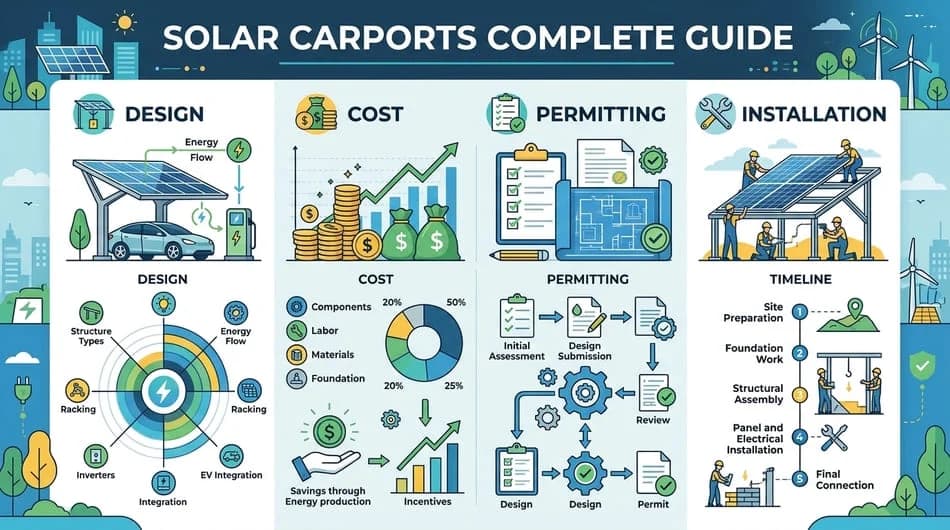
Solar Carports: Complete Guide to Design, Cost, Permitting & Installation
Complete solar carport guide for installers: cost per watt, engineering requirem...