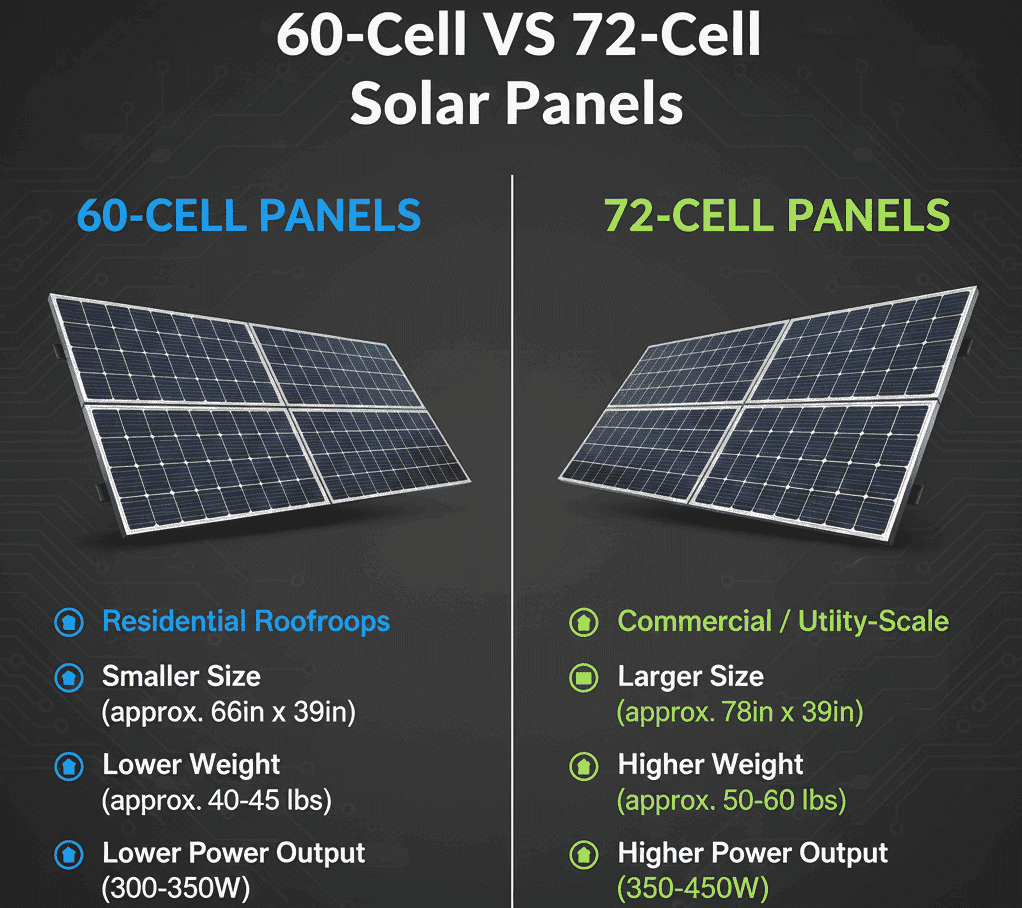
60-cell solar panels measure approximately 5.4 feet by 3.25 feet, while 72-cell panels measure roughly 6.5 feet by 3.25 feet. The primary differences between these configurations include
Key Differences:
- Size: 72-cell panels are about 1 foot taller than 60-cell panels due to two additional cell rows
- Best Use: 60-cell panels dominate residential installations; 72-cell panels serve commercial and utility-scale projects
- Power Output: Both can produce 300-400+ watts depending on cell quality, not just cell count
- Installation: 60-cell panels offer easier handling and fit tight spaces; 72-cell panels reduce total panel quantities needed
- Cost Efficiency: 72-cell panels lower large-scale installation costs; 60-cell panels reduce residential labor expenses

60 vs 72 Cell Solar Panels: Which Should You Choose?
- Choose 60-cell panels for residential roofs, limited space, complex layouts, or strict setback requirements
- Choose 72-cell panels for commercial buildings, ground-mount systems, or large-scale installations with ample space
The solar panel market offers numerous configurations, but 60-cell and 72-cell assemblies represent the two dominant standards for residential and commercial solar installations. Understanding the distinctions between these panel types and determining which configuration suits your specific project requirements becomes essential when planning your solar energy system.
Understanding Solar Photovoltaic Cells
Solar photovoltaic cells serve as the fundamental building blocks that transform sunlight into usable electrical energy. These cells utilize crystalline silicon wafer technology to capture and convert solar radiation. The conversion process activates when photons strike the silicon material, causing electrons to gain energy and flow through the cell’s structure, generating direct current electricity.
Individual photovoltaic cells generate minimal electrical output, making it necessary to combine multiple cells into integrated solar panel modules. Modern solar panels contain anywhere from 36 to 144 individual cells depending on the design specifications. The predominant configurations in today’s solar market are 60-cell and 72-cell panel assemblies.
Key Differences Between 60-Cell and 72-Cell Solar Panels
Both 60-cell and 72-cell configurations work effectively across various installation types, including rooftop systems, ground-mounted arrays, solar carports, and other applications. However, installation patterns reveal distinct preferences: 60-cell panels dominate residential solar projects, while 72-cell panels typically serve commercial and utility-scale deployments. Several critical factors differentiate these configurations and influence the optimal choice for specific installations.
Physical Dimensions and Size Specifications
The increased cell count in 72-cell panels directly impacts their physical footprint, making them substantially larger than 60-cell alternatives. Standard 60-cell panel construction arranges cells in a 6×10 grid pattern (six cells across, ten cells vertically). The 72-cell configuration maintains the same six-cell width but extends the height with two additional cell rows.
Converting these layouts to actual measurements: 60-cell panels typically measure approximately 5.4 feet in length by 3.25 feet in width. The 72-cell panels maintain similar width dimensions but extend to roughly 6.5 feet in height.
These dimensional differences significantly affect solar array design and layout planning. Properties with expansive, unobstructed roof surfaces or substantial ground area can accommodate either configuration without constraints. However, installations facing space limitations or complex architectural features benefit from 60-cell panels. Examples include isolated dormer installations, compact garage roofs, or layouts requiring panels to fit unconventional spaces. The reduced dimensions of 60-cell panels enable placement in confined areas where 72-cell modules cannot physically fit.
Narrow roof configurations present another scenario favoring 60-cell panels. When building code requirements or fire safety regulations mandate strict setback requirements around solar arrays, the shorter profile of 60-cell panels provides greater flexibility. Consult with certified solar installers to evaluate your specific roof characteristics and determine the optimal panel configuration for your property.
Installation Cost Considerations
Installation expenses vary between 60-cell and 72-cell panel systems based on project scale and deployment strategy. Large-scale commercial installations typically achieve lower costs with 72-cell panels. The higher cell count per panel means fewer total panels needed to reach the target. system capacity. Reduced panel quantities translate to decreased racking infrastructure, mounting hardware, and overall material expenses.
Conversely, 60-cell panels offer installation advantages for residential rooftop systems. Their lighter weight and more manageable dimensions simplify handling and positioning during installation, potentially reducing labor hours and associated costs. Commercial projects utilizing 72-cell panels mitigate size and weight challenges by employing mechanical lifting equipment such as cranes for rooftop placement, making the larger dimensions less problematic at scale.
Power Output and Wattage Performance
While 72-cell panels contain additional photovoltaic cells that could theoretically produce higher wattage ratings, cell count alone doesn’t determine power output. Panel performance depends primarily on the quality, efficiency, and manufacturing standards of the individual solar cells rather than quantity.
Consider a practical comparison: a 310-watt 72-cell panel may actually deliver less power than a 325-watt 60-cell module from a different manufacturer using higher-efficiency cell technology. This demonstrates that advanced cell quality can outperform raw cell quantity.
Premium high-wattage panels often combine superior cell efficiency with increased cell counts. For instance, 405-watt 72-cell panels represent the upper performance tier in the solar market. While 60-cell configurations rarely reach 400-watt outputs, high-efficiency models can achieve 350 watts or higher ratings.
Solar Permit Solutions
Need Solar Permit Plans?
Professional, permit-ready solar plan sets delivered fast. Residential and commercial projects across all 50 states.
Additional Selection Criteria for Solar Panels
Cell count represents just one specification among multiple factors requiring evaluation when selecting solar equipment. Prioritize comprehensive assessment of cost efficiency, visual appearance, warranty coverage, energy conversion efficiency, and long-term durability when choosing panels for residential or commercial installations.
Cost Analysis: Evaluate panel options using cost-per-watt ($/W) metrics to standardize pricing comparisons. This approach mirrors the dollars-per-square-foot methodology used in real estate evaluation. The $/W calculation reveals the true installed system cost normalized per unit of generating capacity, enabling accurate comparisons between 60-cell and 72-cell systems of varying sizes.
Aesthetic Considerations: Solar panels come in diverse visual configurations, including cell colors (dark blue, blue, and black), backsheet colors (white and black), and frame finishes (silver, black, and white). Request visual samples or completed installation photographs from your contractor before finalizing equipment selection to ensure the appearance aligns with your preferences. Black-on-black panel designs deliver the most streamlined visual profile, though premium aesthetic options typically carry higher price points. HOA regulations may also influence design choices in certain communities.
Performance Specifications: Compare warranty terms, efficiency ratings, and durability metrics across different panel manufacturers to identify products offering optimal long-term value and reliability for your solar investment.
Conclusion
Selecting between 60-cell and 72-cell solar panels requires careful evaluation of your specific installation requirements, available space, budget parameters, and performance objectives. Neither configuration inherently outperforms the other; the optimal choice depends on your unique circumstances. Residential installations typically benefit from 60-cell panels due to their compact dimensions, lighter weight, and easier roof integration. Commercial and utility-scale projects often achieve better economies of scale with 72-cell panels, reducing overall system costs through fewer required panels and simplified racking infrastructure.
Beyond cell count, prioritize panel quality, efficiency ratings, warranty coverage, and total system cost per watt when making your final decision. Consult with Solar Permit Solutions professionals who can assess your property’s characteristics, electrical requirements, and layout constraints to recommend the configuration that maximizes your solar investment returns. Understanding permit timelines and avoiding common design mistakes ensures smooth project approval. The right panel choice balances physical compatibility with your installation site, budget considerations, and long-term energy production goals.
FAQs
What is the average cost difference between 60-cell and 72-cell solar panel installations?
Installation costs depend more on project scale and labor requirements than panel type alone. Large commercial installations using 72-cell panels often achieve lower total costs because fewer panels are needed to reach target capacity, reducing racking materials and installation time. Residential installations with 60-cell panels may experience lower labor costs due to easier handling and positioning of lighter, more compact panels. The meaningful cost comparison uses the cost-per-watt ($/W) metric rather than total panel price. Calculate your complete system cost divided by total wattage capacity to accurately compare 60-cell versus 72-cell installations. Most residential projects find minimal price difference when evaluated on a $/W basis after accounting for all installation factors. Consider available federal tax credits and potential credit denial scenarios when budgeting.
Need Solar Permit Plans?
Professional, permit-ready solar plan sets delivered fast. Residential and commercial projects across all 50 states.
Frequently Asked Questions
Neither 72-cell nor 60-cell panels are universally superior—each configuration excels in different applications. The 72-cell panels work best for large-scale commercial installations and ground-mounted systems where space isn't constrained, offering potential cost savings through reduced panel quantities. The 60-cell panels prove ideal for residential rooftops with limited space, complex layouts, or strict setback requirements. Panel quality, efficiency ratings, and manufacturer specifications impact performance more significantly than cell count alone. Choose based on your installation site characteristics, available space, and project scale rather than assuming more cells automatically means better performance.
Cell count doesn't directly determine power output—a 72-cell panel doesn't automatically produce 20% more electricity than a 60-cell panel. Power generation depends primarily on individual cell quality and efficiency rather than quantity. High-efficiency 60-cell panels can outperform standard 72-cell panels. For example, a premium 325-watt 60-cell panel generates more electricity than a standard 310-watt 72-cell panel. However, the highest-wattage panels (400+ watts) typically combine superior cell technology with 72-cell configurations. Always compare actual wattage ratings and efficiency percentages rather than cell counts when evaluating power output potential.
You can install 72-cell panels on residential roofs if your property meets specific requirements. The roof must have sufficient continuous space to accommodate the larger dimensions (approximately 6.5 feet tall by 3.25 feet wide per panel). Consider whether your roof structure can support the additional weight, as 72-cell panels are heavier than 60-cell alternatives. Verify that local fire codes and setback requirements don't restrict panel placement due to the increased height. Complex roof geometries, dormers, or narrow roof sections typically make 60-cell panels more practical. Schedule a professional site assessment to determine if your residential roof can accommodate 72-cell panels effectively.
Installation costs depend more on project scale and labor requirements than panel type alone. Large commercial installations using 72-cell panels often achieve lower total costs because fewer panels are needed to reach target capacity, reducing racking materials and installation time. Residential installations with 60-cell panels may experience lower labor costs due to easier handling and positioning of lighter, more compact panels. The meaningful cost comparison uses the cost-per-watt ($/W) metric rather than total panel price. Calculate your complete system cost divided by total wattage capacity to accurately compare 60-cell versus 72-cell installations. Most residential projects find minimal price difference when evaluated on a $/W basis after accounting for all installation factors.
Determining the right panel size requires evaluating multiple property-specific factors. Start by assessing available roof space—measure continuous unobstructed areas suitable for panel placement. Consider roof complexity, including dormers, vents, skylights, and architectural features that might limit panel positioning. Review local building codes and fire department setback requirements that mandate clearances around solar arrays. Calculate your energy consumption needs to determine total system capacity requirements. Properties with ample simple roof space can accommodate either configuration, while homes with space constraints, narrow roofs, or complex layouts typically benefit from 60-cell panels. Request professional site assessments from multiple certified solar installers who can provide customized recommendations based on your roof's structural capacity, orientation, shading analysis, and electrical service specifications.
Panel lifespan depends on manufacturing quality, materials, and warranty coverage rather than cell count configuration. Both 60-cell and 72-cell panels typically carry similar 25-year performance warranties from reputable manufacturers, guaranteeing 80-85% of original output after 25 years of operation. Actual panel longevity often exceeds 30 years with proper installation and minimal maintenance. Focus on manufacturer reputation, warranty terms, product certifications, and quality ratings when evaluating durability. Premium panels from established manufacturers using high-grade materials and robust construction methods outlast budget options regardless of whether they contain 60 or 72 cells. Review independent performance testing data and manufacturer track records to assess expected lifespan rather than basing durability assumptions on cell count alone.

SPS Editorial Team
Solar Permit Solutions
Solar Permit Solutions provides professional solar permit design services for residential, commercial, and off-grid installations across all 50 states. Our team ensures permit-ready plan sets delivered fast.
Related Articles
How Many Solar Panels Do I Need to Run Off the Grid?
Most off-grid homes need about 8 to 16 solar panels rated at 400 watts, dependin...
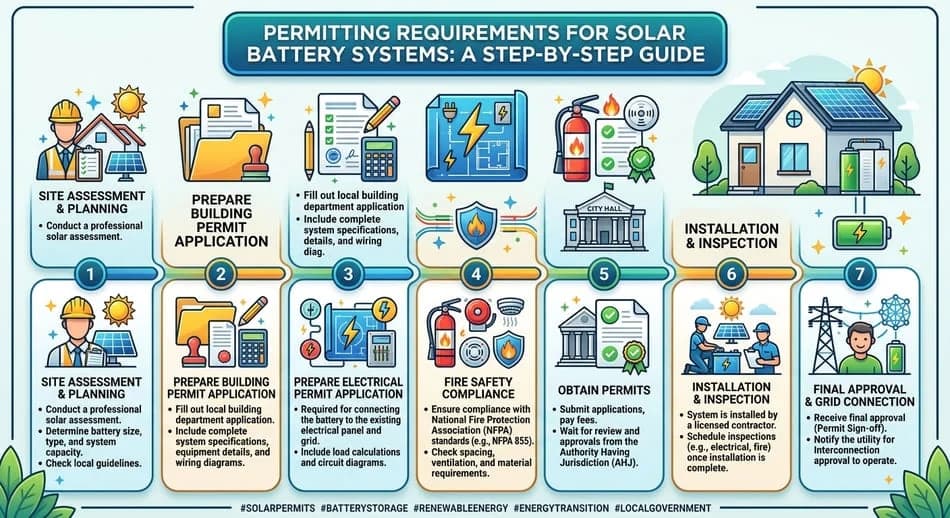
Solar Battery Permit Requirements: What You Need to Know
A solar battery usually needs local approval and a utility review before it can ...
How To Add A Battery To Your Existing Solar System
Adding a battery to your solar system costs $10,000-$20,000. Save with 30% feder...