
What is AHJ solar permitting and why does it matter? AHJ solar permitting is the mandatory approval process required from the Authority Having Jurisdiction (AHJ), typically your local building department, fire marshal, or electrical inspector, before any solar energy system can be legally installed and energized. Every solar project in the United States must obtain an AHJ permit and pass inspection to ensure compliance with the National Electrical Code (NEC), local building codes, and safety standards.
How long does the AHJ solar permitting process take? The timeline varies significantly by jurisdiction, ranging from a few days for streamlined residential permits under 15 kW to several weeks or months for commercial projects. States like California have implemented expedited permitting processes, while other areas may require multiple review cycles and in-person submissions.
What documents do you need for AHJ solar permitting? Standard requirements include structural and electrical engineering plans, site plans showing panel placement and setbacks, equipment specification sheets for modules and inverters, proof of HOA approval (if applicable), and utility interconnection agreements. The specific documentation depends on your local AHJ’s requirements, project size, and property type.
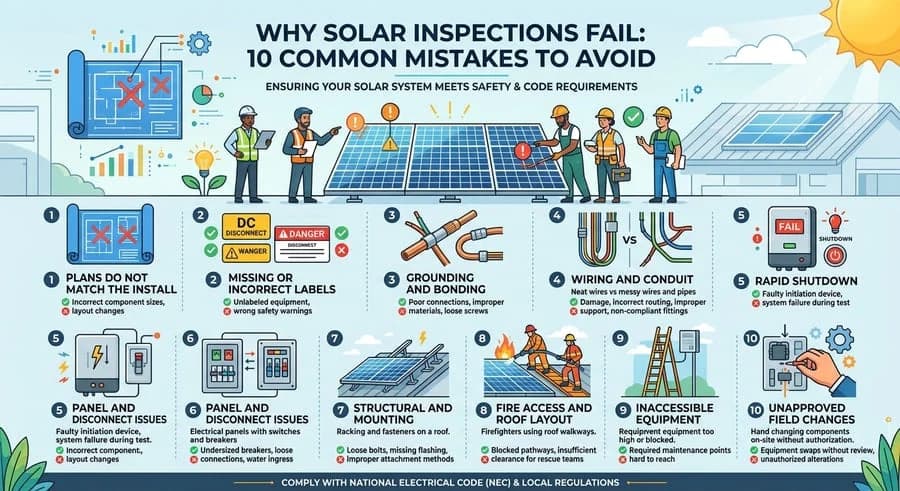
What are the most common reasons AHJ solar permits get rejected? The top five AHJ corrections that delay solar permits are: missing structural load calculations for wind and snow, conductor and breaker size mismatches that violate NEC 690, incomplete equipment specification sheets, inadequate labeling and rapid shutdown compliance per NEC 690.12, and missing rooftop access pathways required for fire safety (typically 3-foot clearances).
Do all solar installations require AHJ permits? Most solar installations require AHJ permits, including residential rooftop systems, commercial projects, and ground-mounted arrays. However, off-grid systems in rural areas may not always require permits depending on local jurisdiction. Regardless of location, it’s essential to verify requirements with your local AHJ before beginning any solar installation to avoid penalties, project delays, or forced system removal.
Understanding these fundamentals of AHJ solar permitting helps solar contractors minimize delays, reduce soft costs, and maintain positive relationships with local authorities. The following guide provides six proven strategies to streamline your AHJ permitting process and ensure faster project approvals.

Defining the AHJ
The AHJ designation identifies the municipal authority tasked with verifying that projects satisfy safety codes and regulations. This entity might be a building department, fire marshal, or another organization supervising construction and electrical operations to maintain safety and code compliance. These authorities examine plans, distribute AHJ permits, and perform inspections confirming projects fulfill all required standards.
Standard AHJ Solar Permit Requirements
Below are typical requirements for AHJ permits:
Structural Engineering Plans: AHJs may mandate a structural engineering solar plan set covering the solar energy system, encompassing solar panel configuration, racking specifications, and electrical connections.
Electrical Engineering Plans: AHJ solar standards may necessitate electrical engineering plans outlining the electrical elements of the solar energy system, including utility interconnection, wiring schematics, and equipment specifications.
Solar Site Plan: A site plan displaying solar panel placement, proximity to neighboring structures, setback distances, clearance from soffits and ridges, plus additional pertinent details.
Solar Equipment Specification Sheets: Most AHJs demand comprehensive technical specifications for solar panels, inverters, racking systems, and additional components, confirming adherence to local codes and standards for the solar permit submission.
Building Permit and/or Electrical Permits: AHJ solar standards frequently incorporate building and/or electrical permits for solar panel installation, with certain AHJs requiring both.
Homeowners Association (HOA) Approval: When a homeowners association oversees the property, the AHJ may seek documentation of the solar energy system approval from the association.
Fire Department Approval: Local fire departments occasionally must authorize the solar energy system design to verify fire safety standards compliance, though many AHJs don’t mandate this for solar permits.
Zoning Review: This might encompass factors like setbacks, solar equipment screening from public visibility, building height specifications, and additional aesthetic or design-oriented requirements for solar energy systems.
Utility Interconnection Agreement: AHJs may demand evidence of an executed interconnection agreement between the customer and utility provider as part of solar permitting procedures.
Compliance with National and Local Electrical Codes: AHJs may enforce specific codes or ordinances requiring adherence, including the National Electrical Code (NEC) and particular local codes.
Environmental Impact Review: AHJs may mandate an environmental impact assessment for solar panel installations, particularly for substantial commercial projects.
AHJ Solar Inspection: A solar inspection constitutes a methodical evaluation performed to confirm proper installation, safety, and compliance of a solar energy system with applicable codes and standards.
Common Obstacles in Obtaining AHJ Solar Permits
The renewable energy permitting pathway can present challenges with AHJs or utility companies that elevate your soft costs. Occasionally, permitting extends for considerable periods, creating project delays. Sometimes, assembling all necessary documentation or comprehending specific AHJ requirements proves challenging.
Varying AHJ Solar Permitting Requirements
Requirements frequently differ between neighboring municipalities or even properties within the same municipality. For instance, when installing a solar energy system on a historical structure, restrictions may exist concerning solar panel visibility from public streets.
Homeowners Association (HOA) Solar Permitting Requirements
AHJ solar regulations may intersect with HOA solar permitting mandates. When a homeowners association or condominium association governs the property, compliance with their covenants, conditions, and restrictions (CC&Rs) becomes essential. HOAs oversee 40 million homes in the U.S. and can levy fines or liens when homeowners don’t follow their solar installation protocols.
AHJ Solar Permits for Historical Properties
When planning to install a solar energy system on a historical structure, special considerations may apply regarding solar panel street visibility. Municipal historic preservation societies or zoning boards may participate in the solar panel permitting process to ensure the building’s exterior aesthetics remain unaffected.
Pole-Mounted Solar Projects
Installing pole-mounted solar panels may necessitate having an engineer determine the foundation specifications, accounting for soil composition and maximum wind loads. Fortunately, residential rooftop solar systems seldom face such restrictions. However, when a solar energy contractor remains unaware of local AHJ permitting requirements for pole-mounted arrays, it can increase project costs and extend the project timeline, so consider this when preparing job bids.
Utility-scale Solar Project Permits
Utility-scale solar farms frequently encounter more intricate permitting processes because of their larger scope and potential effects on local grid infrastructure and natural resources. These projects may demand extensive environmental impact studies, interconnection agreements with utility companies, and compliance with regional planning and zoning mandates. Understanding solar radiation patterns across different regions helps inform system design and permitting requirements for large-scale installations.
Solar Permit Solutions
Skip the Permit Headaches
We design plan sets that pass inspection the first time. Code-compliant, PE-stamped, accepted by AHJs nationwide.
TOP 5 AHJ CORRECTIONS THAT DELAY SOLAR PERMITS
Missing Structural Loads Provide required stamped PE calculations for wind, snow, and roof loads.
Conductor / Breaker Mismatch Correctly size wiring and OCPD per NEC 690.
Incomplete Spec Sheets Include module, inverter, and racking datasheets with every submission.
Labeling & Rapid Shutdown Display NEC 690.12 compliant labels and RSD layout in your plan set.
Rooftop Access & Pathways Update site plan with required 3-ft fire access pathways.

6 Strategies for AHJ Solar Permitting Success
- Organize Before Beginning The AHJ Solar Permitting Process
Maintaining organization ensures the AHJ permit process proceeds smoothly for all parties. Many solar companies designate one or two staff members to manage all permitting tasks and serve as primary AHJ contacts.
Similarly, conveying permitting requirements to customers proves critical, especially when they create delays or additional costs. For instance, when the utility company must upgrade a transformer, this can cause delays beyond your control. Without proactively communicating this, customer dissatisfaction can result. Understanding residential solar system costs upfront helps set proper expectations with clients about both equipment and permitting expenses.
- Investigate AHJ Solar Permitting Requirements
Understanding the permitting requirements for a specific PV system proves critical. Many AHJs will demand an electrical permit, while others require a building permit as well. Ideally, you’ll possess all necessary information on AHJ solar permits before bidding on a project since it can influence your costs and solar system design.
Many permitting requirements stem from National Electrical Code requirements, but AHJs may impose additional AHJ permit requirements. Ground-mounted solar panel systems may also necessitate environmental permits, especially for larger commercial projects and solar farms. Research any additional restrictions from a condominium association, HOA, or due to historical zoning or designations.
When such restrictions exist, ensure you understand the requirements clearly. In certain situations, communicating directly with a condominium association or HOA proves helpful. This might seem time-intensive, but it beats relocating solar panels after completing the installation.
Unfortunately, utility interconnection may necessitate utility grid upgrades, particularly for larger photovoltaic (PV) solar systems. Investigating this during the design phase remains essential to maintaining projects on schedule and budget and obtaining permission to operate (PTO).
- Assemble Your AHJ Permit Application
Gather all required documents and forms from the AHJ solar office to submit applications for different permits, including an AHJ permit when required. Having everything compiled in a presentable package ensures the reviewer can examine everything simultaneously. This reduces the time necessary to secure solar permit approval and maintains positive relationships with the AHJ, utility company, or HOA.
For certain residential projects, simply listing the solar equipment, such as the panels, inverter, and mounting hardware, may suffice. However, solar drawings become necessary for other residential projects and larger commercial solar installations. Pay special attention to rapid shutdown requirements and exemptions when preparing your application package.
Many AHJs permit online applications, though some permit applications have traditionally demanded an in-person visit.
- Evaluate Using a Solar Permit Service
Many solar contractors lack sufficient time or expertise to develop solar plan sets or perform engineering reviews. Specialized solar permitting services with networks of licensed engineers across all 50 states can save time and reduce staffing requirements, lowering overhead costs.
- If the AHJ Rejects the Solar Permit, Determine What’s Wrong
When your AHJ permit or grid interconnection application faces rejection, understanding the reason proves essential. In certain cases, mitigation will be straightforward. In others, advancing with a project might prove difficult, or extended delays could occur. For example, solar farms sometimes experience delays due to interconnection issues.
- Install The Solar System According to the Solar Plan Set
Installing the solar system according to the solar plan set proves critical to passing the AHJ solar inspection because the plans specify the structural and electrical components of the system, ensuring compliance with safety regulations and building codes.
Any departure from the plan set could create safety hazards, structural problems, or non-compliance with local regulations, potentially resulting in AHJ permit issues, inspection failure, and project delays.
Streamline Your Solar Permitting Efforts To Save Time
Considering permitting before designing the solar project proves essential, as it may influence your designs and project timeline. Although the PV permitting process may appear daunting, solar installers can take numerous steps to streamline and simplify the process.
Solar designers and engineers with experience working with AHJs nationwide can help solve your most challenging AHJ solar permitting obstacles.
Conclusion
Mastering the AHJ solar permitting process stands as a critical component of successful solar project execution. While navigating varying requirements across different jurisdictions, understanding HOA regulations, and managing potential delays may seem challenging, proper preparation and systematic approaches can transform permitting from an obstacle into a manageable workflow step.
Success in AHJ solar permitting hinges on three fundamental principles: thorough research of local requirements before project bidding, meticulous organization of all required documentation and specifications, and strict adherence to approved plan sets during installation. Solar contractors who invest time in understanding their local AHJ’s specific requirements, maintain clear communication with all stakeholders, and ensure their plan sets meet structural and electrical code standards will experience fewer rejections, faster approval times, and smoother inspection processes.
Remember that every jurisdiction presents unique challenges, whether involving historical property restrictions, pole-mounted system specifications, or utility-scale project complexities. By treating the permitting process as an integral part of project planning rather than an afterthought, solar professionals can minimize soft costs, reduce project timelines, and maintain positive relationships with AHJs, utility companies, and customers alike.
The solar industry continues to evolve, with many municipalities working toward streamlined permitting processes that reduce barriers to solar adoption. Staying informed about these changes, maintaining organized documentation practices, and approaching each permit application with attention to detail will position your solar business for long-term success in an increasingly competitive market. With the right preparation and knowledge, AHJ solar permitting becomes not just a regulatory requirement, but an opportunity to demonstrate professionalism and build trust with authorities and clients throughout your service area.
FAQs
Let’s examine some common permitting questions that solar installers and clients encounter.
Skip the Permit Headaches
We design plan sets that pass inspection the first time. Code-compliant, PE-stamped, accepted by AHJs nationwide.
Frequently Asked Questions
The AHJ solar permitting process can require varying timeframes, depending on the AHJ. Some state and local governments and municipalities, such as the State of California, have undertaken focused efforts to establish a streamlined permitting process to facilitate solar adoption. Sometimes, expedited solar permits become available for residential solar systems under 15 kW.
Permitting requirements for off-grid solar systems vary considerably by location. Often, you won't need to secure an AHJ permit for customers in rural areas. This represents good news because it saves time and solar permitting fees. However, some towns and cities mandate permitting for off-grid solar arrays. The beneficial (and time-saving) aspect is that because the system isn't connected to the power grid, interconnection approval becomes unnecessary.
The AHJ meaning in solar designates the Authority Having Jurisdiction, the local government entity responsible for enforcing building codes and regulations for solar installations. This encompasses reviewing plans, issuing AHJ permits, conducting inspections, and ensuring compliance with safety standards. Depending on the jurisdiction, AHJs can be municipal building departments, fire departments, or electrical inspectors.
Setback requirements for solar PV projects differ depending on the jurisdiction and property type. They're typically established to ensure a safe distance from property lines and neighboring structures and to prevent shading issues. Consult with the AHJ to identify the specific setback requirements for your location and to incorporate them in your AHJ solar permit application.
Installing solar panels without obtaining the required AHJ permit can result in serious consequences, including substantial fines, mandatory system removal, voided equipment warranties, denial of utility interconnection, and difficulty selling your property. Additionally, unpermitted solar installations may violate local building codes, create liability issues if damage or injury occurs, and prevent you from receiving solar incentives, rebates, or tax credits. Most importantly, insurance companies may refuse to cover damages related to unpermitted solar systems, leaving property owners financially exposed. Always secure proper AHJ permits before installation to protect your investment and ensure legal compliance.

SPS Editorial Team
Solar Permit Solutions
Solar Permit Solutions provides professional solar permit design services for residential, commercial, and off-grid installations across all 50 states. Our team ensures permit-ready plan sets delivered fast.
Related Articles
Why Solar Inspections Fail: 10 Common Mistakes to Avoid
Discover the 9 critical reasons solar inspections fail and how to avoid costly m...

Solar Grounding And Bonding: How To Pass Inspection Every Time
Learn how to pass solar grounding and bonding inspections every time. Avoid comm...
Solar Inspection After Installation: What Happens Next?
Learn how to pass your solar inspection by following essential tips for obtainin...