Solar permit design is the process of creating detailed engineering plan sets, including site plans, electrical single-line diagrams, structural calculations, and equipment specifications, that local authorities (AHJs) require before approving a solar panel installation. A professionally prepared permit plan set must comply with the National Electrical Code (NEC 2023 in most jurisdictions) along with jurisdiction-specific building and fire codes. A PE-stamped engineering review is required in most states, and the entire plan set typically takes 1-2 business days to produce through a professional service.
This guide covers everything solar contractors, installers, and homeowners need to know about solar permit design, from what a plan set includes and how the permitting process works to why permits get rejected and how to get first-pass approval from your local Authority Having Jurisdiction.
What Is Solar Permit Design?
Solar permit design is the engineering documentation process that translates a solar installation concept into a complete set of construction-ready, code-compliant drawings and calculations. These documents, collectively called a plan set or permit package, are submitted to your local Authority Having Jurisdiction (AHJ) for review and approval before any installation work can begin.
The plan set serves two purposes. First, it demonstrates to the building department that the proposed solar system meets all applicable electrical, structural, and fire safety codes. Second, it provides the installation crew with precise construction documents showing exactly where and how every component should be installed. Without an approved permit, a solar installation is considered illegal in virtually every U.S. jurisdiction, and proceeding without one can result in fines, forced system removal, voided homeowner insurance, and serious complications when selling the property.
Why Solar Permits Are Required
Solar permits exist to protect public safety. A photovoltaic system introduces significant electrical loads onto a building’s structure and connects to the utility grid, creating potential hazards if the system is improperly designed or installed. Building departments review permit plans to confirm that the roof or ground structure can support the added weight, that all electrical wiring and connections meet the National Electrical Code, that fire department access pathways are maintained, and that the system will not create hazards for first responders or utility workers.
Beyond safety, permits also protect the homeowner’s investment. An unpermitted solar system can create title issues during a property sale, may not qualify for utility interconnection agreements, and will not be eligible for net metering credits in most utility territories.
Building Permits vs. Electrical Permits vs. PV-Specific Permits
The type and number of permits required for a solar installation vary by jurisdiction. Some AHJs issue a combined solar or PV permit that covers both structural and electrical review under a single application. Others require separate electrical and building permits, which may involve different reviewers and different fee schedules. In certain jurisdictions, fire department review is also required as a standalone approval, particularly for commercial installations or systems in wildfire-prone areas.
The key takeaway for installers is to confirm permit requirements with the specific AHJ before beginning plan set preparation. What works in one city may not work in the neighboring county. Resources like SolSmart’s National Simplified Permitting Guide and the International Code Council (ICC) provide useful frameworks, but local requirements always take precedence.

What Does a Solar Permit Plan Set Include?
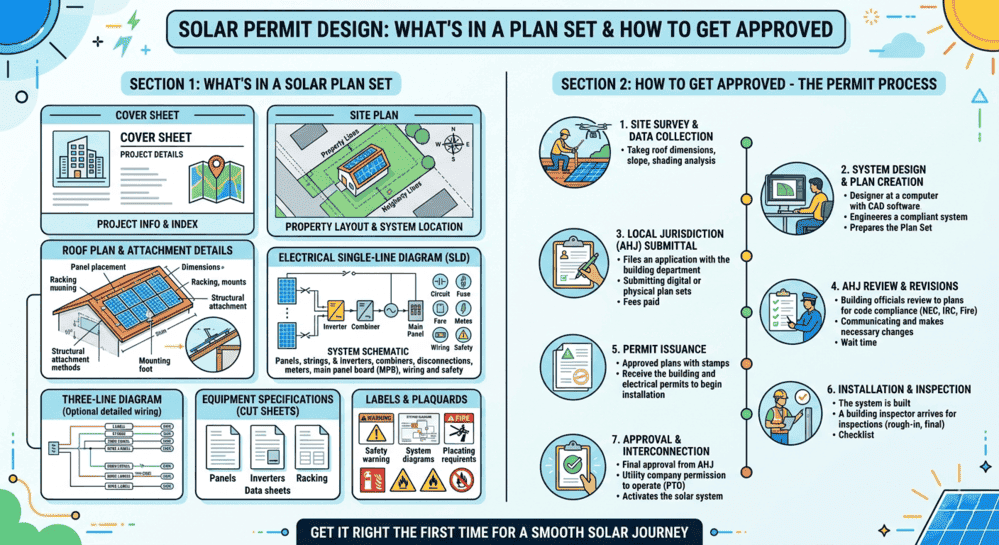
A solar permit plan set is a collection of engineering drawings, calculations, and documentation that gives the AHJ everything it needs to verify code compliance. While exact requirements vary by jurisdiction and project complexity, most permit-ready plan sets include the following core components:
- Cover sheet: Project description, site address, contractor and engineer contact information, applicable code editions, and AHJ-specific notes or disclaimers.
- Site plan and array layout: An overhead view of the property showing panel placement, property boundaries, setback dimensions from ridges, eaves, and edges per fire code, access pathways for firefighters, and the locations of the utility meter, electrical panel, and inverter.
- Roof plan with dimensions: Detailed roof measurements including all obstructions (vents, skylights, chimneys, plumbing stacks), fire setback zones per the International Fire Code (IFC), and exact panel positions with row and column spacing.
- Electrical single-line diagram: A simplified schematic of the entire electrical system from solar panels through string wiring, combiner boxes (if applicable), inverters, disconnects, and the point of grid interconnection. This is the document most AHJ reviewers scrutinize first.
- Three-line diagram (commercial/complex systems): A detailed AC-side wiring diagram showing all three phases, neutral, and ground conductors. Most residential projects require only a single-line diagram; commercial and utility-scale projects typically require both.
- Structural calculations and load analysis: Engineering computations verifying that the roof structure can support the added dead load of the solar array plus wind uplift and snow loads per ASCE 7. Includes rafter or truss spacing, member sizes, and material specifications.
- NEC calculations: Conductor sizing per NEC 310, overcurrent protection per NEC 240, voltage drop calculations, the 120% busbar rule calculation per NEC 705.12, and ground fault protection documentation per NEC 690.41.
- Equipment datasheets and bill of materials (BOM): Manufacturer specification sheets for every component, panel, inverter, racking, disconnect, conduit, and wire, showing UL listings, electrical ratings, and dimensional data.
- Safety placards and labeling: Documentation showing all required NEC 690.56 placards, rapid shutdown signage per NEC 690.12, and any local labeling requirements for fire department access.
- Notes and governing codes: The specific NEC edition the design references (2017, 2020, 2023, or 2026), the IBC/IRC edition, and any local code amendments the AHJ enforces.
- Elevation views: Side-view drawings showing panel tilt angle, mounting height, and clearances. Required by some AHJs, particularly for ground-mount and commercial rooftop systems.
Site Plan and Array Layout
The site plan is the AHJ reviewer’s first visual reference for the entire project. It must accurately represent the property as it exists today, not just the proposed solar installation. Reviewers check site plans against satellite imagery and GIS records, so inaccurate property boundaries or missing structures will trigger immediate redlines. For residential rooftop systems, the site plan must clearly show fire setback dimensions, typically 3 feet from ridges and hips, 18 inches from eaves and valleys, and a minimum 3-foot-wide access pathway, per IFC requirements adopted by the local jurisdiction. Commercial site plans require additional detail, including parking areas, landscape features, and emergency vehicle access routes.
Electrical Single-Line and Three-Line Diagrams
The single-line diagram (SLD) is the electrical backbone of the permit plan set. It traces the circuit path from the PV modules through string wiring, combiner boxes, charge controllers (for battery systems), inverters, AC and DC disconnects, production meters, and the point of utility interconnection. Every component must be labeled with its manufacturer, model number, and relevant electrical ratings. Three-line diagrams expand the single-line schematic to show individual phase conductors, neutral, and equipment grounding conductors on the AC side. These are standard for commercial projects and any system with three-phase electrical service.
Structural Calculations and Load Analysis
Structural calculations verify that the building can safely support the additional weight and wind loads created by the solar array. A licensed professional engineer evaluates the existing roof framing, rafter or truss size, spacing, material, and span, against the added dead load of the panels, racking, and attachment hardware. Wind uplift calculations follow ASCE 7 standards and are critical in high-wind zones, hurricane-prone coastal areas, and regions with significant snow loads. For a detailed breakdown of how these calculations work, see our structural engineering calculations guide.
NEC Calculations and Code Compliance Notes
NEC calculations are the mathematical proof that the electrical design is safe and code-compliant. The most commonly required calculations include conductor sizing based on the maximum circuit current (NEC 690.8), overcurrent protection device ratings, voltage drop verification (ideally below 2% for DC circuits and 3% for AC runs), and the 120% busbar rule for load-side interconnections. The plan set must clearly state which NEC edition the design references, as different AHJs may still enforce NEC 2017, 2020, or 2023 depending on their adoption cycle.
Equipment Datasheets and Bill of Materials
Every piece of equipment specified in the plan set must include a manufacturer datasheet showing its UL listing, electrical specifications, dimensions, and warranty information. The bill of materials serves as both an installation checklist and a verification tool for the AHJ reviewer. Missing or expired UL listings on equipment spec sheets are one of the most common reasons for permit rejections, so this section requires careful attention to detail.
Solar Permit Solutions
Skip the Permit Headaches
We design plan sets that pass inspection the first time. Code-compliant, PE-stamped, accepted by AHJs nationwide.
The Solar Permitting Process: Step by Step
Understanding the full permitting workflow helps contractors plan realistic project timelines and avoid delays. While the specifics vary by jurisdiction, the process follows a consistent sequence from initial data collection through final inspection. For more detail on how long each phase takes, see our dedicated timeline guide.
Step 1: Site Assessment and Data Collection
Every solar permit design project begins with gathering accurate site data. For rooftop systems, this includes roof measurements and dimensions, photos or measurements of the existing electrical panel (busbar rating, main breaker size, available spaces), attic or truss photos showing rafter spacing, size, and material, and a shading analysis of the proposed array area. For ground-mount systems, a site survey with property boundaries and topographic data replaces the roof assessment. Many installers now use drone-based survey tools like Scanifly to capture precise 3D site models that feed directly into design software, reducing measurement errors and speeding up the design process.
Step 2: System Design and Engineering
Using the site data, a designer selects equipment (panels, inverters, racking) and configures the system layout. Industry-standard design tools include HelioScope, Aurora Solar, OpenSolar, and Unirac’s U-Builder. The designer determines string configuration, inverter sizing, conductor routing, and interconnection method (supply-side or load-side) based on the existing electrical service. The output of this phase is a preliminary system design that forms the basis of the permit plan set.
Step 3: Plan Set Creation
The system design is translated into the full permit plan set described in the previous section — site plan, electrical diagrams, structural calculations, NEC calculations, equipment datasheets, and all supporting documentation. Professional plan set services typically complete this step in 1-2 business days for residential projects. Creating a plan set in-house using CAD software is possible but requires significant expertise in AHJ-specific formatting requirements and increases the risk of rejection.
Step 4: PE Stamp and Engineering Review
A licensed Professional Engineer (PE) reviews the structural and/or electrical plans and affixes their seal, certifying that the design meets applicable codes. The PE must be licensed in the state where the project is located — a California PE stamp is not valid for a Texas project. Most states require PE-stamped plans for all grid-tied solar systems, though some jurisdictions waive the requirement for small residential systems below a certain kW threshold. The threshold varies: some states set it at 10 kW, others at 15 kW, and some require PE stamps regardless of system size. PE stamp services that offer all-50-state coverage work through networks of partner engineers licensed in each state.
Step 5: AHJ Submission and Plan Review
The completed, PE-stamped plan set is submitted to the local building department for review. Many AHJs now accept digital submissions through online portals, while others still require printed hard copies. Review timelines vary widely. In jurisdictions using SolarAPP+ (covered later in this article), permits can be approved the same day. Standard manual review typically takes 1-4 weeks for residential projects and 2-8 weeks for commercial. Some AHJs charge flat permit fees ($50-$500 for residential), while others use per-kW or valuation-based fee schedules.
Step 6: Revisions (If Required)
If the AHJ reviewer identifies issues with the plan set, they issue corrections, commonly called redlines or plan check comments. The plan set must be revised to address each comment and resubmitted for rereview. Common revision requests include missing safety labels, incorrect setback dimensions, outdated NEC edition references, and incomplete equipment specifications. Professional plan set services typically handle revisions within 12-24 hours at no additional cost. Multiple rejection cycles can delay a project by weeks, which is why first-pass approval matters so much.
Step 7: Permit Approval, Installation, and Inspection
Once the AHJ approves the plans and issues the building permit, installation proceeds exactly as specified in the approved plan set. Any deviations from the approved design, such as moving panels, changing inverter models, or altering wiring routes, may require a revised permit before the work can continue. After installation is complete, the AHJ conducts a final inspection to verify that the physical installation matches the approved plans. Upon passing inspection, the installer can proceed with the utility interconnection application to obtain Permission to Operate (PTO).
How Permit Requirements Vary by Location and Project Size
One of the most challenging aspects of solar permit design is that requirements differ significantly from one jurisdiction to the next and from one project type to another. A plan set format that earns first-pass approval in Phoenix may generate a stack of redlines in Chicago. Understanding these differences before starting the design process saves time, money, and frustration.
The table below summarizes how permit requirements scale with project size and complexity:
| Factor | Residential | Commercial | Utility-Scale |
| Typical System Size | 5-15 kW | 25-500 kW | 1 MW+ |
| PE Stamp Required? | Usually (varies by state/kW threshold) | Always | Always + environmental review |
| Permit Timeline | 1-4 weeks | 2-8 weeks | 3-12+ months |
| Diagrams Required | Single-line diagram | Single-line and three-line | Full electrical set + civil |
| Structural Review | Roof load analysis | Full structural and seismic | Foundation + geotechnical |
| Additional Permits | Electrical + building | + fire dept. + zoning | + environmental + land use |
State-Level Differences in Code Adoption and PE Stamp Rules
Different states adopt different editions of the National Electrical Code at different times, and some add state-specific amendments. California, for instance, enforces Title 24 energy code requirements on top of the NEC, while Texas follows a patchwork approach where major cities like Houston and Dallas typically require PE stamps for commercial systems, but many smaller jurisdictions have different standards. New York requires PE stamps for most installations, with snow load and wind exposure calculations that vary significantly between New York City and upstate regions.
PE stamp thresholds also vary by state. Florida requires PE stamps on virtually all solar installations with no size-based exemptions, driven by hurricane zone regulations. Other states exempt systems under 10 kW or 15 kW from the PE stamp requirement. The bottom line: always verify your specific AHJ’s requirements before submitting plans. Databases like DSIRE and direct contact with the local building department are the most reliable sources.
NEC Code Requirements for Solar Permit Design
The National Electrical Code is the foundation of every solar permit plan set. AHJ reviewers check plans against the NEC edition their jurisdiction has adopted, and referencing the wrong edition is one of the most common reasons for plan check comments. Below are the NEC articles most relevant to solar permit design.
NEC 2023 Article 690: Solar PV Systems
Article 690 is the core NEC article governing photovoltaic system design and installation. The sections most frequently reviewed during plan examination include maximum circuit current calculations (690.8), overcurrent protection requirements (690.9), disconnect requirements (690.15), rapid shutdown (690.12), ground fault protection (690.41), and labeling and signage (690.56). The 2023 NEC edition introduced several updates to Article 690, including revised requirements for arc fault protection and grounding configurations. Plan sets must clearly reference the specific NEC edition and demonstrate compliance with the version the local AHJ enforces.
NEC Article 705: Interconnection Requirements
Article 705 governs how distributed energy resources connect to the utility grid. For solar permit design, the most critical sections are 705.12 (load-side and supply-side interconnection rules), which includes the 120% busbar rule for load-side connections, and 705.13 (energy management systems). The 120% rule and supply-side connection documentation are among the most commonly flagged items in AHJ plan review, particularly when the existing electrical panel has limited capacity for a solar breaker.
Rapid Shutdown (NEC 690.12) and Fire Setback Requirements
Module-level rapid shutdown compliance is required in all jurisdictions that have adopted NEC 2017 or later. The standard requires that conductors within the array boundary drop to 80V or less, and conductors outside the array boundary drop to 30V or less, within 30 seconds of initiating shutdown. Compliance typically requires module-level power electronics (MLPEs) such as microinverters or DC optimizers. Plan sets must document the rapid shutdown method and identify all compliant equipment.
Fire setback requirements work hand-in-hand with rapid shutdown to protect first responders. The International Fire Code (IFC) and many local jurisdictions require clear access pathways on rooftops, typically 3 feet from ridges and a 3-foot-wide pathway from eave to ridge for firefighter access. Non-compliance with setback or rapid shutdown requirements is a frequent cause of permit rejection. For detailed guidance on fire code compliance, see our roof setback guide.

Solar Interconnection Agreements: What They Are and What You Need
An interconnection agreement is a separate but related process to the building permit. While the AHJ permit authorizes the physical installation, the interconnection agreement authorizes the system to connect to the utility grid. Without it, the system cannot legally export power or participate in net metering programs.
The interconnection process typically follows two phases. The first phase, Permission to Install (PTI), requires submitting the system design, equipment specifications, and a signed interconnection application to the utility before installation begins. The utility reviews the application to verify that the proposed system will not create grid stability issues and that the local distribution infrastructure can accommodate the additional generation. The second phase, Permission to Operate (PTO), occurs after installation and requires proof that the system passed AHJ inspection and was installed per the approved plans.
Utility interconnection applications generally require the number and rated capacity of solar panels and inverters, the electrical single-line diagram showing the point of grid connection, the location of the PV array, electrical panels, utility meter, and disconnects, and proof of IEEE 1547 compliance for anti-islanding protection. The timeline from PTO application to final utility approval ranges from a few days in streamlined jurisdictions to several months in utility territories with large interconnection backlogs.
For a complete application walkthrough, see our solar interconnection agreement checklist and guide.
Solar Permit Design for Battery Storage and ESS
The addition of battery energy storage systems (ESS) to a solar installation introduces permit design requirements that go well beyond a standard PV-only plan set. As battery storage adoption accelerates, more AHJs are requiring dedicated ESS documentation as part of the solar permit package.
NEC Article 706 governs energy storage system installations and works alongside Article 690 for combined PV+storage systems. NFPA 855, the Standard for the Installation of Stationary Energy Storage Systems, adds requirements for fire safety, ventilation, spacing, and suppression that are especially critical for indoor battery installations. Many AHJs are still developing their ESS review processes, which can lead to longer review times and more detailed correction requests compared to PV-only submissions.
Solar permit plan sets that include battery storage typically require additional documentation beyond the standard PV package: a battery location plan showing clearances from combustible materials and egress pathways, ventilation calculations for indoor installations, fire suppression or detection details where required by NFPA 855, updated electrical diagrams showing AC-coupled or DC-coupled battery integration with the PV system and grid, and revised NEC calculations reflecting the additional circuits, overcurrent protection, and disconnects required for the ESS.
One important note for existing solar installations: adding battery storage to a system that was originally permitted as PV-only typically requires a new or amended permit. The original plan set will not cover the additional electrical circuits, disconnects, and safety documentation that a battery system introduces. Plan accordingly and verify requirements with the local AHJ before beginning any retrofit work.
Common Solar Permit Rejection Reasons (And How to Avoid Them)
Permit rejections cost time and money. Every rejection cycle adds 1-4 weeks to the project timeline depending on the AHJ’s resubmission review queue. Based on patterns observed across thousands of plan set submissions to AHJs nationwide, these are the most frequent reasons solar permits get sent back for corrections:
- Incomplete or missing equipment datasheets. This is the single most common rejection reason. Every component in the BOM must have a current manufacturer spec sheet showing UL listing, electrical ratings, and dimensional data. Expired or draft UL listings will be flagged.
- Incorrect or missing fire setback dimensions. If the site plan does not clearly show setback distances from ridges, eaves, valleys, and edges per the locally adopted fire code, the plan will be returned. Setback requirements vary by jurisdiction, so using a template from one AHJ in a different jurisdiction often causes this issue.
- The wrong NEC edition was referenced. Submitting plans referencing NEC 2020 to a jurisdiction that adopted NEC 2023 or vice versa triggers an automatic revision request. Always verify the AHJ’s adopted code edition before starting design.
- Missing or incorrect rapid shutdown documentation. The plan set must identify the rapid shutdown solution, show it on the electrical diagram, and confirm compliance with NEC 690.12. Generic statements like ‘system complies with rapid shutdown’ without specific equipment identification are insufficient.
- Structural calculations not signed by a licensed PE. If the jurisdiction requires PE-stamped structural and/or electrical plans, submitting without the stamp is an automatic rejection regardless of the quality of the engineering.
- 120% busbar rule violation. For load-side interconnections, the combined rating of the main breaker and solar breaker cannot exceed 120% of the panel busbar rating per NEC 705.12. Plans that exceed this limit without a documented supply-side connection alternative are flagged immediately.
- Missing safety placards or labeling per NEC 690.56. The plan set must show all required warning labels, their text, and their locations. AHJ inspectors cross-reference these labels during the post-installation inspection.
- The site plan does not match actual conditions. Reviewers compare site plans to satellite imagery and GIS data. If the roof dimensions, property lines, or existing structures do not match, the plan is returned.
- Conductor sizing errors or missing voltage drop calculations. Undersized conductors or missing documentation of voltage drop within acceptable limits (typically 2% DC, 3% AC) are flagged as safety concerns.
- Missing or expired equipment UL listings. All solar equipment installed in the U.S. must carry valid UL certification. Plans specifying equipment without active UL listings or with listings that have been revoked or superseded are rejected.
What AHJs Actually Look For When Reviewing Solar Permit Plans
Most solar permit design guides tell you what to submit. This section explains what happens on the other side of the counter, how AHJ plan reviewers actually evaluate your submission, and what separates a first-pass approval from a revision cycle.
When a plan set lands on a reviewer’s desk (or screen), the evaluation typically follows a consistent pattern. The reviewer starts with the title block and cover sheet, checking that the project address matches their records, the contractor license is valid, the PE stamp is present and current, and the NEC edition referenced matches their jurisdiction’s adopted code. A missing PE stamp or wrong code edition often ends the review within the first 60 seconds.
Next comes the site plan. Reviewers overlay the proposed layout against aerial imagery to verify that roof dimensions, setbacks, and property boundaries are accurate. Any discrepancy between the plan and reality triggers a correction. This is why plan sets based on estimated measurements rather than actual site survey data carry significantly higher rejection risk.
The electrical review focuses on the single-line diagram and NEC calculations. Reviewers trace the circuit path from panels to grid, verifying that every conductor is properly sized, every overcurrent device is correctly rated, and the interconnection method complies with NEC 705. They check rapid shutdown compliance, ground fault protection, and disconnect locations. The 120% busbar rule calculation is verified against the panel busbar rating shown on the equipment datasheet, not the main breaker rating, which is a common point of confusion.
Structural review confirms that load calculations use the correct ASCE 7 design criteria for the project location, the right wind speed, exposure category, snow load, and seismic design category. Reviewers verify that rafter or truss data matches the structural calculations and that attachment spacing is within the engineered limits.
The pattern across all of these review steps is clear: AHJs do not have time to interpret ambiguous plans. Reviewers are looking for complete, clearly labeled, code-referenced documentation that leaves nothing to assumption. The plan sets that earn first-pass approval are the ones that anticipate the reviewer’s questions and answer them before they are asked. This is the fundamental advantage of working with a professional solar permit design service that maintains an AHJ database with jurisdiction-specific requirements, formatting preferences, and known review patterns.
SolarAPP+ and Streamlined Permitting Programs
SolarAPP+ (Solar Automated Permit Processing) is a web-based platform developed by the National Renewable Energy Laboratory (NREL) that automates the permit review process for residential solar installations. Instead of waiting weeks for a manual plan review, contractors submit their design data through SolarAPP+, which runs an automated code compliance check and, if the system meets all requirements, issues an instant permit.
As of December 2025, SolarAPP+ was active in more than 520 jurisdictions across 17 states. In Pima County and the City of Tucson, Arizona, two early adopters, solar installations increased by 140% within two years of SolarAPP+ deployment, more than double the growth rate in surrounding jurisdictions that were not using the platform. According to NREL research, permitting soft costs remain a significant portion of total residential solar installation costs, making streamlined permitting one of the most impactful levers for reducing the price of going solar.
For solar permit designers, SolarAPP+ changes the workflow in one important way: the system enforces strict data completeness upfront. Plans that might pass a lenient manual reviewer may fail the automated compliance check if any required data field is incomplete. This means plan sets submitted through SolarAPP+ must be exceptionally thorough in their documentation, but the reward is same-day approval instead of a multi-week wait.
To check whether a specific jurisdiction uses SolarAPP+, visit the SolarAPP+ website or the Department of Energy’s program page. Not all jurisdictions that have adopted SolarAPP+ use it for every project type; some limit it to PV-only systems while routing PV+storage applications to manual review.
DIY Solar Permit Design vs. Professional Plan Set Services
For technically skilled homeowners or contractors with CAD experience, creating solar permit plans in-house is possible. But the question is not whether you can create a plan; it is whether the time investment and rejection risk are worth the savings compared to a professional service.
DIY plan sets make the most sense for experienced installers who do a low volume of projects in a single jurisdiction and have developed a working relationship with their local AHJ. In this scenario, the installer knows exactly what the reviewer expects and can produce plans that match those expectations.
Professional services make more sense when you are entering a new jurisdiction and do not know the local AHJ’s requirements, you are scaling project volume and need consistent turnaround times, you need PE-stamped plans and do not have an existing engineering relationship, or the AHJ has a reputation for detailed plan review and high rejection rates. Many contractors find that the time saved on plan set production and revision handling more than offsets the cost of a professional service, particularly once project volume exceeds 5-10 installations per month.
Solar Permit Design Software and Tools
The solar industry uses a range of software tools for system design and plan set creation. While a full comparison of design platforms is beyond the scope of this guide, the tools most commonly used in permit design workflows include:
- HelioScope: Industry-standard web-based design tool for residential and commercial PV layout, shading analysis, and production modeling. Widely used by professional plan set services and engineering firms.
- Aurora Solar: Popular with residential installers for site modeling, system design, and proposal generation. Integrates 3D modeling with financial analysis.
- OpenSolar: Free cloud-based design platform with permitting document generation capabilities. A common entry point for installers managing design in-house.
- Unirac U-Builder: A free design tool specific to Unirac racking products. Generates engineering reports and CAD exports using code-specific design criteria by zip code.
- Scanifly: Drone-based 3D site survey platform that integrates with plan set workflows. Reduces manual measurement errors and speeds up the data collection phase.
- SolarDesignTool: Generates NEC-compliant single-line diagrams, site plans, and electrical calculations. Used by many DIY installers and smaller contractors.
Professional plan set services use these tools internally but add critical value on top: AHJ-specific formatting, PE review and stamping, jurisdiction database compliance checks, and revision handling. The software creates the design; the professional service makes it permit-ready.
How to Get Your Solar Permit Approved on the First Submission
First-pass approval saves time, money, and client goodwill. Based on patterns observed across thousands of AHJ submissions, these practices consistently lead to higher approval rates:
- Verify which NEC edition your AHJ has adopted before starting design. Do not assume; call the building department or check their website. Some jurisdictions still enforce NEC 2017 or 2020.
- Use the AHJ’s preferred plan set format if one exists. Some building departments publish template requirements or sample plan sets. Matching their expectations eliminates formatting-related corrections.
- Include complete equipment datasheets for every component in the BOM. Every panel, inverter, racking component, disconnect, and wire type needs a current spec sheet with an active UL listing.
- Double-check fire setback dimensions against the locally adopted IFC edition and any local amendments. Do not use default setback values from a different jurisdiction.
- Confirm rapid shutdown compliance documentation is present, specific, and current. Name the exact equipment that provides rapid shutdown and reference the applicable NEC 690.12 requirements.
- Obtain PE stamps from an engineer licensed in the state where the project is located. Out-of-state PE stamps are not valid.
- Submit a complete application. Missing pages, unsigned forms, or absent permit fees cause automatic rejection at many AHJs before the technical review even begins.
- Check SolarAPP+ availability for your jurisdiction. If your AHJ uses SolarAPP+, prepare for stricter upfront data requirements but dramatically faster approval.
Solar Permit Solutions delivers PE-stamped, AHJ-ready plan sets for residential and commercial solar projects across all 50 states. Create a free account to get started, or explore our complete blog library for more technical guidance on solar permitting, NEC compliance, and system design.
Conclusion
Solar permit design is not just paperwork; it is the engineering foundation that determines whether a project moves forward on schedule or stalls in a revision cycle. Every section of the plan set, from the site plan and single-line diagram to the structural calculations and equipment datasheets, serves a specific purpose in the AHJ reviewer’s evaluation. When any piece is missing, inaccurate, or formatted incorrectly for the local jurisdiction, the result is the same: delays, added costs, and frustrated clients.
The contractors and installers who consistently get first-pass approvals share a few things in common. They verify the AHJ’s adopted NEC edition before starting design. They use complete, current equipment datasheets for every component. They confirm fire setback dimensions against the locally adopted code rather than relying on defaults from another jurisdiction. And they submit plan sets that are formatted the way the specific reviewer expects to see them, not a generic template that worked somewhere else.
Whether you handle plan set creation in-house or work with a professional service, the principles are the same. Accuracy, completeness, and jurisdiction-specific compliance are what separate a one-week permitting timeline from a two-month one. For contractors scaling across multiple jurisdictions, maintaining an up-to-date AHJ database and working with engineers licensed in each project’s state are not optional; they are the operational infrastructure that keeps projects moving.
Solar Permit Solutions provides PE-stamped, permit-ready plan sets for residential and commercial solar projects across all 50 states. Our team maintains jurisdiction-specific formatting requirements and AHJ compliance databases so your submissions are built for first-pass approval.
Frequently Asked Questions
Skip the Permit Headaches
We design plan sets that pass inspection the first time. Code-compliant, PE-stamped, accepted by AHJs nationwide.
Frequently Asked Questions
Yes. Virtually all solar installations in the United States require permits from the local Authority Having Jurisdiction (AHJ). This includes rooftop residential systems, ground-mount arrays, solar carports, and battery storage additions. Even certain off-grid systems require building or electrical permits depending on the jurisdiction. Installing without proper permits can result in fines, forced system removal, insurance claim denials, and complications during property sale. Always verify specific requirements with your local building department before beginning any installation work.
Timelines vary significantly by jurisdiction and project type. Residential solar permits typically take 1-4 weeks for standard manual review, though jurisdictions using SolarAPP+ can issue same-day approvals. Commercial projects generally require 2-8 weeks, and utility-scale installations may take 3-12 months or longer due to additional environmental and land use reviews. The plan set itself typically takes 1-2 business days to produce through a professional service. The AHJ review period is almost always the longest phase of the permitting process.
A PE (Professional Engineer) stamp is a licensed engineer's official certification that the permit plan set meets applicable structural and electrical codes. The PE reviews all calculations, verifies code compliance, and affixes their professional seal to the documents. Most states require PE-stamped plans for grid-tied solar installations, though some jurisdictions waive this requirement for small residential systems below a certain kilowatt threshold (typically 10-15 kW, depending on the state). The PE must hold a current license in the state where the project is located.
In most jurisdictions, yes. Off-grid solar systems are still subject to building and electrical permit requirements because they involve structural modifications (mounting panels) and electrical work (wiring, inverters, batteries) that must meet safety codes. The key difference is that off-grid systems skip the utility interconnection process since they do not connect to the power grid. However, structural, electrical, and fire code requirements still apply in full.
It is technically possible for homeowners or installers with CAD experience and electrical knowledge to create their own solar permit plans. However, DIY plan sets carry significantly higher rejection rates (estimated 50-70% compared to 85-95%+ for professional services) and require 10-20 hours of work per plan set. Most AHJs still require a PE stamp from a licensed engineer regardless of who creates the initial design, adding a separate cost and coordination step. Professional plan set services typically cost $200-$500 for residential projects and substantially reduce both time investment and rejection risk.
When a permit is rejected, the AHJ issues corrections (also called redlines or plan check comments) detailing exactly what needs to be fixed. The plan set must be revised to address each correction and resubmitted for rereview. Professional plan set services typically handle revisions within 12-24 hours at no additional cost. DIY plan creators must manage revisions on their own timeline. Each rejection cycle adds 1-4 weeks to the project timeline depending on the AHJ's resubmission queue, making first-pass approval a significant priority for project scheduling.
Residential plan set design typically costs $200-$500, depending on system complexity. PE stamp fees add $100-$300 for residential and $300-$1,000+ for commercial projects. AHJ permit fees vary by jurisdiction, ranging from $50 to $500 for residential and $500 to $5,000+ for commercial. The total cost for a residential project typically falls between $350 and $1,200 when combining plan set design, PE stamp, and permit fees. Some plan set services bundle the PE stamp into their pricing, while others charge it separately.
The primary NEC articles governing solar installations are Article 690 (Solar Photovoltaic Systems), which covers system sizing, overcurrent protection, disconnects, rapid shutdown, and grounding; Article 705 (Interconnection of Distributed Resources), which governs load-side and supply-side grid connections, including the 120% busbar rule; Article 706 (Energy Storage Systems), which applies to battery storage installations; and Article 710 (Standalone Power Systems) for off-grid applications. The most commonly cited sections during AHJ plan review are 690.12 (rapid shutdown), 690.41 (ground fault protection), and 705.12 (interconnection rules).

SPS Editorial Team
Solar Permit Solutions
Solar Permit Solutions provides professional solar permit design services for residential, commercial, and off-grid installations across all 50 states. Our team ensures permit-ready plan sets delivered fast.
Related Articles
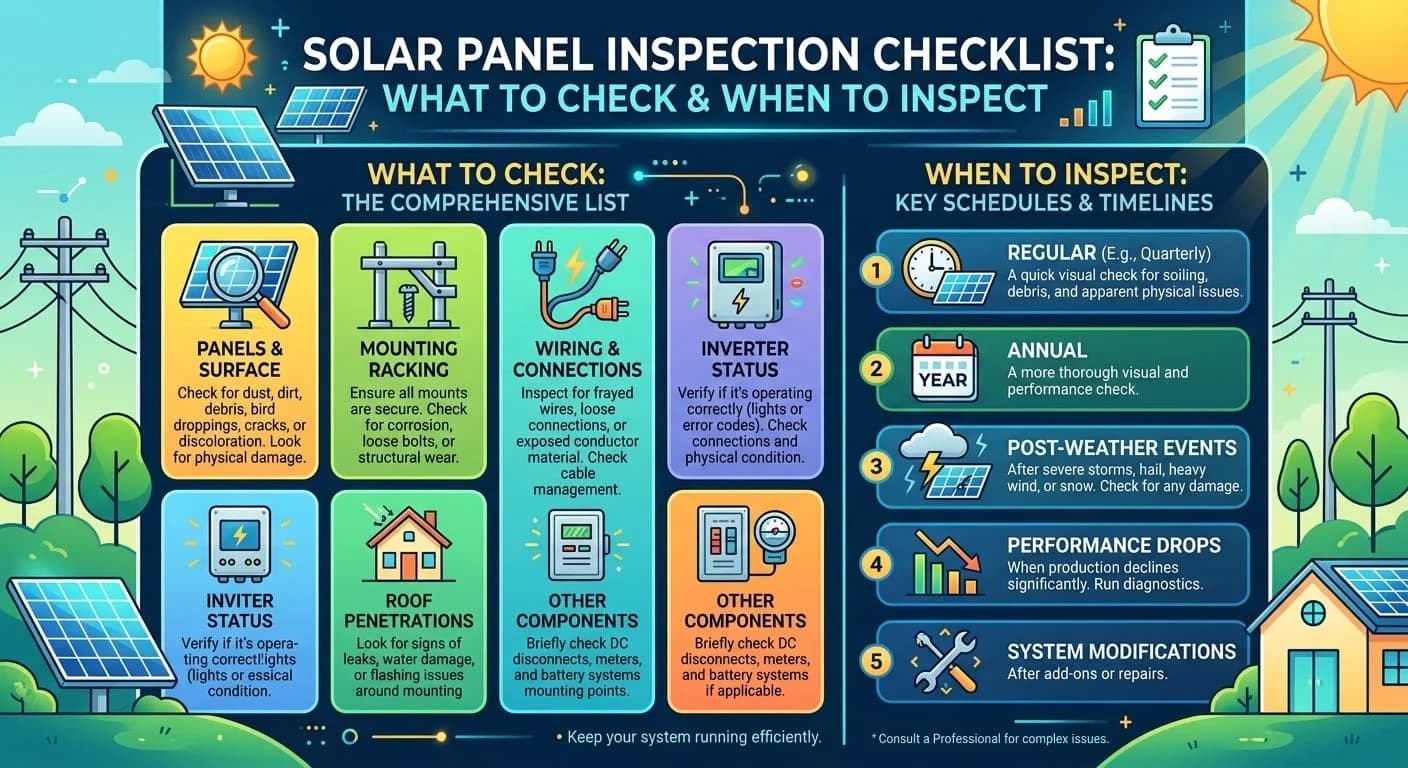
Solar Panel Inspection Checklist: What To Check & When To Inspect
Solar panel inspection guide: Learn what to check, when to inspect (annually + e...
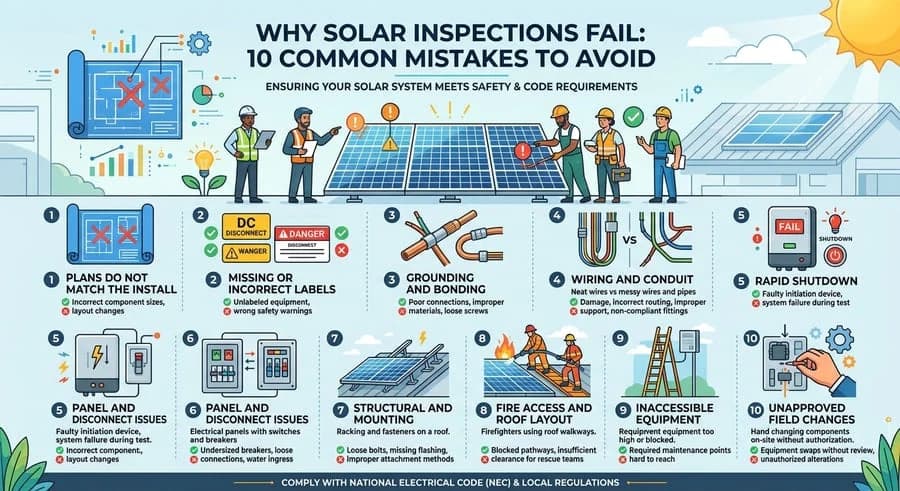
Why Solar Inspections Fail: 10 Common Mistakes to Avoid
Discover the 9 critical reasons solar inspections fail and how to avoid costly m...

Solar Grounding And Bonding: How To Pass Inspection Every Time
Learn how to pass solar grounding and bonding inspections every time. Avoid comm...