
Installing solar panels without a permit can result in fines of $500 to $10,000 or more, forced system removal, denied utility interconnection, voided homeowner insurance, and serious complications when selling your home. Most jurisdictions require at least a building permit and an electrical permit, and installing without them is a code violation in virtually every U.S. jurisdiction. Retroactive permitting is often possible but costs significantly more than pulling permits upfront.
Key Takeaways
- Most residential solar installations require permits; rooftop systems, ground mounts, and battery storage all typically need AHJ approval before installation begins.
- Fines range from $500 to $10,000+ depending on the jurisdiction and whether you cooperate with code enforcement once discovered.
- Utilities can deny interconnection for unpermitted systems, meaning your panels may legally be unable to export power or earn net metering credits.
- Insurance claims can be denied when roof damage, fire, or storm damage involves an unpermitted electrical installation.
- Home sales can stall or fall through when unpermitted solar is discovered during title review or the buyer’s inspection.
- Retroactive permitting is possible in most jurisdictions, but it costs more, takes longer, and may require system modifications to meet current code.
- If your installer skipped the permit, you may have legal recourse; the FTC Holder Rule and state consumer protection statutes may apply.
Can You Install Solar Panels Without a Permit?
The short answer is “not legally, in almost any U.S. jurisdiction.” A solar installation introduces significant electrical loads onto your home, adds a second power source that connects to the utility grid, and requires fire department access pathways on the roof. These are exactly the categories of work that building and electrical permits exist to regulate under the National Electrical Code (NEC) and local building codes.
Your local Authority Having Jurisdiction (AHJ), usually your city or county building department, is the entity responsible for reviewing and approving permit applications before any solar installation begins. The U.S. Department of Energy confirms that permitting and inspection must be completed before a solar system receives permission to interconnect to the grid.
When Solar Permits Are Typically Required
These types of solar installations require permits in virtually all U.S. jurisdictions:
- Roof-mounted residential solar systems of any size
- Ground-mounted solar arrays
- Battery energy storage systems (ESS), including retrofits added to an existing solar installation
- Main service panel upgrades triggered by a new solar installation
- Grid-connected solar installations of all types
Are There Any Exceptions?
A few limited exceptions exist, but they are narrower than most homeowners assume. Small, fully off-grid portable solar kits, camping panels charging a battery bank with no structural attachment and no grid connection, typically fall outside permit requirements. RV solar systems that are entirely self-contained and not attached to a building generally do not require permits.
Off-grid residential systems that permanently attach to a structure are different. Most AHJs still require building and electrical permits for off-grid installations because they involve structural mounting and electrical wiring that must meet safety codes. Some jurisdictions exempt small outbuildings under a certain square footage, but you should never assume an exemption applies without confirming with your specific building department. A quick phone call is always the right first step. See our complete guide to solar permit requirements for a jurisdiction-by-jurisdiction breakdown.
| Note: Even “off-grid” solar systems usually need permits in most jurisdictions. The exemption applies to the utility interconnection process, not to structural and electrical permit requirements. |
What Happens If You Get Caught Installing Solar Panels Without a Permit?
The consequences of unpermitted solar are not abstract. Code enforcement, utility interconnection review, insurance adjusters, and real estate transactions all create regular discovery events, and any one of them can trigger costs far exceeding whatever was “saved” by skipping the permit. Here is what each scenario actually looks like.
Fines and Penalties
Most jurisdictions classify unpermitted electrical work as a code violation subject to fines. Documented penalties run from $500 to $10,000 or more for solar-specific violations. Some jurisdictions assess fines on a per-day basis after notice is issued, which means delaying in resolving the violation multiplies the cost.
In jurisdictions that use a permit-doubling policy, which is common, the standard permit fee is automatically doubled for after-the-fact permit applications. This means the cheapest path to compliance is always pulling the permit before installation, not after discovery.
Stop-Work Orders
If an inspector discovers an active installation in progress without an approved permit, the jurisdiction can issue a stop-work order. This is a legal order to halt all work on the project immediately. Violating a stop-work order is a separate offense and can result in additional fines and, in severe cases, misdemeanor charges for the contractor.
For homeowners, a stop-work order means the installation halts mid-project: panels may be on the roof but not wired, or wiring may be partially run but not connected. Getting the project back on track requires obtaining proper permits, passing inspections for any work already done, and resuming only after AHJ approval, which can add weeks to the timeline.
Required System Modifications or Removal
The worst-case scenario: the AHJ determines that the installed system does not meet current code requirements and orders modifications or full removal. This is not uncommon when an installer skips permits and uses improper equipment, incorrect wiring methods, or ignores rapid shutdown requirements under NEC 690.12. In some cases, the inspector requires partial tear-down and reinstallation to expose conductors for inspection, effectively doubling the labor cost of the project.
If the AHJ concludes that the system cannot be brought into compliance, for example, because equipment lacks valid UL listings or because the roof structure cannot safely support the load — full removal is required at the homeowner’s expense. Removal and disposal of a residential solar system typically costs $1,500 to $5,000 or more before any reinstallation costs. See our fire safety and roof setback guide for the structural requirements that frequently surface during retroactive reviews.
Failed Final Inspections and Code Violations on Record
Even when fines are manageable and removal is not required, an unpermitted installation creates a permanent code violation record at your property address. These records appear in the building department’s public database and are visible to future buyers, lenders, title companies, and insurance adjusters. Clearing a code violation requires formally resolving each flagged item, which is exactly what the retroactive permitting process is designed to do.
Solar Permit Solutions
Skip the Permit Headaches
We design plan sets that pass inspection the first time. Code-compliant, PE-stamped, accepted by AHJs nationwide.
How Do Authorities Discover Unpermitted Solar Installations?
A common reason homeowners skip permits is the assumption that no one will notice. This assumption has become increasingly inaccurate as multiple discovery mechanisms have converged. Here are the most common ways unpermitted solar gets found.
Utility Interconnection Applications
This is the most frequent trigger. When a homeowner or installer submits an interconnection application to the utility, which is required for the system to legally export power and earn net metering credits — the utility typically requires proof of a passed AHJ inspection before issuing Permission to Operate (PTO). No permit, no PTO. The system may physically produce power, but it cannot legally do so without the utility’s sign-off, and that sign-off depends on AHJ approval.
Smart meters are a parallel mechanism. Utilities detect backfeed, power flowing from your property onto the grid, within seconds of a system going live. An unauthorized grid connection without PTO triggers a utility site visit in many service territories. For a full walkthrough of how the utility interconnection process works, see our dedicated guide.
Home Sales and Property Transfers
Real estate transactions are the second most common discovery event. When a homeowner lists a property with an unpermitted solar system, buyers routinely hire inspectors who flag permit history as part of standard due diligence. Title companies check permit records. FHA and VA lenders require that all open permit issues be resolved before a loan can close.
The financial consequence is not abstract: a buyer who discovers unpermitted solar can walk away from the sale, demand a price reduction to cover remediation, or require the seller to resolve the permit before closing. Any of these outcomes delays and complicates a transaction that would otherwise have been straightforward.
Insurance Claims
If you file a homeowner’s insurance claim for roof damage, a house fire, or storm damage that involves the solar system or the roof area around it, your insurance adjuster will review permit records as part of the claims investigation. If the system was installed without permits, the claim may be denied for the portion of damage related to the solar installation.
Unpermitted electrical work is a standard exclusion in many homeowner’s insurance policies. Some insurers go further and void the entire policy if material unpermitted work is discovered during a claim, arguing that the undisclosed installation changed the risk profile of the property. Verify your policy language before assuming your coverage is unaffected.
Building Inspections for Other Projects
Future renovation work on your home often requires a permit, which means an inspector visits the property. If an inspector notices solar panels on the roof and there is no corresponding closed permit in the building department’s records, the unpermitted system becomes part of the inspection report. Inspectors are not specifically looking for unpermitted solar during unrelated visits, but they do check permit history for the address.
Aerial Imagery and Permit Databases
Some county assessors and building departments use aerial imagery and GIS tools to identify improvements that do not appear in permit records. According to NREL permitting research, permitting barriers and soft costs remain a significant portion of residential solar costs, and the digitization of permit databases has made cross-referencing property improvements against permit records easier for code enforcement agencies. While solar installations are exempt from property tax reassessment in many states (verify yours via DSIRE), the presence of panels without a corresponding permit can still trigger a code enforcement inquiry.
Can You Get a Retroactive Permit for Solar Panels?
Yes, in most jurisdictions. The process goes by several names depending on the AHJ: after-the-fact permit, permit for existing work, as-built permit, or permit for legalization. The goal is the same: bring the existing installation onto the official record with proper documentation and inspections.
The honest reality is that retroactive permitting costs more, takes longer, and carries no guarantee of success. Work that was compliant with the code in effect when it was installed may not meet the current code that applies to a retroactive permit application. The AHJ can require modifications to bring the system up to current standards, even if the original installation would have passed under an older edition of the NEC.
How the Retroactive Permitting Process Works
- Contact your local AHJ. Call the building department and explain the situation. Ask about their process for after-the-fact permits and what documentation they require. Some jurisdictions have a formal amnesty or legalization program; others handle retroactive applications through the standard permit process with additional fees.
- Gather existing system documentation. Collect everything you have: installer invoices, equipment spec sheets, photos from installation, and the original interconnection application if one was submitted. The more documentation you can provide, the smoother the review process.
- Obtain engineering review if needed. If the original installation was done without a PE-stamped plan set, you will likely need to commission one retroactively. A licensed professional engineer must inspect the as-built installation, prepare drawings showing what was actually installed, and stamp the plans certifying code compliance. This is typically the most expensive part of a retroactive permit. See our state-by-state PE stamp requirements guide for what different jurisdictions require.
- Apply for the retroactive permit. Submit the application with all required documentation. Expect to pay the standard permit fee plus a penalty surcharge, commonly a doubling of the permit fee, though some jurisdictions assess a flat penalty.
- Complete required inspections. The AHJ will conduct inspections of the as-built system. If the inspector identifies items that do not meet current code, such as incorrect wiring, missing disconnects, inadequate rapid shutdown, or the wrong NEC edition applied, those must be corrected before the permit can be closed. Each correction may require a reinspection, adding to the timeline and cost.
The timeline for retroactive solar permits varies widely. Simple residential systems in cooperative jurisdictions might resolve in a few weeks. Complex systems or those in large cities with high inspection backlogs can take 6 to 18 months. Budget accordingly. The International Code Council (ICC) and local jurisdiction websites are the primary resources for understanding which codes apply to your retroactive review.
Common Challenges in Retroactive Solar Permitting
- Missing original plans. If the installer never prepared a permit-ready plan set, you will need to commission new as-built drawings that document what was actually installed.
- Equipment documentation gaps. Every component needs current manufacturer spec sheets with active UL listings. If the original installer used equipment whose UL listing has since been revoked, replacement may be required.
- Code changes since installation. If the system was installed under NEC 2017 and your AHJ now enforces NEC 2023, rapid shutdown requirements, labeling, and grounding rules may all have changed. The retroactive permit is evaluated against current code, not the code in effect at installation.
- Structural concerns. If the installer failed to verify that the roof structure could support the array per ASCE 7 load standards, the retroactive permit process may surface load deficiencies that require structural reinforcement before approval.
Will Insurance Cover Unpermitted Solar Panels?
This is where many homeowners discover the full cost of unpermitted solar, not during an inspection but during a claim. Most homeowner’s insurance policies require that the property and its improvements comply with applicable building codes. An unpermitted solar installation creates a gap between the policy’s coverage assumptions and reality.
When Insurance Claims Can Be Denied
Insurance adjusters investigate the cause and contributing factors of any claim involving an electrical system or structural component. For a claim involving roof damage, fire, or storm damage near the solar array, the adjuster will pull permit records for the address. If there is no closed permit for the solar system, the denial path typically follows one of these patterns:
- Denial for the solar-related portion of the claim. The insurer pays the non-solar portion of the damage but excludes anything attributable to the unpermitted electrical work or the structural modification the panels represent.
- Policy voiding or non-renewal. Some insurers treat unpermitted work as a material misrepresentation of the property’s condition and invoke provisions allowing them to void the policy retroactively or decline renewal.
- Denial with subrogation. If the insurer pays a claim and later discovers the installation was unpermitted, they may pursue the homeowner or the original installer for reimbursement.
The safest approach is to notify your insurance carrier when a solar system is installed and provide proof of permits and final inspection sign-off. Many carriers require this notification and may adjust your premium accordingly. Providing documentation keeps your claim path clear.
Can You Sell a House With Unpermitted Solar Panels?
Yes, in the sense that nothing prevents you from listing a house with unpermitted solar. But the transaction is unlikely to close smoothly without resolving the permit issue first. Real estate transactions surface unpermitted solar through multiple overlapping mechanisms.
Problems During Real Estate Transactions
The typical sequence: the seller discloses the solar system (as required in most states), the buyer orders a home inspection, the inspector flags the solar installation as unpermitted when pulling permit history, and the deal enters renegotiation. From that point, the buyer has leverage to demand a price reduction or require seller remediation before closing.
Lenders are a separate obstacle. FHA and VA loans have explicit requirements that all work on the property be properly permitted and inspected. If the lender orders an appraisal and the appraiser notes unpermitted solar, the lender may require the issue to be resolved as a loan condition before disbursing funds.
Disclosure Obligations
Most states require sellers to disclose known defects and material conditions of the property. An unpermitted solar installation is a material condition in virtually every state. Failing to disclose it creates legal exposure for the seller, a buyer who discovers undisclosed unpermitted work after closing can pursue a fraud or misrepresentation claim.
Options Before Listing Your Home
- Pursue retroactive permitting before listing. This is the cleanest path. A closed permit removes the issue entirely and allows the transaction to proceed without solar-related complications.
- Disclose and adjust pricing. If the retroactive permit timeline is long, some sellers disclose the issue and reduce the asking price by the estimated remediation cost.
- Remove the system before listing. In cases where retroactive permitting is unlikely to succeed due to significant code deficiencies or structural issues, removing the panels before listing removes the complication from the transaction.
Can Unpermitted Solar Affect Utility Interconnection?
Yes, and this is often the issue that brings everything else to a head. A solar system that is not properly permitted cannot legally connect to the utility grid. The interconnection agreement and permission to operate are separate from the local building permit, but they depend on it: most utilities require proof of a passed AHJ inspection before issuing PTO.
Why Utilities Require Approved Permits
From the utility’s perspective, a solar system connecting to the grid without AHJ approval is unknown: its electrical characteristics, anti-islanding protection, rapid shutdown capability, and interconnection method have not been verified by a licensed reviewer. Utilities have a legal obligation and a financial incentive to protect the grid from improperly designed connections. A failed rapid shutdown system or improperly wired inverter can endanger lineworkers during outages. That is why IEEE 1547 compliance and UL 1741 certification are standard interconnection requirements. OSHA’s 29 CFR 1910.303(b)(2) also requires that listed or labeled equipment be installed per manufacturer instructions, another reason unpermitted work creates liability.
Risks of Operating Without Utility Approval
A system generating and exporting power without PTO violates the utility’s interconnection tariff. Consequences can include disconnection of service, back-billing for energy exported without an approved net metering agreement, and in severe cases, legal action by the utility. The SolarAPP+ platform used by 275+ jurisdictions specifically requires verified AHJ approval and system compliance data before a permit is issued, making it even harder to circumvent the process in jurisdictions that have adopted automated permitting.
What If Your Solar Installer Failed to Pull Permits?
This is a common scenario, and it puts homeowners in an uncomfortable position: you contracted for a professional installation and trusted the installer to handle permitting, and they did not.
Who Is Responsible?
In most states, the licensed contractor who pulls a permit is legally responsible for the installation meeting code. If your installer was licensed and contracted to handle permitting, their failure to do so is a breach of the contract and, depending on the state, a violation of their contractor’s license. Most state contractor licensing boards have complaint processes specifically for permit-related violations.
If the installer has gone out of business, a growing concern given recent industry consolidation, you may still have recourse through the FTC Holder Rule. This rule allows you to raise installer defenses against the bank that holds your financing. For a full walkthrough of options when an installer is unresponsive or bankrupt, see our solar contract cancellation guide.
Steps Homeowners Should Take
- Request your permit records from the AHJ. Submit a public records request to your city or county building department for all permits and inspection records at your property address. Most AHJs respond within 10 to 20 business days.
- Check your interconnection application status. Contact the utility directly and ask whether Permission to Operate was issued for your address.
- Document everything and contact your installer in writing. Email or certified letter, not phone calls. Create a paper trail documenting your discovery of the permit failure and the installer’s response.
- File a complaint with the state contractor licensing board. If the installer holds a state license, this is free and creates an official record. The board can investigate, impose penalties, and in some cases order restitution.
- Contact your insurance company. Notify your homeowner’s insurance carrier before you need to make a claim. Discovering a coverage gap during an emergency is worse than addressing it proactively.

How to Bring an Unpermitted Solar System Into Compliance
If you have an unpermitted solar system and want to resolve it properly, here is the step-by-step process, whether you discovered the issue yourself or were informed by code enforcement, a buyer, or a utility.
Step 1: Contact Your Local AHJ
Call the building department directly. Explain that you have an existing solar installation that was never properly permitted and ask about their process for after-the-fact permits. Ask specifically about fees (including any penalty multipliers), what documentation they require, and whether they have a formal legalization or amnesty program. Knowing what you are dealing with upfront avoids surprises later.
Step 2: Gather Existing System Documentation
Collect everything available: the original installer’s contract and invoice; equipment spec sheets for all components (panels, inverter, racking, and disconnects); installation photos; the interconnection application if one was submitted; and any communications with the installer about permits. This documentation forms the basis of the retroactive plan set and the single-line diagram the AHJ will require.
Step 3: Obtain Engineering Review
Unless the original installer can provide a PE-stamped plan set that matches the as-built installation, you will need a licensed professional engineer to inspect the system and prepare as-built drawings. The PE review identifies whether the installation meets current code requirements and flags any deficiencies that must be corrected before the permit can be closed. For a complete explanation of what a permit plan set includes and why PE stamps matter, see our dedicated guide.
Step 4: Apply for the Retroactive Permit
Submit the permit application with the as-built plan set, equipment datasheets, and any additional documentation the AHJ requires. Pay the permit fee and any penalty. If the AHJ requires corrections based on plan review, the wrong NEC edition was applied, there are missing NEC 690 labels, inadequate rapid shutdown documentation, address those before the application moves to field inspection.
Step 5: Complete Required Inspections
The AHJ will conduct field inspections to verify the as-built installation matches the approved plan set and meets current code. Common checkpoints include verifying required labels at all locations, checking the single-line diagram against actual wiring, confirming rapid shutdown compliance under NEC 690.12, and verifying the 120% busbar rule calculation for load-side interconnections. Any items that fail must be corrected and reinspected before the permit closes.
Unpermitted vs. Properly Permitted Solar: Side-by-Side Comparison
| Factor | Unpermitted | Properly Permitted |
|---|---|---|
| Legality | Code violation in virtually all U.S. jurisdictions | Fully legal and code-compliant |
| Utility interconnection / PTO | Typically denied; no net metering | PTO issued after inspection; net metering eligible |
| Insurance coverage | Claims may be denied or policy voided | Coverage maintained per policy terms |
| Home sale | Complicates or blocks sale; buyer leverage | No permit-related complications |
| Fines risk | $500 to $10,000+ if discovered | No fine risk |
| Removal risk | Possible if code deficiencies found | None if installation matches approved plans |
| Retroactive cost | $1,000 to $5,000+ (plan set + PE + fees + corrections) | N/A — costs paid upfront at lower rates |
Getting Your Solar Installation Right the First Time
Unpermitted solar is almost always a false economy. The permit process adds a few hundred dollars and a few weeks to a project. The cost of resolving an unpermitted installation, fines, PE review, corrections, reinspection, and possible removal routinely runs into the thousands, and that is before factoring in insurance exposure, home sale complications, and inability to earn net metering credits.
The contractors and homeowners who avoid these outcomes share one habit: they confirm permit requirements with the specific AHJ before any installation work begins. They verify which utility serves the property, what interconnection documentation is required, and what the current adopted NEC edition is. And they submit a complete, PE-stamped plan set designed for first-pass AHJ approval.
Solar Permit Solutions produces PE-stamped, AHJ-ready plan sets for residential and commercial solar projects across all 50 states. Our team maintains jurisdiction-specific formatting requirements and AHJ compliance databases so your submissions are built for first-pass approval. Create a free account to get started, or explore our complete blog library for more technical guidance on solar permitting, NEC compliance, and interconnection requirements.
Frequently Asked Questions
What happens if you install solar panels without a permit?
Installing solar panels without a permit can result in fines of $500 to $10,000 or more, forced system removal or modification, denied utility interconnection (no PTO, no net metering), voided homeowner insurance for damage claims, and complications when selling your home. Most AHJs require at least a building permit and an electrical permit, and the system cannot legally connect to the grid without a passed inspection.
Can I get a retroactive solar permit?
Yes, in most jurisdictions. The process, variously called an after-the-fact permit, as-built permit, or permit for legalization, requires submitting the permit application with as-built engineering drawings (typically PE-stamped), passing AHJ inspections, and paying the standard permit fee plus a penalty surcharge. If the existing installation has code deficiencies, corrections are required before the permit closes. Retroactive permitting is more expensive and time-consuming than pulling permits before installation.
How much are solar permit fines?
Documented fines for unpermitted solar installations typically range from $500 to $10,000 or more, depending on the jurisdiction and the scope of the violation. Many jurisdictions apply a permit fee doubling policy for after-the-fact applications. Per-day fines are possible once a violation notice is issued. Costs for required corrections or removal are separate from the fines themselves.
Will insurance cover unpermitted solar panels?
Not reliably. Most homeowner’s insurance policies require that improvements comply with applicable building codes. If you file a claim for roof damage, fire, or storm damage involving an unpermitted solar system, the insurer may deny the solar-related portion, invoke a code violation exclusion, or in some cases void the policy. Always verify your coverage with your carrier and provide proof of permits and inspection sign-off at installation time.
Can I sell my house with unpermitted solar panels?
Yes, but transactions rarely close smoothly. Buyers’ inspectors flag permit history, title companies check permit records, and FHA and VA lenders require code-compliant improvements as a loan condition. The most common outcomes are price reduction demands, seller remediation requirements, or deals that fall through entirely. Resolving the permit before listing is the cleanest path.
How do building departments find unpermitted solar installations?
The most common discovery triggers are utility interconnection applications (utilities require AHJ inspection proof before issuing PTO), home sale inspections, homeowner’s insurance claims, and inspections for other projects that flag permit history at the address. Smart meters detecting unauthorized back-feed, aerial imagery, and neighbor reports are additional discovery mechanisms.
Who is responsible if my installer never pulled a permit?
The licensed contractor is legally responsible for permit compliance in most states. If your installer contracted to handle permitting and did not, that is a breach of contract and potentially a contractor licensing violation. File a complaint with your state contractor licensing board, send a written demand letter to the installer, and consult a construction attorney if the installer is unresponsive. If the installer is out of business, see our solar contract cancellation guide for options under the FTC Holder Rule.
Does an off-grid solar system need a permit?
In most jurisdictions, yes. Off-grid solar systems permanently attached to a structure still require building and electrical permits because they involve structural mounting and electrical wiring that must meet safety codes. The key difference from grid-tied systems is that off-grid installations skip the utility interconnection process; they do not need PTO because they do not connect to the grid. But structural, electrical, and fire code requirements apply in full. Always verify with your specific AHJ before assuming an exemption.
Skip the Permit Headaches
We design plan sets that pass inspection the first time. Code-compliant, PE-stamped, accepted by AHJs nationwide.

SPS Editorial Team
Solar Permit Solutions
Solar Permit Solutions provides professional solar permit design services for residential, commercial, and off-grid installations across all 50 states. Our team ensures permit-ready plan sets delivered fast.
Related Articles
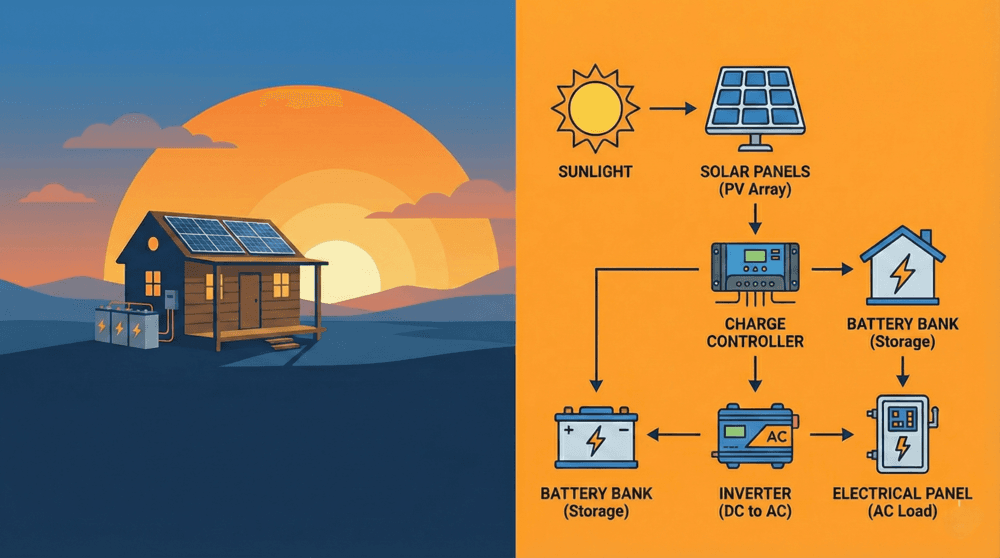
Off-Grid Solar System Requirements: Sizing, Permits & NEC Code Guide
Off-grid solar permit requirements by state: building codes, NEC compliance, bat...
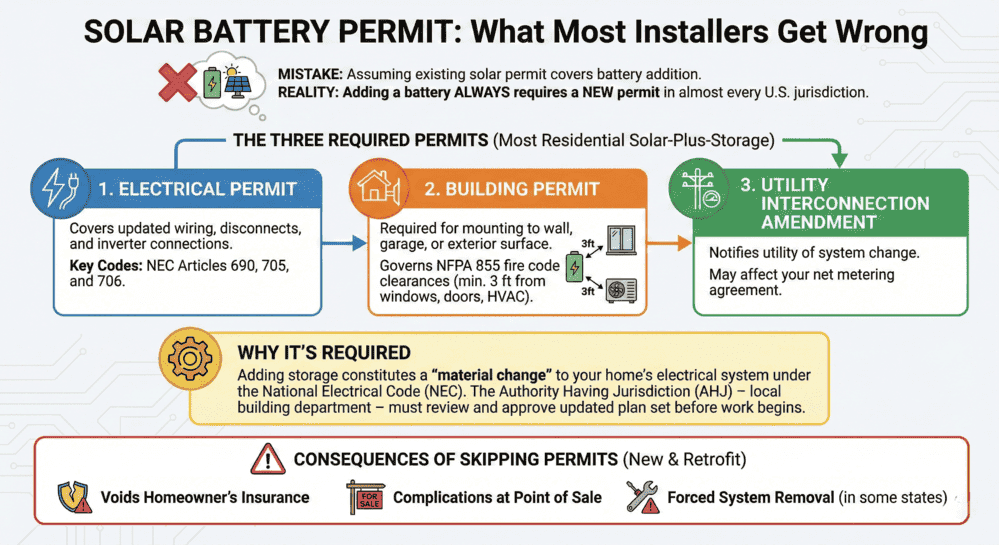
Solar Battery Permit: What Most Installers Get Wrong
Quick Answer: Adding battery storage to a solar system almost always requires ne...
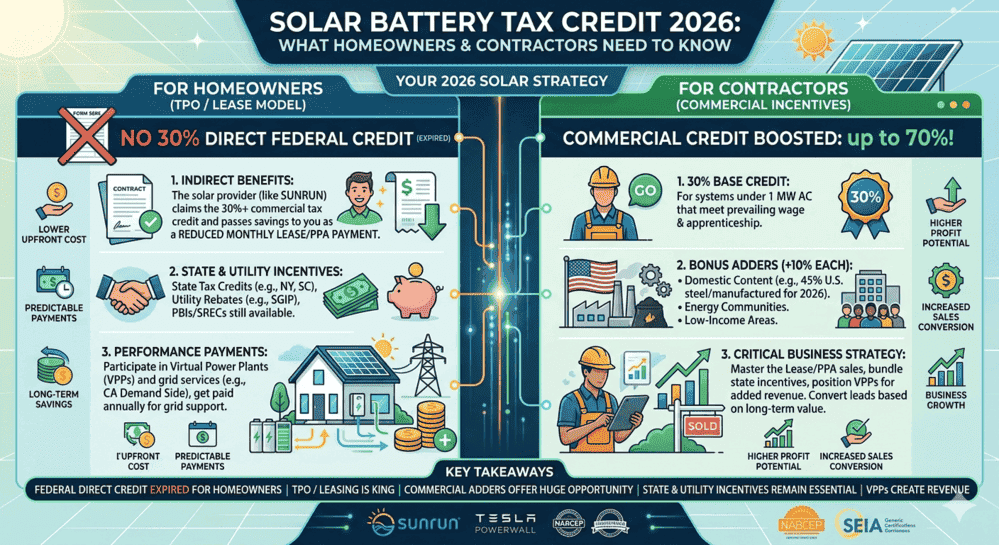
Solar Battery Tax Credit 2026: What Homeowners and Contractors Need to Know
There is no federal solar battery tax credit available to homeowners in 2026. Th...