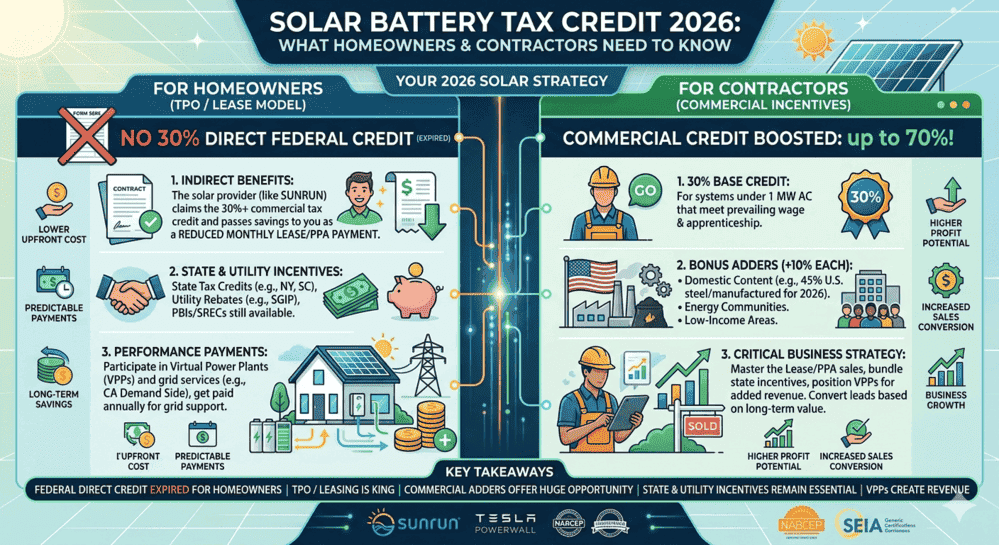
There is no federal solar battery tax credit available to homeowners in 2026. The 30% Residential Clean Energy Credit (Section 25D) was terminated by the One Big Beautiful Bill Act, signed July 4, 2025, for all systems placed in service after December 31, 2025. Homeowners who purchase battery storage with cash or a loan in 2026 cannot claim any federal tax credit. However, battery systems installed through a solar lease or PPA still qualify for up to 30% under the Section 48E commercial investment tax credit, which remains available for standalone energy storage through 2032. State programs in California, Connecticut, New York, and Colorado continue to offer battery rebates worth $5,000 to $16,000 depending on the program.
The Federal Battery Tax Credit Landscape Has Changed
Battery storage has become a core component of residential solar installations across the United States. Roughly 40% of new residential solar projects now include a battery, and that number exceeds 60% in some markets. Batteries provide backup power during outages, help homeowners avoid peak electricity rates through time-of-use optimization, and increase the amount of solar energy a household consumes directly rather than exporting to the grid.
The federal incentive landscape for battery storage shifted dramatically when President Trump signed the One Big Beautiful Bill Act (OBBBA) on July 4, 2025. This legislation terminated the Section 25D Residential Clean Energy Credit nearly a decade ahead of its original 2034 expiration. Starting January 1, 2026, homeowners who purchase a battery storage system outright (with cash or a loan) can no longer claim the 30% federal tax credit.
That does not mean all federal battery incentives are gone. The commercial investment tax credit under Section 48E remains available for third-party owned battery systems through 2032, and several state-level programs continue to offer substantial rebates. For a broader look at how solar incentives changed under the OBBBA, see our complete guide to solar tax credits in 2026. This guide focuses specifically on battery storage: every pathway still available for reducing costs, and how the permitting process changes when batteries are part of a solar installation.
What Section 25D Covered and Why It Ended
The Inflation Reduction Act of 2022 made standalone battery storage eligible for the Residential Clean Energy Credit for the first time. Prior to the IRA, batteries only qualified for the credit when installed alongside a solar energy system. After the IRA passed, any battery storage technology with a minimum capacity of 3 kilowatt-hours qualified for a 30% credit on equipment and installation labor, whether it was paired with solar or installed independently.
The OBBBA ended this credit for all residential expenditures made after December 31, 2025. There is no phase-down period and no partial credit. The termination was absolute. For a typical residential battery installation costing $12,000 to $15,000, the expired credit represented $3,600 to $4,500 in direct tax savings.
Homeowners who installed a battery storage system in 2025 can still claim the credit on their 2025 federal tax return using IRS Form 5695. The filing deadline is April 15, 2026, with an extension available until October 15, 2026. Unused credit carries forward to future tax years.

Section 48E: The Third-Party Ownership Pathway for Battery Storage
While Section 25D is gone, Section 48E of the Internal Revenue Code provides a parallel pathway. This commercial investment tax credit allows businesses that own clean energy equipment, including battery storage systems, to claim a credit worth up to 30% of the qualified investment. Bonus adders for domestic content, energy community location, and prevailing wages can push the total credit above 40%.
For homeowners, this credit becomes accessible through third-party ownership (TPO) arrangements. In a TPO structure, a solar or battery company installs and owns the system on the homeowner’s property. The homeowner pays either a fixed monthly lease payment or a per-kilowatt-hour rate through a Power Purchase Agreement (PPA). Because the company owns the system, it claims the 48E credit and passes a portion of those savings through to the homeowner as lower monthly payments.
Standalone battery storage projects under Section 48E have a longer timeline than solar. The ITC for battery storage remains available for projects that begin construction before 2033, with phase-downs starting in 2034. This is significantly more generous than the solar timeline, which requires projects to begin construction before July 4, 2026, or be placed in service by December 31, 2027. SolarReviews’ federal tax credit guide provides additional detail on the July 4 safe harbor deadline and what qualifies as beginning construction.
Not every state permits TPO arrangements. Approximately 28 states plus Washington D.C. and Puerto Rico allow both solar leases and PPAs. Homeowners in states that restrict TPO options should consult with a local solar installer to explore alternative financing structures.
Solar Permit Solutions
Solar Contractor? We Design Your Plans.
Outsource your permit plan sets to our team. PE-stamped, code-compliant, fast turnaround so you can focus on installation.
FEOC Rules and Battery Supply Chain Compliance
The OBBBA introduced Prohibited Foreign Entity (PFE) rules that directly impact battery storage projects seeking the 48E credit. Companies with ties to China, Russia, Iran, or North Korea are classified as Foreign Entities of Concern (FEOC). Because Chinese manufacturers dominate the global battery supply chain, controlling the processing of most battery-grade lithium, cobalt, and graphite; these rules have significant practical implications.
For energy storage technology, the minimum required share of non-PFE costs starts at 55% for projects beginning construction in 2026. That threshold increases to 60% in 2027, 65% in 2028, 70% in 2029, and 75% for projects starting in 2030 and beyond. If a project falls below these thresholds, it becomes entirely ineligible for the 48E credit.
These FEOC thresholds for battery storage are higher than those for solar facilities, which start at 40% in 2026. The difference reflects the deeper Chinese penetration in battery manufacturing relative to solar panel assembly. Homeowners entering TPO arrangements should confirm that their provider uses FEOC-compliant equipment. Major FEOC-compliant battery manufacturers in the U.S. market include domestic production lines from Enphase, SolarEdge, and Sonnen.
The IRS released interim guidance in early 2026 operationalizing the material assistance cost ratio, but final regulations have not been published. Treasury must issue safe harbor tables by December 31, 2026. Until then, TPO providers and solar permit designers should document component sourcing carefully to protect credit eligibility.
Federal Battery Tax Credit: 2025 vs. 2026 Comparison
| Dimension | 2025 (Section 25D) | 2026 (Section 48E via TPO) |
| Credit Rate | 30% of qualified costs | Up to 30% base + bonus adders |
| Who Claims | Homeowner | TPO company (passes savings to homeowner) |
| Battery Minimum Capacity | 3 kWh | 3 kWh (residential); 5 kWh (commercial) |
| Standalone Battery Eligible | Yes | Yes, through 2032 |
| Ownership Requirement | Homeowner-owned | Third-party owned (lease/PPA) |
| FEOC Compliance Required | No | Yes, 55% non-PFE in 2026 |
| Construction Deadline | Placed in service by Dec 31, 2025 | Begin construction before 2033 (storage) |
| Credit Type | Nonrefundable personal income tax credit | Commercial investment tax credit |
| Carryforward | Yes, unlimited years | N/A (claimed by TPO provider) |
| Form Filed | IRS Form 5695 | IRS Form 3468 (filed by TPO company) |
State Battery Storage Incentives Still Available in 2026
With the federal residential credit gone, state-level incentive programs carry more weight than ever for homeowners adding battery storage. Several states offer rebates and credits that can reduce battery costs by thousands of dollars.
California SGIP. The Self-Generation Incentive Program remains the most valuable state battery incentive in the country. For income-qualified households, rebates of up to $1,100 per kWh make batteries partially or fully free. For a standard 13.5 kWh battery, that translates to a potential rebate of nearly $14,850. As of early 2026, general market SGIP budgets are closed, but the Residential Solar and Storage Equity (RSSE) waitlist is accepting applications funded by $280 million in state allocation. California solar permitting requirements apply to all battery installations in the state.
Connecticut. The Energy Storage Solutions program provides residential customers up to $16,000 per installation, plus additional performance-based incentives for energy exported to the grid during peak demand periods. Businesses qualify for a 50% upfront incentive.
New York. NYSERDA’s Residential and Retail Energy Storage Incentive Program offers fixed-rate rebates for grid-connected battery systems up to 25 kWh. The state also provides a solar energy system equipment tax credit that can be combined with storage incentives. See our New York City solar permitting guide for local requirements.
Colorado. The state offers a 10% tax credit on eligible battery storage equipment. Xcel Energy provides additional rebates of up to $5,000 for qualifying battery installations (subject to program availability) and up to $10,000 for customers in high wildfire risk areas who require medical equipment.
Massachusetts. The SMART program provides a battery storage adder that increases compensation for systems paired with storage. The Mass Save Connected Solutions program offers zero-percent financing and performance incentives for batteries supporting grid reliability during peak demand.
Other states with active battery incentives or favorable policies include Maryland, New Jersey, Vermont, Oregon, and Hawaii. The DSIRE database provides the most comprehensive listing of state and local incentive programs. EnergySage’s battery incentive guide also provides detailed breakdowns by state. Since these programs change frequently, homeowners should verify current availability before making purchasing decisions.
How Battery Storage Changes the Solar Permitting Process
Adding a battery to a solar installation changes the permitting package in several important ways. Contractors and homeowners should account for these additional requirements when planning project timelines and budgets.
Most jurisdictions require a separate battery permit in addition to the standard solar building and electrical permits. The electrical one-line diagram must show the battery, hybrid inverter or AC coupling method, automatic transfer switch (if applicable), and connections to the main load center. Detailed solar wiring diagrams are required to document battery integration. Fire code compliance documentation is required in all jurisdictions, covering ventilation, wall clearances, and separation from habitable spaces per NFPA 855 standards.
Battery placement must meet specific safety requirements. Garages are the most common and safest indoor installation location. Outdoor installations require IP67-rated weatherproofing and minimum 3-foot clearance from windows, doors, and vents. Batteries cannot be installed in bedrooms, closets, hallways, or along escape routes.
The Authority Having Jurisdiction (AHJ) may require additional engineering review for battery systems above a certain capacity threshold. PE-stamped structural calculations may be needed if the battery is wall-mounted or if the installation adds significant weight to a floor or platform. Solar Permit Solutions provides PE-stamped permit plan sets that include battery storage for residential projects in all 50 states, with typical turnaround times of 2 to 5 business days.
Making Solar + Battery Pencil Out Without the Residential Federal Credit
Losing the 30% federal credit changes the math for homeowner-purchased battery systems, but it does not eliminate the financial case. Several factors continue to make battery storage a sound investment for many households.
Rising electricity rates. Residential electricity prices have been increasing faster than general inflation since 2022. In states like California, where rates range from $0.30 to $0.50 per kWh depending on the utility and rate plan, batteries that enable self-consumption of solar energy deliver significant savings regardless of federal incentives.
Time-of-use rate optimization. Batteries allow homeowners to store solar energy generated during off-peak daytime hours and use it during expensive peak evening periods. In markets with aggressive time-of-use rate structures, this arbitrage can accelerate battery payback by two to three years.
Virtual power plant (VPP) programs. Utilities and grid operators in many states now pay homeowners to participate in demand response programs. These programs tap into residential batteries during peak grid stress periods, providing bill credits or direct payments in exchange. Green Mountain Power in Vermont, for example, offers rebates of up to $10,500 through its bring-your-own-device battery program. Tesla’s 2026 incentives overview provides a consolidated list of state and utility battery programs currently accepting enrollment.
Backup power value. The value of uninterrupted power during grid outages is difficult to quantify but increasingly important. Wildfire-related public safety power shutoffs in California, hurricane season in the Southeast, and ice storms in the Northeast all make battery backup a practical necessity for many homeowners rather than a luxury. A typical 10kW solar system paired with a 13.5 kWh battery provides enough backup capacity to cover critical loads for one to two days during an outage.
Claiming the 2025 Battery Tax Credit During the 2026 Tax Season
Homeowners who installed a qualifying battery storage system before the December 31, 2025 deadline can still claim the 30% credit on their 2025 federal tax return. The process requires filing IRS Form 5695 (Residential Energy Credits) alongside the standard Form 1040.
Qualified expenses include the cost of the battery equipment, installation labor, wiring, and any on-site preparation work. Homeowners must subtract any utility rebates or purchase-price adjustments from the total before calculating the credit. Net metering credits are not considered purchase-price adjustments and do not reduce eligible costs.
The battery must have had a minimum capacity of 3 kWh to qualify. It must have been new equipment, not used or refurbished. The system must have been installed at the homeowner’s primary or secondary residence in the United States. Documentation to retain includes itemized invoices, payment receipts, manufacturer certifications, and the Permission to Operate (PTO) letter dated 2025.
If the credit amount exceeds the homeowner’s federal tax liability for 2025, the unused portion carries forward indefinitely to reduce future tax bills. The credit is nonrefundable, meaning it cannot generate a refund beyond the taxes owed. Homeowners who are uncertain about filing should consult a tax professional to ensure they capture the full benefit. For guidance on how battery permits fit into the overall solar permitting process, our national guide covers requirements by state.
What Solar Contractors Need to Know About Battery Incentives in 2026
The shift away from the homeowner-claimed credit changes the sales conversation for contractors. Customers who were planning to purchase a battery system outright may now find better economics through a lease or PPA. Contractors who offer TPO products alongside cash and loan options will have a significant advantage in 2026.
FEOC compliance is now a project-level responsibility for any installation seeking the 48E credit. Contractors working with TPO financing partners should verify that all battery components, including cells, power conversion systems, and battery management electronics, meet the applicable non-PFE cost ratios. This may require switching suppliers or working with distributors who provide FEOC compliance documentation.
The permitting requirements for battery storage continue to evolve. Some AHJs have adopted streamlined processes for batteries installed alongside solar, while others require entirely separate applications. Contractors can reduce approval timelines by submitting complete PE-stamped plan sets that include the battery system from the outset rather than adding it as a supplement after the solar permit is approved.
For contractors operating in multiple states, understanding the patchwork of state incentives is critical. The value proposition for batteries differs substantially depending on whether the state offers direct rebates (like California’s SGIP), production-based incentives (like Massachusetts SMART), or limited state-level support. Battery storage also applies to emerging project types like solar carports, where backup power and demand charge reduction strengthen the ROI case. Contractors who can clearly communicate the total cost reduction, combining TPO federal credit passthrough, state incentives, and utility VPP payments, will close more battery-inclusive deals.
Conclusion
The expiration of Section 25D removed the most straightforward federal incentive for residential battery storage. But the underlying reasons homeowners install batteries, backup power, bill reduction, energy independence, and grid resilience, remain as strong as ever. The Section 48E credit keeps federal incentives alive for battery storage through 2032 via third-party ownership, with a much longer runway than solar projects receive under the same law.
State incentive programs, rising electricity costs, expanding VPP opportunities, and the practical value of backup power all contribute to a financial case that holds up in many markets even without a direct federal credit. Homeowners and contractors who understand the new incentive landscape and navigate it effectively will continue to find battery storage a worthwhile investment.
Whether you are a homeowner evaluating your battery options or a contractor building solar-plus-storage proposals, the key in 2026 is matching the right financing structure with your state’s available incentives. Start with your local permitting requirements, verify FEOC compliance for any TPO arrangement, and layer every available state and utility incentive to bring the total cost down.
Need a PE-stamped permit plan set that includes battery storage? Solar Permit Solutions delivers complete residential and commercial solar-plus-storage permit packages in all 50 states with 2 to 5 business day turnaround.
Frequently Asked Questions
Solar Contractor? We Design Your Plans.
Outsource your permit plan sets to our team. PE-stamped, code-compliant, fast turnaround so you can focus on installation.
Frequently Asked Questions
No, homeowners who purchase battery storage outright can no longer claim the 30% federal tax credit. Section 25D expired on December 31, 2025. However, battery systems under third-party ownership (leases and PPAs) still qualify for the Section 48E commercial investment tax credit, which remains available for standalone battery storage through 2032.
Yes. Under a lease or PPA, the company that owns the battery system claims the Section 48E credit and passes savings to the homeowner through lower monthly payments. This is currently the primary pathway to federal battery incentives for residential installations.
Under Section 25D (now expired), battery storage technology needed a minimum capacity of 3 kilowatt-hours. For commercial projects under Section 48E, the IRA originally specified 5 kWh for standalone storage, though residential TPO arrangements typically use the same 3 kWh threshold. Most residential batteries on the market today exceed both minimums.
Foreign Entity of Concern (FEOC) rules restrict tax credit eligibility for projects using components from companies tied to China, Russia, Iran, or North Korea. For battery storage projects beginning construction in 2026, at least 55% of manufactured component costs must come from non-FEOC sources. This threshold increases annually, reaching 75% by 2030.
A: California (SGIP, up to $1,100/kWh for qualifying households), Connecticut (up to $16,000), New York (NYSERDA storage incentives), Colorado (10% state tax credit plus utility rebates), Massachusetts (SMART adder and Connected Solutions), Vermont (Green Mountain Power rebates up to $10,500), and several others. Check the DSIRE database for the most current listings.
In most jurisdictions, yes. Battery installations typically require a separate building or electrical permit, updated one-line diagrams showing the battery and its connections, and fire code compliance documentation per NFPA 855. Some AHJs allow combined solar-plus-battery permits, but this varies by location.
File IRS Form 5695 (Residential Energy Credits) with your 2025 federal tax return. Enter qualified battery expenses, calculate 30% of the total, and transfer the credit amount to Schedule 3 of Form 1040. The filing deadline is April 15, 2026, or October 15, 2026 with an extension. Unused credit carries forward.
For many homeowners, yes. Rising electricity rates, time-of-use rate optimization, virtual power plant participation payments, state rebates, and backup power value all contribute to positive economics. The financial case is strongest in states with high electricity rates, strong state incentives, and frequent grid outages.

SPS Editorial Team
Solar Permit Solutions
Solar Permit Solutions provides professional solar permit design services for residential, commercial, and off-grid installations across all 50 states. Our team ensures permit-ready plan sets delivered fast.
Related Articles
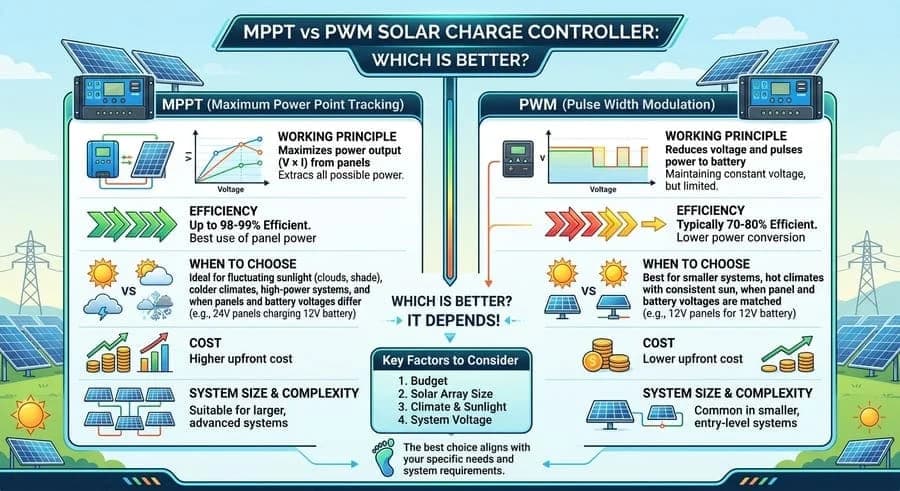
MPPT vs PWM Solar Charge Controller: Which Is Better?
Compare MPPT vs PWM solar charge controllers. Discover efficiency rates, cost di...
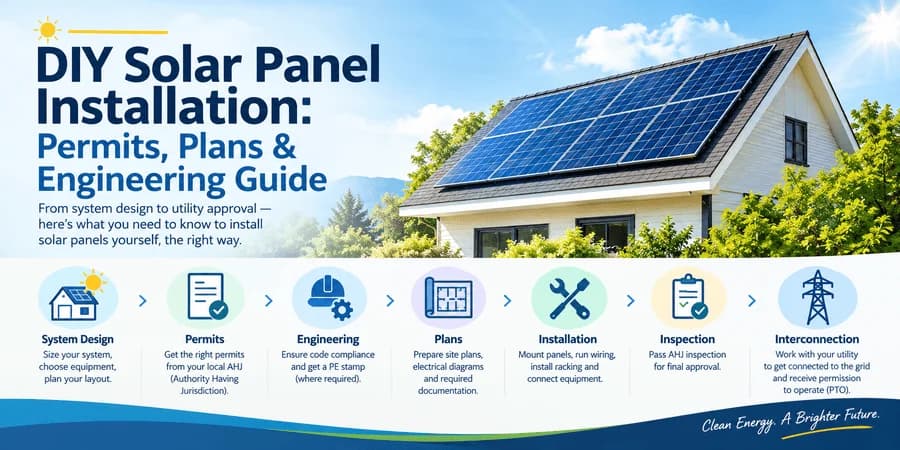
DIY Solar Panel Installation: Permits, Plans & Engineering Guide
Yes, you can install solar panels yourself in most U.S. jurisdictions. DIY solar...
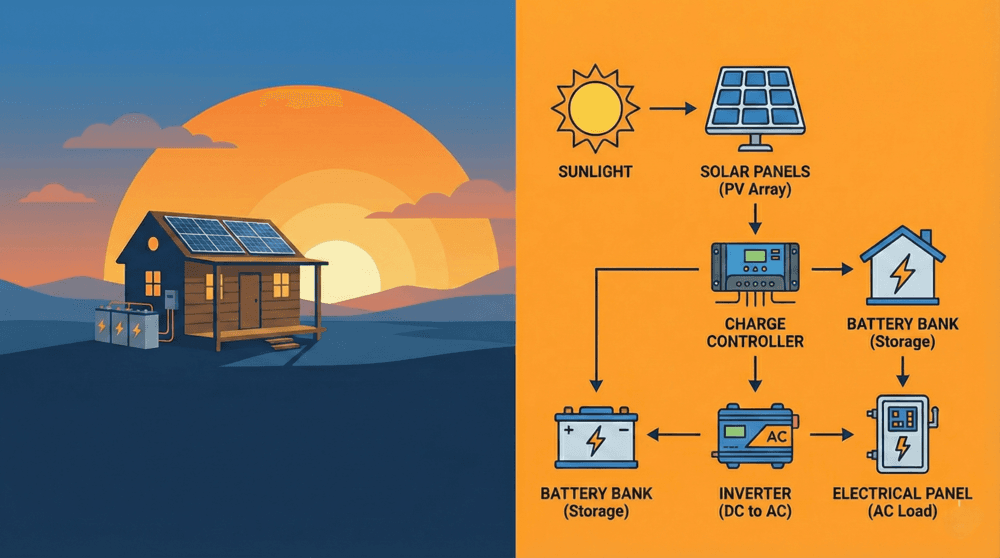
Off-Grid Solar System Requirements: Sizing, Permits & NEC Code Guide
Off-grid solar permit requirements by state: building codes, NEC compliance, bat...