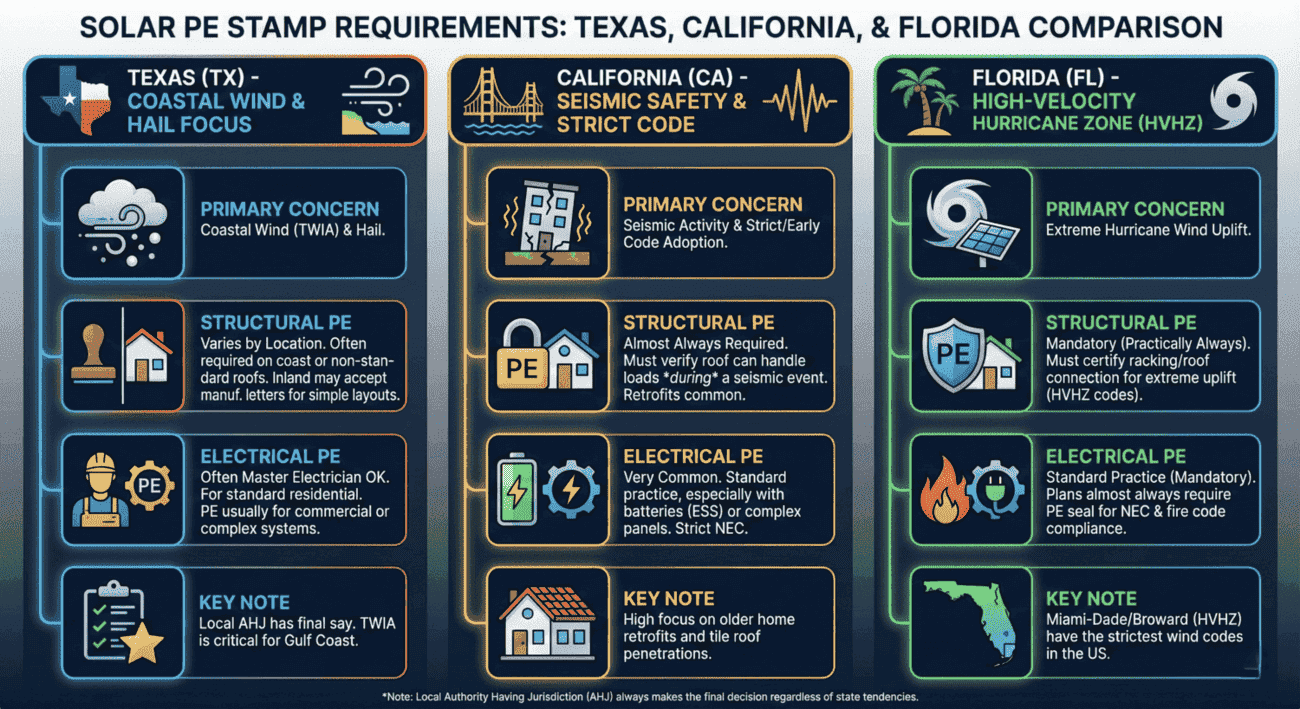
What Are the PE Stamp Requirements for Solar in Texas, California, and Florida?
PE (Professional Engineer) stamp requirements vary significantly by state. Texas has no statewide framework, so requirements depend on local AHJ solar regulations; most require PE stamps for systems over 10 kW. California requires structural PE stamps for rooftop systems over 10 kW and electrical stamps above 50 kW, plus Title 24 compliance. Florida mandates PE stamps for virtually all solar installations due to hurricane zone regulations, with site-specific wind load calculations required regardless of system size.
PE stamps cost $150–$400 for residential projects and $500–$1,500+ for commercial installations, with typical turnaround times of 24–48 hours. This guide breaks down the exact thresholds, costs, turnaround times, and common rejection reasons for each state.
According to the Solar Energy Industries Association (SEIA), the solar industry installed a record-breaking 50 GW of new capacity in 2024. Authorities Having Jurisdiction (AHJs) have tightened engineering review standards accordingly. For contractors operating in Texas, California, and Florida, three states representing over 50% of the U.S. solar market, understanding these requirements prevents costly permit rejections, project delays, and liability exposure. The days of simplified permit packages and rubber-stamp approvals are ending, particularly in high-growth markets where building officials prioritize safety and code compliance above all else.
What is a PE Stamp for Solar Projects?
A PE stamp is an official seal from a licensed professional engineer certifying that your solar design meets all applicable structural, electrical, and safety codes. When a PE reviews your plans, they take professional responsibility for the design’s integrity. This certification transfers legal liability to the licensed engineer, confirming compliance with local building codes, the National Electrical Code (NEC), and state-specific engineering standards. For a deeper dive into what engineers evaluate, see our guide on solar engineering requirements for permits.
Professional engineers must complete a four-year engineering degree, gain supervised work experience, and pass two comprehensive examinations. Each state regulates PE qualifications independently; an engineer licensed in California cannot legally stamp plans for a Texas project without obtaining Texas licensure.
What Types of PE Stamps Do Solar Projects Require?
- Electrical PE Stamp: Verifies wiring diagrams, circuit design, load calculations, inverter sizing, overcurrent protection, grounding methods, and NEC compliance. Required for utility interconnection approval.
- Structural PE Stamp: Confirms mounting systems, roof load capacity, wind uplift calculations, seismic considerations, and foundation designs meet safety standards. Essential for rooftop and ground-mount installations. Understanding your electrical panel type is critical for interconnection planning.
Some AHJs specifically require a Structural Engineer (SE) stamp. While all structural engineers are professional engineers, not all PEs are structural engineers. The SE designation indicates specialized structural expertise with additional examination requirements.

What Are Texas PE Stamp Requirements for Solar?
Texas led all states for new solar capacity additions in 2024, installing 11.6 GW of new solar capacity, replicating a record-setting 2023. This makes it one of the fastest-growing solar markets in the country. However, Texas does not have a statewide solar regulatory framework, which means AHJs play a significant role in solar approvals. For comprehensive information on navigating these requirements, see our complete guide to solar permits in Texas. This decentralized approach creates substantial variation in requirements depending on project location; what passes easily in Austin may face rejection in Houston, and vice versa.
What Size Solar System Requires a PE Stamp in Texas?
- Systems exceeding 10 kW generally require PE stamps regardless of property type
- Commercial projects in major metros typically require both structural and electrical PE stamps
- Residential systems under 10 kW may qualify for simplified permitting in some jurisdictions
- Ground-mounted systems and solar carports typically require PE stamps regardless of size
How Do Texas Cities Differ in PE Stamp Requirements?
- Houston: Currently piloting SolarAPP+ and is the only AHJ in Texas using this automated permitting system. The dedicated solar permitting department handles high volume.
- Austin: Offers same-day in-person solar permitting and online submission options. Known for progressive renewable energy policies.
- Dallas: Provides online permitting with emphasis on site utilities and drainage notes. PE stamps are required for most commercial installations.
- San Antonio & Fort Worth: Online solar permitting is available with varying structural review requirements based on system complexity.
Texas Technical Requirements
- Wind Load Calculations: Coastal areas require hurricane-zone engineering. Interior regions require analysis per IBC and ASCE 7-22 wind load standards.
- Utility Interconnection: Oncor, CenterPoint, and AEP Texas each have specific requirements. PE-stamped plans are typically required for utility approval.
- NEC Compliance: Most Texas AHJs have adopted NEC 2023, requiring updated Article 690 rapid shutdown configurations and conductor sizing.

Solar Permit Solutions
Need Solar Permit Plans?
Professional, permit-ready solar plan sets delivered fast. Residential and commercial projects across all 50 states.
What Are California Solar PE Stamp Requirements?
California leads the nation in solar energy production with over 40 GW of total installed capacity across utility-scale and distributed systems. The state has comprehensive regulations through the California Solar Initiative (CSI) and Building Energy Efficiency Standards (Title 24). PE stamping requirements are among the strictest in the country, particularly for commercial installations. California’s aggressive renewable energy goals, combined with unique seismic and fire safety considerations, mean PE stamps aren’t just required; they’re scrutinized closely by plan reviewers.
What Size Solar System Requires a PE Stamp in California?
- Structural PE stamps commonly required for rooftop systems over 10 kW
- Electrical PE stamps typically required for systems above 50 kW
- Commercial installations generally require both structural and electrical PE review
- Some municipalities accept simplified checklists for smaller residential systems
How Does Title 24 Affect PE Stamp Requirements?
California’s Title 24 Building Energy Efficiency Standards require solar PV and battery storage on most new commercial buildings. The 2022 standards (effective January 1, 2023) apply to current projects. The 2025 standards take effect January 1, 2026. Three compliance methods exist:
- Conditioned Floor Area (CFA) Method: Formula-based calculation using building square footage
- Solar Access Roof Area (SARA) Method: Accounts for roof obstructions. If SARA is less than 3% of CFA, no solar required
- Performance Method: Uses EnergyPro software to model building efficiency holistically
California Seismic and Fire Safety Requirements
California’s seismic activity requires PV systems engineered for earthquake resistance. Structural PE stamps must include mounting designs accounting for seismic loads per California Building Code (CBC) and ASCE 7 provisions. Fire safety regulations require setback distances from roof edges (typically 3 feet), firefighter access pathways, and spacing requirements. Fire department review is standard for commercial installations.

Does Florida Require PE Stamps for All Solar Installations?
Yes. Florida ranks third nationally with over 18.5 GW of installed solar capacity, earning its “Sunshine State” nickname through both residential rooftop systems and large utility-scale solar farms. Hurricane zone regulations make PE stamps mandatory for virtually all solar installations; this isn’t a threshold issue like in other states. Wind load calculations and structural integrity assessments aren’t optional additions; they’re survival mechanisms that protect property and human life during severe weather events.
Why Does Florida Require PE Stamps for Every Solar Installation?
The Florida Building Code requires site-specific measurements of wind speed, exposure category, and risk category for every project. Generic assumptions are explicitly not acceptable; module pressures and attachment spans must be calculated for each specific installation location. Florida accepts either a PE stamp or FSEC certification (per FS 377.705).
Florida Building Code 8th Edition Requirements
The FBC 8th Edition (2023) introduced significant updates for solar installations, published through the International Code Council:
- Full adoption of ASCE 7-22 for wind load calculations
- Seven distinct wind zones (expanded from three in previous code)
- UL 2703 compliance for mounting system equipment listings
- Module exposure classification (edge, exposed, non-exposed)
What Are HVHZ Requirements for Solar in Florida?
Miami-Dade and Broward counties fall within the High Velocity Hurricane Zone (HVHZ), requiring the strictest wind load requirements in the nation. According to the Sustainable Energy Action Committee, these requirements include:
- Design wind speed of 175 mph for Risk Category II structures
- Miami-Dade Product Approvals (NOAs) required for all components
- Zone-specific fastening schedules with detailed uplift calculations
- Wind exposure categories: Exposure B (urban), C (open terrain), D (waterfront)
How Much Do Solar PE Stamps Cost in 2025?
Costs vary by project complexity and state requirements. Florida projects typically cost more due to mandatory wind load calculations. Commercial utility-scale projects may exceed these ranges.
How Long Does It Take to Get a Solar PE Stamp?
Turnaround times depend on documentation completeness and project complexity. For detailed state-by-state timelines, see our average solar permit timeline guide:
- Standard Residential: 24-48 hours with complete documentation
- Complex Commercial: 5-7 business days
- Rush/Expedited: 15-24 hours available from specialized providers
- Incomplete Documentation: Adds 3-5 days minimum while engineers request missing information
How Does NEC 2023 Affect Solar PE Stamp Requirements?
The 2023 National Electrical Code introduces significant updates to Article 690 that affect PE stamping requirements across all three states. Many AHJs have already adopted NEC 2023, and designs referencing outdated code editions face automatic rejection. Key changes include terminology updates (“PV output circuit” is now “PV string circuit”), new rapid shutdown exceptions for carports and trellises, updated voltage limits (600 Vdc for dwellings, 1,000 Vdc for commercial), and simplified labeling requirements that allow field-printed labels. PE engineers must ensure all electrical plans comply with the jurisdiction’s currently adopted NEC version.
Why Do Solar Permits Get Rejected?
Top engineering firms maintain first-time approval rates between 96% and 99%, while budget providers often fall below 80%. Common rejection reasons include:
- Missing PE Stamp: Submitting plans without required engineering certification
- Non-Site-Specific Calculations: Using generic wind speeds or load assumptions instead of location-specific data
- Incorrect Wind Zones: Using outdated wind zone maps or wrong exposure categories
- Missing Module Classification: Failing to identify edge, exposed, and non-exposed module locations
- Incomplete Safety Documentation: Missing AFCI, GFCI, or rapid shutdown details. Proper arc-fault protection documentation is essential.
- Outdated NEC References: Designs based on NEC 2020 when AHJ has adopted NEC 2023
The average permit resubmission adds 2-4 weeks to project timelines. Resubmission fees range from $100 to $500 depending on jurisdiction.
Do AHJs Accept Digital PE Stamps or Require Wet Stamps?
Many AHJs now accept digital PE stamps, which expedite approvals by eliminating shipping delays. However, some jurisdictions still require physical “wet stamps,” either inked or embossed on paper drawings. California and Florida generally accept digital stamps in most jurisdictions, while some Texas municipalities prefer wet stamps for certain project types. Always verify requirements with your specific AHJ before submission.
Conclusion
Successful solar companies integrate PE stamping into their workflow from project inception rather than treating it as a permit-time afterthought. During the sales process, budget for PE stamp costs upfront so clients understand the complete project investment. Collect detailed site information during assessments: accurate roof measurements, electrical panel specifications, structural details, and local AHJ code requirements.
Partnering with engineering firms that maintain active licenses across multiple states and deliver consistent first-time approval rates provides significant competitive advantages. Whether you’re handling residential solar design or commercial solar projects, look for providers offering 24-48 hour turnaround times, demonstrated familiarity with Texas, California, and Florida AHJ requirements, and transparent pricing.
PE stamp requirements across Texas, California, and Florida are becoming more stringent as the solar industry matures and code officials gain experience with PV installations. With increased regulatory scrutiny following the industry’s record-breaking growth, successful companies are integrating engineering review into their standard operating procedures rather than fighting requirements as obstacles. Building thorough PE stamping workflows keeps projects moving forward on schedule, clients satisfied with predictable timelines, and your business protected from liability exposure that can arise from improperly engineered installations.
Need PE stamping services for your next solar project? Solar Permit Solutions provides structural and electrical PE stamps across all 50 states with industry-leading turnaround times and first-time approval rates. Contact us today to streamline your permitting process.
FAQs
- Site plan with panel layout and roof dimensions
- Single-line electrical diagram showing system components
- Equipment specification sheets (panels, inverters, racking)
- Structural details, including roof framing type and condition
- Electrical load calculations and panel specifications
- Site photos showing roof condition, electrical panel, and proposed mounting areas
Need Solar Permit Plans?
Professional, permit-ready solar plan sets delivered fast. Residential and commercial projects across all 50 states.
Frequently Asked Questions
It depends on your state and system size. In Florida, PE stamps are required for virtually all solar installations regardless of size due to hurricane regulations; even a 5 kW residential system needs engineering certification. In California, structural PE stamps are commonly required for systems over 10 kW, and electrical stamps above 50 kW. In Texas, requirements vary significantly by city; most major metros like Houston, Dallas, and Austin require PE stamps for systems exceeding 10 kW, while some smaller jurisdictions accept simplified permits for residential systems. Ground-mounted systems and solar carports typically require PE stamps regardless of size in all three states.
A PE (Professional Engineer) stamp represents broad professional engineering certification and can cover electrical or general structural work. An SE (Structural Engineer) stamp indicates specialized structural engineering expertise with additional education and examination requirements. While all structural engineers are professional engineers, not all PEs are structural engineers. Most jurisdictions require a "structural PE stamp" for solar projects, but some AHJs specifically require an SE stamp for complex structural evaluations involving roof load capacity, seismic calculations, or foundation designs.
No. Each state regulates PE qualifications independently, meaning an engineer licensed in California cannot legally stamp plans for a Texas or Florida project without obtaining licensure in that state. This is why solar contractors often partner with engineering firms that maintain active PE licenses across multiple states. Some states offer reciprocity agreements that streamline the licensing process for PEs already licensed elsewhere, but separate state licensure is still required.
To get PE stamps approved quickly, submit complete documentation, including accurate roof measurements, electrical panel specifications, structural details, equipment spec sheets, and site-specific information. Specialized solar PE stamping services typically deliver stamps in 24-48 hours for residential projects with complete documentation. Incomplete plan sets cause the most delays, as engineers must request missing information before review. Many providers offer expedited 15-24 hour turnaround for rush projects at an additional cost.
Required documentation typically includes: Site plan with panel layout and roof dimensions, Single-line electrical diagram showing system components, Equipment specification sheets (panels, inverters, racking), Structural details including roof framing type and condition, Electrical load calculations and panel specifications, and Site photos showing roof condition, electrical panel, and proposed mounting areas.
Submitting permits without required PE stamps results in automatic rejection in most jurisdictions. This adds 2-4 weeks to your project timeline while you obtain proper engineering certification and resubmit. Many AHJs charge resubmission fees ranging from $100 to $500. Beyond permit delays, installing without proper PE certification exposes contractors to liability if structural or electrical issues arise. The modest cost of PE stamps ($200-$900 depending on project type) is significantly less than the cost of permit rejections, timeline delays, and potential legal exposure.
When selecting a PE stamping provider, look for several key factors. First, verify they maintain active licenses in your project states; an engineer cannot legally stamp plans for states where they're not licensed. Check their first-time approval rates; top firms maintain 96-99% approval rates versus below 80% for budget providers. Confirm turnaround times (24-48 hours is standard for residential) and whether they offer rush services. Request proof of professional liability insurance, as this protects you if issues arise. Finally, look for solar-specific experience; engineers who work regularly on PV projects understand AHJ nuances and complete reviews faster than generalists.

SPS Editorial Team
Solar Permit Solutions
Solar Permit Solutions provides professional solar permit design services for residential, commercial, and off-grid installations across all 50 states. Our team ensures permit-ready plan sets delivered fast.
Related Articles
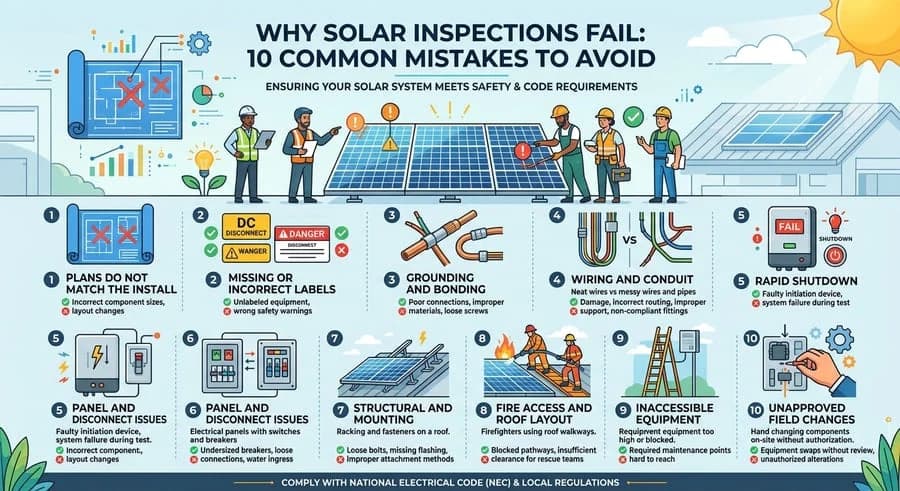
Why Solar Inspections Fail: 10 Common Mistakes to Avoid
Discover the 9 critical reasons solar inspections fail and how to avoid costly m...
Solar Grounding And Bonding: How To Pass Inspection Every Time
Learn how to pass solar grounding and bonding inspections every time. Avoid comm...
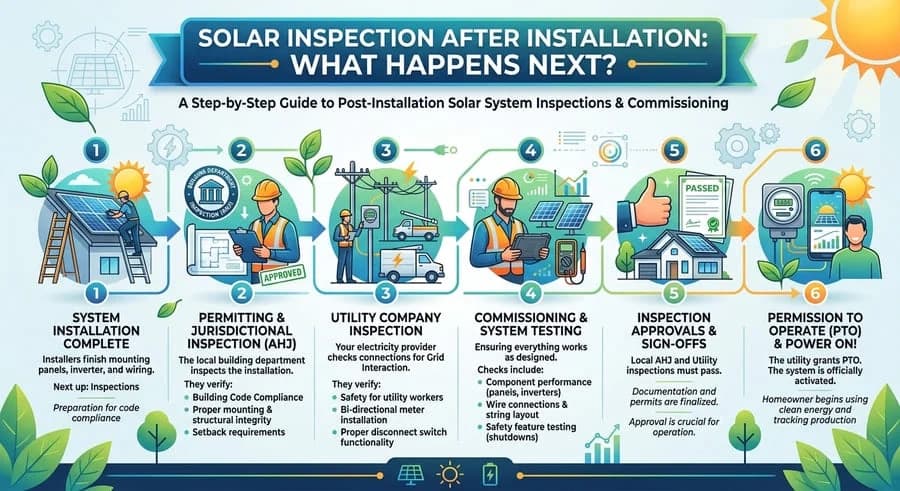
Solar Inspection After Installation: What Happens Next?
Learn how to pass your solar inspection by following essential tips for obtainin...