
complete guide solar virginia

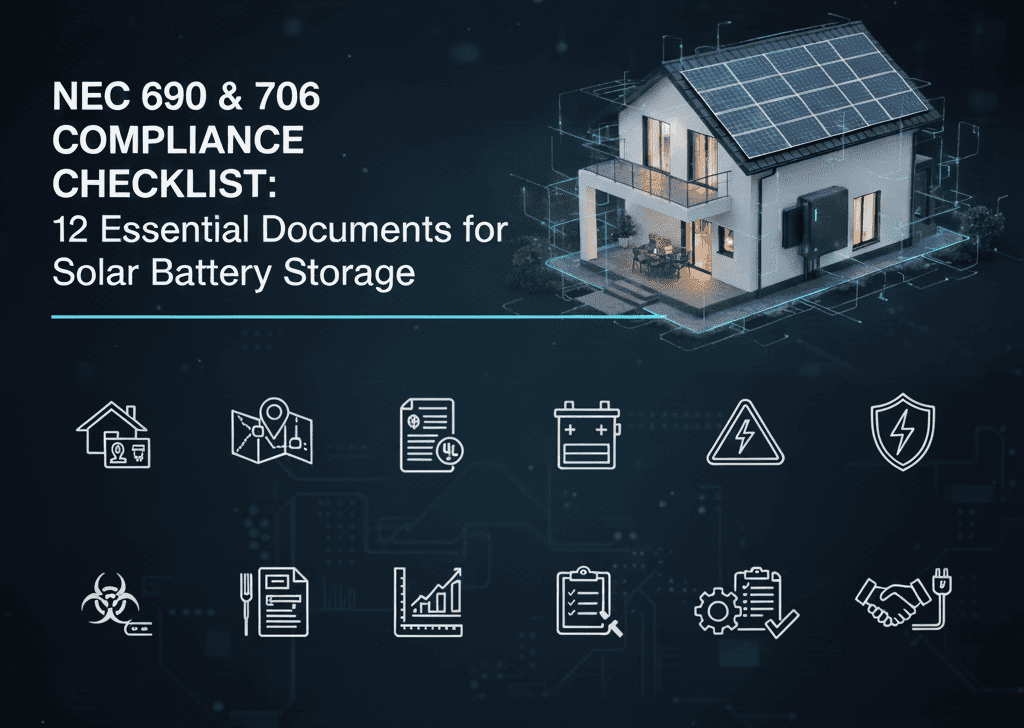
NEC 690 and 706 Compliance Checklist: 12 Essential Documents for Solar Battery Storage

What are the 12 required documents for NEC 690 and 706 compliance? Solar photovoltaic systems with battery storage require these 12 documents for permit approval: (1) single-line diagrams, (2) site plans with service directory maps, (3) equipment listing certifications, (4) ESS nameplate data sheets, (5) labeling and signage schedules, (6) rapid shutdown and AFCI documentation, (7) battery safety data sheets, (8) grounding and bonding calculations, (9) overcurrent protection coordination studies, (10) commissioning test records, (11) O&M and emergency shutdown procedures, and (12) interconnection approvals or stand-alone attestations.

These documents satisfy NEC Article 690 (solar PV systems), NEC Article 706 (energy storage systems), and related UL certification requirements including UL 9540, UL 1973, and UL 1741. Use this compliance checklist as your foundation for permit submittals and as-built records, supplementing with additional forms your local Authority Having Jurisdiction (AHJ) or utility requires.

Single-Line Diagram (SLD) and Equipment Layout

Draft a detailed solar single-line diagram tracing the electrical path from PV source circuits through the energy storage system, inverter, disconnecting means, overcurrent protective devices, grounding conductors, and point of interconnection. Incorporate equipment placement on a scaled site plan. Specify conductor gauges, insulation ratings, and raceway types throughout. Clearly delineate rapid shutdown boundaries around PV arrays and mark the ESS disconnect location with direct visibility from service equipment.

Site Plan and Service Directory Map

Illustrate property boundaries, utility meters, main service equipment, PV array locations, ESS enclosures, and all disconnecting means on your site plan. Include the directory placard legend that installers will mount at service equipment—this guides emergency responders to remote disconnects following standard NEC 690 directory protocols.

Equipment Listings and Certification Documentation

Compile specification sheets and listing certifications for all major components: ESS units, battery modules, inverter/chargers, combiners, circuit breakers, and disconnect switches. For grid-interactive installations, verify UL 1741 (SA) certification for grid support functions, this satisfies California Rule 21, HECO 14H, and similar interconnection standards. Document battery cell and module certifications (UL 1973) alongside complete ESS system listings (UL 9540). Note any protective device ratings meeting UL 489 H requirements where applicable. The DOE Homeowner's Guide to Solar provides additional guidance on selecting certified equipment.

ESS Nameplate Data Sheet

Consolidate critical battery specifications, including total kWh capacity, nominal and maximum voltage ranges, charge and discharge current limits, short-circuit withstand ratings, operating temperature range, and minimum clearance requirements. Calculate and document usable capacity based on depth of discharge (DoD) assumptions. Reference performance metrics, such as round-trip efficiency, cycle life projections, and temperature derating factors—to help plan reviewers understand how these variables impact usable energy output and warranty terms. The IAEI NEC Article 706 overview details specific nameplate marking requirements.

 Labeling and Signage Schedule (NEC 690/706)

Develop a comprehensive label matrix documenting each required placard: exact wording, background and text colors, material specifications, minimum font height, and precise mounting locations. Cover PV DC source circuit labels, DC and AC output circuit labels, rapid shutdown placards, service equipment directories, and ESS hazard warnings displaying stored energy capacity. Cross-reference each label requirement to the applicable NEC 690 and 706 code sections directly on the schedule.

Rapid Shutdown and Arc-Fault Protection Documentation

Submit equipment listings and functional narratives for rapid shutdown systems (commonly governed by NEC 690.12 requirements in most jurisdictions) and arc-fault detection devices. Map the rapid shutdown boundary on your drawings, identify the control initiation method, and outline the verification test procedure you will execute during commissioning. Review solar panel safety codes for AFCI and GFCI requirements to ensure complete documentation. The 2023 NEC rapid shutdown exemptions clarify which structures require RSD compliance.

Battery Safety Data Sheets and Hazard Mitigation Records

Provide manufacturer Safety Data Sheets (SDS) for the specific battery chemistry installed (LiFePO4, NMC, etc.). When available, include UL 9540A test summaries or thermal runaway propagation assessments, these documents help AHJs and fire marshals evaluate equipment placement, ventilation requirements, and emergency response protocols. NFPA 855 installation standards provide additional guidance on residential ESS fire safety requirements.

Grounding, Bonding, and Conductor Sizing Calculations

Document equipment grounding conductor sizing, grounding electrode system connections, bonding jumper specifications, and ampacity calculations for all current-carrying conductors. Apply temperature correction factors and conduit fill derating where required. Clearly distinguish aluminum versus copper conductors and confirm termination temperature ratings match installed equipment. Review the complete solar PV grounding and bonding guide for NEC 250 compliance details. For conductor specifications, reference solar conductor sizing per NEC standards and solar cable types.

Overcurrent Protection and Fault Current Coordination Study

Record overcurrent protective device ratings and interrupting capacities for both DC and AC circuits. Calculate available fault current at the ESS location and main service equipment. When multiple power sources exist (grid, PV, battery), develop a coordination study demonstrating that the appropriate protective device clears faults without compromising critical safety functions. Learn how to size fuses and circuit breakers for solar systems and understand NEC 690.16 fuse servicing requirements. For complex interconnections, review solar supply-side connection guidelines.

 Commissioning and Functional Test Records

Prepare a structured commissioning checklist for field completion: insulation resistance measurements, polarity verification, torque documentation for all connections, inverter/charger operational tests, rapid shutdown function verification, anti-islanding confirmation, smart inverter parameter configuration, and energy management system setpoint validation. Date and sign all test results, then archive copies for the AHJ and system owner.

Operations, Maintenance, and Emergency Shutdown Procedures

Assemble a complete O&M manual covering routine inspection schedules, firmware update protocols, battery maintenance requirements, decommissioning procedures, and step-by-step emergency shutdown instructions. Post a simplified emergency placard near service equipment with clear directions for de-energizing both PV and ESS components. The CPUC energy storage safety best practices provide additional guidance on O&M documentation requirements.

Interconnection Approval or Stand-Alone System Attestation

For grid-connected installations, attach the executed utility interconnection agreement along with final smart inverter configuration sheets documenting Volt/VAR, Frequency-Watt, and other grid support settings. Understand how solar panels connect to the grid and review US electrical panel types for solar interconnection. For off-grid systems, prepare a signed attestation confirming the installation operates as a stand-alone system within the scope of NEC Article 710. Reference off-grid solar system design requirements for stand-alone documentation. The Mayfield Renewables NEC 690/706 navigation guide provides additional code interpretation resources.

Labeling Details Inspectors Frequently Verify

PV DC Circuit Labels: Install permanent placards at combiners, disconnect switches, and raceways displaying maximum system voltage and current ratings.

PV Rapid Shutdown Placards: Mount an exterior-visible label identifying the rapid shutdown system type and delineating its controlled boundary. Position this placard at main service equipment or the utility meter location for immediate responder visibility.

AC Output and Back feed Warning Labels: Mark the point of interconnection where the interactive inverter system connects to premises wiring with appropriate back feed hazard warnings.

ESS Identification Placards: Display total stored energy capacity (kWh), nominal system voltage, and emergency de-energization procedures at both the ESS enclosure and main service equipment locations.

Directory Placards and Service Maps: Affix a durable, weather-resistant directory placard that clearly maps all disconnecting means locations and identifies ESS equipment placement for emergency responders.

Document Preparation Responsibilities and Retention Requirements

Solar Documentation Requirements
Document Primary Purpose Prepared By Code Reference Retention
SLD & Equipment Layout Define system scope, conductor routing, protective devices Designer/Engineer NEC 690, 706 Project lifetime
Site Plan & Directory Map Guide responders to disconnects Designer/Installer NEC 690 labeling Posted + digital
Equipment Listings Verify code-listed components Manufacturer/Designer UL 9540, 1973, 1741 Project lifetime
ESS Nameplate Sheet Document voltage, kWh, current Manufacturer/Designer NEC 706 marking Project lifetime
Labeling Schedule Specify text, colors, locations Designer/Installer NEC 690/706 Posted + digital
Rapid Shutdown & AFCI Verify life-safety functions Manufacturer/Installer NEC 690 safety Project lifetime
Battery SDS & 9540A Hazard and mitigation data Manufacturer SDS/UL 9540A Project lifetime
Grounding/Bonding Calcs Shock and fault protection Designer/Engineer NEC 250, 690/706 Project lifetime
OCPD & Coordination Fault clearing, device ratings Designer/Engineer NEC 240, 690/706 Project lifetime
Commissioning Records Proof of system function Installer/Commissioner NEC + utility rules Project lifetime
O&M & Emergency Procedures Safe operation and response Installer/Manufacturer NEC 690/706 signage Posted + digital
Interconnection/Attestation Grid-tie or stand-alone scope Installer/Utility NEC 705/710; UL 1741 Project lifetime

Case Example: 7 kW PV Array with 10 kWh LiFePO₄ Battery Storage

A residential property owner installs a 7 kW rooftop photovoltaic array paired with a hybrid inverter and 10 kWh lithium iron phosphate (LiFePO₄) energy storage system. The installation team compiles and submits all 12 required documents. Their labeling schedule specifies PV rapid shutdown placard placement at main service equipment, a directory plaque directing responders to the garage-mounted ESS, and battery identification labels displaying stored energy capacity and nominal voltage. The commissioning checklist documents rapid shutdown verification testing, connection torque logs, and smart inverter configuration screenshots. During plan review, the AHJ requests clarification on how the 10 kWh nameplate capacity translates to actual usable energy. The submittal package includes a technical note explaining performance variables—depth of discharge limitations and round-trip efficiency losses. This level of detail satisfies the plan reviewer and demonstrates engineering competence in the system design. NYSERDA's energy storage program provides additional residential ESS guidance.

Interconnection Requirements and Smart Inverter Configuration

Most utility providers now mandate smart inverter functionality, including Volt/VAR optimization, frequency-watt response curves, and voltage ride-through capabilities. Manufacturers certify these grid support features through UL 1741 (SA) testing protocols, which satisfy interconnection standards like California Rule 21 and HECO 14H. European markets reference EN 50549 requirements and IECRE certification schemes that harmonize testing procedures and equipment approval across jurisdictions. Retain the manufacturer's inverter settings documentation in your permit submittal, and archive a printed copy within the O&M manual for field reference.

solar contractor before and after seamless approval

Practical Strategies to Prevent Permit Rework

Prioritize Label Legibility: Select large, high-contrast fonts for all safety placards. Many AHJs enforce specific color combinations and minimum character heights; verify local preferences before fabrication.

Consolidate Label Information: Transfer all required label text directly onto your labeling schedule drawing. This allows inspectors to verify compliance within seconds during plan review.

Document Installed Signage: Capture photographs of every mounted label and upload images to your digital closeout archive for permanent record retention.

Timestamp Commissioning Evidence: Save all functional test screenshots with visible date and time stamps. Annotate records with serial numbers from inverters, battery modules, and other major equipment.

Establish Cloud-Based Project Archives: Maintain a comprehensive digital project binder in cloud storage and distribute read-only access links to both the system owner and AHJ for ongoing reference.

Why Comprehensive Documentation Delivers Long-Term Value

Thorough records support ongoing safety compliance, simplify routine maintenance activities, and streamline future system expansions or modifications. The EPA's battery storage safety guidance and Building America's energy storage compliance resources reinforce the critical importance of maintaining traceable equipment data and configuration settings throughout the system lifecycle. Understanding what happens if you install solar without a permit highlights the importance of proper documentation from the start.

Conclusion

Meeting NEC 690 and NEC 706 compliance requirements demands more than quality equipment installation; it requires systematic documentation that demonstrates code adherence from design through commissioning. These 12 essential documents create a complete compliance package covering system drawings, equipment certifications, safety labeling, functional testing verification, and grid interconnection status. Each document serves a specific purpose: protecting occupants, guiding emergency responders, satisfying plan reviewers, and providing system owners with actionable maintenance references. Solar contractors and design professionals who implement this documentation framework experience faster permit approvals, smoother field inspections, and fewer revision requests. For professional permit preparation assistance, Solar Permit Solutions provides comprehensive solar permit packages for residential and commercial projects across all 50 states.

FAQs

What documents do I need for NEC 690 and 706 solar permit approval?

NEC 690 and 706 permit approval typically require 12 core documents: single-line diagrams, site plans with service directory maps, equipment listing certifications (UL 9540, UL 1973, UL 1741), ESS nameplate data sheets, labeling schedules, rapid shutdown documentation, battery safety data sheets, grounding and bonding calculations, overcurrent protection coordination studies, commissioning test records, O&M manuals with emergency procedures, and interconnection approvals or stand-alone attestations. Your local AHJ may require additional jurisdiction-specific forms beyond this baseline package.

What labels are required on solar battery storage systems under NEC 706?

NEC 706 requires several specific labels on energy storage systems, including ESS identification placards displaying stored energy capacity (kWh), nominal system voltage, and emergency shutdown procedures. These labels must appear at both the ESS enclosure and main service equipment. Additional required signage includes directory placards mapping all disconnecting means locations, hazard warnings for stored energy, and placards indicating the presence of multiple power sources when grid-connected.

How long should I keep solar installation documentation?

Retain all solar and battery storage installation documents for the entire project lifetime. Critical records, including single-line diagrams, equipment certifications, grounding calculations, and commissioning test results, should remain accessible for future inspections, warranty claims, system modifications, or property transfers. Maintain both posted physical copies at service equipment locations and secure digital archives with read-only access for system owners and AHJs.

What is the difference between NEC 690 and NEC 706?

NEC 690 governs photovoltaic (PV) solar electric systems, including array wiring, disconnecting means, grounding requirements, and rapid shutdown provisions. NEC 706 specifically addresses energy storage systems (ESS), covering battery installations, disconnecting means, overcurrent protection, and safety labeling for stored energy hazards. Projects combining rooftop solar with battery backup must comply with both articles, plus NEC 705 for interconnected electric power production sources when grid-connected.

Who is responsible for preparing solar permit documents?

Document preparation responsibilities are distributed across multiple parties. Licensed designers or engineers typically prepare single-line diagrams, site plans, grounding calculations, and overcurrent protection coordination studies. Manufacturers provide equipment specification sheets, UL certifications, battery safety data sheets, and UL 9540A test summaries. Installers or commissioning agents complete labeling schedules, commissioning test records, and O&M documentation. Utility providers issue interconnection approvals for grid-tied systems.

What is UL 9540 certification for battery storage systems?

UL 9540 is the safety standard for energy storage systems and equipment, covering complete battery storage installations including enclosures, battery modules, inverters, and control systems. This certification verifies the ESS meets safety requirements for electrical, mechanical, and fire hazards. Related standard UL 9540A specifically tests for thermal runaway fire propagation in battery systems. AHJs and fire marshals typically require a UL 9540 system listing plus UL 9540A test documentation for permit approval.

What is rapid shutdown compliance for solar systems?

Rapid shutdown compliance refers to NEC 690.12 requirements that limit voltage within the PV array boundary to safe levels within 30 seconds of system shutdown initiation. This protects firefighters and emergency responders working near energized solar equipment. Compliance documentation includes equipment listings for rapid shutdown devices, boundary maps on system drawings, control initiation method descriptions, and commissioning test records verifying proper function before system energization.

Compliance Disclaimer: This content provides general educational information only and does not constitute legal or engineering advice. Always defer to your local Authority Having Jurisdiction, utility provider requirements, and manufacturer installation guidelines.

Contact us

Get in touch today

We are dedicated to providing top-notch solar permit services to homeowners, business owners, DIY, and solar installers. Contact us today.

Check - Elements Webflow Library - BRIX Templates

Thank you

Thanks for reaching out. We will get back to you soon.
Oops! Something went wrong while submitting the form.
Solar COMPANIES SUPPORTING
Solar Permit Solutions
Choosing Solar Permit Solutions means benefiting from our fast turnaround times, comprehensive packages, and dedicated support team.

We take the hassle out of the permitting process so you can focus on your solar installation.
Partners / Sponsors