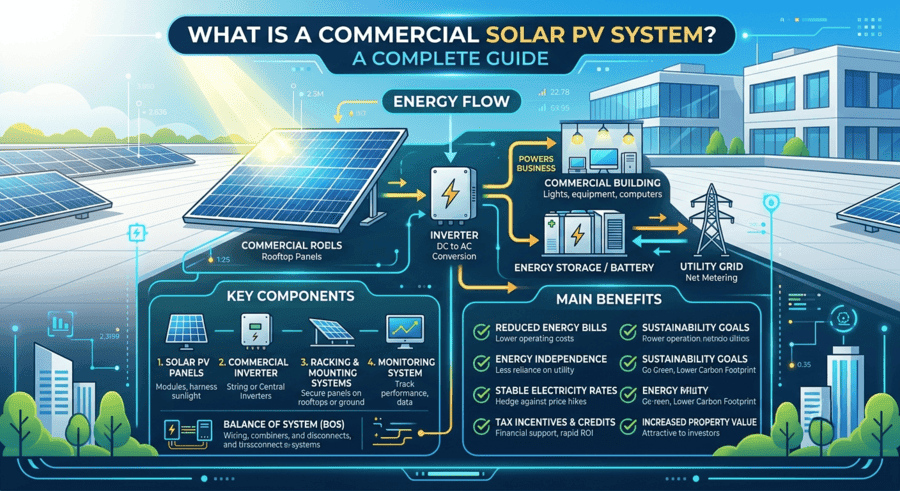
A commercial solar PV system is a photovoltaic installation, typically ranging from 20 kilowatts to several megawatts, that generates electricity for a business, institution, or organization rather than a single household. Unlike a residential system, which usually sits on one roof and serves one electric meter, a commercial system is engineered around a facility’s specific energy use, its structural or land constraints, and often a large parking footprint or multiple buildings. The core hardware, panels, inverters, racking, and a grid connection, works on the same physics as residential solar. What changes is scale, mounting method, and the number of stakeholders involved in getting the project designed, permitted, and approved.
At a glance:
- Typical size range: 20 kW for a small business up to 2 MW or more for a large industrial site
- Five common configurations: rooftop, ground-mounted, carport, canopy, and floating solar
- Core components: PV modules, inverter(s), racking and mounting, monitoring, disconnects, and optionally battery storage
- Typical service life: 25 to 30 or more years of production
- Common users: warehouses, manufacturers, schools, retailers, hotels, healthcare facilities, farms, and municipalities
This guide covers what a commercial solar PV system is, how it works, the equipment it’s built from, the five common ways it can be mounted, how systems are typically sized, which industries use them, and how a commercial project moves from initial assessment to operation. Reducing the soft costs involved in that process, including permitting and interconnection, remains a major focus of NREL‘s ongoing solar market research.
How a Commercial Solar PV System Works
Every commercial PV system moves electricity through the same basic sequence, regardless of size or mounting type:
- Sunlight strikes the PV panels, which generate direct current (DC) electricity through the photovoltaic effect
- DC electricity flows to the inverter, which converts it into alternating current (AC), the form of power buildings and the grid use
- AC power routes through the facility’s main electrical panel, where it is available to run equipment, lighting, and HVAC alongside grid power
- Any electricity the building isn’t using in real time is exported to the utility grid, typically earning a bill credit through net metering or a similar arrangement
- The utility’s meter tracks power flowing in both directions, and the interconnection agreement between the system owner and the utility governs how that exported power is credited
The exact wiring path, string configuration, and equipment shown in this flow are documented in an electrical single-line diagram, one of the core documents in any solar permit plan set and typically the first thing an AHJ reviewer checks.
The Core Components of a Commercial Solar PV System
A commercial system is built from six categories of equipment. Panels and inverters get the most attention, but racking, monitoring, disconnects, and, increasingly, batteries are just as central to how the system is designed and permitted.
Solar Panels (PV Modules)
Solar panels are the modules that convert sunlight into direct current (DC) electricity through the photovoltaic effect. Commercial projects typically use monocrystalline modules rated between 400 and 700 watts each, wired together into strings to reach the voltage and current the rest of the system is designed around. On a commercial project, panel count is driven by available roof or land area, the facility’s energy use, and structural or shading constraints identified during the site assessment. Panel selection also affects the rest of the plan set: the equipment datasheet, wiring diagram, and structural load calculations all reference the specific module chosen, so a late panel change can trigger a redesign of several other documents. Commercial buyers also weigh temperature coefficient, degradation rate, and warranty length more heavily than residential buyers do, since a 500 kW array represents a much larger capital commitment and a longer expected service life.
Inverters
The inverter converts the DC electricity produced by the panels into alternating current (AC), the form of power a building’s electrical system and the utility grid use. Commercial systems generally use one of three inverter architectures: string inverters, which handle a group of panel strings each; power optimizers paired with a central inverter, which manage panel-level output before it reaches the inverter; or, on larger installations, central inverters that handle the entire array’s DC output at once. The right choice depends on system size, shading conditions, and how much module-level monitoring the facility wants. Inverter selection also determines which interconnection rules apply, since the inverter is what utilities certify against standards like UL 1741 and IEEE 1547 before approving a system to connect to the grid.
Racking and Mounting
Racking is the structural framework that physically attaches panels to a roof, the ground, or an elevated structure like a carport. The racking system has to hold the array at the correct tilt and orientation for energy production while withstanding wind, snow, and seismic loads calculated to ASCE 7 criteria for the site. Rooftop racking varies by roof type: ballasted systems for flat membrane roofs, penetrating mounts for pitched composition or metal roofs, and specialized clamps for standing-seam metal. Ground-mounted and carport-racking instead rely on driven or embedded foundations engineered for the local soil conditions. Because racking carries the full weight and wind load of the array, it is one of the first things a structural engineer reviews, and it is a major driver of both installation cost and permitting complexity on larger commercial projects.
Monitoring Systems
Monitoring hardware and software tracks how much electricity the system produces, often down to the individual string or panel, and flags underperformance before it becomes a larger maintenance issue. For a commercial owner, monitoring data supports utility bill reconciliation, warranty claims, and, for a business with multiple properties, portfolio-level performance comparisons across sites. Most inverter manufacturers include cloud-based monitoring as standard, while larger commercial and multi-site portfolios often add a third-party monitoring platform that can pull data from multiple inverter brands into a single dashboard. Monitoring is not usually a permitting requirement on its own, but production data is frequently what a facility manager uses to confirm the system is performing the way the original proposal projected.
Disconnects and Safety Equipment
Every commercial PV system includes a set of disconnecting means, DC disconnects near the array, AC disconnects near the inverter and utility connection, and often a rapid shutdown device, that allow the system to be de-energized for maintenance, emergency response, or utility work. These components exist primarily for safety: a firefighter, lineworker, or electrician needs a reliable way to isolate the solar system from the rest of the building’s power. Disconnect placement, labeling, and rapid shutdown compliance are governed by NFPA 70 (NEC) and by workplace electrical safety rules under OSHA 29 CFR 1910.303, and are reviewed closely during permitting; our guide to solar PV labeling requirements covers the specific placards and wording an inspector will check in the field.
Battery Storage (Optional)
A growing share of commercial systems pair solar with battery storage to shift energy use, reduce demand charges, or provide backup power during an outage. At a high level, a battery sits between the inverter and the building’s electrical panel, charging from excess solar production and discharging when the facility needs it most. Adding storage introduces its own equipment, disconnects, and code requirements under NEC Article 706, and a battery bolted onto an existing PV-only system typically needs its own permit rather than a simple addition to the original plan set. This overview only touches the basics; sizing, chemistry, and the fire and life-safety code details that apply to commercial battery installations are substantial enough to warrant their own dedicated guide.
Types of Commercial Solar PV Systems
Commercial solar can be mounted five different ways, and the right choice depends on available roof condition, land, parking area, and what the facility needs the structure to do beyond generating electricity.
Rooftop Systems
Rooftop mounting is the most common configuration for commercial solar because it uses space the building already has, adds no additional land footprint, and keeps the array out of the way of normal site operations. It works best on roofs with at least 10 to 15 years of remaining service life and adequate structural capacity, since the roof has to carry the added dead load of panels, racking, and attachment hardware in addition to existing wind and snow loads.
Ground-Mounted Systems
Ground-mounted arrays sit on dedicated racking anchored directly into the earth, typically on adjacent land rather than the building itself. They suit facilities with available acreage, roofs that cannot support the added weight, or owners who would rather keep the roof untouched for a future replacement. Ground mounts allow more flexibility in panel orientation and tilt, but they require their own foundation design, site grading, and often additional land use or zoning approval.
Carports
A solar carport is an elevated structure built over a parking area that generates electricity while also providing covered parking. Carports are popular at retail centers, schools, and corporate campuses where parking lots offer more usable area than the roof does, and they pair naturally with EV charging infrastructure installed underneath the array. Because the structure is freestanding, it needs its own engineered foundation and framing designed to the same wind and snow criteria as any other commercial structure.
Canopies
Canopies function similarly to carports but are typically used over walkways, building entrances, outdoor seating areas, or smaller vehicle areas rather than a full parking field. The distinction is mostly one of scale and purpose: a canopy is often part of a building’s architectural design as much as its energy strategy, while a carport is primarily sized around parking capacity. Our dedicated guide to solar canopies covers the structural and permitting differences in more depth.
Floating Solar
Floating solar, sometimes called floatovoltaics, places arrays on pontoons or platforms anchored on reservoirs, retention ponds, or other water bodies. It remains a smaller share of the commercial market in the United States but is gaining traction at wastewater treatment plants, agricultural irrigation ponds, and utility properties where land is limited but water surface area is available. Floating arrays benefit from the cooling effect of the water, which can modestly improve panel efficiency, but they introduce mooring, electrical, and environmental permitting considerations that rooftop and ground-mounted systems do not have.
For cost and structural planning specific to parking-area installations, see our guides to solar carports and solar canopies.
Solar Permit Solutions
Commercial Solar Design Services
Professional permit plan sets for commercial installations. PE-stamped, code-compliant, fast delivery.
Typical Commercial Solar System Sizes
System size is driven by two things above all else: how much electricity the facility uses and how much roof or land area is available for the array. The table below shows the rough size bands the industry commonly uses.
| Category | Typical Size | Common Examples |
|---|---|---|
| Small Business | 20 to 100 kW | Single-tenant retail, small offices, restaurants |
| Medium Commercial | 100 to 500 kW | Warehouses, mid-size manufacturers, schools |
| Large Commercial | 500 kW to 2 MW | Distribution centers, hospitals, large campuses |
| Utility-Scale Commercial | 2 MW and above | Industrial parks, solar farms, large agricultural operations |
These ranges are general planning references rather than firm categories. A facility with unusually high energy use, such as a cold storage warehouse, may need a system well above what its square footage alone would suggest, while a facility with a large roof but modest energy use may intentionally build a smaller array. State and utility incentives that affect the economics of a given size also vary widely; the DSIRE database is the standard reference for researching what applies to a specific location.
Which Industries Use Commercial Solar?
Commercial solar shows up wherever a facility combines a large roof or land footprint with meaningful daytime electricity use. The most common adopters include:
- Warehouses and distribution centers, which pair large flat roofs with high daytime energy use from refrigeration, conveyor systems, and lighting
- Manufacturing facilities, where solar offsets a portion of continuous production-line electricity demand
- Schools and higher education campuses, which often combine rooftop and carport systems and can access public financing options
- Retail properties, from single storefronts to shopping centers with carport arrays over shared parking
- Agricultural operations, including barns, cold storage, and irrigation pumping loads
- Hotels and hospitality properties, where solar helps offset high HVAC and laundry loads
- Healthcare facilities, which have high continuous electricity demand and often pair solar with backup power planning
- Municipal and government buildings, including public works facilities, wastewater plants, and administrative offices
For a closer look at the financial and operational case these industries make for going solar, see our guide to the benefits of commercial solar panels.
Commercial vs. Residential Solar: What’s Different
Commercial and residential solar share the same underlying technology, but they differ in scale, complexity, and who is involved in approving the project.
| Factor | Residential | Commercial |
|---|---|---|
| Typical system size | 5 to 15 kW | 20 kW to 2 MW or more |
| Common mounting types | Rooftop | Rooftop, ground-mounted, carport, canopy, floating |
| Stakeholders involved | Homeowner and installer | Owner, tenant, facilities manager, and sometimes a lender or board |
| Electrical service | Single-phase, one meter | Often three-phase, sometimes multiple meters or buildings |
| Permitting documentation | Standard residential plan set | More detailed structural, electrical, and interconnection documentation |
For a deeper look at how the two markets differ in practice, including proposal development, financing structures, and stakeholder management, see our guide to how a commercial solar system works.
The Commercial Solar Project Lifecycle
A commercial solar project moves through eight stages from initial assessment to ongoing operation:
1. Site Assessment. An engineer or designer evaluates roof condition, available land, shading, and the facility’s electrical service to determine feasibility.
2. System Design. The design team lays out panel placement, string configuration, and equipment selection based on the site assessment. See our guide to the electrical single-line diagram.
3. Engineering. Structural and electrical calculations are finalized, and the plan set is prepared for a PE stamp from an engineer licensed in the project’s state. See our guide to the PE stamp requirements by state.
4. Permitting. The PE-stamped plan set is submitted to the local AHJ for building and electrical permit review. See our guide to the local AHJ.
5. Installation. The system is installed exactly as shown in the approved plan set, including racking, wiring, disconnects, and labeling.
6. Inspection. The AHJ conducts a final inspection to confirm the installed system matches the approved plans before signing off.
7. Utility Approval. The utility reviews and approves the interconnection application and issues Permission to Operate (PTO) so the system can export power. See our guide to the interconnection agreement.
8. Operation. The system begins generating electricity, with monitoring in place to track production against expectations over its service life.
Permitting alone touches several specialized documents and requirements: our solar permit requirements guide covers what AHJs check during plan review, and our commercial solar compliance guide covers the codes and standards a commercial system has to meet in more depth. Utility approval has its own multi-step process as well, detailed in our commercial solar interconnection guide.
If a project includes battery storage, that adds a parallel set of permitting and equipment requirements; see our solar battery permit guide and our solar PV labeling requirements guide for the disconnect and placard documentation reviewers expect to see in the plan set. Systems that connect using a load-side tap should also reference our supply-side vs. load-side interconnection guide.
Some jurisdictions speed up the permitting stage through SolarAPP+, an automated code-compliance platform that can issue eligible permits instantly rather than waiting for manual plan review. On the interconnection side, IREC maintains model interconnection procedures that many states use as the basis for their own utility interconnection rules.
Getting Your Commercial Solar Project Permitted Right the First Time
Every commercial solar project, regardless of mounting type or size, eventually needs a PE-stamped, AHJ-ready plan set to move from design into installation. Solar Permit Solutions produces permit-ready plan sets for rooftop, ground mount, carport, canopy, and battery-integrated commercial systems across all 50 states. See our commercial solar design services to get started, or explore the guides linked throughout this article for a deeper look at permitting, interconnection, and compliance.
Frequently Asked Questions About Commercial Solar PV Systems
Commercial Solar Design Services
Professional permit plan sets for commercial installations. PE-stamped, code-compliant, fast delivery.
Frequently Asked Questions
A commercial solar PV system is a photovoltaic installation, generally 20 kW or larger, designed to generate electricity for a business, institution, or organization rather than a single home. It uses the same core technology as residential solar, panels, an inverter, racking, and a grid connection, but is engineered around a specific facility's energy use, roof or land constraints, and applicable commercial building and electrical codes.
Commercial systems generally range from about 20 kW for a small retail location or restaurant up to 2 MW or more for a large distribution center or industrial campus. Size is driven primarily by the facility's annual electricity use and the amount of usable roof or land area available for the array.
A commercial solar system includes PV panels, one or more inverters, a racking and mounting structure, a monitoring platform, and disconnecting means required for safety. Many systems also include battery storage, though storage adds its own equipment and permitting requirements beyond a PV-only installation.
Most commercial solar panels carry a 25- to 30-year production warranty, and well-maintained systems commonly continue generating electricity beyond that window, typically at a slightly reduced output due to gradual panel degradation. Inverters generally have shorter service lives than panels and may need replacement once or twice over the system's lifetime.
Commercial solar is common among warehouses, manufacturers, schools, retail properties, hotels, healthcare facilities, agricultural operations, and municipal or government buildings. These facilities tend to have large roof or land areas, high daytime electricity use, or both, which improves the economics of a larger array.
Commercial solar systems are larger in scale, involve more complex engineering and permitting, and are designed around a business's specific energy profile rather than a single household's usage. Commercial projects more often use ground-mount, carport, or canopy configurations, may involve multiple stakeholders such as landlords and tenants, and typically require more detailed structural and electrical documentation during permitting.
Commercial systems typically use string inverters, power optimizers paired with a central inverter, or, on larger arrays, central inverters that handle the full DC output of the system. The right choice depends on system size, roof or site shading conditions, and how much panel-level monitoring the facility wants.
Yes. Battery storage can be added to a commercial solar system to shift energy use, reduce demand charges, or provide backup power during an outage. Storage introduces additional equipment, disconnects, and code requirements under NEC Article 706 and typically requires its own permit rather than a simple addition to an existing PV-only system.

SPS Editorial Team
Solar Permit Solutions
Solar Permit Solutions provides professional solar permit design services for residential, commercial, and off-grid installations across all 50 states. Our team ensures permit-ready plan sets delivered fast.
Related Articles
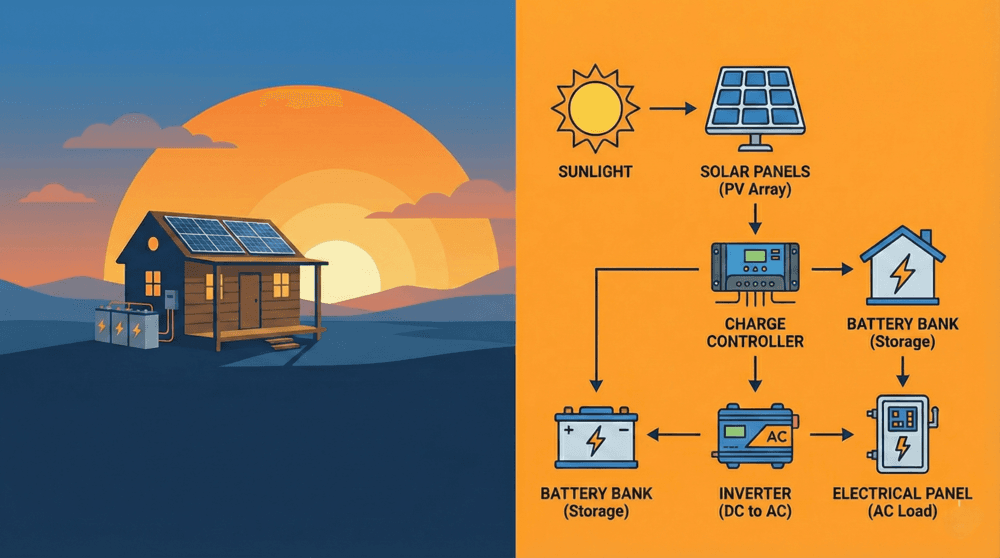
Off-Grid Solar System Requirements: Sizing, Permits & NEC Code Guide
Off-grid solar permit requirements by state: building codes, NEC compliance, bat...
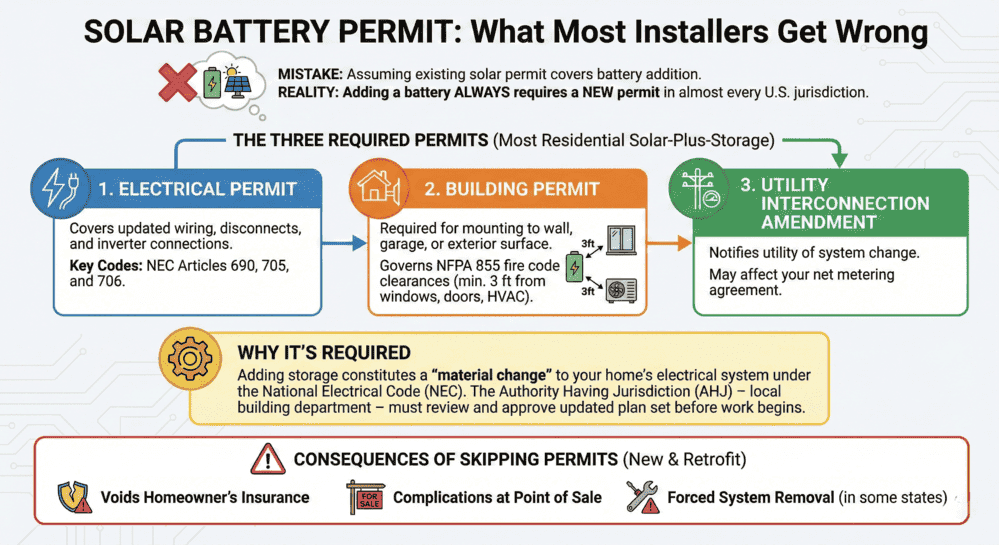
Solar Battery Permit: What Most Installers Get Wrong
Quick Answer: Adding battery storage to a solar system almost always requires ne...
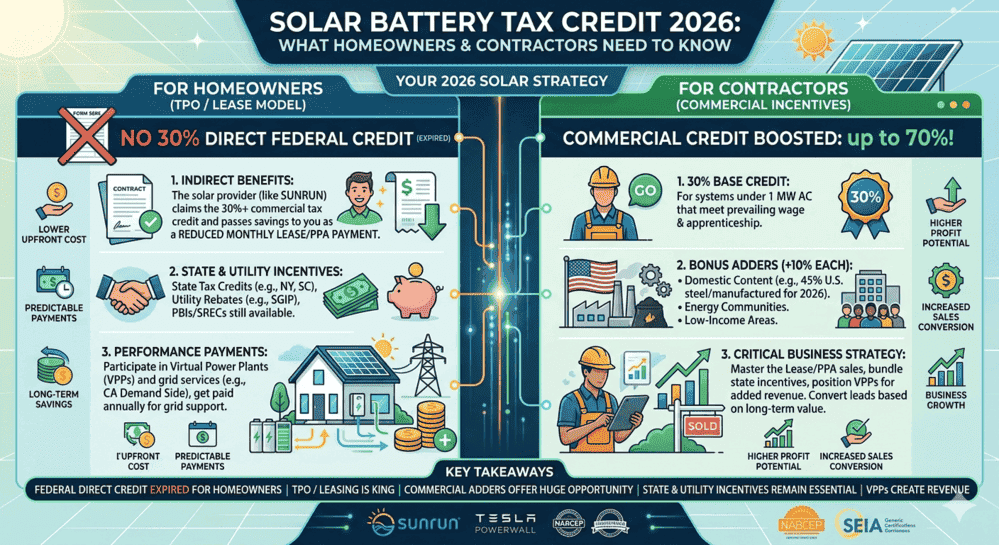
Solar Battery Tax Credit 2026: What Homeowners and Contractors Need to Know
There is no federal solar battery tax credit available to homeowners in 2026. Th...