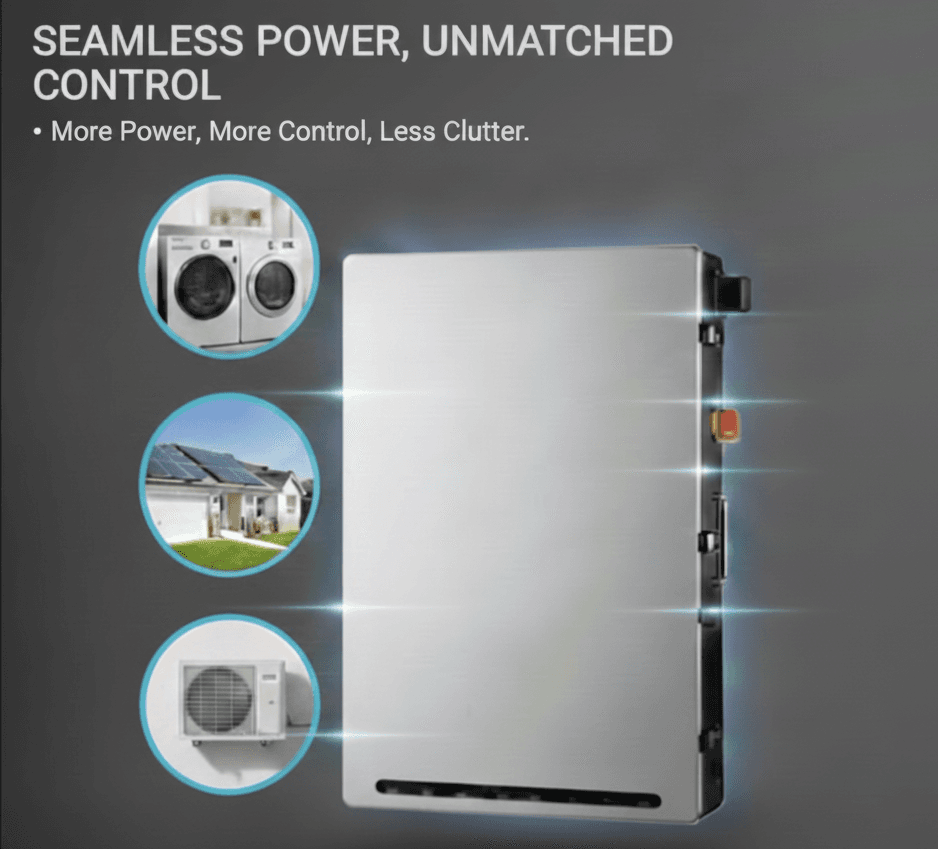
The EG4 GridBOSS is a 200A-rated Microgrid Interconnect Device (MID) that simplifies solar permitting by consolidating utility connections, up to three EG4 hybrid inverters, a 125A generator input, and four smart load ports into a single NEMA 3R service-entrance-rated enclosure. For solar contractors and permit designers, the GridBOSS reduces plan set complexity by eliminating separate transfer switches, subpanels, and interconnection hardware, which typically saves up to $7,500 in equipment and installation costs while streamlining AHJ approval processes.
This comprehensive guide covers everything solar professionals need to know about specifying, documenting, and permitting EG4 GridBOSS installations, including NEC code compliance requirements, single-line diagram callouts, utility interconnection considerations, and common AHJ questions.
What Is the EG4 GridBOSS?
Product Overview and Core Function
The EG4 GridBOSS functions as a microgrid interconnect device, also known as a power gateway, that serves as the central hub for residential and light commercial solar-plus-storage installations. Unlike traditional system architectures that require multiple separate components for utility connection, inverter integration, load management, and backup power switching, the GridBOSS consolidates these functions into a single wall-mounted enclosure.
The device is rated as a 200A service entrance with a 22kAIC (kilo-ampere interrupting capacity) rating, meaning it can serve as the main service disconnect while providing sufficient fault current protection for most residential electrical services. This service entrance rating eliminates the need for a separate main breaker panel in many installation scenarios, further reducing component count and simplifying the electrical design.
At its core, the GridBOSS manages power flow between five distinct connection points: the utility grid, solar hybrid inverters, battery storage systems (through the inverters), backup generator, and building loads. The device automatically handles grid synchronization, islanding during outages, generator integration, and load prioritization without requiring complex programming or additional control equipment.
Key Specifications for Permit Documentation
When preparing solar permit applications and plan sets, the following specifications must be accurately documented:
The 55-pound weight is particularly important for structural considerations when wall-mounting the unit. Installers should verify that the mounting surface can support this load, and permit drawings should indicate appropriate backing or support framing where required. Additionally, to maintain UL certifications, copper wiring must be used inside the GridBOSS unit. This requirement should be noted in the plan set specifications.
Compatible EG4 Inverters
The GridBOSS is designed to integrate exclusively with EG4’s hybrid inverter lineup. Compatible inverters include the EG4 12kPV, 18kPV, FlexBOSS18, and FlexBOSS21. Third-party inverters are not supported on the hybrid ports. When paired with the FlexBOSS21, the combination significantly reduces installation complexity and cost by eliminating extra components and reducing installation time.
Each inverter requires a specific breaker size: 50A for the 12kPV, 70A for the 18kPV and FlexBOSS18, and 90A for the FlexBOSS21. These breakers are sold separately and must be specified correctly in the permit documentation. The 200A main breaker (Eaton CSR2200N/CSR25K) is also sold separately and is required for the GridBOSS to function as service entrance equipment.

Why Solar Contractors Choose the GridBOSS
Reduced Equipment and Labor Costs
One of the primary advantages of the GridBOSS for solar contractors is the significant reduction in both equipment costs and installation labor. Traditional solar-plus-storage installations with backup capability typically require separate components, including a main breaker panel, automatic transfer switch, critical loads subpanel, generator interlock or transfer switch, and various interconnection hardware. The GridBOSS consolidates all of these functions into a single device.
According to EG4, this consolidation can save contractors up to $7,500 per installation when accounting for both eliminated equipment and reduced labor hours. The single-device approach also reduces the number of potential failure points and simplifies troubleshooting, which can lower warranty service costs over the system lifetime. The GridBOSS is available through authorized distributors, including Signature Solar.
Faster Permitting Approval
From a permitting perspective, fewer components translate directly to simpler documentation. Single-line diagrams become cleaner and easier to review when there is one central device rather than multiple interconnected panels and switches. This simplicity reduces the likelihood of revision requests from plan reviewers who may be unfamiliar with complex multi-component system architectures. Understanding how long solar permits take helps contractors plan projects more effectively.
The GridBOSS also simplifies utility interconnection applications. Rather than explaining how multiple components work together to meet utility requirements for anti-islanding, rapid shutdown, and grid synchronization, the permit package can reference a single listed device that incorporates all required protective functions.
Simplified Whole-Home and Partial Backup Designs
The GridBOSS supports both 200A backed-up loads and 200A non-backed-up loads, providing flexibility for various backup configurations. For whole-home backup designs, the full 200A service can be protected during outages. For partial backup scenarios, the four smart ports (rated at 125A, 80A, 60A, and 60A) allow for selective load management based on priority and available stored energy.
The smart port functionality includes five programmable drivers for optimized load management, and the device monitors energy flow across eight circuits. This built-in monitoring capability can reduce or eliminate the need for separate energy monitoring equipment, further simplifying the installation and permit documentation. For projects requiring standalone power, off-grid solar system design services can help with system sizing and documentation.
Solar Permit Solutions
Solar Contractor? We Design Your Plans.
Outsource your permit plan sets to our team. PE-stamped, code-compliant, fast turnaround so you can focus on installation.
NEC Code Compliance for EG4 GridBOSS Installations
Proper National Electrical Code compliance documentation is essential for permit approval. The following sections outline the primary code articles that apply to GridBOSS installations and the documentation requirements for each.
NEC 705: Interconnection Requirements
NEC Article 705 governs the interconnection of distributed energy resources with the utility grid. For GridBOSS installations, the most relevant sections include NEC 705.12, which addresses the point of interconnection method. The GridBOSS serves as the point of connection between the utility service and the inverter systems, and the plan set should clearly indicate this relationship on the single-line diagram. For systems requiring supply-side connections, additional documentation may be required.
NEC 705.13 addresses loss of primary source requirements, commonly known as anti-islanding protection. The GridBOSS incorporates grid disconnect functionality that prevents the system from backfeeding the utility during outages. This protection is integral to the device and should be noted in the plan set documentation.
Plan sets should include notes referencing compliance with NEC 705 and indicating that the GridBOSS provides the required interconnection protection. The specific model number and relevant certifications should be listed in the equipment schedule to facilitate plan review. For systems with fuses in DC circuits, NEC 690.16 fuse servicing requirements may also apply.
NEC 706: Energy Storage System Integration
NEC Article 706 covers energy storage systems, which applies to GridBOSS installations that include battery storage through the connected hybrid inverters. The GridBOSS itself does not contain batteries but serves as the integration point for battery-backed inverter systems.
Key compliance considerations under NEC 706 include overcurrent protection requirements for the battery circuits (handled at the inverter level), disconnecting means (provided by the GridBOSS and inverter disconnects), and labeling requirements for energy storage systems. The plan set should indicate the location and ratings of all disconnecting means and overcurrent protection devices in the system. For detailed guidance on electrical panel configurations for battery backup, consult our technical resources.
NEC 710: Standalone and Microgrid Systems
For installations designed to operate in off-grid or microgrid configurations, NEC Article 710 provides additional requirements. The GridBOSS is specifically designed for microgrid applications and supports seamless transition between grid-connected and islanded operation.
When documenting NEC 710 compliance, the plan set should indicate the system’s capability for standalone operation, the automatic transfer functionality between grid and backup power sources, and the generator integration if applicable. The 125A generator input capacity should be documented along with the generator specifications if known at the time of permitting.
NEC 230: Service Entrance Considerations
Because the GridBOSS carries a 200A service entrance rating, NEC Article 230 requirements for services apply. The plan set must document proper grounding and bonding per NEC 250, service conductor sizing appropriate for 200A service, the service disconnecting means (which can be the GridBOSS main breaker), and meter-main configuration if the GridBOSS is used downstream of a meter-main combination.
The 22kAIC interrupting rating should be verified against the available fault current at the service location. For most residential applications, this rating is sufficient, but commercial installations or locations near utility substations may require verification that the available fault current does not exceed the device rating.
Solar Plan Set Requirements for GridBOSS Installations
Single-Line Diagram Elements
The single-line diagram is the most critical sheet in the permit package for demonstrating proper system design and code compliance. For GridBOSS installations, the SLD should clearly show the following elements:
- Utility service connection showing 200A service conductors to the GridBOSS
- GridBOSS represented as the central hub with its model number and ratings
- Inverter connections (up to three) with appropriate breaker protection for each
- Smart port connections with individual breaker sizes noted
- Generator connection (if applicable) with 125A maximum rating
- Clear delineation between backed-up loads and non-backed-up loads
- Grounding electrode system and conductor sizes
- All overcurrent protection devices with ratings
The GridBOSS should be shown as a single symbol with multiple connection points rather than as separate components. This accurately represents the integrated nature of the device and helps plan reviewers understand the simplified system architecture.
Electrical Site Plan Details
The electrical site plan should indicate the physical location of the GridBOSS relative to other system components. Key elements to include are the mounting location with dimensions from reference points, conduit routing from the utility meter to the GridBOSS, conduit routing from the GridBOSS to inverters, battery systems, and load panels, required working clearances per NEC 110.26, and disconnect locations accessible to utility personnel and first responders.
Given the 55-pound weight of the GridBOSS, the site plan should note any structural backing or support requirements for the mounting location. The NEMA 3R outdoor rating allows for exterior installation, but the plan should still document weather protection and enclosure placement considerations.
Equipment Schedule Information
The equipment schedule should include complete information for the GridBOSS and all connected components. For the GridBOSS specifically, document the manufacturer (EG4 Electronics), model number (MI-200-2P-HYB-AW-01, 02, or 03), electrical ratings (200A, 22kAIC), physical dimensions (31.5 x 19.7 x 7.0 inches), weight (55 lbs), NEMA 3R outdoor rating, and listing/certification information (UL1741, UL67, UL869A).
Each connected hybrid inverter should also appear in the equipment schedule with its model number, power rating, and current ratings. If a generator is included in the system, its specifications should be listed with verification that the output does not exceed the 125A GridBOSS generator input capacity.
Required Notes and Callouts
Plan sets should include specific notes to address common plan reviewer questions and demonstrate code compliance. Recommended notes for GridBOSS installations include:
- UL certification references for the GridBOSS (UL1741, UL67, UL869A) and all major components
- Note that copper wiring is required inside the GridBOSS to maintain UL certifications
- Rapid shutdown compliance statement indicating the method used (see our rapid shutdown compliance guide)
- Grounding electrode conductor sizing calculations or references
- Overcurrent protection coordination notes
- Anti-islanding protection statement referencing the GridBOSS integral protection
- NEC article references for interconnection (705), energy storage (706), and standalone systems (710) as applicable
Utility Interconnection Considerations
Service Entrance Rating Documentation
The 200A service entrance rating with 22 kAIC interrupting capacity positions the GridBOSS to meet most utility interconnection requirements for residential systems. The utility interconnection application should clearly state this rating and reference the device listing information.
For systems where the GridBOSS serves as the main service disconnect, the application should indicate compliance with utility requirements for accessible disconnecting means. The GridBOSS can be locked in the off position if required by the utility for maintenance access.
Anti-Islanding and Grid Protection
The GridBOSS incorporates grid disconnect functionality that provides anti-islanding protection. The device is certified to UL1741, which is based on IEEE 1547 standards for grid interconnection. This protection prevents the solar and battery system from energizing utility lines during grid outages, which is a fundamental requirement for all grid-connected distributed energy resources.
The interconnection application should reference this integral protection and note that no additional anti-islanding equipment is required. If the utility requires specific relay settings or protective functions, verify that the GridBOSS meets those requirements or document any additional equipment needed.
Net Metering and Export Considerations
For systems participating in net metering programs, the interconnection application should document the bidirectional power flow capability of the system. The GridBOSS allows for export of solar generation to the grid when production exceeds on-site consumption. According to the Solar Energy Industries Association, net metering policies vary by state and utility.
Production meter placement should be indicated on the plan set if required by the utility. Some utilities require a separate production meter for incentive programs, while others use the bidirectional service meter for net metering calculations. Verify local utility requirements and document meter placement accordingly.
Generator Integration and Permitting
Generator Connection Specifications
The GridBOSS supports generator input up to 125A, equivalent to approximately 30 kW of generator capacity. This generous capacity allows for integration of generators sized to support substantial backup loads, which is particularly valuable for whole-home backup applications or installations in areas with extended outage risk.
The plan set should document the generator connection method, including conductor sizing appropriate for the generator output current, overcurrent protection at the GridBOSS generator input, and start/stop control integration if automatic generator start is included.
Transfer Switch Elimination
One of the significant advantages of the GridBOSS for systems that include generator backup is the elimination of a separate automatic transfer switch (ATS). Traditional generator installations require an ATS to switch between utility power and generator power while preventing backfeed. The GridBOSS incorporates this functionality, reducing component count and simplifying the electrical design.
For permit documentation, this means the single-line diagram shows the generator connecting directly to the GridBOSS rather than through a separate transfer switch. Notes should indicate that the GridBOSS provides the transfer switching function and that no separate ATS is required.

Common AHJ Questions and How to Address Them
Understanding AHJ requirements and local regulations is essential for first-time permit approval. Here are the most common questions plan reviewers ask about GridBOSS installations.
Certification and Listing Documentation
Plan reviewers may request verification of product certifications and listings. The permit package should include reference to the GridBOSS certifications: UL1741, UL67 and UL869A (when used with the Eaton CSR2200N/CSR25K main breaker). The manufacturer spec sheet should be included or available for reference, and the plan set notes should reference the listing file numbers. EG4 provides Certificates of Compliance documentation on their website.
If questions arise during plan review, contact EG4 technical support for certification documentation or contact Solar Permit Solutions for assistance in responding to plan reviewer comments.
Load Calculation Verification
Some jurisdictions may request load calculations to verify that the 200A backed-up load rating is appropriate for the installation. Standard load calculations per NEC Article 220 should be provided showing that the total connected load does not exceed the GridBOSS capacity.
For partial backup configurations using the smart ports, document the load allocation for each port and verify that individual port capacities (125A, 80A, 60A, 60A) are not exceeded. Include a critical loads schedule if required by the jurisdiction.
Rapid Shutdown Compliance
Rapid shutdown requirements under NEC 690.12 apply to the PV array portion of the system. While the GridBOSS itself is not a rapid shutdown device, the plan set must document how rapid shutdown safety requirements are met, whether through module-level power electronics (MLPEs) or inverter-level shutdown.
Include the rapid shutdown initiation device location on the site plan and note the rapid shutdown method on the single-line diagram. The GridBOSS does not affect rapid shutdown compliance but should not be confused with rapid shutdown equipment.
Installation Best Practices for Permit Compliance
Mounting and Clearance Requirements
The GridBOSS requires installation with proper NEC working space clearances. Per NEC 110.26, a minimum of 36 inches of clear working space is required in front of the device, with a width of at least 30 inches or the width of the equipment (19.7 inches), whichever is greater. A headroom of 6.5 feet minimum is required.
Given the 55-pound weight, the mounting surface must be capable of supporting this load. The plan set should indicate backing requirements if the GridBOSS is wall-mounted on standard residential construction. The installation should follow manufacturer mounting instructions for fastener type and placement. The NEMA 3R rating makes the GridBOSS suitable for outdoor installation, though weather protection considerations should still be documented.
Conductor Sizing and Termination
Proper conductor sizing is essential for both code compliance and system performance. Service entrance conductors should be sized for 200A capacity per NEC Table 310.12 for dwelling services. Common choices include 2/0 AWG copper or 4/0 AWG aluminum for 200A service.
Inverter circuit conductors should be sized based on the inverter maximum output current with appropriate temperature correction and conduit fill adjustment factors. Smart port circuits should be sized for the maximum port rating (125A, 80A, 60A, or 60A) unless load calculations demonstrate a lower current requirement.
Labeling and Signage Requirements
NEC requires specific labels for solar and energy storage systems. Required labels for GridBOSS installations include the main service disconnect label, solar system identification per NEC 690.56, battery storage system identification per NEC 706.30, point of interconnection label, and emergency shutdown procedure labels as required by local jurisdiction. For systems with arc-fault protection requirements, additional labeling may apply.
The plan set should include a label schedule indicating the text, size, and location of all required labels. Utility-required signage should also be documented based on the local utility interconnection requirements.
EG4 GridBOSS vs. Traditional MID/Transfer Switch Configurations
Understanding the differences between a GridBOSS installation and a traditional multi-component configuration helps illustrate the permitting advantages of the integrated approach:
Conclusion
The EG4 GridBOSS represents a significant advancement in solar-plus-storage system architecture, offering solar contractors and permit designers a simplified approach to complex backup power installations. By consolidating multiple components into a single 200A-rated device, the GridBOSS reduces equipment costs, installation time, and permitting complexity while maintaining full code compliance. The International Energy Agency projects continued growth in solar installations, making efficient permitting processes increasingly important.
For solar professionals, understanding the GridBOSS specifications, NEC compliance requirements, and plan set documentation needs is essential for successful project execution. The streamlined system architecture translates to faster AHJ approvals, reduced revision requests, and more efficient installations. Contractors pursuing NABCEP certification will find that familiarity with integrated MID systems demonstrates advanced technical competency. Additionally, homeowners can maximize savings by combining GridBOSS installations with the federal solar tax credit.
Whether designing whole-home backup systems, partial backup configurations, or microgrid installations with generator integration, the GridBOSS provides a versatile platform that simplifies every aspect of the project from initial design through final inspection. For professional permit design services and expert plan sets that get approved the first time, contact Solar Permit Solutions today.
FAQs
Solar Contractor? We Design Your Plans.
Outsource your permit plan sets to our team. PE-stamped, code-compliant, fast turnaround so you can focus on installation.
Frequently Asked Questions
The GridBOSS is certified to UL1741, UL67, and UL869A standards when used with a 200A Eaton CSR2200N (CSR25K) main breaker. Model 03 also carries UL916 certification. Contact EG4 for specific certification documentation needed for permit applications. Note that copper wiring is required inside the unit to maintain UL certifications.
Yes. The GridBOSS carries a 200A service entrance rating with 22kAIC interrupting capacity, making it suitable for use as the main service disconnect for most residential applications.
The GridBOSS supports up to three EG4 hybrid inverters. Breaker sizes vary by inverter model: 50A for the 12kPV, 70A for the 18kPV and FlexBOSS18, and 90A for the FlexBOSS21.
No. The GridBOSS incorporates transfer switching functionality for generators up to 125A (30 kW), eliminating the need for a separate automatic transfer switch.
The primary applicable articles are NEC 705 (Interconnection), NEC 706 (Energy Storage), NEC 710 (Standalone Systems), and NEC 230 (Services) for service entrance installations.
Represent the GridBOSS as a single device (box symbol) with connection points for utility input, inverter connections, smart ports, generator input, and backed-up/non-backed-up load outputs. Label with model number and ratings.

SPS Editorial Team
Solar Permit Solutions
Solar Permit Solutions provides professional solar permit design services for residential, commercial, and off-grid installations across all 50 states. Our team ensures permit-ready plan sets delivered fast.
Related Articles
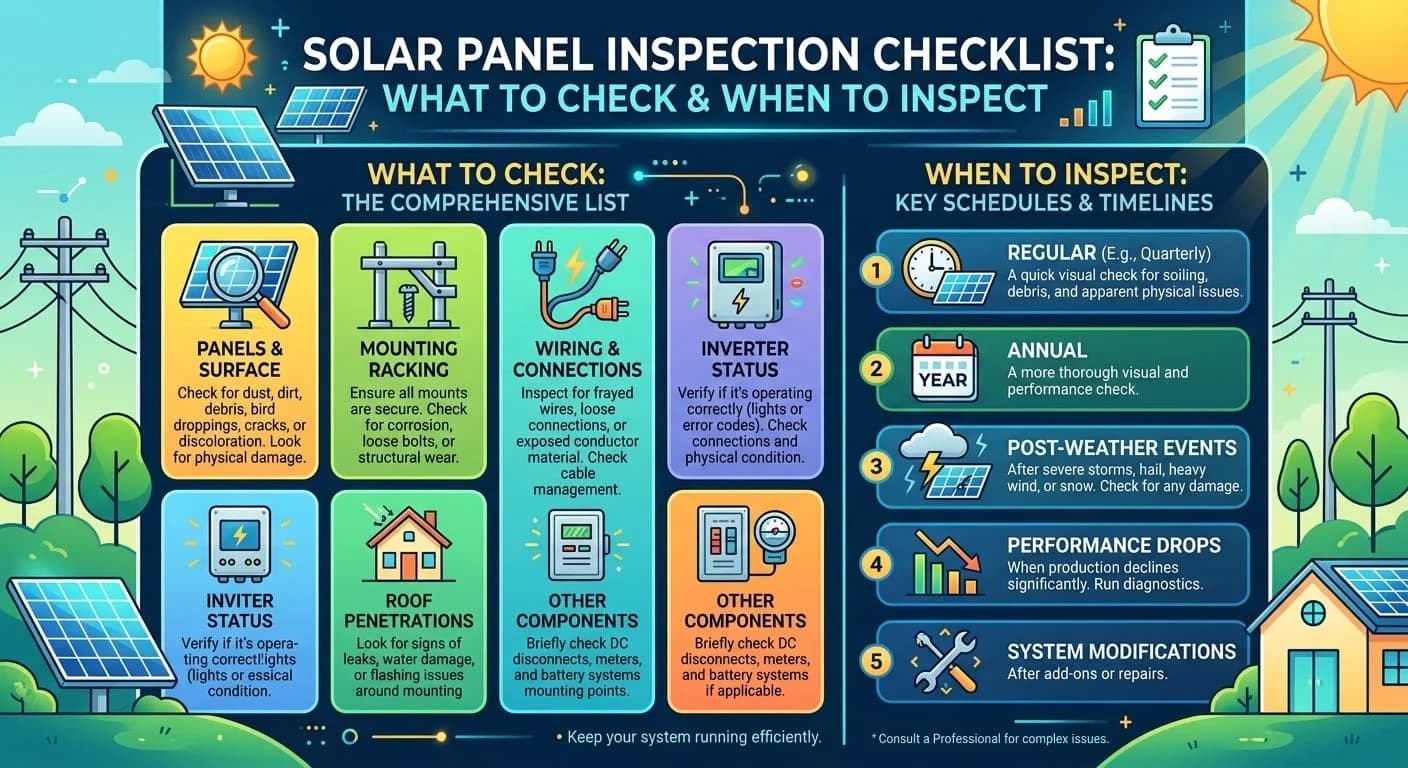
Solar Panel Inspection Checklist: What To Check & When To Inspect
Solar panel inspection guide: Learn what to check, when to inspect (annually + e...
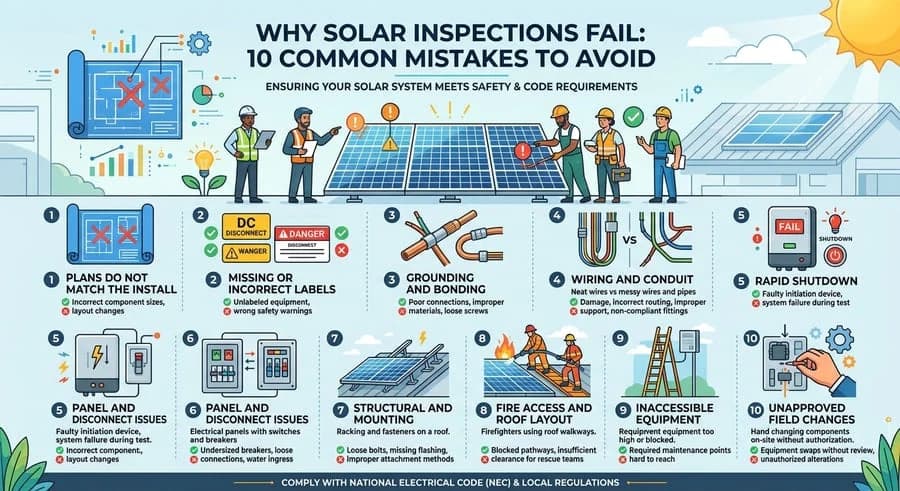
Why Solar Inspections Fail: 10 Common Mistakes to Avoid
Discover the 9 critical reasons solar inspections fail and how to avoid costly m...

Solar Grounding And Bonding: How To Pass Inspection Every Time
Learn how to pass solar grounding and bonding inspections every time. Avoid comm...