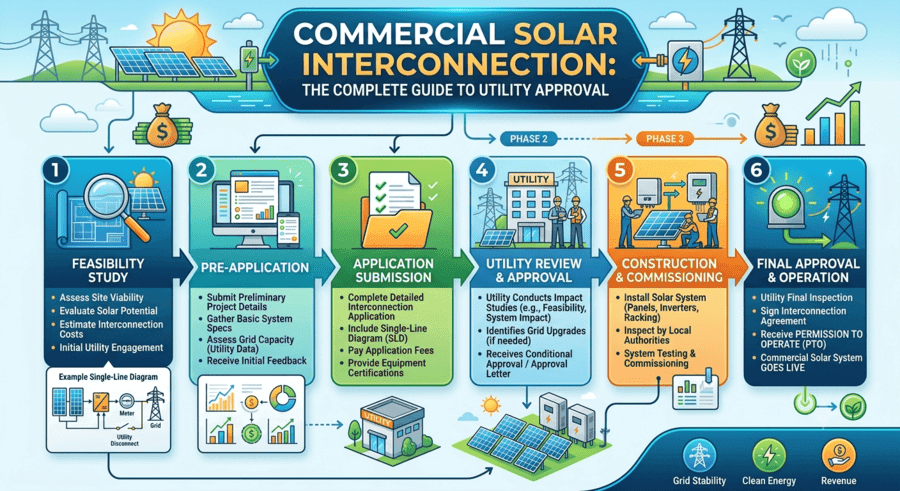
Commercial solar interconnection is the utility-side review and approval process that authorizes a business’s solar or solar-plus-storage system to connect to the electric grid, separate from the local building permit. It typically runs alongside AHJ permitting and covers a feasibility check, an engineering review of the utility’s distribution circuit, an interconnection agreement, and a final Permission to Operate (PTO). Review levels and required studies scale with system size, ranging from a fast-track review for small inverter-based systems to a full impact and facilities study for large or complex commercial arrays, and timelines commonly run from a few weeks to several months.
Commercial solar interconnection is considerably more involved than the residential process because larger systems, three-phase service, and higher export capacity all trigger additional utility engineering scrutiny. This guide covers the full process from feasibility review through Permission to Operate, what documents a utility application requires, how review levels and studies work, what typically causes delays, and what a commercial project should budget for interconnection-related costs. For the plan set and code compliance side of a commercial project, see our guides to commercial solar compliance and installation standards and solar permit design and plan sets.
Commercial Solar Interconnection at a Glance
The core elements of a commercial solar interconnection application are consistent across most U.S. utilities, though the specific forms, fees, and review timelines vary by territory. At minimum, expect the following:
- A completed interconnection application identifying system capacity (kW-AC and kW-DC), inverter make and model, and the point of common coupling
- An electrical single-line diagram showing the array, inverter, disconnects, metering, and interconnection point, consistent with NEC Article 705
- Proof of UL 1741 and IEEE 1547 certified inverter equipment, since utilities will not approve uncertified equipment regardless of system size
- A determination of review track (fast track, supplemental, or detailed study) based on system capacity relative to the utility’s screening thresholds
- An executed interconnection agreement and, where required, a facilities study covering any transformer, protection, or metering upgrades
- A signed-off electrical inspection and Certificate of Completion before the utility issues Permission to Operate (PTO)
- Payment of any application, engineering review, or facilities upgrade costs, which scale with system size and the complexity of the required utility work
What Is Commercial Solar Interconnection?
Commercial solar interconnection is the utility’s review and approval process for connecting a business’s solar, solar-plus-storage, or other distributed generation system to the electric grid. It is a separate process from the local building and electrical permit, and it happens in parallel rather than in sequence at most utilities. Where the local authority having jurisdiction reviews the system for structural and electrical code compliance, the utility reviews the same system for grid safety, protection coordination, and capacity on its own distribution circuit.
A commercial solar system is, at its core, a commercial solar PV system sized well beyond typical residential capacity, which is exactly why the interconnection review carries more engineering weight. For background on why businesses are pursuing these systems in the first place, see our guide to the benefits of commercial solar panels.
Permit vs. Interconnection vs. Permission to Operate
These three approvals are often confused, but each one authorizes a different part of the project and comes from a different authority:
| Approval | Who Issues It | What It Authorizes |
|---|---|---|
| Building and electrical permit | Local AHJ (building department) | Physical construction and electrical work on the property |
| Interconnection agreement | Serving utility | Connecting the system to the grid at a specified point of common coupling |
| Permission to Operate (PTO) | Serving utility, after final inspection | Energizing the system and exporting or offsetting power on the grid |
A system can pass its AHJ inspection and still be legally prohibited from operating until PTO is issued. Confirm both tracks are moving in parallel; our solar interconnection agreement checklist and guide walk through the full PTI-to-PTO sequence in detail.

Why Commercial Solar Interconnection Is More Complex Than Residential
Residential interconnection is largely a formality for small, single-phase, inverter-based systems that fall well under a utility’s fast-track thresholds. Commercial interconnection is a different exercise for several structural reasons:
- Three-phase electrical service is standard on commercial buildings, which changes protection coordination, transformer loading, and the diagrams a utility engineer must review
- Larger inverter capacities and higher system voltages increase the potential impact on the local distribution circuit, which is what triggers supplemental or detailed engineering review
- Existing service transformers are frequently undersized for the added generation capacity, which can require a transformer or service upgrade before the utility will approve export
- Demand charges and export strategy decisions (full export, partial export, or zero export) change how the system needs to be metered and protected
- Multiple meters, submetering, or campus-style distribution are common on commercial and multi-tenant sites, adding coordination steps that residential projects rarely face
- Battery storage is far more common on commercial projects, and batteries introduce their own protection, backfeed, and export-control requirements
The result is that a commercial system of similar wattage per square foot as a residential array can trigger an entirely different review track. Our commercial solar compliance guide covers the parallel building code and structural side of that added complexity.
One clarification worth making up front: the tiered utility screening process described in this guide applies to distribution-level interconnection, which is how nearly all commercial rooftop, ground-mount, and carport systems connect. It is a separate process, governed by state commissions and individual utility tariffs, from the transmission-level generator interconnection queue that the Federal Energy Regulatory Commission (FERC) reformed under Order No. 2023, which applies to large generating facilities connecting directly to the transmission grid rather than to a local distribution circuit. The U.S. Department of Energy’s Solar Energy Technologies Office tracks how both interconnection tracks affect overall project timelines and soft costs nationally.
Solar Permit Solutions
Commercial Solar Design Services
Professional permit plan sets for commercial installations. PE-stamped, code-compliant, fast delivery.
Commercial Solar Interconnection Process: Step by Step
While every utility’s forms differ, the underlying workflow for commercial interconnection follows a consistent sequence. Coordinating this timeline with the AHJ permitting process from the start is one of the most effective ways to avoid a stalled project.
Step 1: Utility Feasibility Review
Some utilities offer or require a preliminary feasibility check before a formal application, particularly for larger systems. This identifies obvious circuit capacity issues early, before engineering fees are spent.
Step 2: Site Assessment
The installer or design team confirms existing service capacity, transformer rating, meter configuration, and available space for any new equipment the utility may require.
Step 3: Engineering Design
A licensed engineer finalizes the single-line diagram, protection settings, and equipment selection, all of which must reference the utility’s own interconnection technical requirements document.
Step 4: Determine Export Strategy
The project team decides whether the system will be full export, partial (net) export, or zero export. This decision changes the metering configuration and, in some cases, the review track itself.
Step 5: Submit the Utility Application
The formal interconnection application is submitted with the required forms, site plan, single-line diagram, equipment datasheets, and application fee.
Step 6: Utility Screening
The utility screens the application against standardized technical criteria to sort it into a review track: fast track, supplemental review, or detailed study.
Step 7: Impact Study (If Triggered)
Systems that fail the initial screening move to an impact study, which may include thermal, voltage, and protection coordination analysis against the local hosting capacity.
Step 8: Utility Approval and Interconnection Agreement
Once engineering review is complete, the utility issues an interconnection agreement specifying any required upgrades, metering, and protection settings.
Step 9: Construction
The installer completes construction per the approved single-line diagram and any facilities upgrades identified in the interconnection agreement.
Step 10: Inspection
The AHJ performs the final building and electrical inspection, confirming the as-built system matches the approved permit plan set.
Step 11: Permission to Operate (PTO)
After the utility confirms the interconnection meter is in place and any required field verification is complete, PTO is issued and the system may legally export or offset power.
Export vs. Zero-Export Solar Systems
Export strategy is one of the earliest decisions a commercial project team makes, because it directly affects which review track a system falls into and how it must be metered and protected.
| Export Type | How It Works | Utility Implication |
|---|---|---|
| Full export | The system can export any excess generation back to the grid. | Full technical screening applies; it may trigger supplemental or detailed review at lower capacity thresholds. |
| Partial (net) export | System offsets on-site load and exports limited excess under a net metering or net billing tariff. | Reviewed against the applicable net metering or net billing program rules |
| Zero export | Export relays or controls prevent any power from flowing back onto the utility grid. | May qualify for a simplified review path at some utilities, since grid impact is limited to on-site load offset |
Zero-export configurations use certified export-limiting relays or inverter-level controls and still require utility documentation confirming the control method, even though the system will never feed power back onto the grid. Peak-shaving applications, where a battery discharges specifically to reduce demand charges without exporting, are frequently configured this way.
Commercial Solar Interconnection Review Levels
Most utilities use a tiered screening framework, closely modeled on the standardized procedures published by IREC and adopted in some form by nearly every state commission. The exact capacity thresholds vary by utility and by state, so checking DSIRE for the specific interconnection standard and net metering rules that apply to a project’s utility territory is a useful first step. The overall structure, however, is consistent:
| Review Level | Typical Trigger | What Happens |
|---|---|---|
| Fast Track | Small inverter-based systems, typically under roughly 25 kW to 2 MW depending on the utility and circuit, using certified equipment | Expedited screening against standard technical criteria; no full engineering study required |
| Supplemental Review | The system fails one or more fast-track screens (for example, aggregate generation on the circuit segment or minimum load ratio). | Additional utility engineering review targeting the specific screen that failed, without a full impact study |
| Detailed (Impact) Study | Larger systems, systems that fail supplemental review, or projects on constrained circuits | Full engineering study covering thermal, voltage, protection, and sometimes a facilities study for required upgrades |
Required Documents for Commercial Solar Interconnection
A complete application package moves faster through utility review than an incomplete one, and resubmissions caused by missing documents are one of the most common self-inflicted delays on commercial projects. A typical package includes:
Electrical single-line diagram: Shows the array, inverter, AC and DC disconnects, metering, and point of common coupling. See our guide to solar energy diagrams for what a reviewer expects on this drawing.
Site plan: Shows equipment locations, access pathways, and the interconnection point relative to the building or property line.
Equipment datasheets: UL-listed cut sheets for every major component, particularly the inverter, which must show its UL 1741 and IEEE 1547 certification.
PE stamp: Most commercial submittals require a professional engineer stamp on the electrical design and often the structural design as well.
Load calculations: Documentation of existing building load, demand profile, and how the system interacts with existing service capacity.
Protective device settings: Relay and breaker settings for any protection equipment required by the utility’s interconnection standard.
Transformer information: Existing transformer rating and, if applicable, specifications for any new or upgraded transformer.
Utility application form: The utility’s own interconnection application, completed and signed by the system owner or an authorized representative.
Insurance certificates: Commercial general liability coverage naming the utility as an additional insured, required by many utilities before construction begins.
Interconnection agreement: The executed agreement specifying the terms, any required upgrades, and metering configuration.
PE stamp requirements vary meaningfully by state and by system size; see our state-by-state PE stamp requirements guide for the specific thresholds that apply to a given jurisdiction, and our solar energy diagrams guide for what belongs on the single-line diagram itself.
How Battery Storage Changes Commercial Interconnection
Adding battery storage to a commercial solar project changes the interconnection review in ways a PV-only system does not trigger. A battery is a bidirectional device, and utilities evaluate it differently depending on whether it is paired with the array through a hybrid inverter or configured as a standalone system with its own power conversion system (PCS).
- Hybrid inverter systems combine PV and battery through a single inverter, which simplifies interconnection documentation but still requires the utility to evaluate combined export capacity
- Standalone battery systems use a separate PCS, which utilities generally treat as their own generating source, requiring their own interconnection review
- Backfeed calculations must account for the battery discharging at full rated capacity simultaneously with solar production, not just the PV array’s rated output alone
- Export controls become more complex when a battery is peak-shaving or performing demand response, since the system’s real-time export profile is no longer static
- IEEE 1547 compliance applies to the battery’s inverter or PCS just as it does to the solar inverter, and both must be documented on the interconnection application
Because a battery adds circuits, disconnects, and a labeling scope beyond a PV-only design, it needs its own compliance review rather than being treated as a simple hardware add-on. See our NEC 690 and 706 compliance checklist for battery storage for the documentation an AHJ and utility will both expect.
Common Utility Studies Explained
Systems routed to supplemental or detailed review may encounter one or more of the following utility engineering studies, each targeting a different technical concern on the distribution circuit:
Hosting Capacity Study: Evaluates how much additional generation a specific circuit segment can accommodate before voltage, thermal, or protection limits are reached.
Impact Study: A broader analysis of how the proposed system affects circuit operation, often the first formal study for systems that fail fast-track screening.
Facilities Study: Identifies and costs out any physical utility upgrades (transformers, protection equipment, metering) required to safely interconnect the system.
Protection Study: Confirms relay and breaker coordination between the customer’s system and the utility’s protection scheme, particularly important for systems with battery storage.
Power Quality Study: Assesses harmonic distortion, flicker, and voltage fluctuation the system may introduce onto the circuit.
Transformer Loading Study: Confirms the existing or proposed service transformer can handle the combined building load and generation capacity.
Voltage Rise Study: Analyzes whether the added generation will push circuit voltage outside acceptable limits, especially on longer or more heavily loaded feeders.
Short Circuit Study: Confirms fault current contribution from the new generation source does not exceed the rating of existing utility protection equipment.
Common Reasons Commercial Solar Interconnection Gets Delayed
Most interconnection delays trace back to a small set of recurring, preventable issues:
- Missing or incomplete documents in the initial application, which restarts the utility’s review clock
- Single-line diagrams that do not match the as-built equipment list submitted with the application
- Inverter certifications that are outdated or do not match the specific firmware version installed
- Transformer sizing that was not evaluated early enough, forcing a late-stage facilities study
- Incomplete PE stamps, or a stamp from an engineer not licensed in the project’s state
- General utility backlog, particularly in territories with high solar interconnection volume
- AHJ correction cycles that delay the permit track and, in turn, delay the utility’s final inspection sign-off
- Meter upgrades or bidirectional metering requirements identified late in the review
- Protection relay coordination issues discovered during the impact study rather than at initial design
- General grid congestion on the specific circuit segment, which can push a project into a longer queue regardless of paperwork quality
Commercial Solar Interconnection Costs
Interconnection costs are separate from the cost of the solar system itself and from AHJ permit fees. They scale with system size, review level, and whether the utility requires facilities upgrades. Typical cost categories include:
| Cost Category | Typical Range | Notes |
|---|---|---|
| Application fee | $50 to a few hundred dollars for fast-track; higher for supplemental or detailed study tracks | Often non-refundable regardless of outcome |
| Engineering review fee | Several hundred to several thousand dollars | Scales with system size and review complexity |
| Transformer upgrade | A few thousand to tens of thousands of dollars | Only required if the existing service transformer cannot handle added generation capacity |
| Protection and relay upgrades | Varies by existing equipment condition | Common on older commercial services with outdated protection schemes |
| Metering | A few hundred to a few thousand dollars | Bidirectional or production metering may require a utility-supplied meter upgrade. |
| Switchgear | Can run into the tens of thousands for larger systems | Typically required only for larger commercial or multi-meter sites |
| Utility construction costs | Highly variable | Applies when the utility must perform work on its own side of the meter, such as feeder upgrades |
Every commercial project needs its own site-specific estimate rather than a generic figure, since existing service capacity and the utility’s specific tariff structure drive most of the variation in these numbers. NREL’s market research on solar soft costs notes that permitting and interconnection together remain one of the largest non-hardware cost categories on commercial projects, which is why getting the application right on the first submission matters as much as the equipment specification itself.
Interconnection costs are separate from the project’s tax position. Commercial systems that begin construction before the applicable deadline may still qualify for the federal Section 48E Clean Electricity Investment Credit: See the current Treasury regulations for Section 48E for the qualifying construction-start rules, and consult a tax professional for how the credit applies to a specific project.
Utility and Code Requirements Every Commercial Solar Project Must Meet
Regardless of utility territory, commercial interconnection applications are evaluated against a consistent set of national standards and NEC articles:
- IEEE 1547: the foundational standard for interconnecting distributed energy resources with the electric grid, covering voltage and frequency ride-through, anti-islanding, and grid-support functions.
- UL 1741 SB: the inverter certification supplement that verifies a device can perform the advanced grid-support functions IEEE 1547-2018 requires, using IEEE 1547.1 test procedures. Utilities increasingly require SB-certified inverters rather than basic UL 1741 listing alone.
- NEC Article 690: governs the solar PV system itself, including conductor sizing, overcurrent protection, disconnects, and rapid shutdown.
- NEC Article 705: governs the interconnection of distributed energy resources to the building’s electrical service, including the 120 percent busbar rule for load-side connections.
- Local utility interconnection rules: each utility publishes its own technical requirements document that layers on top of these national standards, and it takes precedence for that specific territory.
- Visible, lockable AC disconnect: most utilities require a disconnecting means that is accessible to utility personnel without entering a locked building or enclosure.
Utility Upgrade Requirements
Utility-side upgrades are one of the most overlooked cost and timeline factors on commercial projects, particularly larger rooftop, ground-mount, or carport-mounted systems that add substantial generation capacity to an older service. Common upgrade triggers include:
- A new or larger service transformer, when the existing unit cannot handle the combined building load and generation capacity
- A general service upgrade, when the existing electrical service was not sized with future generation capacity in mind
- Primary metering, required on some larger commercial systems in place of standard secondary metering
- Switchgear replacement, when existing gear cannot accommodate the added protection and disconnect requirements
- Dedicated feeders, occasionally required for larger systems or campus-style commercial sites
- Substation improvements, reserved for the largest commercial and utility-scale projects on constrained circuits
Ground-mount and carport-style commercial arrays add a structural dimension to this planning as well, since the racking and foundation design must independently satisfy ASCE 7 wind, snow, and seismic criteria before the utility-side upgrades even come into play.
Identifying these needs early, ideally during the feasibility or site assessment phase, keeps them from surfacing as a late-stage surprise after engineering design is already finalized.
Commercial Solar Interconnection Best Practices
- Start the utility interconnection review early and in parallel with AHJ permitting rather than waiting for the permit to clear first
- Do not order long-lead equipment until the interconnection agreement and any required upgrades are confirmed
- Submit a complete application package the first time; missing documents are the single most common cause of avoidable delay
- Coordinate the AHJ and utility review tracks simultaneously, since a permit revision can quietly stall the utility’s final approval as well; see our overview of how commercial solar systems work for how the two tracks fit together
- Track every revision request in writing and confirm resubmission timelines with both the AHJ and the utility engineer assigned to the project
- Use an experienced permitting and interconnection team that already tracks utility-specific requirements; see our commercial solar plan sets guide and our solar permit plans overview for what a complete commercial submittal package includes
Commercial Solar Interconnection Checklist
- Site survey and existing service assessment complete
- Load analysis and demand profile documented
- Export strategy determined (full, partial, or zero export)
- Utility interconnection application submitted
- Engineering drawings and single-line diagram finalized
- PE stamps obtained for structural and electrical scope
- Equipment specifications and UL 1741 / IEEE 1547 certifications confirmed
- Utility review level determined and any required studies underway
- Construction complete per the approved plan set
- AHJ final inspection passed
- Permission to Operate (PTO) received
Getting Commercial Solar Interconnection Right the First Time
Commercial solar interconnection succeeds or stalls based on how early and how completely a project team engages with the utility. The businesses that move through review without repeated delays share the same habits: they start the utility conversation at the same time as permit design, not after; they submit complete, code-referenced documentation the first time; and they treat transformer capacity, export strategy, and protection coordination as design inputs rather than afterthoughts discovered mid-review.
Solar Permit Solutions produces PE-stamped, AHJ-ready plan sets and coordinates the supporting documentation commercial interconnection applications require for rooftop, ground-mount, and carport-mounted commercial solar projects across all 50 states. Visit our solar permit plans overview to see the full scope of our engineering and permitting services, or explore our complete blog library for more technical guidance on solar permitting, NEC compliance, and utility interconnection.
Frequently Asked Questions
How long does commercial solar interconnection take?
Timelines vary by system size and review track. Fast-track systems can be approved in a few weeks. Systems requiring supplemental review commonly take one to three months, and systems requiring a full impact or facilities study can take several months to a year or longer, particularly in utility territories with significant interconnection backlogs.
What is an interconnection agreement?
An interconnection agreement is the contract between the system owner and the utility that authorizes the system to connect to the grid at a specified point, defines any required equipment or upgrades, and sets the terms for ongoing operation, including protection and metering requirements.
What is a utility impact study?
A utility impact study is an engineering analysis of how a proposed system affects the distribution circuit it will connect to, covering factors such as voltage, thermal loading, and protection coordination. It is triggered when a system fails the utility’s initial fast-track screening criteria.
Who pays for utility upgrades?
In most territories, the interconnection customer (the business installing the system) pays for any utility-side upgrades required specifically because of their project, such as a transformer upgrade or new switchgear, though the specific cost allocation rules vary by state and utility tariff.
Can commercial solar operate before a Permission to Operate is issued?
No. Energizing a system and exporting or offsetting grid power before the utility issues permission to operate violates the interconnection agreement and can result in penalties or forced disconnection, even if the AHJ has already signed off on the electrical inspection.
What size systems require engineering studies?
This varies by utility, but systems that exceed a utility’s fast-track capacity threshold, commonly in the range of tens of kilowatts to a few megawatts depending on the circuit and utility, or that fail an initial screening test, are typically routed to a supplemental or detailed engineering study.
What is the difference between export and non-export systems?
A full-export system can send excess generation back onto the utility grid, while a zero-export system uses certified relays or inverter-level controls to ensure no power ever flows back onto the grid, even though the system still offsets on-site load.
Can battery storage speed up interconnection approval?
Not typically. Battery storage generally adds review complexity rather than reducing it, since utilities must evaluate combined solar-plus-battery export capacity and backfeed scenarios. Some zero-export or peak-shaving-only configurations may qualify for a simplified review path at certain utilities.
What happens if the utility rejects my interconnection application?
A rejected or failed-screening application is typically routed to the next review tier rather than denied outright. The utility identifies the specific technical issue, and the project team can revise the design, request a supplemental review, or proceed to a full impact study to resolve it.
What documents are required for commercial solar interconnection?
A typical package includes the utility application form, a single-line diagram, a site plan, equipment datasheets showing UL 1741 and IEEE 1547 certification, load calculations, protective device settings, and, for larger systems, a PE stamp on the electrical design.
Can commercial projects use net metering?
Many utilities offer commercial net metering or net billing tariffs, though eligibility, system size caps, and compensation structure vary significantly by state and utility. Larger commercial systems sometimes exceed a program’s size cap and are instead compensated under a separate export tariff.
What is IEEE 1547?
IEEE 1547 is the industry standard for interconnecting and interoperating distributed energy resources with the electric grid. The 2018 revision requires inverters to actively support grid stability (voltage and frequency ride-through) rather than simply disconnecting during minor disturbances.
What is UL 1741 SB?
UL 1741 SB is a supplement to the UL 1741 inverter safety standard that provides a testing methodology, based on IEEE 1547.1 procedures, for verifying the advanced grid-support functions required by IEEE 1547-2018. Utilities increasingly require SB certification rather than basic UL 1741 listing.
Does every commercial project require a transformer upgrade?
No. A transformer upgrade is only required when the existing service transformer cannot handle the combined building load and added generation capacity. A site assessment early in the design process identifies whether this applies to a specific project.
How much does commercial interconnection cost?
Costs vary widely based on system size and required upgrades, ranging from a modest application and engineering review fee for a fast-track system to tens of thousands of dollars when transformer, switchgear, or metering upgrades are required.
Commercial Solar Design Services
Professional permit plan sets for commercial installations. PE-stamped, code-compliant, fast delivery.

SPS Editorial Team
Solar Permit Solutions
Solar Permit Solutions provides professional solar permit design services for residential, commercial, and off-grid installations across all 50 states. Our team ensures permit-ready plan sets delivered fast.
Related Articles
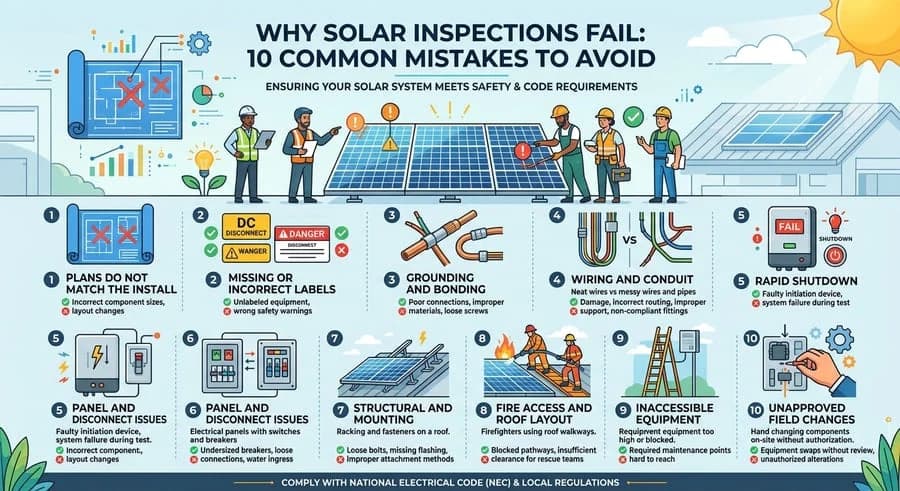
Why Solar Inspections Fail: 10 Common Mistakes to Avoid
Discover the 9 critical reasons solar inspections fail and how to avoid costly m...

Solar Grounding And Bonding: How To Pass Inspection Every Time
Learn how to pass solar grounding and bonding inspections every time. Avoid comm...
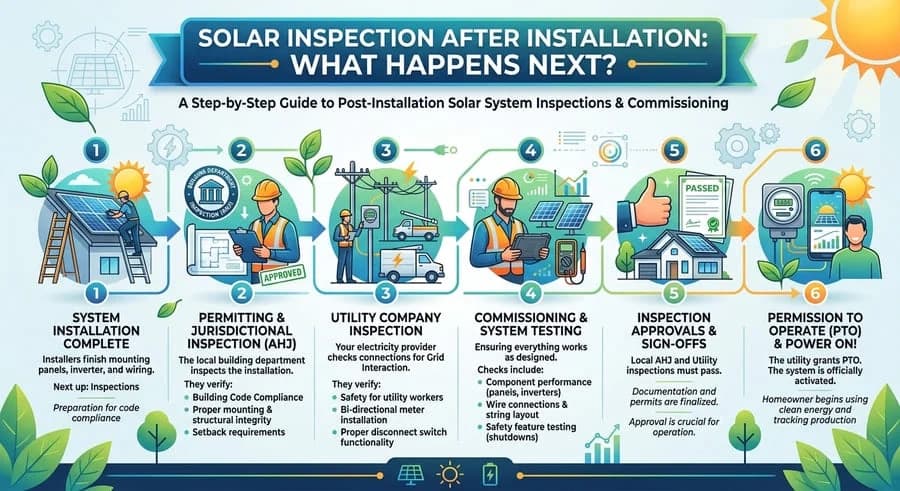
Solar Inspection After Installation: What Happens Next?
Learn how to pass your solar inspection by following essential tips for obtainin...