Duke Energy Florida (DEF) serves approximately 1.9 million customers across a 13,000-square-mile service area, making it one of the state’s largest investor-owned utilities. For homeowners considering solar installation, understanding DEF’s specific programs, requirements, and compensation structures is essential for maximizing your return on investment. This comprehensive guide covers everything you need to know about going solar with Duke Energy Florida, from net metering policies to the complete interconnection process.
Whether you’re comparing Duke Energy to Florida Power & Light’s solar programs or evaluating your options for the first time, this guide provides the detailed information you need to make an informed decision.
Quick Answer: Duke Energy Florida offers full retail net metering for solar customers, crediting excess generation at the same rate you pay for electricity. The utility charges a $30 monthly minimum bill regardless of solar production. DEF also offers the Clean Energy Connection community solar program for customers who cannot install rooftop panels. No utility rebates are currently available, but Florida’s property tax and sales tax exemptions provide meaningful savings.
Key Takeaways
- Duke Energy Florida provides full retail net metering, crediting excess solar at your current electricity rate
- All customers pay a $30 monthly minimum bill, even with solar panels producing excess energy
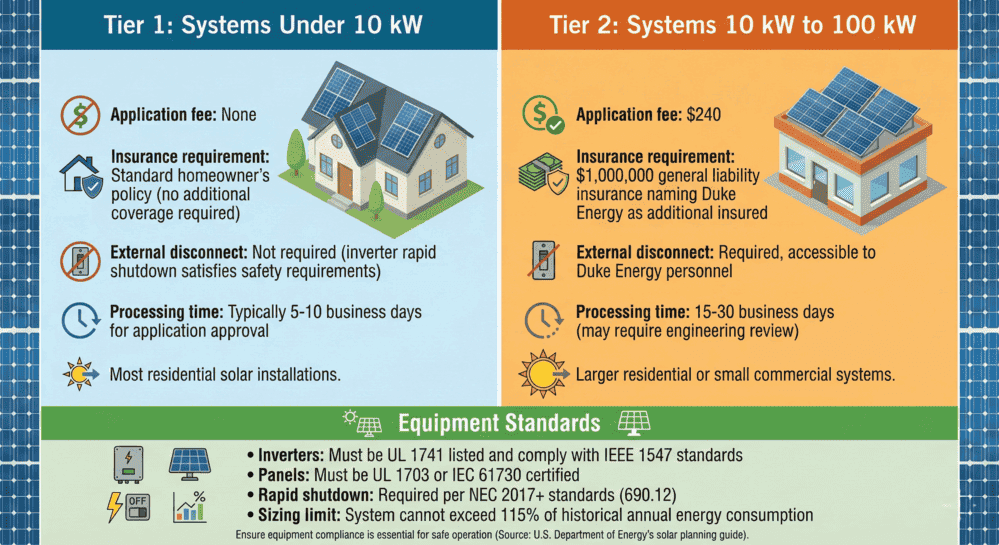
- Tier 1 systems (under 10 kW) require no application fee; Tier 2 systems (10 kW and above) require $240 fee plus $1M liability insurance
- Clean Energy Connection community solar offers 5-7 year payback with no installation required
- Duke Energy does NOT offer solar rebates or incentives beyond net metering
- Florida’s 100% property tax exemption for solar (through 2037) prevents increased property taxes
- Florida’s sales tax exemption saves approximately 6-7.5% on solar equipment costs
- HOAs cannot prohibit solar installations under Florida law (F.S. 163.04)
Understanding Duke Energy’s Florida Service Territory
Before exploring solar options, confirm you’re in Duke Energy Florida’s service area. Duke Energy operates two separate utilities in Florida with different service territories:
- Duke Energy Florida (DEF): Serves central Florida, including portions of Orange, Seminole, Volusia, Lake, Sumter, Marion, Citrus, Levy, Pasco, Pinellas, and Hillsborough counties
- Duke Energy Progress (DEP): Serves a small portion of northwest Florida near Pensacola (different programs and rates apply)
This guide focuses specifically on Duke Energy Florida programs. DEP customers should contact Duke Energy directly for northwest Florida-specific information.
Duke Energy Florida Net Metering: How It Works
Net metering is the billing arrangement that makes rooftop solar financially viable for most homeowners. Under Florida’s net metering rules established by the Florida Public Service Commission (Rule 25-6.065), Duke Energy Florida must credit your account for excess solar electricity at the full retail rate.
Full Retail Rate Credits
When your solar panels produce more electricity than your home uses, the excess flows to the grid. Duke Energy credits your account at the same rate you pay for electricity, typically $0.11-0.14 per kWh depending on your rate schedule. This is known as full retail net metering, and it’s one of the most favorable policies in the country for solar customers. To understand how your solar system connects to the grid for net metering, review our guide on how solar panels connect to the grid.
Monthly Credit Rollover
Excess credits roll over month-to-month throughout the year. This allows you to bank credits during sunny summer months and use them during shorter winter days or periods of higher consumption.
Annual True-Up and Excess Credit Payout
At the end of your annual billing cycle (typically 12 months from your interconnection date), Duke Energy settles any remaining excess credits. If you have accumulated more credits than you used over the year, Duke pays out the excess at the avoided cost rate, which is approximately $0.02-0.04 per kWh. This wholesale rate is significantly lower than retail, so the best strategy is to size your system to minimize year-end surplus.
The $30 Monthly Minimum Bill
Even if your solar panels produce enough electricity to fully offset your usage, you’ll still pay Duke Energy’s $30 monthly minimum bill. This charge covers the cost of maintaining grid infrastructure and ensures all customers contribute to system reliability. The minimum bill includes the base customer charge ($12.45) plus additional grid maintenance costs.
Important: Income-qualified customers may be eligible for minimum bill modifications through 2027. Contact Duke Energy to determine eligibility based on participation in programs like SSI, Medicaid, TANF, SNAP-EBT, or LIHEAP.
Rate Schedules for Solar Customers
Duke Energy Florida offers several residential rate schedules. Most solar customers remain on the standard residential rate (RS-1), but you should evaluate whether time-of-use rates might benefit your specific usage patterns:
- RS-1 (Standard Residential): Flat rate per kWh, simplest option for most solar customers
- RSVP-1 (Time-of-Use): Higher rates during peak hours (weekdays 6-10 AM and 6-10 PM), lower rates during off-peak
- RSVP-2 (Seasonal Time-of-Use): Varies by season with different peak/off-peak periods
Duke Energy Florida Solar Incentives And Rebates
Understanding the current incentive landscape helps you accurately calculate your solar investment and set realistic payback expectations. While Duke Energy does not offer direct rebates, Florida provides meaningful tax benefits that reduce your overall cost. For comprehensive details on available incentives, visit the DSIRE database for Florida solar incentives.
Duke Energy Rebates: None Currently Available
Duke Energy Florida does not currently offer any rebates or direct incentives for residential solar installation. Some solar companies may incorrectly advertise “utility rebates” – verify any claims directly with Duke Energy before signing contracts.
Florida State Tax Exemptions
While Florida does not have a state income tax (and therefore no state solar tax credit), the state provides two valuable exemptions that reduce your solar costs. The Florida Solar Energy Center provides detailed information on state energy policies.
Property Tax Exemption (F.S. 193.624): Under Florida Statute 193.624, solar energy systems are 100% exempt from property tax assessment through December 31, 2037. This means installing a $25,000 solar system won’t increase your property taxes, even though it increases your home’s market value. For a typical system, this exemption saves $300-600 annually in avoided property taxes.
Sales Tax Exemption (F.S. 212.08): Solar energy equipment is exempt from Florida’s 6% state sales tax (plus any applicable local sales taxes, typically 0.5-1.5%). On a $25,000 system, this exemption saves approximately $1,500-1,875 in avoided sales tax.

Solar Permit Solutions
Skip the Permit Headaches
We design plan sets that pass inspection the first time. Code-compliant, PE-stamped, accepted by AHJs nationwide.
Duke Energy Florida Solar System Requirements
Duke Energy Florida classifies solar installations into tiers based on system capacity. Each tier has different application requirements, fees, and technical standards. Understanding these requirements upfront helps ensure a smooth solar permit approval process.
Tier 1: Systems Under 10 kW
Most residential solar installations fall into Tier 1. These systems have the simplest interconnection requirements:
- Application fee: None
- Insurance requirement: Standard homeowner’s policy (no additional coverage required)
- External disconnect: Not required (inverter rapid shutdown satisfies safety requirements)
- Processing time: Typically 5-10 business days for application approval
Tier 2: Systems 10 kW to 100 kW
Larger residential or small commercial systems require additional documentation and fees:
- Application fee: $240
- Insurance requirement: $1,000,000 general liability insurance naming Duke Energy as additional insured
- External disconnect: Required, accessible to Duke Energy personnel
- Processing time: 15-30 business days (may require engineering review)
Equipment Standards
All solar equipment must meet specific technical standards. According to the U.S. Department of Energy’s solar planning guide, ensuring equipment compliance is essential for safe operation:
- Inverters: Must be UL 1741 listed and comply with IEEE 1547 standards
- Panels: Must be UL 1703 or IEC 61730 certified
- Rapid shutdown: Required per NEC 2017+ standards (690.12)
- Sizing limit: System cannot exceed 115% of historical annual energy consumption

Duke Energy Florida Solar Interconnection Process: Step-By-Step Guide
The interconnection process connects your solar system to Duke Energy’s grid and enables net metering. The solar interconnection agreement process varies by system size but follows a consistent framework. For detailed guidance on supply-side and load-side interconnection methods, review our technical guide.
Step 1: Submit Interconnection Application
Your solar installer typically submits the application through Duke Energy’s online interconnection portal. Required documentation includes the completed application form, electrical single-line diagram, equipment specification sheets (inverter, panels), site plan showing system location, and proof of insurance (Tier 2+ systems).
Step 2: Duke Energy Application Review
Duke Energy reviews your application for completeness and technical compliance. They may request additional information or clarification. For Tier 2 systems, an engineering review determines if grid upgrades are needed.
Step 3: Receive Approval to Install
Once approved, Duke Energy issues an “Approval to Install” letter. This authorizes your contractor to begin installation but does NOT permit operating the system. According to the solar permitting timeline by state, Florida typically averages 34 days for complete approval.
Step 4: Obtain Local Building Permits
Separately from Duke Energy approval, you need permits from your local Authority Having Jurisdiction (AHJ). Our solar permit design services can help ensure your permit package meets local requirements. Thanks to Florida’s HB 683 (effective July 2025), residential solar permits must be approved within 5 business days or face automatic approval.
Step 5: Complete Installation
Your installer mounts the panels, installs inverter(s), connects wiring, and configures the system. For guidance on optimizing panel placement, see our guide on optimal solar panel orientation. The system remains OFF until final approval.
Step 6: Pass Local Inspection
Schedule inspection with your local building department. Inspector verifies electrical connections, structural mounting, code compliance, and safety requirements. Your installer should be present to address any concerns.
Step 7: Receive Permission to Operate (PTO)
After passing inspection, submit documentation to Duke Energy. They install a bi-directional meter (if needed) and issue Permission to Operate. Learn more about bi-directional meter requirements in our detailed guide. Only after receiving PTO can you legally operate your solar system.
Typical Interconnection Timeline
Duke Energy Clean Energy Connection: Community Solar Alternative
For customers who cannot install rooftop solar (renters, unsuitable roofs, shading issues, HOA restrictions), Duke Energy offers the Clean Energy Connection community solar program.
How Clean Energy Connection Works
You subscribe to a portion of a large-scale solar facility operated by Duke Energy. Your subscription generates bill credits based on solar production, without any equipment on your property. According to Duke Energy’s official announcement, the program is designed for a seven-year full payback.
Program Costs and Credits
- Monthly subscription fee: $8.35 per kW subscribed
- Bill credit rate (Years 1-3): $0.04 per kWh produced by your subscription share
- Credit escalation: After the first three years, the credit increases by 1.5% annually
- Typical subscription: 5 kW covers approximately 1,000 kWh monthly usage
Financial Analysis
The 1.5% annual credit increase beginning in Year 4 (month 37) gradually improves the economics. According to Duke Energy, bill credits are projected to first exceed subscription fees around Year 3-5, with full payback achieved by approximately Year 7. As long as you remain in the program for seven years, the annual bill credits are projected to exceed subscription costs, creating real customer savings over time.
Income-Qualified Program
Duke Energy reserves 26 MW of Clean Energy Connection capacity for income-qualified customers. Participants in SSI, Medicaid, TANF, SNAP-EBT, LIHEAP, or Duke Energy’s Neighborhood Energy Saver program receive an enhanced credit rate ($9.03/kWh vs. $8.35 subscription fee), providing immediate savings from day one rather than requiring a multi-year payback period.
Rooftop Solar vs. Clean Energy Connection Comparison
Battery Storage With Duke Energy Florida Solar
Adding battery storage to your solar system provides backup power and potential additional savings, though Duke Energy’s full retail net metering reduces the financial incentive compared to utilities with less favorable policies. For comprehensive battery backup design, explore our off-grid solar system design services.
Battery Benefits in Duke Energy Territory
- Backup power: Keep critical loads running during grid outages (increasingly important given Florida’s hurricane exposure)
- Time-of-use optimization: If on a TOU rate, store solar energy during low-rate periods and use during peak hours
- Self-consumption maximization: Use more of your own solar energy rather than exporting to the grid
Battery Storage Considerations
With Duke Energy’s full retail net metering, the financial case for batteries is primarily about backup power rather than bill savings. Since excess solar already receives full retail credit, storing energy in a battery (with 10-15% round-trip efficiency losses) doesn’t provide additional financial benefit on standard rates.
Popular battery options include the Tesla Powerwall (13.5 kWh, ~$12,000-15,000 installed), Enphase IQ Battery (3.36-10.08 kWh modular, ~$10,000-20,000 installed), and LG RESU (9.6-16 kWh, ~$10,000-16,000 installed).
Florida Solar Legal Protections
Florida law provides strong protections for solar customers, ensuring your right to install solar panels and receive fair compensation for excess generation.
Solar Rights Act (F.S. 163.04)
Florida’s Solar Rights Act prohibits homeowners associations (HOAs) from banning solar installations. While HOAs may establish reasonable aesthetic guidelines (such as requiring panels to be parallel to the roofline), they cannot prohibit solar energy systems or require approval processes that effectively prevent installation.
Net Metering Protection (F.S. 366.91)
In April 2022, Governor DeSantis vetoed HB 741, which would have significantly reduced net metering compensation for new solar customers. This veto preserved full retail net metering in Florida, maintaining the current favorable compensation structure. For the latest on Florida’s net metering policies, refer to the EPA’s interconnection and net metering guide.
Property Tax Exemption (F.S. 193.624)
As discussed earlier, Florida law exempts solar systems from property tax assessment through 2037. This protection is codified in state statute, not subject to local government discretion.
Real Customer Savings Example: Orlando Area Homeowner
To illustrate potential savings, consider a typical Duke Energy Florida customer in the Orlando area. Use the NREL PVWatts Calculator to estimate production for your specific location.
Customer Profile
- Location: Orlando, FL (Duke Energy Florida territory)
- Pre-Solar Monthly Bill: $250 average ($3,000/year)
- Annual Consumption: Approximately 18,000 kWh
- System Size: 8.5 kW (24 panels at 355W each)
- Annual Production: Approximately 12,500 kWh
- Gross Installation Cost: $25,500
- Net Cost (after sales tax exemption savings): Approximately $23,700
Savings Analysis
These figures assume Duke Energy’s electricity rates continue increasing at their historical average of approximately 3% per year. Actual savings may vary based on individual energy usage patterns, system performance, and future rate changes.
Conclusion
Duke Energy Florida’s full retail net metering, combined with Florida’s solar-friendly policies and abundant sunshine, makes rooftop solar a financially attractive investment for most homeowners. While the utility doesn’t offer direct rebates, the combination of net metering credits, property tax exemption, and sales tax exemption provides meaningful financial benefits.
For customers who cannot install rooftop solar, the Clean Energy Connection program offers a zero-upfront-cost alternative with projected savings over time. However, rooftop solar generally provides superior long-term returns and adds value to your home.
The key to maximizing your solar investment is proper system sizing (to minimize year-end excess credits paid at wholesale rates) and working with a qualified installer who understands Duke Energy’s interconnection requirements.
Ready to explore solar for your Duke Energy Florida home? Contact our team for professional solar permit design services that ensure your project meets all utility and local requirements for smooth approval.
FAQs
What is Duke Energy Florida’s minimum bill for solar customers?
Duke Energy Florida charges a $30 monthly minimum bill for all customers, including those with solar panels. Even if your solar system produces enough electricity to fully offset your usage, you’ll still pay this minimum charge, which covers grid infrastructure and maintenance costs.
How long does Duke Energy’s interconnection process take?
For Tier 1 systems (under 10 kW), the complete process typically takes 3-6 weeks from application to Permission to Operate. Tier 2 systems may take 6-10 weeks due to additional engineering review requirements. For detailed solar permit timeline information, see our complete guide.
What’s the difference between Duke Energy Florida and Duke Energy Progress?
Duke Energy operates two separate utilities in Florida. Duke Energy Florida (DEF) serves central Florida, while Duke Energy Progress (DEP) serves a small area in northwest Florida near Pensacola. Programs, rates, and requirements differ between the two utilities. This guide specifically covers Duke Energy Florida.
panels on their property. Subscribers pay a monthly fee ($8.35/kW) and receive bill credits based on solar production. More information is available at Duke Energy’s illumination site.
Skip the Permit Headaches
We design plan sets that pass inspection the first time. Code-compliant, PE-stamped, accepted by AHJs nationwide.
Frequently Asked Questions
No. Duke Energy Florida does not currently offer any rebates or direct financial incentives for residential solar installation. Be cautious of solar companies claiming otherwise. The primary financial benefits come from net metering bill credits and Florida's state tax exemptions (property and sales tax).
Duke Energy Florida charges a $30 monthly minimum bill for all customers, including those with solar panels. Even if your solar system produces enough electricity to fully offset your usage, you'll still pay this minimum charge, which covers grid infrastructure and maintenance costs.
Yes, through net metering. Excess energy your panels produce is sent to the grid and credited to your account at the full retail electricity rate. Credits roll over monthly throughout the year. At your annual true-up, any remaining excess credits are paid out at the lower wholesale rate (approximately $0.02-0.04/kWh), so it's best to size your system to minimize year-end surplus.
For Tier 1 systems (under 10 kW), the complete process typically takes 3-6 weeks from application to Permission to Operate. Tier 2 systems may take 6-10 weeks due to additional engineering review requirements.
Duke Energy operates two separate utilities in Florida. Duke Energy Florida (DEF) serves central Florida, while Duke Energy Progress (DEP) serves a small area in northwest Florida near Pensacola. Programs, rates, and requirements differ between the two utilities.
No. Under Florida's Solar Rights Act (F.S. 163.04), HOAs cannot prohibit solar installations. They may establish reasonable aesthetic guidelines, but these cannot effectively prevent installation or unreasonably increase costs.
Batteries are optional with Duke Energy Florida's net metering. Since you receive full retail credit for excess solar sent to the grid, batteries primarily provide backup power value rather than additional bill savings. However, for customers concerned about power outages (especially during hurricane season), battery backup can be a worthwhile investment.
Clean Energy Connection is Duke Energy Florida's community solar program. It allows customers to subscribe to a portion of a large-scale solar facility without installing panels on their property. Subscribers pay a monthly fee ($8.35/kW) and receive bill credits based on solar production.
No. Under Florida Statute 193.624, solar energy systems are 100% exempt from property tax assessment through December 31, 2037. While your home's market value may increase, your property taxes will not increase due to the solar installation.
Begin by getting quotes from multiple licensed solar installers in your area. They will assess your roof, review your electricity usage, design an appropriately sized system, and handle the interconnection application process. For residential solar design assistance and permit preparation, professional solar permit services can help ensure a smooth approval process.

SPS Editorial Team
Solar Permit Solutions
Solar Permit Solutions provides professional solar permit design services for residential, commercial, and off-grid installations across all 50 states. Our team ensures permit-ready plan sets delivered fast.
Related Articles
Off-Grid Solar System Requirements: Sizing, Permits & NEC Code Guide
Off-grid solar permit requirements by state: building codes, NEC compliance, bat...
Solar Battery Permit: What Most Installers Get Wrong
Quick Answer: Adding battery storage to a solar system almost always requires ne...
Solar Battery Tax Credit 2026: What Homeowners and Contractors Need to Know
There is no federal solar battery tax credit available to homeowners in 2026. Th...