
how many solar panels do you need

Best Direction For Solar Panels: Complete Orientation Guide

South-facing solar panels are the best direction for maximum energy production in North America, generating up to 30% more electricity than other orientations. West-facing panels work better for Time-of-Use rate plans, while east-facing options suit morning energy needs. North-facing installations are only recommended in Hawaii and Puerto Rico during summer months.
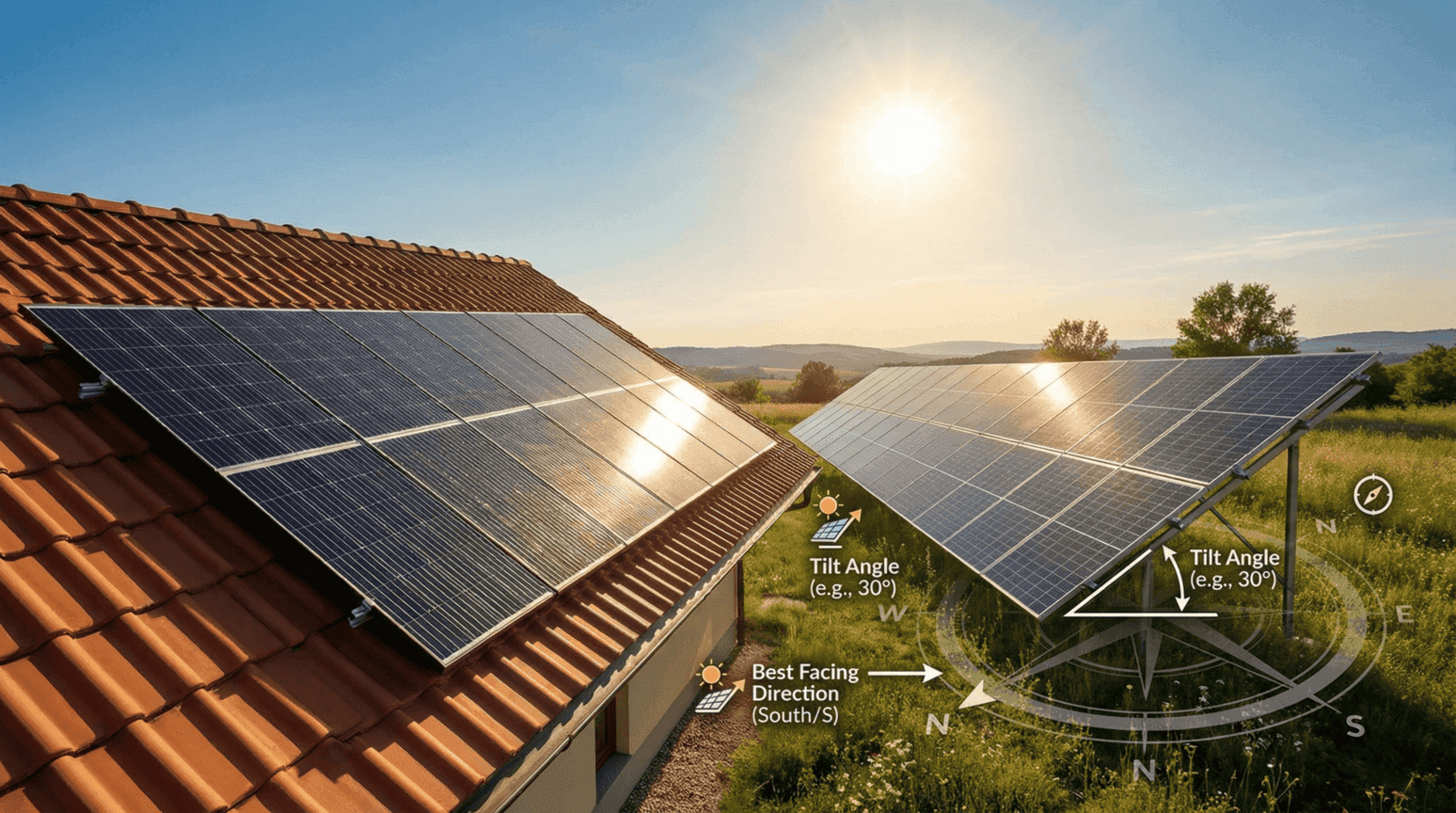
Solar Panel Direction Performance Table

At a Glance: Solar Panel Direction Performance

Compare how different panel orientations affect your solar energy production

Orientation Efficiency vs. South Best For
South 100% (baseline) Maximum year-round energy production, net metering optimization
Southwest/Southeast 92% (8% reduction) Balanced production with slight time-of-day preference
West 85% (15% reduction) Time-of-Use rate plans, evening electricity demand
East 85% (15% reduction) Morning energy consumption, early battery charging
North 70% (30% reduction) Last resort (continental U.S.), viable in Hawaii/Puerto Rico summers

Why Direction Matters: Solar photovoltaic cells can only capture 33% of available sunlight energy due to bandgap limitations. Optimal orientation ensures panels receive direct sunlight at ideal angles, maximizing absorption rather than reflection of light wavelengths.

Key Factors That Determine Best Direction:

  • Geographic latitude relative to the equator
  • Electricity rate structure (standard vs. Time-of-Use pricing)
  • Available roof orientations and slope
  • Net metering availability in your state
  • Daily energy consumption patterns
  • Battery storage integration goals

This guide examines optimal positioning strategies for various objectives and the elements that shape these choices. We also present alternatives when southward-facing installations prove unfeasible. Continue reading to discover more.

Importance of solar positioning

The importance of solar array positioning

Before diving into positioning techniques, you might question why orientation matters at all. As long as panels point skyward toward sunlight, they'll generate electricity, correct?

Where do installers mount solar panels?

Installers typically mount solar arrays on rooftops, specifically on the section receiving maximum direct sunlight exposure. This matters because while panels generate some electricity whenever exposed to sun, their positioning and directional setup significantly impact daily energy production capacity.

Each panel contains multiple photovoltaic (PV) cells (components that capture solar radiation)⁴. These cells use semiconductor materials engineered to absorb particular light wavelengths, known as the bandgap. Research demonstrates that contemporary silicon cells capture only 33% of incoming solar energy.

Since this bandgap selectively absorbs specific wavelengths, PV cells require direct sunlight exposure. Even minor deviations from optimal sun angles cause these cells to deflect wavelengths rather than capture them.

When solar arrays access limited energy quantities, optimizing directional positioning becomes financially prudent. This straightforward modification, combined with proper tilt angles, can substantially enhance your residential solar design performance.

Top solar panel orientations

For North American residents, southward-facing solar installations yield optimal results. Located above the equatorial line (positioning the sun toward the southern horizon), property owners gain maximum capacity to satisfy power demands, replenish battery reserves, and optimize net metering benefits.

That said, certain situations warrant alternative array orientations. Let's explore ideal solar panel positioning for different objectives.

Southward-facing solar installations

Understanding why south remains the premier orientation for U.S. solar panels begins with the equator.

This conceptual boundary divides Earth into dual hemispheres: northern (home to the United States) and southern. It marks the midpoint of the sun's celestial range. During equinox events, the sun appears directly above at midday along this equatorial boundary.

How does this affect American installations? All locations above this line experience the sun positioned slightly southward.

Leveraging this geographic reality, orienting panels toward the south provides optimal energy absorption potential, supplying household power and filling battery storage. Understanding solar panel layout optimization helps maximize this southward-facing advantage.

Benefits extend beyond basic energy production for south-oriented arrays. Property owners in states offering net metering programs can link systems to utility grids, accumulating credits that reduce monthly power costs.

Westward-facing solar installations

When PV systems shift away from southern orientation, efficiency immediately decreases. West-oriented solar panels typically generate approximately 15% less power².

Nevertheless, customers enrolled in Time-of-Use (TOU) rate structures may profit from this directional adjustment.

TOU programs bill consumers using tiered pricing tied to demand peaks. Rates typically climb during evening hours as residents arrive home from daily activities. Southwest or true west panel orientation increases energy production during premium rate periods.

Which regions implement TOU rate structures?

Regions utilizing TOU pricing programs include:

• California 

• Arizona 

• Maryland 

• Delaware 

• Oklahoma 

• Texas 

• Ohio 

• Arkansas 

• Louisiana 

• New York

Eastward-facing solar installations

Similar to west-oriented panels, east-facing arrays generate roughly 15% reduced energy compared to optimal configurations. Consider this orientation only when south-facing roof sections remain unavailable. Professional solar panel installation experts can assess whether east-facing configurations suit your needs.

Northward-facing solar installations

Positioned opposite to south-facing systems, north-oriented arrays deliver approximately 30% diminished output, ranking as the least favorable choice. Continental U.S. residents select this orientation solely when alternatives don't exist.

However, Hawaiian and Puerto Rican residents face different circumstances.

The sun's position shifts throughout annual cycles rather than remaining fixed at the equatorial line; seasonal variations move it across latitudes (detailed further below). During June's summer solstice, it reaches 23.4 degrees north from its equinox position.

This knowledge proves valuable for Hawaiian and Puerto Rican residents, situated at 19.9 and 18.2 degrees north latitude, respectively.

Throughout summer months, when the sun spends maximum overhead time annually, it actually positions north of residential structures. This means Honolulu or San Juan residents might reasonably implement north-facing solar installations.

elements affecting solar direction performance

Elements affecting solar panel directional performance

Distance from southern orientation

Average American homeowners achieve maximum array performance by directing panels southward. Every degree away from south progressively reduces energy output. According to research on photovoltaic orientation, expect efficiency reductions of roughly 15% per 90-degree deviation:

  • Southwest or southeast orientations: 8% efficiency reduction
  • West or east orientations: 15% efficiency reduction
  • North orientation: 30% efficiency reduction

Before finalizing your system design, consider whether your roof supports solar panels and explore metal roof solar mounting systems if applicable. Additionally, understanding which roof type works best for solar panels can significantly impact your system's directional performance.

Conclusion

Determining the optimal orientation for your solar panel system directly impacts your return on investment and long-term energy savings. For most North American property owners, southward-facing installations remain the gold standard, delivering maximum energy production throughout the year. However, your specific situation, whether influenced by TOU rate structures, roof limitations, or geographic location, may benefit from alternative orientations.

West-facing arrays can capitalize on peak electricity rates, while Hawaiian and Puerto Rican residents enjoy unique opportunities with north-facing configurations during summer months. The key lies in evaluating your energy goals, local utility programs, and available roof space to select the orientation that best aligns with your needs.

When southward positioning isn't feasible, understanding the trade-offs in efficiency helps you make informed decisions about your solar investment. Whether you're considering commercial solar design or off-grid solar system design, consulting with solar professionals ensures your system achieves optimal performance regardless of directional constraints. Contact our team to discuss your specific orientation requirements and receive expert guidance on maximizing your solar investment.

FAQs

What happens if my roof doesn't face south?

If your roof lacks south-facing sections, you still have viable solar options. East or west-facing installations typically produce about 15% less energy than optimal configurations, which remains highly productive for most households. Many homeowners successfully operate solar systems on non-south roofs and still achieve significant utility bill reductions. You can also explore ground-mounted arrays positioned at ideal angles, or combine multiple roof sections to maximize total energy capture. Understanding how much a home solar system costs helps you evaluate whether adding extra panels to compensate for non-south orientation fits your budget. Professional solar installers can assess your property's specific conditions and recommend the best configuration for your situation.

Can I install solar panels on a north-facing roof in the continental United States?

While technically possible, north-facing installations in the continental U.S. generate approximately 30% less power than south-facing systems, making them financially unfavorable in most cases. This orientation should only be considered as a last resort when absolutely no other roof sections or ground-mount options exist. However, if you live in Hawaii or Puerto Rico at specific latitudes, north-facing panels can perform reasonably well during summer months when the sun shifts north of the equator. Always conduct a professional site assessment to determine whether north-facing installation makes economic sense for your location.

How do Time-of-Use rates affect solar panel direction choices?

Time-of-Use (TOU) pricing programs charge higher rates during peak demand periods, typically evening hours. If you're enrolled in a TOU plan, west or southwest-facing panels generate more electricity during these premium rate windows, potentially offsetting the 15% efficiency loss compared to south-facing arrays. This strategy maximizes the financial value of your solar production by creating power when it's worth the most. Property owners in California, Arizona, Texas, and other TOU states should carefully analyze their rate schedules alongside directional options to optimize economic returns rather than focusing solely on total kilowatt-hour production. Those interested in building their own home solar power system should factor TOU rates into their design decisions.

Does solar panel direction affect battery charging efficiency?

Solar panel orientation significantly impacts battery charging patterns and efficiency. South-facing panels provide the most consistent energy production throughout daylight hours, offering steady battery charging from morning through afternoon. East-facing arrays charge batteries earlier in the day, which benefits households with morning energy demands or those wanting fully charged backup systems before evening. West-facing installations delay peak charging until afternoon and evening hours. According to photovoltaic systems research, orientation affects not just total energy capture but also timing of peak production. When designing battery-integrated solar systems, consider your daily energy usage patterns and backup power priorities alongside directional efficiency trade-offs to ensure your batteries receive adequate charging when you need it most.

How much efficiency loss should I accept when choosing a non-south orientation?

Acceptable efficiency loss depends on your energy goals, available roof space, and financial objectives. An 8% reduction for southwest or southeast orientations typically remains economically viable for most installations, as the slight decrease in production is offset by sufficient energy generation and incentive programs. West or east-facing systems with 15% efficiency loss can still provide excellent returns, particularly under TOU rate structures or when roof space allows for additional panels to compensate. North-facing arrays with 30% reduced output rarely justify installation costs unless no alternatives exist. Before making your decision, review solar equipment specification sheets and understand solar panel permit requirements. Additionally, consider whether used vs new solar panels might help you install more capacity within budget. According to UNESCO's solar photovoltaic systems manual and research on optimum panel orientation, calculating your specific payback period and lifetime savings for each directional scenario helps determine which efficiency compromise aligns with your investment expectations.

Contact us

Get in touch today

We are dedicated to providing top-notch solar permit services to homeowners, business owners, DIY, and solar installers. Contact us today.

Check - Elements Webflow Library - BRIX Templates

Thank you

Thanks for reaching out. We will get back to you soon.
Oops! Something went wrong while submitting the form.
Solar COMPANIES SUPPORTING
Solar Permit Solutions
Choosing Solar Permit Solutions means benefiting from our fast turnaround times, comprehensive packages, and dedicated support team.

We take the hassle out of the permitting process so you can focus on your solar installation.
Partners / Sponsors