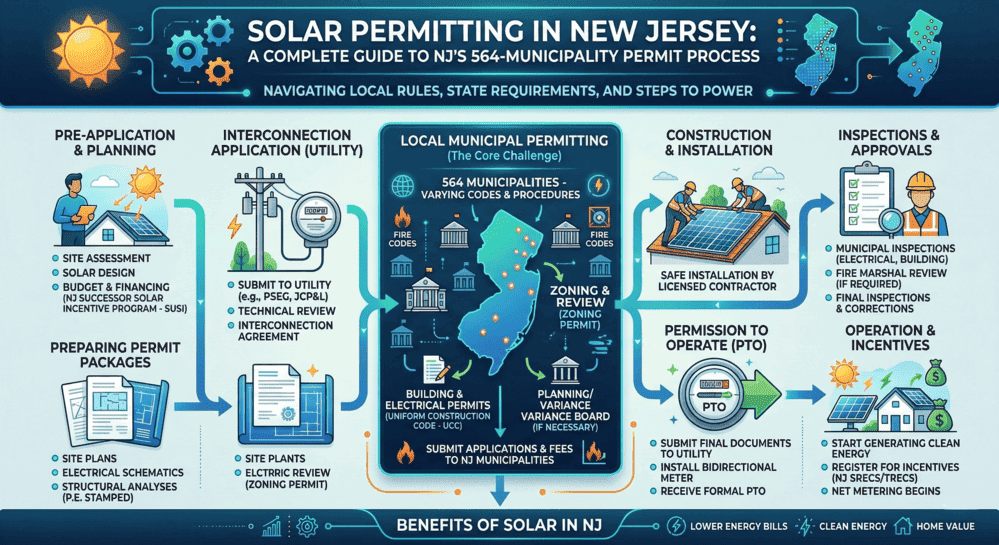
Solar permitting in New Jersey requires a construction permit (building and electrical subcodes) from your local municipality for every residential and commercial PV installation. Permit fees start at $65 for systems under 50 kW under N.J.A.C. 5:23-4.20. As of December 2025, the NJ Smart Solar Permitting Law (S4100/A5264) mandates a statewide automated permitting platform to streamline approvals and reduce the $3,800 to $4,500 in soft costs that permitting currently adds to each project.
New Jersey doesn’t have one solar permitting process. It has 564 of them.
Unlike most states, New Jersey grants each of its 564 municipalities independent authority over construction permitting through the Uniform Construction Code (UCC). That means the permit requirements, review timelines, fee structures, and inspection procedures for a rooftop solar installation in Verona can look meaningfully different from those in Mendham, Jersey City, or Cape May. For homeowners and solar installation contractors alike, this fragmented system has historically been one of the biggest barriers to faster solar adoption in the Garden State.
According to a Regional Plan Association report, New Jersey has the third-slowest permitting timelines for residential solar projects in the country (the legislation itself cites NJ as fifth-slowest by a separate measure). The Greenhouse Institute estimates that permitting inefficiencies add $3,800 to $4,500 to the cost of a typical rooftop solar system in the state, while the Solar Energy Industries Association puts the broader figure at $6,000 to $7,000 when all bureaucratic barriers are included. And Environment America reports that approximately 22% of residential solar projects are cancelled before installation begins, with installers citing permitting barriers as the number one reason.
This guide walks through everything you need to know about solar permitting in New Jersey in 2026: what permits are required, how much they cost, which documents you need, how the process works step by step, and what the new Smart Solar Permitting Law means for your next project.
Do You Need a Permit to Install Solar Panels in New Jersey?
Yes. Every solar installation in New Jersey, whether residential rooftop or commercial ground-mount, requires a construction permit from your local municipality’s building department. This is mandated by the New Jersey Uniform Construction Code (N.J.A.C. 5:23) and enforced by each town’s construction code official.
A solar construction permit in NJ is not a single document. It is a package that typically includes a building subcode permit (covering structural attachment, fire setbacks, and roof load capacity) and an electrical subcode permit (covering wiring, overcurrent protection, inverters, disconnects, and grounding and bonding requirements). Commercial installations also require a fire subcode permit and, in most towns, a separate zoning permit.
There is no exemption for small systems or DIY installations. Even if you are a homeowner performing work on your own single-family, owner-occupied residence under the N.J.A.C. 5:23-2.15 homeowner exemption, you still need to apply for and receive the permit before beginning work. For a broader overview of how solar permits work across the United States, see our national guide.
Residential vs. Commercial Permit Requirements
The permit package differs based on the building’s use group. Residential properties classified as R-3 (one- and two-family dwellings) or R-5 typically require only an electrical permit and a building permit. Commercial solar projects require those plus a fire protection subcode permit and a zoning permit. The Township of Verona’s published solar checklist is a good example of this distinction: residential projects require two permits, while commercial projects require four, including sign-off from the zoning officer.
For commercial installations, the zoning permit application typically requires site plan review under the Municipal Land Use Law, which can add several weeks to the timeline. Some municipalities also require planning board or zoning board approval for larger systems, particularly ground-mounted arrays that may affect lot coverage calculations or violate setback requirements.
Ground-Mount vs. Rooftop Solar: Different Permit Requirements
Standard rooftop solar installations on residential properties typically do not require a zoning permit in most NJ municipalities. The system is considered an accessory use and is permitted by right, provided it meets fire setback and roof load requirements.
Ground-mounted systems are a different story. In virtually every NJ municipality, a ground-mount installation triggers a mandatory zoning application regardless of the property’s location. Ground-mount systems must comply with property line setbacks (commonly 10 feet from side and rear lot lines), maximum height restrictions, and impervious coverage limits. In Mendham Borough, ground-mounted solar panel systems are not permitted at all under the current zoning ordinance. Other towns may require a variance application if the proposed system cannot meet standard setback or height requirements.
How Much Does a Solar Permit Cost in New Jersey?
New Jersey’s Uniform Construction Code establishes statewide base permit fees for photovoltaic systems under N.J.A.C. 5:23-4.20(c)(2)(iii)(13). These are the building subcode fees only. Electrical subcode fees are calculated separately based on the number of devices and fixtures.
| System Size (kW) | Building Permit Fee | Notes |
| 1 to 50 kW | $65.00 | Covers most residential systems (typical home = 6-10 kW) |
| 51 to 100 kW | $129.00 | Small commercial or large residential systems |
| Greater than 100 kW | $640.00 | Commercial and utility-scale installations |
Source: N.J.A.C. 5:23-4.20(c)(2)(iii)(13)
In addition to the building subcode fee, you will pay an electrical subcode fee based on the number of receptacles, fixtures, and devices in the system. The first block of 1 to 50 devices costs $50, with each additional block of up to 25 devices adding $9. There is also a DCA state permit surcharge of $1.90 per $1,000 of construction value.
Keep in mind that individual municipalities may adopt their own fee schedules that differ from the state base. Always check with your local building department for the exact fee schedule in effect. For strategies to keep these expenses manageable, see our guide on how to reduce solar permit design costs.
What Are the Hidden Costs of Solar Permitting in NJ?
The permit application fee is only a fraction of the total soft cost of permitting. Other expenses that frequently catch homeowners and contractors off guard include: PE-stamped or architect-sealed plan sets (required by the UCC for all solar installations), structural engineering reports for older roofs, zoning variance application fees if your system does not meet setback or height requirements, and time-and-materials charges from your installer for the hours spent preparing and submitting permit packages. Collectively, the Solar Energy Industries Association estimates that permitting and related bureaucratic barriers add $6,000 to $7,000 to the total cost of a residential solar installation in New Jersey, with $3,800 to $4,500 of that attributable to the permitting process itself.

What Documents Do You Need for a Solar Permit in New Jersey?
Every solar permit application in New Jersey requires a set of UCC forms and supporting technical documents. The specific forms are standardized statewide, though individual municipalities may have supplemental requirements. Here is the complete list of documents you should prepare before applying.
1. UCC Form F100-1 (Construction Permit Application) and F100-2 (Supplemental Form): These are the master application forms. Section D should describe the work as ‘Rooftop Solar PV System’ or ‘Ground-Mount Solar PV System.’ The cost of work field should reflect the total installed cost of the system.
2. UCC Form F110 (Building Subcode Technical Section): Covers the structural attachment of the racking system to the roof or foundation, fire setback compliance, and pathway requirements.
3. UCC Form F120 (Electrical Subcode Technical Section): Covers all electrical work including wiring, conductor sizing, overcurrent protection, inverter specifications, disconnects, rapid shutdown, and the AC connection to the building’s electrical panel.
4. UCC Form F140 (Fire Subcode Technical Section): Required for commercial installations. For residential one- and two-family dwellings, fire setback compliance is reviewed under the building subcode and a separate fire form is typically not required.
5. CRES Renewable Energy Form: This state form captures the system’s generation capacity and is required for tracking renewable energy installations across New Jersey.
6. Signed and Sealed Design Plans: Two copies of PE-stamped drawings from a New Jersey licensed architect or professional engineer, referencing currently adopted NJ codes. Plans must include the PV array configuration with required fire setback pathways, wiring system and single-line diagram, overcurrent protection, inverter and disconnect locations, required signage, AC connection detail, and roof attachment or ground-mount footing details. Plans must reference applicable snow loads, wind loads, and seismic design criteria. See our solar permitting best practices guide for tips on preparing compliant plan sets.
7. Equipment Specification Sheets and Installation Manuals: For all manufactured components including PV modules, inverters, combiner boxes, disconnects, rapid shutdown devices, and racking systems. Two copies are typically required.
8. Structural Load Calculations: Demonstrating that the existing roof structure can support the dead load of the panels and racking plus applicable live loads (snow, wind).
Some municipalities have additional requirements. Mendham Borough, for example, requires applicants to indicate the kW rating of the system and the AMP size of the subpanel on the application. Towns with historic district overlays may require additional architectural review submissions.
Do Solar Plans Need a PE Stamp in New Jersey?
Yes. Under the NJ Uniform Construction Code, design plans for solar PV installations must be signed and sealed by a New Jersey registered architect, a New Jersey licensed professional engineer, or (for electrical designs on R-3/R-5 residential properties only) a New Jersey licensed electrical contractor. This is not optional. Unsigned or unsealed plans will be rejected during plan review. Solar Permit Solutions provides PE-stamped permit packages for residential, commercial, and off-grid installations across all 564 NJ municipalities.
Solar Permit Solutions
Skip the Permit Headaches
We design plan sets that pass inspection the first time. Code-compliant, PE-stamped, accepted by AHJs nationwide.
Step-by-Step Solar Permitting Process in New Jersey
While each municipality has its own review procedures, the general solar permitting process across New Jersey follows these steps.
Step 1: Verify Local Requirements – Contact your municipality’s building department or visit their website to confirm the specific permits required, the fee schedule, and any supplemental submission requirements beyond the standard UCC forms. Some towns now have dedicated solar permit checklists (Verona, West Windsor, and others) that outline exactly what to submit.
Step 2: Design the System and Prepare Plan Sets – Work with your solar installer or a permit plan set provider to design the system and produce PE-stamped drawings that reference currently adopted NJ codes. As of September 2022, NJ requires compliance with the 2021 International Residential Code (IRC) NJ Edition, the 2020 National Electrical Code (NEC/NFPA 70), and all applicable local design criteria including wind speed, snow load, and frost depth requirements for the project location.
Step 3: Prepare the Permit Application Package – Complete UCC Forms F100-1, F100-2, F110, F120, and (if commercial) F140, plus the CRES renewable energy form. Assemble two copies of the signed and sealed plans, two copies of all equipment specification sheets and installation manuals, and any required structural calculations. Ensure that the contractor applying for the permit holds a valid NJ Home Improvement Contractor (HIC) license and NJ electrical license. For tips on avoiding common submission errors, review our solar permit application process guide.
| Need help preparing your NJ solar permit package? Solar Permit Solutions handles plan sets, PE-stamped drawings, and interconnection packages for residential and commercial projects in every NJ municipality. Get a quote at solarpermitsolutions.com. |
Step 4: Submit the Application – Deliver the complete permit package to your local building department. Some towns accept physical drop-off only (Verona requires packets in the drop-off bin at 880 Bloomfield Avenue), while others accept electronic submissions. Pay the applicable permit fees at this time.
Step 5: Plan Review – The construction code official and applicable subcode officials (building and electrical at minimum) review the submitted plans for code compliance. If the application is complete and code-compliant, review times vary by municipality. See the timeline section below.
Step 6: Permit Issuance – Once approved, the building department issues the construction permit. At this point, installation work may begin. Note that permits expire if work is not started within 12 months of issuance.
Step 7: Rough Electrical Inspection – Before solar panels are installed on the roof, a rough electrical inspection is required in most municipalities. This inspection verifies that inverters, disconnects, wiring, piping, grounding, and rapid shutdown devices are properly installed and visible. This is a critical hold point. Do not mount panels until this inspection passes.
Step 8: Installation and Final Inspections – After panels are mounted and all electrical connections are complete, schedule final inspections with both the building subcode official and the electrical subcode official. Both inspections must pass before the system can be energized.
Step 9: Permission to Operate (PTO) – After passing final inspections, your installer submits the interconnection application to your utility (PSE&G, JCP&L, Atlantic City Electric, or Rockland Electric). The utility reviews the application, installs a production meter, and grants Permission to Operate. Only after PTO is received can the system be connected to the grid and begin generating credits under NJ’s net metering program. For a detailed walkthrough of this final stage, see our complete guide to solar Permission to Operate.
How Long Does Solar Permitting Take in New Jersey?
Permitting timelines vary dramatically across NJ’s 564 municipalities. For a broader comparison of how NJ stacks up nationally, see our average solar permit timeline by state.
| Municipality | Residential | Commercial | Special Zones | Notes |
| Verona | 3-5 days | 10 days | N/A | Published checklist. Fast review if complete. |
| Solar Instant Permit towns (68+ towns) | 3 days | Varies | N/A | Pre-approved designs bypass plan review. |
| Typical NJ town | 10-15 days | 15-20 days | N/A | Assumes complete application with no deficiencies. |
| Historic districts (Princeton, Cape May) | 30-45 days | 45-60 days | +30-45 days | Requires architectural review board approval. |
| Coastal (LBI, etc.) | 15-20 days | 20-30 days | CAFRA review | Hurricane-resistant mounting may be required. |
After the permit is issued, add 1 to 3 days for installation, then 2 to 4 weeks for utility interconnection and PTO approval. The total timeline from application to system activation is typically 8 to 12 weeks for a standard residential installation.
What Inspections Are Required for Solar Installations in New Jersey?
A solar PV system requires multiple inspections depending on the scope of work. At minimum, every residential installation requires the following.
Rough Electrical Inspection: Conducted after all electrical components are installed but before panels are mounted on the roof. The inspector verifies that inverters, disconnects, wiring, piping, grounding electrodes, and rapid shutdown equipment are properly installed, visible, and code-compliant. This is a critical hold point. Do not mount panels until this inspection passes.
Building Final Inspection: Verifies that the racking system is properly attached to the roof structure, that fire setback pathways are maintained, and that the installation matches the approved plans.
Electrical Final Inspection: Conducted after all panels are mounted, wired, and the system is ready for energization. The inspector verifies the complete electrical installation from array to service panel, including conductor sizing, overcurrent protection, labeling and signage, and rapid shutdown compliance.
After all inspections pass, the building department issues a certificate of approval. This documentation is essential for SREC-II registration, maintaining equipment warranties, and protecting your homeowner’s insurance coverage. For more on what happens after inspections, see our PTO requirements and timeline guide.
NJ Solar Zoning Requirements and HOA Rules
Zoning regulations for solar energy systems vary by municipality, but several statewide rules apply universally.
The New Jersey Solar Rights Act (N.J.S.A. 45:22A-48.2) prohibits homeowners associations from banning solar panel installations. While HOAs may enforce reasonable aesthetic guidelines (such as requiring all-black panels or rear-roof placement in visible areas), they cannot impose restrictions that would increase installation costs by more than 10% or significantly reduce the system’s energy production.
Common zoning provisions across NJ municipalities include: roof-mounted panels must be affixed generally parallel to the roof surface and cannot extend above the roof ridge, ground-mounted systems must meet property line setbacks (typically 10 feet from side and rear lot lines), systems in historic district overlay zones may not be visible from any public right-of-way, and all solar panel systems must be marked with reflective weather-resistant labels stating ‘CAUTION: SOLAR ELECTRIC SYSTEM CONNECTED.’ In some municipalities like Mendham Borough, ground-mounted solar panel systems are prohibited entirely under the current zoning code.
If your proposed installation cannot meet the applicable zoning requirements, you will need to apply for a variance from the zoning board of adjustment. Variance applications require public notice, a hearing, and documentation showing that the variance will not substantially impair the intent of the zoning plan. This process can add 60 to 90 days to your project timeline.
New Jersey’s Smart Solar Permitting Law: What S4100/A5264 Means for You
In December 2025, Governor Phil Murphy signed into law S4100/A5264, a landmark piece of legislation designed to overhaul how New Jersey handles residential solar and battery storage permitting. Both the State Senate and Assembly passed the bill unanimously, reflecting broad bipartisan support for addressing the state’s fragmented permit process.
Here is what the law requires:
Statewide Automated Permitting Platform: The New Jersey Department of Community Affairs (DCA) must develop and launch an online, automated permitting platform for rooftop solar and battery installations. The platform must be available statewide within 18 months of the bill’s signing, meaning a target date of approximately June 2027.
Instant Approvals for Code-Compliant Projects: Households with code-compliant projects will be able to submit applications through the platform and receive permits nearly instantly, bypassing the traditional multi-week plan review cycle.
Community Opt-Out with Alternative: Individual municipalities may choose not to use the DCA platform, but only if they implement a comparable alternative automated permitting system. These communities must submit annual reports documenting their platform’s performance.
Licensed Professional Requirement: The law explicitly limits the use of the platform and preparation of materials submitted through it to licensed professionals, including contractors, engineers, and architects.
The impact of this legislation could be transformative. Brown University’s Climate Solutions Lab estimates that statewide smart permitting could result in an additional 200,000 residential solar installations in New Jersey by 2040, generating annual savings of $422 to $430 million for NJ ratepayers. The National Renewable Energy Laboratory has documented that communities using SolarApp+, the federal smart permitting platform, saved over 15,400 staff hours in 2023 and cut permitting timelines by an average of 14.5 days. Texas passed similar smart permitting legislation (SB 1202) in 2025, and California adopted SolarAPP+ statewide in 2023.
Implementation of S4100/A5264 will fall to the DCA under the administration of Governor Mikie Sherrill, who declared a utility affordability emergency shortly after taking office in January 2026 and signed executive orders to accelerate solar and energy storage deployment.
Special Permitting Zones: CAFRA, Pinelands, and Highlands
Certain areas of New Jersey are subject to additional state-level environmental review requirements that apply on top of the standard municipal construction permit process.
Coastal Area Facility Review Act (CAFRA): Solar installations in New Jersey’s coastal zone may require a CAFRA permit from the NJ Department of Environmental Protection. This applies to properties in municipalities along the Atlantic coast and certain tidal waterway areas.
Pinelands Area: Properties within the New Jersey Pinelands Area require approval from the New Jersey Pinelands Commission in addition to local permits. The Pinelands Commission applies its own set of land use standards, and early engagement through a pre-application meeting is advisable.
Highlands Preservation and Planning Area: Properties in the NJ Highlands region may require approval from the New Jersey Highlands Council. The Highlands Water Protection and Planning Act imposes additional land use restrictions designed to protect drinking water resources.
If your project site falls within any of these special zones, the NJ DEP’s Office of Permitting and Project Navigation (OPPN) offers a ‘one-stop’ coordination process that can help identify all required permits and connect you with the appropriate review programs before you submit applications.
What Happens If You Install Solar Without a Permit in New Jersey?
Installing solar panels without a permit is illegal in New Jersey and carries serious consequences.
Financial Penalties: Under N.J.A.C. 5:23-2.31, penalties for performing construction work without a permit are up to $2,000 per offense, and municipalities can assess additional penalties per day that violations remain outstanding after their deadline for correction. Municipalities can also require the removal of the unpermitted system at the homeowner’s expense.
Insurance Implications: Unpermitted solar work can void your homeowner’s insurance coverage for any damages related to the installation. If a fire, roof leak, or electrical fault originates from an unpermitted system, your insurance company may deny the claim entirely.
SREC-II Ineligibility: To register your system for New Jersey’s Successor Solar Incentive (SuSI) program and begin earning SREC-II certificates (currently worth $85 per MWh for 15 years), you must provide documentation that the system was properly permitted, inspected, and received Permission to Operate from your utility. An unpermitted system cannot be registered.
Property Sale Complications: When you sell your home, the buyer’s inspection and title search will flag unpermitted construction work. This can delay or derail the sale, reduce your home’s appraised value, or require you to retroactively obtain permits and inspections before closing, which may mean dismantling and reinstalling portions of the system.
How Solar Permit Solutions Simplifies NJ Solar Permitting
Solar Permit Solutions provides permit-ready plan sets for residential projects, commercial solar design packages, and interconnection packages for solar installations across all 50 states, including every one of New Jersey’s 564 municipalities.
Our team handles the technical documentation that makes up the bulk of a permit application: single-line diagrams, three-line diagrams, site plans, structural attachment details, electrical load calculations, equipment schedules, and fire setback pathway layouts. Every plan set is prepared by licensed professionals and sealed by a New Jersey PE, ready to submit directly to your local building department. Learn more about our complete solar permit design services.
Whether you are a homeowner managing your own project, a solar contractor processing hundreds of installations a year, or a commercial developer navigating complex AHJ requirements, we eliminate the permit preparation bottleneck so you can focus on installation.
| Ready to get started? Visit solarpermitsolutions.com for a free quote on your NJ solar permit plan set. Typical turnaround: 2 to 5 business days. |
Conclusion
Solar permitting in New Jersey is more complex than in most states, but it does not have to be a barrier to going solar. The key is preparation: know which permits your municipality requires, gather the right UCC forms and PE-stamped plans before you apply, and budget for the full cost of permitting beyond just the application fee. With the Smart Solar Permitting Law (S4100/A5264) now signed and an automated statewide platform on the horizon for 2027, the process is set to become significantly faster and less expensive for homeowners and contractors alike.
If you are planning a residential or commercial solar installation anywhere in New Jersey, Solar Permit Solutions can prepare your complete permit package so you can submit to your local building department with confidence. Our team delivers PE-stamped plan sets accepted by all 564 NJ municipalities, typically within 2 to 5 business days.
Frequently Asked Questions About Solar Permitting in New Jersey
Skip the Permit Headaches
We design plan sets that pass inspection the first time. Code-compliant, PE-stamped, accepted by AHJs nationwide.
Frequently Asked Questions
The statewide building subcode base fee for residential solar systems under 50 kW is $65, established by N.J.A.C. 5:23-4.20. Electrical subcode fees start at $50 for the first 50 devices. Individual municipalities may charge additional local fees. Total permit costs (including plan preparation, PE stamp, and application fees) typically range from $500 to $2,500 depending on system size and local requirements.
For standard residential rooftop systems with a complete application, most municipalities complete plan review in 10 to 15 business days. Towns participating in the Solar Instant Permit Program can approve pre-approved designs in as few as 3 business days. Historic districts may take 30 to 45 days due to architectural review requirements.
NJ allows homeowners to perform work on their own single-family, owner-occupied residence under the N.J.A.C. 5:23-2.15 homeowner exemption. However, you still need to obtain all required permits, submit PE-stamped plans, and pass all inspections. Electrical work must comply with the NEC as adopted by NJ.
The UCC requires that solar installation plans be signed and sealed by a NJ licensed professional engineer, registered architect, or (for electrical designs on residential R-3/R-5 properties) a licensed electrical contractor. Structural load calculations are required to verify the roof can support the added weight.
S4100/A5264, signed into law in December 2025, requires the NJ Department of Community Affairs to develop a statewide automated permitting platform for residential solar and battery installations within 18 months. The platform will enable instant permit approvals for code-compliant projects, reducing the $3,800 to $4,500 in permitting soft costs that currently burden each installation.
No. The NJ Solar Rights Act (N.J.S.A. 45:22A-48.2) prohibits HOAs from banning solar installations. HOAs may impose reasonable aesthetic guidelines, but these cannot increase costs by more than 10% or significantly reduce system efficiency. If your HOA attempts to block your installation, the law is on your side.
Unpermitted installations face fines up to $2,000 per offense under N.J.A.C. 5:23-2.31. Your homeowner's insurance may deny claims related to the system. You will be ineligible for SREC-II incentives. You may be required to remove the system or retroactively obtain permits, which can involve dismantling and reinstalling components.
Yes. Properly permitted and inspected solar systems transfer to new owners automatically with the property. Maintaining complete permit records, inspection certificates, and PTO documentation ensures a smooth transfer and protects the value of the system. For more on the NJ Clean Energy permits and warranty requirements, visit the NJ OCE website.

SPS Editorial Team
Solar Permit Solutions
Solar Permit Solutions provides professional solar permit design services for residential, commercial, and off-grid installations across all 50 states. Our team ensures permit-ready plan sets delivered fast.
Related Articles
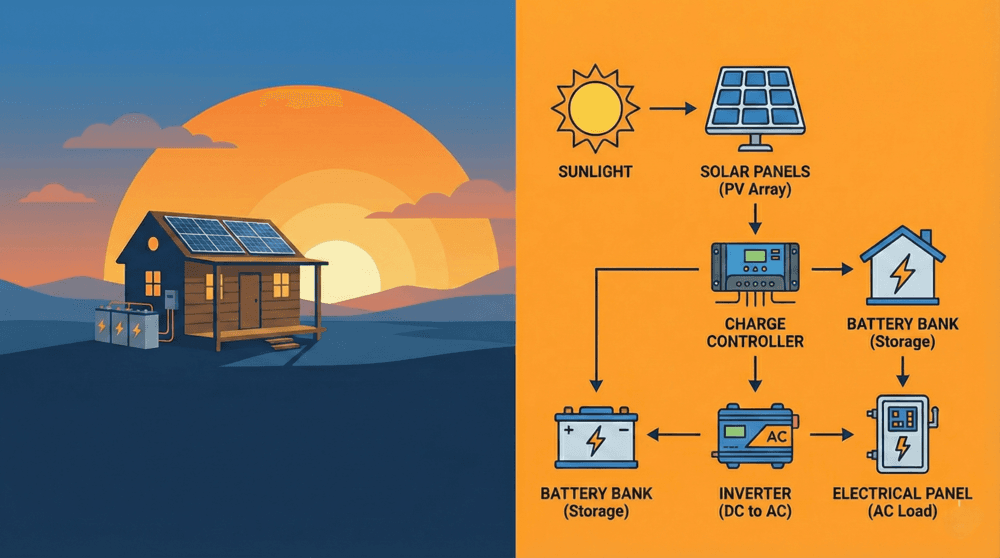
Off-Grid Solar System Requirements: Sizing, Permits & NEC Code Guide
Off-grid solar permit requirements by state: building codes, NEC compliance, bat...
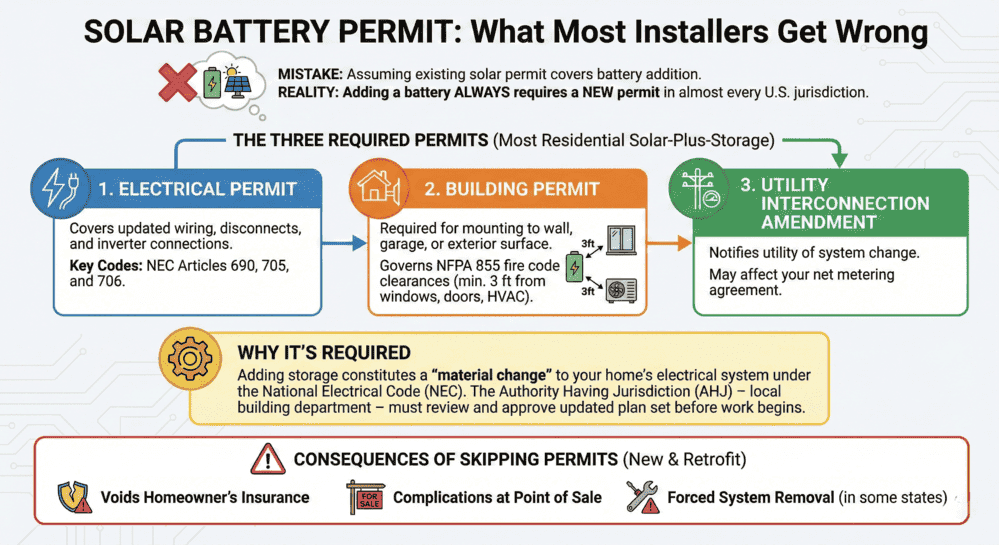
Solar Battery Permit: What Most Installers Get Wrong
Quick Answer: Adding battery storage to a solar system almost always requires ne...
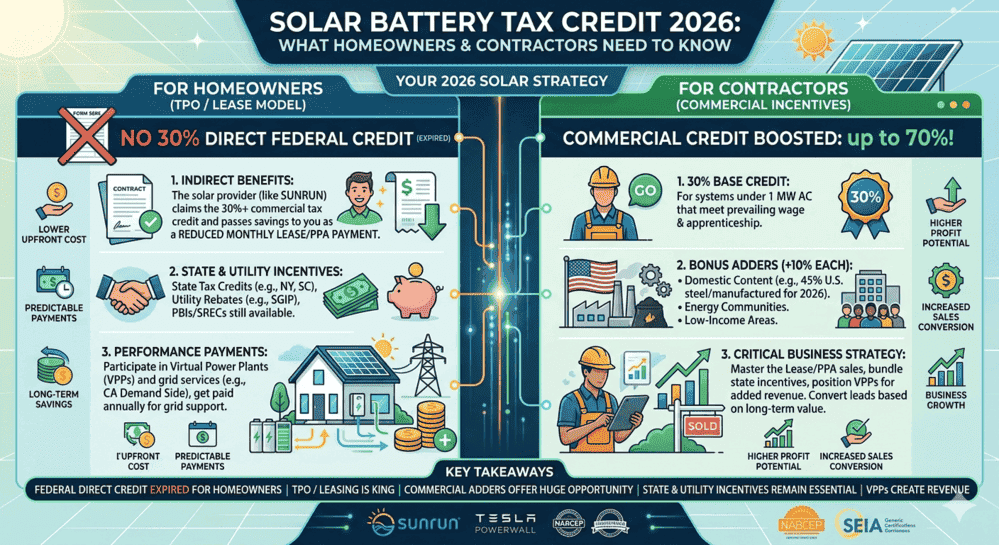
Solar Battery Tax Credit 2026: What Homeowners and Contractors Need to Know
There is no federal solar battery tax credit available to homeowners in 2026. Th...