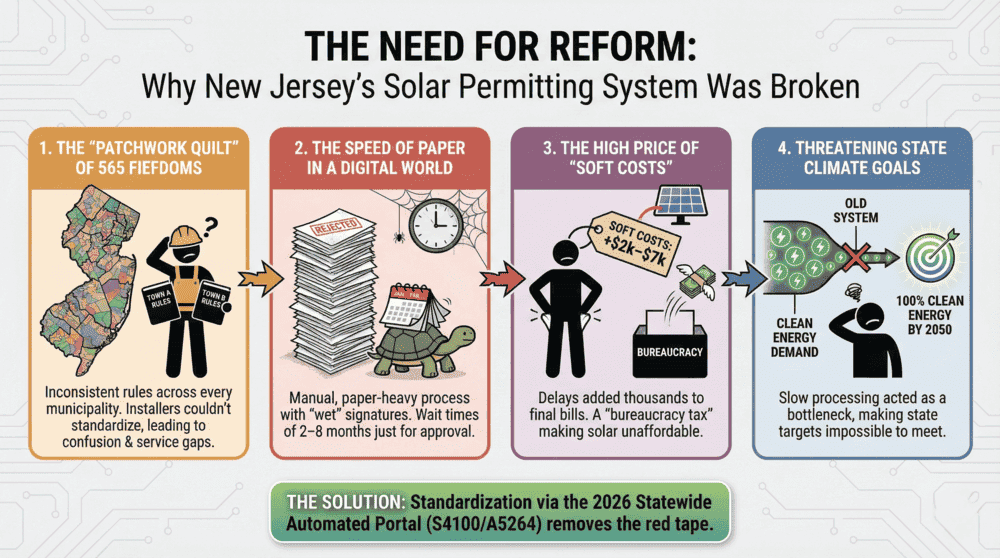
Summary: New Jersey’s Smart Solar Permitting Act requires an automated permit platform for residential solar by mid-2027. The law addresses the state’s 3rd-slowest permitting ranking and $3,800-$4,500 in added costs per installation.
New Jersey’s Smart Solar Permitting Act (A5264/S4100) is a law signed by Governor Phil Murphy on December 22, 2025, that requires the state to create an automated online platform for instant residential solar and battery permit approvals. The platform must be available statewide by mid-2027 (within 18 months of signing).
Key facts about NJ’s smart solar permitting law:
- What it does: Automates permit approvals for code-compliant residential solar and battery systems
- When it passed: Signed December 22, 2025; passed Senate 39-0
- When it launches: Platform required within 18 months (approximately June 2027)
- Why it matters: New Jersey has the third-slowest solar permitting in the U.S., with delays adding $3,800-$4,500 to installation costs
- Who benefits: Homeowners, solar installers, and municipalities
The law addresses a documented problem: approximately 22% of residential solar projects in New Jersey are canceled before installation, with permitting barriers cited as the top reason. Under the new system, standard rooftop solar installations that meet code requirements will receive permits in minutes rather than weeks.
This guide covers what the law requires, the implementation timeline, current permitting requirements while you wait, and what you should do now if you’re considering solar.

Why New Jersey’s Solar Permitting Needed Reform
Before examining what’s changing, it’s worth understanding why this legislation was necessary. The numbers tell a compelling story about a system that wasn’t working.
The Problem in Numbers
New Jersey’s solar permitting challenges are well-documented across multiple studies. When analyzing solar permit timelines by state, the Regional Plan Association released a 2025 report finding New Jersey ranks third from the bottom nationally for residential solar permitting speed. Only two states have slower average approval times for homeowners trying to install rooftop solar.
The financial impact is substantial. Research from the Greenhouse Institute found that permitting inefficiencies add between $3,800 and $4,500 to the cost of a typical residential solar installation in New Jersey. The Solar Energy Industries Association’s industry research has cited even higher figures in some analyses, estimating $6,000 to $7,000 in added costs from permitting and bureaucratic barriers. Regardless of which estimate you use, the message is clear: a significant portion of what New Jersey homeowners pay for solar doesn’t buy panels, inverters, or installation labor-it covers administrative delays and the overhead costs those delays create.
Perhaps most telling: approximately 22% of residential solar projects in New Jersey are canceled before installation ever begins. When researchers surveyed solar installers about why projects fall through, permitting barriers emerged as the number one reason for cancellations. That’s roughly one in five families who wanted to go solar but gave up due to the process.
New Jersey already has over 209,000 homes with solar installations, ranking sixth nationally for residential solar according to SEIA’s New Jersey solar data. The state has strong incentives and high electricity rates that make solar financially attractive. Imagine how many more families could be saving on electricity if the permitting process weren’t standing in the way.
The 565-Municipality Challenge
New Jersey’s permitting problems stem largely from its governmental structure. The state has 565 separate municipalities, and each one sets its own AHJ solar requirements, fees, timelines, and review processes.
For a homeowner, this means your experience going solar depends heavily on your address. Some towns have embraced solar-friendly policies and streamlined their processes-permits can be approved in days. Others require multi-departmental reviews involving building, electrical, zoning, and fire officials, with inconsistent requirements and outdated procedures that can stretch timelines to months.
The variation is so dramatic that many solar installers simply avoid certain municipalities altogether. If your town has a reputation for difficult permitting, you may find fewer installation companies willing to serve your area, which limits your options and potentially increases your costs. Some installers charge premiums of 10-20% for projects in municipalities known for burdensome requirements-they’re accounting for the additional staff time, multiple site visits, and project management complexity.
Historic districts present particular challenges. Towns like Princeton and Cape May require additional architectural review board approvals, which can add 30 to 45 days to an already lengthy process. Even homeowners who want solar and can afford it face significant hurdles in these areas-similar to how HOA solar panel restrictions create additional approval layers in other communities.
What Those Delays Actually Cost
When we talk about permitting adding thousands of dollars to system costs, it helps to understand where that money goes.
Some of it covers direct expenses: permit application fees, plan review charges, and multiple inspection trip costs. But the larger portion reflects indirect costs that accumulate during delays. Every week your project sits waiting for approval is a week you’re not generating electricity and saving money on your utility bill. Installers carry overhead during extended project timelines-staff, trucks, and warehoused equipment-and those carrying costs get built into customer quotes.
The cancellation problem creates its own costs. When 22% of projects fail to close, installers must account for that lost revenue by charging more on projects that do complete. Customer acquisition costs rise when the sales-to-installation ratio drops. Understanding how to reduce solar permit design costs has become essential for installers operating in this environment.
What the Smart Solar Permitting Law Does
Now let’s examine what A5264/S4100 actually requires and how automated permitting works in practice.
Core Requirements
The law directs the New Jersey Department of Community Affairs (DCA) to create and maintain a statewide automated permitting platform for residential solar and battery storage systems. The platform must be available within 18 months of the bill’s signing, which means approximately June 2027.
The key innovation is automation. Rather than having a human reviewer examine every permit application-a process that can take days or weeks depending on staff workload and backlog-the platform uses software to perform instant code compliance checks. Systems that pass all automated checks receive permits immediately, often within minutes. Those that don’t pass get flagged for manual review with specific feedback about what needs correction.
The bill also establishes that only licensed professionals-including contractors, engineers, and architects-can use the platform and submit materials through it. This requirement ensures that automation doesn’t compromise safety or professional standards.
One notable change from the original bill: the compliance deadline was extended from 12 months to 18 months during the amendment process, giving the DCA additional time to develop and deploy a reliable platform.
How Automated Permitting Works
While New Jersey hasn’t announced which specific technology the state will use, the model for automated solar permitting already exists and has been proven at scale. The National Renewable Energy Laboratory developed the SolarAPP+ automated permitting platform, a free tool funded by the Department of Energy that over 335 communities nationwide are already using successfully.
Here’s how systems like SolarAPP+ work in practice. A licensed solar contractor enters detailed system specifications into the platform: panel type and quantity, inverter specifications, mounting configuration, electrical characteristics, and structural load calculations. The software then performs automated checks against all applicable codes-the National Electrical Code, local building codes, fire safety requirements, and structural standards.
If every data point passes the compliance checks, the system issues a permit instantly. If something doesn’t pass, the platform identifies exactly what failed and why, allowing the contractor to correct the issue and resubmit immediately rather than waiting weeks for feedback from a human reviewer.
NREL’s solar permitting research demonstrates significant benefits from automated permitting. SolarAPP+ reduces the full timeline from permit submission to final passed inspection by an average of 14.5 days compared to traditional permitting. In 2023 alone, the platform saved participating local governments over 15,400 hours of staff time while processing nearly 19,000 permits. SolarAPP+ permits accounted for roughly 43% of all permits issued in participating jurisdictions.
The Department of Energy’s SolarAPP+ resources provide detailed implementation guidance for jurisdictions considering adoption.
What Systems Qualify for Instant Approval
Not every solar project will be eligible for automated approval, and that’s intentional. The systems that benefit most from instant permitting are standard residential rooftop installations that use code-compliant equipment in straightforward configurations.
Standard residential rooftop solar arrays using approved equipment and typical mounting systems should qualify for instant approval. Solar-plus-battery storage systems are also explicitly covered under the law-an important inclusion as battery adoption grows.
Projects that may still require manual review include ground-mounted systems, which often involve additional setback and zoning considerations that require human judgment. Installations on historic properties will likely need architectural review regardless of the permitting platform. Non-standard structural situations-older roofs requiring engineering assessment, unusual load conditions-may be routed to human reviewers. Commercial-scale or oversized installations typically fall outside the scope of automated residential permitting.
The Municipal Opt-Out Provision
The law includes an important provision allowing municipalities to opt out of using the state platform, but there’s accountability built in. Any municipality that opts out must implement a “comparable alternative” that provides equivalent functionality for residents and contractors.
Towns that choose this route face ongoing reporting requirements. They must submit annual reports to the DCA documenting the number of permit applications processed through their alternative platform and providing evidence that their system meets the requirements established by the state.
For homeowners, this means you’ll want to verify whether your municipality uses the state platform or an alternative system once implementation begins. In practice, most smaller municipalities will likely adopt the state platform rather than building and maintaining their own software. Larger cities with existing digital infrastructure may develop their own systems, but they’ll need to meet the same performance standards.
Implementation Timeline
Understanding the realistic timeline helps set appropriate expectations for when you’ll actually see changes.
Key Milestones
The law was signed on December 22, 2025. Governor-elect Mikie Sherrill took office on January 20, 2026, and her administration will oversee the implementation process through the Department of Community Affairs.
During the first half of 2026, expect the DCA to issue a Request for Proposals for platform development. The law specifically directs the agency to go through an RFP process, with the Board of Public Utilities playing a consultative role in evaluating proposals.
Platform development and pilot testing will likely occur through the second half of 2026 and into early 2027. Software development, integration with existing municipal systems, contractor registration processes, and testing all take time. The 18-month deadline from the bill signing puts the statewide launch requirement around June 2027.
The Sherrill Administration Factor
Implementation quality will depend significantly on the new administration’s priorities. Governor Sherrill campaigned heavily on clean energy and utility cost reduction, declaring a “state of emergency on utility costs” as part of her Day 1 agenda. These signals suggest the administration may pursue aggressive implementation timelines rather than taking the full 18 months allowed.
However, building a reliable statewide technology platform takes time, and rushing could create problems that undermine the system’s effectiveness. The smart expectation is platform availability sometime in the first half of 2027, with possible pilot programs in select municipalities launching earlier to work out issues before statewide rollout.
What This Means Right Now
Here’s the reality that news coverage often glosses over: the traditional permitting process remains fully in place until the new platform launches. If you’re going solar in 2026, you’ll navigate the same system that exists today with all its municipal variations and potential delays.
Timelines will still vary by municipality. Documentation requirements remain unchanged. There are no shortcuts available yet. For a broader perspective on what to expect, our guide on how long solar permits take covers the current reality.
This doesn’t mean you should wait, however. As we’ll discuss in the incentives section, there are compelling financial reasons to consider moving forward now rather than waiting for streamlined permitting.
Solar Permit Solutions
Solar Contractor? We Design Your Plans.
Outsource your permit plan sets to our team. PE-stamped, code-compliant, fast turnaround so you can focus on installation.
Current NJ Solar Permitting Requirements
Until the smart permitting platform launches, here’s what you need to know about navigating the existing system.
Required Permits
Every residential solar installation in New Jersey requires a construction permit from your local building department. This typically combines building and electrical permits into a single application process, though some municipalities handle them separately.
Zoning approval is also required, though most standard rooftop systems receive favorable treatment. New Jersey law designates solar energy facilities as an “inherently beneficial use,” which provides legal support for approvals. Ground-mounted systems may face additional scrutiny around setback requirements and height restrictions.
Separate from municipal permits, you need utility interconnection approval. Understanding the complete solar interconnection agreement process is essential for navigating this step. This is filed with your electric utility-PSE&G, JCP&L, Atlantic City Electric, or Rockland Electric depending on where you live. After your system passes final inspection, the utility issues Permission to Operate (PTO), which authorizes you to turn on your system and begin generating power. Our guide on solar PTO requirements and timeline covers this final authorization step in detail.
Documentation Required
For your permit application, expect to provide: a site plan showing proposed panel placement on your roof, equipment specifications including panel model, inverter type, and racking system, an electrical single-line diagram showing how the system connects to your home’s electrical panel, and structural load calculations demonstrating your roof can support the added weight.
If your home is in a historic district, additional requirements apply. You may need architectural drawings, a visual impact assessment, and documentation of alternative panel placement options you considered.
Most homeowners don’t prepare these materials themselves. Your solar installer typically handles the entire permit package as part of their service. When evaluating installers, ask about their experience with permits in your specific municipality and their average approval timeline for your area.
Current Timeline Expectations
Current permit timelines vary dramatically depending on where you live. Our average solar permit timeline guide provides detailed state-by-state analysis:
Solar-friendly municipalities: 5-10 business days for standard rooftop systems Average municipalities: 2-4 weeks typical processing time Slow municipalities: 4-8 weeks, sometimes longer during busy periods Historic district properties: 6-12 weeks, accounting for architectural review Ground-mounted systems: 4-8 weeks plus additional time if variances are required
Before signing a contract, it’s worth understanding what you’re facing in your specific town. Ask your installer directly-experienced local companies know which municipalities are fast, which are slow, and which have unusual requirements.

How Smart Permitting Affects Solar Costs and ROI
Faster permitting isn’t just about convenience-it has direct financial implications.
Current Cost Impact
The $3,800 to $4,500 that permitting currently adds to New Jersey installations covers both direct and indirect costs.
Direct permit costs include application fees, which typically run $65 to $130 depending on system size under state fee schedules, plus inspection fees and any expediting charges. These won’t change dramatically under smart permitting.
The bigger savings come from indirect costs. Faster permitting means earlier system activation, so you start saving on electricity sooner. Installers can complete more projects with the same staff when they’re not managing lengthy permit processes, which should reduce overhead built into pricing over time. With fewer projects falling through due to permitting frustration, customer acquisition costs decrease industry-wide.
Current New Jersey Solar Incentives
Understanding available incentives matters because some programs have critical deadlines that interact with your timing decisions.
Federal Tax Credit: The Residential Clean Energy Credit provided a 30% tax credit on total solar installation costs. However, this credit expired for residential systems on December 31, 2025, following passage of the One Big Beautiful Bill Act in July 2025. The credit was eliminated nearly a decade ahead of its original scheduled expiration. If you didn’t install by that deadline, this incentive is no longer available.
SREC-II Program: New Jersey’s Successor Solar Incentive (SuSI) program pays you for the clean energy your system produces. Under the Administratively Determined Incentive (ADI) program, residential systems earn one Solar Renewable Energy Certificate II (SREC-II) for every megawatt-hour generated. Each certificate is currently worth $85, and payments continue for 15 years from your interconnection date.
For a typical system generating 8-10 MWh annually, that’s $680-$850 per year, or $10,200-$12,750 over the full 15-year program term. The New Jersey Board of Public Utilities plans to review SREC-II pricing in March 2026, so current rates aren’t guaranteed for future installations. EnergySage’s NJ solar incentives guide provides additional details on available programs.
Tax Exemptions: New Jersey provides both sales tax and property tax exemptions for solar. The sales tax exemption saves you 6.625% on equipment costs. The property tax exemption ensures the value solar adds to your home doesn’t increase your property tax bill.
Net Metering: New Jersey requires utilities to credit you at the full retail rate for excess electricity your system sends to the grid. Credits roll over indefinitely, though they cash out at the lower avoided-cost rate if you move.
Rising Electricity Rates Create Urgency
There’s another financial factor beyond incentive deadlines: New Jersey electricity rates increased dramatically in 2025.
On June 1, 2025, residential customers saw rate increases ranging from 17.24% for PSE&G customers to 20.20% for JCP&L customers, according to the New Jersey Board of Public Utilities. A typical household using 650 kWh monthly saw their bill increase by roughly $22-$27 per month-over $250-$320 annually.
These increases were driven by PJM capacity auction results, surging electricity demand from data centers throughout the region, and insufficient new generation coming online to meet growing demand. The same structural factors remain in place, suggesting rates may continue climbing in future years.
Every month you wait to install solar is a month you’re paying elevated electricity rates instead of generating your own power.
Next Steps for New Jersey Homeowners
If You’re Considering Solar Now
The smart permitting platform won’t launch until mid-2027 at earliest. Consider these timing factors:
The federal tax credit expired December 31, 2025. That 30% savings opportunity is no longer available for residential systems.
Electricity bills already increased 17-20% as of June 2025, and structural factors suggest continued increases. Every month waiting means paying elevated rates.
SREC-II payments remain strong at $85 per certificate, but pricing review comes in March 2026.
Action steps:
- Get quotes from multiple licensed New Jersey installers
- Ask about permit timelines in your specific municipality
- Verify the installer handles all permitting and interconnection
- Understand your complete incentive picture
- Make decisions based on your financial situation and timeline
Understanding how solar panels connect to the grid helps you ask the right questions when evaluating installers.
Looking Ahead
Smart permitting will make going solar easier and reduce soft costs. However, the overall financial picture depends on when you act and which incentives remain available.
Proper labeling and code compliance will be essential for automated approval. Resources on NEC 690.56(C) rapid shutdown labels help installers understand requirements that automated systems will verify.
The bottom line: smart permitting removes a barrier, but it’s one factor among many in your solar decision.
What Solar Installers Need to Know
If you’re a solar contractor operating in New Jersey, the smart permitting law will significantly impact your business operations.
Operational Changes Coming
When the state platform launches, licensed contractors will need to register and have their credentials verified through the system. Expect the platform to integrate with existing permitting software systems like Accela and OpenGov, which many New Jersey municipalities already use.
Your workflow will shift toward designing systems that pass automated code compliance checks on the first submission. This means standardizing equipment specifications, using approved component combinations, and ensuring structural calculations are complete and accurate before hitting submit. Understanding current NEC 2023 Article 690 requirements will be essential for systems passing automated review.
The feedback loop changes dramatically. Instead of waiting weeks to learn that something in your permit package needs revision, you’ll get instant notification of any compliance issues. Systems that pass will be approved immediately.
For code compliance, the 2023 NEC rapid shutdown requirements have specific implications for automated permitting systems that contractors should understand.
Business Implications
Opportunities: Faster project completion means more installations per year with the same crew capacity. Reduced administrative overhead improves margins. You’ll be able to profitably serve municipalities that were previously too difficult. Early adopters who master the new system will have competitive advantages. Leveraging the right solar permit design tools can help your team prepare for automated review requirements.
Challenges: Ensuring your designs consistently pass automated checks requires tighter quality control on the front end. Your team will need training on the new platform. During the transition period, you’ll need to manage customer expectations while the old system remains in place.
Preparing Your Business Now
Start auditing your current permit packages. Are they optimized for automated review? Do you use standardized equipment configurations? Are structural calculations complete? Understanding supply-side vs load-side interconnection options helps ensure your designs pass technical review.
Familiarize your team with SolarAPP+ and how automated permitting works. Even if New Jersey develops its own platform, the principles will be similar. Resources on IEEE 1547 interconnection standards provide technical background on the grid integration requirements that automated systems verify.
Stay informed about implementation timeline updates from the DCA. When pilot programs launch, consider participating-early experience with the new system will be valuable.
Conclusion
New Jersey’s smart solar permitting law represents a significant step forward. By requiring an automated platform, the legislation directly addresses documented problems: the state’s third-slowest permitting ranking nationally, thousands in unnecessary soft costs, and the 22% of projects that cancel due to permitting frustration.
Implementation under Governor Sherrill’s administration will be critical. The 18-month timeline is ambitious but achievable given the administration’s clean energy priorities.
For homeowners weighing options, understand that waiting for smart permitting involves trade-offs. The permitting system will improve, but incentive structures, utility rates, and your own energy costs create their own timeline pressures worth considering.
FAQs
What is New Jersey’s smart solar permitting law?
The Smart Solar Permitting Act (A5264/S4100), signed December 22, 2025, requires New Jersey to create an automated online platform that instantly approves residential solar and battery permits for code-compliant systems. The platform must launch within 18 months.
What if my system doesn’t pass automated review?
Systems that don’t pass are flagged for manual review rather than rejected. The platform identifies specific issues, allowing correction and resubmission or routing through traditional review if needed.
How does NJ’s permitting compare to other states?
New Jersey currently ranks third-slowest nationally. For comparison, see how California handles solar panel permitting, which has already implemented SolarAPP+ in many jurisdictions.
References
Solar Contractor? We Design Your Plans.
Outsource your permit plan sets to our team. PE-stamped, code-compliant, fast turnaround so you can focus on installation.
Frequently Asked Questions
The Smart Solar Permitting Act (A5264/S4100), signed December 22, 2025, requires New Jersey to create an automated online platform that instantly approves residential solar and battery permits for code-compliant systems. The platform must launch within 18 months.
The law requires launch within 18 months of signing - approximately mid-2027. Pilot programs in select municipalities may begin earlier.
Currently, permitting adds $3,800-$4,500 to typical installations according to Greenhouse Institute research. Smart permitting should significantly reduce these soft costs.
Yes. All solar installations require construction permits from your local municipality regardless of whether they use automated or traditional review.
Yes, if they implement a comparable alternative and submit annual compliance reports to the DCA demonstrating equivalent functionality.
Yes. The law explicitly covers both residential solar and battery storage installations.
Systems that don't pass are flagged for manual review rather than rejected. The platform identifies specific issues, allowing correction and resubmission or routing through traditional review if needed.
New Jersey currently ranks third-slowest nationally. California, for comparison, has already implemented SolarAPP+ in many jurisdictions for faster permit processing.

SPS Editorial Team
Solar Permit Solutions
Solar Permit Solutions provides professional solar permit design services for residential, commercial, and off-grid installations across all 50 states. Our team ensures permit-ready plan sets delivered fast.
Related Articles
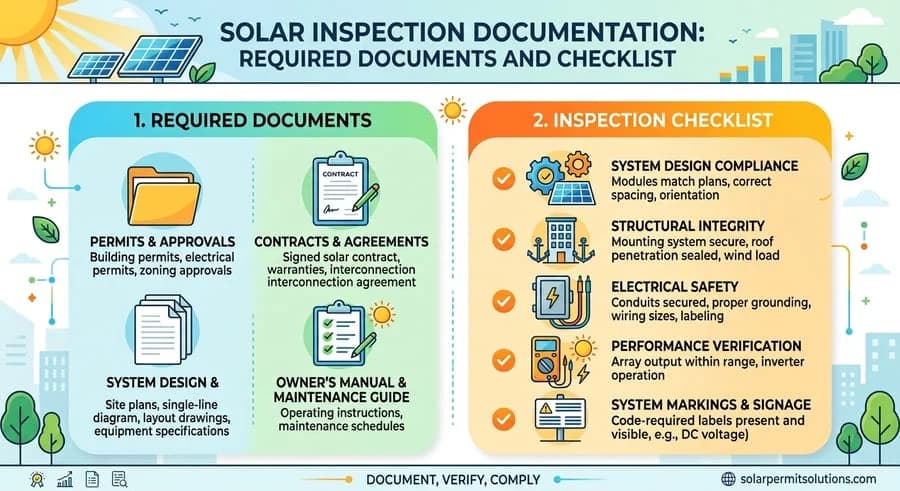
Solar Inspection Documentation: Required Documents and Checklist
Learn about solar inspection documentation, including permit requirements, NEC c...
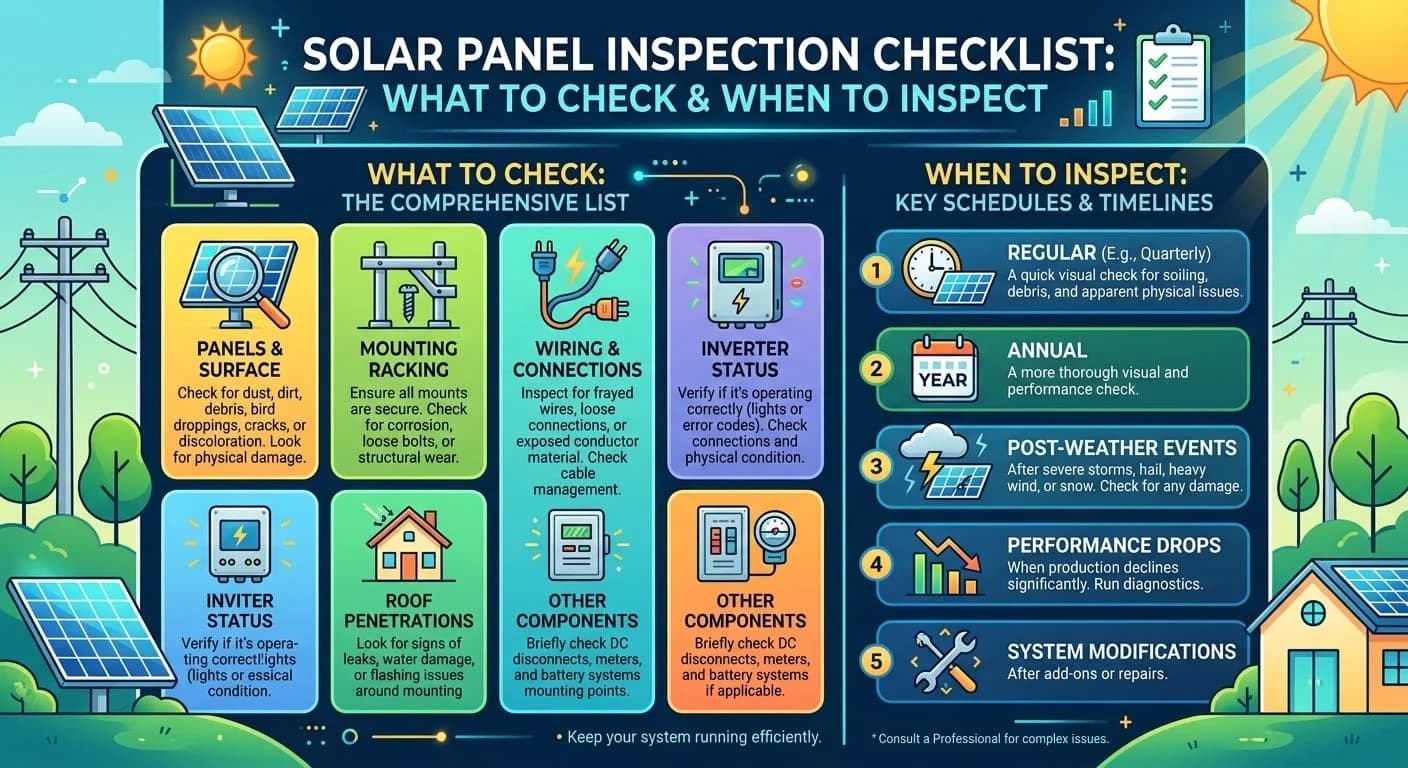
Solar Panel Inspection Checklist: What To Check & When To Inspect
Solar panel inspection guide: Learn what to check, when to inspect (annually + e...
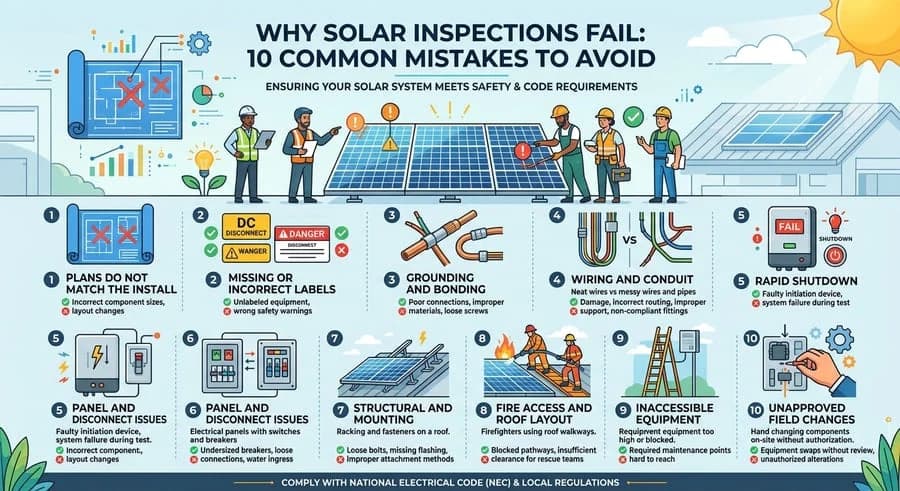
Why Solar Inspections Fail: 10 Common Mistakes to Avoid
Discover the 9 critical reasons solar inspections fail and how to avoid costly m...