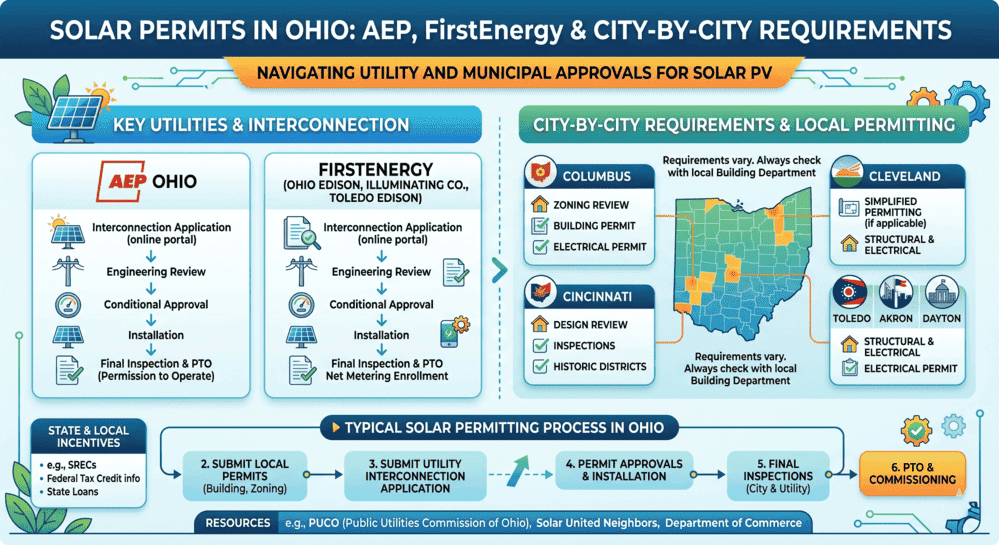
Ohio solar permits require a building permit and an electrical permit from your local Authority Having Jurisdiction (AHJ), plus a utility interconnection application submitted to AEP Ohio, FirstEnergy (Ohio Edison, Toledo Edison, or the Illuminating Company), or another serving utility before your system can export power.
Ohio adopted the 2023 NEC effective March 1, 2024, making rapid shutdown compliance under NEC 690.12 and PE-stamped plan sets the baseline standard for all grid-tied residential and commercial installations. Permit timelines range from 3 business days (Columbus email review) to same-day in-person at Cincinnati’s Permit Center, with utility interconnection adding 2-8 additional weeks. This guide covers every major Ohio city, both primary utilities, applicable Ohio state codes, and how to submit a plan set that earns first-pass AHJ approval.
Ohio Solar Permit Quick-Reference: City-by-City Summary
Requirements vary substantially across Ohio cities. The table below summarizes the key variables for each jurisdiction covered in this guide.
| City | AHJ Portal | Utility | Electrical Permit Issuer | Review Timeline | Key Differentiator |
| Cleveland | City of Cleveland Division of Permits | Illuminating Company (FirstEnergy) | City of Cleveland | Varies — call dept. | Zoning review required; exterior alteration classification |
| Columbus | City BZS (columbus.gov/BZS) | AEP Ohio | City of Columbus BZS | ~3 business days (email) | Requires NABCEP/PE special inspector; unique inspection process |
| Cincinnati | Permit Center (CAGIS portal) | Duke Energy Ohio | Inspection Bureau Inc. (IBI) — third party | 5 BD residential / same-day in-person | Electrical permit issued by IBI, not the city |
| Toledo | City of Toledo Building Inspection | Toledo Edison (FirstEnergy) | City of Toledo | Per AHJ checklist | FirstEnergy service territory; detailed published checklist |
| Dublin | Accela/ProjectDox (dublinohiousa.gov/aca) | AEP Ohio | City of Dublin | 14 days / 30 days max | SolSmart Bronze; Historic District requires ARB review |
| Springboro | City of Springboro Building Dept. | AES Ohio (DP&L) | City of Springboro | Per AHJ | Dayton Power & Light / AES Ohio service territory |
| Athens | City of Athens Building Dept. | AEP Ohio | City of Athens | Per checklist | Published AHJ checklist; active solar market for city size |
Ohio Solar Permitting Framework: State Codes and Utility Oversight
Before diving into city-level requirements, it is essential to understand the statewide baseline that every Ohio AHJ operates within. Two regulatory layers govern Ohio solar installations: the Ohio Building Code and its adopted NEC edition, and the Public Utilities Commission of Ohio (PUCO) rules governing utility interconnection.
Ohio Building Code and the 2023 NEC Adoption
The Ohio Board of Building Standards (BBS) adopted the 2023 National Electrical Code effective March 1, 2024 — the current statewide baseline for all electrical work, including solar PV installations. The 2023 NEC changes most relevant to plan set preparation include:
- Rapid shutdown labeling moved from NEC 690.56(C) to 690.12(D) — the buildings-with-rapid-shutdown placard color mandate was removed; only contrasting text is required. See our NEC 690 updates guide for the full breakdown.
- DC voltage label moved from NEC 690.53 to NEC 690.7(D)
- Power source directory requirements consolidated into Article 705.10, adding an off-site emergency contact requirement. For labeling documentation best practices, see our solar PV labeling requirements guide.
- New carport and canopy exception to rapid shutdown under NEC 690.12 Exception No. 2
Ohio enforces the Residential Code of Ohio (RCO) for 1-3 dwelling structures and the Ohio Basic Building Code (OBC) for commercial. Structural calculations must comply with ASCE 7 wind and snow load criteria for the specific project location. The Ohio Board of Building Standards certifies county, township, and municipal building departments to enforce these codes — meaning local AHJs have authority to add requirements above the state baseline.
Confirm the adopted code edition with your specific AHJ before finalizing any plan set. While NEC 2023 is the state standard effective March 2024, individual AHJs may still be in transition.
PUCO Interconnection Framework for Ohio Utilities
All Ohio investor-owned utilities — including AEP Ohio, FirstEnergy subsidiaries (Ohio Edison, Toledo Edison, The Illuminating Company), Duke Energy Ohio, and AES Ohio (Dayton Power & Light) — must follow interconnection rules under Ohio Administrative Code 4901:1-22. These rules establish a tiered application system based on system capacity. For a complete walkthrough of the interconnection agreement process, see our solar interconnection agreement checklist and guide.
| Level | Capacity | Application Type | Notes |
| Level 1 | 25 kW or less, inverter-based, UL 1741 certified | Expedited | Applies to 90-95%+ of residential installations; fastest review path |
| Level 2 | 25 kW to 2 MW | Standard with engineering review | Additional 5-day engineering review period |
| Level 3 | Greater than 2 MW (up to 20 MW) or fails L1/L2 criteria | Full impact and facility study | Reserved for commercial and utility-scale projects |
All grid-tied inverters must meet UL 1741 and UL 1741 SA requirements for advanced inverter functions, including voltage-frequency ride-through. IEEE 1547 compliance documentation is required for all interconnection applications. Municipal electric utilities and rural electric cooperatives are not subject to PUCO retail interconnection rules and set their own procedures. Use DSIRE or contact the specific utility to confirm which rules apply to a given address.
AEP Ohio Interconnection: Service Territory, Application Process, and Net Metering
AEP Ohio serves central and southeastern Ohio, including Columbus, Dublin, Athens, and surrounding areas. For a detailed breakdown of system costs, net billing rates, and the full AEP Ohio interconnection timeline, see our dedicated AEP Ohio solar guide. AEP Ohio’s interconnection process is administered through its DG Coordinator office and is available online via PowerClerk.
AEP Ohio Service Territory
AEP Ohio’s service territory covers much of central Ohio (Columbus metro), southeastern Ohio, and parts of northwestern Ohio. Key cities served include Columbus, Dublin, Athens, and surrounding communities. The Illuminating Company (FirstEnergy) serves Cleveland; Toledo Edison serves Toledo, and Ohio Edison serves Akron and surrounding northeast Ohio. Use the PUCO net metering resource page to confirm which utility serves a specific address.
AEP Ohio Interconnection Application Steps
- Design your system. Work with your solar installer to finalize system layout, equipment selection, and string configuration. Include a detailed single-line diagram (SLD) before applying.
- Submit the interconnection application through AEP Ohio’s online PowerClerk portal. Include a site plan and one-line diagram. AEP Ohio’s technical requirements document (revised November 2024) governs what documentation is required. The diagram must be signed and stamped by a licensed Professional Engineer for systems above Level 1 criteria.
- Pay the application fee. For Level 2 (expedited review): $50 plus $1/kW of nameplate capacity. For Level 3 (standard review): $100 plus $2/kW. AEP Ohio’s published tip sheet does not separately itemize a Level 1 application fee; confirm the current Level 1 fee directly with AEP Ohio at time of application.
- Receive technical and safety review from AEP Ohio. AEP reports that 90-95% of applicants are approved on the first review.
- Execute the Interconnection Service Agreement prepared by AEP Ohio. Note: AEP Ohio requires the utility-accessible disconnect switch to be located outdoors within 6 feet of the AEP meter, readily accessible without entering a building or locked enclosure, and lockable in place with a padlock. For supply-side vs. load-side connection details, see our interconnection method guide.
- Pass AHJ inspection and have a new bi-directional meter installed by AEP Ohio. AEP Ohio requires a UL-approved Solar Ready type meter-load center combination enclosure for net metering.
- Enroll in Net Energy Metering Service (NEMS) and begin exporting. Contact: dgcoordinator-ohio@aep.com or 614-883-6775.
AEP Ohio Net Energy Metering (NEMS)
AEP Ohio does not offer full-retail net metering. Instead, it provides a Net Energy Metering Service (NEMS) under two tariff schedules: Schedule NEMS for non-shopping customers and OAD-Schedule NEMS for customers who receive generation from a competitive retail electric service (CRES) provider. Key features:
- Excess solar generation (negative kWh in a billing period) is credited at the generation energy component rate, not the full retail rate. In 2025, excess generation was credited at approximately $0.11/kWh.
- Credits carry forward to reduce future bills but cannot be cashed out as a check.
- The system must not be oversized relative to the customer’s demand; oversized systems may not qualify for NEMS and may incur additional interconnection costs.
- AEP Ohio conducts a field verification after installation to confirm the installed system matches the submitted application.
The Section 25D Residential Clean Energy Credit expired for most expenditures after December 31, 2025. See our solar battery tax credit 2026 guide for how this affects storage pairing. Ohio’s sales tax exemption for solar equipment purchases remains in effect.
For more on the financial case for solar in AEP Ohio territory, including how the energy-component credit affects system sizing decisions, see our complete AEP Ohio solar guide.
Solar Permit Solutions
Skip the Permit Headaches
We design plan sets that pass inspection the first time. Code-compliant, PE-stamped, accepted by AHJs nationwide.
FirstEnergy Ohio: Toledo Edison, The Illuminating Company, and Ohio Edison
FirstEnergy operates three regulated electric distribution companies in Ohio: Toledo Edison (northwest Ohio, including Toledo), The Illuminating Company (northeast Ohio, including Cleveland), and Ohio Edison (northeast and north-central Ohio, including Akron). All three operate under a unified interconnection process administered through FirstEnergy’s Ohio Retail Interconnection portal.
FirstEnergy Ohio Interconnection Application Process
The interconnection process for all three FirstEnergy Ohio utilities follows the same sequence. Applications are submitted to the specific operating company:
- Toledo Edison: TE_interconnection@firstenergycorp.com / Toledo Edison Company, Attn: TE Interconnection, 6099 Angola Rd, Holland, OH 43528
- The Illuminating Company (Cleveland): CEI_interconnection@firstenergycorp.com / 6099 Angola Rd, Holland, OH 43528
- Ohio Edison (Akron/Northeast Ohio): OE_interconnection@firstenergycorp.com / Ohio Edison, Attn: OE Interconnection, 1910 W. Market Street, Akron, OH 44313
Required documents at application include a site plan and a one-line diagram. See our single-line diagram guide for what must be documented. The site plan must show the overall property layout with street access and a north arrow, the nearest cross-street in each direction, and for ground-mounted installations, clearances from surrounding structures. Overhead internet (satellite) photos are not acceptable as site plans.
FirstEnergy Ohio Level 1 vs. Level 2/3 Applications
| Level | Capacity Threshold | Key Requirement | Notes |
| Level 1 | 25 kW or less, inverter-based, IEEE 1547/UL 1741 certified | One-line diagram + site plan | Fast-track; covers 90%+ of residential installs |
| Level 2 | 25 kW to 2,000 kW (up to 2 MW) | Engineering review + application fee | Includes additional 5-day engineering review period |
| Level 3 | >2,000 kW and <20,000 kW, or fails Level 2 criteria | Full impact study + facility study agreement | Contact FirstEnergy EDC directly for application procedures |
FirstEnergy Net Metering
FirstEnergy Ohio subsidiaries offer net metering under the Net Energy Metering Rider, governed by PUCO-approved tariffs. Unlike AEP Ohio’s energy-component-only credit, FirstEnergy’s net metering credits each kWh received from the customer against kWh delivered to the customer on a one-for-one basis, up to the amount consumed in a billing period. This is a meaningful distinction for system sizing decisions in FirstEnergy territory versus AEP territory.
A bi-directional meter is required. Customers should not energize an interconnected system prior to electrical inspection and receipt of a signed Certificate of Completion. FirstEnergy publishes a Solar Accommodation Map (updated January 2025) for Ohio Edison, Toledo Edison, and Illuminating Company distribution circuits showing estimated hosting capacity to help guide developers to circuits that can accommodate additional generation.
City-by-City Solar Permit Requirements in Ohio
Cleveland Solar Permits
Solar installations in Cleveland are classified as exterior alterations under the general building permitting system and require a building permit from the City of Cleveland Department of Building & Housing. The City of Cleveland solar permit page outlines the process, and the Department has published a Solar Panel Guide detailing requirements for both rooftop and ground-mounted systems. Both commercial and residential installations require zoning review. For contractors managing plan set preparation and PE stamping, see our Cleveland solar permit services.
- Permit type: Building permit (exterior alteration classification)
- Zoning review: Required for all installations
- Utility: The Illuminating Company (FirstEnergy) — submit interconnection to CEI_interconnection@firstenergycorp.com
- Electrical permit: City of Cleveland Building & Housing
- Contact: 216-664-2000 / 601 Lakeside Ave, Cleveland
Cleveland’s published Solar Guide is dated 2017. Confirm current checklist requirements directly with the Building Department before submitting plans, as specific requirements may have been updated.
Columbus Solar Permits
Columbus has one of the most distinctive solar permitting processes in Ohio. The City of Columbus Building and Zoning Services (BZS) requires a third-party special inspector — holding either NABCEP certification or a PE license — to perform inspections of PV systems. See the Columbus BZS rooftop solar process document for the full procedure. For permit-ready plan sets designed specifically for Columbus BZS, see our Columbus solar permit services and our guide to Columbus solar permit requirements.
The Columbus process:
- Submit permit application by email to BZS. Include the phrase ‘install rooftop solar panels’ in the project description and name the BZS-registered third-party PV inspector who will perform the required inspection.
- Receive fee invoice by email. Pay the fee to initiate review.
- Receive permit approval within approximately 3 business days for complete, correct submissions.
- A registered Columbus electrical contractor obtains the electrical permit per Columbus Building Code Section 4113.
- Third-party special inspector performs final inspection. The inspector must appear on the Columbus BZS-registered PV inspector list (Columbus.gov/BZS > Document Library > Inspection Information > Photovoltaic Systems).
- Plans must be sealed by a design professional registered in the State of Ohio
- Utility: AEP Ohio — see our AEP Ohio interconnection guide for the full application process
Columbus’s special inspector requirement is unique among major Ohio cities. Failing to name a BZS-registered PV inspector on the application is the most common cause of Columbus permit delays. Confirm the inspector is on the current approved list before submitting.
Cincinnati Solar Permits
Cincinnati has one of the most clearly documented and streamlined solar permitting processes in Ohio. The City of Cincinnati Permit Center published a comprehensive Solar PV Installations Checklist covering all requirements for residential and commercial installations. The Permit Center offers same-day review for in-person applications — a significant advantage for contractors working on tight timelines.
Required permits and key details:
- Building permit: Required for all solar installations — submitted to the Cincinnati Permit Center, 805 Central Avenue, Suite 500, Cincinnati, OH 45202 / 513-352-3271
- Electrical permit: Issued by Inspection Bureau, Inc. (IBI) — not the City of Cincinnati. Contractors must register with IBI separately at inspectionbureau.com.
- Zoning review: Conducted concurrently. For properties in a local historic district, additional locational approval may be required — check via OpenCincy or contact ZoningInfo@cincinnati.oh.gov
- Utility: Duke Energy Ohio — not AEP Ohio or FirstEnergy. Duke Energy’s interconnection process follows PUCO rules under its own tariff.
Document requirements for residential rooftop systems:
- System plans showing array layout with required clearances, plus signed and stamped documentation from an Ohio-licensed design professional confirming structural adequacy
- Electrical diagram from a licensed professional showing PV configuration, wiring, overcurrent protection, inverter, disconnects, required signs, and AC connection — see our solar wiring diagram guide for what must be documented
- Specification sheets and installation manuals for all manufactured components including PV modules, inverter(s), combiner box, disconnects, and mounting system
Review timeline:
- Residential: 5 business days (best efforts), or same-day for in-person submissions at the Permit Center
- Commercial/non-residential: 10 business days (best efforts)
- Revision reviews: 5 business days
The electrical permit is issued by IBI, not the City of Cincinnati. The city’s building permit Certificate of Completion is only issued after the IBI electrical permit is certified as complete. Coordinate both tracks in parallel to avoid delays.
Toledo Solar Permits
Toledo falls within Toledo Edison’s service territory (FirstEnergy). The City of Toledo Building Inspection Department handles solar permit applications. Toledo’s AHJ uses a published checklist available from the City covering residential and commercial PV installations that aligns with Ohio Building Code and NEC 2023 requirements.
- Permit type: Building permit from City of Toledo Building Inspection
- Checklist: Available from the City of Toledo — includes site plan, structural documentation, electrical single-line diagram, equipment specifications, and NEC compliance notes
- Utility: Toledo Edison (FirstEnergy) — apply for interconnection at TE_interconnection@firstenergycorp.com
- PE stamp: Required per Ohio BBS standards for structural calculations
- The FirstEnergy Solar Accommodation Map covers Toledo Edison circuits and can help assess hosting capacity before finalizing array size
Toledo Edison is part of FirstEnergy’s unified Ohio interconnection portal. Use the same Level 1/2/3 process described in the FirstEnergy section above, directed to the Toledo Edison address.
Dublin Solar Permits
Dublin is one of the best-documented solar permitting environments in Ohio, having earned a SolSmart Bronze designation for reducing barriers to solar energy growth. The city publishes specific residential and commercial plan requirement documents and operates an online portal at dublinohiousa.gov/solar.
Dublin’s review process includes two tracks:
- Historic District and Appendix G properties: Require minor project review with Architectural Review Board (ARB) approval before permit submission. Check your property on Dublin’s Dubscovery map before assuming the standard track applies.
- All other properties: Administrative staff approval — most applicants proceed directly to permit submission
Required permits and fees:
- Residential: Residential Alteration Permit ($100) plus Residential Electric Permit ($105)
- Commercial: Commercial Alteration Permit plus Commercial Electric Permit
- All applications submitted through Accela/ProjectDox at dublinohiousa.gov/aca
Additional requirements:
- If panels are located on the front of a principal or accessory structure, an energy efficiency analysis demonstrating that location provides the greatest production efficiency is required
- Specification sheets must show panel color and shingle color are similar (Dublin aesthetic standard)
- The contractor must be registered with the City of Dublin
- Utility: AEP Ohio — see our AEP Ohio interconnection guide for the full application process
Review timeline: 14 days (best efforts) / 30 days maximum. Inspections are typically completed within one day of request.
Ohio SB 61 (effective September 2022) limits HOA authority to prohibit solar but allows reasonable size, place, and manner restrictions. Dublin specifically requires applicants to verify deed restrictions and obtain any required HOA approvals before contacting the city.
Springboro Solar Permits
Springboro is served by AES Ohio (formerly Dayton Power & Light), making it the primary example in this guide of the DP&L/AES Ohio service territory. AES Ohio operates its own interconnection portal at aes-ohio.com/interconnection with application levels matching the PUCO framework. For Level 1 systems (25 kW or less), the application fee is $50. A separate $95 fee applies for upgrading to a bi-directional residential meter. Level 2 fee: $50 plus $1/kW plus the cost of any network upgrades. Level 3: $100 plus $2/kW plus impact and facility study costs.
The City of Springboro’s Building Department handles the local permit under Ohio Residential Code. Key Springboro permit requirements mirror Ohio BBS standards: structural calculations from an Ohio-licensed PE (see our PE stamp requirements guide), an electrical single-line diagram, and equipment specification sheets.
Athens Solar Permits
Athens is served by AEP Ohio, and the City of Athens handles local permitting. The City of Athens has a published solar permitting checklist covering residential and small commercial PV systems. Requirements include a site plan showing panel placement and property boundaries, structural documentation demonstrating roof load capacity, an electrical diagram, and equipment specification sheets. Athens is a university town with an historically active solar community. Contact the Athens Building Department directly to confirm current checklist requirements before preparing plan sets.
For AEP Ohio interconnection in Athens, follow the same PowerClerk application process described in the AEP Ohio section above. The AEP Ohio NEMS tariff and interconnection timeline apply uniformly across the AEP Ohio service territory.
NEC 2023 Requirements for Ohio Solar Permit Plan Sets
Ohio adopted NEC 2023 effective March 1, 2024. Every plan set submitted to an Ohio AHJ after that date should reference NEC 2023 unless the specific AHJ confirms it is still enforcing an earlier edition. For a full breakdown of what changed in the 2023 edition, see our NEC 2023 Article 690 updates guide. The following NEC sections are most commonly reviewed by Ohio AHJ plan examiners:
| NEC Section | Requirement | Ohio-Specific Note |
| Article 690 | Solar PV systems – covers sizing, overcurrent protection, disconnects, rapid shutdown, grounding | Primary code article for all Ohio solar plan sets |
| 690.12 / 690.12(D) | Rapid shutdown – conductors in array boundary must drop to 80V or less within 30 seconds; labeling moved to 690.12(D) in NEC 2023 | RSD required on all rooftop systems; carport/canopy exception in 690.12 Exception No. 2 |
| 690.7(D) | Maximum DC voltage label – required at DC disconnect (moved from 690.53 in NEC 2020/2023) | Confirm AHJ code edition- affects which section to cite |
| 705.12 | Interconnection rules – 120% busbar rule for load-side connections | Critical for AHJ plan review; see load-side vs. supply-side guide |
| 705.10 | Power source directory – CAUTION: MULTIPLE SOURCES OF POWER; off-site emergency contact added in NEC 2023 | New NEC 2023 requirement; required on all Ohio plan sets after March 2024 |
| 690.31(G)(4) | DC conduit and raceway labeling — WARNING: PHOTOVOLTAIC POWER SOURCE every 10 feet | Commonly missed at Ohio inspections; required on every junction box lid |
| Article 706 | Energy storage systems — required when battery storage is included | ESS adds documentation scope beyond PV-only plan sets |
For complete documentation of all required labels and their exact wording, see our solar PV labeling requirements guide. For rapid shutdown compliance specifics, see our rapid shutdown compliance roadmap. For battery storage permit requirements, see our solar battery permit guide.
PE Stamp Requirements in Ohio
The Ohio Board of Building Standards requires plan sets for grid-tied solar installations to be sealed by a design professional licensed in the State of Ohio. This applies to both structural calculations and electrical plans. An out-of-state PE stamp is not valid for an Ohio project. For a state-by-state breakdown of PE stamp thresholds and costs, see our solar PE stamp requirements guide. Cleveland, Columbus, and Cincinnati mandate PE stamps for most installations; systems exceeding 15 kW typically trigger requirements across all Ohio cities.
AEP Ohio vs. FirstEnergy Ohio vs. AES Ohio: Interconnection Comparison
| Factor | AEP Ohio | FirstEnergy (Toledo Edison / Illuminating Co. / Ohio Edison) | AES Ohio (DP&L) |
| Service territory | Central and southeastern Ohio (Columbus, Athens, and surrounding areas) | Northwest, northeast, and north-central Ohio (Toledo, Cleveland, Akron) | Southwest Ohio (Dayton, Springboro, and surrounding areas) |
| Level 1 threshold | 25 kW or less, inverter-based, UL 1741 certified | 25 kW or less, inverter-based, IEEE 1547/UL 1741 certified | 25 kW or less, inverter-based, UL 1741/IEEE 1547 certified |
| Net metering type | NEMS — energy-component credit (~$0.11/kWh excess in 2025); credits carry forward but are not paid out as cash | Net Energy Metering Rider — one-for-one kWh offset up to consumption | Net metering — one-for-one up to consumption; $95 bidirectional meter upgrade fee applies |
| Application portal | PowerClerk (online) | FirstEnergy Ohio Retail Interconnection portal | AES Ohio online interconnection portal |
| Key contact | dgcoordinator-ohio@aep.com / 614-883-6775 | Toledo: TE_interconnection@firstenergycorp.com / Cleveland: CEI_interconnection@firstenergycorp.com / Akron: OE_interconnection@firstenergycorp.com | aes-ohio.com/interconnection |
| L2 application fee | $50 + $1/kW (expedited) | Per FirstEnergy Ohio tariff schedule | $50 + $1/kW + cost of network upgrades |
| L3 application fee | $100 + $2/kW (standard) | Per FirstEnergy Ohio tariff schedule | $100 + $2/kW + impact and facility study costs |
| Hosting capacity map | Not published; contact AEP Ohio directly | Solar Accommodation Map published January 2025 for all three Ohio operating companies | Contact AES Ohio directly |
Duke Energy Ohio serves Cincinnati and parts of southwest Ohio not covered by AEP Ohio or AES Ohio. Duke’s interconnection process follows PUCO rules with its own tariff schedule. Confirm your utility before preparing any interconnection documentation.
Common Ohio Solar Permit Rejection Reasons
Ohio AHJ rejection patterns track closely with national patterns, with several Ohio-specific triggers. For a broader national view of rejection causes and how to prevent them, see our solar permit requirements and rejection avoidance guide. Based on requirements observed across the cities documented in this guide:
| Rejection Reason | Ohio-Specific Context | How to Prevent |
| Wrong NEC edition cited | Ohio adopted NEC 2023 effective March 1, 2024; some AHJs may still be in transition | Confirm the AHJ’s adopted edition by phone before finalizing the plan set; note the edition prominently on the cover sheet |
| Missing PE stamp | Ohio requires PE stamp from an Ohio-licensed PE for structural and electrical plans; out-of-state stamps are invalid | Use a PE licensed in Ohio; see our PE stamp guide for state-specific requirements |
| Columbus special inspector not named | Columbus requires a BZS-registered PV inspector named on the application before review begins | Identify the special inspector and include their NABCEP or PE number on the application before submitting |
| Cincinnati electrical permit submitted to city instead of IBI | Electrical permits in Cincinnati are issued by Inspection Bureau, Inc. (IBI), not the Permit Center. Submitting to the city causes misdirection. | Register with IBI separately; track both building and electrical permit tracks in parallel |
| Dublin aesthetic non-compliance | Dublin requires documentation that panel color is similar to shingle color; front-facade arrays need an efficiency analysis | Include spec sheets showing panel and shingle color similarity; provide the efficiency analysis for any front-facing arrays |
| Missing rapid shutdown documentation | NEC 2023 places RSD labeling in 690.12(D), not 690.56(C). Citing the wrong section generates a correction. | Reference NEC 690.12(D) for RSD labeling. RSD switch label remains red/white reflective; buildings-with-rapid-shutdown placard only requires contrasting text under NEC 2023. |
| Incorrect 120% busbar rule calculation | Common rejection trigger at all Ohio AHJs; calculation must reference the panel busbar rating, not the main breaker rating | Document the busbar rating from the panel equipment datasheet explicitly; show the arithmetic clearly in the plan set. See our load-side vs. supply-side guide. |
| Incomplete or expired equipment datasheets | Columbus and Cincinnati reviewers specifically check UL listing currency | Use current manufacturer datasheets with active UL listings; never use draft or expired spec sheets |
How to Get First-Pass Approval on Ohio Solar Permits
According to NREL’s SolarTRACE data, Ohio’s residential solar permits average 47 days from submission to approval, faster than New Jersey (51 days) but slower than top-performing states. For a state-by-state comparison of permit timelines, see our solar permit timeline guide. The contractors who move through Ohio’s diverse AHJ landscape without revision cycles share a consistent set of practices:
- Verify the specific AHJ’s adopted NEC edition before starting the plan set. Do not assume NEC 2023 uniformly; call the building department.
- Confirm which utility serves the property address and which interconnection portal applies (AEP Ohio, FirstEnergy operating company, AES Ohio, or Duke Energy Ohio).
- In Columbus, name a BZS-registered special PV inspector on every application. This is not optional and cannot be added after initial submission without causing delay. See the Columbus BZS process document for the inspector registration list.
- In Cincinnati, initiate both the building permit at the Permit Center and the electrical permit at IBI in parallel. Do not wait for the building permit to be approved before contacting IBI.
- In Dublin, confirm the property is not in the Historic District or on an Appendix G list before skipping the ARB review step. Check the property on Dublin’s Dubscovery map before designing the system.
- Include a dedicated label schedule in every plan set that documents exact label wording, format, and NEC section reference, not a generic note stating ‘all labels per NEC 690.’
- Use PE stamps from engineers licensed in Ohio. See our PE stamp requirements guide for Ohio-specific thresholds and how to arrange state-specific stamping.
- For AEP Ohio Level 1 applications, confirm the meter base is a UL-approved solar-ready type meter-load center combination enclosure before ordering equipment.
- For systems including battery storage, review the additional permit and labeling requirements. A PV-only plan set will not cover the additional documentation an ESS requires. See our solar battery permit guide.
Conclusion
Ohio solar permitting is more varied than most states because requirements differ not just city by city but also by utility territory. The same plan set that earns same-day approval at Cincinnati’s Permit Center will need a named special inspector added before Columbus will even begin review. Dublin’s aesthetic compatibility requirement for front-facing arrays has no equivalent in Cleveland or Toledo. And the difference between AEP Ohio’s energy-component net metering credit and FirstEnergy’s one-for-one offset changes the economics of system sizing in ways that affect the design before the permit application is ever prepared.
The contractors and designers who move through Ohio’s AHJ landscape without revision cycles share one operational habit: they confirm jurisdiction-specific requirements before starting the plan set. That means verifying the AHJ’s adopted NEC edition, confirming the utility service territory, and reviewing the specific city’s checklist or portal requirements — every time, for every project.
Solar Permit Solutions produces PE-stamped, AHJ-ready plan sets for residential and commercial solar projects across all 50 states, including Cleveland, Columbus, and all other Ohio jurisdictions covered in this guide. Create a free account at solarpermitsolutions.com to get started, or explore our complete blog library for more technical guidance on solar permitting, NEC compliance, and interconnection requirements.
Frequently Asked Questions
Skip the Permit Headaches
We design plan sets that pass inspection the first time. Code-compliant, PE-stamped, accepted by AHJs nationwide.
Frequently Asked Questions
Yes. All Ohio jurisdictions require at least a building permit and an electrical permit for residential and commercial solar installations. Both rooftop and ground-mounted systems require permits. Installing without proper permits violates the Ohio Building Code, can void homeowner insurance, and creates title issues during property sales. See our guide to solar permit requirements and how to avoid rejections for the full documentation checklist.
Ohio's major investor-owned utility territories are AEP Ohio (central and southeastern Ohio, including Columbus); FirstEnergy Ohio Edison (northeast and north-central Ohio, including Akron); FirstEnergy Illuminating Company (Cleveland and surrounding northeast Ohio); FirstEnergy Toledo Edison (northwest Ohio, including Toledo); AES Ohio/Dayton Power & Light (southwest Ohio, including Dayton and Springboro); and Duke Energy Ohio (Cincinnati and parts of southwest Ohio). Use the PUCO net metering resource page or contact your specific utility to confirm service territory before preparing any interconnection documentation.
Yes. The Ohio Board of Building Standards requires structural calculations and electrical plans to be sealed by a design professional licensed in Ohio. There is no universal kW-based exemption in Ohio. An out-of-state PE stamp is not valid. See our state-by-state PE stamp requirements guide for Ohio-specific thresholds and cost ranges.
Ohio adopted the 2023 National Electrical Code effective March 1, 2024. This is the current statewide baseline. Some local AHJs may still be in transition to NEC 2023. Confirm with your specific building department before finalizing plan set code references. The key NEC 2023 changes for Ohio solar plan sets are covered in our NEC 2023 Article 690 updates guide.
Per NREL SolarTRACE data, Ohio residential solar permits average approximately 47 days from submission through final approval. City-level timelines vary significantly: Cincinnati offers same-day review for in-person residential permit submissions; Columbus targets approximately 3 business days for complete email submissions; Dublin targets 14 days with a 30-day maximum. Utility interconnection adds 2-8 weeks on top of the AHJ review timeline. For a full state-by-state comparison, see our solar permit timeline guide.
AEP Ohio's NEMS credits excess generation at the energy generation component rate (approximately $0.11/kWh for excess in 2025), not the full retail rate. Credits carry forward but cannot be cashed out. FirstEnergy Ohio utilities offer net metering that credits each exported kWh against imported kWh on a one-for-one basis up to the customer's consumption. This distinction matters for system sizing: in AEP Ohio territory, oversizing a system to export power has diminishing returns because the export credit is lower than the import rate. See our complete AEP Ohio solar guide and our interconnection agreement guide for full details.
Ohio SB 61 (effective September 13, 2022) limits HOA and condominium association authority to prohibit solar panels. Unless the HOA declaration specifically prohibits solar, installation is generally permissible when the homeowner is responsible for the roof. HOAs may impose reasonable restrictions on size, place, and manner of installation. Dublin specifically requires applicants to verify deed restrictions and obtain HOA approvals before contacting the City. Use DSIRE to research Ohio's solar access laws in full.

SPS Editorial Team
Solar Permit Solutions
Solar Permit Solutions provides professional solar permit design services for residential, commercial, and off-grid installations across all 50 states. Our team ensures permit-ready plan sets delivered fast.
Related Articles
How To Add A Battery To Your Existing Solar System
Adding a battery to your solar system costs $10,000-$20,000. Save with 30% feder...
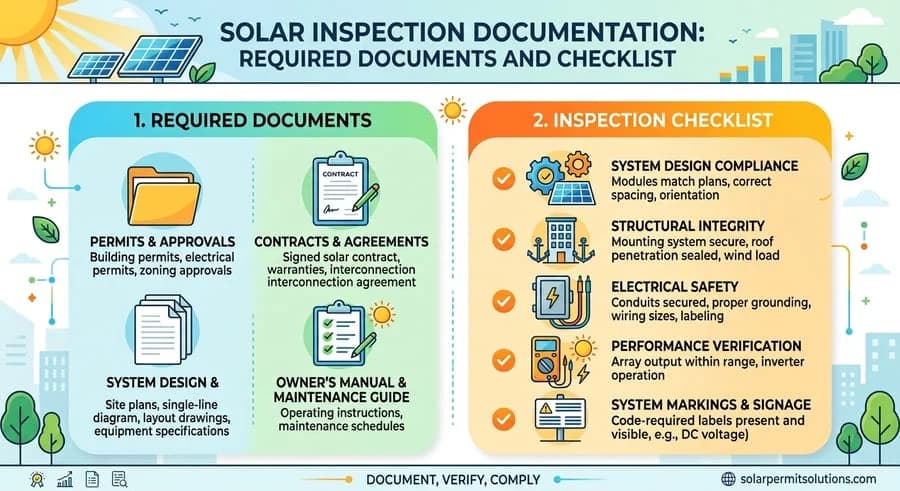
Solar Inspection Documentation: Required Documents and Checklist
Learn about solar inspection documentation, including permit requirements, NEC c...
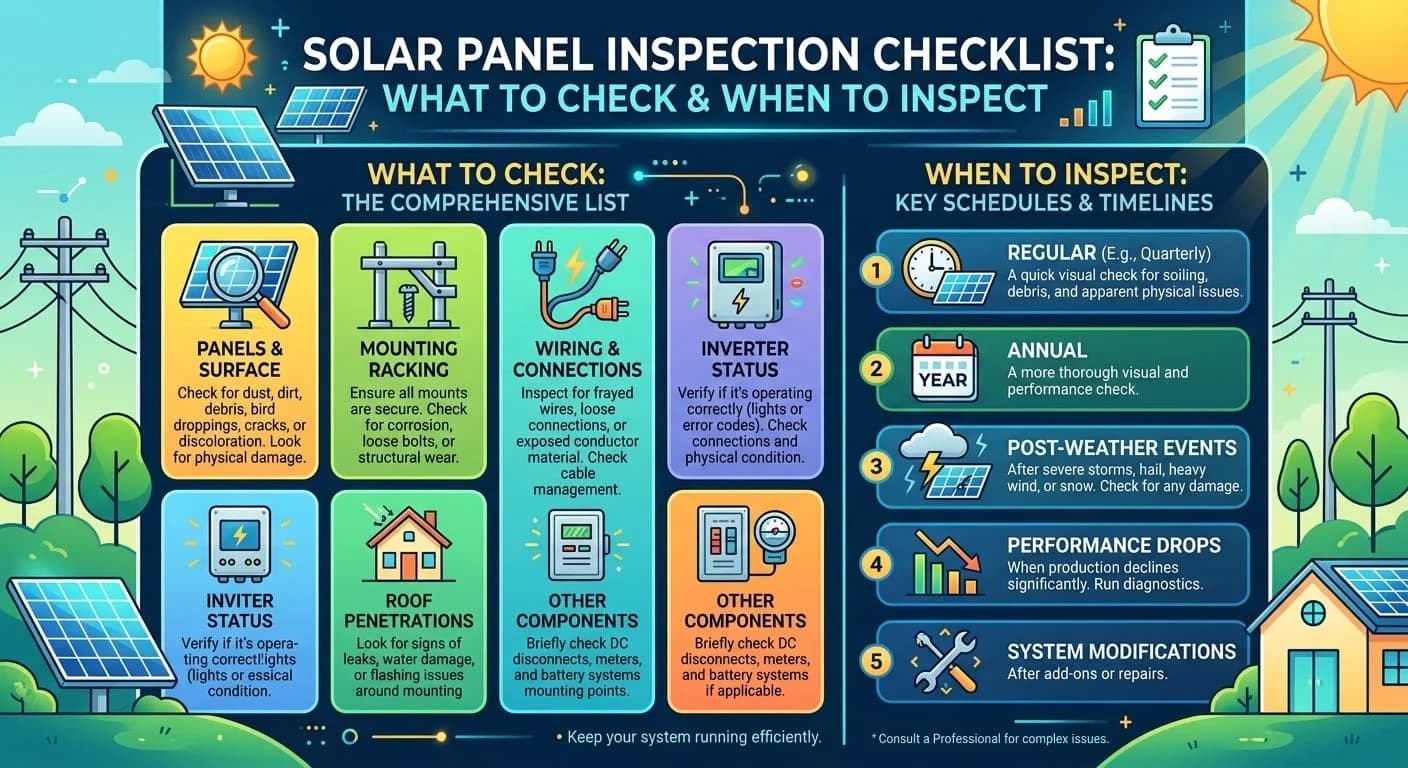
Solar Panel Inspection Checklist: What To Check & When To Inspect
Solar panel inspection guide: Learn what to check, when to inspect (annually + e...