
Solar panel warranties include three coverage types: product warranties (12–40 years) that protect against manufacturing defects, performance warranties (25–30 years) that guarantee 80–92% power output retention, and labor warranties that cover replacement costs (typically sold separately). In 2026, the strongest installer-facing programs come from Maxeon (40-year comprehensive coverage), REC Solar’s ProTrust (25-year product, performance, and labor with 0.25% annual degradation), and Silfab (30-year performance warranty). Understanding these three layers — and which manufacturers still honor them after recent exits by LG, Panasonic, and SunPower — is essential for protecting both customer investments and installer liability.
Quick Answer: What You Need to Know
- Product warranty range: 12-40 years (covers defects and materials)
- Performance warranty range: 25-30 years (guarantees 80-92% output retention)
- Industry changes: LG (exited 2022), Panasonic (discontinued 2025), and SunPower (bankrupt 2024) no longer manufacture panels but honor existing warranties
- Labor coverage: Typically NOT included in standard warranties; available separately through programs like REC ProTrust
- Top active manufacturers: Q CELLS, REC Solar, Silfab, Canadian Solar, Jinko Solar, and Trina Solar
A solar installation represents a substantial financial commitment, frequently reaching into tens of thousands of dollars. Since solar panels typically account for the largest portion of a photovoltaic system’s cost, securing comprehensive solar panel warranty coverage becomes critical for safeguarding your long-term investment. These modules operate in demanding environments, enduring extreme temperatures, freezing conditions, hailstorms, strong winds, and continuous ultraviolet radiation exposure, though quality solar panels demonstrate impressive durability.
Drawing from over a decade of expertise in solar engineering and permitting, Solar Permit Solutions has witnessed firsthand how robust solar panel warranty protection shields both property owners and contractors from unexpected expenses. This comprehensive guide compares warranties from 10 major manufacturers, explains what coverage includes, identifies common warranty-voiding actions, and helps solar installers select equipment with superior protection programs that deliver confidence to clients.

Understanding Solar Panel Warranties
A solar panel warranty represents a manufacturer’s commitment to cover defects and performance concerns. These guarantees typically span 10 to 25 years, ensuring customers that their photovoltaic modules will meet established performance benchmarks according to industry testing standards. This warranty protection includes repair or replacement services for problems occurring within the coverage period, functioning as essential consumer safeguarding.
Residential solar arrays typically feature warranties designed to protect property owners against premature module failure or insufficient energy production. For those new to solar energy, understanding warranty coverage helps ensure informed purchasing decisions. Commercial photovoltaic installations generally include more extensive warranty provisions, corresponding to the larger system scale and capital expenditure. Coverage can extend to performance metrics, inverter replacement services, and installation quality assurance.
Premium photovoltaic modules generally provide extended product warranties alongside superior power output assurances. Numerous solar providers market both economy and premium panel options, allowing customers to select based on their priorities. The primary distinctions between economy and premium modules typically involve solar panel efficiency ratings and warranty terms.
Solar Panel Warranty Categories
Three distinct warranty categories exist for solar panel coverage, making comprehension of each type essential when selecting products offering optimal solar panel warranty protection. Property insurance presents an additional option for covering damage from weather events, fires, or vandalism, which falls outside typical solar panel warranty claim parameters as outlined by the Federal Trade Commission’s warranty guidelines.
Performance Warranty (Output Guarantees)
Photovoltaic modules continuously face environmental exposure, potentially causing reduced efficiency in converting solar radiation to electricity over time through light-induced degradation.
Solar panel warranty packages typically incorporate power output assurances guaranteeing modules maintain specific percentages of their original production capacity across designated timeframes. A standard guarantee promises panels will deliver no less than 90% of their baseline capacity for 10 years and 80% for 25 years, according to manufacturer specifications.
Solar panel warranties frequently differ among product lines from identical manufacturers, with certain models receiving improved terms. The Jinko Tiger N-type panel, for instance, includes a power output guarantee spanning 30 years, attributable to its reduced light-induced degradation rate. This prolonged warranty exceeds the standard 25-year coverage available for other Jinko products, positioning it among superior solar panel warranty offerings.
Decoding Solar Performance Guarantees
Interpreting how a solar panel warranty’s performance guarantee functions can prove challenging. The guarantee is typically expressed as a percentage of nominal power during the initial year, followed by annual power reduction up to a specified percentage.
Q Cells, for example, guarantees 98% nominal power during year one, with nominal output decrease not exceeding 0.5% annually from years 2 through 25. When calculating this solar panel warranty, recognize that the year-one nominal power calculation differs from years 2 through 25. Consequently, the minimum nominal power after 25 years equals 86%. The calculation: 0.86 = 0.98 – (24 x 0.005)
For nominal power output after 11 years: 0.93 = 0.98 – (10 x 0.005)
Remember that solar panels sometimes underperform due to cleaning requirements, which doesn’t constitute a solar panel warranty concern. Heavily contaminated modules can generate less electricity when solar radiation gets obstructed.
Solar Panel Warranty: Product and Materials Coverage
These warranties address solar panel structural integrity and provide protection against manufacturing defects certified by UL safety standards. While most leading module producers provide equipment warranties spanning at least 10 or 12 years, numerous premium panel manufacturers or product lines deliver extended protection, including 20-year or 25-year warranties.
Manufacturers have progressively extended product warranty durations. A decade ago, 25-year product warranties were uncommon. Currently, they represent standard offerings. Note that warranty terms may vary across different models from the same manufacturer. Solar panel warranty duration often differs, with certain panels receiving longer coverage than others. High-performance models sometimes feature extended warranty periods.
Several solar module manufacturers deliver flexible warranty arrangements, simplifying the process of identifying the best solar panel warranty for specific requirements. Silfab provides a baseline 12-year warranty on solar panels with an extension option to 25 years when utilizing a registered and approved Silfab solar installer. Similarly, REC delivers a 20-year solar panel warranty for all installers and a 25-year product warranty for REC-certified contractors.
Solar Panel Warranty Comparison by Manufacturer
Canadian Solar
Product Warranty: 12 years (standard models), 25 years (select premium models including HiKu, HiDM, and TOPCon series)
Performance Warranty: 25-30 years depending on model. Standard models maintain 80-83.1% output at 25 years with 0.6-0.7% annual degradation. Premium models with 30-year warranties show improved retention.
Status: Active manufacturer; has been upgrading select models to 25-year product warranty since 2021
Learn more: Canadian Solar Warranty Information
Jinko Solar
Product Warranty: 12 years (standard models), 15-20 years (premium N-type models like Tiger Neo), 25 years (select markets/models)
Performance Warranty: 25 years (standard P-type models), 30 years (Tiger N-type series). P-type models maintain 83.1% at 25 years with 0.62% annual degradation. Tiger N-type maintains 87.4% at 30 years with 0.4% annual degradation.
Status: Active manufacturer; Tiger N-type series offers exceptional 30-year performance warranty
Learn more: Jinko Solar Warranty Documentation
LG Solar
Product Warranty: 25 years
Performance Warranty: 25 years, maintaining 88.4% (NeON R series) with approximately 0.48% annual degradation
Status: ⚠️ EXITED June 2022 – Still honoring all warranties for existing customers
Learn more: LG Solar Support Information
Panasonic
Product Warranty: 25 years (includes labor with AllGuard/TripleGuard)
Performance Warranty: 25 years. Standard models maintain 86% at 25 years; premium models maintain up to 92% at 25 years with 0.25-0.50% degradation depending on the model.
Status: ⚠️ DISCONTINUED April 28, 2025 – Committed to warranty support for existing customers and installations in progress
Contact: panasonicsolar@us.panasonic.com
Learn more: Panasonic Solar Support
Q CELLS (Hanwha Q CELLS)
Product Warranty: 12 years (commercial/standard models), 25 years (premium residential models including Q.PEAK DUO BLK-G10+, Q.TRON)
Performance Warranty: 25-30 years. Q.PEAK DUO maintains 86% at 25 years (98% year 1, then a maximum 0.5% annual decline in years 2-25). Q.TRON maintains 90.58% at 25 years. Bifacial models maintain 88% at 30 years.
Status: Active manufacturer; most popular brand in US residential solar
Learn more: Q CELLS Warranty Information
REC Solar
Product Warranty: 20 years (standard for all installers), 25 years (REC ProTrust program with REC-certified installers)
Performance Warranty: 25 years (all models maintain 98% in year 1). Alpha Pure series maintains 92% at 25 years with only 0.25% annual degradation. TwinPeak 5 series maintains 86% at 25 years with 0.5% annual degradation.
Additional Coverage: ProTrust includes 25-year labor warranty for systems under 25kW installed by certified contractors
Status: Active manufacturer with industry-leading low degradation rates
Learn more: REC Solar Warranty
Silfab Solar
Product Warranty: 12 years (standard), 25 years (when installed by registered and approved Silfab installers)
Performance Warranty: 30 years, maintaining 82.6% at 30 years with 0.5% annual degradation
Status: Active manufacturer; North American manufacturing; offers the industry’s longest performance warranty at 30 years
Learn more: Silfab Warranty Information
Solaria
Product Warranty: 25 years (standard), 30 years (PowerXT series)
Performance Warranty: 30 years (PowerXT 400 Series)
Additional Coverage: PowerXT series includes comprehensive 30-year warranty covering parts, power, and labor
Status: Active manufacturer; PowerXT upgraded to 30-year comprehensive coverage in March 2022
Learn more: Solaria Warranty Details
Maxeon Solar (formerly SunPower)
Product Warranty: 40 years
Performance Warranty: 40 years, maintaining 92% at 25 years and 88.3% at 40 years with 0.25% annual degradation
Status: ⚠️ SUNPOWER BANKRUPT August 5, 2024 – Maxeon Solar Technologies (independent since 2020) honors warranties for SunPower-branded Maxeon-manufactured panels. The registration deadline was December 31, 2024.
Learn more: Maxeon Warranty Support | SunPower Legacy Warranty
Trina Solar
Product Warranty: 12 years (standard), 25 years (TrinaProtect program for residential modules)
Performance Warranty: 25 years (standard), 30 years (bifacial models). Standard models maintain 83.1% at 25 years with 0.55% annual degradation. Premium models maintain 87% at 30 years with 0.4% annual degradation. Vertex S+ bifacial maintains 89% at 25 years with 25-year product warranty.
Special Feature: TrinaProtect 25/25 warranty applies automatically at purchase with no registration, exclusivity, or training requirements
Status: Active manufacturer; straightforward warranty process
Learn more: Trina Solar Warranty Information
Solar Permit Solutions
Solar Contractor? We Design Your Plans.
Outsource your permit plan sets to our team. PE-stamped, code-compliant, fast turnaround so you can focus on installation.
Understanding Labor Coverage in Solar Panel Warranties
Most solar panel warranties focus primarily on equipment protection but frequently omit labor expenses tied to module replacement. Repairing solar installations involves considerable complexity, as qualified technicians must safely access rooftops, extract damaged panels, and properly install replacements, resulting in substantial labor charges. Proper solar panel racking and mounting systems are essential for safe access during warranty service.
Numerous solar manufacturers and installers provide standalone labor warranty options, typically spanning 1 to 10 years of coverage. Property owners and commercial clients should carefully evaluate labor warranty provisions during the purchasing process, as comprehensive protection including labor represents optimal solar panel warranty coverage by offsetting unforeseen repair costs.
Coverage Included in Solar Panel Warranties
Solar panel warranties generally address manufacturing defects and early-stage light-induced degradation issues. When warranty claims arise, manufacturers typically resolve them through one of three methods: repairing the defective component, providing a replacement panel, or issuing a refund equivalent to the module’s original purchase price. This protection safeguards consumers against unexpected complications that could compromise their solar energy investment.
Proper installation practices remain essential for preserving warranty validity. Professional residential solar design services ensure that mounting systems meet the wind load specifications for your project location, helping prevent panel damage. Accurate diagnostics also prove crucial, determining whether problems originate from the solar panels themselves or from associated components like inverters or power optimizers. Understanding electrical fundamentals helps identify the root cause of system issues.
Common Actions That Void Solar Panel Warranties
Multiple circumstances can invalidate solar panel warranty protection, leaving customers vulnerable to defects or performance failures without recourse. Avoiding common solar permit design mistakes helps maintain warranty validity from the start.
Key warranty-voiding scenarios include:
Installation Errors: Panels installed contrary to manufacturer guidelines can nullify warranty coverage. This encompasses using non-approved mounting hardware or incorrect electrical connections. Following proper solar permitting requirements and local building codes ensures compliant installations that maintain warranty protection.
Insufficient Maintenance: Failing to perform routine solar system upkeep, including panel cleaning and damage inspections, may create problems excluded from warranty protection. System neglect can reduce efficiency while simultaneously voiding coverage.
Weather-Related Damage: Harm from severe weather conditions, including hurricanes, hailstorms, or flooding, might void warranty protection, particularly when installations lack appropriate safeguarding or reinforcement. Engineering calculations verified through independent third-party testing laboratories ensure adequate structural protection.
Unauthorized Alterations: Making unapproved modifications or repairs to solar equipment can invalidate warranty terms. When non-authorized technicians attempt system repairs or alterations, warranty coverage may be forfeited. Those considering DIY solar installations should carefully review warranty implications before proceeding.
Registration Failures: Certain manufacturers mandate warranty registration within specified timeframes. Missing these registration deadlines can result in complete warranty invalidation.
Intentional Damage: Harm resulting from vandalism or deliberate acts typically falls outside warranty parameters. Coverage excludes intentional destruction and theft of solar panels.
Solar Panel Warranty Cost Considerations
Warranty protection comes included with solar panel purchases at no additional charge. Extension options exist but remain uncommon for solar panels, though more prevalent with inverter warranties.
A more typical scenario involves customers needing to expand their homeowners insurance coverage, which may modestly affect insurance premium rates according to insurance industry data. When filing homeowners insurance claims, customers must first satisfy their policy deductible.
For instance, with a $500 deductible and $3,000 in hail damage to a solar system, insurance coverage would apply to $2,500 of the total loss, leaving the homeowner responsible for the remaining $500 deductible amount. Understanding whether you’ll need a different meter after going solar also affects insurance and warranty considerations.
Conclusion
Understanding solar panel warranties represents a critical component of any successful solar installation project. With product warranties ranging from 12 to 40 years and performance warranties guaranteeing 80-92% output retention after 25 years, manufacturers demonstrate varying levels of commitment to long-term quality and customer protection.
The solar industry landscape has shifted significantly, with major players like LG, Panasonic, and SunPower exiting the market. These changes underscore the importance of selecting manufacturers with strong financial stability and Bloomberg Tier 1 bankability ratings. Currently active brands, including Q CELLS, REC Solar, Silfab, Canadian Solar, Jinko Solar, and Trina Solar, continue offering robust warranty programs backed by operational manufacturing capabilities.
For solar installers and contractors, warranty knowledge provides a competitive advantage when educating clients about equipment selection. The best solar panel warranty combines comprehensive product coverage and strong performance guarantees with minimal degradation rates and labor protection. Premium options like REC’s ProTrust program, Maxeon’s 40-year coverage, and Silfab’s 30-year performance warranty demonstrate industry-leading protection that delivers genuine peace of mind.
Beyond warranty duration, installers should emphasize proper installation practices, regular maintenance requirements, and registration procedures to ensure warranty validity. Labor warranties, though often overlooked, can save thousands of dollars in unexpected repair costs over a system’s lifetime. Whether working on projects in Los Angeles, Riverside County, Columbus, or Arizona, understanding local requirements alongside warranty terms ensures comprehensive protection.
As solar technology continues advancing and the industry matures, warranty programs will remain essential safeguards protecting both installer reputations and customer investments. Staying informed about manufacturer warranty terms, understanding coverage limitations, and selecting financially stable partners positions solar professionals to deliver superior value while minimizing long-term risk.
At Solar Permit Solutions, our expertise in solar engineering and permitting includes helping installers navigate warranty requirements, equipment specifications, and compliance standards that ensure successful project outcomes and satisfied customers.
FAQs
A performance warranty (also called a power output warranty) guarantees that your solar panels will maintain a minimum percentage of their original power output over time. Most manufacturers guarantee panels will retain at least 80-86% of their original capacity after 25 years, with premium brands like REC Alpha Pure and Maxeon guaranteeing 92% retention. Performance warranties account for natural degradation from light exposure and environmental conditions.
Among fully operational manufacturers, REC Solar’s ProTrust program and Silfab Solar provide exceptional coverage. REC offers 25-year product and labor warranties with only 0.25% annual degradation (92% at 25 years) for their Alpha Pure series when installed by certified contractors. Silfab provides the longest performance warranty at 30 years, while Solaria’s PowerXT series offers 30-year comprehensive coverage, including parts, power, and labor.
The “best” warranty depends on your specific needs: longest duration (Maxeon/Silfab), lowest degradation (REC Alpha Pure), or most comprehensive installer support (REC ProTrust). For utility-specific guidance, see our guide on how to go solar with SDG&E.
For SunPower’s bankruptcy, Maxeon Solar Technologies (which manufactured many SunPower panels) stepped in to honor warranties for Maxeon-manufactured panels, though customers needed to register by December 31, 2024.
Some manufacturers secure their warranties through third-party insurance policies (like Canadian Solar’s 25-year insurance-backed warranty) that provide coverage even if the company ceases operations. When evaluating solar panels, consider the manufacturer’s financial stability, Bloomberg Tier 1 bankability rating, and whether warranties are insurance-backed. Homeowners insurance may also cover certain types of damage, providing an additional layer of protection.
However, several manufacturers offer enhanced warranty programs that include labor coverage:
- REC ProTrust: Includes 25-year labor warranty for systems under 25kW installed by REC-certified contractors
- Panasonic AllGuard/TripleGuard: Covered labor costs for authorized installations (discontinued April 2025)
- Solaria PowerXT: Includes labor coverage in their 30-year comprehensive warranty
- Q CELLS: Offers labor reimbursement for Q.PARTNERS with qualifying claims
Separate labor warranties are also available through some installers, typically ranging from 1-10 years. Installers should clearly communicate whether labor is included in warranty coverage and consider offering extended labor warranties as added value for customers. Those interested in educational resources about solar can learn more about warranty considerations before installation.
Improper Installation: Installing panels contrary to manufacturer specifications, using non-approved mounting equipment, or making incorrect electrical connections voids warranties. Always follow installation manuals precisely and use certified installers when required.
Unauthorized Modifications: Having non-authorized technicians perform repairs or making system alterations without manufacturer approval immediately voids coverage. Always contact the manufacturer or authorized service providers for repairs.
Failure to Register: Many manufacturers require warranty registration within 30-90 days of installation. Missing this deadline can completely void your coverage, so register immediately after installation.
Inadequate Maintenance: While solar panels require minimal maintenance, complete neglect, allowing debris buildup, failing to inspect for damage, or ignoring performance issues can void warranties.
Environmental Factors: Installing panels without proper wind load calculations, inadequate protection from extreme weather, or in locations with excessive salt exposure or chemical contamination can void coverage.
Physical Damage: Warranties typically exclude damage from vandalism, theft, acts of war, power surges, lightning strikes, and natural disasters unless specifically covered under separate insurance policies.
To maintain warranty validity, follow manufacturer installation guidelines, use certified installers, register promptly, perform routine inspections, and document all maintenance activities.
Ready to ensure your solar projects have the proper engineering and permitting for warranty compliance? Contact Solar Permit Solutions today for expert support on solar design, engineering stamps, interconnection applications, and PTO processing that meets manufacturer specifications and protects your customers’ investments.
Solar Contractor? We Design Your Plans.
Outsource your permit plan sets to our team. PE-stamped, code-compliant, fast turnaround so you can focus on installation.
Frequently Asked Questions
A product warranty (also called an equipment or materials warranty) covers manufacturing defects, workmanship issues, and physical failures of the solar panel itself, including components like junction boxes, frames, and glass. These typically last 12-25 years, though some premium manufacturers offer up to 40 years.
Maxeon Solar currently offers the industry's longest warranty at 40 years for product, performance, and service coverage, maintaining 88.3% output at 40 years. However, since SunPower's bankruptcy in August 2024, Maxeon only covers SunPower-branded panels they manufactured.
This depends on several factors. When LG exited solar manufacturing in 2022, they committed to honoring all existing warranties and maintaining inventory for replacements. Similarly, Panasonic discontinued solar operations in April 2025 but pledged continued warranty support for existing customers.
Most standard solar panel warranties cover only the equipment itself and do not include labor costs for removing damaged panels, shipping, or installing replacements. Labor expenses can be significant, as repairs require trained technicians to safely access rooftops and properly install new modules.
Several common mistakes can invalidate solar panel warranty protection:

SPS Editorial Team
Solar Permit Solutions
Solar Permit Solutions provides professional solar permit design services for residential, commercial, and off-grid installations across all 50 states. Our team ensures permit-ready plan sets delivered fast.
Related Articles
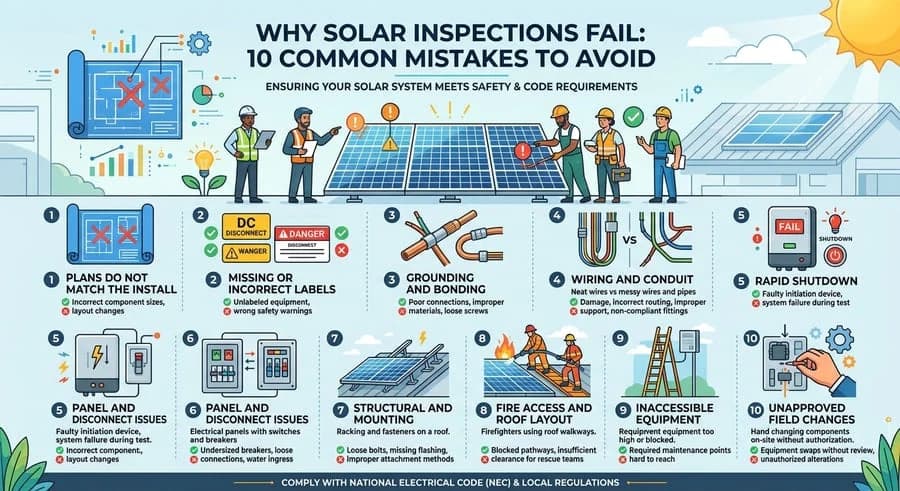
Why Solar Inspections Fail: 10 Common Mistakes to Avoid
Discover the 9 critical reasons solar inspections fail and how to avoid costly m...
Solar Grounding And Bonding: How To Pass Inspection Every Time
Learn how to pass solar grounding and bonding inspections every time. Avoid comm...
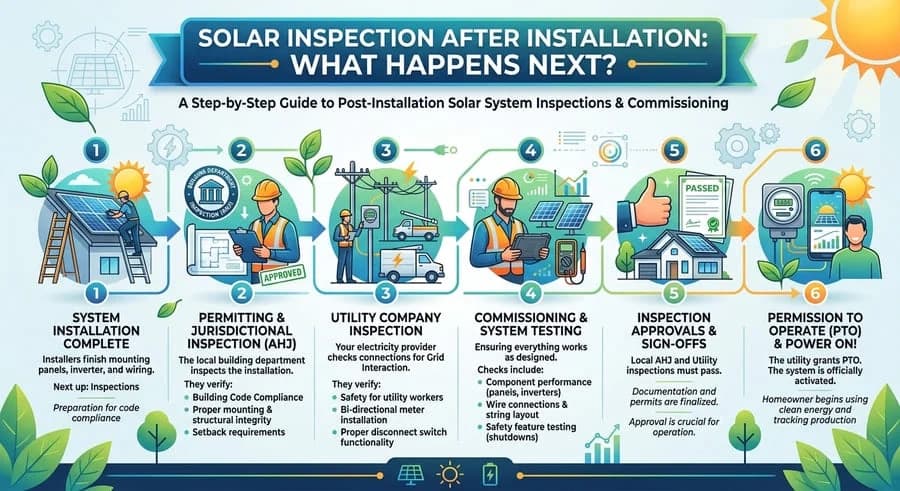
Solar Inspection After Installation: What Happens Next?
Learn how to pass your solar inspection by following essential tips for obtainin...