
Georgia solar permits are required for every residential and commercial solar installation in the state – no size exemptions, no grandfathering, and no self-installation exception for most homeowners. Permits are issued by local Authorities Having Jurisdiction (AHJs): your county or city building department, not a state agency. As of January 1, 2026, Georgia’s mandatory statewide electrical code is NEC 2023 with 2026 Georgia Amendments, adopted by the Georgia Department of Community Affairs. PE-stamped engineering plans are required for virtually all grid-tied systems regardless of size. Residential permits typically take 2-4 weeks; a professional plan set takes 1-2 business days.
Georgia Solar Permit Quick Facts (2026)
| Topic | Key Fact |
|---|---|
| Electrical code | NEC 2023 with 2026 Georgia Amendments – mandatory statewide as of January 1, 2026 (Georgia DCA) |
| Who issues permits | Local AHJ (county or city building department) – no statewide permit exists |
| PE stamp required? | Yes – for virtually all grid-tied residential and commercial installations; Georgia has no kW exemption threshold |
| Residential timeline | 2-4 weeks standard; 1-5 business days under Athens-Clarke County expedited program |
| Plan set turnaround | 1-2 business days through a professional permit design service |
| Georgia Power interconnection | Separate from building permit; applied via PowerClerk after AHJ inspection passes |
| Solar Buy Back (RNR) rate | ~7.2¢/kWh for 2026 (3.2188¢ base + 4¢ PSC adder); retail rate ~13¢/kWh |
| Federal ITC status | Section 25D eliminated for cash purchases after December 31, 2025 (Big Beautiful Bill, July 4, 2025); leased/PPA systems retain access to Section 48E through end of 2027 |
Do I need a permit for solar in Georgia?
Yes. Every solar installation in Georgia requires a building permit and electrical permit from the local AHJ. There is no statewide size exemption, no DIY exception for most homeowners, and no grandfather clause for existing properties.
Installing without a permit carries serious consequences: the AHJ can order the system removed, your homeowner’s insurance may deny claims related to the installation, and the Georgia Power interconnection application will not be approved without evidence of a passed AHJ inspection. Title complications during a property sale are also common when solar work is unpermitted.
Why Solar Permits Are Required in Georgia
Solar permits exist to protect public safety. A photovoltaic system introduces a second power source onto a building’s structure and connects to the utility grid, creating potential hazards if the system is improperly designed or installed. Georgia’s local building departments review permit plans to confirm the following:
- The roof or ground structure can safely support the added weight and wind loads per ASCE 7 design standards for the specific Georgia location
- All electrical wiring and connections meet the National Electrical Code edition the jurisdiction has adopted
- Fire department access pathways are maintained on the roof per the locally adopted International Fire Code
- Rapid shutdown systems comply with NEC 690.12 to protect first responders
- The system will not create grid stability hazards for utility workers
Who Issues Solar Permits in Georgia? (AHJs, Not the State)
Georgia has no statewide solar permitting authority. Each county, city, or consolidated government operates its own building department and sets its own requirements. For a deeper look at how AHJs evaluate submissions, see our guide on what is an AHJ in solar. This means the plan set format that earns first-pass approval in Athens-Clarke County may generate a stack of redlines in Savannah, even if the underlying system is identical. Confirming requirements with your specific AHJ before starting plan set design is the single most important step in the Georgia permitting process.
Key insight: Georgia’s permitting landscape is a patchwork, not a unified system. Always call the local building department before submitting plans. Requirements vary not just by county but sometimes by project type within the same county.

What Georgia AHJs Require in a Solar Permit Plan Set
A solar permit plan set is the collection of engineering drawings, calculations, and documentation the AHJ needs to verify code compliance. For a full national breakdown of what every plan set must contain, see our solar permit design guide. While exact requirements vary by jurisdiction, most Georgia building departments require the following core components for residential rooftop solar installations:
| Plan Set Component | What Georgia AHJ Reviewers Check |
|---|---|
| Cover sheet | Project address, contractor license number, NEC edition referenced, PE stamp |
| Site plan & array layout | Accurate roof dimensions, fire setback distances, panel placement, obstructions |
| Electrical single-line diagram | Full circuit path from modules to utility meter; rated equipment labels |
| Structural calculations | Roof load analysis signed by a licensed Georgia PE; ASCE 7 wind and snow loads |
| NEC calculations | Conductor sizing, 120% busbar rule (NEC 705.12), voltage drop, overcurrent protection |
| Equipment datasheets / BOM | Active UL listings for every component: panels, inverter, racking, disconnects |
| Rapid shutdown documentation | Specific equipment identified; NEC 690.12 compliance confirmed |
| Safety labels / placards | All NEC 690.56 / 705.10 required labels shown with exact wording and location |
| Septic approval (Fayette County) | Signed Environmental Health approval required for all roof/ground mounts. |
Commercial and ground-mount systems require additional documentation, including three-line electrical diagrams, full geotechnical or foundation engineering for ground mounts, and, in some jurisdictions, a separate fire department review.
Which NEC Edition Does Georgia Enforce?
Georgia adopted the NEC 2023 with 2026 Georgia State Amendments as the mandatory statewide electrical code, effective January 1, 2026. This was enacted by the Georgia Department of Community Affairs (DCA) Board and applies to all jurisdictions in the state for permits submitted on or after January 1, 2026. Plan sets for Georgia solar projects submitted in 2026 must reference NEC 2023 with 2026 Georgia amendments.
This is a significant change from the NEC 2020 that Georgia previously enforced. Key differences affecting solar permit design include revised rapid shutdown marking requirements under NEC 690.12(D), consolidated power source identification rules under Article 705.10, and the new carport/canopy exemption from rapid shutdown. Review the full NEC 2023 Article 690 changes for installers before preparing plan sets for any Georgia jurisdiction.
Note on Savannah: The City of Savannah’s published permitting checklist still references the 2012 IRC and 2014 NEC. This checklist is significantly outdated. The statewide NEC 2023 adoption supersedes it. Always verify directly with Savannah’s Development Services Department, and reference the current Georgia DCA mandatory code list on your plan set cover sheet.
PE Stamp Requirements for Georgia Solar Permits
A licensed Professional Engineer (PE) stamp certifies that the structural and/or electrical plans meet applicable codes. In Georgia, PE-stamped plans are required for virtually all grid-tied solar installations. The PE must hold a current license in the State of Georgia, an engineer licensed in another state cannot stamp plans for a Georgia project.
Georgia does not have a statewide kW threshold that exempts small residential systems from the PE stamp requirement the way some other states do. Even a small 5 kW rooftop system typically requires PE-stamped structural calculations and, in most jurisdictions, PE-stamped electrical plans.
Professional plan set services that offer all-50-state coverage work through networks of partner PEs licensed in each state, including Georgia. This is the most efficient option for contractors working across multiple Georgia jurisdictions without an existing engineering relationship in the state.
Georgia Solar Permitting Process: Step by Step
While exact workflows vary by AHJ, the following sequence reflects the standard residential solar permitting process across most Georgia jurisdictions. For a national comparison of how long solar permitting takes by state, including Georgia’s typical timelines, see our dedicated guide.
1. Contact your local AHJ before designing anything. Confirm the required NEC edition, whether online submission is accepted, any jurisdiction-specific formatting requirements, and current review timelines. This single step prevents the majority of first-submission rejections.
2. Conduct a site assessment. Gather roof measurements and photos, existing electrical panel data (busbar rating, main breaker size, available spaces), attic or truss photos showing rafter spacing and size, and a shading analysis. For ground-mount systems, obtain a site survey with property boundaries.
3. Design the system. Select equipment and configure the array layout using tools like HelioScope, Aurora Solar, or OpenSolar. Determine string configuration, inverter sizing, conductor routing, and interconnection method (load-side or supply-side) based on the existing Georgia Power or EMC electrical service.
4. Prepare the permit plan set. Translate the system design into the full set of engineering documents: site plan, single-line diagram, structural calculations, NEC calculations, equipment datasheets, and a label schedule. For most Georgia jurisdictions, this also means arranging PE review and stamping.
5. Submit to the AHJ. Most Georgia jurisdictions now accept digital submissions. Fayette County uses SagesGov; Savannah uses eTRAC; Athens-Clarke County has its own online portal. Include all required fees at submission; missing fees cause automatic rejection at many Georgia AHJs before technical review begins.
6. Respond to plan check comments (if any). The AHJ issues redlines detailing required corrections. Professional plan set services typically handle revisions within 12-24 hours. Each revision cycle adds 1-4 weeks to the timeline depending on the AHJ’s resubmission queue.
7. Obtain building permit and install. Once the AHJ approves the plans and issues the building permit, installation proceeds exactly as specified in the approved documents. Any deviation, changing inverter models, moving panels, or altering wiring routes may require a permit amendment.
8. Pass final inspection. The AHJ inspector verifies the physical installation matches the approved plans. In Georgia, inspectors cross-reference installed labels against the label schedule in the plan set. All seven required NEC 690 / 705.10 label locations must be present and correctly formatted.
9. Apply for utility interconnection. Submit the interconnection application to Georgia Power (via PowerClerk) or your EMC. This is a separate process from the building permit and is covered in detail in the Georgia Power Interconnection section below.
Solar Permit Solutions
Skip the Permit Headaches
We design plan sets that pass inspection the first time. Code-compliant, PE-stamped, accepted by AHJs nationwide.
How Georgia Solar Permitting Varies by Jurisdiction
Georgia has over 150 county governments and hundreds of municipal building departments, each operating independently. The table below covers the major jurisdictions most solar contractors and homeowners encounter, based on publicly available AHJ documentation.
| Jurisdiction | Online Portal | NEC Edition | PE Stamp Required? | Typical Residential Timeline |
|---|---|---|---|---|
| Atlanta / Fulton County | Atlanta Permits Online | NEC 2023 w/ 2026 GA Amendments (eff. Jan 1, 2026) | Yes | 2–4 weeks |
| Savannah | eTRAC | NEC 2023 w/ 2026 GA Amendments (eff. Jan 1, 2026) — verify with AHJ; published checklist was outdated | Yes | 2–4 weeks + historic review if applicable |
| Athens-Clarke County | Accela / online portal | NEC 2023 w/ 2026 GA Amendments (eff. Jan 1, 2026) | Yes | Expedited program available; 1–5 business days |
| Fayette County | SagesGov | NEC 2023 w/ 2026 GA Amendments (eff. Jan 1, 2026) | Yes | Standard review; 2–3 weeks |
| DeKalb County | Department portal | NEC 2023 w/ 2026 GA Amendments (eff. Jan 1, 2026) | Yes | 2–4 weeks |
| Cobb County | Cobb County portal | NEC 2023 w/ 2026 GA Amendments (eff. Jan 1, 2026) | Yes | 2–3 weeks |
Important: NEC edition data in this table reflects publicly available information as of early 2026. Adoption cycles change. Always verify directly with the building department before submitting plans.
Atlanta and Fulton County
Atlanta and unincorporated Fulton County operate separate permit processes, but both follow the statewide NEC 2023 with 2026 Georgia Amendments adoption. For Office of Buildings submission requirements, Solar PV Express vs. Light Commercial permit paths, Fire Rescue review thresholds, and current fee schedules, see our complete Atlanta solar permit design guide.
City of Savannah – Historic District Overlay
Savannah’s permitting process includes a critical layer that exists in few other Georgia jurisdictions: the historic district overlay. Properties within the Landmark Historic District, the Victorian District, and the Mid-City/Cuyler-Brownsville Phase I area require a Certificate of Appropriateness (COA) from the Historic Preservation Secretary before a building permit can be issued for any exterior change visible from the public right-of-way – including rooftop solar panels.
The COA application goes to the Metropolitan Planning Commission (MPC). Minor items may be approved by preservation staff; more complex installations require full Board of Review action. The additional review can add 4-8 weeks to the total permitting timeline for historic district properties. Contact the Savannah Historic Preservation Secretary at (912) 651-1457 early in the project to determine if a COA is required.
Additionally, Savannah requires that tree trimming or removal needed to improve solar access must be reviewed by the Park and Tree Department before work begins.
Athens-Clarke County – Expedited Permitting
Athens-Clarke County has developed an expedited permitting process for residential solar PV systems. ACC’s program is designed to reduce standard review timelines to as few as 1-5 business days for qualifying systems. This aligns with the SolarAPP+-style streamlined permitting approach being adopted in progressive Georgia jurisdictions. Verify current program availability and eligibility criteria with the ACC Unified Government Building Inspections Department.
Fayette County – Unique Requirements
Fayette County has two requirements that catch installers off guard who are used to working in other Georgia jurisdictions. First, a signed approval from the Environmental Health Department is required for all solar permits, both roof mount and ground mount, even when no septic work is involved. Second, applicants must also contact the Environmental Management Department if any clearing, grading, or land disturbance is planned. Both approvals must be obtained before the online permit application can be submitted through SagesGov.
Georgia Power Solar Interconnection: How It Works
The interconnection agreement is a separate but related process to the building permit. For a complete walkthrough of what every interconnection application requires nationwide, see our solar interconnection agreement checklist and guide. The AHJ permit authorizes the physical installation; the Georgia Power interconnection authorization allows the system to connect to the utility grid and export power.
Georgia Power processes all residential rooftop solar interconnection applications through its online PowerClerk system. The solar contractor typically submits and manages the application as a courtesy to the customer. Here is the full sequence:
| Step | Phase | What Happens |
|---|---|---|
| 1 | Application Submission (PTI) | Installer submits application through Georgia Power’s PowerClerk system on your behalf. You receive email updates at each stage. |
| 2 | Utility Technical Review | Georgia Power reviews system size, equipment specs, and grid impact. Systems ≤10 kW AC on standard residential service typically qualify for a simplified review. |
| 3 | PTI Issued | Georgia Power issues Permission to Install (PTI). Physical installation can now begin. |
| 4 | Installation & AHJ Inspection | System is installed per the approved permit plan set. Local AHJ conducts final inspection. You receive a Certificate of Occupancy or equivalent. |
| 5 | Interconnection Agreement Signed | Customer signs the Georgia Power Interconnection Agreement. Required before the system can export power. |
| 6 | Meter Upgrade / Net Meter Install | Georgia Power installs a bidirectional meter if not already present. Typical wait: 2–6 weeks after inspection. |
| 7 | PTO Granted | Permission to Operate (PTO) is issued. System is now live and eligible for the RNR Solar Buy Back program. |
EMC Customers: A Different Interconnection Process
Approximately 40% of Georgia’s electricity customers are served by Electric Membership Cooperatives (EMCs) rather than Georgia Power. EMC customers, served by utilities like Jackson EMC, Cobb EMC, Walton EMC, Sawnee EMC, Snapping Shoals EMC, and others, do not use the Georgia Power PowerClerk system. Each EMC has its own interconnection application process, its own net billing or buy-back rate, and its own interconnection agreement.
If your project is in an EMC service territory, contact the specific cooperative directly before designing the system. EMC interconnection timelines and rate structures vary considerably. Palmetto’s LightReach lease program, for instance, is currently available only to Georgia Power customers and not to EMC customers – a distinction that affects financing and installer selection.
Georgia Power Solar Buy Back Rate (RNR Program)
Georgia does not have a statewide full-retail net metering mandate. Georgia Power’s RNR-Instantaneous Netting (Solar Buy Back) program is the primary mechanism for residential solar customers to receive value for exported energy. For full program details and FAQs, see the Georgia Power rooftop solar FAQ page. Key terms for 2026:
- Export rate: approximately 7.2¢/kWh (3.2188¢ base Solar Avoided Cost Rate + 4¢/kWh adder approved in the 2022 rate case)
- System size cap: 10 kW AC or smaller to participate in the residential program
- Program cap: 0.2% of Georgia Power’s prior-year peak electricity demand. Enrollment is first-come, first-served; check availability before purchasing
- Unused monthly credits roll over to the following month
- Export rate is well below the retail rate of approximately 13¢/kWh (2026), which is why battery storage for self-consumption can improve the economics of a Georgia solar installation
Georgia Solar Incentives in 2026
The Georgia solar incentive landscape changed significantly in 2025. The Big Beautiful Bill, signed into law on July 4, 2025, eliminated the federal Section 25D Residential Clean Energy Tax Credit for expenditures after December 31, 2025. The IRS has confirmed this on its One Big Beautiful Bill provisions page. This means homeowners who purchase a solar system outright in 2026 can no longer claim the 30% federal tax credit. Homeowners who lease a system may still benefit indirectly, as the installer (who owns the system) can claim the commercial ITC (Section 48E) and pass savings through lower lease payments.
The following state and utility-level incentives remain available in 2026. Georgia Power’s Community Solar program is also an option for customers who cannot install rooftop panels:
| Incentive | Type | Who Qualifies | Key Details (2026) |
|---|---|---|---|
| Georgia Power RNR Solar Buy Back | Net billing credit | Georgia Power residential customers; systems ≤10 kW AC | Export rate ~7.2¢/kWh (3.2188¢ base + 4¢ adder). Below retail rate of 14.14¢/kWh. Cap: 0.2% of GP peak demand. |
| Georgia Power Community Solar | Community solar subscription | Any Georgia Power customer | $24/block/month (residential). 1 block = est. 115–215 kWh/month. No installation required. |
| Green Power EMC Cooperative Solar | Community solar subscription | EMC cooperative members | ~$19/block/month (Central Georgia EMC). Varies by cooperative. No rooftop installation required. |
| Central Georgia EMC Solar Rebate | One-time rebate | Central GA EMC residential members | $450/kW AC for systems up to 10 kW. Max $4,500 for a 10 kW system. $100 application fee. |
| GreyStone Power Solar Rebate | One-time rebate | GreyStone Power member-owners | $450/kW AC for systems up to 10 kW. Max $4,500. Licensed contractor required. |
| GEFA Solar Program | Rebate | GA cities, counties, K-12 public schools only | Up to 50% of project cost or $50,000 max. Systems up to 60 kW. |
| USDA REAP Grant | Federal grant + loan | Rural small businesses & agricultural producers | Grant: up to 50% of costs (up to $1M). Loan guarantee: up to 75%. Check current application status with USDA. |
| Federal Residential ITC (Section 25D) | Tax credit | ELIMINATED for cash purchases after Dec 31, 2025 | The Big Beautiful Bill (2025) ended the residential 30% ITC. Leased systems may still access the commercial ITC through the installer. |
For homeowners who installed solar before December 31, 2025 and need to claim the ITC on their 2025 return, the credit is filed using IRS Form 5695 (Residential Energy Credits). Consult a tax professional for guidance on carryforward rules if the credit exceeds your 2025 tax liability.
Georgia Power RNR enrollment note: The program has a statewide capacity cap. Before purchasing or signing a lease, verify with Georgia Power that enrollment slots are available in your service area. A sold-out program means you cannot export power and earn credits, which significantly changes the financial return on a solar investment.
Common Reasons Georgia Solar Permits Get Rejected
Permit rejections cost time and money. Every revision cycle adds 1-4 weeks to the project timeline. For the full national list of solar panel permit requirements and rejection reasons, see our dedicated guide. Beyond universal rejection reasons, Georgia has several jurisdiction-specific pitfalls that catch even experienced out-of-state contractors off guard.
| Rejection Reason | How to Prevent It in Georgia |
|---|---|
| Wrong NEC edition referenced | Georgia statewide adopted NEC 2023 with 2026 Georgia Amendments, effective January 1, 2026. Plan sets submitted in 2026 must reference NEC 2023. Referencing NEC 2020 or earlier will generate an automatic revision request. |
| Outdated or missing equipment datasheets | Include current manufacturer spec sheets with active UL listings for every component. Verify UL status before submission. |
| Incorrect fire setback dimensions | Use setback requirements from the locally adopted IFC edition, not a template from another jurisdiction. |
| Missing rapid shutdown documentation | Name the exact RSD equipment and reference NEC 690.12 specifically. Generic compliance statements are not accepted. |
| No PE stamp (or out-of-state stamp) | Georgia requires a PE license in Georgia. Out-of-state PE stamps are invalid regardless of the engineer’s qualifications. |
| 120% busbar rule violation | For load-side interconnections, verify that main breaker + solar breaker ≤ 120% of panel busbar rating per NEC 705.12. |
| Site plan doesn’t match satellite/GIS data | Use actual site measurements or drone survey data. AHJ reviewers cross-reference plans against county GIS records. |
| Missing safety placards / label schedule | Include a dedicated label schedule in the plan set with exact NEC-required wording for each of the 7 required label locations. |
| Savannah historic district: no COA | If the property is in the Landmark Historic District, Victorian District, or Mid-City/Cuyler-Brownsville Phase I, a Certificate of Appropriateness is required before permit approval. |
| Fayette County: missing septic approval | A signed Environmental Health Department approval is required for all roof and ground-mount solar permits in Fayette County, even if no septic work is being done. |
Solar Permit Design for Battery Storage in Georgia
Adding battery energy storage to a solar installation in Georgia requires a permit scope that goes well beyond a standard PV-only plan set. NEC Article 706 governs energy storage system (ESS) installations, and NFPA 855 (Standard for the Installation of Stationary Energy Storage Systems) adds requirements for fire safety, ventilation, spacing, and suppression, especially critical for indoor battery installations.
Georgia AHJs are still developing their ESS review processes. For commercial-scale storage projects, see our guide to commercial solar plan sets, which covers three-phase electrical diagrams and ESS documentation requirements. The additional documentation typically required for residential ESS includes:
- A battery location plan showing clearances from combustible materials and egress pathways
- Ventilation calculations for indoor installations
- Fire suppression or detection details where required by NFPA 855
- Updated electrical diagrams showing AC-coupled or DC-coupled battery integration with the PV system and the grid
- Revised NEC calculations reflecting additional circuits, overcurrent protection, and disconnects
- A complete label schedule update, never carry forward a PV-only label set to a storage project
One critical point for existing Georgia solar installations: adding battery storage to a system that was originally permitted as PV-only requires a new or amended permit. The original plan set will not cover the additional electrical circuits, disconnects, and safety documentation that a battery system introduces. Verify requirements with the local AHJ before beginning any retrofit work.
What Georgia Solar Permitting Costs
Solar permitting costs in Georgia include three distinct components: the plan set design fee, the PE stamp fee, and the AHJ permit fee. These are separate from the system hardware and installation cost. The table below summarizes typical ranges for each component.
| Cost Component | Residential (5–15 kW) | Small Commercial (25–100 kW) | Notes |
|---|---|---|---|
| PE stamp (Georgia-licensed) | $150–$400 | $400–$1,500+ | Must be licensed in Georgia. Often bundled with professional plan set services. |
| AHJ permit fee | $50–$500 | $500–$5,000+ | Varies significantly. Savannah: $8/1,000 sq ft min. $45. Fayette County: see fee schedule at sagesgov.com. |
| System cost (hardware + labor) | ~$24,814 avg. ($2.78/W) | Varies by size | Georgia average per Palmetto 2026 installation data. Excludes incentives. |
| Total permitting cost (typical) | $400–$1,400 | $1,400–$8,500+ | Permitting costs = plan set + PE stamp + permit fee. Does not include system cost. |
For context: a typical Georgia homeowner installing an 8.93 kW system pays approximately $24,814 for the complete installation (hardware + labor + permitting), based on 2026 Palmetto installation data at $2.78/W. The permitting component of that cost, plan set, PE stamp, and permit fee combined, typically represents $400-$1,400 for a standard residential project.
Rural property owners and agricultural producers may be able to offset system costs through the USDA Rural Energy for America Program (REAP), which provides grants of up to 50% of eligible project costs for qualifying rural small businesses and agricultural producers in Georgia.
Public entities such as Georgia cities, counties, and K-12 schools should also investigate the GEFA Solar Program (Georgia Environmental Finance Authority), which reimburses up to 50% of solar installation costs (maximum $50,000) for eligible governmental projects.
The payback period on a cash-purchased system in Georgia currently averages approximately 15-16 years, based on a 13¢/kWh retail rate, 5.1 peak sun hours, and the eliminated federal ITC. This payback period is longer than in states with stronger net metering policies, which is why the Georgia Power RNR program enrollment status is such a critical factor in the financial analysis.
How to Get Your Georgia Solar Permit Approved on the First Submission
First-pass approval saves time, money, and client goodwill. Based on what Georgia AHJ reviewers consistently flag, these practices lead to higher approval rates across the state:
- Reference the correct NEC edition on your plan set. Georgia statewide adopted NEC 2023 with 2026 Georgia Amendments, effective January 1, 2026. All plan sets for Georgia projects submitted in 2026 must reference NEC 2023.
- Use current, Georgia-appropriate equipment datasheets. Every component in the bill of materials panels, inverter, racking, disconnects, conduit, and wire, needs a manufacturer spec sheet with an active UL listing.
- Confirm fire setback dimensions against the locally adopted IFC edition and any local amendments. Do not use default values from another jurisdiction.
- Document rapid shutdown compliance specifically. Identify the exact RSD equipment, show it on the single-line diagram, and reference NEC 690.12 with the specific subsection. Generic statements fail. See our full guide on solar rapid shutdown compliance for the complete NEC 690.12 documentation checklist.
- Use a Georgia-licensed PE for structural and electrical stamping. Out-of-state stamps are not valid. Verify the PE’s Georgia license number before submitting.
- Include a complete label schedule. List all seven required NEC 690 / 705.10 label locations with exact wording, format specifications, code citations, and placement notes. Reviewers and inspectors use this as a checklist.
– Check whether your existing electrical panel can support the solar interconnection before finalizing the system design. Our guide to electrical panel upgrades for solar explains when a 100A or 150A panel needs upgrading and how this affects the permit package.
- For Fayette County: obtain Environmental Health Department and Environmental Management Department sign-offs before submitting the online application.
- For Savannah historic district properties: start the Certificate of Appropriateness process at least 4-6 weeks before your planned permit submission.
- Submit a complete application package. Missing pages, unsigned forms, or absent permit fees cause automatic rejection at most Georgia AHJs before technical review even begins.
Conclusion
Georgia’s solar permitting landscape is more specific, more current, and more consequential than most guides acknowledge. The rules changed meaningfully on January 1, 2026. Statewide NEC 2023 adoption replaced the patchwork of locally held NEC 2020 jurisdictions that preceded it. The federal ITC disappeared for cash buyers on December 31, 2025. Georgia Power’s solar buyback rate is set at approximately 7.2¢/kWh for 2026, well below retail. Every one of these details affects whether a plan set gets approved, whether a system is financially viable, and whether a homeowner ends up with a legal installation that passes inspection.
The contractors and installers who consistently get first-pass approval across Georgia share three habits. They verify AHJ requirements directly before starting design, not from a template used in another county. They reference the correct code (NEC 2023 with 2026 Georgia Amendments) on every cover sheet submitted in 2026. And they treat the permit package as an engineering document, not a formality, with a complete label schedule, PE-stamped calculations, and site data that matches what AHJ reviewers will check against county GIS records.
The jurisdictional quirks matter just as much as the technical ones. Savannah’s historic district overlay adds weeks to the timeline for properties in the Landmark Historic District and requires a Certificate of Appropriateness before the building permit can be approved. Fayette County’s Environmental Health sign-off requirement catches out-of-state installers on virtually every project. Athens-Clarke County’s expedited program can cut a residential timeline from weeks to days, but only for contractors who know to use it.
What Changes in 2026 Every Georgia Installer Should Know
- NEC 2023 with 2026 Georgia Amendments is now the mandatory statewide electrical code. Every plan set must reference it.
- The Section 25D residential ITC is gone for cash purchasers. Section 48E for leases and PPAs remains through the end of 2027.
- Georgia Power’s Solar Buyback rate is approximately 7.2¢/kWh for 2026. Self-consumption and battery storage are worth significantly more than grid export at this rate.
- RNR program enrollment remains capped at 0.2% of Georgia Power’s prior-year peak demand. Verify availability before a customer commits to a system purchase.
- Battery storage projects require a full permit amendment or new permit in Georgia, not just an addendum to the existing PV-only approval.
Georgia Permitting Checklist: Five Non-Negotiables
Before submitting any Georgia solar permit application in 2026, confirm all five of the following:
- Plan set references NEC 2023 with 2026 Georgia Amendments on the cover sheet.
- PE stamp is from a Georgia-licensed engineer. Out-of-state stamps are invalid.
- Rapid shutdown documentation names specific equipment and cites NEC 690.12 with the applicable subsection.
- Label schedule is included as a dedicated section with exact NEC wording, format specs, and placement notes for all seven required locations.
- Jurisdiction-specific requirements are confirmed: Fayette County Environmental Health sign-off, Savannah COA for historic district properties, Athens-Clarke expedited program eligibility verified.
Solar permitting in Georgia is not difficult when you know what each AHJ expects. The delays, rejections, and reinspections that slow projects down almost always trace back to the same root cause: a plan set designed for a different jurisdiction, a different code edition, or a different year. The guide above gives you the current facts for every major Georgia AHJ. The rest is execution.
Frequently Asked Questions
Skip the Permit Headaches
We design plan sets that pass inspection the first time. Code-compliant, PE-stamped, accepted by AHJs nationwide.
Frequently Asked Questions
Yes. All residential and commercial solar installations in Georgia require permits from the local authority having jurisdiction. This includes rooftop systems, ground-mount arrays, solar carports, and battery storage additions. There is no statewide size exemption. Installing without a permit can result in forced system removal, insurance claim denials, failed interconnection applications, and title complications when the property is sold.
Residential permits typically take 2-4 weeks for standard manual review in most Georgia jurisdictions. Athens-Clarke County’s expedited program can reduce this to 1-5 business days for qualifying systems. Savannah projects in historic districts add 4-8 weeks for the Certificate of Appropriateness review. Commercial projects typically require 4-8 weeks. The plan set itself takes 1-2 business days through a professional service.
Yes. Georgia requires PE-stamped plans for virtually all grid-tied solar installations. Unlike some other states, Georgia does not have a standard kW threshold that exempts small residential systems from the PE stamp requirement. The PE must hold a current license in the State of Georgia, an out-of-state engineer’s stamp is not valid.
Georgia does not have a statewide full-retail net metering mandate. Georgia Power, the state’s largest utility, offers the RNR-Instantaneous Netting Solar Buy Back program at an effective export rate of approximately 7.2¢/kWh for 2026 (3.2188¢ solar avoided cost rate base + 4¢/kWh PSC-approved adder). This is well below the retail rate of approximately 13¢/kWh. The program is capped at 0.2% of Georgia Power’s prior-year peak demand, and enrollment is first-come, first-served. EMC customers have separate, cooperative-specific net billing programs.
No, for cash purchasers. The 2025 Big Beautiful Bill eliminated the Section 25D Residential Clean Energy Tax Credit for residential solar expenditures after December 31, 2025. Homeowners who purchase a system outright in 2026 cannot claim the 30% ITC. Homeowners who lease a system may still benefit indirectly, as the installer (who owns the system) can claim the commercial ITC (Section 48E) and typically passes those savings through lower monthly lease payments.
In most Georgia jurisdictions, a licensed electrical contractor must perform the electrical work. A homeowner who holds a current Georgia electrician’s license may perform work on their own residence in some jurisdictions (Savannah specifically allows this with a notarized homeowner's affidavit), but this is an exception rather than the rule. All work must still be permitted, inspected, and comply with the adopted NEC edition. Unlicensed DIY electrical work is a violation of Georgia licensing law regardless of whether a permit is obtained.
The RNR (Rate Netting and Reimbursement) Solar Buy Back program is Georgia Power’s net billing program for residential solar customers. Once your system passes AHJ inspection and you sign the Georgia Power Interconnection Agreement, you are enrolled automatically if program slots are available. Your solar contractor manages the interconnection application through the Georgia Power PowerClerk online system. Credits earned from exported power appear on your monthly bill and roll over month to month.
The primary NEC articles governing solar installations are Article 690 (Solar Photovoltaic Systems), covering system sizing, overcurrent protection, rapid shutdown, disconnects, and labeling; Article 705 (Interconnection of Distributed Resources), covering load-side and supply-side grid connections, including the 120% busbar rule; Article 706 (Energy Storage Systems) for battery installations; and Article 710 (Standalone Power Systems) for off-grid applications. Georgia adopted NEC 2023 with 2026 Georgia Amendments as the mandatory statewide code effective January 1, 2026. The most commonly cited sections during Georgia AHJ plan review are 690.12 (rapid shutdown), 690.56 / 705.10 (labeling), and 705.12 (interconnection method).
A grid-tied solar system connects to Georgia Power's or your EMC's distribution grid, allowing you to export excess power for Solar Buy Back credits and draw grid power at night. Off-grid systems operate independently of the utility. Both require building and electrical permits in Georgia. Grid-tied systems also require the utility interconnection process through Georgia Power PowerClerk or your EMC. Off-grid systems skip the interconnection process but must still meet NEC Article 710 and local structural and electrical code requir

SPS Editorial Team
Solar Permit Solutions
Solar Permit Solutions provides professional solar permit design services for residential, commercial, and off-grid installations across all 50 states. Our team ensures permit-ready plan sets delivered fast.
Related Articles
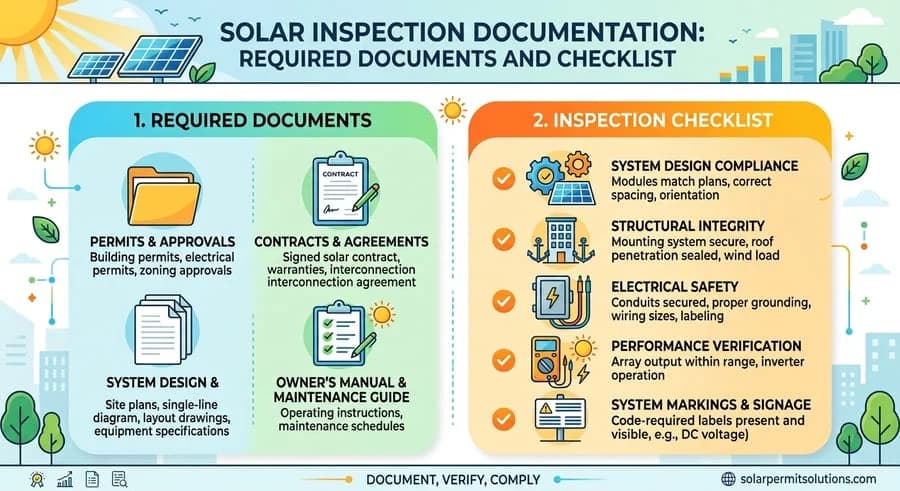
Solar Inspection Documentation: Required Documents and Checklist
Learn about solar inspection documentation, including permit requirements, NEC c...
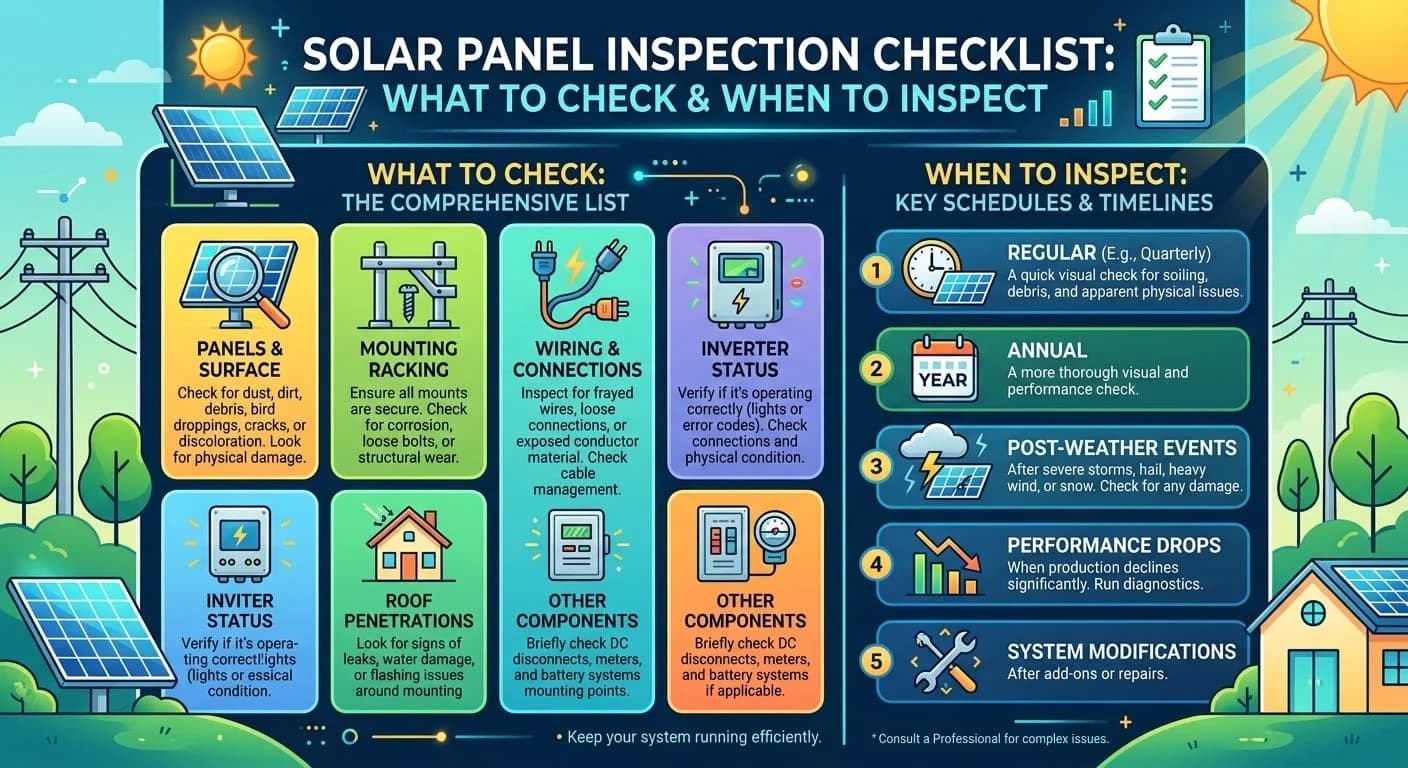
Solar Panel Inspection Checklist: What To Check & When To Inspect
Solar panel inspection guide: Learn what to check, when to inspect (annually + e...
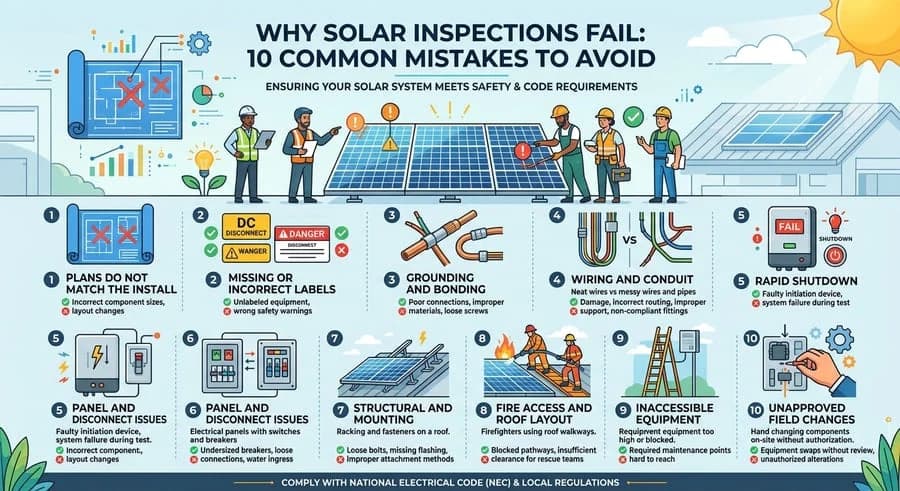
Why Solar Inspections Fail: 10 Common Mistakes to Avoid
Discover the 9 critical reasons solar inspections fail and how to avoid costly m...