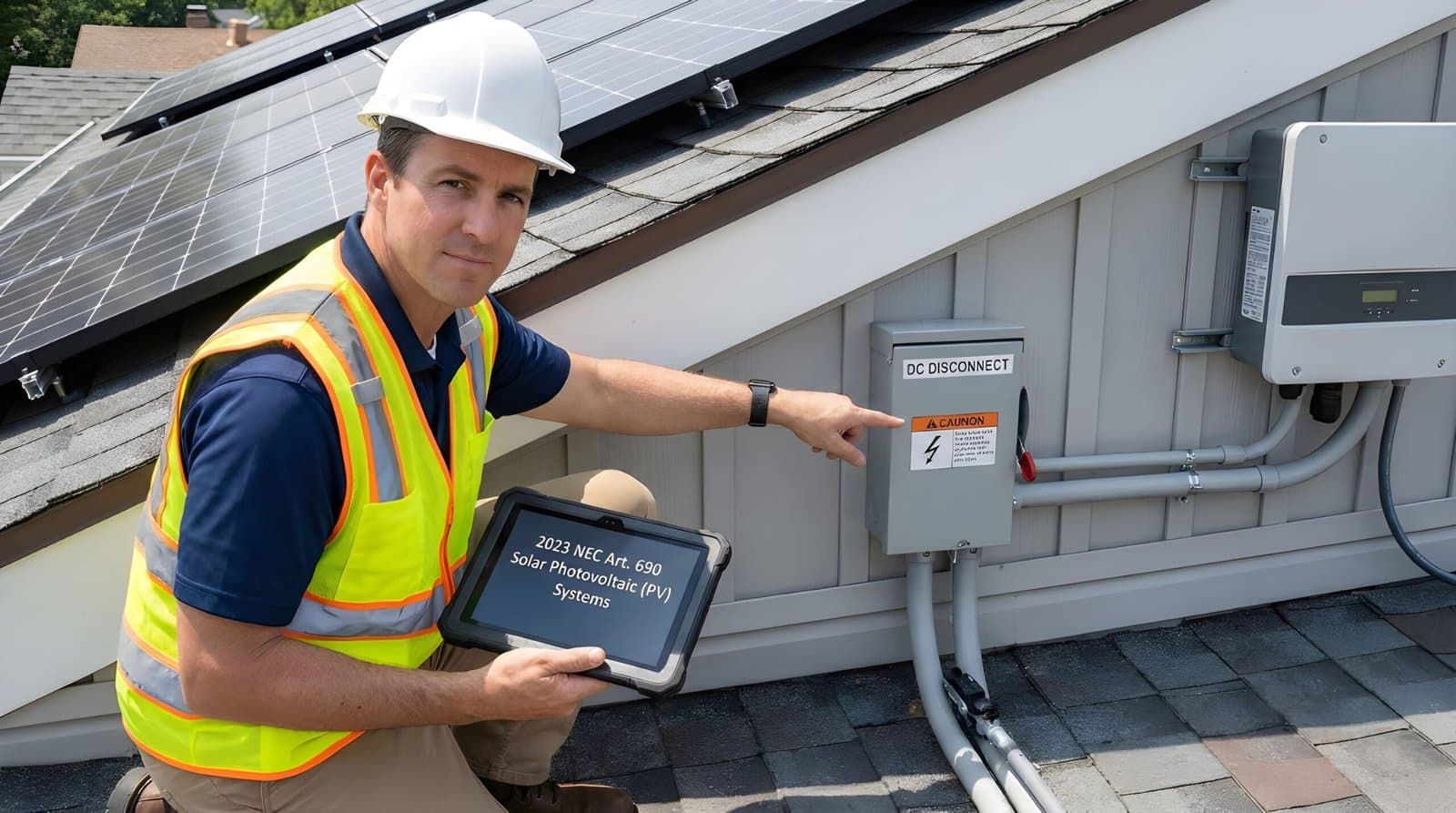
NEC 690.13 is the National Electrical Code section that requires a photovoltaic system disconnecting means for every solar PV installation. This disconnect provides the primary safety mechanism to isolate the entire solar system from building electrical conductors during emergencies, maintenance, or repairs. Understanding these requirements is essential for professional solar design services across all project types.
What Does NEC 690.13 Require?
The 2023 NEC 690.13 establishes five critical requirements for solar PV system disconnects, building on the comprehensive Article 690 framework:
Location: The disconnect must be installed in a readily accessible location, meaning it can be reached quickly without ladders, climbing obstacles, or removing obstructions.
Interrupting Rating: The disconnect must have sufficient interrupting capacity to safely handle the nominal circuit voltage and maximum available fault current from the PV system.
Maximum Number: No more than six disconnecting means are permitted per PV system, and multiple disconnects must be grouped at a single location.
Labeling: The disconnect requires permanent, durable marking identifying it as a “PV SYSTEM DISCONNECT” with warning labels when terminals remain energized in the open position.
Device Type: The disconnect must be one of five acceptable types specified in NEC 690.13(E), including manually operated switches, circuit breakers, or pull-out devices with proper ratings.
Why NEC 690.13 Compliance Matters
Proper implementation of NEC 690.13 photovoltaic system disconnecting means protects lives and property. The disconnect enables firefighters to rapidly shut down solar power generation during structure fires. Service technicians require safe system de-energization before performing maintenance. Building owners need clear control over their electrical systems, especially when coordinating with rapid shutdown requirements.
Solar installations without code-compliant disconnects create electrical shock hazards, increase fire risks, and fail inspection requirements. Master and journeyman electricians must understand these specifications to deliver safe, code-compliant residential solar systems and commercial installations.

NEC 690.13: Photovoltaic System Disconnect Requirements
NEC 690.13 establishes specific disconnecting means requirements that work within the broader framework of NEC 690.4 requirements for solar PV system installations.
Placement Requirements: Understanding “Readily Accessible”
NEC 690.13 requires installing the PV system disconnecting means in a “readily accessible location.” NEC Article 100 defines “readily accessible” as capable of being reached quickly without climbing over obstacles, removing obstructions, or using portable ladders.
This ensures anyone from homeowners to firefighters can quickly shut down the system during emergencies. While the code addresses outdoor emergency disconnects for dwellings, the PV system disconnect maintains its own specific requirements and does not need grouping with other service disconnects.
Calculating Proper Interrupting Ratings and Fault Current Capacity
A disconnect’s effectiveness depends on its ability to safely open circuits under load. NEC 690.13(B) mandates that the PV system disconnecting means shall have an interrupting rating sufficient for the nominal circuit voltage and available fault current.
Electricians must perform AC/DC disconnect sizing calculations to determine the maximum current the device may need to interrupt. This involves assessing PV system DC circuit characteristics to ensure the selected circuit breaker or switch in the breaker panel can handle worst-case scenarios without failing.
Continuing education resources provide detailed calculation methodologies for determining proper ratings.
All ungrounded conductors of the PV system must disconnect simultaneously.
Required Labeling and Identification Standards
Emergency situations demand clarity. The code requires permanent marking on the PV system disconnecting means to identify it as such. This label must be clear, durable, and easily visible. Proper labeling standards save critical seconds and eliminate confusion during service calls or emergency responses.
Maximum Number of Disconnects
NEC 690.13(C) limits the maximum number of PV system disconnecting means to six for any single PV system. This prevents confusion during emergencies by maintaining clear, manageable disconnect points.
When multiple disconnects are used, they must be grouped at a single location. This grouping requirement ensures first responders and technicians can quickly identify and operate all necessary disconnects without searching multiple locations.
Each disconnect must be clearly labeled and numbered when part of a group. Proper identification prevents partial system shutdown mistakes and ensures complete isolation when required.
Disconnect Types and Equipment Requirements
NEC 690.13(E) specifies acceptable disconnecting means types. The PV system disconnect must be one of the following five device types, as outlined in NEC solar requirements and detailed in professional electrical resources:
A manually operable switch or circuit breaker meeting interrupting rating requirements remains the most common choice. These devices provide clear visual indication of open or closed positions.
Power-operated switches or circuit breakers are permitted when equipped with manual operating handles. The manual override ensures functionality during power outages or equipment failures.
Pull-out devices rated for the application provide another acceptable option. These disconnects offer positive disconnection with visible separation between contacts.
Remote-controlled disconnecting means are allowed when they can be locally operated. The local control ensures emergency shutdown capability regardless of remote system status.
Each disconnect type must be externally operable without exposing operators to energized parts. Safety during operation remains paramount in code requirements.
Grouping with Other Disconnects
While NEC 690.13 does not require the PV system disconnect to be grouped with other building service disconnects, many installations benefit from this arrangement. Grouping provides centralized control and simplifies emergency response procedures.
When grouped with service equipment, the PV disconnect must be clearly marked and distinguishable from other disconnects. Proper labeling prevents confusion about which disconnect controls which system.
Some local jurisdictions or utilities may require specific grouping arrangements. Always verify local requirements in addition to NEC base code compliance.

Solar Permit Solutions
Skip the Permit Headaches
We design plan sets that pass inspection the first time. Code-compliant, PE-stamped, accepted by AHJs nationwide.
How to Implement NEC 690.13 Disconnects: A Practical Approach
Implementing compliant PV system disconnecting means requires systematic planning and execution. Follow this process for proper NEC 690.13 compliance, staying current with 2023 code updates:
Step 1 – Review System Design: Examine the complete PV system design including array configuration, inverter specifications, and circuit routing.
Key consideration: Identify where the PV system conductors enter the building or structure. This entry point guides disconnect placement decisions.
Step 2 – Select Readily Accessible Location: Choose a location meeting NEC Article 100’s “readily accessible” definition. The disconnect must be reachable quickly without portable ladders, climbing over obstacles, or removing obstructions.
Key consideration: Exterior locations near the service equipment often work well while maintaining independent control.
Step 3 – Calculate Interrupting Rating Requirements: Determine the maximum available fault current the PV system can generate. Calculate based on PV array short-circuit current, system voltage, and circuit configuration.
Code requirement: The disconnect’s interrupting rating must meet or exceed this calculated value per NEC 690.13(B).
Step 4 – Determine Number of Disconnects Needed: Decide if a single disconnect suffices or if multiple disconnects (up to six maximum) are necessary. Multiple disconnects may be needed for complex systems or multi-inverter installations.
Important: Group all disconnects at a single location when using multiple devices.
Step 5 – Select Appropriate Disconnect Type: Choose from the acceptable types listed in NEC 690.13(E). Manually operated switches or circuit breakers remain most common.
Verification checklist: Verify the device meets voltage, current, and interrupting rating requirements. Ensure the device clearly indicates open and closed positions.
Step 6 – Plan Permanent Labeling: Design clear, durable labels identifying each disconnect as “PV SYSTEM DISCONNECT” or equivalent marking.
Labeling requirements: Include warning labels if line and load terminals may be energized when open. Plan label placement for maximum visibility.
Step 7 – Verify Local Requirements: Check local jurisdiction amendments to NEC 690.13. Some authorities having jurisdiction impose additional requirements beyond base code.
Additional considerations: Utility companies may also specify disconnect requirements for interconnection approval. Solar Permit Solutions provides nationwide compliance expertise for all jurisdictional requirements.
Step 8 – Consider Future Maintenance Access: Position disconnects to remain accessible throughout the system’s life. Avoid locations that may become blocked by future landscaping, equipment additions, or structural modifications.
Proper NEC 690.13 implementation establishes the foundation for safe solar system operation. Taking time to plan thoroughly prevents costly modifications and ensures long-term code compliance.
NEC 690.13 Interactions with Battery Storage and Backup Generators
Modern electrical systems frequently integrate solar PV with battery storage and backup generators. The PV system disconnecting means under NEC 690.13 must coordinate with these additional power sources while maintaining clear isolation capabilities, particularly for off-grid installations.
When battery storage systems are present, the NEC 690.13 disconnect isolates only the PV system conductors. Separate disconnects governed by other code articles handle battery and energy storage system isolation.
Understanding where the PV system ends and energy storage begins remains critical for proper disconnect placement, similar to arc fault protection zones.
For systems with backup generators and transfer switches, plan the PV system disconnect location carefully. The disconnect must prevent back-feeding into utility lines while allowing the building to operate on generator power when solar is disconnected. Coordination between the PV disconnect, generator transfer switch, and service disconnect ensures safe, reliable operation.
Supply-side PV connections require special attention to NEC 690.13 compliance. The PV system disconnect must be grouped or located near the service disconnect to maintain clear emergency shutdown capability. Some jurisdictions require specific grouping arrangements for supply-side connections.
Load-side PV connections offer more flexibility in disconnect placement while still meeting “readily accessible” requirements. The disconnect must be clearly distinguishable from the service disconnect and other building disconnects through proper labeling.

Essential NEC 690.13 Requirements for PV System Disconnects
Primary Purpose: NEC 690.13 requires a photovoltaic system disconnecting means to isolate the entire PV system from all other building conductors, providing the main safety mechanism for solar installations.
Readily Accessible Location: The disconnect must be installed in a readily accessible location per NEC Article 100. This means reachable quickly without ladders, climbing obstacles, or removing obstructions.
Interrupting Rating: The PV system disconnect must have sufficient interrupting rating for the nominal circuit voltage and available fault current. Proper calculations ensure the device can safely interrupt worst-case fault conditions.
Maximum of Six Disconnects: No more than six PV system disconnecting means are permitted for any single PV system. Multiple disconnects must be grouped at a single location for emergency access.
Clear Identification: Permanent, durable labels must identify the disconnect as a PV system disconnect. Warning labels are required when terminals remain energized in the open position, following proper servicing protocols.
Acceptable Device Types: The PV system disconnect must be one of five types specified in NEC 690.13(E), including manually operated switches, circuit breakers, pull-out devices, power-operated switches with manual override, or remote-controlled devices with local operation.
No Service Equipment Required: The PV system disconnect does not need to meet service equipment standards unless it also serves as service equipment for the building.
Coordination with Rapid Shutdown: While NEC 690.13 addresses system disconnection, it works in conjunction with rapid shutdown requirements (NEC 690.12) for comprehensive safety protection. Reference official NEC documentation for detailed coordination requirements.
Conclusion
NEC 690.13 establishes critical safety requirements for solar PV system disconnecting means. This primary disconnect serves as the main isolation point, protecting lives and property by enabling rapid system shutdown during emergencies, maintenance, or inspection activities.
Understanding NEC evolution helps electricians stay current with code requirements.
Proper implementation requires understanding readily accessible location standards, calculating appropriate interrupting ratings, selecting acceptable disconnect types, and ensuring permanent identification. The 2023 NEC maintains these essential requirements while allowing practical flexibility in system design and installation approaches. For additional solar code guidance, explore our comprehensive blog resources.
Master NEC 690.13 compliance to deliver safe, code-compliant solar installations that protect everyone who interacts with them. For professional assistance navigating local code amendments, ensuring permit-ready designs, or coordinating complex system requirements, consult with solar permitting specialists who understand nationwide jurisdictional variations and building code standards.
FAQs
Skip the Permit Headaches
We design plan sets that pass inspection the first time. Code-compliant, PE-stamped, accepted by AHJs nationwide.
Frequently Asked Questions
The photovoltaic system disconnecting means required by NEC 690.13 provides the primary method to isolate the entire PV system from all other building conductors. This disconnect enables rapid system shutdown during emergencies, allows safe maintenance activities, and gives building owners clear control over their solar installation.
NEC 690.13(A) requires the PV system disconnecting means to be installed in a readily accessible location. Per NEC Article 100, this means the disconnect must be reachable quickly without needing portable ladders, climbing over obstacles, or removing obstructions. This ensures emergency responders and building occupants can rapidly shut down the system when needed.
The interrupting rating is the maximum current a protective device can safely interrupt without failing or causing an explosion. NEC 690.13(B) requires the PV system disconnect to have an interrupting rating sufficient for the nominal circuit voltage and available fault current. This ensures the disconnect can safely open the circuit even during worst-case fault conditions without equipment failure or safety hazards.
NEC 690.13(C) limits the maximum number of PV system disconnecting means to six for any single PV system. When multiple disconnects are used, they must be grouped at a single location to prevent confusion during emergencies. Each disconnect in a group must be clearly labeled and numbered for proper identification.
No, NEC 690.13 does not require the PV system disconnecting means to be grouped with the service disconnect or other building disconnects. However, many installations choose to group them for centralized control and simplified emergency response. When grouped, clear labeling must distinguish the PV disconnect from other disconnects. Some local jurisdictions or utilities may impose additional grouping requirements beyond the base NEC code.

SPS Editorial Team
Solar Permit Solutions
Solar Permit Solutions provides professional solar permit design services for residential, commercial, and off-grid installations across all 50 states. Our team ensures permit-ready plan sets delivered fast.
Related Articles

How Many Solar Panels Do I Need to Run Off the Grid?
Most off-grid homes need about 8 to 16 solar panels rated at 400 watts, dependin...
Solar Battery Permit Requirements: What You Need to Know
A solar battery usually needs local approval and a utility review before it can ...
How To Add A Battery To Your Existing Solar System
Adding a battery to your solar system costs $10,000-$20,000. Save with 30% feder...