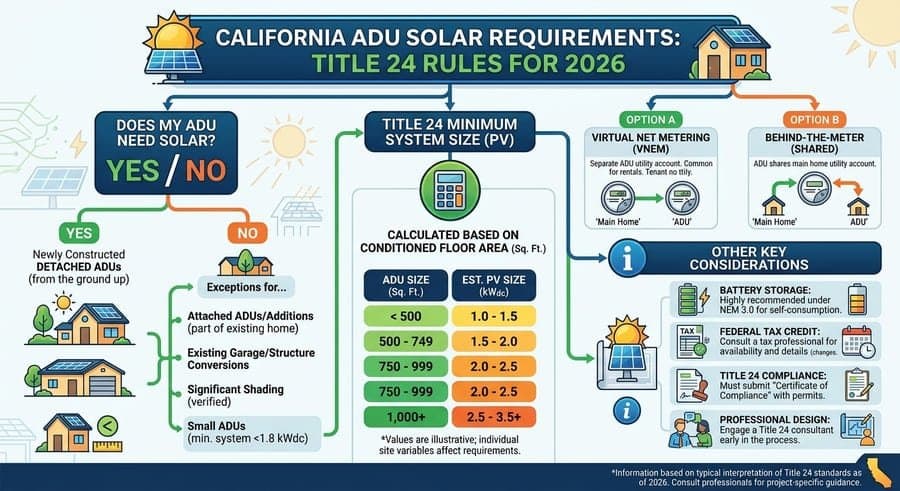
Not every California ADU requires solar panels. Under the 2025 Title 24 Energy Code, which took effect January 1, 2026, whether an ADU needs solar PV depends on how the project is classified, as new construction, an addition, or an alteration, not simply on whether it is detached or attached. A newly constructed detached ADU is generally treated as new single-family construction and must include a sized solar PV system under Section 150.1(c)(14), unless one of five code exceptions applies. Attached ADUs, garage conversions, and conversions of existing conditioned space are generally treated as additions or alterations and fall outside the prescriptive new-construction PV trigger.
This guide uses the 2025 California Energy Code (Title 24, Part 6), current California Energy Commission (CEC) guidance, and the rules that apply specifically to accessory dwelling units. For the broader statewide solar mandate covering new single-family and commercial construction, see our California Title 24 solar requirements guide. For the non-energy side of ADU law, zoning, size limits, and permitting streamlining, see the HCD Accessory Dwelling Unit Handbook.
Quick Answer: Does Your ADU Need Solar?
| ADU Project Type | Solar PV Requirement |
|---|---|
| New detached ADU | Generally yes. |
| New attached ADU | No prescriptive PV requirement, treated as an addition |
| Garage conversion | Generally no PV requirement |
| Conversion of existing conditioned space | Generally no new PV requirement |
| Existing detached structure converted to conditioned ADU | Follows the applicable addition or alteration classification |
| New detached ADU qualifying for an exception | PV may not be required if an applicable exception is satisfied. |
Source: CEC, 2025 Single-Family Solar PV. This table reflects general prescriptive-path treatment. Confirm project-specific facts with your AHJ before finalizing a design.
Does an ADU Need Solar Panels in California?
It depends on how the ADU is classified under the Energy Code, not simply on whether it sits attached to or apart from the main house. The critical distinction the CEC draws is new construction versus an addition versus an alteration.
Saying “California requires solar on ADUs” is too broad and leads to costly design mistakes. Section 150.1(c)(14) of the 2025 Energy Code requires solar PV for newly constructed single-family residential buildings, a category that includes detached ADUs built as new construction. Attached ADUs are treated as additions to the existing residence, and these requirements do not apply to additions or alterations to existing buildings or unconditioned buildings, per CEC guidance.
Which ADUs Are Required to Have Solar?
New Detached ADU
- Newly constructed
- Detached from the primary residence
- Generally subject to Section 150.1(c)(14)
- PV must be a newly installed system or newly installed modules, unless an exception applies
- PV does not necessarily have to be mounted on the ADU itself
Attached ADU
An attached ADU shares at least one wall with the primary residence. The CEC treats attached ADUs as additions to the existing building, and solar PV is not required under the prescriptive new-construction PV requirement that applies to detached units.
Garage Conversion ADU
Converting existing unconditioned space, such as a garage, into a dwelling unit is generally treated as an addition rather than new construction. This applies to an attached garage conversion, a detached garage conversion, and a conversion of existing storage space, though the specific classification depends on project scope and should be confirmed with the AHJ.
ADU Created From Existing Conditioned Space
A conversion of existing conditioned space into an ADU can be classified as an alteration rather than an addition, depending on the scope of work. The 2025 Energy Code distinguishes between these classifications, and the classification determines whether any PV or efficiency requirements apply at all.
California ADU Solar Requirements Under the 2025 Energy Code
The controlling code section is Title 24, Part 6, Section 150.1(c)14, which took effect January 1, 2026. It establishes solar PV requirements for newly constructed single-family residential buildings, a category that the CEC has confirmed includes qualifying detached ADUs, townhouses, and certain occupancy group R-3 and U buildings on residential lots.
The required PV system size, when one is required, is shaped by several factors working together rather than any single variable:
- Conditioned floor area (CFA) of the dwelling
- Climate zone (CZ) of the project location
- Number of dwelling units
- Solar access roof area (SARA) and available solar resource
- Building energy efficiency measures
- Applicable code exceptions
- Battery energy storage system (BESS) configuration, if included
Per the CEC, increasing a building’s energy efficiency, such as more efficient space cooling or added insulation, decreases electrical consumption and can decrease the required PV system size. A qualifying, JA12-compliant battery storage system can also reduce the required PV size. Installing a larger PV system cannot be substituted for lower energy efficiency without a JA12-compliant battery system in place.
Solar Permit Solutions
Need Solar Permit Plans?
Professional, permit-ready solar plan sets delivered fast. Residential and commercial projects across all 50 states.
How Much Solar Does an ADU Need?
This is the highest-value question in ADU solar planning, and the honest answer is that it depends on where the ADU sits, not on square footage alone.
The California Title 24 PV Calculation
Under the 2025 code, the required minimum PV system size is the smaller of two calculations:
- Solar access roof area (SARA) capacity: SARA multiplied by 18 watts per square foot for steep-sloped roofs, or SARA multiplied by 14 watts per square foot for low-sloped roofs
- Equation 150.1-C output, which factors climate zone, conditioned floor area, and number of dwelling units
SARA includes roof areas, covered parking, carports, and newly constructed structures on the lot that can support a PV system. It excludes roof areas with less than 70 percent annual solar access due to shading, occupied roof area under California Building Code Section 503.1.4, and roof area unavailable due to other code requirements. See CEC guidance on the 2025 single-family PV calculation for the full methodology.
Example: 500-Square-Foot ADU
There is no single universal answer for a “500-square-foot ADU.” Two 500-square-foot detached ADUs built to the same plan can carry different required PV sizes depending on where they sit. A unit in a hot, high cooling-demand climate zone such as inland Southern California will generally model a higher electrical consumption and therefore a larger required PV system than an identical unit in a mild coastal climate zone. The number of dwelling units and the specific SARA available on the lot shift the number further. A project-specific Equation 150.1-C run, performed as part of Title 24 compliance documentation, is the only reliable way to get an actual kWdc figure.
Why Square Footage Alone Isn’t Enough
A 600-square-foot ADU in one California climate zone does not necessarily carry the same PV requirement as a 600-square-foot ADU somewhere else. Climate zone drives cooling load, cooling load drives modeled electrical consumption, and consumption drives the Equation 150.1-C result. Any calculator or rule of thumb that ignores climate zone should be treated as a rough estimate only, not a compliance figure.
California ADU Solar PV Exceptions
Section 150.1(c)(14) lists five exceptions that either eliminate the PV requirement or reduce the required system size. Per CEC FAQ guidance, these exceptions generally cannot be combined with each other, and Exception 2 specifically cannot be combined with Exception 5.
Limited Solar Access Roof Area
No PV system is required if the usable SARA is less than 80 contiguous square feet. For steep-sloped roofs, SARA excludes roof areas facing between 300 and 90 degrees from true north when applying this exception.
PV Requirement Below 1.8 kWdc
No PV system is required if the calculated minimum PV system size under Section 150.1(c)(14)14 is less than 1.8 kWdc. This is often the exception that applies to smaller detached ADUs with modest conditioned floor area, though the actual result still depends on climate zone and available SARA.
Structural and Snow Load Exception
No PV system is required if the local enforcement authority determines the system cannot meet ASCE 7-16, Chapter 7, snow load requirements for the project’s location.
Other Code-Specific Exceptions
- Buildings approved by the local planning department before January 1, 2020, with mandatory conditions of approval already in place
- If a PV system is installed with a qualifying battery energy storage system (BESS) that meets Reference Joint Appendix JA12 and has a minimum cycling capacity of 7.5 kWh, the required PV size under Equation 150.1-C may be reduced by 25 percent
An important distinction the CEC flags directly: a solar-ready requirement and an actual PV exemption are not the same thing. Qualifying for a PV exception under Section 150.1(c)(14) does not automatically mean solar-ready wiring or roof provisions are also waived elsewhere in the code, though for ADUs on existing lots, solar-ready generally does not apply in the first place (see below).
Can ADU Solar Panels Be Installed on the Main House?
Yes, in certain circumstances. Per CEC guidance, the 2025 Energy Code does not specify where new solar PV modules must physically be installed. New PV modules can be added to an existing PV system on the primary residence rather than being mounted on the new detached ADU, provided the added modules are part of the ADU’s permit application, are sized to satisfy the Energy Code requirement, and comply with other applicable building code provisions.
Can the ADU Use the Existing Solar System?
Existing PV alone: No. The CEC is explicit that an existing solar PV system, by itself, cannot be used to satisfy the PV requirement for a newly constructed ADU.
New PV modules added to an existing system: Yes. New modules added to the existing array satisfy the requirement if they are documented in the ADU’s permit application, sized per the code, and the expansion is allowed by the load-serving entity (the utility).
Does the ADU Need Its Own Solar System?
Not necessarily. The Energy Code allows several configurations for a newly constructed detached ADU that requires PV:
- A new PV system installed on the ADU itself
- New PV modules added to the primary home’s existing PV system, documented in the ADU permit
- Other permitted configurations, such as a ground-mounted array or a carport-mounted array on the same lot
The Energy Code does not require that the PV modules serve the ADU’s specific electric meter. A system can satisfy the requirement while continuing to serve the primary home’s meter, which is a detail generic ADU guides frequently miss.
Does a Separate ADU Electrical Meter Change the Solar Requirement?
- A separate meter does not automatically eliminate the PV requirement for a new detached ADU
- New PV modules may still be added to the main home’s existing system rather than installed at the ADU
- The CEC does not require that added modules serve the ADU’s specific meter
- Utility, or load-serving entity, approval of the system expansion still matters and should be confirmed before finalizing the design
For utility-specific interconnection context in Northern and Central California, see our PG&E NEM 3.0 guide, and for the difference between how a system connects to the electrical service, our supply-side vs. load-side interconnection guide.
Is a Battery Required for a California ADU?
PV requirements and battery energy storage system (BESS) readiness requirements are governed by separate code sections and are not the same obligation.
BESS-Ready Requirements for New Detached ADUs
Per Section 150.0(s) of the 2025 Energy Code, a newly constructed ADU of any size must meet BESS-ready requirements if the load-serving entity provides electrical service to the dwelling unit greater than 125 amps. If the ADU’s electric service is 125 amps or less, the BESS-ready requirement does not apply. These requirements are mandatory but do not apply to additions or alterations, and there is an exception if a BESS is already installed.
Does That Mean I Have to Install a Battery?
No. BESS-ready means the electrical system includes the interconnection equipment, backed-up capacity, and dedicated branch circuits or raceway needed to add a battery later. It does not mean a battery must be purchased and installed at the time of construction. The CEC’s summary of 2025 single-family changes confirms BESS-ready is not required if a BESS is already installed. Separately, if a battery is installed and meets Reference Joint Appendix JA12 with a minimum 7.5 kWh cycling capacity, it can reduce the required PV system size by 25 percent under Exception 5 to Section 150.1(c)14.
For a full document checklist on pairing PV with storage, see our NEC 690 and 706 compliance checklist for solar battery storage, and for how federal incentive changes affect storage economics, see our solar battery tax credit 2026 guide.
ADU Solar vs. Solar-Ready Requirements
Solar PV requirement and solar-ready requirement are not the same thing. Solar-ready provisions under Section 110.10(b) through (e) are mandatory, but they apply only to newly constructed single-family buildings that do not require a PV system, located in subdivisions of ten or more single-family residences where the tentative subdivision map has been deemed complete or approved.
Per CEC guidance, solar-ready requirements do not apply to newly constructed ADUs built on an existing lot. A newly constructed ADU that does not trigger the PV requirement does not automatically carry the same solar-ready roof and conduit provisions that apply to a new single-family subdivision home.
Where Can Solar Panels Be Installed for an ADU?
Per CEC guidance, PV does not have to be installed directly on the ADU roof. Permitted locations under the SARA definition include:
On the ADU Roof
The most common configuration, subject to the 70 percent solar access, shading, and orientation rules used to calculate SARA.
On the Main House
New modules added to the primary residence’s roof or existing array, documented in the ADU’s permit application.
Ground-Mounted Solar
An array installed elsewhere on the lot, subject to standard structural, setback, and electrical requirements.
Carport or Other Eligible Structure
A carport or newly constructed structure on the property that can support a PV system also qualifies as usable SARA.
ADU Solar Requirements by Project Type
| Project | PV Required? | Why |
|---|---|---|
| New detached ADU | Generally yes. | New construction |
| New attached ADU | Generally no | Addition |
| Attached garage conversion | Generally no | Addition |
| Detached garage conversion | Generally no | Addition |
| Existing conditioned-space conversion | Generally no new PV | Alteration |
| New detached ADU replacing a demolished structure | Generally yes. | New construction |
| New detached ADU qualifying for a code exception | Potentially no | Code exception (SARA, 1.8 kWdc, snow load, pre-2020 approval, or BESS-paired reduction) |
How to Determine Your ADU’s Required Solar Size
1. Determine whether the ADU is new construction, an addition, or an alteration
2. Determine the California climate zone for the project address
3. Determine the conditioned floor area (CFA)
4. Run the applicable PV calculation, the smaller of SARA capacity or Equation 150.1-C
5. Check whether any of the five PV exceptions apply
6. Evaluate solar access, shading, and roof orientation across the available SARA
7. Determine whether a qualifying battery energy storage system affects the calculation
8. Incorporate the result into the Title 24 compliance documentation submitted with the permit
What Documents Are Needed for ADU Solar Compliance?
A complete ADU solar compliance package generally includes:
- ADU architectural plans
- Site plan showing the ADU, primary residence, and any ground-mount or carport PV location
- Roof plan
- Conditioned floor area and climate zone documentation
- PV layout
Electrical information, including an electrical single-line diagram and a complete label schedule
- Equipment specifications for panels, inverters, and any battery hardware
- Title 24 compliance documentation (CF1R or equivalent performance/prescriptive forms)
- Structural information, where a ground-mount, carport, or added roof load applies
- Battery information, where a BESS is installed or BESS-ready provisions apply
For utility and interconnection information, where the system will export to the grid, see our solar interconnection agreement checklist.
Structural and electrical documentation typically requires a PE stamp from an engineer licensed in California, and rapid shutdown compliance should be documented per our rapid shutdown compliance roadmap.
California ADU Solar Permitting: What Happens After the Design?
Once the Title 24 analysis and PV sizing are complete, the practical workflow follows a consistent sequence: ADU plans, Title 24 analysis, PV sizing, electrical and structural design, permit package assembly, AHJ review, revisions if requested, and approval. This mirrors the sequence covered in our solar permit design and plan set guide.
Local review specifics vary by jurisdiction. Los Angeles offers express PV permit pathways through LADBS, covered in our Los Angeles solar permit guide, while San Francisco requires review through DBI and, in most cases, a Fire Department inspection, covered in our San Francisco solar permit guide. For the statewide permitting framework that applies regardless of city, see our California solar permitting guide.
Common California ADU Solar Mistakes
- Assuming every ADU needs solar, regardless of classification
- Assuming every ADU is exempt from solar requirements
- Using outdated 2022 code assumptions without confirming the current 2025 code applies
- Assuming existing solar on the main house automatically satisfies a new detached ADU’s requirement
- Assuming the PV modules must be physically installed on the ADU itself
- Confusing the PV requirement with the separate BESS-ready requirement
- Calculating PV size from square footage alone, without climate zone and SARA
- Ignoring local AHJ and load-serving entity requirements on top of the state baseline
- Treating a garage conversion and a new detached ADU as the same project type for compliance purposes
California ADU Solar Requirements FAQ
Does every ADU in California need solar panels?
No. The requirement applies to newly constructed detached ADUs treated as new single-family construction under Section 150.1(c)(14). Attached ADUs, garage conversions, and conversions of existing conditioned space are generally treated as additions or alterations and are not subject to the prescriptive new-construction PV requirement.
Does a detached ADU need solar in California?
Generally yes. A newly constructed detached ADU is treated as new single-family construction under the 2025 Energy Code and must include a sized PV system, unless it qualifies for one of the five exceptions to Section 150.1(c)(14).
Does an attached ADU need solar?
Generally no. Attached ADUs are treated as additions to the existing residence, which places them outside the prescriptive new-construction PV requirement that applies to detached units.
Does a garage conversion need solar panels?
Generally no. A garage conversion is typically treated as an addition rather than new construction, so the prescriptive PV requirement generally does not apply, though the specific classification should be confirmed with the AHJ.
How many solar panels does a California ADU need?
There is no fixed number. The required system size is calculated per Equation 150.1-C or the solar access roof area (SARA), whichever is smaller, based on the project’s climate zone, conditioned floor area, and number of dwelling units.
How many kW of solar does an ADU need?
It varies by project. The required minimum size is the smaller of the SARA-based capacity (18 watts per square foot for steep-sloped roofs, 14 for low-sloped) or the Equation 150.1-C result, which factors climate zone, conditioned floor area, and dwelling unit count.
Can I use my existing solar panels for my ADU?
No. An existing solar PV system, by itself, cannot satisfy the PV requirement for a newly constructed ADU. The ADU must have newly installed PV, whether that means new panels on the ADU or new modules added to an existing system.
Can I add new panels to my existing solar system for an ADU?
Yes. New PV modules can be added to an existing system on the primary residence to meet the ADU’s requirement, provided the added modules are part of the ADU’s permit application, sized per the code, and the expansion is allowed by the load-serving entity.
Can ADU solar panels be installed on the main house?
Yes. The 2025 Energy Code does not specify where new PV modules must be installed. Modules added to the main house’s system, or ground-mounted or carport-mounted arrays on the same lot, can satisfy the requirement.
Does an ADU with a separate electric meter need its own solar system?
Not necessarily. A separate meter does not automatically require a dedicated PV system for the ADU. New modules can still be added to the main home’s system, since the code does not require the added modules to serve the ADU’s specific meter.
Is a battery required for an ADU in California?
Not in the sense of a mandatory purchase. Newly constructed detached ADUs with electrical service over 125 amps must meet BESS-ready wiring requirements under Section 150.0(s), but installing an actual battery is optional unless the project owner chooses it to reduce the required PV size.
What is the 1.8 kW solar exemption?
Exception 2 to Section 150.1(c)(14) states that no PV system is required if the calculated minimum PV system size under Equation 150.1-C is less than 1.8 kWdc. This exception cannot be combined with the battery-storage-based Exception 5.
Does a shaded ADU qualify for a solar exemption?
Possibly. If the usable solar access roof area (SARA) is less than 80 contiguous square feet, no PV system is required. Shading, roof orientation, and nearby obstructions all factor into how much SARA is available.
What is the difference between solar PV and solar-ready requirements?
The PV requirement under Section 150.1(c)(14) mandates an actual installed system for qualifying new construction. Solar-ready requirements under Section 110.10 are a separate, mandatory wiring and roof-provisioning standard that applies only to new single-family subdivisions of ten or more homes and do not apply to ADUs built on an existing lot.
Which California code applies to my ADU?
The 2025 Title 24 Energy Code, which took effect January 1, 2026, applies to permits submitted on or after that date. Projects permitted under the prior code cycle should confirm with their AHJ which version governs their specific application.
California ADU Solar Requirements: Quick Takeaway
- Is the ADU newly constructed and detached? Check Title 24 PV requirements and exceptions.
- Is it attached? Treat it as an addition. No prescriptive new-construction PV requirement applies.
- Is it a conversion? Determine whether it is an addition or an alteration before assuming any PV obligation.
- Is PV required? Calculate the required system size and evaluate the five applicable exceptions.
- Need permit plans? Prepare the PV, electrical, and structural documentation as part of the full ADU permit package.
A Note on Incentives for ADU Solar Projects
The federal Section 25D Residential Clean Energy Credit is not available for property placed in service after December 31, 2025. Third-party-owned systems may still qualify for the Section 48E commercial credit and DSIRE for state and utility-level incentive programs that may apply to a California ADU project. Permitting speed also matters for project economics; per NREL research, permitting and inspection remain a meaningful share of residential solar soft costs nationally.
Get Your California ADU Solar Plans Permit-Ready
Before designing the solar system, determine how the ADU is classified under California’s Energy Code. That classification changes whether PV is required, how much PV is required, and which compliance documentation applies.
Solar Permit Solutions prepares permit-ready solar permit plan sets with PE-stamped electrical and structural documentation for California ADU and accessory dwelling solar projects. Create a free account to get started, or contact our team to discuss your project.
Need Solar Permit Plans?
Professional, permit-ready solar plan sets delivered fast. Residential and commercial projects across all 50 states.

SPS Editorial Team
Solar Permit Solutions
Solar Permit Solutions provides professional solar permit design services for residential, commercial, and off-grid installations across all 50 states. Our team ensures permit-ready plan sets delivered fast.
Related Articles
Solar Grounding And Bonding: How To Pass Inspection Every Time
Learn how to pass solar grounding and bonding inspections every time. Avoid comm...
Solar Inspection After Installation: What Happens Next?
Learn how to pass your solar inspection by following essential tips for obtainin...
Solar Permit Services in Austin, TX
Solar permits in Austin center on an Auxiliary Power Electrical Permit for any s...